

Your classic Mopar belongs on the open road, not stuck on jack stands because a mismatched oil pan hit the K-member. While the restomod market is projected to reach $7.9 billion this year, many builders still struggle with the technical puzzles that come with modern power. You want the reliability of a modern engine without the headache of unexpected costs or steering clearance issues. Finding the right gen 3 hemi swap kit is the first step in turning that dream into a high-performance reality.
I understand the hesitation. Wiring a modern EFI system or worrying about hood clearance can feel like a barrier to entry. This guide acts as your mentor, breaking down the complexities of the swap into logical, achievable steps. You’ll get a definitive shopping list of essential components and the confidence to ensure every part works in harmony. We will explore everything from mounting brackets to fuel systems, providing a clear roadmap to a reliable, daily-drivable machine that honors its heritage while embracing the thrill of contemporary technology.
Key Takeaways
- Select the ideal power plant by comparing the characteristics of 5.7L, 6.1L, and 6.4L Apache engines for your specific build goals.
- Identify the essential components of a gen 3 hemi swap kit to ensure your engine clears the K-member and steering linkage without costly modifications.
- Navigate the specific engine bay constraints of A-Body, B-Body, and E-Body chassis to avoid common fitment pitfalls.
- Implement a two-phase installation strategy that prioritizes pre-fitment and mock-ups to streamline the final plumbing and wiring process.
- Transition from a hobbyist to a creator by utilizing documented blueprints that guarantee a reliable and professional finish for your restomod project.
The Evolution of Mopar Power: Why Choose a Gen 3 Hemi Swap Kit?
The roar of a vintage V8 defines the Mopar experience. For decades, the LA-series small blocks and thumping Big Blocks provided the heartbeat for iconic muscle cars. However, The Evolution of Mopar Power took a massive leap forward with the introduction of the Gen 3 Hemi platform. This modern architecture, spanning from the versatile 5.7L to the track-ready 6.4L Apache and the supercharged Hellcat, offers a level of precision that vintage iron simply cannot match. You don’t have to sacrifice your car’s soul to gain 21st-century performance.
Choosing a gen 3 hemi swap kit allows you to bridge the gap between classic aesthetics and modern dependability. While traditional builds often require constant tuning and deal with heat-soak or leaks, a modern Hemi delivers turn-key reliability and massive power potential right out of the box. A pre-engineered kit is the smartest investment for any DIY builder because it eliminates the guesswork. Instead of fabricating custom mounts or hunting for obscure sensors, you can follow a proven roadmap to success.
To better understand how these components come together in a real-world build, watch this helpful video:
The 5.7L vs 6.4L Debate: Picking Your Powerplant
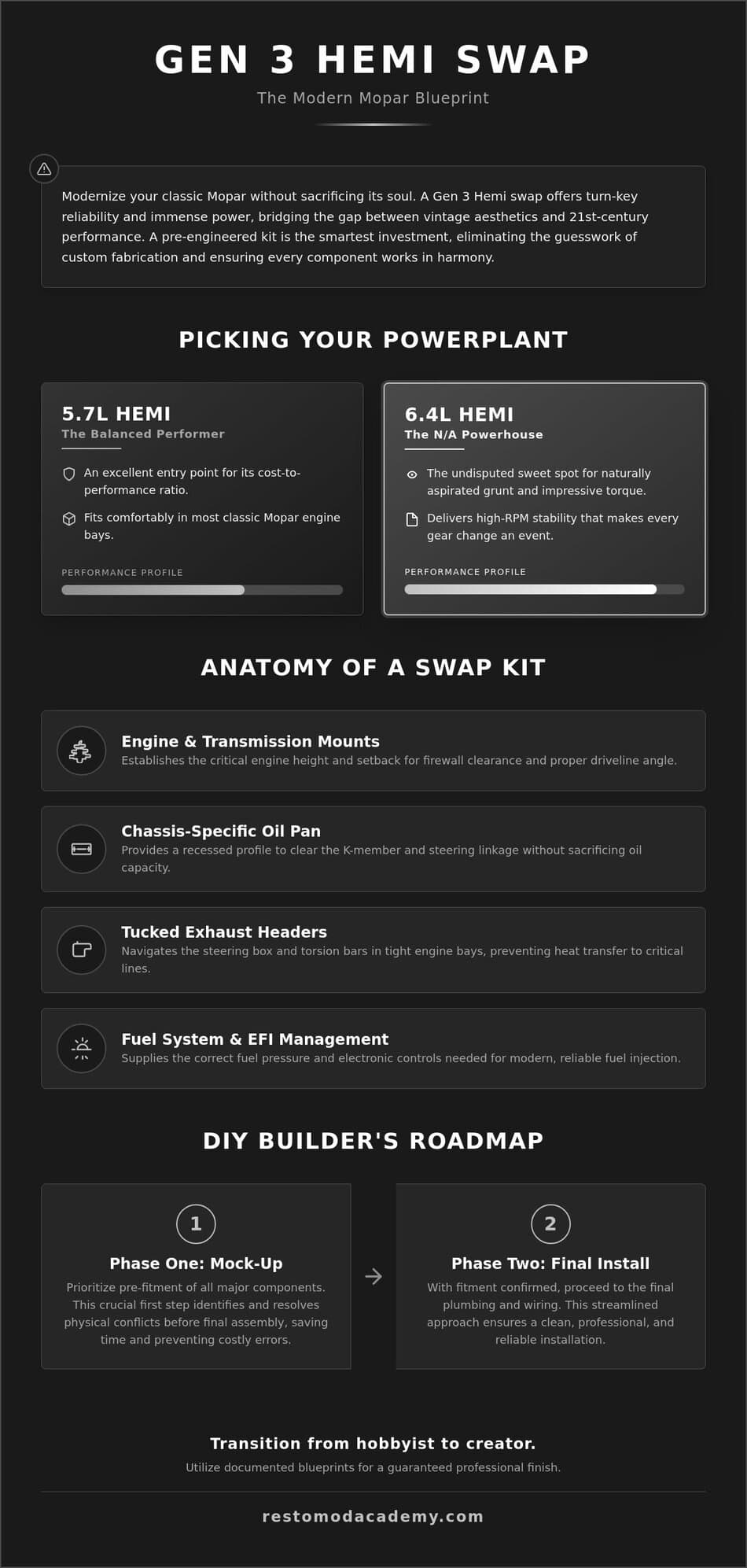
Deciding on an engine is your first major hurdle. The 5.7L Eagle is a fantastic entry point; it offers an excellent cost-to-performance ratio and fits comfortably in most engine bays. If you crave more naturally aspirated grunt, the 6.4L Apache is the undisputed sweet spot. It provides impressive torque and high-RPM stability that makes every gear change an event. Beyond the power, you’ll benefit from significant weight savings. Modern aluminum heads sitting on a lighter block improve your car’s weight distribution, making your classic handle better than it ever did with an old iron-headed Big Block.
Restomod Philosophy: Respecting the Past while Embracing the Future
A true restomod is about balance. You want to maintain that unmistakable Mopar look while enjoying the benefits of electronic fuel injection and modern cooling. This approach increases the usability of your car; you’ll actually want to drive it on cross-country trips or through morning traffic. There is a deep psychological reward in knowing your car will start every time you turn the key. Building a vehicle that is both a showstopper and a daily driver is the ultimate goal. If you are still asking yourself what is a restomod, it is this exact intersection of heritage and innovation that adds lasting value to your project. By utilizing a gen 3 hemi swap kit, you ensure the technical foundation of your build is as solid as the steel it’s bolted to.
Anatomy of a Comprehensive Gen 3 Hemi Swap Kit
Think of your gen 3 hemi swap kit as the skeletal system of your build. It is not merely a collection of loose brackets; it is a precision-engineered solution designed to solve the physical conflicts between 1960s steel and 21st-century casting. When you open that crate, you are looking at the foundation of your car’s new identity. Every component must work in a choreographed dance to ensure the crankshaft centerline remains true and the weight is distributed for optimal handling. If the geometry is off by even a fraction of an inch, you will feel it in the vibration of the floorboards or the struggle of a binding steering shaft.
The core of any kit begins with the engine and transmission conversion mounts. These parts establish the engine’s height and setback, which is critical for hood clearance and firewall spacing. Paired with these are chassis-specific oil pans. Factory Hemi pans, especially those from trucks, hang dangerously low and will collide with your classic K-member or steering linkage. A well-designed swap pan provides a recessed profile that clears the suspension while maintaining the oil capacity necessary for high-performance driving. You should also look for headers specifically tucked for your chassis. In the tight confines of a Mopar engine bay, exhaust tubes must navigate the steering box and torsion bars without transferring excessive heat to your brake lines or floor pans.
Fuel Systems and EFI Management
Modern power requires modern fueling. You must choose between reflashing a factory ECU or opting for a standalone aftermarket controller. While factory units offer OEM reliability, standalone systems provide the tuning flexibility needed for cam swaps or forced induction. Your fuel tank also needs an upgrade. You’ll need a high-pressure EFI pump capable of maintaining a steady 58 PSI, along with a regulator and return lines. Don’t overlook the Drive-By-Wire (DBW) gas pedal. Modern Hemis don’t use traditional throttle cables, so your kit must include a bracket to mount the electronic pedal assembly in a natural, comfortable position for your foot.
Cooling and Plumbing Essentials
Modern Hemi engines are efficient but they generate significant heat that a vintage radiator cannot handle. Invest in a high-capacity aluminum radiator with electric fans to keep temperatures stable in traffic. Plumbing also requires a specialized touch. The power steering pump on a Gen 3 Hemi often produces higher pressure than a vintage steering box is designed to receive. You may need a pressure-reducing valve to prevent blowing out your seals. Before you finalize your parts list, browse our recommended gear to see which plumbing solutions have survived our rigorous shop testing.
Finally, pay close attention to heater hose routing. The water pump outlets on a Hemi are positioned differently than your old LA-block, often requiring 90-degree fittings or custom-molded hoses to clear the inner fenders. Taking the time to map these connections now prevents the frustration of a “nickel and dime” project stall later in the build. Precision here leads to a reliable, daily-drivable machine you can be proud of.
Chassis Compatibility and Preparing Your Classic Mopar
Before you hoist that modern Hemi into place, you must evaluate the canvas you are working with. Every Mopar chassis has its own personality and physical limitations. While your gen 3 hemi swap kit provides the necessary hardware, the success of the project depends on how well you prepare the engine bay to receive it. Think of this phase as the structural foundation of your build. You aren’t just dropping in an engine; you are re-engineering the vehicle’s center of gravity and mechanical harmony.
A-Body owners face the steepest climb. Vehicles like the Dart, Duster, and Valiant possess the narrowest engine bays in the Mopar family. Space between the inner fenders is at a premium, making header clearance and steering shaft routing a game of millimeters. In contrast, B-Body and E-Body cars are the gold standard for compatibility. Chargers, Challengers, and Road Runners offer generous room, allowing for easier access to accessories and more forgiving exhaust routing. Even in these larger bays, a gen 3 hemi swap kit is essential to maintain the correct crankshaft centerline and ensure the oil pan clears the K-member.
Your choice of K-member defines the scope of your labor. You can modify a factory unit with conversion brackets, which preserves the original torsion bar suspension and keeps costs manageable. However, many builders now opt for aftermarket tubular K-members. These units often convert the front end to coil-overs, shedding weight and opening up massive amounts of room for headers and oil pans. Be prepared for transmission tunnel work as well. Modern gearboxes like the 8HP70 eight-speed or the 545RFE are significantly bulkier than a vintage 727. You will likely need to massage or cut the tunnel to achieve the proper driveline angle.
Steering and Braking Clearance
Interference is the enemy of a clean build. Factory power steering boxes are notoriously bulky and often collide with the driver-side header tubes. Moving to a manual steering box or a rack-and-pinion setup can alleviate these headaches. Braking also requires a modern touch. The increased velocity provided by a Hemi demands superior stopping power. Many builders find that factory drum or small disc setups are insufficient, leading them to adopt big brake kits from manufacturers like Wilwood. For a deeper look at how these changes affect your car’s behavior, consult our guide on suspension upgrades for cars to ensure your handling matches your horsepower.
Structural Integrity and Torque
Modern Hemi engines produce violent torque that can twist a classic unibody. Subframe connectors are not optional; they are a mandatory requirement to prevent your quarter panels from rippling or your windshield from cracking under load. If you are sticking with a factory K-member for a high-horsepower build, reinforce the steering box mount and the engine perch areas with gussets. Addressing these structural needs early ensures that your car remains straight and true, allowing you to enjoy the power with total confidence in your machine’s safety.

The DIY Builders Roadmap to a Successful Installation
Approach your installation as a series of deliberate phases rather than a single weekend sprint. This methodical rhythm ensures that every bolt and wire serves a specific purpose in your car’s new ecosystem. While your gen 3 hemi swap kit provides the physical components, your patience provides the quality. Transitioning from a passive admirer to an active creator means embracing the slow, rewarding pace of technical restoration.
Execute a comprehensive mock-up in Phase 1. Drop the engine and transmission into the bay while the metal is still in its raw form. This is your chance to verify that the headers don’t kiss the steering shaft and the bulky modern transmission doesn’t require further tunnel surgery. In Phase 2, move into plumbing and wiring. This is often the most time-consuming stage. Route your fuel lines with care, keeping them far from exhaust heat, and map your wiring harness with the precision of a surgeon. Phases 3 and 4 involve the first start and long-term testing. Follow a strict heat cycling protocol; let the engine reach operating temperature, check for leaks, and allow it to cool completely before your first real road test. This roadmap ensures your restomod is reliable enough for a cross-country journey.
Avoiding Common Swap Mistakes
Most troubleshooting scenarios during the first start boil down to poor grounding or weak sensor signals. Modern ECUs are incredibly sensitive to electrical noise, so keep your high-current power wires away from your crank and cam sensor leads. Never skip the mock-up phase if you are using a new transmission or an unfamiliar gen 3 hemi swap kit. Discovering an interference issue after the engine bay has been freshly painted is a heartbreak you can easily avoid. Managing the wiring harness is an art form; use high-quality loom and heat shrink to keep the engine bay organized and professional. A clean bay isn’t just about ego; it makes future maintenance much simpler.
Essential Tools for the Hemi Swap
Precision requires the right equipment. You’ll need specialty tools for EFI fuel lines, specifically high-quality crimpers for AN fittings and a reliable fuel pressure gauge to verify your 58 PSI baseline. When handling modern aluminum-headed engines, use a heavy-duty engine hoist with a load leveler. This allows you to adjust the tilt of the engine as you navigate the tight confines of the Mopar bay. For a complete list of the hardware we trust in our own shop, visit our recommended gear page. To take the guesswork out of your build entirely, secure your success with our Premium Project Blueprints and follow a proven path to modern performance.
Beyond the Bolt-ons: Mastering Your Restomod Journey
Completing the engine installation is a massive milestone, but it’s really the gateway to a total vehicle transformation. You’ve conquered the mechanical heart; now you must harmonize the rest of the machine. Integrating a gen 3 hemi swap kit into your broader build requires a holistic view of the project. You aren’t just building a fast car. You’re creating a cohesive piece of engineering where the power of the 21st century meets the soul of the 1960s or 70s. This phase is where the artistry of design meets the practical labor of the workshop.
Every successful builder knows that a project is only as good as its documentation. As you move beyond the engine bay, maintain the same level of precision you applied to the motor mounts. Keep detailed records of your custom wiring and plumbing. This isn’t just about finishing the car; it’s about making it maintainable for years to come. You are building a legacy, and that requires a roadmap that others can follow. Joining a community of like-minded enthusiasts provides the ongoing mentor support you need to stay motivated during the long hours in the garage.
Educational Resources and Blueprints
Precision doesn’t happen by accident. It’s the result of meticulous planning and documented sequences. Using our Premium Project Blueprints ensures that your wiring diagrams and plumbing layouts are as professional as the engine itself. These documents prevent the expensive rework that plagues so many unfinished projects. If you’re still refining your vision, start by understanding what is a restomod at its core. This foundational knowledge helps you maintain the balance between vintage aesthetics and modern utility. Our The Ultimate Restomod Guide provides the structure you need to keep your momentum high when the initial excitement of the engine arrival fades.
Your Next Steps as a Builder
Once the Hemi is humming, your focus shifts. You’ll move from the greasy labor of the engine bay to the intricate details of the interior and modern electronics. This transition builds a diverse set of skills that turn a hobbyist into a master creator. Think about the pride of that first drive. It isn’t just about the speed. It’s about the silence of a well-sealed cabin, the crispness of modern gauges, and the reliability of a car that starts every time. You’ve moved beyond being a passive admirer. You are now part of a community of builders who value personal labor and technical excellence. If you hit a roadblock, our Restomod Consulting Services offer the mentor support needed to overcome any hurdle.
Your journey from the workshop to the open road is a shared adventure. Embrace the process. Every challenge you’ve overcome with your gen 3 hemi swap kit has prepared you for the next phase of the build. Now is the time to finalize your roadmap and bring your vision to life. Download the Ultimate Restomod Guide to start your Hemi journey today and join a community dedicated to the art of the modern classic.
Ignite Your Mopar Legacy
Building a modern classic is a journey of precision and patience. You’ve learned that a gen 3 hemi swap kit is the vital bridge between vintage soul and modern reliability. By mastering the anatomy of your kit and respecting the unique structural needs of your chassis, you’ve laid the groundwork for a machine that commands respect on any road. This isn’t just about bolting in horsepower; it’s about the artistry of the build and the satisfaction of personal labor.
You don’t have to face these technical hurdles alone. Join our community of 10,000+ restomod enthusiasts and access expert-led tutorials from Brook Walsh. With our comprehensive engine swap blueprints, you can avoid the costly rework that stalls so many projects. It’s time to transition from an admirer to a creator and bring your vision to life with total confidence.
Start Your Transformation with The Ultimate Restomod Guide
The shop floor is waiting, and the rewards of that first turn of the key are within your reach. Keep your standards high, your measurements exact, and your passion fueled. We’ll be here to guide you every step of the way.
Frequently Asked Questions
How much does a Gen 3 Hemi swap kit typically cost?
Basic kits from Schumacher typically range from $229 to $399 depending on your specific chassis. More comprehensive systems, such as the Holley Hooker BlackHeart kit for 1970-1974 E-Bodies, are priced at $512.65 and include mounting brackets and a transmission crossmember. Keep in mind that the gen 3 hemi swap kit is only one part of the total investment, which includes the engine, transmission, and fuel system.
Do I need to cut my hood to fit a 6.4L Hemi in a classic Challenger?
You don’t usually need to cut the hood of a classic Challenger when using the correct mounting hardware. Most kits are designed to sit the engine low enough to clear factory hood lines. However, if you choose a truck-style intake manifold or a high-rise aftermarket setup, you might encounter clearance issues. Perform a mock-up with your gen 3 hemi swap kit before finalizing your intake choice to ensure everything fits under the steel.
Can I use my original transmission with a Gen 3 Hemi swap kit?
You can use a vintage 727 or 904 transmission, but it requires specific adapter plates and a custom flexplate to mate with the modern block. While this preserves the original feel of the car, most builders prefer modern transmissions like the 8HP70 eight-speed to handle the increased torque. Using a modern gearbox often requires more transmission tunnel work but provides the reliability and efficiency that defines a true restomod project.
What is the difference between a crate engine and a junkyard Hemi for a swap?
A crate engine arrives brand new with a manufacturer warranty and predictable performance right out of the box. Junkyard engines, often pulled from Ram trucks or Chargers, are significantly cheaper but require a thorough inspection and often need a different oil pan or front accessory drive. Choosing between them depends on your budget and your willingness to perform the extra labor of cleaning and refreshing a used power plant before installation.
Does a Hemi swap require a new fuel tank?
Yes, you must upgrade your fuel system to support the high pressure required by modern electronic fuel injection. While you can use an external pump, the most reliable method is installing a new EFI-ready fuel tank with an internal pump and baffles. This setup prevents fuel starvation during cornering and ensures your engine receives a steady 58 PSI for peak performance and long-term reliability on the road.
Is the Hellcat engine swap significantly harder than a 5.7L swap?
A Hellcat swap is considerably more complex due to the supercharger’s cooling requirements and the sheer physical size of the engine. You’ll need to manage intercooler plumbing, high-flow fuel pumps, and significantly more heat than a naturally aspirated 5.7L build. While the power is addictive, the technical hurdles require a higher level of precision and a more robust structural foundation to handle the massive torque effectively.
Will a Gen 3 Hemi fit in an A-Body Dart without changing the K-member?
You can fit a Gen 3 Hemi in an A-Body Dart using your factory K-member by utilizing specialized conversion mounts. Manufacturers like Schumacher offer kits for approximately $399 that adapt the factory K-member to the modern block. Space will be extremely tight, especially around the steering box and headers. Many builders eventually move to a tubular K-member to gain the room necessary for a cleaner, more accessible engine bay.
What is the best engine controller for a DIY Hemi swap?
The Holley Terminator X is widely considered the best option for DIY builders who want a balance of performance and ease of use. It features a self-learning mode that simplifies the initial startup and provides deep tuning flexibility for future upgrades. If you prefer a simpler approach, the factory Mopar crate engine kits offer a reliable, plug-and-play solution that mirrors the dependability of a modern production vehicle.
Your classic Mopar belongs on the open road, not stuck on jack stands because a mismatched oil pan hit the K-member. While the restomod market is projected to reach $7.9 billion this year, many builders still struggle with the technical puzzles that come with modern power. You want the reliability of a modern engine without the headache of unexpected costs or steering clearance issues. Finding the right gen 3 hemi swap kit is the first step in turning that dream into a high-performance reality.
I understand the hesitation. Wiring a modern EFI system or worrying about hood clearance can feel like a barrier to entry. This guide acts as your mentor, breaking down the complexities of the swap into logical, achievable steps. You’ll get a definitive shopping list of essential components and the confidence to ensure every part works in harmony. We will explore everything from mounting brackets to fuel systems, providing a clear roadmap to a reliable, daily-drivable machine that honors its heritage while embracing the thrill of contemporary technology.
Key Takeaways
- Select the ideal power plant by comparing the characteristics of 5.7L, 6.1L, and 6.4L Apache engines for your specific build goals.
- Identify the essential components of a gen 3 hemi swap kit to ensure your engine clears the K-member and steering linkage without costly modifications.
- Navigate the specific engine bay constraints of A-Body, B-Body, and E-Body chassis to avoid common fitment pitfalls.
- Implement a two-phase installation strategy that prioritizes pre-fitment and mock-ups to streamline the final plumbing and wiring process.
- Transition from a hobbyist to a creator by utilizing documented blueprints that guarantee a reliable and professional finish for your restomod project.
The Evolution of Mopar Power: Why Choose a Gen 3 Hemi Swap Kit?
The roar of a vintage V8 defines the Mopar experience. For decades, the LA-series small blocks and thumping Big Blocks provided the heartbeat for iconic muscle cars. However, The Evolution of Mopar Power took a massive leap forward with the introduction of the Gen 3 Hemi platform. This modern architecture, spanning from the versatile 5.7L to the track-ready 6.4L Apache and the supercharged Hellcat, offers a level of precision that vintage iron simply cannot match. You don’t have to sacrifice your car’s soul to gain 21st-century performance.
Choosing a gen 3 hemi swap kit allows you to bridge the gap between classic aesthetics and modern dependability. While traditional builds often require constant tuning and deal with heat-soak or leaks, a modern Hemi delivers turn-key reliability and massive power potential right out of the box. A pre-engineered kit is the smartest investment for any DIY builder because it eliminates the guesswork. Instead of fabricating custom mounts or hunting for obscure sensors, you can follow a proven roadmap to success.
To better understand how these components come together in a real-world build, watch this helpful video:
The 5.7L vs 6.4L Debate: Picking Your Powerplant
Deciding on an engine is your first major hurdle. The 5.7L Eagle is a fantastic entry point; it offers an excellent cost-to-performance ratio and fits comfortably in most engine bays. If you crave more naturally aspirated grunt, the 6.4L Apache is the undisputed sweet spot. It provides impressive torque and high-RPM stability that makes every gear change an event. Beyond the power, you’ll benefit from significant weight savings. Modern aluminum heads sitting on a lighter block improve your car’s weight distribution, making your classic handle better than it ever did with an old iron-headed Big Block.
Restomod Philosophy: Respecting the Past while Embracing the Future
A true restomod is about balance. You want to maintain that unmistakable Mopar look while enjoying the benefits of electronic fuel injection and modern cooling. This approach increases the usability of your car; you’ll actually want to drive it on cross-country trips or through morning traffic. There is a deep psychological reward in knowing your car will start every time you turn the key. Building a vehicle that is both a showstopper and a daily driver is the ultimate goal. If you are still asking yourself what is a restomod, it is this exact intersection of heritage and innovation that adds lasting value to your project. By utilizing a gen 3 hemi swap kit, you ensure the technical foundation of your build is as solid as the steel it’s bolted to.
Anatomy of a Comprehensive Gen 3 Hemi Swap Kit
Think of your gen 3 hemi swap kit as the skeletal system of your build. It is not merely a collection of loose brackets; it is a precision-engineered solution designed to solve the physical conflicts between 1960s steel and 21st-century casting. When you open that crate, you are looking at the foundation of your car’s new identity. Every component must work in a choreographed dance to ensure the crankshaft centerline remains true and the weight is distributed for optimal handling. If the geometry is off by even a fraction of an inch, you will feel it in the vibration of the floorboards or the struggle of a binding steering shaft.
The core of any kit begins with the engine and transmission conversion mounts. These parts establish the engine’s height and setback, which is critical for hood clearance and firewall spacing. Paired with these are chassis-specific oil pans. Factory Hemi pans, especially those from trucks, hang dangerously low and will collide with your classic K-member or steering linkage. A well-designed swap pan provides a recessed profile that clears the suspension while maintaining the oil capacity necessary for high-performance driving. You should also look for headers specifically tucked for your chassis. In the tight confines of a Mopar engine bay, exhaust tubes must navigate the steering box and torsion bars without transferring excessive heat to your brake lines or floor pans.
Fuel Systems and EFI Management
Modern power requires modern fueling. You must choose between reflashing a factory ECU or opting for a standalone aftermarket controller. While factory units offer OEM reliability, standalone systems provide the tuning flexibility needed for cam swaps or forced induction. Your fuel tank also needs an upgrade. You’ll need a high-pressure EFI pump capable of maintaining a steady 58 PSI, along with a regulator and return lines. Don’t overlook the Drive-By-Wire (DBW) gas pedal. Modern Hemis don’t use traditional throttle cables, so your kit must include a bracket to mount the electronic pedal assembly in a natural, comfortable position for your foot.
Cooling and Plumbing Essentials
Modern Hemi engines are efficient but they generate significant heat that a vintage radiator cannot handle. Invest in a high-capacity aluminum radiator with electric fans to keep temperatures stable in traffic. Plumbing also requires a specialized touch. The power steering pump on a Gen 3 Hemi often produces higher pressure than a vintage steering box is designed to receive. You may need a pressure-reducing valve to prevent blowing out your seals. Before you finalize your parts list, browse our recommended gear to see which plumbing solutions have survived our rigorous shop testing.
Finally, pay close attention to heater hose routing. The water pump outlets on a Hemi are positioned differently than your old LA-block, often requiring 90-degree fittings or custom-molded hoses to clear the inner fenders. Taking the time to map these connections now prevents the frustration of a “nickel and dime” project stall later in the build. Precision here leads to a reliable, daily-drivable machine you can be proud of.
Chassis Compatibility and Preparing Your Classic Mopar
Before you hoist that modern Hemi into place, you must evaluate the canvas you are working with. Every Mopar chassis has its own personality and physical limitations. While your gen 3 hemi swap kit provides the necessary hardware, the success of the project depends on how well you prepare the engine bay to receive it. Think of this phase as the structural foundation of your build. You aren’t just dropping in an engine; you are re-engineering the vehicle’s center of gravity and mechanical harmony.
A-Body owners face the steepest climb. Vehicles like the Dart, Duster, and Valiant possess the narrowest engine bays in the Mopar family. Space between the inner fenders is at a premium, making header clearance and steering shaft routing a game of millimeters. In contrast, B-Body and E-Body cars are the gold standard for compatibility. Chargers, Challengers, and Road Runners offer generous room, allowing for easier access to accessories and more forgiving exhaust routing. Even in these larger bays, a gen 3 hemi swap kit is essential to maintain the correct crankshaft centerline and ensure the oil pan clears the K-member.
Your choice of K-member defines the scope of your labor. You can modify a factory unit with conversion brackets, which preserves the original torsion bar suspension and keeps costs manageable. However, many builders now opt for aftermarket tubular K-members. These units often convert the front end to coil-overs, shedding weight and opening up massive amounts of room for headers and oil pans. Be prepared for transmission tunnel work as well. Modern gearboxes like the 8HP70 eight-speed or the 545RFE are significantly bulkier than a vintage 727. You will likely need to massage or cut the tunnel to achieve the proper driveline angle.
Steering and Braking Clearance
Interference is the enemy of a clean build. Factory power steering boxes are notoriously bulky and often collide with the driver-side header tubes. Moving to a manual steering box or a rack-and-pinion setup can alleviate these headaches. Braking also requires a modern touch. The increased velocity provided by a Hemi demands superior stopping power. Many builders find that factory drum or small disc setups are insufficient, leading them to adopt big brake kits from manufacturers like Wilwood. For a deeper look at how these changes affect your car’s behavior, consult our guide on suspension upgrades for cars to ensure your handling matches your horsepower.
Structural Integrity and Torque
Modern Hemi engines produce violent torque that can twist a classic unibody. Subframe connectors are not optional; they are a mandatory requirement to prevent your quarter panels from rippling or your windshield from cracking under load. If you are sticking with a factory K-member for a high-horsepower build, reinforce the steering box mount and the engine perch areas with gussets. Addressing these structural needs early ensures that your car remains straight and true, allowing you to enjoy the power with total confidence in your machine’s safety.
The DIY Builders Roadmap to a Successful Installation
Approach your installation as a series of deliberate phases rather than a single weekend sprint. This methodical rhythm ensures that every bolt and wire serves a specific purpose in your car’s new ecosystem. While your gen 3 hemi swap kit provides the physical components, your patience provides the quality. Transitioning from a passive admirer to an active creator means embracing the slow, rewarding pace of technical restoration.
Execute a comprehensive mock-up in Phase 1. Drop the engine and transmission into the bay while the metal is still in its raw form. This is your chance to verify that the headers don’t kiss the steering shaft and the bulky modern transmission doesn’t require further tunnel surgery. In Phase 2, move into plumbing and wiring. This is often the most time-consuming stage. Route your fuel lines with care, keeping them far from exhaust heat, and map your wiring harness with the precision of a surgeon. Phases 3 and 4 involve the first start and long-term testing. Follow a strict heat cycling protocol; let the engine reach operating temperature, check for leaks, and allow it to cool completely before your first real road test. This roadmap ensures your restomod is reliable enough for a cross-country journey.
Avoiding Common Swap Mistakes
Most troubleshooting scenarios during the first start boil down to poor grounding or weak sensor signals. Modern ECUs are incredibly sensitive to electrical noise, so keep your high-current power wires away from your crank and cam sensor leads. Never skip the mock-up phase if you are using a new transmission or an unfamiliar gen 3 hemi swap kit. Discovering an interference issue after the engine bay has been freshly painted is a heartbreak you can easily avoid. Managing the wiring harness is an art form; use high-quality loom and heat shrink to keep the engine bay organized and professional. A clean bay isn’t just about ego; it makes future maintenance much simpler.
Essential Tools for the Hemi Swap
Precision requires the right equipment. You’ll need specialty tools for EFI fuel lines, specifically high-quality crimpers for AN fittings and a reliable fuel pressure gauge to verify your 58 PSI baseline. When handling modern aluminum-headed engines, use a heavy-duty engine hoist with a load leveler. This allows you to adjust the tilt of the engine as you navigate the tight confines of the Mopar bay. For a complete list of the hardware we trust in our own shop, visit our recommended gear page. To take the guesswork out of your build entirely, secure your success with our Premium Project Blueprints and follow a proven path to modern performance.
Beyond the Bolt-ons: Mastering Your Restomod Journey
Completing the engine installation is a massive milestone, but it’s really the gateway to a total vehicle transformation. You’ve conquered the mechanical heart; now you must harmonize the rest of the machine. Integrating a gen 3 hemi swap kit into your broader build requires a holistic view of the project. You aren’t just building a fast car. You’re creating a cohesive piece of engineering where the power of the 21st century meets the soul of the 1960s or 70s. This phase is where the artistry of design meets the practical labor of the workshop.
Every successful builder knows that a project is only as good as its documentation. As you move beyond the engine bay, maintain the same level of precision you applied to the motor mounts. Keep detailed records of your custom wiring and plumbing. This isn’t just about finishing the car; it’s about making it maintainable for years to come. You are building a legacy, and that requires a roadmap that others can follow. Joining a community of like-minded enthusiasts provides the ongoing mentor support you need to stay motivated during the long hours in the garage.
Educational Resources and Blueprints
Precision doesn’t happen by accident. It’s the result of meticulous planning and documented sequences. Using our Premium Project Blueprints ensures that your wiring diagrams and plumbing layouts are as professional as the engine itself. These documents prevent the expensive rework that plagues so many unfinished projects. If you’re still refining your vision, start by understanding what is a restomod at its core. This foundational knowledge helps you maintain the balance between vintage aesthetics and modern utility. Our The Ultimate Restomod Guide provides the structure you need to keep your momentum high when the initial excitement of the engine arrival fades.
Your Next Steps as a Builder
Once the Hemi is humming, your focus shifts. You’ll move from the greasy labor of the engine bay to the intricate details of the interior and modern electronics. This transition builds a diverse set of skills that turn a hobbyist into a master creator. Think about the pride of that first drive. It isn’t just about the speed. It’s about the silence of a well-sealed cabin, the crispness of modern gauges, and the reliability of a car that starts every time. You’ve moved beyond being a passive admirer. You are now part of a community of builders who value personal labor and technical excellence. If you hit a roadblock, our Restomod Consulting Services offer the mentor support needed to overcome any hurdle.
Your journey from the workshop to the open road is a shared adventure. Embrace the process. Every challenge you’ve overcome with your gen 3 hemi swap kit has prepared you for the next phase of the build. Now is the time to finalize your roadmap and bring your vision to life. Download the Ultimate Restomod Guide to start your Hemi journey today and join a community dedicated to the art of the modern classic.
Ignite Your Mopar Legacy
Building a modern classic is a journey of precision and patience. You’ve learned that a gen 3 hemi swap kit is the vital bridge between vintage soul and modern reliability. By mastering the anatomy of your kit and respecting the unique structural needs of your chassis, you’ve laid the groundwork for a machine that commands respect on any road. This isn’t just about bolting in horsepower; it’s about the artistry of the build and the satisfaction of personal labor.
You don’t have to face these technical hurdles alone. Join our community of 10,000+ restomod enthusiasts and access expert-led tutorials from Brook Walsh. With our comprehensive engine swap blueprints, you can avoid the costly rework that stalls so many projects. It’s time to transition from an admirer to a creator and bring your vision to life with total confidence.
Start Your Transformation with The Ultimate Restomod Guide
The shop floor is waiting, and the rewards of that first turn of the key are within your reach. Keep your standards high, your measurements exact, and your passion fueled. We’ll be here to guide you every step of the way.
Frequently Asked Questions
How much does a Gen 3 Hemi swap kit typically cost?
Basic kits from Schumacher typically range from $229 to $399 depending on your specific chassis. More comprehensive systems, such as the Holley Hooker BlackHeart kit for 1970-1974 E-Bodies, are priced at $512.65 and include mounting brackets and a transmission crossmember. Keep in mind that the gen 3 hemi swap kit is only one part of the total investment, which includes the engine, transmission, and fuel system.
Do I need to cut my hood to fit a 6.4L Hemi in a classic Challenger?
You don’t usually need to cut the hood of a classic Challenger when using the correct mounting hardware. Most kits are designed to sit the engine low enough to clear factory hood lines. However, if you choose a truck-style intake manifold or a high-rise aftermarket setup, you might encounter clearance issues. Perform a mock-up with your gen 3 hemi swap kit before finalizing your intake choice to ensure everything fits under the steel.
Can I use my original transmission with a Gen 3 Hemi swap kit?
You can use a vintage 727 or 904 transmission, but it requires specific adapter plates and a custom flexplate to mate with the modern block. While this preserves the original feel of the car, most builders prefer modern transmissions like the 8HP70 eight-speed to handle the increased torque. Using a modern gearbox often requires more transmission tunnel work but provides the reliability and efficiency that defines a true restomod project.
What is the difference between a crate engine and a junkyard Hemi for a swap?
A crate engine arrives brand new with a manufacturer warranty and predictable performance right out of the box. Junkyard engines, often pulled from Ram trucks or Chargers, are significantly cheaper but require a thorough inspection and often need a different oil pan or front accessory drive. Choosing between them depends on your budget and your willingness to perform the extra labor of cleaning and refreshing a used power plant before installation.
Does a Hemi swap require a new fuel tank?
Yes, you must upgrade your fuel system to support the high pressure required by modern electronic fuel injection. While you can use an external pump, the most reliable method is installing a new EFI-ready fuel tank with an internal pump and baffles. This setup prevents fuel starvation during cornering and ensures your engine receives a steady 58 PSI for peak performance and long-term reliability on the road.
Is the Hellcat engine swap significantly harder than a 5.7L swap?
A Hellcat swap is considerably more complex due to the supercharger’s cooling requirements and the sheer physical size of the engine. You’ll need to manage intercooler plumbing, high-flow fuel pumps, and significantly more heat than a naturally aspirated 5.7L build. While the power is addictive, the technical hurdles require a higher level of precision and a more robust structural foundation to handle the massive torque effectively.
Will a Gen 3 Hemi fit in an A-Body Dart without changing the K-member?
You can fit a Gen 3 Hemi in an A-Body Dart using your factory K-member by utilizing specialized conversion mounts. Manufacturers like Schumacher offer kits for approximately $399 that adapt the factory K-member to the modern block. Space will be extremely tight, especially around the steering box and headers. Many builders eventually move to a tubular K-member to gain the room necessary for a cleaner, more accessible engine bay.
What is the best engine controller for a DIY Hemi swap?
The Holley Terminator X is widely considered the best option for DIY builders who want a balance of performance and ease of use. It features a self-learning mode that simplifies the initial startup and provides deep tuning flexibility for future upgrades. If you prefer a simpler approach, the factory Mopar crate engine kits offer a reliable, plug-and-play solution that mirrors the dependability of a modern production vehicle.