

The Ford GT40 is the ultimate restomod candidate because its 1960s aerodynamics were decades ahead of the mechanical reliability of the era. While a 1966 MkII Factory Lightweight recently commanded $12,375,000 at a January 2026 auction, you don’t need an eight-figure budget to capture that legacy. You’ve likely admired the soul of this car for years but felt stuck between the intimidating complexity of racing history and the confusion of choosing between originals, continuations, and kit replicas. It’s natural to worry if a 60-year-old mid-engine design can handle modern traffic without the constant threat of overheating or mechanical failure.
I’ll help you demystify the engineering secrets of this icon and show you exactly how modern technology is keeping it on the road today. We’ll explore the technical evolution of the platform, weigh the pros and cons of different replica chassis under the 2022 low-volume manufacturing laws, and pinpoint the specific cooling and safety upgrades that transform a temperamental racer into a precision instrument. Let’s get to work on understanding how you can bring this masterclass in racing history into your own garage with confidence and craftsmanship.
Key Takeaways
- Uncover how the original 40-inch tall monocoque chassis design revolutionized high-speed stability and weight management on the Mulsanne Straight.
- Distinguish between multi-million dollar originals and Shelby-licensed continuation cars to identify the right ford gt40 platform for your budget and goals.
- Learn how to modernize your build with a 5.0L Coyote V8 swap and Graziano transaxle for 460+ horsepower and contemporary reliability.
- Evaluate the trade-offs between authentic monocoque frames and easier-to-assemble space-frame replicas to ensure your project matches your fabrication skills.
- Follow a logical, mentor-led roadmap to transition from a vintage enthusiast to the proud builder of a street-legal racing icon.
What is the Ford GT40? The Story of a Giant-Killer
Picture a machine so low to the ground that its roofline barely reaches the beltline of an average adult. That is the ford gt40. Standing exactly 40 inches tall at the windscreen, this mid-engine masterpiece wasn’t just built for speed; it was forged from a corporate vendetta. In 1963, Henry Ford II attempted to buy Ferrari, only for Enzo Ferrari to pull out of the deal at the eleventh hour. Infuriated, Ford ordered his engineers to build a “Grand Touring” racer that would humiliate the Italians at the 24 Hours of Le Mans. This wasn’t a hobby project. It was a multi-million dollar campaign to assert American dominance on the world’s most prestigious stage.
The car’s legacy was cemented during the 1966 24 Hours of Le Mans, where Ford achieved a historic 1-2-3 finish. This victory broke Ferrari’s six-year winning streak and proved that American V8 grit could out-engineer European finesse. For a detailed look at the chronological development and racing results of each chassis, explore this Ford GT40 history. Understanding this heritage is the first step toward appreciating why these cars are the ultimate restomod candidates today.
To better understand the raw presence and engineering of this legend, watch this helpful video:
The Lola Mk6 Connection
Success didn’t happen overnight. The project began with British engineering, specifically Eric Broadley’s Lola Mk6. Ford utilized Broadley’s innovative mid-engine design as the foundation, but the transition to American V8 power was rocky. Early prototypes were notoriously unstable. During testing in 1964, the aerodynamics were so poorly understood that the cars would literally lift their noses at speeds exceeding 200 mph, making them nearly impossible to control on the Mulsanne Straight.
The Carroll Shelby and Ken Miles Influence
The project’s fortunes turned when Carroll Shelby took the reins in late 1964. Alongside driver-engineer Ken Miles, Shelby began the meticulous process of fixing the ford gt40. They redesigned the cooling ducts and refined the suspension geometry to handle the brutal stresses of endurance racing. Perhaps most importantly, they shifted from the 289 cubic inch small block to the massive 427 big block powerplant. This change provided the reliable torque needed to push the car through the air at high speeds for 24 hours straight without mechanical failure.
Anatomy of the Legend: Engineering the GT40
Mastering a build starts with understanding the skeleton. The ford gt40 didn’t just look futuristic; it utilized a semi-monocoque steel chassis that was a revelation in 1964. While most American cars of the era relied on heavy, flexible body-on-frame construction, the GT40’s skin and internal box sections worked together to provide immense torsional rigidity. For the modern builder, this stiffness is the foundation of performance. It ensures that your suspension geometry remains consistent even when you’re pulling high G-loads on modern, sticky rubber. Without a stiff chassis, even the most expensive dampers can’t do their job properly.
The mid-engine layout was essential for balancing weight during 200 mph runs. By placing the heavy V8 ahead of the rear axle, engineers achieved a weight distribution that kept the car composed under heavy braking and high-speed cornering. However, this created a massive transaxle challenge. Managing 500 lb-ft of torque in a compact rear-end configuration meant pushing the limits of the ZF 5-speed units. If you’re planning a high-horsepower project, you’ll need to consider how modern transaxles can solve these historic weak points. Before you start turning wrenches, make sure you have the recommended gear to handle mid-engine fabrication safely.
GT40 Mk I vs. Mk II vs. Mk IV
- Mk I: The original small-block version. It used 289 or 302 cubic inch engines and eventually won Le Mans in 1968 and 1969.
- Mk II: This was the 427-powered beast that secured the 1966 podium sweep. You can see the specific engineering of this Le Mans-winning GT40 MKII, which highlights the move to the heavier but more powerful FE engine.
- Mk IV: An all-American evolution. It featured a unique honeycomb aluminum chassis and a more aerodynamic J-car body style.
The 427 FE Engine: A Heavyweight Heart
The 7.0L FE V8 was the soul of the 1966 victory. To survive 24 hours of abuse, these engines utilized dry-sump oiling systems. This setup used an external reservoir to ensure the engine never starved of oil during high-speed banking. Perhaps the most iconic feature was the “Bundle of Snakes” exhaust. These equal-length headers were a nightmare to fabricate but essential for exhaust scavenging, ensuring each cylinder breathed efficiently. When you see this ford gt40 engine bay, you aren’t just looking at a motor; you’re looking at a functional work of art designed to survive the most grueling race on earth.
Aerodynamics also played a role in the “Gurney Bubble.” When driver Dan Gurney found the 40-inch roofline too low for his helmet, engineers cut a hole in the roof and added a fiberglass bubble. It’s a quirk that reminds us that in racing, form always follows function.
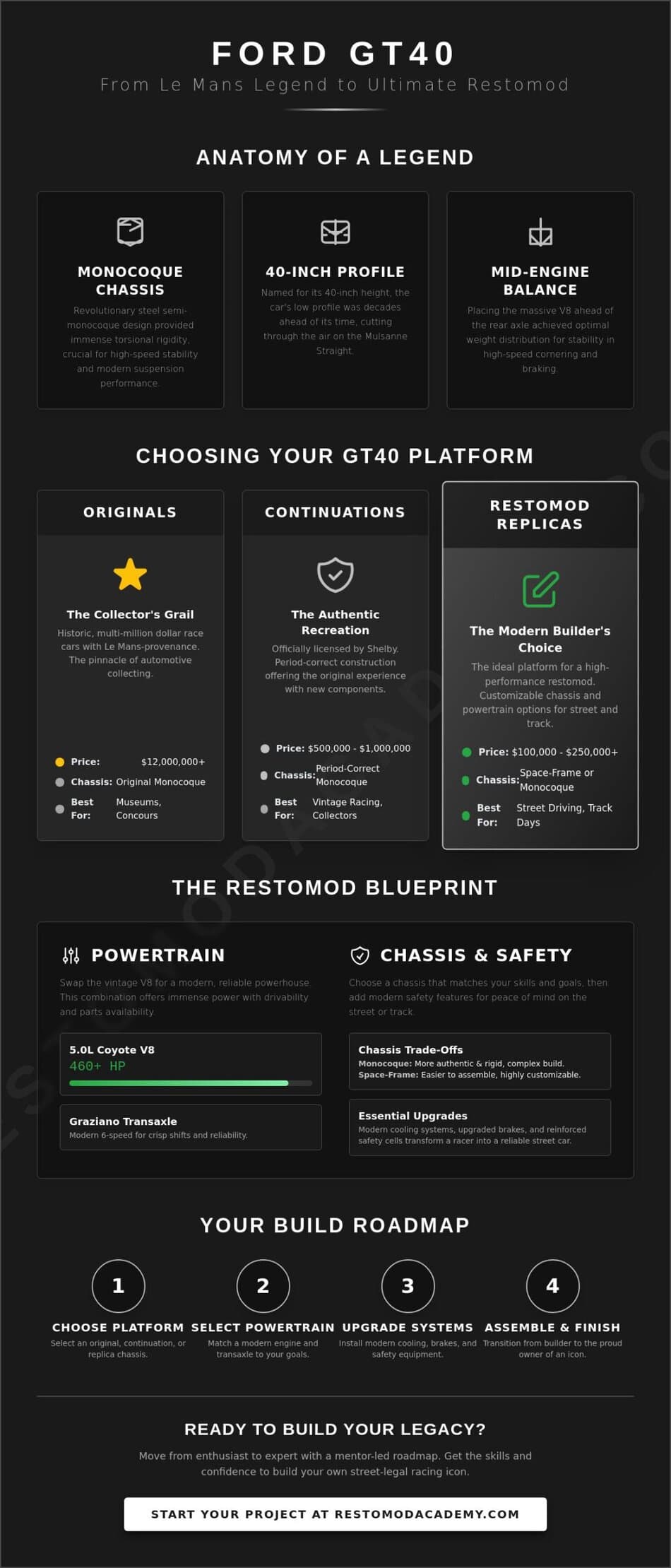
Originals vs. Continuations vs. Replicas: Which is Right for You?
Choosing your path into ford gt40 ownership requires a clear-eyed look at your goals, your budget, and your mechanical appetite. If you’re a high-stakes collector, you’re looking at the original 100 or so cars built in the 1960s. These are eight-figure investments; as of January 16, 2026, a MkII Lightweight sold for a staggering $12,375,000. For the rest of us, the real adventure lies in continuations and replicas. These platforms offer the same heart-stopping silhouette but allow for the modern reliability that makes a restomod project viable for the street.
Continuation cars represent the middle ground. Built by companies like Superformance under license from Shelby, these vehicles carry official CSX serial numbers. They’re so structurally accurate that approximately 70% of their components are interchangeable with the original 1960s racers. In fact, Superformance is the only manufacturer legally permitted to use the “GT40” trademark because their chassis so closely mirrors the original engineering. These are often sold as “turn-key minus” rollers, meaning you choose the powertrain to complete the build.
The Builder’s Choice: RCR vs. Superformance
Decide early if you want a steel or aluminum foundation. Superformance uses a traditional pressed-steel monocoque, staying true to the 1966 blueprints. If you prefer a DIY approach with modern materials, Race Car Replicas (RCR) offers an aluminum monocoque that’s a favorite among fabricators for its weight savings and corrosion resistance. Meanwhile, brands like ERA utilize a square-tube space-frame. While a space-frame is often easier to repair and modify, it lacks the historical “tub” feel of a true monocoque. Pick the platform that matches your garage equipment and your vision for the finished car.
The 2005 and 2017 Ford GT: Modern Successors
Don’t confuse the ford gt40 with its modern descendants. The 2005 Ford GT was a “re-imagining” that grew in every dimension, standing 44 inches tall to accommodate modern safety standards and creature comforts. The 2017 Ford GT took another leap, ditching the V8 for a twin-turbo EcoBoost V6 and a carbon-fiber tub. While these are incredible performance machines, they aren’t GT40s. They lack the raw, mechanical connection of the 40-inch tall original. If you want the soul of Le Mans, stick to the replicas and continuations that honor the 1960s dimensions.
Before committing to a specific chassis, check your local regulations. The 2022 NHTSA low-volume manufacturing rules allow small builders to produce up to 325 replicas a year, but titling and emissions still vary by state. Do your homework now so your project doesn’t stall at the finish line.
Restomodding the Icon: Modern Upgrades for the GT40
Don’t build a car that looks fast but stays in the garage because it’s too temperamental to drive. Restomodding a ford gt40 is about bridging the gap between 1966 soul and 2026 reliability. Your first move should be the powerplant. While a vintage 427 big block has incredible presence, a modern 5.0L Coyote V8 swap provides 460+ horsepower with the peace of mind that comes from modern engineering. It’s lighter, more efficient, and won’t leave you stranded on a humid afternoon due to vapor lock or fouled plugs.
Pair that engine with a modern transaxle. The original ZF 5-speeds are works of art; however, they’re often the weak link in high-torque builds. Look toward Graziano or Quaife units instead. These modern gearboxes handle the power with precision, offering the crisp, reliable shifting you need when pushing through a canyon road. Don’t forget the cockpit environment. Since you’re sitting mere inches from both the asphalt and a roaring engine, thermal management is vital. Install a robust, modern air conditioning system early in the build process. It’s the difference between a car you genuinely love and one you’re afraid to drive during the summer months.
Fuel Injection and Management
Ditch the Weber carburetors for Electronic Fuel Injection (EFI) to gain better cold-starts and drivability. You can maintain the iconic “eight-stack” look by using throttle bodies that mimic the vintage appearance while a hidden ECU manages the fuel maps. This setup ensures your engine breathes perfectly regardless of altitude or temperature changes. If you’re planning a more radical heart transplant or need help with wiring harnesses, check out our Classic Car Modern Engine Swap Guide for professional EFI and management strategies.
Braking and Safety in a 200mph Car
You can’t rely on 1960s solid rotors to stop a car capable of 200 mph. Modern Big Brake Kits with multi-piston calipers and vented rotors are mandatory for any serious build to prevent brake fade. Combine these with a dedicated fire suppression system and a modern safety cell integrated into the chassis. Handling also requires a 21st-century touch. Swap out dated rubber bushings for polyurethane equivalents and install high-performance coilovers to manage weight transfer during aggressive cornering. For a deep dive into chassis stiffening and geometry, explore our Suspension Upgrades for Cars guide.
Before you buy your first set of calipers, make sure you’re equipped with the right tools by checking our recommended gear for advanced fabrication.
Building Your Legacy: How to Start a GT40 Project
Take a breath and visualize the finish line before you commit to your first crate of parts. Building a ford gt40 isn’t a weekend project; it’s a multi-year journey into the heart of automotive craftsmanship. Your first step is to define the mission. A track-focused machine requires aggressive suspension geometry and FIA-spec safety cells, whereas a street-legal cruiser prioritizes sound deadening and air conditioning. Be honest about how you’ll actually use the car. A 40-inch tall racer is a tight fit, and every decision you make now will impact your comfort during those long summer drives.
Once your goal is set, select your foundation. If you value historical accuracy above all else, a steel monocoque chassis is the only way to go. However, if you’re a first-time builder, a space-frame chassis offers more flexibility for modifications and is generally easier to repair. After the chassis is in the garage, source your powertrain. While some purists insist on a period-correct 427 FE big block, many modern builders opt for a Coyote crate engine to ensure turn-key reliability. Finally, don’t work in a vacuum. Surround yourself with the community. Join the forums and leverage the collective wisdom of those who have already navigated these specific mid-engine hurdles.
Budgeting for a GT40 Build
Precision requires a realistic financial roadmap. As of April 2026, the average sale price for a ford gt40 replica or continuation sits at $120,587, but a high-end, professional-grade restomod can easily exceed this. You must prioritize your spending where it counts most. Allocate a larger portion of your budget to the transaxle and safety systems; these are the components that ensure the car is both drivable and secure at speed. You can save on cosmetic items like high-end paint or custom leather interiors early on, as these can be upgraded once the mechanical foundation is proven. To get your finances and timeline in order, start with our Restomod Project Planning Roadmap.
The ‘Built, Not Bought’ Mentality
There is an immense, soul-stirring satisfaction that comes from mastering a mid-engine assembly. When you finally turn the key and hear that V8 bark to life just inches behind your head, you aren’t just starting a car; you’re validating hundreds of hours of meticulous fabrication and wiring. The GT40 is the ultimate test of a restomodder’s skill because it demands excellence in every discipline, from suspension tuning to thermal management. It’s a legacy project that will stay in your family for generations. If you’re ready to transition from a passive admirer to an active builder, join the Restomod Academy to master your next build and ensure every detail is done right the first time.
Ignite Your Legacy in the Garage
You’ve explored the 40-inch tall silhouette that humiliated Ferrari in 1966 and learned how modern EFI and Graziano transaxles can tame that 1960s aggression for the street. Whether you choose an aluminum monocoque for authenticity or a tube-frame chassis for ease of assembly, the ford gt40 remains the ultimate test of a builder’s craftsmanship. It’s a project that rewards your meticulous attention to detail with a visceral driving experience that modern, computer-aided supercars simply can’t replicate. You aren’t just building a car; you’re preserving a piece of history while injecting it with the reliability of 21st-century performance.
Don’t face the complexities of mid-engine fabrication or wiring harnesses alone. You can Master Your Build with The Ultimate Restomod Guide. By joining our community, you’ll receive expert mentorship from Brook Walsh, access comprehensive project blueprints, and benefit from community-driven restoration advice that keeps your project moving forward. Grab your wrenches and start your journey today. The roar of your own Le Mans legend is closer than you think, and we’re here to help you get every detail right the first time.
Frequently Asked Questions
Is the Ford GT40 street legal?
Yes, most modern replicas and continuations can be registered for street use. Under the low-volume manufacturing rules finalized by the NHTSA on March 9, 2022, small builders can produce turn-key replicas that meet current emissions standards. While the original 1960s racers were built specifically for the track, the seven original Mk III models were factory-built as road cars. Always check your specific state regulations for titling a custom mid-engine build.
How much does a real Ford GT40 cost in 2026?
Original models are multi-million dollar investments that continue to appreciate. On January 16, 2026, a 1966 Ford GT40 MkII Factory Lightweight sold for $12,375,000 at auction. Even the road-going 1969 Mk III commanded $2,200,000 on January 17, 2026. For enthusiasts looking to drive rather than collect, high-quality Superformance replicas generally range from $125,000 to $334,950 as of April 2026.
Can a tall driver fit in a GT40?
Fitting into a standard 40-inch tall cabin is difficult for drivers over six feet tall. To solve this, many builders incorporate a “Gurney Bubble,” which is a rounded roof extension originally created for driver Dan Gurney. This modification provides essential helmet clearance without ruining the car’s silhouette. You can also opt for dropped floor pans during the fabrication stage to gain a few extra inches of legroom and headroom.
What is the difference between a Ford GT and a Ford GT40?
The primary difference involves the era of production and the physical dimensions. The ford gt40 refers specifically to the 1960s racers that stood 40 inches tall. The 2005 Ford GT was a modern homage that stood 44 inches tall to meet safety standards. The 2017 Ford GT moved even further away from the original engineering by utilizing a carbon fiber tub and a twin-turbo V6 EcoBoost engine instead of the classic V8.
What engine did the winning 1966 GT40 use?
The 1966 Le Mans-winning Mk II was powered by the legendary 427 cubic inch (7.0L) FE V8 engine. This heavyweight powerplant provided the massive torque needed to push the car past 200 mph on the Mulsanne Straight. It utilized a dry-sump oiling system to ensure the engine remained lubricated during high-speed banking. Modern restomodders often choose the 5.0L Coyote V8 to replicate this performance with significantly better reliability and fuel management.
Are GT40 replicas fast?
Replicas are often faster and more predictable than the original 1960s racing machines. Because modern builds use contemporary suspension geometry and sticky radial tires, they can put power down much more effectively. A ford gt40 replica equipped with a 460-horsepower crate engine and a modern transaxle will often outperform the original track cars while offering better braking performance thanks to modern multi-piston calipers.
How hard is it to build a GT40 kit car?
Building a GT40 is one of the most challenging projects a DIY builder can tackle. Unlike a traditional front-engine kit car, you must manage the complexities of mid-engine transaxle alignment and extensive cooling plumbing that runs from the front radiator to the rear engine bay. It requires advanced fabrication skills and a methodical approach to wiring. We suggest following a proven roadmap to manage these technical hurdles safely.
Why is it called a GT40?
The name is a direct reference to the car’s racing class and its physical height. “GT” stands for Grand Touring, which was the category it competed in during endurance races like Le Mans. The “40” represents the car’s height of exactly 40 inches at the top of the windshield. This low profile was a radical aerodynamic choice designed to minimize the frontal area and maximize top speed on long straights.