
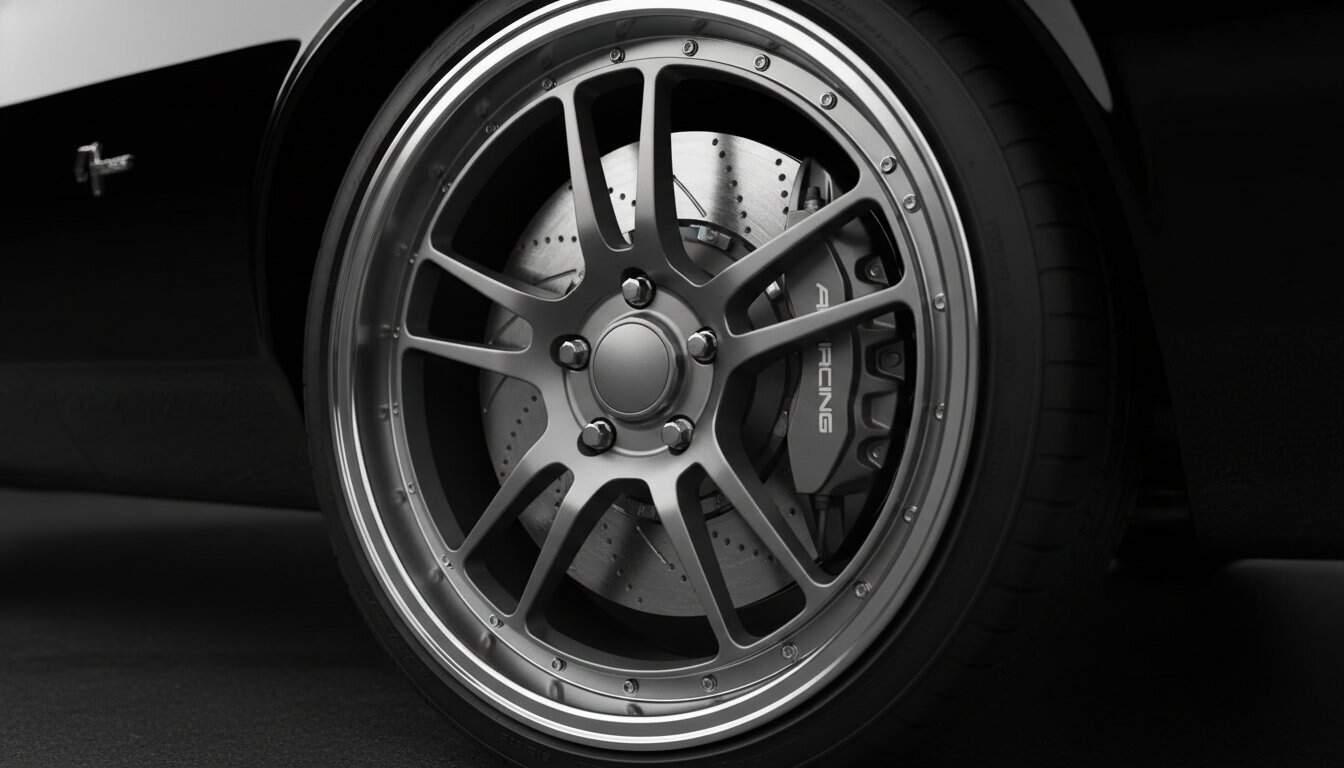
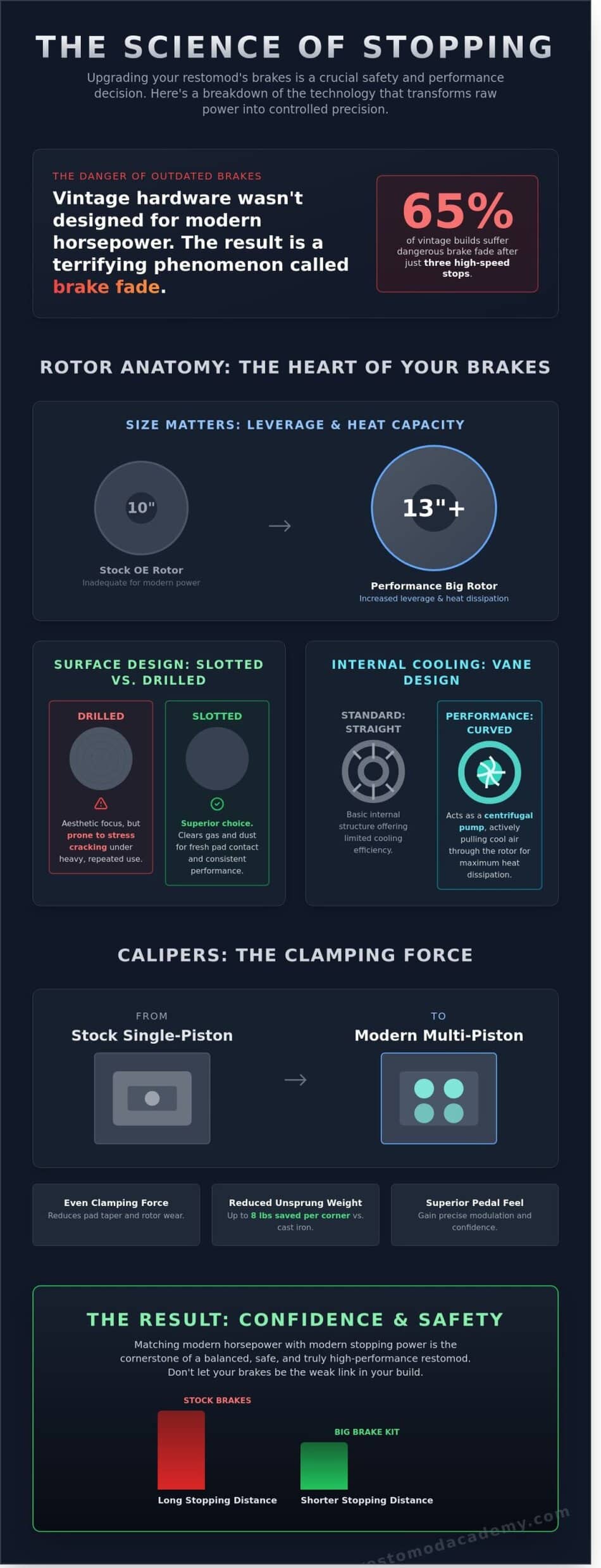
Data from 2025 performance trials shows that nearly 65% of vintage builds suffer from dangerous brake fade after just three high-speed stops. You’ve spent months perfecting the stance and the exhaust note of your build, but if you’re still relying on outdated hardware, you’re driving a liability. Investing in high-performance big brake kits for classic cars isn’t just about the aesthetic of a drilled rotor peeking through your wheels; it’s about the physics of safety and precision.
We all know the gut-wrenching anxiety of a “mushy” pedal when you’re approaching a tight corner. You want that firm, modern response that matches the horsepower of your crate engine. I’ll help you master the technical nuances of modern stopping power so you can choose the perfect kit for your restomod without the headache of wheel clearance issues. We’ll break down the 0.125-inch clearance rules, the real-world difference between 4 and 6-piston calipers, and the hydraulic master cylinder secrets to achieving a rock-solid pedal feel.
Key Takeaways
- Learn to manage the “Kinetic Energy” problem by matching your classic’s modern horsepower with the heat-dissipating capacity of larger rotors.
- Separate marketing myths from track reality by understanding how rotor thickness and surface patterns impact your build’s actual stopping performance.
- Navigate the 15-inch wheel dilemma and master “X-factor” measurements to ensure big brake kits for classic cars fit perfectly behind vintage spokes.
- Perfect your pedal feel by identifying the critical relationship between master cylinder bore size and modern multi-piston calipers.
- Evaluate top 2026 brands like Wilwood and Baer to find the ideal balance between budget-friendly versatility and high-end performance for your project.
Why Big Brake Kits are a Restomod Safety Essential
Building a restomod is about more than just dropping a high-output crate engine into a vintage frame. You’re creating a machine that bridges the gap between 1965 soul and 2026 performance. If you’ve spent months perfecting a 500-horsepower LS swap, your next priority must be the hardware that brings that power to a halt. Selecting high-quality big brake kits for classic cars involves three critical upgrades:
- Oversized rotors for increased thermal mass and better heat dissipation.
- Multi-piston calipers for even clamping force and reduced mechanical flex.
- High-friction pads designed to operate at aggressive temperature ranges.
Understanding what is a restomod means acknowledging that safety and modern reliability are the foundation of any serious build. Your classic car’s ability to stop relies on converting kinetic energy into thermal energy. When you double your vehicle’s horsepower, you exponentially increase the demands on its cooling capacity. To dive deeper into the physics of how these systems manage heat, The Science of Disc Brakes explains how friction material interacts with rotating mass to generate stopping torque.
To see how these modern components translate to real-world performance on vintage iron, watch this helpful breakdown:
The Danger of Original Equipment (OE) Brakes
Most 1960s muscle cars rolled off the assembly line with four-wheel drum brakes or primitive single-piston front discs. These systems weren’t designed for 75 mph highway speeds or the erratic behavior of modern traffic. Drum brakes are notorious for heat soak, which leads to a terrifying phenomenon called brake fade. This happens when the internal components reach temperatures exceeding 500 degrees Fahrenheit, causing the pedal to go soft and the stopping distance to skyrocket. Even early disc conversions often lack the thermal mass needed to handle repeated hard stops without warping or losing effectiveness.
Performance Benefits Beyond Just Stopping
Upgrading to big brake kits for classic cars offers advantages that you’ll feel every time you touch the pedal. Modern aluminum calipers can reduce unsprung weight by as much as 8 pounds per corner compared to cast iron factory units. This improves your suspension’s ability to react to road imperfections and keeps the tires planted. You’ll also gain superior pedal modulation, giving you the precision to trail-brake into a corner with confidence. Beyond the mechanics, the visual impact is undeniable. A 13-inch cross-drilled rotor tucked behind an 18-inch open-spoke wheel signals that your build is a serious performance machine.
The Science of Stopping: Rotors, Calipers, and Heat
Every time you press the brake pedal, you’re asking your car to perform a violent energy transformation. You’re turning kinetic energy, the momentum of your vintage steel, into thermal energy. Your rotors are the primary heat sinks in this equation. When selecting big brake kits for classic cars, remember that diameter provides leverage while thickness provides thermal capacity. A 13-inch rotor has significantly more surface area than a stock 10-inch unit, allowing it to absorb and dissipate heat before it reaches your brake fluid. If your rotor can’t handle the BTU load, your pads will glaze and your pedal will go soft at the very moment you need it most.
Don’t get distracted by the aesthetics of drilled rotors. While they look iconic behind a set of 18-inch wheels, they’re prone to stress cracking under heavy use. Slotted rotors are the superior choice for the modern restomod. They act like a windshield wiper, clearing away gas and dust to keep the pad surface fresh. To understand the mechanical foundation of this process, you can study how modern braking systems function to see why heat management is the ultimate goal of any upgrade.
Rotor Metallurgy and Vane Design
Internal architecture matters more than the outer surface. Standard rotors use straight vanes, but high-performance kits utilize directional, curved vanes. These act as a centrifugal pump, pulling cool air from the center and flinging it outward. You’ll also find two-piece rotors in premium big brake kits for classic cars. These use an aluminum center “hat” bolted to a cast iron ring. This setup saves roughly 3 to 5 pounds of unsprung weight per corner and prevents heat from soaking into your wheel bearings. For a 2026 build, look for rotors with E-coat or zinc plating to ensure your hardware stays crisp and rust-free through every season.
Caliper Construction: Fixed vs. Floating
Ditch the single-piston floating calipers that came on your donor car. Professional builds demand fixed calipers. These units are bolted directly to the spindle, using pistons on both sides of the rotor to apply immediate, symmetrical pressure. This design eliminates the “flex” felt in older systems. When choosing between a 4-piston and 6-piston setup, don’t assume more is always better for the street. A 4-piston caliper with a larger total piston area often provides better modulation than a 6-piston unit with tiny bores. You must match this total piston area to your master cylinder bore, typically aiming for a 20:1 or 25:1 pedal ratio to maintain a firm, confidence-inspiring feel.
Your choice of pad compound is the final piece of the puzzle. A ceramic street pad works perfectly from 100 to 600 degrees Fahrenheit, but a dedicated track pad won’t even start biting until it hits 400 degrees. For most restomod projects, a high-performance semi-metallic pad offers the best balance of cold bite and fade resistance. If you’re ready to start sourcing these components, check out our recommended gear for the hardware we trust in the shop.
Choosing the Right Kit: Fitment and Wheel Clearance
Don’t let the excitement of a new upgrade blind you to the physical limits of your wheel barrel. The most common hurdle when installing big brake kits for classic cars is the 15-inch wheel dilemma. While vintage-style rims look period-correct, they rarely accommodate modern multi-piston calipers. If you’re dead-set on keeping those 15-inch Torq Thrusts, you’re usually limited to 11-inch or 12-inch rotors. To run a 13-inch rotor, you’ll need at least a 17-inch wheel. If you’re aiming for 14-inch rotors or larger, prepare to step up to 18-inch or 19-inch hoops to ensure the caliper doesn’t scrape the inner barrel.
Measuring the “X-factor” is your next critical step. This represents the distance between the mounting face of the wheel and the back of the spokes. Modern performance calipers are significantly wider than factory cast-iron units and often protrude 15mm to 25mm beyond the hub surface. Without sufficient X-factor, your beautiful new calipers will grind against your spokes the moment you torque the lug nuts. Grab the digital calipers from our recommended gear list to get precise numbers before you click buy. For those working on vintage Fords, this technical breakdown of Big Disc Brake Conversion Kits highlights how specific spindle types impact your final track width and clearance.
Measuring Your Classic for Big Brakes
Download the manufacturer’s fitment template before you start. Print it at 100 percent scale, glue it to a piece of cardboard, and slide it into your wheel. This simple 10-minute task prevents a 500 dollar restocking fee. Watch out for wheel offset changes; some big brake kits for classic cars push the wheel outward by 0.25 inches or more. This might cause your tires to rub the fender lips during compression. Also, check the clearance between the caliper body and your upper ball joints. On lowered cars, this gap can shrink to less than 3mm during hard cornering, leading to dangerous mechanical interference.
Selecting a Kit Based on Driving Style
Your choice should mirror how you actually use the car. A street cruiser needs a kit that prioritizes low noise, low dust, and immediate cold-stopping power. You want pads that bite hard the first time you hit the pedal at a red light. If you’re building for Pro-Touring or Autocross, shift your focus to thermal capacity. You’ll need aggressive pads that can handle 1,000-degree temperatures and rotors with high vane counts for rapid cooling. This ensures your pedal stays firm and predictable after the fifth lap of the day, giving you the confidence to push your classic to its absolute limit.
Hydraulics: The Secret to Perfect Brake Pedal Feel
You’ve bolted on those massive 6-piston calipers, but don’t make the mistake of leaving your factory master cylinder in place. A stock 1960s master cylinder lacks the fluid displacement needed for modern big brake kits for classic cars. Pushing four or six pistons per corner requires a volume of fluid your original equipment wasn’t built to handle. If you keep the stock unit, you’ll likely bottom out the pedal before the pads even bite. It’s a dangerous mismatch that undermines your entire investment.
The relationship between bore size and pedal effort is a game of leverage. A smaller 15/16 inch bore increases line pressure but requires a longer pedal stroke. A larger 1-1/8 inch bore offers a firm, short stroke but demands significant leg strength. For most street-driven restomods, a 1 inch bore provides the sweet spot between effort and control. Choose manual brakes for maximum feedback if you’re hitting the track, but stick with power-assisted boosters if you want a modern, effortless driving experience.
Mastering the Master Cylinder
Safety is your first priority in the garage. Ditch the single-reservoir “fruit jar” for a tandem master cylinder. This setup creates two independent hydraulic circuits; if a rear line shears, you still have front stopping power to bring the car to a halt. Fill that system with high-quality DOT 4 or DOT 5.1 fluid. These fluids offer dry boiling points exceeding 446 degrees Fahrenheit, ensuring your big brake kits for classic cars won’t fade during spirited mountain runs or heavy track use.
Plumbing Your System for Success
Swap those 50-year-old rubber hoses for stainless steel braided lines immediately. Rubber expands under pressure, which creates a “spongy” feel at the top of the pedal. Stainless steel braiding prevents this expansion, delivering a 20 percent firmer pedal response and more precise modulation. When you’re bending new hard lines, route them at least 3 inches away from exhaust headers. Brake fluid is sensitive to heat, and soak from a 1,200-degree exhaust pipe will turn your pedal to mush in minutes.
Every custom build needs an adjustable proportioning valve. Since you’ve changed the weight distribution and grip levels of your classic, you must fine-tune the pressure sent to the rear wheels. Too much rear bias and the car will spin during hard braking. Too little, and you’re leaving 30 percent of your stopping power on the table. Dial it in until the front wheels lock just a split second before the rears.
Top Big Brake Brands for 2026: Wilwood, Baer, and Beyond
Choosing the right hardware is where your vision meets the pavement. In 2026, the market for big brake kits for classic cars is dominated by names that have spent decades on the track and the street. Wilwood Engineering remains the benchmark for versatility. Their kits often use forged aluminum calipers that reduce unsprung weight by up to 35 pounds compared to factory cast-iron setups. It’s the go-to choice if you’re building a weekend cruiser on a specific budget. They offer over 1,000 vehicle-specific configurations, making them the most accessible entry point for any student of the craft.
Baer Brakes took the lead in the 1990s and hasn’t let go. They don’t just sell calipers; they sell engineered solutions that often include pre-assembled hubs and specialized spindles. This eliminates the guesswork for builders working on 1960s GM A-body or Ford Mustang platforms. When your build leans toward European performance levels, Brembo and StopTech offer racing-grade thermal management. These systems utilize 14-inch or 15-inch rotors designed to dissipate heat during aggressive track sessions. You can find detailed breakdowns of these specific setups in our product reviews section.
Wilwood vs. Baer: The Great American Debate
Wilwood’s primary advantage lies in weight reduction and application variety. Their Superlite and Dynalite series are incredibly light, which improves your suspension’s ability to react to road changes. Baer focuses on the “complete system” philosophy. While a Wilwood kit might require you to reuse your stock hubs, Baer often provides high-strength hubs and spindles as part of the package. This ensures the entire assembly can handle the massive torque loads of modern braking. Price points reflect this difference. You’ll find entry-level Wilwood kits starting around $950, while professional-grade Baer 6S systems often command $3,500 or more for a full four-wheel setup.
Final Steps: Installation and Bedding-In
Don’t treat the first drive like a victory lap. Bedding your pads is the most important step after installation. This process involves a series of 8 to 10 decelerations from 60 mph to 15 mph to transfer a uniform layer of friction material onto the rotor. Skipping this leads to uneven deposits, which causes the vibration and poor pedal feel that ruins the driving experience. Perform a final safety check by turning the steering wheel to full lock in both directions. You must verify zero interference between the caliper, the wheel barrel, and the flexible brake lines. A clearance of at least 0.125 inches is the industry standard for safety. This attention to detail is what separates a garage project from a true restomod masterpiece.
Take Command of Your Build’s Performance
Upgrading your stopping power isn’t just about aesthetics; it’s about meeting the 2026 safety standards for classic cars that demand modern responsiveness. You’ve learned how 6-piston calipers manage heat, but the real magic happens when you balance hydraulic pressure for that perfect pedal feel. Selecting the right big brake kits for classic cars requires a meticulous eye for wheel clearance to ensure every component works in harmony. Don’t let technical specs stall your progress in the garage.
Restomod Academy provides the roadmap you need to navigate these installations with confidence. Our expert-led tutorials by Brook Walsh break down fabrication into logical steps, while our affiliate-neutral comparisons ensure you choose Wilwood or Baer components based on performance. Your vision for a high-performance machine is within reach when you apply these professional-grade principles to your project. Every turn of the wrench brings you closer to a vehicle that handles as well as it looks.
Download The Ultimate Restomod Guide to Plan Your Brake Upgrade
You’ve got the tools and the knowledge; now it’s time to build the car you’ve always envisioned.
Frequently Asked Questions
Do I need a big brake kit for my classic car if I only drive on the street?
Yes, you need a big brake kit if your classic car now produces 30% more horsepower than its original factory rating. Modern commuters in SUVs can stop from 60 mph in 120 feet, while a stock 1965 Mustang often requires over 180 feet. Installing big brake kits for classic cars ensures your vintage ride possesses the stopping power to survive modern traffic. It’s about safety and confidence every time you hit the pedal.
Can I keep my 15-inch wheels with a big brake kit?
You can keep 15-inch wheels only if you limit your rotor diameter to 11 inches or less. Most performance kits featuring 13-inch or 14-inch rotors require at least a 17-inch wheel to clear the larger caliper body. Check the manufacturer’s clearance template before you buy. About 85% of enthusiasts find that moving to a 17-inch wheel opens up the best high-performance brake options for their build.
Will a big brake kit work with my stock master cylinder?
Your stock master cylinder will likely fail to move enough fluid for a multi-piston big brake kit. Most factory units use a 1-inch bore designed for single-piston sliding calipers. Upgrading to a 1.125-inch bore master cylinder ensures the pedal feels firm rather than mushy. Match your master cylinder to the total piston area of your new calipers to maintain proper hydraulic leverage and safety throughout the system.
What is the difference between 4-piston and 6-piston calipers?
A 6-piston caliper provides more even pressure distribution across the brake pad than a 4-piston design. By using three different piston sizes, 6-piston units reduce tapered pad wear and offer a more modulated pedal feel. While a 4-piston setup works perfectly for cars under 3,000 pounds, heavier muscle cars benefit from the increased clamping force and surface area of a 6-piston configuration. It’s a matter of matching the hardware to your car’s weight.
How much does a big brake kit for a classic car typically cost?
Expect to invest between $1,200 and $4,500 for a high-quality front and rear system. A basic front-only kit from a reputable brand like Wilwood or Baer starts around $850. High-end setups featuring forged calipers and 14-inch rotors often exceed $2,500 for the front axle alone. Budget an additional 15% for new fluid, braided stainless lines, and potential proportioning valve upgrades to complete the transformation correctly.
Do I need to upgrade my rear brakes if I install a front big brake kit?
You don’t always need to upgrade the rear, but keeping stock drums can lead to a dangerous 90/10 braking bias. Most restomod builders aim for a 70/30 front-to-rear distribution to prevent the front nose-diving during hard stops. If you increase front clamping force by 40%, your rear brakes should see a proportional upgrade. This balance keeps the car flat and stable when you’re carving corners or stopping in a hurry.
What is brake bedding and why is it necessary?
Brake bedding is the process of transferring a thin, even layer of friction material from the pads to the rotor surface. You achieve this by performing 8 to 10 controlled stops from 60 mph down to 15 mph in rapid succession. Skipping this step results in uneven deposits, which cause 95% of the pedal pulsations that drivers mistake for warped rotors. Proper bedding ensures maximum stopping performance and long-term durability for your investment.
Are drilled and slotted rotors better for classic cars?
Drilled and slotted rotors are better for heat dissipation and gas venting during spirited driving. Slotted rotors specifically help wipe away the boundary layer of gas and dust that forms between the pad and the disc. While some of the benefit on a street car is aesthetic, these features prevent brake fade during 20-minute track sessions or aggressive canyon runs. Choose them to give your big brake kits for classic cars a modern, high-performance look.