
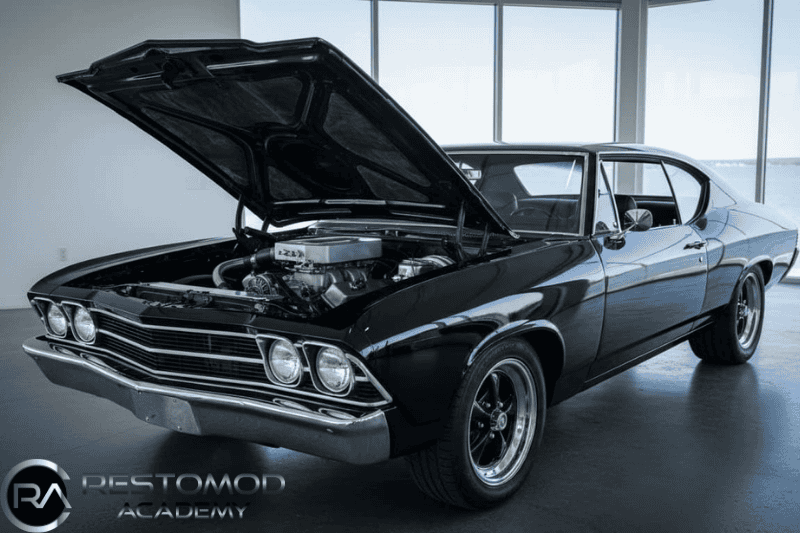
Imagine it is a crisp Saturday morning in 2026, and you are sliding into the hand stitched bucket seat of your 1969 Chevelle. Instead of the usual ritual of pumping the gas and praying the starter catches, you turn the key and hear the immediate, crisp growl of a modern fuel injected V8. You want the soul of a vintage icon, but you are likely tired of the 55 year old mechanical gremlins that keep your car on jack stands instead of the open road. This classic car modern engine swap guide is designed to bridge that gap, giving you the confidence to cut through the noise and build a machine that is as reliable as it is beautiful.
You probably worry that a modern heart will require a “bundle of snakes” wiring nightmare or that you will have to hack your chassis to bits just to fit a new transmission. We understand that fear because industry data suggests that 40 percent of DIY builds stall out during the complex electronic integration phase. This guide provides a clear, 12 step roadmap to help you select the right engine for your performance goals and manage every hidden cost from high pressure fuel lines to custom cooling stacks. We will walk you through the precise fabrication techniques and electronic integration steps needed to finish your project with professional grade craftsmanship.
Key Takeaways
- Define your vision by mastering the restomod philosophy, where vintage aesthetics meet modern reliability to create a “built, not bought” legacy.
- Navigate the “Big Three” powerplant options with our classic car modern engine swap guide to find the perfect LS, Coyote, or Hemi heart for your project.
- Master the critical “supporting cast” of components, from high-pressure EFI fuel systems to wiring harnesses, that represent the true 60% of a successful build.
- Execute a foolproof 5-step roadmap to ensure your modern V8 fits perfectly and your chassis is prepared to handle the increased performance and torque.
- Elevate your craftsmanship by moving beyond random tutorials to a structured, pro-level blueprint that guarantees a safe and high-quality restoration.
The Restomod Philosophy: Why Swap a Modern Engine into a Classic?
You stand in your garage, looking at a 1969 Camaro. It looks perfect, but the original small-block struggles to start every third Tuesday. This is where the restomod philosophy takes hold. It’s the art of keeping the soul of a vintage machine while injecting it with the heart of a modern powerhouse. When you ask yourself, What is an engine swap?, you’re really asking how to make your dream car usable in the 21st century. This classic car modern engine swap guide helps you bridge that gap between nostalgia and performance.
To better understand how this transformation works in the real world, watch this breakdown of the process and costs:
Building a restomod isn’t just about speed. It’s about the “Built, Not Bought” legacy. When you spend 200 hours wiring a Gen V LT1 or fabricating custom mounts, you aren’t just a consumer; you’re a craftsman. You’re building for four essential pillars: 450+ horsepower, turn-key reliability, modern safety, and fuel efficiency that doesn’t require a personal oil rig. This journey transforms a temperamental trailer queen into a reliable long-distance runner.
Restoration vs. Restomod: Choosing Your Path
Choosing between a factory-correct restoration and a restomod meaning comes down to your goals. A 100-point NCRS Corvette belongs in a museum. A restomod belongs on the autocross track or a cross-country highway. While purists argue that modifications hurt resale value, data from 2023 Bring a Trailer auctions shows well-executed restomods often sell for 30% to 50% more than their stock counterparts. Swapping in a modern engine solves the “weekend car” syndrome where 40-year-old carburetors gum up after sitting for three weeks.
The Emotional Reward of Modern Performance
There’s a specific magic in the sensory experience. You get the 80-decibel roar of a V8, but with the fuel-injected precision of a 2026 daily driver. It changes your mindset. You don’t worry about vapor lock on a 95-degree day. Instead, you feel the confidence to take a 50-year-old Mustang on a 1,000-mile road trip. That pride comes from knowing every bolt, every sensor, and every wire was placed by your hands. This classic car modern engine swap guide is your first step toward creating a vehicle that’s as reliable as it is beautiful.
Choosing Your Powerplant: The Best Modern Engines for Classic Swaps
Selecting the heart of your build is the most critical decision in any classic car modern engine swap guide. This choice dictates your chassis modifications, your wiring complexity, and ultimately, how the car feels when you hammer the throttle. While the “Big Three” V8s dominate the scene, the modern builder has more options than ever, ranging from high-revving four-cylinders to silent, high-torque electric motors.
The GM LS Series: The Gold Standard for Restomods
The GM LS series remains the undisputed king of the garage for one reason: it fits. Its pushrod design keeps the engine compact, allowing a 6.2L V8 to slide into engine bays designed for much smaller units. It’s the most documented engine in history, supported by a massive aftermarket that provides “bolt-in” solutions for almost every chassis imaginable. If you’re feeling overwhelmed by the technical hurdles, The Definitive Guide to an LS Engine Swap breaks down the process into manageable steps.
Budget builders should target the 1999-2013 Vortec truck engines, like the 5.3L LM7. These iron-block units are incredibly durable and often cost 60% less than their aluminum car-based siblings, like the LS3, while still offering a platform capable of 400 horsepower with a simple camshaft change.
Ford Coyote and Chrysler Hemi: Modern Muscle Reborn
Blue Oval purists gravitate toward the 5.0L Coyote for its 7,000+ RPM redline and sophisticated power delivery. However, you must account for its physical size. The Dual Overhead Cam (DOHC) heads make the Coyote nearly 30 inches wide. In a 1965 Mustang, this usually requires removing the factory shock towers and installing a Mustang II-style front end. It’s a significant fabrication commitment that adds roughly $3,500 to your total build cost before the engine even drops in.
For the Mopar crowd, the Gen III Hemi is the only way to fly. The 5.7L and 6.4L (392) units provide that signature heavy-hitting torque. While the electronics were once a barrier, companies like Holley now offer plug-and-play harnesses that make these swaps as straightforward as an LS build.
- GM LS3: 6.2L | 430 HP | Avg. Crate Price: $8,900
- Ford Coyote (Gen 3): 5.0L | 460 HP | Avg. Crate Price: $10,250
- Chrysler Hemi (392): 6.4L | 485 HP | Avg. Crate Price: $11,500
Alternative Swaps: K-Series and EV Power
Don’t feel restricted to eight cylinders. The Honda K-series has exploded in popularity for lightweight builds like the Mazda Miata or classic MG roadsters. A K24 swap can shave 200 pounds off your front axle compared to a small-block V8, drastically improving handling balance. For those looking toward the 2030s, EV conversions using Tesla drive units offer 400 lb-ft of instant torque. While the battery packaging is a jigsaw puzzle, the result is a classic that’s faster and more reliable than anything from the 1960s.
Before you turn the first wrench, make sure you have the right tools for the job by checking our recommended gear list to set your shop up for success.
Beyond the Block: Essential Systems for a Successful Swap
Dropping a fresh crate engine into your frame is a massive milestone, but it only represents about 40% of the total workload. Many builders stall at this stage because they underestimate the supporting cast required to make that power usable. Your vintage chassis wasn’t designed for the thermal loads or rotational stresses of 21st-century engineering. This classic car modern engine swap guide focuses on the critical infrastructure that turns a stationary engine into a reliable machine.
Your old mechanical fuel pump pushing 5 to 7 PSI won’t feed a modern beast. You need a dedicated EFI system capable of maintaining a steady 58 PSI. Upgrade to a baffled fuel tank to prevent fuel slosh during hard cornering. These internal walls ensure your pump doesn’t suck air, which prevents lean spikes that could melt a piston in seconds. Precision is the priority here.
Don’t trust a 50-year-old brass radiator with your investment. Most original cooling systems were rated for less than 200 horsepower. When you step up to a 430-horsepower LS3 or a 5.0L Coyote, you’re generating more than double the heat. Move to a high-capacity aluminum radiator with dual electric fans. This setup keeps engine temps stable at 195 degrees, even when you’re stuck in summer traffic.
Drivetrain harmony is the final piece of the puzzle. Power is useless if your rear-end gears aren’t matched to your transmission. Pairing a modern 6-speed overdrive transmission with original 2.73 highway gears will make the car feel sluggish off the line. Aim for a 3.73 or 4.10 ratio to wake up the acceleration and take full advantage of your new torque curve.
Fuel Injection vs. Carburetors: The EFI Revolution
EFI is the gold standard for modern drivability. It uses MAP and O2 sensors to adjust for altitude changes and ambient temperature instantly. This means your car starts on the first turn whether you’re in the Rockies or at sea level. Modern retrofit tanks simplify the plumbing by housing the high-pressure pump internally, which also keeps the pump cool and quiet. Self-learning EFI serves as the bridge for traditionalists by using a wideband oxygen sensor to automatically tune the fuel map while you drive.
Managing the Bundle of Snakes: Electronics & Wiring
Wiring often intimidates the DIY builder, but the standalone ECU simplifies the process. This unit acts as the digital brain for your modern heart, controlling spark timing and fuel delivery with millisecond precision. Use a plug-and-play harness to eliminate the guesswork of splicing into a brittle, 40-year-old factory fuse box. These kits are labeled clearly and significantly reduce the risk of an electrical fire. Check our recommended gear for the specific crimpers and diagnostic scanners that make this stage of your classic car modern engine swap guide project a breeze.
The Builder Roadmap: 5 Critical Steps Before You Turn a Wrench
Don’t grab your socket set just yet. A successful classic car modern engine swap guide starts with a pen, a notepad, and a measuring tape. The transition from a carbureted relic to a fuel-injected powerhouse is a marathon of logic, not a sprint of brute force. You are building a system, not just mounting a motor. This roadmap ensures your vision survives the reality of the garage floor.
Measuring Twice: Clearance and Suspension Geometry
Precision is your best friend when shoehorning a modern V8 into a 50 year old engine bay. A modern DOHC engine can be 30 inches wide, while a vintage small block often sits at 24 inches. Measure the distance between your shock towers. If you have less than 29 inches of clearance, you’ll likely need an aftermarket K-member or a Mustang II style front end. Check your oil pan depth against the crossmember. Most factory pans require a $350 low-profile swap pan to clear the steering rack. You can find the right hardware for these modifications in our product reviews for swap-friendly suspension kits.
Budgeting for the 20% Overrun
Financial discipline keeps projects from becoming permanent jack-stand residents. The engine itself is often the smallest expense. It’s the “death by a thousand cuts” that drains your bank account. Budget an extra 20% for the components that don’t come in the crate. A drive-by-wire pedal assembly averages $150, and custom-crimped AC hoses can easily hit $450. Avoid the “while you’re in there” trap that turns a $6,000 swap into a $15,000 restoration. Prioritize safety. Spend $1,200 on a four-piston disc brake conversion before you spend a dime on chrome valve covers.
- Tooling Up: You’ll need more than a basic wrench set. Invest in a 2-ton engine hoist and a high-quality OBD-II diagnostic scanner to communicate with your new ECU.
- Sourcing Strategy: A new crate engine offers a 24-month warranty and zero miles for about $9,500. A salvage yard pull costs $2,000 but requires a $500 refresh kit and significant cleaning time.
- Chassis Prep: Adding 200 horsepower to a vintage frame causes flex. Plan for subframe connectors or a 4-link rear suspension to handle the increased torque.
Success lives in the details you handle today. If you plan for the $100 sensors and the steering shaft interference now, you won’t be frustrated later. Keep your eyes on the prize: a reliable, high-performance machine that starts every time you turn the key.
Ready to start your journey? Master the most popular swap in the world with our comprehensive LS guide.
Mastering the Art of the Swap with Restomod Academy
Building a restomod isn’t just about turning wrenches. It’s about vision. Many enthusiasts get stuck watching endless, fragmented video clips without a clear path forward. This classic car modern engine swap guide bridges that gap. We turn 40 hours of confusing research into a 10 step execution plan. You don’t have to be a professional fabricator to achieve professional results. You just need the right mentor to show you the sequence of operations.
Professional Blueprints for DIY Success
Our project blueprints eliminate the guesswork that often kills a build’s momentum. Instead of wondering if a specific oil pan clears your crossmember, you’ll work with 100% verified component lists. We’ve documented precise measurements for over 250 unique chassis configurations to ensure your parts fit the first time. There is no feeling like the sensory satisfaction of the first turn of the key. When the fuel pump primes and the engine settles into a perfect 800 RPM idle, the months of hard work instantly pay off. If you hit a mechanical brick wall, our consulting services provide direct access to experts who’ve solved these exact fitment issues before. We help you move past the frustration so you can stay focused on the craft.
Join a Community of Master Builders
A “built, not bought” car represents your personal legacy. It’s a statement of individual craftsmanship that a factory floor could never replicate. At the Academy, we view every snapped bolt or complex wiring harness puzzle as a valuable learning opportunity. You aren’t just a hobbyist; you’re becoming a master builder. Join 5,000 other enthusiasts who value precision over shortcuts and authenticity over ease.
- Access technical breakdowns that simplify complex electronics.
- Learn fabrication techniques that ensure safety and longevity.
- Share your progress with a community that understands the grind.
Take the first step in your restomod journey today by exploring our resources, including the definitive guide to an LS engine swap. Stop being a passive admirer and start being an active creator. Your dream build is just a series of logical steps away.
Ignite Your Build Journey
Your vision for a 1969 muscle car with 2026 reliability starts with a single, deliberate decision. You’ve explored how a fuel-injected heart transforms vintage iron and identified the 5 critical steps necessary to prep your chassis before the first bolt turns. This classic car modern engine swap guide provides the framework to merge nostalgia with 600-horsepower performance. Don’t settle for a project that stalls in the garage for three years. Success requires more than just a crate motor; it demands a mastery of wiring harnesses, cooling systems, and fuel delivery.
At Restomod Academy, we provide the 12-month blueprints you need to finish your build. You’ll gain access to expert consulting from builders who’ve completed over 50 high-end swaps and join a community of 5,000 DIY enthusiasts. It’s time to stop dreaming and start fabricating. Every hour you spend in the shop is an investment in your automotive legacy.
Start Your Transformation with The Ultimate Restomod Guide
Your legacy is waiting in the driveway. Grab your torque wrench and let’s get to work.
Frequently Asked Questions
How much does a modern engine swap typically cost?
A modern engine swap typically costs between $5,000 for a DIY junkyard build and $25,000 for a professional crate engine installation. You’ll spend roughly $1,500 on a used LS engine, but support components like fuel systems and wiring harnesses add $3,000 to that base price. High-end builds featuring a 5.0L Coyote or LT4 often exceed $30,000 once you account for professional labor and custom fabrication.
Can I swap a modern engine into a classic car by myself?
You can perform a swap yourself if you possess basic mechanical skills and about 300 hours of garage time. This classic car modern engine swap guide emphasizes that 70% of the work involves patience with wiring and plumbing. Modern bolt-in motor mounts and plug-and-play harnesses remove the need for advanced engineering; this makes the project accessible to any dedicated enthusiast with a standard toolset.
Is an LS swap easier than a Ford Coyote swap?
An LS swap is significantly easier than a Ford Coyote swap because of the engine’s physical dimensions. The pushrod LS measures about 20 inches wide, while the DOHC Coyote spans nearly 28 inches. This 8-inch difference means the LS fits into 95% of vintage engine bays without cutting the shock towers. The Coyote often requires a complete front suspension redesign to clear its massive cylinder heads.
What is the best modern engine for a daily driver classic car?
The GM LS3 is the gold standard for a daily driver classic car because it balances 430 horsepower with modern fuel injection reliability. It delivers 20 miles per gallon in most 3,200-pound vehicles and starts instantly in temperatures from -10 to 110 degrees Fahrenheit. For Ford fans, the 2.3L EcoBoost is a rising star, offering 310 horsepower and superior weight distribution for better city handling.
Will an engine swap decrease the value of my classic car?
An engine swap increases the value of a non-rare classic by 20% to 50% in the current restomod market. While a 1-of-500 Hemi Cuda loses value if modified, a standard 1967 Mustang often jumps from a $30,000 valuation to $55,000 after a modern swap. Buyers today prioritize the ability to drive 500 miles without a breakdown over having original, numbers-matching hardware under the hood.
How long does a typical engine swap project take for a DIYer?
A typical DIY engine swap takes between 150 and 300 hours of active labor to complete correctly. If you commit 12 hours every weekend, expect your car to be off the road for 4 to 6 months. Roughly 40 hours of that time is dedicated solely to the wiring harness and ECU integration. This is the stage where most first-time builders at the Restomod Academy feel the most pressure.
Do I need to upgrade my brakes and suspension for an engine swap?
You must upgrade your brakes and suspension to safely manage the 200% power increase common with modern swaps. Stock 10-inch drum brakes cannot dissipate the heat generated by a 450-horsepower engine during repeated stops. Install 11-inch or 12-inch disc brakes and stiffen your chassis with subframe connectors. This ensures your 50-year-old frame doesn’t twist under the 400 lb-ft of modern torque.
What are the most common mistakes made during an engine swap?
The most common mistakes include undersized cooling systems and inadequate fuel delivery setups. Data shows that 30% of builders try to reuse old radiators, which leads to overheating in under 10 minutes of idling. Additionally, failing to use a baffled fuel tank results in engine starvation during cornering. This simple oversight ruins the driving experience and reliability of your newly powered restomod project.