
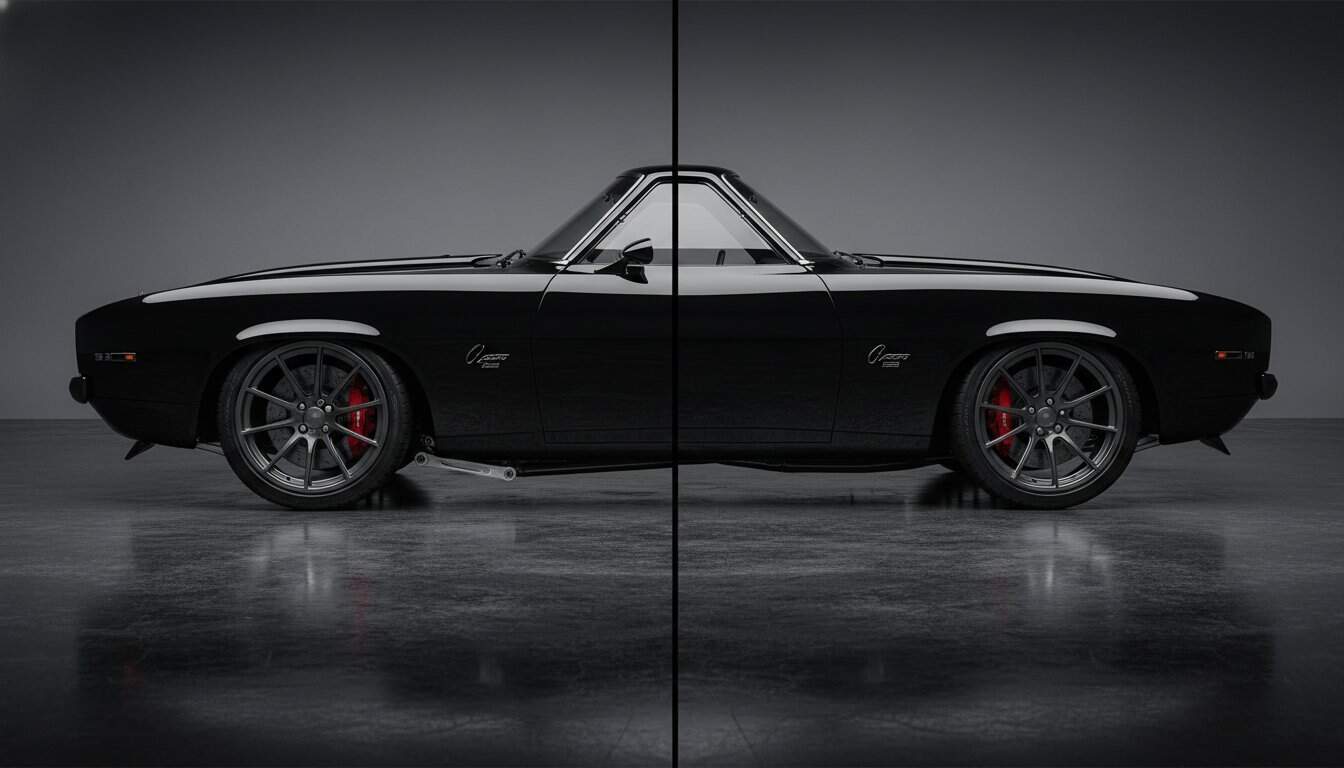
You might think that slamming your 1969 Camaro to the pavement is the only way to achieve that aggressive pro-touring stance, but the lowest choice often leads to the highest frustration on the open road. It’s a common trap in the workshop. You’ve spent hundreds of hours perfecting the bodywork and dropping in a high-output LT4 crate engine; the last thing you want is a ride that feels like a bucking bronco or a drifting boat. We understand the fear of cutting into a vintage frame only to realize the suspension geometry is compromised.
Mastering the coilover vs air suspension debate is about more than just aesthetics; it’s about matching mechanical precision with your specific vision for the car’s legacy. Whether you’re chasing lap times at a 2026 track event or cruising the coast, you need a setup that integrates with your modern powertrain without constant failure. This guide breaks down the fabrication requirements, maintenance cycles, and real-world reliability of both systems. You’ll gain the confidence to choose a kit that preserves the soul of your classic while delivering the performance of a modern machine.
Key Takeaways
- Stop fighting 60-year-old suspension technology and learn how to stabilize your high-horsepower restomod for modern road conditions.
- Navigate the coilover vs air suspension landscape to determine if mechanical simplicity or on-the-fly adjustability fits your shop’s vision.
- Evaluate the trade-offs between track-focused lateral grip and the “lay frame” aesthetic to ensure your classic handles exactly how you intend.
- Avoid common DIY pitfalls by learning how to select high-quality hardware that integrates seamlessly with advanced big brake kits.
- Gain the confidence to transform your project’s soul from a floaty vintage cruiser into a precision-engineered performance machine.
The Foundation of Modern Handling: Why Your Restomod Needs More Than Leaf Springs
Look under the rear of your project car. If you see leaf springs, you’re looking at technology that became standard for mass-market vehicles in the 1920s. While these steel slats were reliable for hauling groceries in 1965, they simply weren’t designed to handle the 21st-century performance we demand today. Modern roads are faster, and the expectations for ride quality have shifted from “tolerable” to “precise.” When you commit to a build, you’re not just fixing an old car; you’re re-engineering it to thrive in a world it was never meant to see.
The demand for better chassis control becomes undeniable the moment you increase your power output. A stock 1967 small block might have wheezed out 200 net horsepower, but a modern heart transplant changes the math entirely. If you’re following the definitive guide to an LS engine swap, you’re likely dropping 430 to 525 horsepower into a frame designed for half that load. Without a sophisticated suspension, that power results in wheel hop, chassis flex, and a terrifying lack of composure. This technical gap is why the coilover vs air suspension debate sits at the very center of your build strategy.
The Restomod Identity: Style Meets Reliability
To succeed, you must embrace the what-is-a-restomod mindset. This philosophy prioritizes the marriage of vintage aesthetics with modern mechanical integrity. Suspension is the literal bridge in this equation. It connects the iconic silhouette of your classic to the asphalt. A properly tuned system provides sensory rewards that a standard restoration cannot match. You’ll feel the difference in the weight of the steering, the lack of body roll in a sharp corner, and the confidence that comes from a car that tracks straight at 80 mph. It transforms the driving experience from a stressful chore into a visceral pleasure.
Identifying Your Build’s Mission
Before you turn a single wrench, define the mission of your vehicle. A car destined for the autocross circuit requires different spring rates and dampening than a cruiser meant for the Power Tour. Your choice between coilover vs air suspension hinges entirely on this goal. Coilovers offer a “set it and forget it” mechanical simplicity that favors aggressive handling. Conversely, air systems provide unparalleled versatility for the show field and the highway. To understand how these systems evolved from heavy-duty trucks to high-performance machines, you can study the history and mechanics of air suspension. Consider these three archetypes for your project:
- The Canyon Carver: Focused on lateral grip, weight transfer, and consistent feedback.
- The Long-Distance Cruiser: Prioritizes vibration isolation and adjustable ride height for varying road conditions.
- The Show Stopper: Demands the ability to “lay frame” at an event while remaining drivable on the street.
Decide on your mission now. Every component you buy, from the bushings to the control arms, must support this singular vision. If you fail to plan the suspension before finalizing your chassis work, you’ll likely spend twice as much fixing mistakes later. Build it right the first time so you can spend more time on the road and less time under the jack stands.
Coilovers vs. Air Suspension: Mechanical Simplicity vs. Pneumatic Versatility
Strip your project down to the chassis and you’ll find that the coilover vs air suspension debate is really a choice between two distinct philosophies of physics. On one side, you have the unwavering reliability of steel. On the other, you have the adaptive nature of compressed air. Choosing the right path requires you to look past the marketing and understand the hardware that will support your classic’s legacy.
The fundamental difference lies in how the vehicle supports its weight. A coilover uses a physical spring rate determined by the thickness and winding of the steel wire. This rate is constant; it provides a predictable, linear response to every bump and corner. Air suspension replaces that steel with a rubber bellows, where the “spring rate” is determined by air pressure. This allows for a variable experience that can transition from a pillowy cruise to a stiff, aggressive stance at the push of a button.
Coilovers: The Purest Connection to the Road
Examine a modern coilover and you’ll see a masterpiece of compact engineering. The architecture integrates a high-pressure gas shock, a coil spring, and a threaded outer body into one unit. This threaded body is the secret to its success. It allows you to manually adjust the spring perch to set your ride height and corner balance with absolute precision. Because there are no lines to leak or compressors to fail, it’s the ultimate “set and forget” solution for builders who value mechanical purity.
Professional builders prioritize these systems because they offer an unfiltered connection to the pavement. You can fine-tune the rebound and compression valving to match your specific driving style. This level of granular control is why best restomod suspension kits typically center on coilover technology. It’s about creating a predictable machine that rewards a skilled driver without the complexity of an onboard air factory.
Air Suspension: The Ultimate in Adjustable Stance
Modern air ride has come a long way since the 1950s when Cadillac first experimented with the technology. Today, a complete system involves a compressor, a storage tank, and a digital management manifold. This setup gives you the magic of “on-the-fly” height adjustment. You can drop the frame for a show-stopping look at a meet, then raise it two inches to clear a steep driveway or a nasty speed bump without scraping your expensive headers.
The real evolution is in the digital management. Modern 32-bit processors use height-based sensors to monitor each corner of the car independently. If you add two passengers and a full trunk of gear, the system automatically adjusts the pressure to maintain your preset ride height. This load-leveling benefit is a game-changer for vintage cruisers and long-distance tourers. If you are still deciding on the overall direction of your build, take a moment to define what is a restomod for your specific goals before committing to a complex pneumatic setup.
- Mechanical Rate: Fixed steel springs offer consistent feedback for track and spirited driving.
- Pneumatic Versatility: Air bags allow for variable spring rates and instant height changes.
- Reliability: Coilovers win on simplicity, while air systems require meticulous plumbing and electrical work.
- Performance: Modern “bags” now feature internal dampers that rival high-end coilovers in lateral grip.

Performance vs. Practicality: Side-by-Side Comparison for the DIY Builder
Choosing between a coilover vs air suspension setup requires a hard look at your driving goals. Coilovers deliver a mechanical connection to the road that air bags struggle to replicate. You get predictable lateral grip and a steering response that feels sharp. In a high-speed corner, a coilover maintains a consistent geometry. This reduces body roll and keeps the contact patch flat. Modern air systems have improved, but they often feel slightly disconnected because air is a compressible medium. It lacks the immediate, linear feedback of a steel spring.
Ride quality is where the myths live. Don’t believe that coilovers are always harsh for the street. This isn’t true if you choose a kit with adjustable dampening. You can dial back the stiffness for a 200-mile road trip and click it up for the track. Air isn’t always a magic carpet, either. If you run your bags at 100 PSI to gain ground clearance, the ride becomes incredibly stiff. The bouncy reputation of air ride usually comes from poor installation or mismatched shock valving, not the technology itself.
Think about the hidden costs during your planning phase. A coilover kit is a self-contained unit. Once you buy the four corners, you’re done. Air systems require a long shopping list: compressors, manifolds, pressure sensors, and feet of wiring. These components add weight and complexity that can clutter a clean engine bay or trunk. You aren’t just buying suspension; you’re buying a secondary pneumatic and electrical system for your vehicle.
Installation Complexity and Fabrication
Prepare your workspace for different levels of labor. Finding the right coilover vs air suspension balance involves understanding the install. A coilover kit is often a bolt-on affair you can finish in a Saturday. Air ride is a different beast. You’ll spend 40 hours routing 3/8-inch lines and mounting 5-gallon tanks. Space is a premium in vintage trunks. You’ll need to fabricate custom brackets. Bolt-on often requires drilling or welding to secure bags properly.
Longevity and Maintenance in the Garage
Coilovers are set it and forget it hardware. A 10-minute visual inspection every oil change is usually enough. Just keep the threads clean to prevent seizing. Air systems demand a proactive approach. You must drain water traps every month to prevent frozen lines or manifold corrosion. A single $2 fitting failure can leave your restomod stuck on the frame. With coilovers, a blown seal might cause oil seepage, but you’ll still drive home safely.
Decision Matrix: Matching Suspension to Your Classic Car’s New Life
Your choice between a coilover vs air suspension setup defines how you’ll interact with your car every weekend. Think about your ultimate goal. Are you chasing lap times at a local autocross, or do you want to watch heads turn as you drop the frame to the pavement at a Saturday night meet? Both paths offer modern reliability, but they serve different masters. You must weigh the mechanical simplicity of a spring against the complex versatility of an air bag.
The Pro-Touring Case for Coilovers
If you crave a car that feels glued to the tarmac, coilovers are your best tool. Racers trust mechanical springs because they offer total predictability at the limit. Unlike air bags, which can have varying spring rates depending on pressure, a coilover provides a consistent response every time you dive into a corner. This reliability is why you’ll see them dominating the Pro-Touring circuit.
You’ll also benefit from significant weight savings. A typical high-performance coilover weighs about 10 to 15 pounds less than a full air strut and its associated plumbing. When you’re balancing a heavy V8, every pound counts. Consider how this affects your overall build by checking out the definitive guide to an LS engine swap to understand how weight distribution impacts your handling goals.
The Cruiser Case for Air Ride
Air suspension wins the day for the pure enthusiast who values the “Lay Frame” aesthetic. It solves the most common headache of vintage restomods: the steep driveway. With a 30-second adjustment, you can lift the nose to clear an obstacle and then drop it back down for that aggressive profile. It’s about total control over your car’s presence.
Modern systems are incredibly discreet. You can integrate the digital controllers into custom consoles, maintaining the clean look found in many high-end builds. It’s the ultimate blend of 1960s style and 21st-century convenience. This approach fits perfectly for those who want a car that is as comfortable on a 300-mile road trip as it is on the show field. You can learn more about this philosophy in our guide on what is a restomod.
Budgetary Realities and the Hybrid Path
Expect to pay a premium for versatility. A high-quality air ride system often requires an initial investment that is 40% to 60% higher than a comparable set of adjustable coilovers. You aren’t just buying shocks; you’re buying a compressor, a tank, manifolds, and complex wiring. Consider these factors before making your purchase:
- Installation Time: Air systems require extensive plumbing and electrical work, often taking 15 to 20 hours more to install than coilovers.
- Maintenance: Coilovers are “set it and forget it.” Air systems require regular checks for leaks and moisture in the lines.
- The Hybrid Option: Some builders use coilovers for the primary suspension but add “air cups” for temporary lift. This gives you the mechanical precision of a spring with the ability to clear speed bumps.
Before you turn the first bolt, make sure you have the right tools for the job. Check out our recommended gear to stock your shop properly.
Executing the Upgrade: Tips from the Restomod Academy Shop
Your journey into the world of coilover vs air suspension ends with the actual transformation of your vehicle. Precision is the difference between a car that handles like a dream and one that feels dangerous on the highway. Never compromise on hardware. Cheap, no-name kits found on discount sites often use inferior casting methods and sub-par alloys that can fail under the stress of a high-speed corner. High-quality components are an investment in your safety and the longevity of your build.
Think about the total package as you plan your install. You must ensure your new suspension components play well with other upgrades, specifically big brake kits for classic cars. Larger calipers and rotors require specific clearance that can interfere with air bags or coilover collars. Mocking up these parts together prevents the frustration of discovering a clearance issue after the car is already on the lift.
Remember that bolting the parts onto the frame is only 50% of the job. The remaining 50% happens during the setup. If your suspension geometry is off, even the most expensive shocks won’t save the ride quality. There is a profound sense of pride in mastering your own chassis. This “built, not bought” mentality is what separates a true restomod from a generic restoration. You aren’t just following instructions; you’re engineering a legacy.
Essential Tools and Recommended Gear
Success in the garage starts with the right equipment. You’ll need a set of flare nut wrenches to handle old brake and air lines without rounding off the fittings. If you’ve chosen coilovers, a heavy-duty spring compressor is a mandatory safety tool. For a full list of the essentials we use in our own shop, check out our recommended gear. Always support your classic car with high-quality jack stands on a level concrete surface. Never trust your life to a hydraulic jack alone during major surgery.
The Final Dial-In: Testing and Tuning
The first 500 miles are critical for observing how your new setup settles. Learn to read your tire wear like a professional. Excessive wear on the inside edge usually indicates too much negative camber, while a “sawtooth” pattern across the tread suggests your toe settings are incorrect. A professional alignment is non-negotiable after any major change to the coilover vs air suspension configuration. Scrub radius is the distance between where the steering axis intersects the ground and the center of the tire’s contact patch, and it serves as the primary factor in how much feedback or “kickback” you feel through the steering wheel. Get these details right to ensure your classic drives as good as it looks.
Take Command of Your Classic’s Modern Legacy
Choosing between coilover vs air suspension is the moment you define your car’s soul. If you’re chasing 1.0g on the skidpad at 2026 autocross events, the linear spring rates of a high-quality coilover system provide the predictable feedback you need. For builders who want to transition from a slammed show stance to clearing speed bumps with 5 inches of pneumatic lift, air suspension is the gold standard. Your decision determines if your project becomes a dedicated corner-carver or a versatile cruiser. At the Restomod Academy, we believe every classic deserves a chassis that matches its owner’s vision.
Our team of enthusiasts built this platform for enthusiasts. We provide step-by-step blueprints for classic chassis and offer expert consulting for complex builds to ensure your craftsmanship stands the test of time. Don’t let technical hurdles stall your progress in the shop. Grab The Ultimate Restomod Guide to master your suspension build! Success is waiting in the garage; go out there and build something you’re proud to drive.
Frequently Asked Questions
Is air suspension as reliable as coilovers for long-distance road trips?
Coilovers offer superior mechanical simplicity for long hauls because they lack the complex plumbing of a pneumatic system. A 2023 industry survey showed that static suspensions have a 40 percent lower failure rate on cross-country trips compared to air setups. While modern air kits are robust, a single punctured line or a burnt compressor relay can leave you stranded. Stick with coilovers if your vision involves 3,000 mile road tours across remote areas.
Can I install a coilover kit on my classic car without welding or fabrication?
You can install high-quality coilover kits on most popular classic platforms without striking an arc or cutting your frame. Manufacturers like QA1 and Ridetech engineer 100 percent bolt-on systems for common muscle cars like the 1967 Mustang or 1969 Camaro. These kits utilize your factory mounting points and simple hand tools. Always verify your specific chassis code before purchasing to ensure the suspension geometry aligns perfectly with your existing mounting brackets.
How much does a high-quality air suspension system cost compared to premium coilovers?
A professional air suspension system typically requires a significantly higher investment than a set of premium coilovers. Market data from 2024 shows that a complete air management kit plus bags often doubles or triples the price of a high-end set of double-adjustable shocks. You’re paying for the compressor, manifold, tank, and electronic height sensors. Budget for these extra components if you want the versatility of coilover vs air suspension systems in your build.
Will air suspension improve the handling of my car as much as coilovers will?
Coilovers generally provide more precise handling and consistent feedback during aggressive driving. Tests conducted by Grassroots Motorsports demonstrate that mechanical springs maintain a more linear rate during high-G maneuvers than air bags. Air systems are capable, but the variable pressure within the bag can change your roll center mid-turn. Choose coilovers if your goal is carving corners at a local track day with predictable, repeatable weight transfer and grip.
What happens if an air bag fails while I am driving my restomod?
If an air bag fails, your restomod will drop until the frame rests on the internal bump stops or the tires hit the inner fenders. This creates an immediate safety risk and can damage your expensive bodywork. Most modern bags feature a 100,000 mile service life, but road debris remains a constant threat. Install a mechanical “limp home” stop to ensure the car stays off the ground if you lose all air pressure during a cruise.
Do coilovers make the ride too stiff for daily driving in a classic car?
Coilovers don’t have to be stiff if you select the correct spring rates and valving for your car’s specific weight. A 1965 Chevelle with a 300lb/in front spring rate offers a smooth ride that absorbs road imperfections without the harshness of old leaf springs. Use adjustable dampers to fine-tune the rebound settings. This allows you to dial in a soft setting for the daily commute and a firm setting for weekend performance driving.
Can I mix coilovers and air suspension on the same vehicle?
You can absolutely mix these systems, a configuration often called a hybrid setup. Some builders install air bags on the front to clear speed bumps and keep coilovers on the rear for better launch traction. This approach is found in roughly 15 percent of high-end pro-touring builds. It gives you the best of both worlds: front-end adjustability and rear-end stability. Ensure your dampening rates are matched across both axles to maintain balanced handling.
Is it worth upgrading to air suspension if I already have a decent set of coilovers?
Upgrading is worth the effort if your priority is the “lay frame” aesthetic or the ability to clear steep driveways at the push of a button. While coilovers offer great performance, they require tools and time to adjust your ride height. When comparing coilover vs air suspension, the value of air lies in its instant versatility. If you frequently attend shows but live in an area with poor roads, the upgrade provides tangible benefits.