
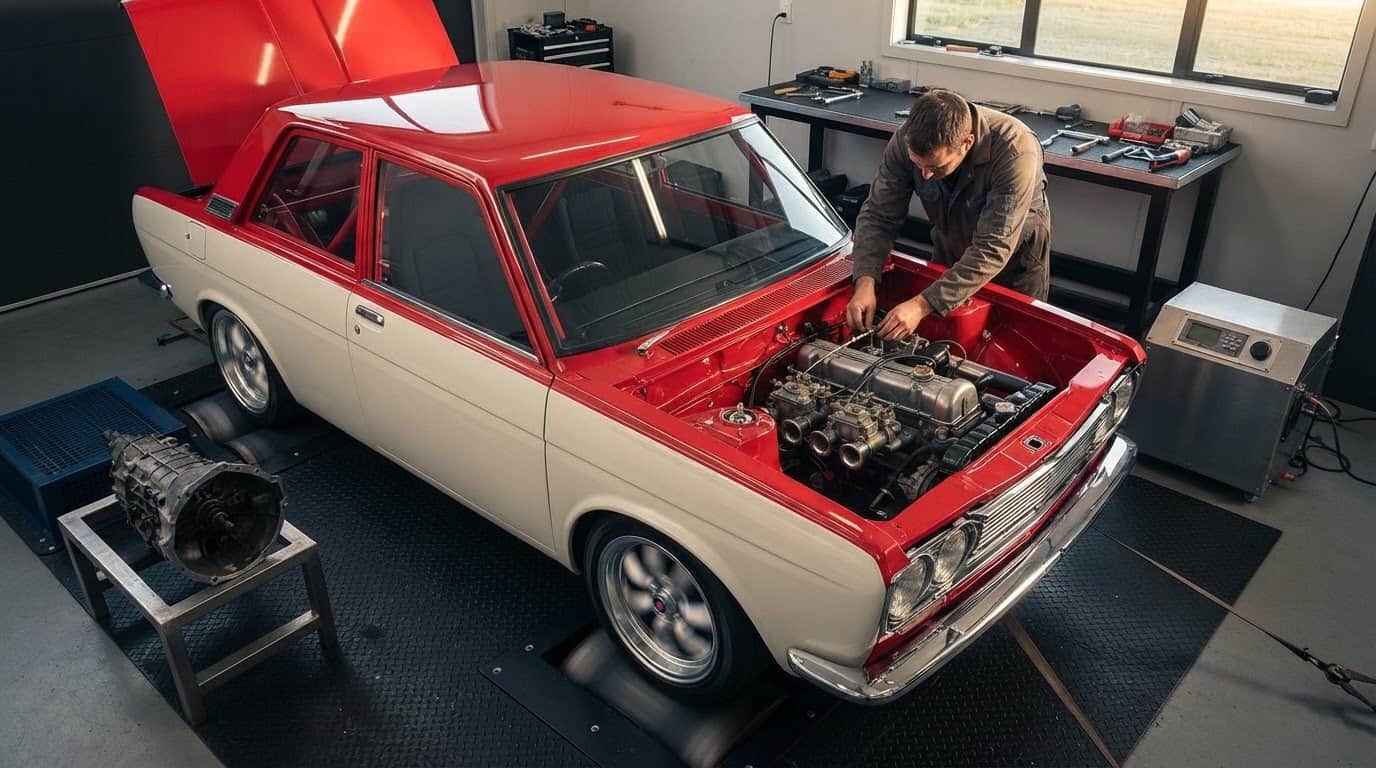
A Datsun 510 pro-touring build sheet is more than a parts list: it shows how the engine, transmission, suspension, brakes, wheels, and tires work together. One documented Datsun 510 used 45 Weber side-draft carburetors, an NOS 280Z five-speed gearbox, and Yokohama 195/50/R15 tires. Those choices offer a concrete starting point, but the right setup depends on how you want the car to drive.
The appeal of a 510 is that its vintage character doesn’t need to disappear for modern performance to take shape. A thoughtful build keeps the sedan’s classic feel while making each upgrade part of a coherent plan, rather than a collection of disconnected components.
Here, you’ll learn what to record on a build sheet and how parts and setup decisions shape the finished car. We’ll cover the powertrain, chassis, brakes, wheels, and details that keep the project aligned with its intended use. Treat each choice as a chance to build with purpose, preserve the car’s character, and make the result your own.
Key Takeaways
- Organize the build sheet around the car’s intended use so each component supports a coherent driving goal.
- Record powertrain, chassis, braking, and wheel choices together to see how one decision affects the rest of the setup.
- Use the build process to balance modern performance with the Datsun 510’s classic character.
- Turn to Restomod Academy’s guides, consulting, or project blueprints when you want structured direction for the next stage.
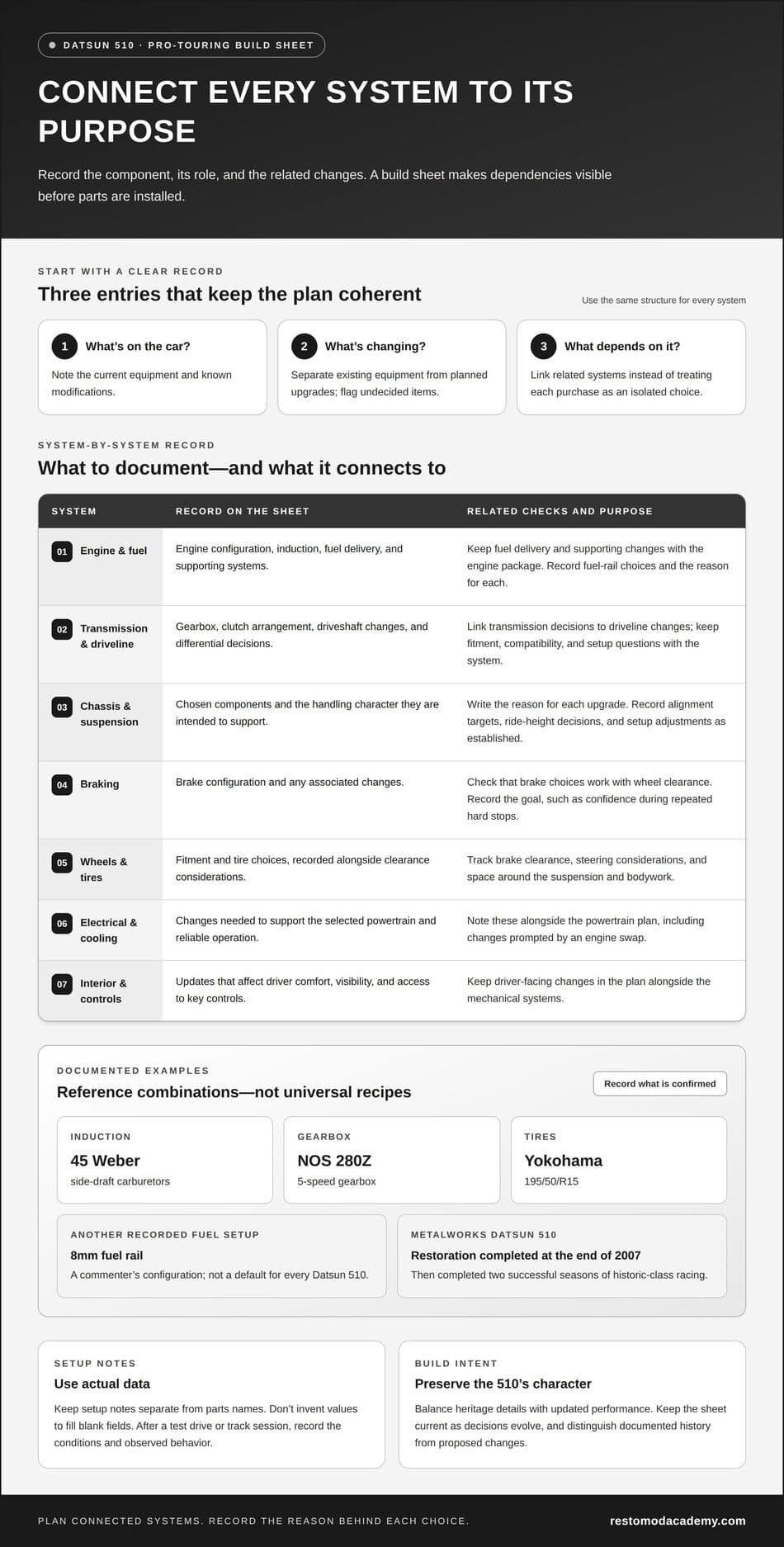
Datsun 510 pro-touring build sheet
Build a Datsun 510 plan around the way you want the car to behave, not a pile of impressive parts. A useful build sheet connects each major system to a purpose, from responsive acceleration to predictable cornering. Record the chosen component, its role, and any related changes. That simple structure makes trade-offs visible before parts are installed and keeps the project’s direction clear.
Start with the car’s baseline. Note its current engine, transmission, suspension, brakes, wheels, and tires, along with known modifications. Separate existing equipment from planned upgrades, and flag anything that still needs a decision. For example, an engine swap can affect transmission fitment, fuel delivery, cooling, and exhaust routing. Record those dependencies together instead of treating each purchase as an isolated choice.
- Engine and fuel: Record the engine configuration, induction, fuel delivery, and supporting systems as one package.
- Transmission and driveline: Note the gearbox, clutch arrangement, driveshaft changes, and differential decisions.
- Chassis and suspension: Describe the chosen components and the handling character they’re meant to support.
- Braking: Track the brake configuration and any changes that must work with the wheels.
- Wheels and tires: Record fitment and tire choices alongside clearance and steering considerations.
- Electrical and cooling: Include changes needed to support the selected powertrain and reliable operation.
- Interior and controls: List updates that affect driver comfort, visibility, and access to key controls.
Use the MetalWorks Datsun 510 as a reference for documenting a complete combination, not as a universal recipe. Its race-car restoration was completed at the end of 2007, then it completed two successful seasons of historic-class racing. Those milestones show why a build sheet should preserve both component choices and project outcomes. Note the intended use, major setup decisions, and what the finished car was built to do.
For each planned upgrade, write down the reason before naming the part. A suspension change might target calmer responses through a corner, while a brake change might address confidence during repeated hard stops. These examples describe goals, not guaranteed results. The Datsun 510’s weight distribution, existing condition, and intended road or track use all shape which decisions make sense together.
Track compatibility as carefully as each component. Wheel choice can affect brake clearance, while tire dimensions influence the space available around the suspension and bodywork. A transmission decision can prompt changes elsewhere in the driveline. Add a “depends on” note beside each item, then link it to related systems. This turns the sheet into a working map rather than a shopping list.
Keep setup notes separate from parts names. Record alignment targets, ride-height decisions, and adjustments as they’re established during the build. Don’t invent values to fill blank fields; use the car’s actual setup data. After a test drive or track session, note the conditions and observed behavior. A clear record helps connect a handling change to the adjustment that produced it.
Finally, preserve the Datsun 510’s character while planning modern capability. Restomod thinking balances heritage details with updated performance, rather than replacing every original element. That balance is central to understanding what a restomod is. Keep the sheet current as decisions evolve, and use it to explain why each system belongs in the finished build.
Carry the same discipline into details that can be easy to overlook. Record fuel-rail choices with the engine package, along with the reason for each selection. A commenter says their fuel setup uses an 8mm rail; treat that as one documented configuration, not a default for every Datsun 510. Note what is confirmed, what remains undecided, and which supporting changes still need checking. This keeps assumptions separate from established parts and makes later revisions easier to follow.
Document transmission choices just as carefully. The MetalWorks Datsun 510 used an NOS 280Z 5-speed gearbox, a specific choice worth recording alongside its role in the overall combination. Use it as a reference point rather than a promise of fit or suitability for another car. Capture the actual configuration and the intent behind it, and keep unresolved fitment, compatibility, and setup questions with the relevant system. Update those notes when decisions are confirmed. A useful build sheet distinguishes documented history from proposed changes, so another person can understand what the car has, why a choice was made, and what still needs attention.
Restomod Academy
Restomod Academy helps enthusiasts turn a parts plan into a more deliberate classic-car project. If you’re weighing how a Datsun 510’s systems fit together, its educational resources can help you understand the choices and shape your next steps. The Ultimate Restomod Guide offers a broader foundation, while Restomod Consulting Services can help you think through project-specific decisions. Premium Project Blueprints provide another way to bring structure to a build.
Choose guidance that matches your stage: learning the fundamentals, working through a decision, or organizing a project plan. The goal is a build that reflects your priorities and respects the original car’s character. For support with your restomod plans, turn to Restomod Academy’s Premium Project Blueprints or Restomod Consulting Services.
Shape the Next Stage of Your Build
Let the next decision serve a clear purpose. Before moving from planning to fabrication, decide what you want the car to feel like behind the wheel, then use that intention to guide the details still in flux. A Datsun 510 pro-touring build sheet can remain a living document as your priorities sharpen and the project develops. Keep the choices connected to the experience you want, not just the appeal of individual upgrades. That focus gives each stage of the build a direction and helps preserve the character that drew you to the 510 in the first place.
If you’d value support as you turn your plans into a more defined project, contact Restomod Academy to discuss your build. Take the next step at your own pace, keep learning as you work, and enjoy shaping a classic into a machine that feels unmistakably yours.
A Datsun 510 pro-touring build sheet is more than a parts list: it shows how the engine, transmission, suspension, brakes, wheels, and tires work together. One documented Datsun 510 used 45 Weber side-draft carburetors, an NOS 280Z five-speed gearbox, and Yokohama 195/50/R15 tires. Those choices offer a concrete starting point, but the right setup depends on how you want the car to drive.
The appeal of a 510 is that its vintage character doesn’t need to disappear for modern performance to take shape. A thoughtful build keeps the sedan’s classic feel while making each upgrade part of a coherent plan, rather than a collection of disconnected components.
Here, you’ll learn what to record on a build sheet and how parts and setup decisions shape the finished car. We’ll cover the powertrain, chassis, brakes, wheels, and details that keep the project aligned with its intended use. Treat each choice as a chance to build with purpose, preserve the car’s character, and make the result your own.
Key Takeaways
- Organize the build sheet around the car’s intended use so each component supports a coherent driving goal.
- Record powertrain, chassis, braking, and wheel choices together to see how one decision affects the rest of the setup.
- Use the build process to balance modern performance with the Datsun 510’s classic character.
- Turn to Restomod Academy’s guides, consulting, or project blueprints when you want structured direction for the next stage.
Datsun 510 pro-touring build sheet
Build a Datsun 510 plan around the way you want the car to behave, not a pile of impressive parts. A useful build sheet connects each major system to a purpose, from responsive acceleration to predictable cornering. Record the chosen component, its role, and any related changes. That simple structure makes trade-offs visible before parts are installed and keeps the project’s direction clear.
Start with the car’s baseline. Note its current engine, transmission, suspension, brakes, wheels, and tires, along with known modifications. Separate existing equipment from planned upgrades, and flag anything that still needs a decision. For example, an engine swap can affect transmission fitment, fuel delivery, cooling, and exhaust routing. Record those dependencies together instead of treating each purchase as an isolated choice.
- Engine and fuel: Record the engine configuration, induction, fuel delivery, and supporting systems as one package.
- Transmission and driveline: Note the gearbox, clutch arrangement, driveshaft changes, and differential decisions.
- Chassis and suspension: Describe the chosen components and the handling character they’re meant to support.
- Braking: Track the brake configuration and any changes that must work with the wheels.
- Wheels and tires: Record fitment and tire choices alongside clearance and steering considerations.
- Electrical and cooling: Include changes needed to support the selected powertrain and reliable operation.
- Interior and controls: List updates that affect driver comfort, visibility, and access to key controls.
Use the MetalWorks Datsun 510 as a reference for documenting a complete combination, not as a universal recipe. Its race-car restoration was completed at the end of 2007, then it completed two successful seasons of historic-class racing. Those milestones show why a build sheet should preserve both component choices and project outcomes. Note the intended use, major setup decisions, and what the finished car was built to do.
For each planned upgrade, write down the reason before naming the part. A suspension change might target calmer responses through a corner, while a brake change might address confidence during repeated hard stops. These examples describe goals, not guaranteed results. The Datsun 510’s weight distribution, existing condition, and intended road or track use all shape which decisions make sense together.
Track compatibility as carefully as each component. Wheel choice can affect brake clearance, while tire dimensions influence the space available around the suspension and bodywork. A transmission decision can prompt changes elsewhere in the driveline. Add a “depends on” note beside each item, then link it to related systems. This turns the sheet into a working map rather than a shopping list.
Keep setup notes separate from parts names. Record alignment targets, ride-height decisions, and adjustments as they’re established during the build. Don’t invent values to fill blank fields; use the car’s actual setup data. After a test drive or track session, note the conditions and observed behavior. A clear record helps connect a handling change to the adjustment that produced it.
Finally, preserve the Datsun 510’s character while planning modern capability. Restomod thinking balances heritage details with updated performance, rather than replacing every original element. That balance is central to understanding what a restomod is. Keep the sheet current as decisions evolve, and use it to explain why each system belongs in the finished build.
Carry the same discipline into details that can be easy to overlook. Record fuel-rail choices with the engine package, along with the reason for each selection. A commenter says their fuel setup uses an 8mm rail; treat that as one documented configuration, not a default for every Datsun 510. Note what is confirmed, what remains undecided, and which supporting changes still need checking. This keeps assumptions separate from established parts and makes later revisions easier to follow.
Document transmission choices just as carefully. The MetalWorks Datsun 510 used an NOS 280Z 5-speed gearbox, a specific choice worth recording alongside its role in the overall combination. Use it as a reference point rather than a promise of fit or suitability for another car. Capture the actual configuration and the intent behind it, and keep unresolved fitment, compatibility, and setup questions with the relevant system. Update those notes when decisions are confirmed. A useful build sheet distinguishes documented history from proposed changes, so another person can understand what the car has, why a choice was made, and what still needs attention.
Restomod Academy
Restomod Academy helps enthusiasts turn a parts plan into a more deliberate classic-car project. If you’re weighing how a Datsun 510’s systems fit together, its educational resources can help you understand the choices and shape your next steps. The Ultimate Restomod Guide offers a broader foundation, while Restomod Consulting Services can help you think through project-specific decisions. Premium Project Blueprints provide another way to bring structure to a build.
Choose guidance that matches your stage: learning the fundamentals, working through a decision, or organizing a project plan. The goal is a build that reflects your priorities and respects the original car’s character. For support with your restomod plans, turn to Restomod Academy’s Premium Project Blueprints or Restomod Consulting Services.
Shape the Next Stage of Your Build
Let the next decision serve a clear purpose. Before moving from planning to fabrication, decide what you want the car to feel like behind the wheel, then use that intention to guide the details still in flux. A Datsun 510 pro-touring build sheet can remain a living document as your priorities sharpen and the project develops. Keep the choices connected to the experience you want, not just the appeal of individual upgrades. That focus gives each stage of the build a direction and helps preserve the character that drew you to the 510 in the first place.
If you’d value support as you turn your plans into a more defined project, contact Restomod Academy to discuss your build. Take the next step at your own pace, keep learning as you work, and enjoy shaping a classic into a machine that feels unmistakably yours.