
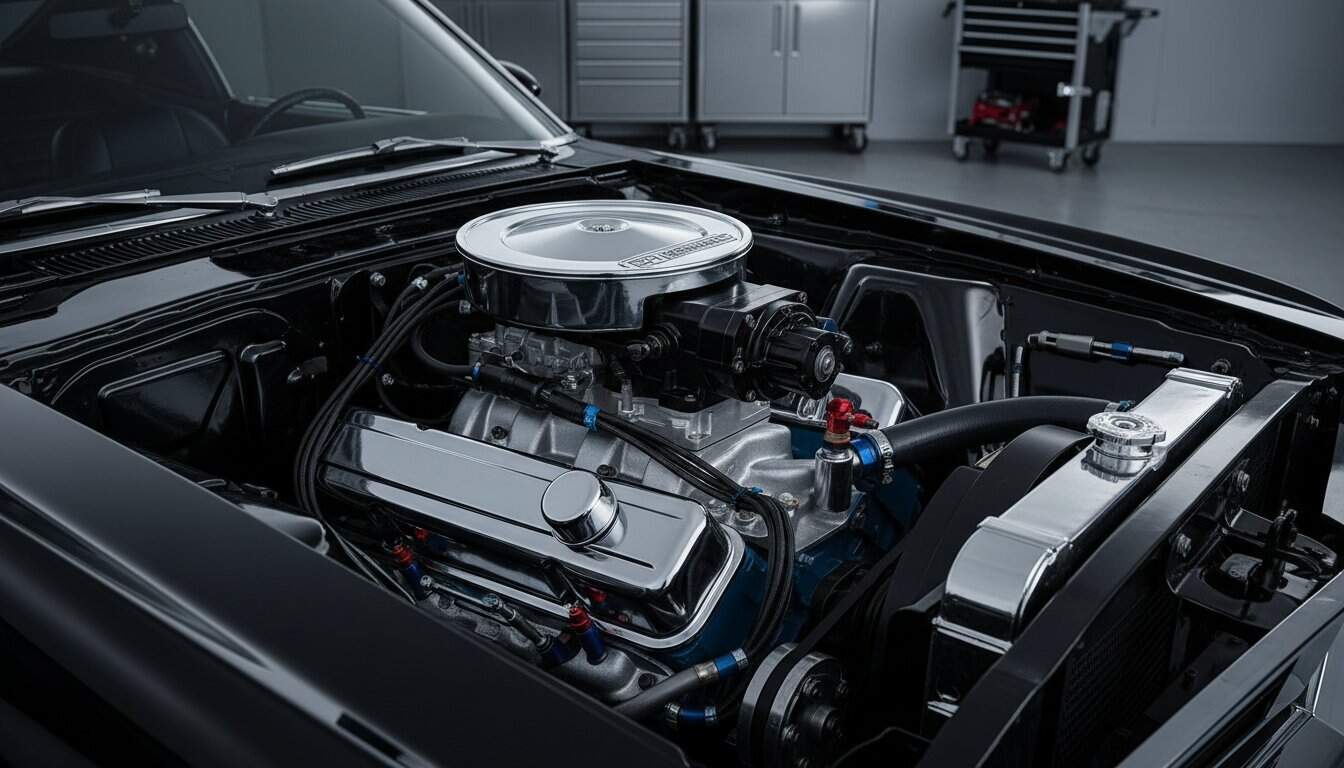
Picture this: it’s a 42 degree morning in October 2026, and while your neighbors’ SUVs hum to life instantly, you’re stuck pumping the gas pedal of your 1969 fastback, praying the 15 percent ethanol blend hasn’t finally dissolved your carburetor seals. You’ve likely spent more time adjusting floats and cleaning needle valves than actually hitting the apex, but making the switch to fuel injection for classic cars changes the game forever. We all cherish the raw soul of a vintage engine, yet nobody misses the smell of raw gas or the constant frustration of a cold start stall.
Master the transition from finicky carburetors to modern EFI reliability with our comprehensive guide. We’ll show you how to achieve that elusive turn-key reliability and crisp throttle response without losing your car’s period-correct charm. From demystifying the 20-wire harness to plumbing a high-pressure fuel system, this walkthrough provides the logical steps you need to build a clean, professional engine bay that performs as good as it looks. Let’s stop tuning for the weather and start driving for the thrill.
Key Takeaways
- Unlock the “Three R’s” of modern performance-Reliability, Response, and Range-to transform your temperamental vintage ride into a dependable daily driver.
- Navigate the technical differences between TBI and Multi-Port architectures to select the ideal fuel injection for classic cars based on your specific engine displacement.
- Identify the critical supporting upgrades, from high-pressure fuel lines to tank modifications, required to sustain a modern ECU-controlled system.
- Evaluate top-tier conversion kits from industry leaders like Holley and Edelbrock to ensure your engine receives the precise electronic calibration it deserves.
- Adopt a “built, not bought” mindset by mastering the structured installation roadmap before you turn a single wrench in the garage.
Why Switch to Fuel Injection for Your Classic Car?
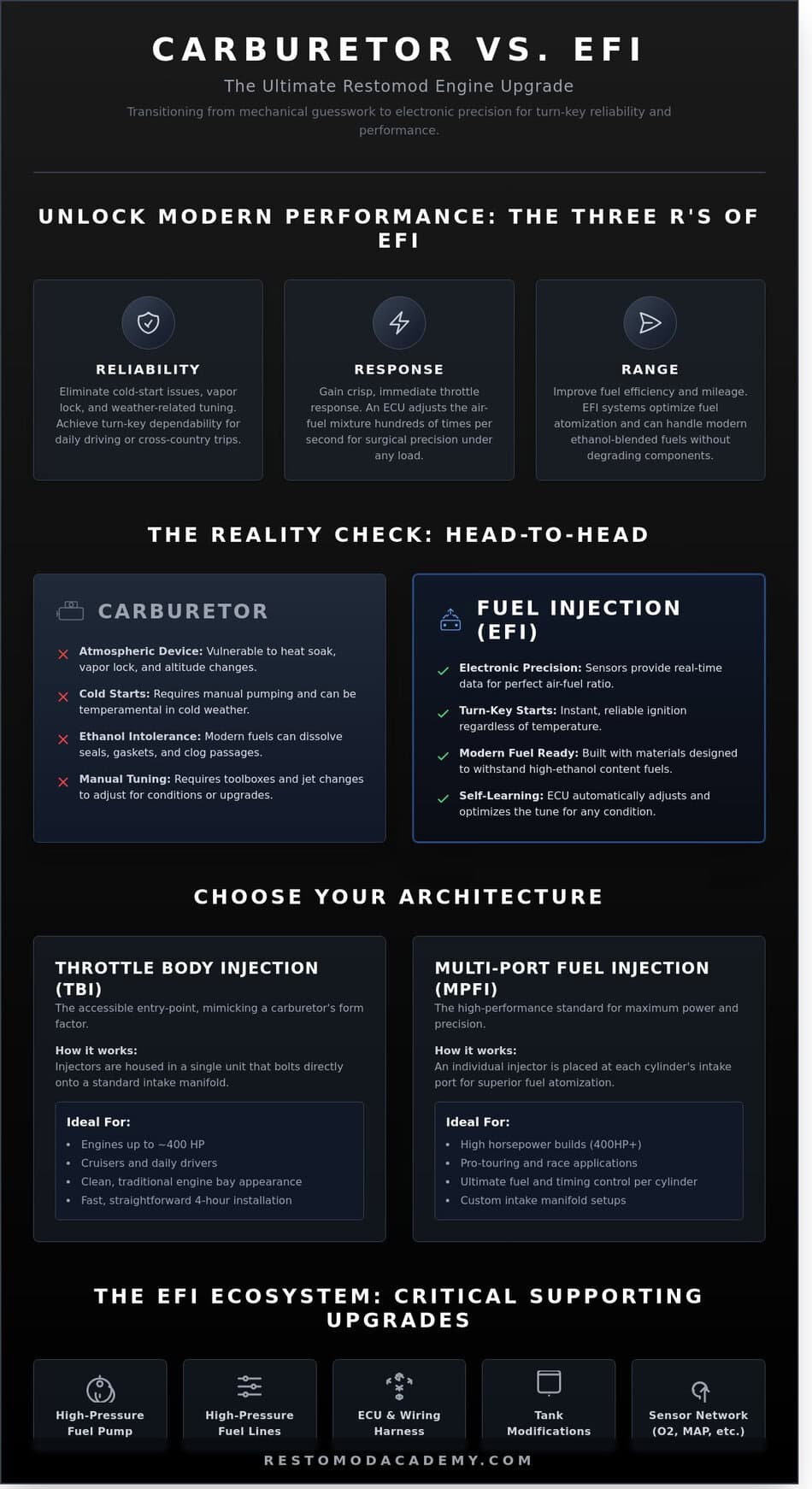
Think of an EFI conversion as a brain transplant for your engine. You are replacing mechanical guesswork with electronic precision. When you choose fuel injection for classic cars, you move away from the limitations of floats and jets into a world where sensors monitor every breath your engine takes. This upgrade focuses on the Three R’s: Reliability, Response, and Range. Your car stops being a temperamental weekend project and becomes a machine ready for a cross-country haul at a moment’s notice. You get to keep the vintage soul of your vehicle while gaining the steady heartbeat of modern technology.
Modern driving conditions demand more from our vintage iron than they did forty years ago. By the year 2026, fuel standards will continue to lean heavily on ethanol blends that punish older fuel systems. Traditional carburetors use gaskets and diaphragms that dry out or melt when exposed to high-ethanol content. Electronic systems utilize high-pressure pumps and stainless-steel injectors built to withstand these chemical changes. You keep the vintage look you love while upgrading the guts to handle the realities of the modern gas station.
To see the transformation in action, watch this comprehensive walkthrough:
Carburetor vs. EFI: The Reality Check
Carburetors are atmospheric devices; they rely on air speed and pressure to pull fuel into the engine. This makes them vulnerable to heat soak, where fuel boils in the bowls on a 90-degree day, leaving you stranded at a gas station. They also can’t adjust for altitude changes without a toolbox and a set of jets. While some purists argue for the “maintenance-free” carb, the truth is that ethanol-clogged passages require constant attention. Fuel injection systems offer surgical precision by adjusting the air-fuel mixture 100 times per second. You trade the temperamental nature of a carb for crisp, immediate throttle response.
The ROI of Reliability
Building a car is about more than just parts; it is about protecting your legacy. Adding fuel injection for classic cars significantly increases the resale value of your project. Potential buyers today look for “turn-key” reliability. They want the roar of a classic without the headache of a car that refuses to start on a cold morning. Consider the “frustration tax” of a failed cruise night; that is a cost you can’t recover. By integrating modern tech, you validate the true meaning of what is a restomod. You are creating a vehicle that honors its heritage while outperforming its original factory specifications.
Understanding EFI Systems: TBI, Multi-Port, and Beyond
Modernizing your vintage engine starts with choosing the right architecture. When you explore fuel injection for classic cars, you aren’t just swapping parts; you’re installing a digital brain. The Engine Control Unit (ECU) acts as the command center for your build, making thousands of calculations per second to ensure the perfect air-to-fuel ratio. This level of precision requires data from a network of sensors that your original engine never had. You’ll need to integrate a Throttle Position Sensor (TPS) to tell the ECU how hard you’re pushing the pedal and a Manifold Absolute Pressure (MAP) sensor to monitor engine load. These components work together to eliminate the cold-start struggles and vapor lock issues that plague 1960s muscle cars, giving you a vehicle that starts reliably every time you turn the key.
Throttle Body Injection (TBI) vs. Port Fuel Injection
Throttle Body Injection is the most accessible entry point for enthusiasts. These systems bolt directly onto your existing square-bore or spread-bore intake manifold, mimicking the look of a traditional carburetor while housing the injectors and ECU in one unit. For a 300hp cruiser that prioritizes a clean engine bay and a 4-hour installation window, TBI is often the winning choice. However, if you’re building a 600hp pro-touring beast, Multi-Port Fuel Injection (MPFI) is the standard. MPFI places an individual injector at each intake port, providing superior fuel atomization and precise cylinder-to-cylinder tuning that a central TBI unit cannot match. If you’re planning a high-performance build, check out our LS engine swap guide to see how port injection changes the game.
Self-Learning ECUs: Myth vs. Reality
The DIY market has been revolutionized by self-tuning technology from brands like Holley and FiTech. These systems use a base map to get the engine running, then refine the fuel table as you drive. A Wideband O2 sensor is the critical component for self-tuning because it provides high-resolution, real-time data on the air-to-fuel ratio across the entire engine operating range. While these kits handle 90 percent of street driving scenarios perfectly, they aren’t magic. When you’re converting from carb to EFI, remember that self-learning cannot fix mechanical issues like vacuum leaks or poor ignition timing. For aggressive cam profiles or forced induction setups, professional dyno time remains a critical step to ensure safety and peak performance. You can find the right tools for these advanced adjustments in our recommended gear list.
Choosing the Best Fuel Injection Kit for Your Engine
Selecting the right system requires more than just picking a brand name off a shelf. You need to match the hardware to your specific build goals. Holley Sniper systems dominate the market for their user-friendly interfaces, while FiTech offers a budget-friendly entry point for hobbyists. If you want maximum performance, the Edelbrock Pro-Flo 4 provides a true multi-port injection setup that outperforms basic throttle body units by delivering fuel directly to the intake runners.
Don’t guess on your airflow requirements. A standard 350 cubic inch V8 typically thrives with a 600 to 650 CFM throttle body. Stepping up to a big block 454 might require 800 CFM or more to avoid choking the engine at high RPMs. You must also verify if the ECU can handle ignition timing control. Letting the EFI system manage your spark advance is the secret to unlocking modern drivability. If you run an automatic transmission like a 700R4 or AOD, ensure your kit includes the correct kickdown linkage or throttle position sensor output to protect your gearbox.
Top EFI Kits for Small Block and Big Block V8s
Most builders start with “Master Kits.” These packages include the throttle body, handheld tuner, and basic fuel delivery hardware. Expect to spend extra on high-pressure fuel lines and a baffled fuel tank. While a base kit might cost $1,200, a professional-grade installation often reaches $2,000 once you account for the necessary plumbing and electrical upgrades. For those moving beyond the original iron block, our LS engine swap guide covers how to integrate modern powerplants with factory-style EFI. Proper electrical grounding is vital; follow Holley’s guide to wiring for fuel injection to prevent electromagnetic interference from ruining your tune. Systems like the Ultimate Rebel LS are specifically designed for swappers who need a standalone harness that eliminates the complexity of thinning out a factory loom.
Fuel Injection for Niche Classics
You don’t need a V8 to enjoy fuel injection for classic cars. Owners of vintage British roadsters or American inline-sixes can use adapters from specialists like Patton Machine to mount modern injectors on original manifolds. This preserves the unique geometry of your engine while ditching the temperamental side-draft carburetors. If you want to maintain a period-correct engine bay, choose a “Stealth” style throttle body. These units hide the injectors and sensors inside a casting that looks identical to a classic 4-barrel carburetor. Bolt on your original 14 inch chrome air cleaner, and no one will know you’ve gone digital until you turn the key and the engine fires instantly on a cold morning. It is the perfect blend of 1960s aesthetics and 2024 reliability.
The EFI Installation Roadmap: Beyond the Throttle Body
The dirty secret of switching to fuel injection for classic cars is that the throttle body is the easiest part of the job. Many enthusiasts buy a kit thinking it’s a simple afternoon bolt-on, but the real work happens under the chassis and behind the dashboard. Your factory fuel system is the biggest hurdle. Carburetors operate on a low-pressure trickle of 5 to 7 PSI, but modern EFI systems demand a constant, high-pressure supply between 43 and 60 PSI. Your original 50 year old steel lines and mechanical pump simply aren’t built for those specifications.
Electrical health is another area where vintage cars fail the EFI test. A standard 1965 Mustang or 1969 Camaro typically left the factory with a 35-amp or 55-amp alternator. An EFI computer, high-pressure fuel pump, and the necessary electric cooling fans can pull 30 amps alone. To keep the ECU from surging or resetting, you must upgrade to a high-output alternator capable of at least 100 to 140 amps. Stable voltage is the foundation of a reliable restomod build.
The Fuel Delivery System: Tanks, Pumps, and Returns
You have two main choices for your pump: in-tank or external. I always recommend an in-tank pump for a street-driven car. Submerging the pump in fuel keeps it cool and muffles the 60-decibel whine that external pumps often produce. If you want to avoid that lingering “old car” smell in your garage, use PTFE-lined hoses. Standard rubber lines permeate fuel vapors over time, while PTFE provides a permanent vapor barrier. You also need to decide on the plumbing architecture. A return-style system uses a regulator to send excess fuel back to the tank, which keeps the fuel rails cool and prevents vapor lock in high-heat environments. Before you start bending hardlines, check out the recommended gear for the professional-grade flaring and cutting tools you’ll need.
Wiring and Sensor Placement
Wiring is where a project either succeeds or becomes a diagnostic nightmare. Route your EFI harness away from “noisy” components like spark plug wires and the alternator to prevent electromagnetic interference. When you install the oxygen (O2) sensor, don’t just weld the bung anywhere. Drill your exhaust pipe and position the sensor at least 10 degrees above the horizontal plane. This prevents condensation from pooling on the sensor tip, which can lead to a premature failure within the first 500 miles. For those seeking maximum performance, integrate the EFI with your ignition system. This allows the ECU to manage the spark map, providing 100 percent control over timing for better throttle response and fuel economy.
Ready to master the technical side of your build? Grab the right tools for your fuel system upgrade here.
Master Your Build with Restomod Academy
The 2026 build season belongs to the creators who embrace the “built, not bought” philosophy. There is a specific kind of pride that comes from turning the key and hearing a modernized engine roar to life for the first time. You’ve analyzed the technical differences between old-school carburetors and modern setups. Now, it’s time to bridge the gap between theory and reality. Implementing fuel injection for classic cars is one of the most rewarding steps you can take, but it requires more than just a box of parts. It requires a mentor’s mindset and a disciplined approach to the craft.
Structured learning is the secret weapon of the elite builder. Without it, you risk falling into the trap of project creep, where a simple weekend upgrade spirals into a three-year garage ornament. Industry data suggests that nearly 40% of DIY restorations stall because the owner lacks a logical sequence of operations. At Restomod Academy, we prioritize the “measure twice, cut once” mentality. We help you understand the logic behind every sensor and fuel rail, ensuring your build is as safe as it is powerful. You aren’t just putting a car together; you’re engineering a legacy that will last for decades.
The Ultimate Restomod Roadmap
Success in the garage starts with a clear blueprint. Our premium resources are designed to save you hundreds of dollars in wasted parts and countless hours of frustration. By following a proven path, such as our LS engine swap guide, you gain access to the collective wisdom of seasoned professionals. This structured approach ensures that your suspension, fuel system, and wiring harness work in perfect harmony. You’ll join a dedicated community of builders who value precision and performance, moving you closer to that first drive with every milestone you hit.
Next Steps for Your Project
Transforming your vision into a high-performance reality requires action. Don’t let your project sit idle while you wait for the “perfect” moment. Follow this actionable checklist to gain momentum today:
- Assess Your Powerplant: Perform a compression test and evaluate if your current block is a worthy candidate for fuel injection for classic cars.
- Define Your Budget: Create a detailed spreadsheet for 2026 that accounts for the kit, fuel lines, and high-pressure pumps.
- Select Your Hardware: Research the latest technology by visiting our product reviews for comprehensive tests on 2026 EFI conversion kits.
The transition from dreamer to builder is a choice you make every time you step into the shop. You have the tools, the vision, and now you have the roadmap. I’ve seen thousands of enthusiasts turn their garage dreams into street-slaying realities by simply following the right instructions. Trust your hands, respect the process, and get to work. Your masterpiece is only a few well-planned steps away.
Bring Your Vision to Life on the Open Road
You’ve done the research and felt the frustration of a flooded carb on a cold morning. Transitioning to fuel injection for classic cars is about more than just reliability; it’s about reclaiming the joy of the drive. By selecting the right EFI system and following a structured installation roadmap, you ensure your engine breathes with 21st-century precision while maintaining its vintage soul. This upgrade can boost your fuel economy by 20% and provide crisp throttle response that makes every mile more rewarding.
Don’t let the technical complexity of wiring harnesses or fuel maps stall your progress. Seasoned restomod expert Brook Walsh developed a system to guide you through every step of the build. You get access to comprehensive blueprints for LS, Coyote, and Hemi swaps that have already helped a community of 10,000+ active builders achieve professional results in their own garages. Grab The Ultimate Restomod Guide and start your conversion today! Your project is waiting, and the satisfaction of that first turn of the key is closer than you think.
Frequently Asked Questions
Do I need a new fuel tank for a fuel injection conversion?
You don’t always need a new tank, but upgrading to an EFI-ready tank is the most reliable way to house the high-pressure pump. Standard carburetors run on 5 to 7 PSI, while fuel injection for classic cars requires a steady 43 to 60 PSI. Using a baffled tank prevents fuel starvation during cornering. If you keep your stock tank, you’ll need an external surge tank or a retrofit in-tank pump assembly.
Can I install an EFI kit on a classic car myself?
You can absolutely install a modern EFI kit in your own garage over a single weekend. Most entry-level systems utilize a simple 4-wire hookup that identifies power, ground, ignition, and tachometer signals. This accessibility is why 75% of restomod builders choose TBI systems over complex multi-port setups. Grab your wrench set and follow the wiring schematic carefully to ensure a clean finish that honors your car’s legacy.
How much horsepower can a standard TBI fuel injection kit handle?
A standard 4-barrel TBI fuel injection kit typically supports engines producing between 400 and 650 horsepower. If your build pushes beyond these limits, you’ll need an 8-injector master kit capable of handling up to 1,200 horsepower. Most street-driven small blocks fall well within the 500-horsepower range. Always check the injector flow rate in pounds per hour to confirm the system matches your engine’s specific air-intake demands.
Will fuel injection improve my classic car’s gas mileage?
You’ll typically see a 10% to 15% improvement in gas mileage after swapping your carburetor for an EFI system. While a carburetor relies on physical vacuum signals, fuel injection uses a wideband O2 sensor to maintain a precise 14.7:1 air-fuel ratio during cruise conditions. This efficiency removes the guesswork from your build. You’ll spend less time at the pump and more time enjoying crisp throttle response on the open road.
Is a return line necessary for all EFI systems?
A return line isn’t mandatory for every setup, but it’s the most effective way to prevent vapor lock in high-heat environments. Returnless systems use pulse-width modulation to regulate pressure at the pump. However, 90% of professional builders prefer a traditional return line because it constantly circulates cool fuel. This keeps fuel temperatures 20 to 30 degrees lower, ensuring your engine stays refreshed even during long summer cruises through the valley.
What is the difference between self-tuning and professional tuning?
Self-tuning systems use internal algorithms to adjust fuel maps as you drive, whereas professional tuning involves a technician using a chassis dyno. A self-learning ECU handles 95% of street driving scenarios perfectly well. For those chasing the final 5% of peak performance, a 3-hour dyno session can fine-tune ignition timing and cold-start enrichment. Choose the path that fits your performance goals and your comfort level with laptop software.
Can I keep my original air cleaner with an EFI conversion?
You can keep your factory air cleaner because most EFI throttle bodies feature the industry-standard 5.125-inch neck. This allows you to maintain the vintage aesthetic of your engine bay while enjoying modern reliability. Check the total height of the EFI unit first. Most systems are designed to match the height of a standard 4150-style carburetor, ensuring you have the necessary hood clearance for a seamless, stealthy installation.
What happens if the ECU fails while I am driving?
If the ECU experiences a total hardware failure, the engine will shut down instantly as the injectors stop firing. While this sounds daunting, modern automotive processors have a failure rate of less than 1% when installed correctly. Ensure your wiring harness is routed away from high-heat sources. Proper grounding is the most critical step; 80% of reported EFI issues stem from poor electrical connections rather than actual computer malfunctions.