

The most successful restomod budgets aren’t built on total numbers, but on a strict 20% contingency buffer and a hierarchy that puts safety before style. You’ve likely spent hours staring at that vintage silhouette in your garage, dreaming of modern fuel injection and crisp handling, yet the fear of a stalled project keeps your tools on the bench. It’s a valid concern when professional labor rates now average $135 per hour and high-end builds can easily crest $400,000. Learning how to budget for a restomod build is the difference between a car that carves canyons and one that sits under a dusty tarp for a decade.
We understand the emotional weight of preserving heritage while demanding modern performance. This guide provides a masterclass in financial precision, offering a clear system-by-system cost breakdown and strategies to maximize your DIY labor. You’ll discover how to prioritize high-value upgrades and navigate the complex 2026 emissions landscape so your investment stays on the road where it belongs. Let’s transition from passive admiration to active creation by building a roadmap that respects both your bank account and your automotive vision.
Key Takeaways
- Define your resource mix of time, money, and skill to avoid the common pitfalls that stall projects mid-build.
- Apply the 30-20-20-30 allocation system to distribute your funds effectively across the drivetrain, suspension, interior, and bodywork.
- Learn how to budget for a restomod build by incorporating a mandatory 20% contingency fund for invisible rust and specialized fabrication needs.
- Establish a safety-first spending hierarchy that prioritizes modern braking and steering systems over expensive cosmetic finishes.
- Develop a phased project timeline that allows you to fund your build through logical milestones rather than overwhelming upfront costs.
The Restomod Financial Triad: Balancing Time, Money, and Skill
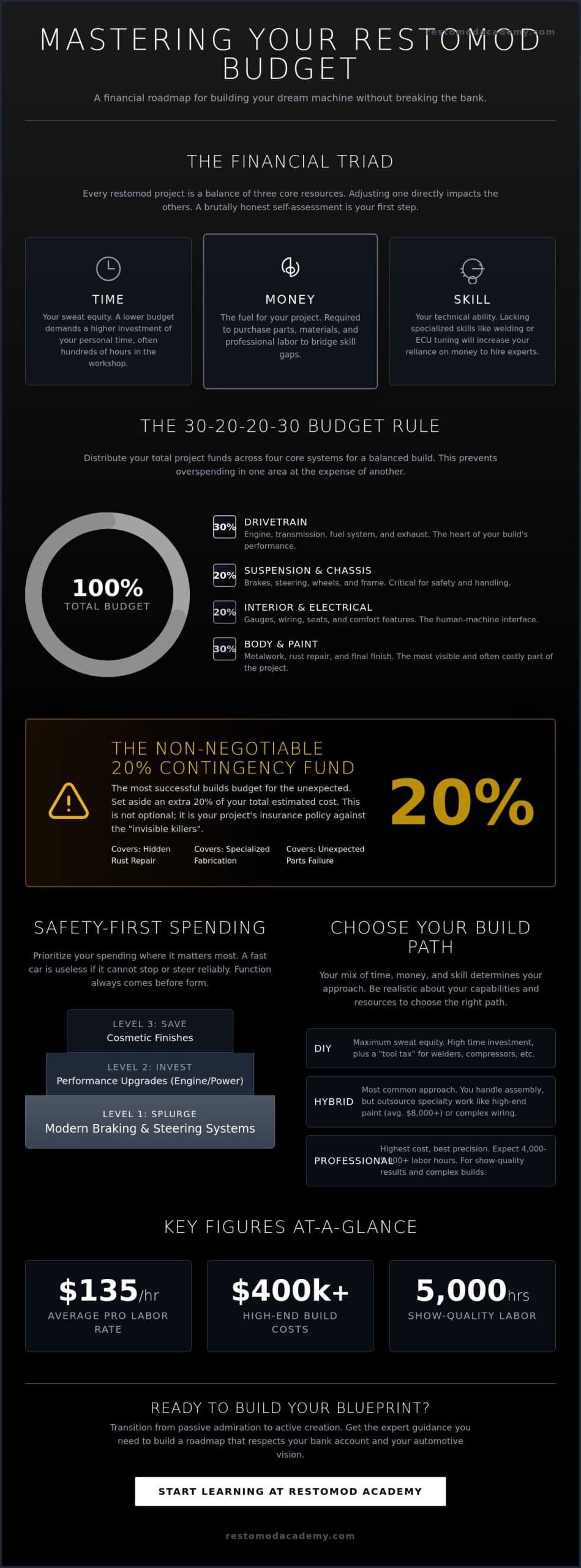
Map your resources before you purchase a single bolt. Every restomod project is a delicate negotiation between three finite assets: time, money, and skill. Think of these as a triad where adjusting one inevitably pulls on the others. If you lack the specialized mechanical skill to rebuild a transmission or wire a modern ECU, you’ll need to spend more money to hire a professional. Conversely, if your budget is tight, you’ll need to invest hundreds of hours in the workshop to bridge the gap. Understanding how to budget for a restomod build starts with a brutally honest assessment of where you stand on this spectrum.
In 2026, this calculation is more critical than ever. With high-end shop rates averaging $135 per hour and inflation impacting the cost of raw materials, your sweat equity is your most valuable asset. Before you turn a single wrench, consult the historical standards for the conservation and restoration of road vehicles to grasp the technical standards required for a safe, roadworthy machine. This foundation ensures you don’t waste money on parts that won’t work together or require expensive rework later.
To better understand whether you should take on the labor yourself or hire a professional, watch this helpful comparison:
Understanding the Three Build Tiers
As you learn how to budget for a restomod build, decide which of these three paths fits your lifestyle. The DIY path maximizes sweat equity, but you must account for the tool tax. Many novices forget that buying a high-quality welder, a 60-gallon air compressor, and specialized pullers can add thousands to the initial cost. The hybrid approach is often the most realistic; you handle the disassembly and mechanical assembly while outsourcing specialized tasks like the $8,000 paint material application or complex fabrication. A full professional build offers unmatched precision but requires a significant financial commitment, as show-quality projects often demand 4,000 to 5,000 hours of labor at professional rates.
Defining Your Project Scope Early
Your budget is dictated by the intended use of the vehicle. A basic cruiser restomod focuses on reliability and comfort, while a pro-touring build demands high-end suspension and braking systems designed for the track. This choice influences your donor car selection significantly. For example, a solid 1966 Mustang hardtop might cost $22,500, whereas a rough project car under $10,000 might actually cost more in the long run due to extensive rust repair. Utilize Premium Project Blueprints to lock in your vision before spending. To ensure your vision aligns with your financial reality, start by understanding the core principles of restomodding to avoid scope creep that can drain your accounts.
Systematic Budgeting: Estimating the Core Components of Your Build
Stop treating your project like a single, massive expense. To master how to budget for a restomod build, you must view the vehicle as a collection of integrated systems. A common mistake is dumping half the budget into a high-horsepower engine only to realize there is no money left for the brakes required to stop it. By breaking the project down into manageable categories, you maintain financial control and ensure no single area of the build is neglected.
Adopt the 30-20-20-30 Rule for a balanced build: allocate 30% to the drivetrain, 20% to suspension and chassis, 20% to the interior and electrical systems, and 30% to the body and paint. This framework prevents lopsided spending and keeps your priorities in check. It is a proven method often echoed in 7 Budgeting Rules for Your Project Car, which emphasizes the need for a structured plan to avoid financial exhaustion. The condition of your donor car shifts these percentages significantly. A solid 1973 Chevrolet C10, valued around $40,100 in excellent condition, will require a much smaller body allocation than a $10,000 project Mustang riddled with floor pan rust.
The Drivetrain and Performance Budget
Your drivetrain is the heart of the machine. A Ford Performance Gen 4 Coyote crate engine costs $11,499.99, offering immediate reliability and a factory warranty. Alternatively, a junkyard LS swap might seem cheaper initially, but the supporting cast usually doubles the price. You must account for modern cooling systems, high-pressure fuel delivery, and custom exhaust work to make the swap functional. Review the definitive guide to an LS engine swap to understand the true cost of modern performance before you commit to a specific engine platform.
Suspension, Brakes, and Chassis Modernization
Safety is non-negotiable. Prioritize big brake kits and modern steering geometry over cosmetic upgrades. While lowering springs are an affordable way to improve a stance, a full independent rear suspension provides the precision today’s drivers expect from a performance vehicle. For high-horsepower builds, chassis stiffening through subframe connectors or a full aftermarket frame is a necessary investment to prevent body flex and ensure the car can handle modern torque levels.
Interior Comfort and Aesthetics
The interior is where you experience the fruit of your labor. Modern climate control kits and high-quality sound deadening are essential for a reliable daily-driver experience. You will need to choose between the nostalgic charm of restored analog gauges and the data-rich integration of digital displays. These electronic upgrades often require a complete rewiring of the car, which is a significant labor expense. If you want a detailed breakdown of every system, The Ultimate Restomod Guide provides the precision you need to plan your build with confidence.
The Invisible Budget Killers: Account for the Restomod Contingency
Commit to a 20% contingency fund before you buy your first socket set. This is the golden rule of how to budget for a restomod build. While the 30-20-20-30 system discussed previously provides a solid target, reality often has other plans. This buffer isn’t for the upgrades you want; it’s for the problems you didn’t see coming. In the world of custom building, the “unknown unknowns” are what typically stall a project in its tracks. If you don’t have this cash set aside, you’re essentially planning for failure.
Rust is the most frequent budget killer. A car that looks solid under a twenty-year-old paint job often reveals a different story after media blasting. You might find “Swiss cheese” floor pans or poorly patched quarter panels that require hundreds of hours of professional fabrication. At $150 per hour for a specialist fabricator, these discoveries can easily consume a five-figure sum before you even think about performance. If you want to identify these risks before they become financial disasters, our Restomod Consulting Services can provide an expert second opinion on your project plan.
Don’t ignore the logistics and hardware. Shipping a crate engine or a full independent rear suspension kit involves heavy freight charges that digital shopping carts often hide until the final click. Then there is the “nickel and dime” effect. A single high-grade bolt kit or a set of custom fuel lines might seem insignificant. However, when these small expenses are multiplied across an entire vehicle, they frequently total $3,000 to $5,000. These are the costs that bridge the gap between a pile of parts and a functional machine.
The Cost of Discovery
Media blasting is the moment of truth. It strips away the nostalgia and exposes the structural integrity of your donor. This phase often reveals that the “solid” 1965 Mustang you bought for $22,500 needs significant metal work. If you find yourself in over your head, the cost of professional troubleshooting becomes a necessary evil. Factoring in the price of missing trim pieces and obsolete hardware is also vital, as hunting down rare components can be both time-consuming and expensive.
Engineering and Integration Challenges
The hardest part of a restomod is making 1960s steel play nice with 2026 electronics. Custom fabrication is often required for simple tasks like mounting a modern radiator or adapting seat tracks. Wiring is another hidden trap. A complete EFI conversion with modern gauges and climate control requires a sophisticated harness that can cost $2,500 just for the parts, plus dozens of hours for meticulous installation. These integration tasks are where the most significant labor hours are burned, so plan your timeline accordingly.
Splurge vs. Save: Prioritizing Performance and Safety
Learning how to budget for a restomod build requires a disciplined approach to the splurge versus save debate. Your spending should follow a strict hierarchy: safety first, performance second, and aesthetics last. It’s tempting to prioritize a mirror-finish paint job, but that money is better spent on a modern disc brake conversion and a rack-and-pinion steering system. A car that looks fast but can’t stop is a liability, not a masterpiece. By securing the chassis and braking systems first, you ensure the vehicle can handle the modern horsepower you plan to install later.
Invest in your own capability by addressing the tool tax early. While it feels counterintuitive to spend money on equipment rather than parts, high-quality gear saves significant labor time and prevents ruined components. If you plan to handle the assembly yourself, you must budget for essential tools that allow for professional-grade precision in your own garage. This initial investment pays dividends by reducing the need for expensive shop interventions when a task becomes too technical for basic hand tools.
High-ROI Investments
Focus your splurge on components that fundamentally change the driving experience. A modern overdrive transmission is worth every penny because it transforms a high-strung weekend cruiser into a comfortable long-distance machine. Similarly, the ROI on Electronic Fuel Injection (EFI) is found in reliability; you’ll spend less time tuning a carburetor and more time on the road. Don’t overlook the long-term savings of premium weatherstripping and a high-quality wiring harness. These parts protect your more expensive interior investments from water damage and electrical failures.
Smart Savings for the DIY Builder
You can save tens of thousands by taking over the most labor-intensive tasks. Professional body and prep work for a high-end build can easily consume 600 hours. At an average shop rate of $135 per hour, doing your own sanding and panel alignment can save you over $80,000 in labor costs. Source your trim and interior pieces through enthusiast communities or refurbished swap-meet finds rather than buying every single item new. For a deeper look at how to sequence these savings, our Premium Project Blueprints offer a structured path to a high-value finish without the professional price tag.
The Master Blueprint: Building a Phased Financial Roadmap
A successful project is a marathon, not a sprint. To master how to budget for a restomod build, you must align your spending with a logical assembly sequence. Buying a $5,000 leather interior while the car is still a rusted shell is a recipe for financial and physical clutter. Instead, break your build into three distinct phases that prioritize mechanical integrity before cosmetic finish. This phased approach allows you to fund the project through manageable milestones rather than one overwhelming upfront cost.
- Phase 1: The Foundation. Focus on acquiring your donor car and securing the chassis. Whether you start with a 1965 Ford Mustang Hardtop at an average price of $22,500 or a $10,000 project, your first dollars must go toward rust repair, chassis stiffening, and suspension modernization.
- Phase 2: The Heart. This is the drivetrain installation. Budget for your chosen powerplant, such as a $11,499.99 Ford Performance Gen 4 Coyote or a $9,600 392 HEMI. This phase ends with the first start, a psychological milestone that provides the motivation needed for the final stretch.
- Phase 3: The Shell. Only after the car is mechanically sound and drivable should you invest in the 600 hours of body prep and final paint. This is also when you install the glass, trim, and final interior components.
Before you begin the first phase, it is vital to learn more about the fundamentals of a restomod project to ensure your financial goals align with the technical requirements of modernizing a classic machine.
Phasing Your Purchases
Manage your garage space as carefully as your bank account. Part degradation is a real threat; rubber seals can dry out and upholstery can attract pests if stored for years during a slow build. Use The Ultimate Restomod Guide to sequence your parts procurement so that items arrive just as you are ready to install them. This just-in-time approach keeps your cash flow fluid and your workspace clear of fragile, expensive components that are easily damaged during heavy fabrication work.
Tracking and Adjusting the Budget
Precision in the workshop requires precision in the ledger. Track every bolt, gasket, and hour spent using a dedicated spreadsheet or project management tool. If you find that the $8,500 paint material cost is straining your resources, be prepared to pivot. Adjusting your vision from a concours-level show car to a high-quality driver is a sign of a mature builder. Small, affordable wins maintain your momentum when the larger financial hurdles feel daunting. For those who need professional oversight to keep their project on track, our Restomod Consulting Services can help you audit your spending. Additionally, our Premium Project Blueprints offer a pre-calculated path that minimizes the need for mid-project pivots and keeps your eyes on the finish line.
Secure Your Automotive Legacy
Precision in the workshop starts with precision in your financial planning. You’ve learned that balancing the triad of time, money, and skill is essential to keeping your project moving forward. By applying a system by system allocation and respecting the 20% contingency rule, you protect yourself from the invisible budget killers that stall most builds. Mastering how to budget for a restomod build ensures your classic machine transitions from a garage bound dream to a high performance reality.
You don’t have to navigate this complex journey alone. With expert mentorship from Brook Walsh and our Premium Project Blueprints, you gain the clarity needed to achieve professional results. Join a community of thousands of DIY builders who are reclaiming heritage through modern technology. Download The Ultimate Restomod Guide to master your build budget and take control of your project today.
Your journey from admirer to creator is just beginning. Pick up your tools with confidence; with the right roadmap and a steady hand, any mechanical hurdle can be overcome. It’s time to build the machine you’ve always envisioned.
Frequently Asked Questions
How much does a basic restomod build cost on average in 2026?
A quality restomod with modern upgrades typically ranges between $40,000 and $120,000 in 2026. This estimate includes a solid donor car and professional grade components for the drivetrain and chassis. For those seeking a professional, show quality build, costs frequently start at $300,000 and can exceed $400,000 depending on the level of custom fabrication required.
What is the single most expensive part of a restomod project?
The drivetrain is usually the most expensive part of a project, specifically when purchasing a modern crate engine and matching transmission. A Ford Performance Gen 4 Coyote costs $11,499.99, and the total climbs once you add the ECU, cooling system, and fuel delivery. However, if you outsource the bodywork, professional labor hours for paint and prep often become the largest single expense.
Can I build a reliable restomod for under $30,000?
You can build a reliable restomod for under $30,000 if you choose an affordable donor car and perform the majority of the labor yourself. Start with a platform like a VW Beetle or a 1990s Miata, which average between $10,000 and $16,200. By focusing on essential safety and performance while skipping a professional paint job, you can successfully manage how to budget for a restomod build on a tighter scale.
How much should I expect to pay for a professional restomod shop’s labor?
High end restoration shops currently charge an average of $135 per hour for labor. If your build requires a specialized fabricator, those rates can reach $150 per hour or more. Since a concours level restoration can require 4,000 to 5,000 hours of work, labor is the primary reason why professional builds carry such a high price tag compared to DIY projects.
Is it cheaper to buy a finished restomod or build one myself?
It is almost always cheaper to buy a finished restomod than to build one yourself. Completed cars rarely sell for the total cost of the parts and professional labor hours invested in them. However, building your own vehicle allows you to customize every system to your exact preferences and provides the pride of craftsmanship that comes from personal labor in the workshop.
What are the most common hidden costs in a classic car restoration?
Rust remediation and freight charges are the most common hidden costs that surprise builders. Media blasting often reveals structural damage that was hidden under old paint, requiring hundreds of dollars in unplanned metal work. Additionally, shipping heavy items like engines or axles involves significant logistics fees, and small hardware expenses for bolts and connectors can easily total $5,000 by the end of the project.
How do I find a donor car that won’t break my budget?
Focus on finding a donor with a solid frame and minimal rust, even if the mechanical systems are non-functional. A solid 1966 Mustang hardtop averages $22,500, but you can find project cars for under $10,000 if you’re willing to do the metal work. Avoid rare models or numbers matching cars; you’ll be replacing the original parts anyway, so there’s no reason to pay a premium for collector value.
Should I prioritize the engine or the suspension in my budget?
Prioritize your suspension and braking systems before you invest in a high horsepower engine. Modernizing the chassis ensures the car is safe and predictable once you add the power of a contemporary drivetrain. A car that stops and turns with precision is far more rewarding to drive than a high powered machine that feels unstable on the road. This hierarchy keeps your project safe and functional.
The most successful restomod budgets aren’t built on total numbers, but on a strict 20% contingency buffer and a hierarchy that puts safety before style. You’ve likely spent hours staring at that vintage silhouette in your garage, dreaming of modern fuel injection and crisp handling, yet the fear of a stalled project keeps your tools on the bench. It’s a valid concern when professional labor rates now average $135 per hour and high-end builds can easily crest $400,000. Learning how to budget for a restomod build is the difference between a car that carves canyons and one that sits under a dusty tarp for a decade.
We understand the emotional weight of preserving heritage while demanding modern performance. This guide provides a masterclass in financial precision, offering a clear system-by-system cost breakdown and strategies to maximize your DIY labor. You’ll discover how to prioritize high-value upgrades and navigate the complex 2026 emissions landscape so your investment stays on the road where it belongs. Let’s transition from passive admiration to active creation by building a roadmap that respects both your bank account and your automotive vision.
Key Takeaways
- Define your resource mix of time, money, and skill to avoid the common pitfalls that stall projects mid-build.
- Apply the 30-20-20-30 allocation system to distribute your funds effectively across the drivetrain, suspension, interior, and bodywork.
- Learn how to budget for a restomod build by incorporating a mandatory 20% contingency fund for invisible rust and specialized fabrication needs.
- Establish a safety-first spending hierarchy that prioritizes modern braking and steering systems over expensive cosmetic finishes.
- Develop a phased project timeline that allows you to fund your build through logical milestones rather than overwhelming upfront costs.
The Restomod Financial Triad: Balancing Time, Money, and Skill
Map your resources before you purchase a single bolt. Every restomod project is a delicate negotiation between three finite assets: time, money, and skill. Think of these as a triad where adjusting one inevitably pulls on the others. If you lack the specialized mechanical skill to rebuild a transmission or wire a modern ECU, you’ll need to spend more money to hire a professional. Conversely, if your budget is tight, you’ll need to invest hundreds of hours in the workshop to bridge the gap. Understanding how to budget for a restomod build starts with a brutally honest assessment of where you stand on this spectrum.
In 2026, this calculation is more critical than ever. With high-end shop rates averaging $135 per hour and inflation impacting the cost of raw materials, your sweat equity is your most valuable asset. Before you turn a single wrench, consult the historical standards for the conservation and restoration of road vehicles to grasp the technical standards required for a safe, roadworthy machine. This foundation ensures you don’t waste money on parts that won’t work together or require expensive rework later.
To better understand whether you should take on the labor yourself or hire a professional, watch this helpful comparison:
Understanding the Three Build Tiers
As you learn how to budget for a restomod build, decide which of these three paths fits your lifestyle. The DIY path maximizes sweat equity, but you must account for the tool tax. Many novices forget that buying a high-quality welder, a 60-gallon air compressor, and specialized pullers can add thousands to the initial cost. The hybrid approach is often the most realistic; you handle the disassembly and mechanical assembly while outsourcing specialized tasks like the $8,000 paint material application or complex fabrication. A full professional build offers unmatched precision but requires a significant financial commitment, as show-quality projects often demand 4,000 to 5,000 hours of labor at professional rates.
Defining Your Project Scope Early
Your budget is dictated by the intended use of the vehicle. A basic cruiser restomod focuses on reliability and comfort, while a pro-touring build demands high-end suspension and braking systems designed for the track. This choice influences your donor car selection significantly. For example, a solid 1966 Mustang hardtop might cost $22,500, whereas a rough project car under $10,000 might actually cost more in the long run due to extensive rust repair. Utilize Premium Project Blueprints to lock in your vision before spending. To ensure your vision aligns with your financial reality, start by understanding the core principles of restomodding to avoid scope creep that can drain your accounts.
Systematic Budgeting: Estimating the Core Components of Your Build
Stop treating your project like a single, massive expense. To master how to budget for a restomod build, you must view the vehicle as a collection of integrated systems. A common mistake is dumping half the budget into a high-horsepower engine only to realize there is no money left for the brakes required to stop it. By breaking the project down into manageable categories, you maintain financial control and ensure no single area of the build is neglected.
Adopt the 30-20-20-30 Rule for a balanced build: allocate 30% to the drivetrain, 20% to suspension and chassis, 20% to the interior and electrical systems, and 30% to the body and paint. This framework prevents lopsided spending and keeps your priorities in check. It is a proven method often echoed in 7 Budgeting Rules for Your Project Car, which emphasizes the need for a structured plan to avoid financial exhaustion. The condition of your donor car shifts these percentages significantly. A solid 1973 Chevrolet C10, valued around $40,100 in excellent condition, will require a much smaller body allocation than a $10,000 project Mustang riddled with floor pan rust.
The Drivetrain and Performance Budget
Your drivetrain is the heart of the machine. A Ford Performance Gen 4 Coyote crate engine costs $11,499.99, offering immediate reliability and a factory warranty. Alternatively, a junkyard LS swap might seem cheaper initially, but the supporting cast usually doubles the price. You must account for modern cooling systems, high-pressure fuel delivery, and custom exhaust work to make the swap functional. Review the definitive guide to an LS engine swap to understand the true cost of modern performance before you commit to a specific engine platform.
Suspension, Brakes, and Chassis Modernization
Safety is non-negotiable. Prioritize big brake kits and modern steering geometry over cosmetic upgrades. While lowering springs are an affordable way to improve a stance, a full independent rear suspension provides the precision today’s drivers expect from a performance vehicle. For high-horsepower builds, chassis stiffening through subframe connectors or a full aftermarket frame is a necessary investment to prevent body flex and ensure the car can handle modern torque levels.
Interior Comfort and Aesthetics
The interior is where you experience the fruit of your labor. Modern climate control kits and high-quality sound deadening are essential for a reliable daily-driver experience. You will need to choose between the nostalgic charm of restored analog gauges and the data-rich integration of digital displays. These electronic upgrades often require a complete rewiring of the car, which is a significant labor expense. If you want a detailed breakdown of every system, The Ultimate Restomod Guide provides the precision you need to plan your build with confidence.
The Invisible Budget Killers: Account for the Restomod Contingency
Commit to a 20% contingency fund before you buy your first socket set. This is the golden rule of how to budget for a restomod build. While the 30-20-20-30 system discussed previously provides a solid target, reality often has other plans. This buffer isn’t for the upgrades you want; it’s for the problems you didn’t see coming. In the world of custom building, the “unknown unknowns” are what typically stall a project in its tracks. If you don’t have this cash set aside, you’re essentially planning for failure.
Rust is the most frequent budget killer. A car that looks solid under a twenty-year-old paint job often reveals a different story after media blasting. You might find “Swiss cheese” floor pans or poorly patched quarter panels that require hundreds of hours of professional fabrication. At $150 per hour for a specialist fabricator, these discoveries can easily consume a five-figure sum before you even think about performance. If you want to identify these risks before they become financial disasters, our Restomod Consulting Services can provide an expert second opinion on your project plan.
Don’t ignore the logistics and hardware. Shipping a crate engine or a full independent rear suspension kit involves heavy freight charges that digital shopping carts often hide until the final click. Then there is the “nickel and dime” effect. A single high-grade bolt kit or a set of custom fuel lines might seem insignificant. However, when these small expenses are multiplied across an entire vehicle, they frequently total $3,000 to $5,000. These are the costs that bridge the gap between a pile of parts and a functional machine.
The Cost of Discovery
Media blasting is the moment of truth. It strips away the nostalgia and exposes the structural integrity of your donor. This phase often reveals that the “solid” 1965 Mustang you bought for $22,500 needs significant metal work. If you find yourself in over your head, the cost of professional troubleshooting becomes a necessary evil. Factoring in the price of missing trim pieces and obsolete hardware is also vital, as hunting down rare components can be both time-consuming and expensive.
Engineering and Integration Challenges
The hardest part of a restomod is making 1960s steel play nice with 2026 electronics. Custom fabrication is often required for simple tasks like mounting a modern radiator or adapting seat tracks. Wiring is another hidden trap. A complete EFI conversion with modern gauges and climate control requires a sophisticated harness that can cost $2,500 just for the parts, plus dozens of hours for meticulous installation. These integration tasks are where the most significant labor hours are burned, so plan your timeline accordingly.
Splurge vs. Save: Prioritizing Performance and Safety
Learning how to budget for a restomod build requires a disciplined approach to the splurge versus save debate. Your spending should follow a strict hierarchy: safety first, performance second, and aesthetics last. It’s tempting to prioritize a mirror-finish paint job, but that money is better spent on a modern disc brake conversion and a rack-and-pinion steering system. A car that looks fast but can’t stop is a liability, not a masterpiece. By securing the chassis and braking systems first, you ensure the vehicle can handle the modern horsepower you plan to install later.
Invest in your own capability by addressing the tool tax early. While it feels counterintuitive to spend money on equipment rather than parts, high-quality gear saves significant labor time and prevents ruined components. If you plan to handle the assembly yourself, you must budget for essential tools that allow for professional-grade precision in your own garage. This initial investment pays dividends by reducing the need for expensive shop interventions when a task becomes too technical for basic hand tools.
High-ROI Investments
Focus your splurge on components that fundamentally change the driving experience. A modern overdrive transmission is worth every penny because it transforms a high-strung weekend cruiser into a comfortable long-distance machine. Similarly, the ROI on Electronic Fuel Injection (EFI) is found in reliability; you’ll spend less time tuning a carburetor and more time on the road. Don’t overlook the long-term savings of premium weatherstripping and a high-quality wiring harness. These parts protect your more expensive interior investments from water damage and electrical failures.
Smart Savings for the DIY Builder
You can save tens of thousands by taking over the most labor-intensive tasks. Professional body and prep work for a high-end build can easily consume 600 hours. At an average shop rate of $135 per hour, doing your own sanding and panel alignment can save you over $80,000 in labor costs. Source your trim and interior pieces through enthusiast communities or refurbished swap-meet finds rather than buying every single item new. For a deeper look at how to sequence these savings, our Premium Project Blueprints offer a structured path to a high-value finish without the professional price tag.
The Master Blueprint: Building a Phased Financial Roadmap
A successful project is a marathon, not a sprint. To master how to budget for a restomod build, you must align your spending with a logical assembly sequence. Buying a $5,000 leather interior while the car is still a rusted shell is a recipe for financial and physical clutter. Instead, break your build into three distinct phases that prioritize mechanical integrity before cosmetic finish. This phased approach allows you to fund the project through manageable milestones rather than one overwhelming upfront cost.
- Phase 1: The Foundation. Focus on acquiring your donor car and securing the chassis. Whether you start with a 1965 Ford Mustang Hardtop at an average price of $22,500 or a $10,000 project, your first dollars must go toward rust repair, chassis stiffening, and suspension modernization.
- Phase 2: The Heart. This is the drivetrain installation. Budget for your chosen powerplant, such as a $11,499.99 Ford Performance Gen 4 Coyote or a $9,600 392 HEMI. This phase ends with the first start, a psychological milestone that provides the motivation needed for the final stretch.
- Phase 3: The Shell. Only after the car is mechanically sound and drivable should you invest in the 600 hours of body prep and final paint. This is also when you install the glass, trim, and final interior components.
Before you begin the first phase, it is vital to learn more about the fundamentals of a restomod project to ensure your financial goals align with the technical requirements of modernizing a classic machine.
Phasing Your Purchases
Manage your garage space as carefully as your bank account. Part degradation is a real threat; rubber seals can dry out and upholstery can attract pests if stored for years during a slow build. Use The Ultimate Restomod Guide to sequence your parts procurement so that items arrive just as you are ready to install them. This just-in-time approach keeps your cash flow fluid and your workspace clear of fragile, expensive components that are easily damaged during heavy fabrication work.
Tracking and Adjusting the Budget
Precision in the workshop requires precision in the ledger. Track every bolt, gasket, and hour spent using a dedicated spreadsheet or project management tool. If you find that the $8,500 paint material cost is straining your resources, be prepared to pivot. Adjusting your vision from a concours-level show car to a high-quality driver is a sign of a mature builder. Small, affordable wins maintain your momentum when the larger financial hurdles feel daunting. For those who need professional oversight to keep their project on track, our Restomod Consulting Services can help you audit your spending. Additionally, our Premium Project Blueprints offer a pre-calculated path that minimizes the need for mid-project pivots and keeps your eyes on the finish line.
Secure Your Automotive Legacy
Precision in the workshop starts with precision in your financial planning. You’ve learned that balancing the triad of time, money, and skill is essential to keeping your project moving forward. By applying a system by system allocation and respecting the 20% contingency rule, you protect yourself from the invisible budget killers that stall most builds. Mastering how to budget for a restomod build ensures your classic machine transitions from a garage bound dream to a high performance reality.
You don’t have to navigate this complex journey alone. With expert mentorship from Brook Walsh and our Premium Project Blueprints, you gain the clarity needed to achieve professional results. Join a community of thousands of DIY builders who are reclaiming heritage through modern technology. Download The Ultimate Restomod Guide to master your build budget and take control of your project today.
Your journey from admirer to creator is just beginning. Pick up your tools with confidence; with the right roadmap and a steady hand, any mechanical hurdle can be overcome. It’s time to build the machine you’ve always envisioned.
Frequently Asked Questions
How much does a basic restomod build cost on average in 2026?
A quality restomod with modern upgrades typically ranges between $40,000 and $120,000 in 2026. This estimate includes a solid donor car and professional grade components for the drivetrain and chassis. For those seeking a professional, show quality build, costs frequently start at $300,000 and can exceed $400,000 depending on the level of custom fabrication required.
What is the single most expensive part of a restomod project?
The drivetrain is usually the most expensive part of a project, specifically when purchasing a modern crate engine and matching transmission. A Ford Performance Gen 4 Coyote costs $11,499.99, and the total climbs once you add the ECU, cooling system, and fuel delivery. However, if you outsource the bodywork, professional labor hours for paint and prep often become the largest single expense.
Can I build a reliable restomod for under $30,000?
You can build a reliable restomod for under $30,000 if you choose an affordable donor car and perform the majority of the labor yourself. Start with a platform like a VW Beetle or a 1990s Miata, which average between $10,000 and $16,200. By focusing on essential safety and performance while skipping a professional paint job, you can successfully manage how to budget for a restomod build on a tighter scale.
How much should I expect to pay for a professional restomod shop’s labor?
High end restoration shops currently charge an average of $135 per hour for labor. If your build requires a specialized fabricator, those rates can reach $150 per hour or more. Since a concours level restoration can require 4,000 to 5,000 hours of work, labor is the primary reason why professional builds carry such a high price tag compared to DIY projects.
Is it cheaper to buy a finished restomod or build one myself?
It is almost always cheaper to buy a finished restomod than to build one yourself. Completed cars rarely sell for the total cost of the parts and professional labor hours invested in them. However, building your own vehicle allows you to customize every system to your exact preferences and provides the pride of craftsmanship that comes from personal labor in the workshop.
What are the most common hidden costs in a classic car restoration?
Rust remediation and freight charges are the most common hidden costs that surprise builders. Media blasting often reveals structural damage that was hidden under old paint, requiring hundreds of dollars in unplanned metal work. Additionally, shipping heavy items like engines or axles involves significant logistics fees, and small hardware expenses for bolts and connectors can easily total $5,000 by the end of the project.
How do I find a donor car that won’t break my budget?
Focus on finding a donor with a solid frame and minimal rust, even if the mechanical systems are non-functional. A solid 1966 Mustang hardtop averages $22,500, but you can find project cars for under $10,000 if you’re willing to do the metal work. Avoid rare models or numbers matching cars; you’ll be replacing the original parts anyway, so there’s no reason to pay a premium for collector value.
Should I prioritize the engine or the suspension in my budget?
Prioritize your suspension and braking systems before you invest in a high horsepower engine. Modernizing the chassis ensures the car is safe and predictable once you add the power of a contemporary drivetrain. A car that stops and turns with precision is far more rewarding to drive than a high powered machine that feels unstable on the road. This hierarchy keeps your project safe and functional.