
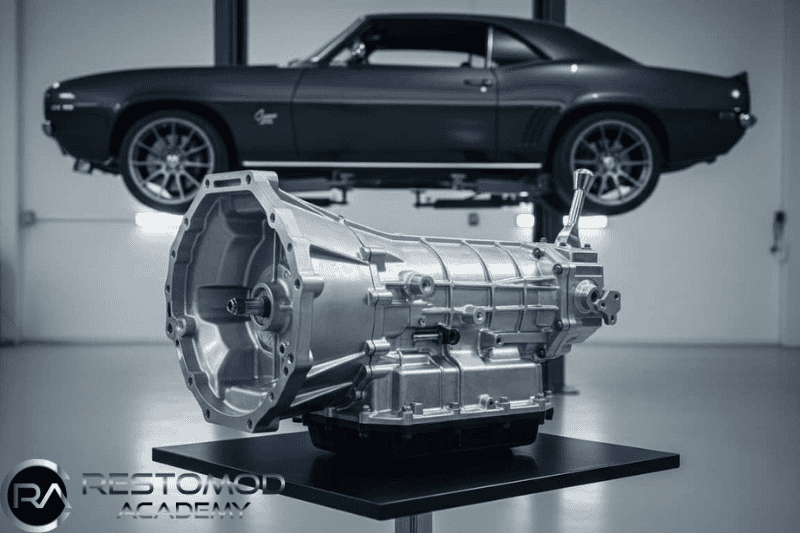
What if your vintage project’s greatest weakness isn’t the engine under the hood, but the 50 year old gearbox struggling to hold it all together? Selecting the right restomod transmission options is about more than just adding an extra gear; it’s about bridging the gap between 1960s style and 2026 performance standards. You’ve likely spent over 1,500 hours perfecting your build’s legacy, so the fear of cutting into an original floorpan or getting lost in a sea of electronic controllers is a legitimate hurdle. It’s a common struggle to find that perfect balance where your car feels like a beast on the track but remains a reliable highway cruiser at 75 mph.
You’ll master the technical landscape of modern manual and automatic swaps to ensure your classic handles up to 800 lb ft of torque with its original soul intact. This guide provides a clear roadmap for matching gear ratios to your rear end differential and selecting torque rated units that fit your specific “built not bought” philosophy. From hydraulic throwout bearings to the latest 10 speed electronic units, we’ll ensure you get the mechanical details right the first time.
Key Takeaways
- Discover how modern gear splits bridge the gap between vintage aesthetics and contemporary power to eliminate the performance limitations of your factory gearbox.
- Weigh the emotional engagement of a manual swap against the relentless efficiency of a modern automatic to determine which gearbox defines your car’s identity.
- Navigate the best restomod transmission options available today, including “no-cut” solutions like the Tremec TKX that preserve your classic car’s original floor tunnel.
- Identify the ideal automatic overdrive for your project, whether you need the proven reliability of a 4L80E or the sophisticated performance of a 10-speed unit.
- Learn the essential engineering steps, such as setting a perfect 3-degree driveline angle, to guarantee your high-performance swap is as smooth as it is powerful.
The Evolution of Gearboxes: Why Your Classic’s Transmission Needs a Modern Upgrade
You’ve spent months perfecting the stance and paint of your classic. Now, you need to make it drive like a 21st-century machine. The original 3-speed or 4-speed manual transmission that came in your 1969 Camaro or Mustang was designed for bias-ply tires and 55 mph speed limits. In a world where modern traffic flows at 80 mph, those vintage units turn your engine into a screaming, vibrating mess. They lack the precision needed for high-performance driving and fail to deliver the mechanical harmony required for a high-end build.
A true restomod driveline preserves the cabin’s period-correct look while hiding massive mechanical improvements underneath. You keep the chrome Hurst shifter handle, but you swap the clunky internals for smooth, synchronized gear splits. Before diving into specific parts, it is vital to understand what is a restomod? It is the marriage of vintage soul and modern reliability. Exploring your restomod transmission options is the most impactful way to bridge that gap between 1965 aesthetics and 2024 performance.
To better understand how these modern units fit into your project, watch this helpful video:
The Overdrive Advantage
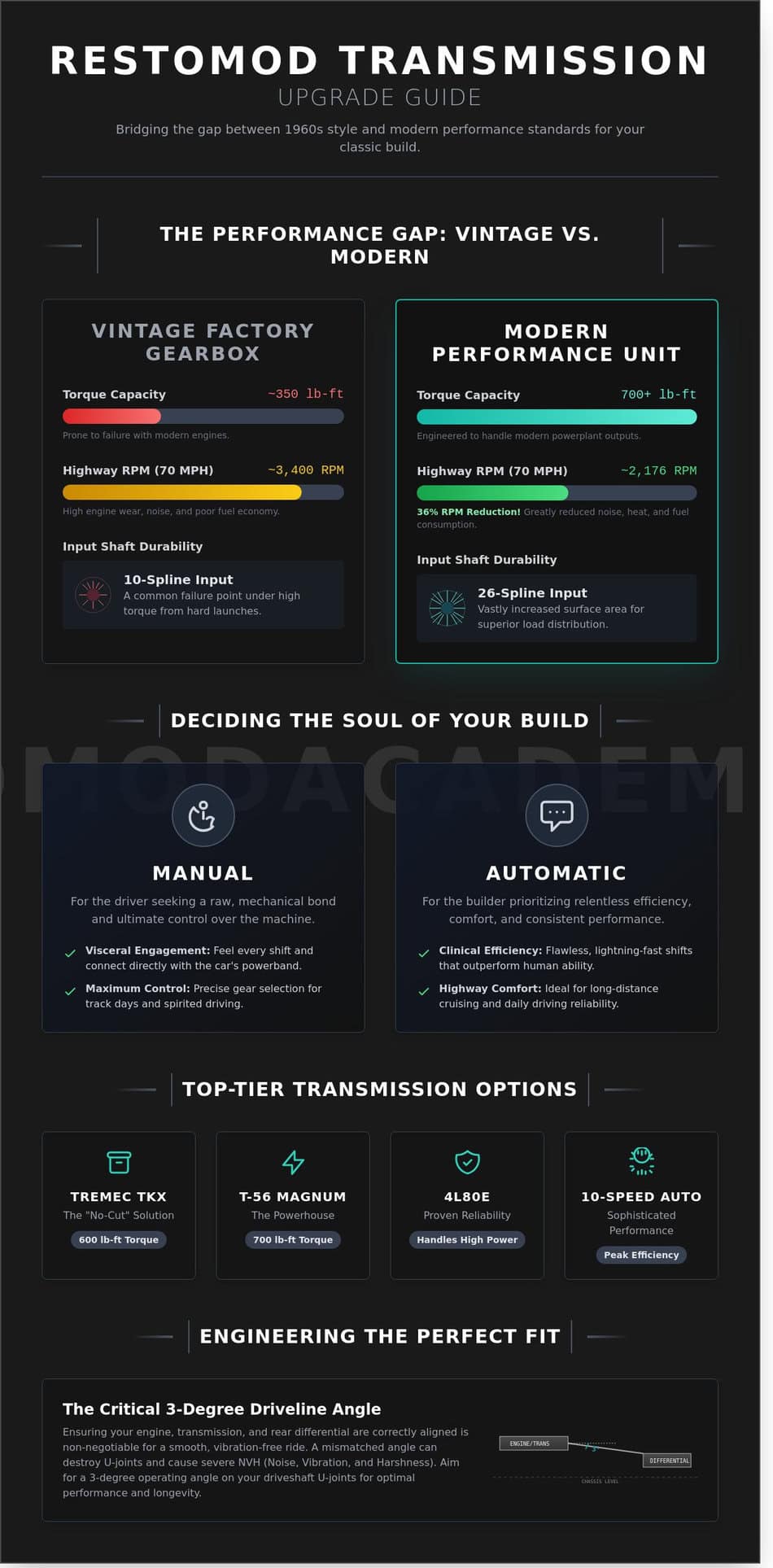
Adding a fifth or sixth gear changes the entire personality of your vehicle. A standard vintage 4-speed has a 1:1 final drive ratio. At 70 mph with a 3.73 rear gear, your engine might roar at 3,400 RPM. By swapping to a unit with a 0.64 overdrive, that engine speed drops to approximately 2,176 RPM. This 36% reduction in engine speed preserves your valvetrain and slashes fuel consumption by nearly 5 miles per gallon in some applications. You get the aggressive 1st gear launch you crave without sacrificing the ability to drive to a show three states away. Lower RPMs also mean less cabin heat and a 20-decibel reduction in NVH, giving your classic a refined, luxury feel that makes long-distance touring a joy rather than a chore.
Torque Capacity vs. Stock Gearboxes
Modern powerplants like the LS3 or Gen 3 Coyote produce torque curves that would shred a factory Muncie M21 or Ford Toploader in seconds. Most vintage gearboxes were rated for roughly 300 to 350 lb-ft of torque. Today’s restomod transmission options, such as the Tremec T56 Magnum, handle 700 lb-ft with ease. This durability comes from increased center distances between shafts and higher spline counts. While a vintage 10-spline input shaft is a common failure point that snaps under hard launches, modern 26-spline shafts provide significantly more surface area to distribute the load. Torque rating is the maximum amount of twisting force a gearbox can safely sustain without internal component deformation or catastrophic gear tooth failure. Investing in a higher rating ensures your transmission survives the 500 horsepower you just dropped under the hood.
Manual vs. Automatic: Deciding the Soul of Your Restomod Build
Deciding on a gearbox is the most critical pivot point in your project. This choice dictates how you interact with the machine every time you turn the key. While engine swaps grab the headlines, your transmission choice defines the driving experience. You must weigh the visceral thrill of a row-your-own manual against the relentless, clinical efficiency of a modern electronic automatic. Both paths offer valid restomod transmission options, but they serve different masters.
Manual gearboxes remain the gold standard for drivers seeking a mechanical bond with their vehicle. This connection is why so many of the best restomods of 2020 and beyond continue to feature three pedals. There is a specific psychological reward in mastering a rev-matched downshift that an computer simply cannot replicate. If your goal is to build a car that feels like an extension of your own limbs, the stick shift is your primary candidate.
The Case for the Modern Stick Shift
Authenticity drives the manual market. A Tremec T56 Magnum or a TKX five-speed offers a “built, not bought” credibility that resonates at every local car meet. Beyond the ego, the engineering benefits are tangible. A typical manual transmission like the T56 weighs approximately 135 pounds; meanwhile, a 6L80 automatic can tip the scales at over 230 pounds once you factor in the torque converter and fluid. Manuals also simplify your engine bay by eliminating the need for complex external cooling lines and bulky heat exchangers. From an investment standpoint, 75% of high-end auction results show that manual-equipped restomods command a 15% to 20% price premium over their automatic counterparts.
The Case for High-Performance Automatics
Modern automatics have evolved far beyond the sluggish three-speed units of the 1960s. High-performance options like the GM 10L90 or the Ford 10R80 execute gear changes in less than 100 milliseconds, a speed no human arm can match. These units integrate directly with your modern ECU or a dedicated Transmission Control Module (TCM) to provide seamless power delivery. For luxury-leaning builds, 6-speed or 8-speed automatics are the new standard. They allow for an aggressive first gear for off-the-line acceleration while maintaining a deep overdrive that keeps engine RPMs below 2,000 at highway speeds. This versatility makes the car usable for cross-country tours rather than just short Sunday sprints.
Evaluate your physical reality before committing to a heavy clutch. If you live in a city where a 20-minute commute involves 50 stop-and-go cycles, your “clutch knee” will eventually regret a stiff performance pressure plate. Modern hydraulic clutch kits have lessened this burden, but they do not eliminate it. If you want to master your build strategy, you must be honest about how you actually intend to use the car. A drag-strip focused build demands the consistency of an automatic, while a canyon carver thrives on the control of a manual.
Budgeting for these restomod transmission options requires looking past the initial purchase price. Hidden costs can derail a build quickly. A manual conversion often requires a custom pedal box and hydraulic master cylinder, which can add $450 to $800 to your tally. Conversely, an electronic automatic requires a standalone TCM and harness, often costing $600 or more, plus the added expense of custom-fabricated cooling lines. Always calculate the total “installed cost” before pulling the trigger on a specific gearbox.
Top-Tier Manual Transmission Options: From Tremec TKX to T-56 Magnum
The manual gearbox is the heartbeat of a driver focused build. Selecting from the available restomod transmission options requires a balance between power handling and physical fitment. You don’t want to butcher your classic floorpan just to get an extra gear. Modern engineering has solved this dilemma. Today, modern overdrive transmissions provide the strength of a race unit with the highway manners of a luxury cruiser. These units allow you to maintain high performance on the strip while keeping your engine’s RPM low enough to hold a conversation at 70 MPH.
Tremec TKX: The Restomodder’s Best Friend
The Tremec TKX changed the game when it arrived in late 2020. Before its release, fitting a five speed into a tight tunnel often meant cutting original sheet metal. Tremec designed the TKX with a rounded, low profile case specifically for classic Mustangs, Camaros, and Chevelles. It fits into these narrow tunnels without floor surgery, preserving the structural integrity of your car’s floorpan. It’s a true “drop-in” solution that respects the craftsmanship of your vintage chassis.
Performance is where the TKX shines. It handles 600 lb-ft of torque reliably. This is the sweet spot for a stout small block or a naturally aspirated big block. If you enjoy high revving engines, the TKX is rated for clean shifts at 7,500 RPM. This is achieved through multi-cone synchronizers and a hybrid brass/carbon friction material. It turns a nervous 3,500 RPM highway scream into a calm 2,100 RPM cruise, depending on your rear gear ratio. You get the benefit of a 26 percent or 32 percent drop in engine speed once you click into fifth gear.
The T-56 Magnum: Strength and Versatility
If your build pushes past the 700 horsepower mark, look toward the T-56 Magnum. This gearbox carries the DNA of the legendary Dodge Viper and Corvette ZR1 units. It’s built for absolute abuse. The Magnum version is the aftermarket evolution of the original T-56, featuring massive gears and an 85mm center distance to handle up to 700 lb-ft of torque. Integrating this beast is a common step in The Definitive Guide to an LS Engine Swap because it matches the power delivery of modern LSX engines perfectly.
One major advantage for the custom builder is its versatility. The T-56 Magnum offers multiple shifter locations. You can move the shifter to the front, middle, or rear positions to line up the handle perfectly with your factory console. You also have choices for your speedometer drive. You can use the electronic pulse output for modern digital gauges or install a mechanical cable conversion to keep your vintage 1960s speedometer functional. It’s a double overdrive unit, meaning both fifth and sixth gears provide a reduction in RPM for maximum efficiency on long hauls.
Richmond 6-Speed: The Niche Choice
The Richmond 6-Speed remains a solid choice for builders with very specific gearing needs. While Tremec dominates the market, Richmond offers unique gear spacing that can optimize a car for specific track layouts or unusual rear end ratios. It’s a rugged, front-loading design that doesn’t always offer the same “no-cut” convenience as the TKX. However, for a custom chassis or a dedicated pro-touring machine, the ability to fine-tune your torque curve through gear selection is invaluable. It’s a choice for the builder who views their restomod transmission options through the lens of specific mechanical advantages rather than just ease of installation.
- TKX: Best for stock floorpans and engines under 600 lb-ft.
- T-56 Magnum: Best for high horsepower LS swaps and 700+ lb-ft applications.
- Richmond: Best for custom gear ratio requirements and track-focused builds.
Modern Automatic Overdrive Options: 4L60E to the 10-Speed Revolution
Stop settling for three-speed slushboxes that leave your engine screaming at 3,500 RPM on the interstate. Modernizing your drivetrain is the most effective way to transform a temperamental classic into a reliable long-distance cruiser. When you weigh your restomod transmission options, you’re choosing more than just gears; you’re choosing the personality of your build. The shift from old-school hydraulics to modern electronic control units (TCUs) defines how your car communicates with the pavement.
GM’s 4L60E and 4L80E remain the gold standard for many builders. The 4L60E is a solid choice for cruisers with engines producing under 360 lb-ft of torque. However, if you’re dropping in a supercharged LT4 or a high-compression big block, the 4L80E is the necessary upgrade. It’s a heavy-duty unit based on the legendary TH400 architecture, adding a 0.75 overdrive ratio to handle up to 440 lb-ft of torque in stock form. While it provides bulletproof reliability, its 32-inch length and 178-pound weight require a massive transmission tunnel to clear the casing.
The 4-Speed Overdrive Stalwarts
The Ford AOD, produced between 1980 and 1993, is the go-to for purists who want to avoid wiring harnesses. It relies on a mechanical TV cable to manage shift points, making it a “dumb” but effective swap. In contrast, the 4L80E demands electronic intervention. You’ll need to budget roughly $650 for a standalone controller like the US Shift Quick 4 to manage line pressure and shift timing. Don’t underestimate the 4L80E’s girth; expect to use a 2-pound sledge or a dedicated tunnel patch kit to get the clearance you need.
Stepping up to the 6L80E or 6L90E offers a middle ground that balances modern efficiency with manageable installation. These six-speed units featured a 4.02:1 first gear ratio when they debuted in 2006, providing incredible off-the-line acceleration even with taller rear-end gears. They utilize an internal Tehama (Transmission Electro-Hydraulic Control Module), which simplifies external wiring but makes custom tuning a requirement for smooth operation.
The Multi-Gear Frontier: 8 and 10-Speeds
The 10R80 and 10L90 transmissions, co-developed by Ford and GM in 2013, represent the pinnacle of current technology. With ten forward speeds, these units keep your engine within 15% of its peak power band at all times. This creates a seamless wave of acceleration that feels more like a jet engine than a traditional V8. Installation is a commitment; these gearboxes are physically large and require sophisticated CAN-bus integration to function. You must also prioritize thermal management. A 10-speed generates significant internal friction, necessitating a dedicated fluid cooler with at least a 20,000 GVW rating to keep temperatures below the 180-degree danger zone.
Selecting between these restomod transmission options requires a honest assessment of your goals. A simple AOD swap might take a weekend, while a 10L90 integration could take a month of fabrication and programming. Focus on the torque capacity first, then look at your floorpan. If you want the ultimate driving experience, the complexity of a modern multi-speed unit is worth every hour spent in the garage. Before you buy your mounting brackets, browse our drivetrain compatibility guides to ensure your choice fits your chassis and your vision.
Engineering the Perfect Fit: Installation Realities and Driveline Geometry
Selecting from the available restomod transmission options is only half the battle. The real work begins when you try to marry a high-tech 6-speed to a chassis built during the Johnson administration. This phase demands extreme precision. You aren’t just swapping parts; you’re re-engineering a complex mechanical system. Start by validating your bellhousing alignment. If your dial indicator shows more than 0.005 inches of runout, you’ll face pilot bearing failure or shifting issues within 10,000 miles. Use offset dowel pins to bring the housing back into spec if the factory tolerances don’t meet modern standards.
Your old steel driveshaft is a ticking time bomb at modern highway speeds. A 1965 Mustang shaft wasn’t designed for the 3,000+ RPM output of an overdrive unit at 80 MPH. Upgrade to a 3.5-inch aluminum or carbon fiber shaft to ensure safety. These materials offer significantly higher critical speed ratings, often exceeding 7,500 RPM. Ensure your U-joints are rated for your specific torque; 1350 series joints are the industry standard for builds pushing over 500 horsepower. If you’re missing the specialized measurement tools for this phase, consult our Recommended Gear for Restomod Builders.
Don’t overlook the clutch selection during this interface. A modern hydraulic throw-out bearing is a superior choice for most restomod transmission options, but it requires precise shimming. You need a gap between 0.125 and 0.175 inches between the bearing and the pressure plate fingers. If you’re building a street car, stick with an organic friction material. Ceramic or metallic puck clutches might hold 800 lb-ft of torque, but they’ll chatter your teeth out in stop-and-go traffic. Choose a setup that matches your 90 percent use case, not your 10 percent track fantasy.
Managing the Driveline Angle
Modern gearboxes are physically larger than vintage units, which often forces the engine to tilt back. This shift alters your driveline geometry. You must aim for a 3-degree working angle at the U-joints to prevent high-speed vibration. Use a digital inclinometer or a smartphone app to measure the crank, driveshaft, and pinion angles. They don’t have to be zero, but they must be equal and opposite within 0.5 degrees. Adjust your rear pinion or shim the transmission mount to achieve a professional-grade setup that lasts.
Shifter Placement and Interior Integration
Integrating a modern shifter into a vintage interior is where true craftsmanship shines. A T-56 Magnum often sits 2 inches further back than a factory Toploader. You’ll likely need to modify the floor tunnel and use an offset shifter lever to retain your original console. For the clutch, mechanical Z-bars are relics of the past. Install a hydraulic master cylinder with a 0.75-inch bore to achieve a smooth, modern pedal feel. This conversion eliminates the binding common in high-performance pressure plates. To see which kits we trust for these modifications, check out our Product Reviews for Restomod Parts.
Command the Road with 2026 Precision
Your drivetrain is the bridge between vintage soul and 21st-century performance. Whether you opt for the crisp, short-throw shifts of a Tremec TKX or embrace the lightning-fast efficiency of a modern 10-speed automatic, your choice defines how your car connects to the asphalt. Remember that a successful swap isn’t just about the gearbox. It involves mastering driveline geometry and ensuring your engine’s torque curve matches your gear ratios perfectly. Navigating the current restomod transmission options requires a blend of mechanical grit and engineering foresight to ensure your project stands the test of time.
Don’t let technical hurdles stall your progress in the garage. Brook Walsh and the Restomod Academy provide the expert mentoring you need to execute a flawless installation. From step-by-step blueprints for Tremec setups to comprehensive reviews of 2026’s top products, we’ve mapped out the path to a high-performance build. Download The Ultimate Restomod Guide to master your drivetrain engineering and start turning your vision into a high-octane reality. Your legacy is waiting to be built, one gear at a time.
Frequently Asked Questions
Will a 6-speed transmission fit in my classic car without cutting the floor?
You’ll likely need to modify your floor tunnel to fit a modern 6-speed like the T-56 Magnum. Most 1960s muscle cars require 2 to 4 inches of additional clearance to maintain proper driveline angles. While some companies offer low-profile kits, plan for fabrication if you want 700 lb-ft of torque capacity. Measure your current tunnel height and compare it to the 12.5-inch height of a standard 6-speed casing.
Do I need a standalone controller for a modern automatic transmission?
You must use a standalone controller if you’re installing an electronically controlled automatic like the 4L60E or 6L80. These units rely on precise signals from throttle position sensors and vehicle speed sensors to shift. Budget between $650 and $1,100 for a reputable controller like the US Shift Quick 4. Exploring your restomod transmission options early ensures you choose a controller that integrates with your existing engine harness.
What is the difference between a T-56 and a T-56 Magnum?
The T-56 Magnum is a significantly beefier aftermarket version of the original T-56, borrowing internals from the TR-6060. While a standard T-56 handles 450 lb-ft of torque, the Magnum is rated for 700 lb-ft. It features larger gears, stronger shafts, and multiple shifter locations. You’ll also find triple-cone synchronizers in the Magnum that provide smoother shifts at 7,000 RPM compared to the older 1990s design.
How do I choose the right gear ratio for my restomod transmission?
Choose your gear ratio by matching your rear-end gears to the transmission’s overdrive percentage. For a street-focused build, aim for an engine speed of 2,100 RPM at 75 MPH. If you run a 3.73 rear gear with a 0.63 overdrive, you’ll hit that sweet spot perfectly. Use a calculator to ensure your first gear ratio stays between 9:1 and 11:1 for crisp acceleration without excessive wheel spin.
Can I use my original mechanical speedometer with a modern transmission?
You can retain your original mechanical speedometer by using an electronic-to-mechanical conversion box. Units like the Dakota Digital ECD-200 cost approximately $400 and use a small motor to spin your factory cable based on the new transmission’s speed sensor signal. This allows you to keep the vintage aesthetic of your dashboard while enjoying modern gear selection. It’s a reliable 3-wire installation that takes about 2 hours.
What is the best transmission for an LS swap?
The T-56 Magnum remains the gold standard for manual LS swaps due to its bolt-on compatibility and high power ceiling. If you prefer two pedals, the 6L80E is the top choice among restomod transmission options for its 4.02:1 first gear and dual overdrives. Both options fit the LS bellhousing pattern perfectly; however, the 6L80E requires a larger 13-inch tunnel clearance than the older 4-speed automatics used in the 1980s.
Is a hydraulic clutch better than a mechanical linkage for restomods?
A hydraulic clutch is superior to mechanical linkage because it eliminates the binding and geometry issues common in modified classic frames. You’ll experience a 25% to 40% reduction in pedal effort, which makes stop-and-go driving much more enjoyable. Modern hydraulic throw-out bearings also self-adjust for wear. This setup saves about 5 hours of fabrication time compared to custom-fitting an old-school Z-bar around modern long-tube headers.
How much does a restomod transmission swap typically cost in 2026?
A complete restomod transmission swap in 2026 typically costs between $5,500 and $10,500 depending on your choice of parts. A new Tremec kit accounts for $4,200 of that total, while specialized crossmembers and driveshafts add another $1,200. If you hire a professional shop, expect to pay for 18 to 22 hours of labor at a standard rate of $165 per hour. DIY builders can save roughly $3,000 in labor costs.