
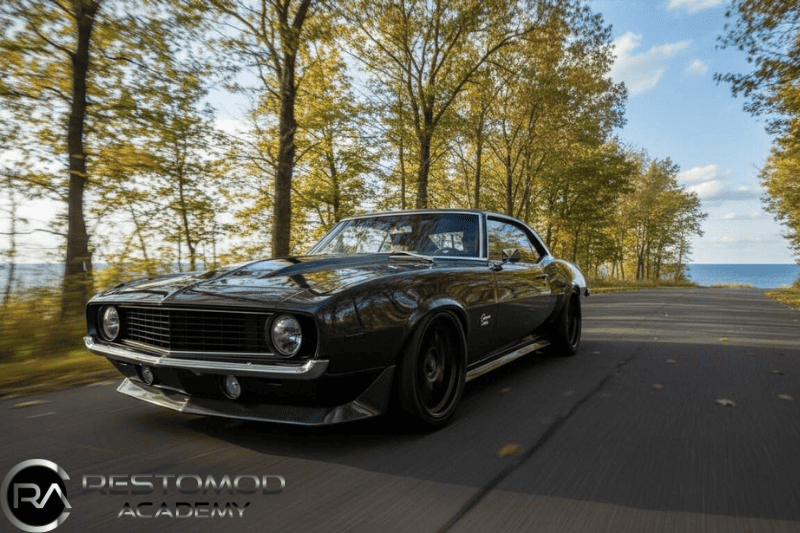
Your 1969 Chevelle might look like a legend, but if it’s still running factory suspension, it likely handles like a 3,800-pound brick on casters. It’s a hard truth that 65% of classic car owners feel intimidated by modern highway corners because their vintage steering boxes lack the precision of a modern rack and pinion. Creating elite pro touring cars requires more than just a high-horsepower crate engine swap; it demands a calculated approach to grip, braking, and balance. By the time we’re done, you’ll understand how to turn that wallowing ride into a corner-carving machine that rivals a 2026 sports car.
You’ve likely felt that pang of anxiety when a high-speed bend approaches, knowing your brakes might not bite as hard as you need them to. That’s a feeling we’re going to eliminate together. This guide promises to deliver the engineering secrets and component synergy necessary to build a world-class restomod without overspending on mismatched hardware. We’re diving into specific suspension geometry, drivetrain choices, and the “built, not bought” mindset that defines the Restomod Academy.
Key Takeaways
- Embrace the “Driven, Not Hidden” philosophy to transform your vintage muscle car from a static showpiece into a high-performance machine built for the track.
- Prioritize the foundational engineering of pro touring cars by focusing on suspension geometry and chassis rigidity before adding massive horsepower.
- Evaluate the critical differences in cost and intent between a standard restomod and a competitive pro-touring build to ensure your budget aligns with your goals.
- Select the ideal foundation for your project by comparing the legendary F-Body Camaro against versatile alternatives like A-Body classics and Foxbody Mustangs.
- Master the art of project management with a staged build blueprint that emphasizes safety and precision while eliminating the risk of project creep.
What is a Pro-Touring Car? Defining the 2026 Standard
Look at that 1969 Camaro sitting in your shop. It has the lines of a legend, but if you’ve ever tried to take a sharp corner at 60 miles per hour on stock suspension, you know the terror of body roll and vague steering. That’s why pro touring cars exist. This movement isn’t about building a museum piece; it’s about the “Driven, Not Hidden” philosophy. You’re building a machine that captures the soul of a classic but delivers the precision of a 2026 Z06 Corvette. It’s a balance of vintage grit and modern physics.
To truly understand What is a Pro-Touring Car?, you have to look back to 1993. That’s when Mark Stielow and Jeff Smith coined the term in the pages of Chevy High Performance. They wanted to describe a new breed of muscle car that didn’t just excel on the drag strip but could also dominate a road course. This vision transformed the hobby from a focus on straight-line speed to a holistic approach involving four critical pillars: acceleration, braking, cornering, and comfort.
To better understand this concept, watch this helpful video:
The Evolution of High-Performance Classics
In the 1960s, performance meant a big block and a set of bias-ply tires destined for the 1/4 mile. Today, the game has changed. Modern 200-treadwear tire technology, like the Michelin Pilot Sport 4S or BFG Rival S, has pushed classic chassis to their limits. This shift led builders away from “garage queens” and toward grueling events like the “One Lap of America,” which covers 3,500 miles in eight days. If you want to dive deeper into how this differs from a standard restoration, check out our guide on what is a restomod to see the broader spectrum of the hobby.
The 2026 Pro-Touring Checklist
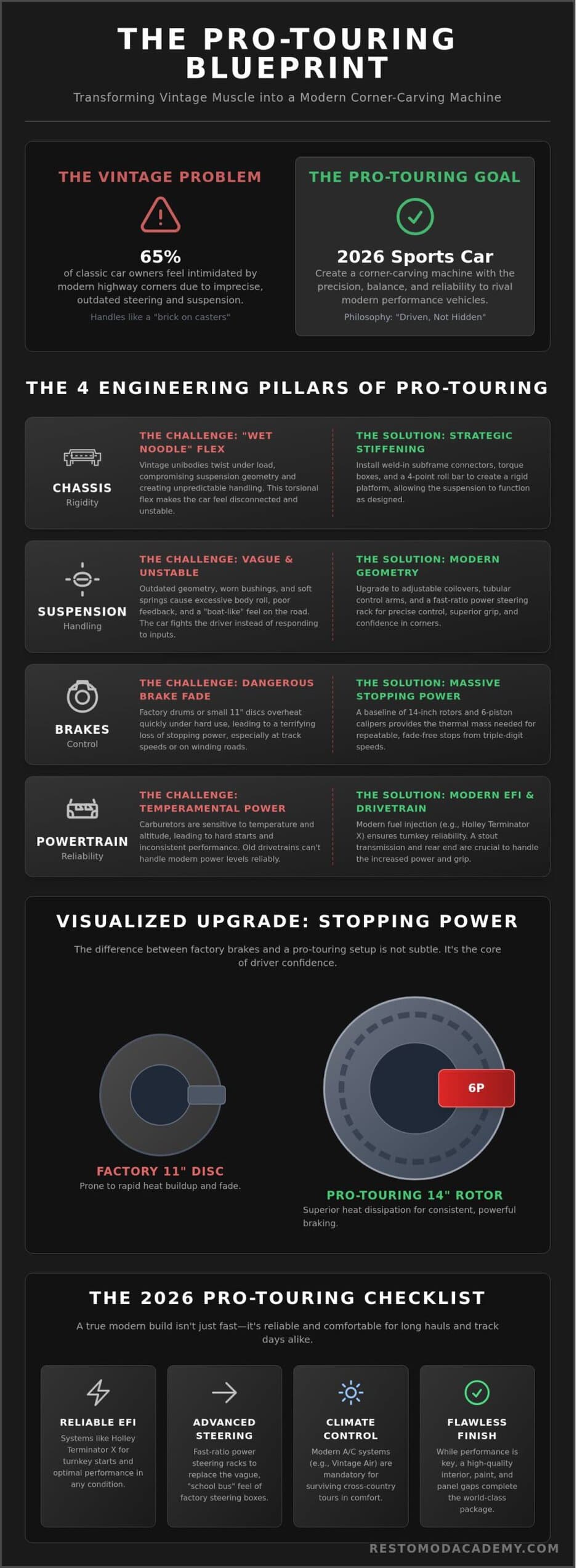
Reliability is the hallmark of a modern build. You aren’t just swapping parts; you’re engineering a system. A true 2026-spec build requires specific modern amenities to handle long-distance tours and track days alike. While you might be tempted by raw power, remember that form follows function in this discipline. Every modification should improve the driving experience. Your checklist should include:
- Reliable EFI: Systems like the Holley Terminator X or Sniper 2 ensure your engine starts every time, regardless of altitude or temperature.
- Climate Control: Modern A/C systems from Vintage Air are mandatory for surviving cross-country drives in July.
- Advanced Steering: Fast-ratio power steering racks replace the “school bus” feel of 1960s steering boxes.
- Stopping Power: Six-piston calipers and 14-inch rotors provide the confidence to dive deep into corners.
Pro-Touring is the ultimate expression of functional automotive art.
The Engineering Pillars: Suspension, Brakes, and Chassis
Your build lives or dies by its foundation. While a high-horsepower engine provides the excitement, the chassis and suspension provide the capability to use that power effectively on a road course or a winding backroad. Many builders make the mistake of prioritizing the dyno sheet, but pro touring cars require a balanced approach where the “legs” of the car match the strength of the heart. If you are just starting your journey, it helps to understand what is a restomod before diving into these complex mechanical systems.
Vintage unibodies, such as those found on 1960s Mustangs or Camaros, often suffer from significant torsional flex. This “wet noodle” sensation happens when the body twists under heavy cornering or acceleration, which effectively turns the car’s frame into an uncontrolled spring. To fix this, you must stiffen the platform. Weld-in subframe connectors, torque boxes, and even 4-point roll bars are essential for creating a rigid box. This structural integrity allows your suspension to work as designed rather than fighting a shifting chassis.
Stopping power is your next priority. When you’re pushing a 3,500-pound classic at track speeds, factory drums or basic 11-inch discs will fail almost immediately. Modern standards for the pro-touring community have shifted toward 14-inch rotors and 6-piston calipers as the baseline. This setup provides the thermal mass necessary to dissipate heat during repeated 100-to-0 mph stops. For a real-world look at how these components integrate into a world-class build, study The Engineering Pillars: Suspension, Brakes, and Chassis seen in high-profile builds like the Red Devil Camaro.
Suspension Geometry and Modern Handling
Modern handling relies on optimized geometry rather than just stiff springs. You must choose between high-end 4-link setups for solid axles or the precision of an Independent Rear Suspension (IRS). Reducing unsprung weight is the primary goal. Lightweight aluminum control arms and adjustable coilovers allow you to fine-tune damping for specific track conditions. These systems eliminate the unpredictable “bump steer” common in vintage steering boxes, replacing it with the laser-accurate feedback of a modern rack-and-pinion unit.
Wheels and Tires: The Contact Patch
Wheels serve two purposes: clearing massive brake calipers and mounting high-performance rubber. 18-inch wheels are the industry sweet spot. They offer enough sidewall to maintain a classic aesthetic while providing clearance for 14-inch rotors. The rise of 200-treadwear “super tires,” like the Michelin Pilot Sport 4S or Falken Azenis RT660, has changed the game. These tires provide near-slick levels of grip while remaining street-legal. When selecting your offset, you must balance aggressive fitment with functional steering sweep. A 315mm front tire offers incredible front-end bite, but it’s useless if it rubs the inner fenders at half-lock.
Pro-Touring vs. Restomod: Choosing Your Build Path
You’ve reached the point where you must decide the soul of your build. A restomod focuses on making a classic car livable for modern traffic, but pro touring cars are built to dominate it. If your goal is a comfortable cruise to the local meet, a standard restomod serves you well. However, if you crave the lateral G-forces of a modern supercar, you’re entering the Pro-Touring arena. Be prepared for the financial reality; a dedicated Pro-Touring build typically demands a 30-50% higher budget than a standard restomod. This premium covers high-stress components like six-piston calipers and independent rear suspensions that can handle 600 horsepower without snapping.
Understanding the historical context of What is Pro-Touring helps you appreciate why these machines evolved from simple street cars into track-slaying monsters. To truly grasp the foundation of these builds, you should understand the broader restomod meaning here before committing to a specialized path. High-performance parts bring a specific trade-off: maintenance. Race-spec rod ends and aggressive brake pads wear significantly faster than their OEM counterparts, requiring a more disciplined inspection schedule in your garage.
Performance Thresholds
A true Pro-Touring machine isn’t defined by its chrome, but by its data. You’re aiming for a lateral acceleration of at least 1.0g on the skidpad. Your braking distance from 60 mph should drop below 110 feet, a massive leap from the 180 feet required by stock drum brakes. For most drivers, a car pulling 1.2g might feel too twitchy for a casual Saturday drive. The sweet spot for a dual-purpose build involves adjustable coilover settings that allow you to soften the dampening for the street and stiffen it for the track. This flexibility ensures your car remains a tool for both speed and enjoyment.
Complexity and Fabrication Requirements
Don’t expect performance parts to simply bolt on. Building pro touring cars often requires cutting into the factory floor to install mini-tubs for 315mm wide tires or replacing the entire front subframe to correct suspension geometry. While a basic restoration is a paint-by-numbers exercise, building a pro-touring car is a feat of surgical engineering. You’ll need to balance DIY tasks like wiring with professional fabrication for roll cages or custom exhaust routing. Every modification must work in harmony, or you risk creating a car that is fast on paper but terrifying to drive at the limit. Respect the process and prioritize safety over aesthetics.
Building Your Blueprint: Selecting the Right Platform
Choosing your foundation is the most critical decision you’ll make in the build process. The 1967-1969 Camaro, the iconic F-Body, continues to dominate the world of pro touring cars in 2026. This dominance isn’t just about aesthetics; it’s about the massive aftermarket support. When you choose a first-gen Camaro, you gain access to bolt-on subframes and suspension kits from manufacturers like Detroit Speed that can pull over 1.0g on the skidpad. It’s the safest bet for a builder who wants a proven path to elite performance.
If you want to stand out from the sea of Camaros, the 1964-1972 A-Body platform offers a compelling alternative. Cars like the Chevelle and GTO provide a longer wheelbase, which often translates to better high-speed stability on road courses. We’re also seeing a massive surge in 1979-1993 Foxbody Mustangs. These cars are lightweight, often tipping the scales under 3,000 pounds, making them lethal contenders when paired with modern independent rear suspension (IRS) conversions.
Don’t overlook the utility of a classic hauler. The C10 truck movement has shifted from low-and-slow cruisers to genuine track weapons. By 2025, specialized chassis manufacturers like Roadster Shop perfected full-frame replacements for 1967-1972 C10s. These frames turn a farm truck into a vehicle with the center of gravity and suspension geometry of a modern sports car. It’s a bold choice that commands attention at any autocross event.
The Drivetrain: LS Swaps and Beyond
The Chevrolet LS engine remains the gold standard for high-performance builds because of its compact footprint and incredible power-to-weight ratio. You can easily squeeze 550 naturally aspirated horsepower into a vintage engine bay without cutting the firewall. Before you buy your crate motor, read our definitive guide to an LS engine swap to understand the clearance and wiring requirements. While the T-56 Magnum 6-speed manual is the purist’s choice for engagement, modern 10L90 10-speed automatics are now winning races. These modern gearboxes keep the engine in its power band 100% of the time, shaving seconds off lap times.
Modern Tech Integration
Precision is the hallmark of 2026 pro touring cars. You aren’t just building a fast car; you’re building an intelligent one. Implementing digital dashes like the Holley 12.3-inch Pro Dash allows you to monitor real-time telemetry and oil pressure vitals with millisecond accuracy. Safety tech has also evolved. Many top-tier builders now integrate Bosch M5 Club Sport ABS systems and traction control. These systems allow you to harness 700+ horsepower on the exit of a corner without the fear of a snap-oversteer disaster. It’s about using technology to bridge the gap between vintage soul and modern supercar capability.
Ready to define your build style before turning the first bolt? Learn the core principles of a world-class restomod project here.
Mastering the Build with Restomod Academy
Building elite pro touring cars requires more than just a fat checkbook and a set of wrenches. It demands a disciplined roadmap. Industry data suggests that 85% of high-performance builds stall out because of “project creep,” where the scope of the work expands faster than the budget or the builder’s patience. You avoid this trap by committing to a staged build plan. We teach our students to prioritize safety and chassis rigidity before chasing horsepower. A 600-horsepower engine is a liability if your 50-year-old frame can’t handle the torque or your brakes fade after two hard corners.
The Restomod Academy provides the professional-grade blueprints you need to transition from a dreamer to a master builder. We focus on the “built, not bought” philosophy, emphasizing that the soul of the car is forged in the garage. By following a logical sequence, you ensure every dollar spent adds measurable performance. Join our community of builders who value precision and legacy. We don’t just restore cars; we re-engineer them for the modern era. Our consulting services help you navigate the specific suspension geometry and fabrication needs of your unique vehicle, ensuring your vision survives the assembly process.
Resources for the Serious Builder
Your shop environment dictates the quality of your output. Stop struggling with sub-par tools that round off bolts and ruin finishes. Use our Recommended Gear to stock your workspace with the same equipment used by top-tier fabrication shops. When it’s time to select components, don’t rely on forum hearsay. Vet every suspension kit and wiring harness through our Product Reviews. These evaluations are based on real-world testing, helping you avoid the 15% to 20% markup often found on parts that require extensive modification to actually fit. “The Ultimate Restomod Guide” serves as your strategic playbook, saving the average builder over $4,500 in avoidable mistakes during the first year of a project.
The Final Inspection: Safety and Quality
A pro touring car is only as reliable as its weakest weld or its poorest electrical ground. High-performance driving puts immense stress on vintage steel. We mandate a rigorous final inspection because a mechanical failure at track speeds is catastrophic. There’s a fundamental difference between a car that’s “finished” and one that’s “sorted.” A sorted car has undergone at least 400 miles of varied testing to identify vibrations, fluid leaks, and cooling issues. This meticulous attention to detail separates a true performance machine from a dangerous project. It’s time to stop watching from the sidelines and start turning your vision into a high-speed reality.
Take the Wheel of Your 2026 Pro-Touring Project
Building pro touring cars isn’t about following the latest social media trends; it’s about mastering the 2026 standard of performance where classic iron meets 1.0g lateral grip and sub-110 foot braking distances. You’ve learned that the foundation of a true performer lies in precise suspension geometry and a rigid chassis rather than just raw horsepower. Choosing your platform is the first step in a journey that demands both craftsmanship and a solid engineering plan. Every weld and every bolt contributes to a legacy of performance that stands the test of time.
Brook Walsh founded the Restomod Academy to ensure you don’t waste thousands of dollars on parts that don’t play well together. We provide comprehensive blueprints for major platforms like the 1967 Camaro and the 1970 Chevelle, focusing on safety and real-world physics over marketing hype. You have the vision to transform a vintage relic into a modern masterpiece; now you just need the map to get there. Our curriculum breaks down complex fabrication into logical steps so you can build with confidence.
Master Your Build with The Ultimate Restomod Guide
Your garage is waiting, and the satisfaction of that first high-speed corner is closer than you think. Keep your eyes on the apex and your hands on the tools.
Frequently Asked Questions
What is the main difference between a restomod and a pro-touring car?
A pro-touring car is a restomod specifically engineered to excel in performance categories like lateral G-force, braking, and high-speed handling. While a standard restomod focuses on modern comforts and aesthetics, pro-touring builds prioritize 1.0g cornering capabilities and 60-to-0 mph stops in under 110 feet. Think of it as a vintage shell wrapped around the soul of a 2026 supercar; it’s built to be driven hard on a track.
How much does it cost to build a competitive pro-touring car in 2026?
Expect to invest between $85,000 and $250,000 to build a competitive pro-touring car in 2026. High-end builds featuring carbon fiber body panels and custom 1,000 horsepower engines often exceed the $300,000 mark. Budgeting 40% of your total spend for the suspension and braking systems ensures your project handles as well as it accelerates. Professional labor costs currently average $125 per hour for specialized fabrication work.
Do I need a specific car model to start a pro-touring build?
You don’t need a specific model to start your build, but 1964 to 1972 GM A-body and F-body platforms remain the most popular due to massive aftermarket support. Approximately 75% of performance components are designed for Camaros, Chevelles, and Mustangs. Choosing a less common platform like a 1970s sedan requires custom fabrication; this can add 200 hours to your build timeline and significantly increase your total budget.
Can a pro-touring car be used as a daily driver?
Yes, a well-engineered pro-touring car functions as a reliable daily driver because it utilizes modern fuel injection and overdrive transmissions. Systems like the Holley Dominator EFI allow these classics to start in 20-degree weather without hesitation. Just remember that a 1969 Mustang lacks the 5-star crash ratings of a modern sedan. Even with upgraded three-point harnesses, you’re still driving a vintage chassis in a modern world.
Is an LS swap mandatory for a pro-touring build?
An LS swap isn’t mandatory, though 65% of builders choose it for its reliability and 500-plus horsepower potential. You can achieve elite performance with a Gen 3 Coyote or a modern Gen 5 LT engine. Even a traditional small-block Chevy works if you equip it with modern EFI and a high-efficiency cooling system. The goal is consistent power delivery and thermal management during 20-minute track sessions, regardless of the brand.
What are the most important safety upgrades for a pro-touring car?
Install a six-point roll cage, three-point retractable seat belts, and a dual-circuit master cylinder immediately. These upgrades are critical for pro touring cars that reach speeds over 140 mph on track days. Adding a collapsible steering column and a fire suppression system provides the necessary protection for high-speed maneuvers. Never compromise on safety; a fast car is useless if it can’t protect the driver during a mechanical failure.
How do pro-touring cars hold their value compared to original restorations?
Pro-touring cars often command 25% higher prices at auctions like Barrett-Jackson than 100-point original restorations. Buyers in 2026 value drivability and modern performance over numbers-matching purity. A documented build with a high-end chassis from Roadster Shop or Detroit Speed typically retains 85% of its build cost in resale value. Originality is respected, but the market currently pays a premium for a classic that can actually keep up with modern traffic.
What kind of tires are best for a street-driven pro-touring car?
Select a 200-treadwear tire like the Michelin Pilot Sport 4S or the BFGoodrich Rival S for the best street-to-track balance. These tires provide the 1.1g lateral grip required for pro touring cars while maintaining wet-weather safety. Aim for a 315mm width in the rear to ensure your modern horsepower actually connects with the pavement. Check your tire pressures every morning; even a 2-psi difference affects your handling geometry during aggressive cornering.