
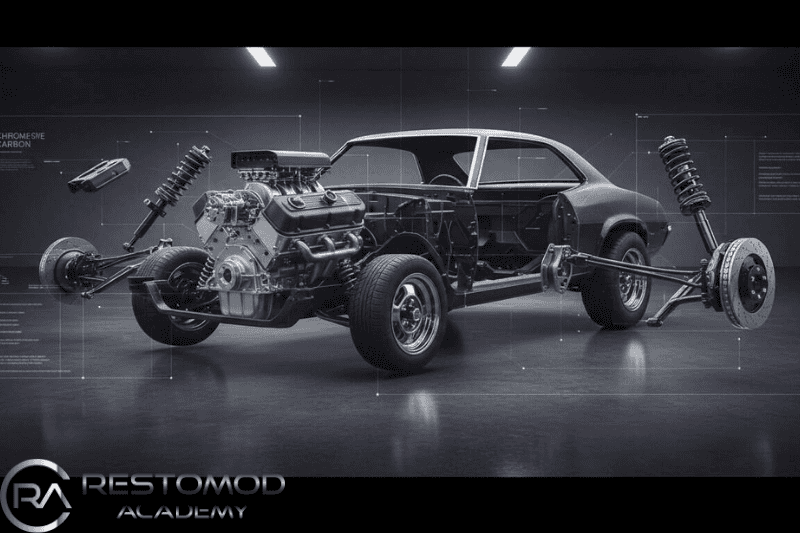
According to a 2023 industry survey, 65% of custom car projects stall indefinitely because the owner underestimated the cost of hidden variables like professional fabrication and paint prep. You’ve likely spent late nights envisioning the perfect stance and the roar of a modern crate engine, only to feel a knot in your stomach when you look at the actual price tags. It’s a common fear that keeps many enthusiasts on the sidelines. Nobody wants their legacy project to become a permanent lawn ornament because of a simple math error. That’s why utilizing a precise restomod budget calculator is the most important tool in your garage.
We’re going to master the art of Restomod Math together. This guide provides a framework to ensure your financial roadmap is as solid as your chassis. You’ll learn how to account for $125 per hour shop labor rates, factor in a 25% “rust tax” for bodywork, and decide exactly where to invest in suspension geometry or wiring harnesses for maximum performance. We’ll break down the build process into logical, achievable steps so you can focus on the craftsmanship instead of the credit card bill. By the time we’re done, you’ll have the confidence to turn your vision into a high performance reality.
Key Takeaways
- Master the fundamental “Restomod Math” formula to account for every component and the essential 20% contingency fund that protects your project from mid-build bankruptcy.
- Utilize a comprehensive restomod budget calculator framework to balance donor vehicle acquisition with the high-performance reality of modern powertrain and drivetrain upgrades.
- Evaluate the true cost of “sweat equity” against current shop rates to strategically decide which fabrication tasks belong in your garage and which require a specialist’s touch.
- Build a bulletproof parts wishlist using real-world pricing to ensure your mechanical vision aligns perfectly with your financial roadmap before the first wrench turns.
- Learn to align your total investment with your long-term legacy goals, keeping your motivation high and your craftsmanship precise throughout the entire build process.
Understanding “Restomod Math”: Why Most Project Budgets Fail
Every great build starts with a dream, but it’s grounded by the cold, hard reality of the numbers. To master your project, you must grasp Understanding ‘Restomod Math’. This isn’t just basic addition; it’s a complex equation involving donor acquisition, modern component costs, and specialized labor rates that often exceed $125 per hour in professional shops. If you don’t use a reliable restomod budget calculator early on, you’ll likely join the 65% of builders who stall out before the first test drive. Understanding what is a restomod requires recognizing that you’re building a new car in an old skin, which carries unique financial challenges.
To better understand how these costs escalate in a professional environment, watch this helpful video:
Successful builders live by the 20% Rule. This means you add 20% to your total estimate for hidden rust repairs or those “while-we-are-in-there” upgrades that always pop up. It’s the difference between a finished car and a permanent garage ornament. You also need to decide on your “Level of Finish.” A high-quality daily driver might cost $45,000 in parts and paint, while a concours-level show car can easily push past $250,000. Be honest about your goals. If you want to drive the car every weekend, don’t spend $20,000 on a paint job you’re afraid to chip.
Building it yourself often costs 30% more in tools and consumables than buying a completed car. However, the emotional ROI of knowing every bolt is priceless. You’re creating a legacy, not just a vehicle. The “Built vs. Bought” paradox shows that while you might save money buying a finished project for $60,000, you lose the ability to customize the wiring harness or suspension geometry to your exact specs.
The Three Pillars of Restomod Spending
- Mechanical Reliability: Expect to spend $12,000 to $22,000 on a modern crate engine and overdrive transmission. This ensures your classic starts every time you turn the key.
- Performance & Safety: Upgrading to 4-piston disc brakes and coilover suspension usually requires a $5,000 to $9,000 investment to handle modern traffic speeds.
- Aesthetics & Comfort: Quality paint jobs now start at $10,000, with custom interior upholstery and modern HVAC systems adding another $7,000.
Why “Project Creep” is Your Budget’s Greatest Enemy
Avoid the “snowball effect” that ruins bank accounts. Swapping a radio often leads to a full $2,500 wiring harness replacement because the old wires are brittle. Stick to your fixed “Build Vision.” If your goal is a reliable cruiser, don’t get distracted by $15,000 carbon fiber body panels or racing slicks. Set a hard ceiling on your investment. If the market value of a finished 1969 Camaro is $85,000, spending $160,000 requires a clear understanding that you won’t get that money back at auction. Using a restomod budget calculator helps keep these impulses in check and ensures you finish what you start.
The 5 Major Cost Categories of a Modern Restomod
Every successful build starts with a realistic restomod budget calculator. You need to categorize your spending to avoid the project creep that kills so many dreams. Breaking your build into specific buckets allows you to prioritize performance over aesthetics, or vice versa, without losing track of the bottom line.
Your donor vehicle choice dictates the next three years of your life. A $2,500 rust bucket often costs three times more than a $7,500 clean shell once you factor in metal fabrication. Focus on structural integrity rather than a running engine. You will likely replace the powertrain anyway; therefore, paying a premium for a numbers-matching engine is a waste of capital if your goal is modern performance.
Powertrain: LS Swaps and Beyond
Reliability requires investment. You can find a high-mileage junkyard pull for $800, but a reliable 430-horsepower crate engine starts around $9,000. Don’t forget the support systems. A high-pressure fuel system, custom cooling, and a standalone wiring harness can add $3,500 to your engine bill. For a deep dive into these specific expenses, check out our Definitive Guide to an LS Engine Swap.
Transitioning from vintage leaf springs to modern handling is a game changer for drivability. A full chassis swap can exceed $20,000; however, a high-quality bolt-on coilover kit and rack-and-pinion steering usually land between $4,000 and $8,000. This is where you transform a boat into a precision machine. High-performance braking systems from brands like Baer or Wilwood add another $2,500 to $5,000 to ensure you can stop the power you just installed.
Bodywork: The “Hidden” Budget Killer
Metal work is the most expensive phase because it is incredibly labor-intensive. A professional paint job might cost $10,000, but the 200 hours of body prep and rust repair before the first drop of primer hits the metal can easily double that price. Reviewing a consumer guide to vehicle restoration helps you understand how professional shops structure these massive labor estimates. Adding these figures into your restomod budget calculator ensures you don’t run out of cash before the final clear coat. Small items like trim, glass, and weatherstripping frequently add another $4,500 to the total.
Modern electronics bring your vintage cabin into the 21st century. A complete rewire using a 22-circuit harness is a non-negotiable safety upgrade. Budget $1,500 for the harness and basic gauges, or up to $7,000 for a custom interior with climate control and digital displays. If you want to master these skills yourself, explore our recommended gear to stock your shop properly and save on labor costs.

DIY vs. Professional Build: Calculating Your Labor Costs
Deciding whether to turn the wrenches yourself or outsource the heavy lifting is the most significant variable in your restomod budget calculator. It is the fork in the road where your project either becomes a personal legacy or a premium investment. For a ground-up build, you are looking at a commitment of 1,500 to 2,500 man-hours. If you dedicate 10 hours every weekend, that project will live in your garage for nearly four years. Understanding the financial weight of that time is essential before you strip the first bolt.
Specialized restomod shops in 2026 have seen labor rates climb significantly. You should expect to pay between $150 and $250 per hour for expert fabrication, electrical engineering, and final assembly. While these rates seem steep, you are paying for a level of precision that ensures modern reliability. Many enthusiasts find success with a hybrid approach. You might handle the teardown and interior assembly but leave the complex suspension geometry and paintwork to the veterans. This strategy protects your restomod budget calculator from spiraling while ensuring the critical safety components are handled by pros.
The “Checkbook Build” Reality
Handing your keys to a professional shop offers a streamlined path to a finished car, but it comes with hidden costs. Beyond the hourly labor, most high-end shops charge a project management fee of 10% to 15% to oversee parts procurement and vendor coordination. You must also account for shop supplies and environmental fees, which typically add another 5% to your monthly invoice. If the shop has a waiting list, you might even encounter storage fees of $200 to $400 per month while your car sits in the queue.
The DIY Builder’s Tool Budget
Equipping a home garage to handle a modern build requires more than a basic socket set. You need to budget $5,000 to $10,000 for essential equipment like a 220V MIG welder, a four-post lift, and high-end diagnostic scanners for modern EFI systems. Before you buy, consult our recommended gear to ensure you are investing in tools that last. You must also factor in a “Learning Curve” tax. Budget an extra 20% on top of your parts estimate to cover the mistakes you will make, such as fried wiring harnesses or botched body filler, as you master new skills. The “built, not bought” path is rewarding, but your first attempt at a custom dash will rarely be your final one.
Step-by-Step: Creating Your Custom Restomod Budget Template
Building a custom restomod budget calculator template is about stripping away the fantasy and looking at the cold, hard metal in your garage. You can’t rely on “ballpark” figures if you want to finish your project without going broke. This process requires a methodical approach to ensure every bolt and hour of labor is accounted for before you turn a single wrench.
Phase 1: The Honest Assessment. Start by evaluating your donor car and your own mechanical skills. Be realistic about what you can do. If you’ve never touched a TIG welder, don’t assume you’ll handle the floor pan replacements yourself. You must decide if you possess the 150 hours of fabrication time required or if you’ll need to pay a professional shop rate. Structural integrity is the foundation of your spend; rust repair alone can consume 40% of a total budget if the body is far gone.
Phase 2: The Parts Wishlist. Build a spreadsheet based on real-world pricing. Don’t guess. Visit reputable supplier websites and add every item to a cart to see the true cost including shipping and taxes. Whether it’s a $1,200 EFI conversion kit or a $4,500 crate engine, these numbers need to be exact. This phase turns your vision into a data-driven roadmap.
Phase 3: The Labor Estimate. Professional labor is where most builders lose control. Get written quotes for specialized tasks like paint, upholstery, and complex fabrication. A high-quality paint job in 2024 often starts at $10,000 and can easily double depending on the prep work. If you plan to outsource the wiring or plumbing, get those estimates early.
Phase 4: The Contingency Buffer. This is the most critical step for any restomod budget calculator. Add a 25% contingency buffer to every single line item. This handles the “while I’m in there” repairs, broken bolts, and the inevitable price hikes on raw materials. If your total estimate is $40,000, plan for $50,000. This cushion keeps the project moving when the unknowns appear.
Prioritizing Your Spend
Safety is your absolute priority. It is a common mistake to dump $15,000 into a high-horsepower engine while leaving 50-year-old drum brakes on the car. Modern performance demands modern stopping power. Always invest in high-quality brakes and suspension geometry before you chase speed. If the total cost feels overwhelming, adopt the “Stage Build” approach. Break the project into logical milestones, such as “Rolling Chassis” or “Powertrain,” and spread those costs over a 2 or 3-year period to maintain your cash flow.
Sourcing Parts Smarter
You don’t always need to buy brand new. High-quality used parts from enthusiast forums or refurbished components like rebuilt steering racks can save you 30% or more on specific assemblies. Timing is also your friend. Many large retailers offer significant discounts during seasonal sales in November and July. By planning your purchases months in advance, you can maximize your buying power without sacrificing the quality of your build. For a curated list of components that offer the best balance of performance and value, check out our Recommended Gear for vetted, cost-effective components.
Ready to start sourcing the right components for your classic? Explore our expert-vetted gear list to maximize your budget.
Finalizing Your Plan: From Spreadsheet to the Street
Look at the final figure produced by your restomod budget calculator. This number represents more than just a financial commitment; it is the roadmap for your entire build. Before you turn the first wrench, verify that this investment aligns with your long-term goals for the vehicle. If you plan to keep the car for a decade, spending an extra $12,000 on a high-end chassis makes sense for the ride quality. However, if you want a quick project to flip, you must be careful not to over-spec the components beyond what the current market will return.
The psychological side of budgeting is just as critical as the math. Costs will inevitably rise when you uncover hidden rust or find that a specific wiring harness is backordered for three months. You must maintain a disciplined tracking system to avoid the mid-project stall. Update your ledger every Friday night. Seeing the progress in black and white keeps you motivated when the garage feels cold and the tasks feel endless. A project that loses financial clarity is a project that ends up as a half-finished listing on a classifieds site.
Once your numbers are set, move from the spreadsheet to the shop floor. The first teardown is a pivotal moment. Using a restomod budget calculator ensures you have the 20% contingency fund ready for the surprises that only appear once the body comes off the frame. This preparation allows you to attack the teardown with confidence rather than hesitation.
Is Your Build Realistic?
Compare your projected total to the last 12 months of auction results on platforms like Bring a Trailer. If similar restomods are hammering at $55,000 but your build sheet says $85,000, you have to decide if the “passion tax” is worth it to you. You can always scale back the scope by choosing a high-quality crate engine instead of a custom-built power plant. Remember that a finished, driving car is always more valuable than a “basket case” project sold in pieces. Completing the build is the only way to protect your investment.
Expert Guidance for Your Build
You don’t have to solve every fabrication or suspension geometry puzzle by yourself. The Restomod Academy community offers a space to learn from those who have already navigated these hurdles. This collective expertise helps you avoid the $3,000 mistakes that happen when parts don’t fit as advertised. To ensure your hard-earned money is spent on the right performance upgrades, Download The Ultimate Restomod Guide and start your build with a professional edge.
Restomod Budgeting is the strategic balance of classic soul and modern performance.
Turn Your Blueprint into Horsepower
You now possess the framework to navigate the financial complexities of a high performance build. By identifying the 5 major cost categories and accounting for the hidden variables in “Restomod Math”, you’ve eliminated the uncertainty that halts most projects. Utilizing a precise restomod budget calculator ensures that your vision for modern reliability remains financially viable from the first tear down to the final shakedown run. It’s about more than just parts; it’s about the discipline of craftsmanship.
Founded by enthusiast Brook Walsh, Restomod Academy provides comprehensive guides designed for all skill levels. We prioritize safety and modern performance to ensure your vintage steel handles like a contemporary machine. Don’t leave your legacy to chance or rough estimates. Grab your tools and start building with the authority of a seasoned pro.
Get the Ultimate Restomod Guide & Master Your Build
The road is calling, and your project is ready for the next level of precision.
Frequently Asked Questions
How much does an average restomod project cost in 2026?
An average restomod project in 2026 typically ranges between $60,000 and $150,000 depending on the vehicle’s starting condition and your performance goals. This estimate accounts for a 5% annual inflation rate in parts and a $125 per hour professional shop labor rate. High-end builds featuring custom chassis and bespoke interiors easily exceed $250,000. Start with a solid foundation to keep costs manageable.
Is it cheaper to buy a finished restomod or build one yourself?
Buying a finished restomod is generally 20% to 30% cheaper than building one from scratch because you avoid the high cost of individual part retail markups and professional labor hours. A completed 1969 Camaro might sell for $85,000; however, building that same car to the same specification often costs $110,000 in 2026. You trade time for total creative control when you choose the “built, not bought” path.
What is the most expensive part of a restomod build?
Body work and professional paint represent the highest single expense, often consuming 25% to 35% of your total restomod budget calculator allocation. A high-quality, show-grade paint job requires 200 to 400 hours of labor to perfect the metal and apply the finish. Expect to pay between $15,000 and $40,000 for this stage alone. Skimping here ruins the entire aesthetic, so prioritize this investment in your planning.
Can I restomod a car on a $20,000 budget?
You can restomod a car on a $20,000 budget if you focus on a “rolling restoration” where you perform all the labor yourself. This budget covers a basic 5.3L LS swap, a disc brake conversion, and a set of budget-friendly coilover shocks. You won’t afford a professional paint job or a custom interior at this price point. Use your $20,000 to prioritize safety and reliability first to get the car back on the road.
How do I estimate the cost of an LS engine swap?
Estimating an LS engine swap requires a baseline of $8,000 for a DIY installation using a used Gen IV donor engine and basic conversion mounts. If you opt for a new 430-horsepower LS3 crate engine with a 4L70E transmission, your costs will jump to $18,000 or more. Factor in an extra $1,500 for a high-pressure fuel system and a standalone wiring harness. Precise planning prevents these hidden costs from stalling your progress.
Does a restomod increase the resale value of a classic car?
A well-executed restomod increases the resale value by 40% to 60% compared to a standard factory restoration. Modern buyers value the 500-horsepower reliability and air-conditioned comfort that a restomod provides over original, temperamental components. Data from 2025 auction results shows that restomodded C2 Corvettes consistently outsell their NCRS-certified counterparts. Your investment builds a legacy that the modern market actively craves.
What percentage of my budget should go toward body and paint?
Allocate exactly 30% of your total project funds to bodywork and paint to ensure a mirror-like finish. If your overall restomod budget calculator target is $100,000, set aside $30,000 specifically for metal fabrication and the paint booth. This ratio balances the visual impact with the mechanical performance upgrades needed for a complete build. High-quality prep work accounts for 80% of this specific cost.
How do I handle budget overruns during a restoration?
Handle budget overruns by maintaining a dedicated 20% contingency fund from the first day of the project. If your estimated costs are $50,000, keep an extra $10,000 in reserve for hidden rust or discontinued parts. Track every receipt in a spreadsheet to catch small leaks before they become floods. Discipline in the accounting phase is just as important as precision in the garage.