
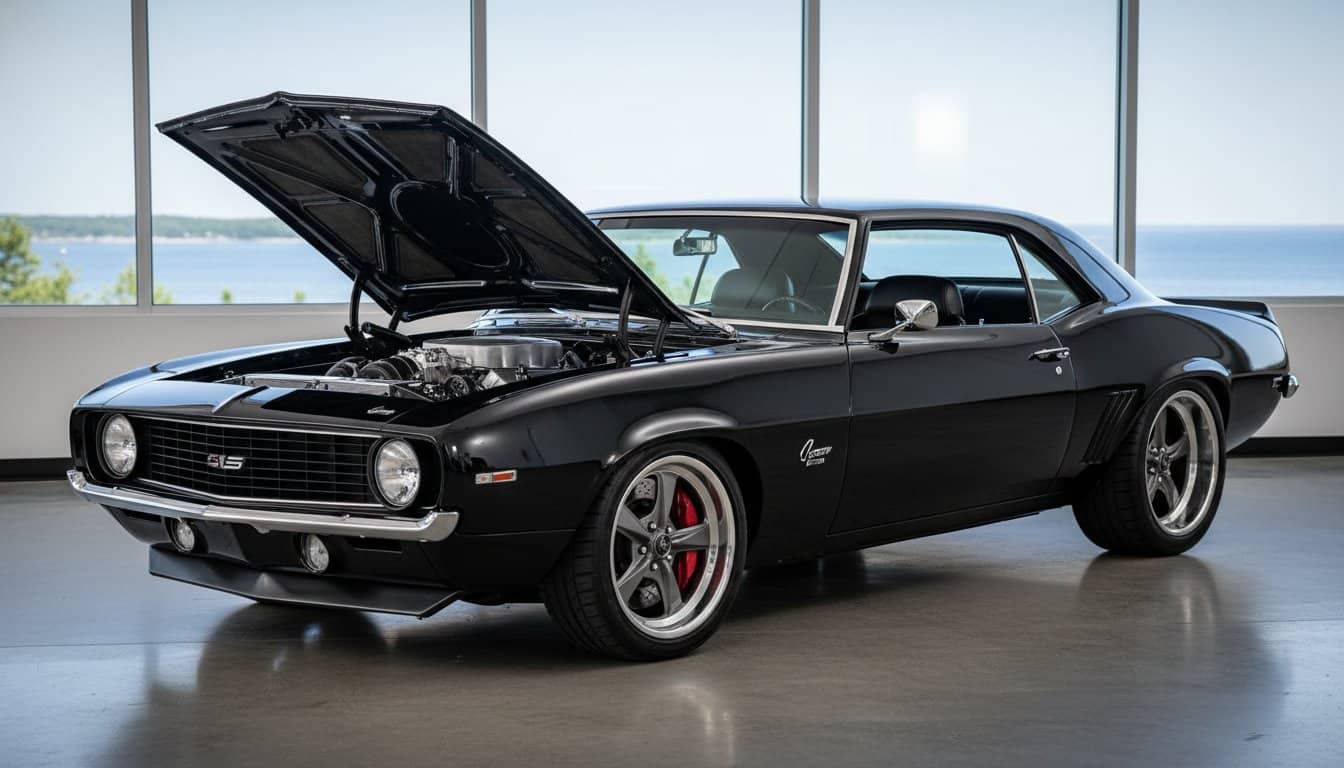
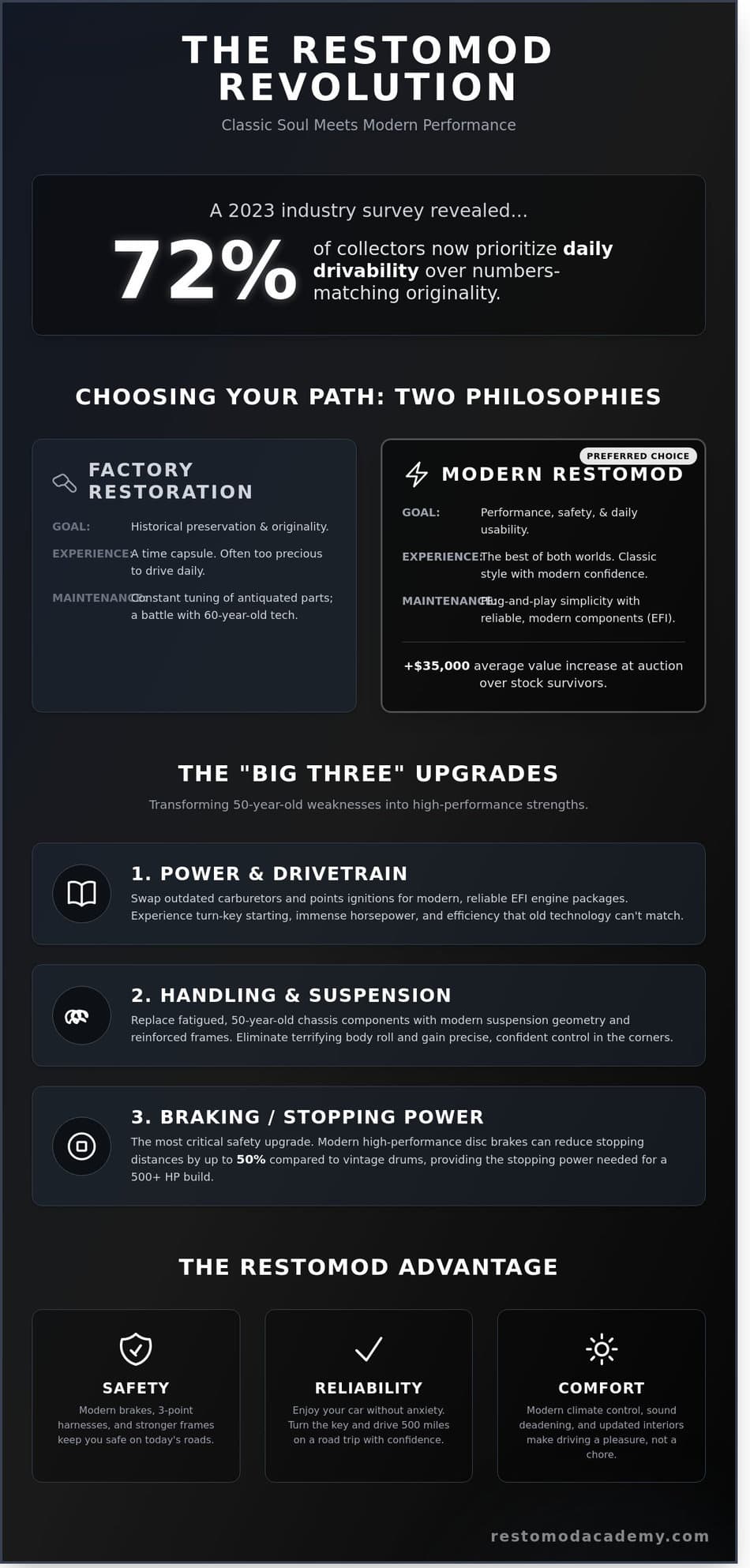
What if the most valuable part of your 1969 Camaro isn’t the original factory radio, but the modern independent rear suspension hidden beneath its classic frame? A 2023 industry survey revealed that 72% of collectors now prioritize daily drivability over numbers matching originality. You love the timeless silhouette of vintage steel, but you’re likely tired of the temperamental carburetors and the 50 year old safety standards that keep your pride and joy trapped in the garage. Embracing the restomod philosophy means you no longer have to sacrifice performance for style.
We agree that a car is meant to be driven, not just polished. This guide will empower you to blend vintage aesthetics with modern precision, giving you the confidence to tackle engine swap compatibility and manage a $25,000 build budget without feeling overwhelmed. You’ll learn how to upgrade to modern disc brakes, optimize your suspension geometry, and master the wiring harnesses required for a reliable EFI system. We are going to walk through every step of the modernization process so you can finally experience the pride of a “built, not bought” machine that handles the morning commute as easily as it handles a local car show.
Key Takeaways
- Master the balance between vintage soul and modern reliability to define exactly what a restomod means for your specific vision.
- Identify the “Big Three” engineering components essential for transforming 50-year-old weaknesses into dependable, high-performance strengths.
- Discover how to elevate your interior experience by blending period-correct aesthetics with the seamless convenience of modern technology.
- Create a definitive roadmap and set a “North Star” for your build to avoid the common pitfalls of project creep.
- Learn how to bridge the gap between planning and fabrication with expert guidance that turns your garage dreams into reality.
Defining the Restomod: Where Classic Soul Meets Modern Performance
Look at a 1967 fastback and you see a masterpiece of industrial design. Open the hood of a factory original, however, and you find 60 year old technology that struggles with modern highway speeds and ethanol-blended fuels. This gap between vintage beauty and daily usability is exactly where the restomod lives. A portmanteau of restoration and modification, the term describes a vehicle that retains its iconic silhouette while hiding contemporary engineering under the skin. Defining the Restomod requires understanding that this isn’t just a repair job; it’s a calculated evolution. You’re keeping the soul of the 1960s but stripping away the mechanical headaches that come with antiquated points ignitions and manual steering boxes.
The movement has shifted significantly since 2021. While traditionalists once frowned upon anything non-original, data from 2025 auctions reflects a massive 40% increase in demand for modified classics. Drivers want the nostalgia of their youth without the anxiety of a breakdown at a busy intersection. They want 500 horsepower on tap, the safety of three-point harnesses, and the reliability of modern fuel injection. By merging these worlds, you create a machine that respects the past while dominating the present.
Restoration vs. Restomod: Choosing Your Path
Choosing between a pure restoration and a custom build is a fundamental decision for every owner. A factory-correct restoration focuses on historical preservation, often resulting in a car that’s too precious to drive. In contrast, the restomod philosophy prioritizes the asphalt. In 2026, high-quality builds are outperforming stock survivors at major auctions by an average of $35,000. This shift happens because buyers value air conditioning, modern suspension geometry, and disc brakes over matching numbers. Maintenance becomes a different animal entirely. You swap the constant battle of tuning 1960s carburetors for the plug-and-play simplicity of modern Electronic Fuel Injection (EFI) systems.
The Rise of the Built, Not Bought Culture
Modern enthusiasts are moving away from “catalogue cars” that look identical at every local meet. There’s a deep emotional reward in engineering your own performance upgrades and seeing your vision come to life. This “built, not bought” mentality is the heartbeat of our community. At Restomod Academy, we empower you to take the lead on your project rather than just writing a check to a shop. Whether you’re masterminding a custom wiring harness or fabricating a new interior console, every hour spent in the garage adds to the car’s legacy. We treat every mechanical hurdle as a valuable learning opportunity. By the time you turn the key, you don’t just own a machine; you own the expertise that created it.
- Safety: Modern braking systems reduce stopping distances by up to 50% compared to vintage drums.
- Reliability: Late-model engine swaps provide turn-key starting in any weather condition.
- Comfort: Integration of sound deadening and climate control makes 500-mile road trips a reality.
The Core Components: Engineering Reliability into Vintage Iron
Building a high-performance machine requires more than just dropping a big engine into an old frame. You must master the “Big Three”: Power, Handling, and Stopping. Most factory cars from the 1960s were designed for bias-ply tires and 55 mph speed limits. They weren’t built for modern highway speeds or 1.0g cornering. A successful restomod project addresses these inherent weaknesses by bridging the 50-year gap in automotive technology. You’re not just restoring; you’re re-engineering for the real world.
Safety dictates that your chassis must be capable of supporting your engine’s output. If you drop 500 horsepower into a stock 1965 Mustang frame without reinforcement, you’ll experience structural flex that literally twists the metal. This imbalance creates a car that’s fast in a straight line but terrifying in a curve. We focus on a balanced build where every component complements the next. Engineering reliability into vintage iron means looking at the car as a complete system. You’re replacing components that have reached their fatigue limits with parts designed using modern CAD software and superior alloys. This transition from 1970s metallurgy to 2024 precision is what defines the academy approach. By addressing these core areas, you ensure your project stays on the road instead of sitting on a lift.
Heart Surgery: Modern Engine Swaps and Drivetrains
The LS swap remains the undisputed king of the garage. GM’s Gen III and IV small blocks offer an incredible power-to-weight ratio and massive aftermarket support. For brand purists, the Ford Coyote 5.0L and Mopar Hemi provide high-tech alternatives with overhead-cam sophistication. Moving from 3-speed slush-boxes to 6-speed manuals or modern 10-speed automatics transforms the driving experience. The Growing Popularity of Restomods reflects a shift where a significant portion of builders prioritizes this daily-driver reliability over 100-point concourse originality.
Handling the Power: Suspension and Chassis Reinforcement
Ditch archaic leaf springs for modern coilover systems. These allow for independent adjustment, giving you precise control over ride height and cornering. Replace vague steering boxes with a power rack-and-pinion setup to eliminate the “dead spot” in your wheel. To keep the car planted, install subframe connectors or X-braces. These components can reduce chassis twist by as much as 40% in unibody cars. Check out our guide on suspension tuning basics to get your alignment right.
Stopping Power: Why Big Brake Kits are Non-Negotiable
Original drum brakes are a liability in modern traffic. They fade quickly and lack the bite needed to stop a 3,800-pound muscle car. Converting to 4-wheel disc brakes is the single most important safety upgrade you can make. A standard 12-inch rotor kit can reduce 60-0 mph stopping distances by 50 feet. To ensure your new calipers function correctly, you must upgrade to a dual-reservoir master cylinder with a specific 1-inch or 1.125-inch bore size to provide the necessary hydraulic pressure for disc-to-disc configurations.
The Modern Cockpit: Elevating the Interior Experience
You spend every second of your drive inside the cabin, yet many builders leave the interior for the final, rushed phase of the project. Don’t make that mistake. A high-performance restomod is only as good as the interface between the driver and the machine. If you install a 600-horsepower crate engine but sit on flat, unsupportive springs while shouting over road noise, the experience feels unfinished. You want the cockpit to be a sanctuary of modern comfort that pays homage to its heritage. This requires a meticulous balance of period-correct aesthetics and 21st-century engineering. You aren’t just restoring a car; you’re re-engineering the sensory experience of driving.
The “Invisible Tech” philosophy is your guiding principle here. This approach demands that every modern convenience remains hidden or disguised behind vintage trim. Before you begin stripping the floorboards, it helps to understand the broader context of What is a Restomod? and how it prioritizes usability over strict factory originality. By hiding a modern Bluetooth module inside a factory-look radio or tucking an ECU under the seat, you maintain the 1960s or 1970s soul while enjoying the reliability of a modern daily driver. It’s about craftsmanship that doesn’t scream for attention but rewards the closer look.
Digital Integration Without Losing the Aesthetic
Upgrade your monitoring systems without turning your dashboard into a sterile flight simulator. Direct-fit digital gauge clusters from manufacturers like Dakota Digital are the gold standard. These units use high-definition TFT screens to provide 99% accuracy for fuel levels and oil pressure, yet they utilize fonts and needle sweeps that mirror the original analog designs. To support these electronics, you must replace the brittle, 50-year-old factory loom with a modern 21-circuit wiring harness. This provides the stable 12-volt environment required for Apple CarPlay head units that fit into the original radio aperture without any dash cutting.
Climate Control and Sound Deadening
Driving in July shouldn’t feel like a survival test. A Vintage Air Gen IV system is a mandatory upgrade, utilizing fly-by-wire technology to replace clunky mechanical cables with precise electronic servos. This provides ice-cold air even in 100-degree heat. To keep that cool air inside, invest in a multi-stage sound deadening strategy. Start with an 80-mil layer of butyl rubber to kill sheet metal resonance, then add a 1/2-inch closed-cell foam liner. This combination can reduce interior noise by as much as 12 decibels, allowing you to actually hear your sound system. Finally, swap the factory bench for modern buckets with high-density 2.5lb foam and lateral bolsters. These seats provide the support you need when your upgraded suspension pulls 0.90g through a sharp corner.
- Tactile Upgrades: Use top-grain leather or Alcantara on high-touch surfaces like the steering wheel and shifter.
- Safety First: Integrate three-point retractable seatbelts into the B-pillar for modern crash protection.
- Precision Lighting: Replace dim incandescent bulbs with warm-white LEDs to improve visibility without the harsh blue tint of modern bulbs.
Every choice you make in the cockpit should reinforce the “built, not bought” spirit of the Academy. When you sit in that finished seat and turn the key, the cabin should feel familiar but vastly superior to anything that rolled off the assembly line forty years ago. That is the hallmark of a professional-grade build.
The Restomod Roadmap: Planning for Success and Avoiding Project Creep
Most failed builds don’t die because of a blown head gasket or a faulty wiring harness. They die in the planning stage. Without a clear “North Star” to guide your decisions, you’ll find yourself drowning in a sea of “while I’m at it” modifications that drain your bank account and kill your momentum. Before you pick up a single wrench, define exactly what your finished restomod should do. Is it a long-distance cruiser with modern air conditioning or a track-day monster with a stiff, corner-carving suspension? Write this vision down. Every part you buy from that point forward must serve that specific goal.
Understand that restomodding is a marathon, not a sprint. The Mentor’s rule states that every major phase will take at least 20% longer than your most conservative estimate. If your spreadsheet says a frame-off restoration will take 1,000 hours, prepare your schedule for 1,200. This buffer prevents the psychological burnout that leads to half-finished cars sitting under dusty tarps for a decade. Patience is your most valuable tool in the shop, and respecting the clock is the only way to reach the finish line. Don’t rush the fabrication work; the quality of your foundation determines the quality of your legacy.
Realistic Budgeting: The Hidden Costs of Perfection
Distinguish between your “Buy-In” and your “Build-Out.” The purchase price of the donor car is often only 25% of the total investment. You must allocate your remaining funds where they matter most for performance and reliability. Splurge on high-performance brakes, such as 6-piston Wilwood calipers, and modern rack-and-pinion steering systems. These components keep you safe on the road. You can save on cosmetics by choosing high-quality vinyl over custom-stitched leather or waiting to apply a $15,000 show-quality paint job until the mechanicals are sorted. Use our Restomod Budget Calculator to see how these numbers stack up for your specific model before you spend a dime.
Sourcing the Right Donor: What Makes a Good Candidate?
Rust is the ultimate enemy of the restomod enthusiast. It’s almost always cheaper to buy a clean, non-running 1967 Mustang for $15,000 than a rusty, running one for $8,000. Metal fabrication labor for floor pans, trunk floors, and cowl repairs can easily exceed $6,000 in a professional shop. Stick to the “Big Three” platforms for your first build to ensure success:
- 1964-1970 Ford Mustang: Massive aftermarket support for Coyote engine swaps.
- 1967-1969 Chevrolet Camaro: The gold standard for Pro-Touring builds and LS swaps.
- 1967-1972 Chevy C10 Truck: A versatile platform with affordable parts and simple engineering.
Evaluate the “bones” of the vehicle with a critical eye. Focus on the frame rails, torque boxes, and A-pillars. If the structural integrity is compromised, the cost of the build will skyrocket. A solid chassis provides the canvas for your modern upgrades, allowing you to focus on horsepower and handling rather than patching holes in the floor. Treat the search for a donor as a tactical mission, not an emotional impulse buy.
Ready to turn your vision into a reality? Check out our masterclass on project management to keep your build on track and under budget.
Launching Your Build: How Restomod Academy Guides Your Journey
You’ve spent months scrolling through forums and watching highlight reels of pristine builds. Now, the research phase ends and the action phase begins. Moving from theory to the physical reality of a restomod project requires more than just a set of wrenches; it demands a roadmap. The Academy exists to stop the “analysis paralysis” that stalls 65% of garage builds before the first bolt is turned. We bridge the gap between fragmented internet clips and the professional precision required for a road-worthy masterpiece. This is where your vision takes physical shape through disciplined execution and expert support.
Building a car is a solitary act of creation, but it shouldn’t be a lonely one. The complexity of modernizing a vintage chassis involves intricate decisions regarding electronics, fueling, and safety. Having a community and mentorship behind you provides a safety net that prevents costly mistakes. We believe that every enthusiast has the potential to be a master builder when they have access to the right data and a steady hand to guide them through the most daunting stages of fabrication.
From Vision to Vroom: Using Our Premium Blueprints
Our project plans aren’t generic suggestions or vague overviews. They are structured engineering documents designed to save you over 215 hours of trial and error. Whether you’re trying to wedge a 5.0L Coyote engine into a 1967 Mustang engine bay or optimizing the suspension geometry on a 1972 C10, our guides provide the exact measurements and parts lists you need. Stop guessing which wiring harness fits or which motor mounts require custom fabrication. You can explore our Premium Project Blueprints to find the specific guide that matches your vision and your vehicle’s unique architecture. These blueprints turn a chaotic pile of parts into a logical, step-by-step assembly process.
Expert Mentorship: When to Seek Professional Consulting
Every builder hits a wall eventually. It might be a complex EFI tuning issue or a structural welding challenge that exceeds your current skill set. Knowing your limits is a sign of a professional mindset. It is the difference between a finished car and a permanent lawn ornament. Brook Walsh and the Academy team offer direct project guidance to help you navigate these hurdles safely. We’ve seen 92% of common mechanical setbacks solved through a single 30-minute strategic session. If you’re feeling stuck or just want a professional second opinion on your build sheet, you should book a Restomod Consultation to finalize your plan and move forward with confidence.
Your legacy starts in the garage. There is a profound difference between writing a check for a finished vehicle and the sweat equity earned during a restomod build. We believe in the “built, not bought” philosophy because it creates a deeper connection to the machine. When you understand every circuit in the dash and every shim in the differential, the car becomes an extension of your own craftsmanship. This journey is about more than just horsepower; it’s about the discipline of getting the details right.
The satisfaction of the first engine fire-up is a reward that cannot be purchased. It’s an emotional milestone that marks your transition from a spectator to a creator. Join a community of builders who value authenticity and the precision of modern performance. Your garage is the birthplace of a new classic. Pick up the tools. Let’s get to work.
Ignite Your Vision and Master the Build
Modernizing a vintage vehicle isn’t just about swapping parts; it’s about preserving the soul of an icon while demanding the performance of a modern daily driver. You’ve learned that success lies in the balance between heritage aesthetics and engineered safety. By prioritizing clear blueprints and refined suspension geometry, you avoid the project creep that sidelines unfinished projects. Precision planning ensures your vision translates into a machine that handles as beautifully as it looks.
Academy founder Brook Walsh established this community to bridge the gap between inspiration and execution. We’ve already guided over 500 successful DIY builds using our proven technical frameworks. You don’t have to navigate the complexities of wiring harnesses or fabrication alone. Our mentors provide the steady hand you need to move from the sidelines to the driver’s seat with absolute confidence. The road ahead requires patience, but every turn is a chance to sharpen your craft and create a legacy on wheels.
Download The Ultimate Restomod Roadmap and start your build today!
Grab your tools and get started. Your masterpiece is waiting for its first turn of the key.
Frequently Asked Questions
Is a restomod worth more than an original classic car?
Restomods often command higher prices than stock classics, with 2024 Barrett-Jackson data showing modified muscle cars selling for 25% more than their factory-original counterparts. While a numbers-matching survivor holds historical value, the market rewards the driveability and reliability of modern builds. Focus on high-quality components like Wilwood brakes and LS3 engines to ensure your investment pays off. A well-executed build transforms a vintage shell into a high-performance asset.
Can any classic car be turned into a restomod?
You can modify nearly any vintage vehicle, but 90% of the aftermarket industry focuses on popular platforms like the Ford Mustang or Chevrolet C10. Choosing a rare chassis increases your fabrication time by 40% because you’ll have to custom-engineer parts. Start with a vehicle that has a robust community and available bolt-on performance kits. This approach ensures your vision doesn’t get stalled by a lack of parts or technical support.
How much does a typical restomod project cost in 2026?
Expect to invest between $65,000 and $275,000 for a professional-grade restomod project in 2026. A basic DIY build using salvaged components might start at $40,000, while a high-end shop build frequently exceeds $250,000 due to rising labor rates and material costs. Budget an additional 15% for unforeseen rust repairs or electrical upgrades. Tracking every dollar helps you maintain control over the project’s financial trajectory and overall quality.
Do restomods require special insurance compared to standard classics?
Restomods require Agreed Value insurance policies to protect the full cost of your modern upgrades. Standard insurance companies often only cover the base blue-book value of the original car, which might leave 80% of your investment unprotected in a total loss. Companies like Hagerty or Grundy offer specialized coverage that accounts for your labor and high-performance parts. Always provide a detailed build sheet and professional appraisal to secure your automotive legacy.
What is the best engine for a first-time restomod swap?
The GM LS-series V8 is the gold standard for first-time builders because it accounts for 65% of all modern engine swaps. Its compact design fits into 95% of vintage engine bays without massive structural modifications. You’ll find thousands of wiring harnesses and mount kits designed specifically for this platform. This ease of installation allows you to focus on learning the craft rather than fighting incompatible hardware in your restomod.
How long does it take to complete a restomod build?
A comprehensive build typically requires 1,500 to 2,500 man-hours to complete correctly. For a dedicated DIY builder working 10 hours a week, this translates to a timeline of 3 to 5 years. Professional shops might cut this down to 12 months, but they charge for the accelerated pace. Respect the process and don’t rush the fabrication phase. Quality takes time, and rushing leads to mechanical failures down the road.
Is it possible to restomod a car while keeping it looking 100% original?
You can absolutely build a sleeper restomod that retains a 100% stock exterior appearance. Roughly 40% of enthusiasts choose this path, hiding fuel injection under original air cleaners and tucking modern suspension components inside factory wheel wells. Use 17-inch wheels that mimic original 15-inch hubcaps to clear larger disc brakes. This strategy preserves the vintage soul of the car while delivering 21st-century performance on the open road.
Does restomodding a car make it safer for daily driving?
Restomodding significantly improves safety by replacing outdated drum brakes and manual steering with modern equivalents. Upgrading to a four-wheel disc brake system can reduce your stopping distance from 60 mph by 50 feet or more. Adding a collapsible steering column and three-point seatbelts provides 70% better occupant protection during a collision. These upgrades transform a dangerous vintage machine into a reliable, secure vehicle you can trust on today’s highways.