
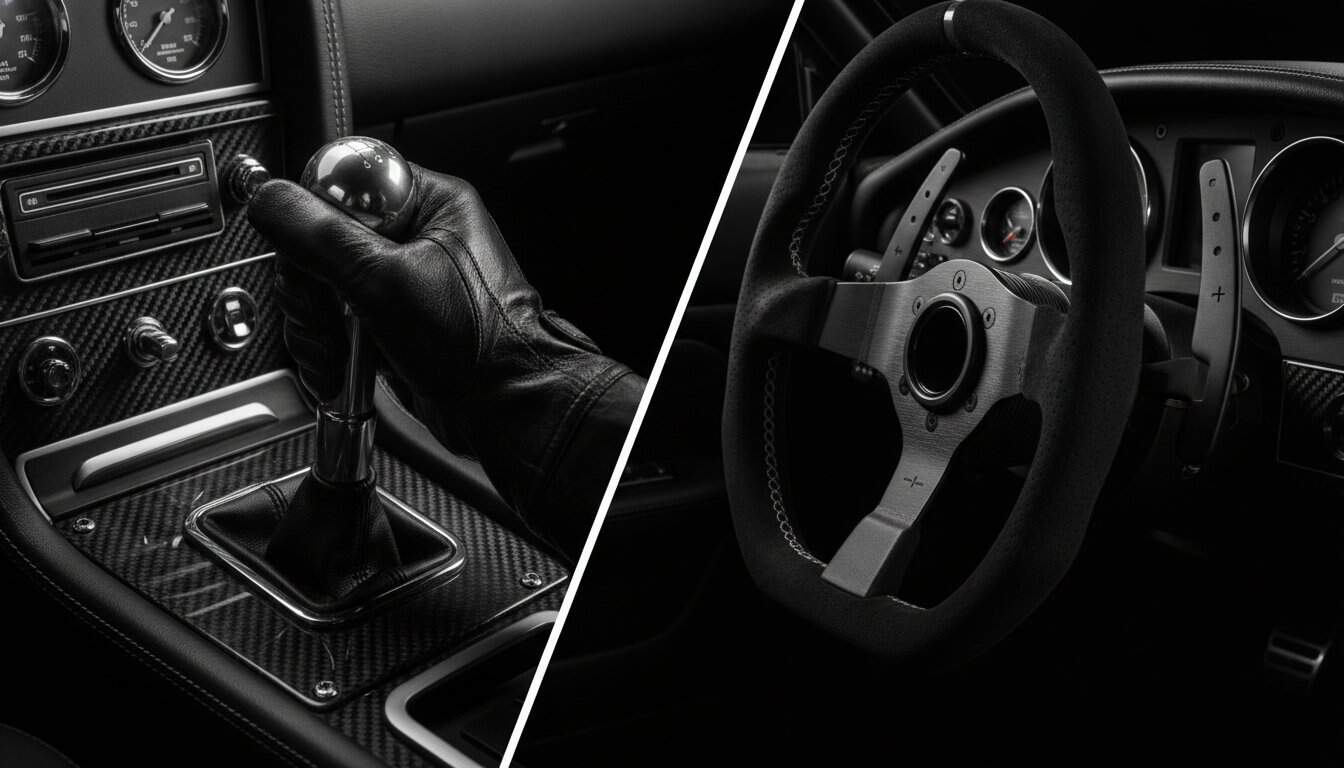
The most expensive gearbox you can buy isn’t the one with the highest price tag; it’s the one that makes you regret turning the key every Sunday morning. Choosing between the raw, tactile connection of a stick shift and the lightning-fast logic of a modern automatic is the most critical decision in your project. You likely feel the weight of this choice, fearing a build that’s either too taxing for a cruise or too disconnected for a spirited drive. It’s a common crossroads where many enthusiasts get stuck, paralyzed by the complexity of electronic controllers or the rising costs of high-performance manual swaps.
You deserve a drivetrain that translates your creative vision into asphalt-shredding reality. This guide empowers you to master the debate of automatic vs manual transmission for restomods, ensuring you select the perfect gearbox for your classic build. We’ll explore how each option alters the car’s character, demystify the technical hurdles of modern swaps, and provide a clear framework for matching your transmission to your specific engine. By the end, you’ll have the confidence to move from the planning phase to the workshop, ready to install a system that feels as good as it looks.
Key Takeaways
- Define your project’s soul by identifying how the gearbox choice serves as the mechanical bridge between your engine and the asphalt.
- Discover the raw satisfaction of rowing through gears with a modern manual swap that prioritizes a pure, non-electronic driving experience.
- Evaluate the precision of automatic vs manual transmission for restomods to see if the effortless cruising of a modern 10-speed unit aligns with your vision.
- Use our decision matrix to calculate the total cost of ownership, ensuring you account for every pedal, linkage, and controller before the first bolt turns.
- Gain the technical confidence to integrate your drivetrain as a single unit, focusing on critical details like driveshaft angle correction for a vibration-free ride.
The Great Drivetrain Debate-Defining Your Restomod Character
Think of your transmission as the mechanical translator between your engine’s raw energy and the asphalt beneath your tires. It is the single most important component for defining whether your build feels like a refined grand tourer or a rowdy street machine. When you weigh the options of an automatic vs manual transmission for restomods, you are not just choosing a part; you are deciding how you will interact with your car every time you leave the garage. This choice dictates the soul of the project.
Market trends in 2026 show a fascinating shift in how enthusiasts value these builds. While the manual gearbox once held an undisputed crown for resale value, high-end electronic automatics are now gaining massive respect among collectors. Buyers are increasingly looking for cars they can actually drive through traffic or on long coastal tours without fatigue. You must also consider the physical constraints of your vintage chassis. Modern gearboxes are often significantly larger than the units they replace, meaning your choice will directly impact how much metal you need to move or cut during the assembly phase.
Why the Transmission Choice Comes First
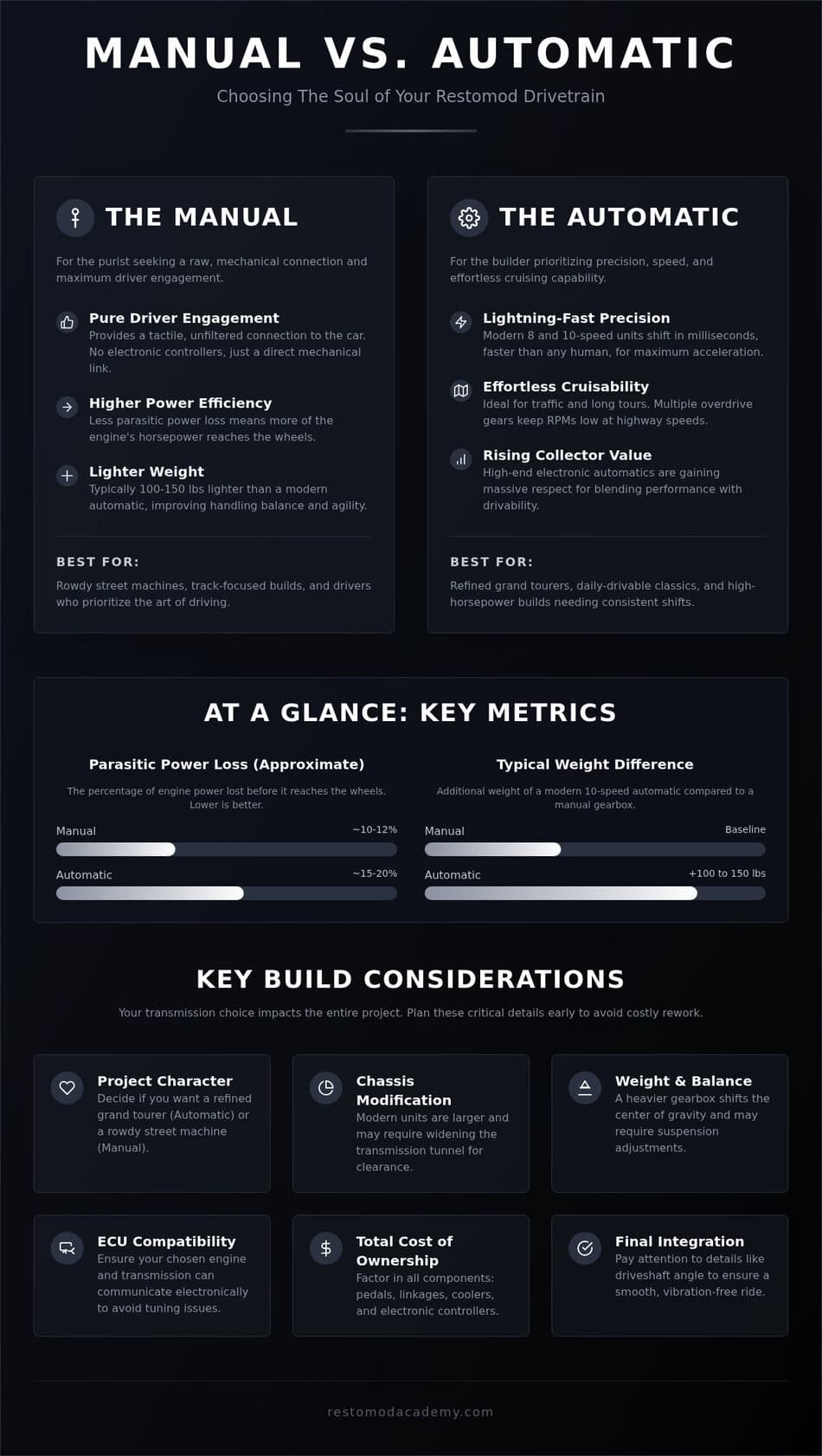
Commit to your gearbox early in the design process to avoid costly rework later. Your choice dictates necessary floor pan modifications and the required tunnel size. For example, fitting a modern 6-speed manual or a heavy-duty 10-speed automatic often requires widening the transmission tunnel to maintain proper clearance. This decision also affects the overall balance of your vintage machine. A heavier transmission shifts the center of gravity, which might require you to adjust your front suspension spring rates to keep the car level and responsive.
Compatibility is the final piece of the puzzle. If you are planning a specific engine swap, you must ensure the gearbox can communicate with the engine control unit. Some modern engines are designed to work in perfect harmony with specific transmissions, and fighting that natural pairing can lead to endless electronic headaches during the tuning phase.
The Evolution of the Restomod Handshake
The driving experience has come a long way from the slushy, three-speed automatics of the 1960s. We have transitioned into an era of 10-speed precision where shifts happen in milliseconds. To put this in perspective, it helps to understand the foundational principles of what is a restomod. The core goal is to blend classic aesthetics with modern performance, and the transmission is the handshake between those two worlds.
True restomods prioritize a level of drivability that old-school manuals simply cannot provide. Modern units offer multiple overdrive gears, allowing you to cruise at highway speeds with low RPMs while still having the torque to pull hard away from a stoplight. When deciding on an automatic vs manual transmission for restomods, remember that you are building a car for the future, not just recreating the limitations of the past.
The Case for the Manual-Mechanical Soul and Driver Engagement
Rowing through the gears of a high-performance manual gearbox provides a level of driver engagement that no paddle shifter can replicate. It’s the ultimate mechanical handshake between you and your machine. When debating the merits of an automatic vs manual transmission for restomods, the manual wins on the grounds of pure simplicity. You won’t find yourself wrestling with complex wiring harnesses or external transmission control modules. Instead, you get a direct link to the drivetrain that responds instantly to your right foot and left hand.
Weight is another critical factor to consider during your assembly. A modern manual gearbox often weighs 100 to 150 pounds less than a sophisticated 10-speed automatic. This reduction in front-end mass improves turn-in and overall handling balance, making the car feel more nimble on twisted backroads. Additionally, manual setups typically suffer from less parasitic power loss. Manuals usually lose about 10 to 12 percent of power between the flywheel and the wheels. Because there’s no heavy internal hydraulic pump to drive, more of your engine’s hard-earned horsepower actually reaches the rear tires.
Modern Manual Legends-Tremec T56 and TKX
Choose your hardware based on your car’s physical limits and your performance goals. The Tremec TKX is a game-changer for vintage muscle cars with notoriously tight transmission tunnels. It was engineered specifically for the aftermarket, featuring a streamlined case that eliminates the need for extensive floor pan surgery. If your project involves a high-horsepower Pro-Touring build, the T56 Magnum remains the gold standard. It handles massive torque loads while offering two overdrive gears for comfortable highway cruising. If you’re planning a high-output engine project, check out our definitive guide to an LS engine swap to see how these gearboxes integrate into a modern drivetrain.
The Reality of Daily Driving a Stick Shift
Don’t let the fear of a heavy clutch pedal deter you from the manual path. Modern hydraulic clutch conversion kits have revolutionized the experience, providing a light, consistent feel that rivals a modern commuter car. While stop-and-go traffic still requires more effort than an automatic, the trade-off is a heightened auditory experience. Every downshift and rev-match allows you to hear the nuance of your engine’s cam profile and exhaust note. If you find the technical details of pedal ratios and master cylinder sizing daunting, our Premium Project Blueprints can help you dial in the perfect feel for your build.
The Rise of the Modern Automatic-Precision Speed and Cruisability
Shed the outdated image of the unresponsive slush-box. Modern electronic gearboxes like the GM 6L80 or the Ford 10R80 have fundamentally changed the conversation regarding an automatic vs manual transmission for restomods. These units deliver shift times measured in milliseconds, providing a level of precision that even the most seasoned driver cannot match with a traditional clutch. For high-performance drag and street builds, this consistency is a massive advantage. You get repeatable, lightning-fast gear changes that keep the engine in the meat of its power band, ensuring every ounce of torque translates into forward momentum.
Beyond raw speed, the greatest gift of a modern automatic is its versatility. Imagine cruising at 75 mph while your engine hums quietly at low RPMs. This is made possible by multiple overdrive gears that vintage transmissions simply lacked. Modern torque converters have also evolved significantly; they now feature sophisticated lock-up mechanisms that eliminate the mushy, disconnected feel of 1960s units. You get a crisp, mechanical connection to the road that feels surprisingly similar to a manual once the car is in motion, providing the best of both worlds for long-distance tours.
Electronic Control-The Brain Behind the Gears
Mastering a modern swap requires you to embrace the Transmission Control Module (TCM). This small computer acts as the brain of your drivetrain, orchestrating every shift with surgical accuracy. You aren’t stuck with factory settings, either. Use a handheld programmer or a laptop to tune your shift points and adjust shift firmness to match your driving style. This level of customization allows you to integrate the transmission perfectly with modern fuel injection systems, creating a cohesive powertrain that feels like it was factory-engineered for your classic chassis.
Bridging the Gap-Paddle Shifters and Manumatics
You don’t have to sacrifice the fun of shifting just because you chose an automatic. Adding paddle shifters to your classic interior provides a supercar feel while maintaining the convenience of an auto-mode for heavy traffic. Modern electronic controllers offer incredibly responsive manual modes, allowing you to click through gears with a tap of your finger. Before you buy your hardware, take a moment to explore our category for product reviews to see which shift controllers offer the best tactile feedback and easiest installation for your specific project.
The Restomod Decision Matrix-Matching Gearbox to Build Goal
Choosing the right gearbox requires looking at your car as a complete ecosystem rather than a collection of parts. Your decision on an automatic vs manual transmission for restomods will ripple through every other mechanical choice, from the rear-end gear ratio to the stiffness of your rear suspension. If you choose an automatic, you might need softer rear springs to handle the smoother torque application. A manual car often requires more aggressive anti-squat geometry to manage the shock of hard shifts. For instance, a modern 10-speed automatic with its deep first gear and multiple overdrives allows you to run a much steeper rear gear for acceleration without sacrificing highway fuel economy. Conversely, a 5-speed manual might require a more conservative 3.55 or 3.08 rear gear to keep the engine from screaming at highway speeds.
Build Archetypes-Cruiser vs Pro-Touring vs Drag
Success starts with an honest assessment of how you will actually use the car. If your goal is a Sunday Cruiser for relaxed trips to the local show, select a modern automatic to enjoy effortless comfort and ease of use. For those building a Pro-Touring machine destined for autocross or track days, opt for a 6-speed manual to maintain total control over weight transfer and engine braking. High-torque builds focused on the drag strip often benefit most from a built 4L80E or a classic Turbo 400; these units provide the consistency and strength needed to survive repeated hard launches.
Budget and Complexity Comparison
Don’t let the initial purchase price of the transmission deceive you. A manual swap carries significant hidden costs, including high-performance flywheels, specialized bellhousings, and the often-frustrating task of hanging a clutch pedal in a car that never had one. Modern electronic automatics present a different challenge: wiring complexity. You must account for the time and tools needed to route a dedicated harness and integrate the Transmission Control Module with your existing sensors. While a manual conversion typically takes longer for physical installation and pedal setup, a modern electronic automatic swap requires nearly double the time for wiring integration and software debugging.
Aligning these technical requirements with your personal skill set is the key to a successful build. To ensure your drivetrain components work in perfect harmony, consider using our Premium Project Blueprints to map out every connection before you pick up a wrench.
Executing the Swap-Integration and Final Assembly
Approach your drivetrain installation as a single, unified system rather than a collection of disparate parts. The success of your project depends on how well the transmission integrates with the chassis and engine. Once you’ve navigated the debate of automatic vs manual transmission for restomods, you must turn your attention to the physical geometry of the swap. Start by verifying your driveshaft angles. Modern gearboxes are often longer than their vintage counterparts, which can alter the pinion angle and lead to destructive driveline vibrations if not corrected. If you’ve chosen a high-performance automatic, integrate a dedicated cooling system early. These units generate substantial heat, especially when paired with high-stall converters, and a secondary cooler is the best insurance policy against premature failure.
Your interior should reflect the same level of care as the mechanicals. Select a shifter that maintains the vintage aesthetic of your cabin while providing the precision of modern engineering. Whether it’s a classic Hurst-style stick or a gated automatic shifter, the tactile feel of that final connection is what you’ll experience most as a builder. This attention to detail ensures your project doesn’t just perform like a modern machine but also retains the heritage feel that makes classic cars so special.
The Drivetrain Handshake-Engine and Transmission
Mating a modern gearbox to a classic block requires surgical precision. For manual builds, you must verify your pilot bearing depth to ensure the input shaft is properly supported without bottoming out. For those opting for an electronic automatic, check your torque converter spacing against the flexplate with extreme care. If the converter is pulled too far forward from the pump, you risk immediate internal damage during the first few seconds of operation. For specific measurements and mating tips tailored to modern powerplants, refer to our definitive guide to an LS engine swap.
Safety and Finishing Touches
Don’t let the excitement of the first start-up cause you to overlook critical safety systems. Install a neutral safety switch to prevent the engine from firing while in gear, and wire up your reverse light triggers to remain compliant with modern safety standards. These details are often what separate a professional-grade build from an amateur project. When the time comes to fill the unit, use only the specific synthetic fluid and high-micron filtration recommended for your modern transmission. To ensure you have the specialized tools required for this level of assembly, consult our recommended gear list before you begin the final installation.
Fuel Your Vision with the Right Gearbox
Your drivetrain is more than just a list of parts on a spec sheet; it is the heartbeat of your entire project. Whether you choose the visceral engagement of a manual or the surgical precision of a modern electronic unit, your decision on an automatic vs manual transmission for restomods will dictate every mile you drive. You now have the framework to match your gearbox to your specific build archetype while ensuring critical details like driveshaft angles and cooling systems are integrated with precision. Remember that a successful swap is about more than just bolting a unit into place. It requires a cohesive plan that respects both vintage aesthetics and modern reliability.
Master these technical nuances before you buy your first component. You can access expert mentorship from seasoned builder Brook Walsh and join a community of DIY enthusiasts dedicated to precision. Download The Ultimate Restomod Guide to plan your perfect drivetrain and secure comprehensive blueprints for your engine and transmission integration. Every mechanical hurdle is simply a learning opportunity in disguise. Pick up your tools with confidence and start building the machine you’ve always envisioned.
Frequently Asked Questions
Is an automatic or manual better for restomod resale value?
Manual transmissions historically held the top spot for resale value due to their deep connection to the driving experience. However, the market in 2026 shows that high-end builds featuring modern 6 or 10-speed automatics are now reaching price parity. Buyers looking for a grand touring experience often prefer the ease of an automatic. Choose based on your target buyer; a track-focused car needs a stick, while a luxury cruiser thrives with a modern auto.
Can I put a modern 10-speed automatic in a 1960s muscle car?
You can certainly install a 10-speed automatic like the 10R80 into a classic chassis, but prepare for surgery. These units are physically much larger than vintage 3-speeds, so you will likely need to cut and widen your transmission tunnel. You must also integrate a dedicated electronic controller to manage the complex shift logic. This swap transforms a vintage machine into a modern highway star, provided you have the floor pan clearance to accommodate it.
How much does it cost to swap from an automatic to a manual in a restomod?
Swapping to a manual involves more than just the gearbox; you must budget for a complete system integration. This includes the clutch pedal assembly, hydraulic master cylinder, flywheel, and a high-performance clutch. You also need a specific bellhousing and potentially a new driveshaft. While hardware choices vary, the cumulative total of these supporting parts often equals or exceeds the price of the transmission itself. Plan your budget for the entire drivetrain unit from the start.
Do I need a computer to run a modern automatic transmission?
Most modern electronic gearboxes require a dedicated Transmission Control Module to function. Unlike vintage hydraulic units, these transmissions rely on sensors to determine shift timing and pressure. When weighing an automatic vs manual transmission for restomods, remember that the automatic adds a layer of electronic complexity. You will need to wire this controller into your engine’s harness and potentially use a laptop to calibrate shift firmness and points for your specific driving style.
Which transmission is best for an LS swap project?
The best choice for an LS swap depends on your horsepower goals and how you intend to drive. The T56 Magnum is the gold standard for manual LS builds, offering incredible strength and two overdrive gears. If you prefer an automatic, the 4L80E is a robust choice for high-torque applications, while the 6L80 provides a more modern feel with better gear spacing. Match the transmission’s torque rating to your engine’s peak output for long-term reliability.
Are modern manual transmissions like the Tremec TKX hard to install?
The Tremec TKX was engineered specifically to solve the fitment issues common in classic muscle cars. Its streamlined case allows it to fit into many factory transmission tunnels without the need for extensive cutting. While the physical box is easier to bolt in, you still must focus on the meticulous task of setting up the hydraulic clutch and ensuring perfect bellhousing alignment. It is an achievable project for a determined DIY builder with the right technical guidance.
What is the difference between a 4L60E and a 4L80E for a restomod?
The primary differences between these two units are torque capacity and physical dimensions. The 4L60E is based on a lighter design, making it ideal for street cruisers with moderate power. In contrast, the 4L80E is a heavy-duty unit derived from truck platforms, capable of handling significantly more torque but requiring more space under the car. When considering automatic vs manual transmission for restomods, choose the 4L80E if you plan on adding a supercharger or frequenting the drag strip.
Can I keep my original column shifter with a modern automatic swap?
You can keep your original column shifter by using an aftermarket cable linkage kit designed for modern swaps. These kits allow the vintage column lever to communicate with the shift arm on a modern electronic transmission. While it requires careful adjustment to ensure every gear gate aligns perfectly, it is the best way to maintain a factory-correct interior aesthetic. This setup hides the modern performance of your drivetrain behind a classic, nostalgic interface.
The most expensive gearbox you can buy isn’t the one with the highest price tag; it’s the one that makes you regret turning the key every Sunday morning. Choosing between the raw, tactile connection of a stick shift and the lightning-fast logic of a modern automatic is the most critical decision in your project. You likely feel the weight of this choice, fearing a build that’s either too taxing for a cruise or too disconnected for a spirited drive. It’s a common crossroads where many enthusiasts get stuck, paralyzed by the complexity of electronic controllers or the rising costs of high-performance manual swaps.
You deserve a drivetrain that translates your creative vision into asphalt-shredding reality. This guide empowers you to master the debate of automatic vs manual transmission for restomods, ensuring you select the perfect gearbox for your classic build. We’ll explore how each option alters the car’s character, demystify the technical hurdles of modern swaps, and provide a clear framework for matching your transmission to your specific engine. By the end, you’ll have the confidence to move from the planning phase to the workshop, ready to install a system that feels as good as it looks.
Key Takeaways
- Define your project’s soul by identifying how the gearbox choice serves as the mechanical bridge between your engine and the asphalt.
- Discover the raw satisfaction of rowing through gears with a modern manual swap that prioritizes a pure, non-electronic driving experience.
- Evaluate the precision of automatic vs manual transmission for restomods to see if the effortless cruising of a modern 10-speed unit aligns with your vision.
- Use our decision matrix to calculate the total cost of ownership, ensuring you account for every pedal, linkage, and controller before the first bolt turns.
- Gain the technical confidence to integrate your drivetrain as a single unit, focusing on critical details like driveshaft angle correction for a vibration-free ride.
The Great Drivetrain Debate-Defining Your Restomod Character
Think of your transmission as the mechanical translator between your engine’s raw energy and the asphalt beneath your tires. It is the single most important component for defining whether your build feels like a refined grand tourer or a rowdy street machine. When you weigh the options of an automatic vs manual transmission for restomods, you are not just choosing a part; you are deciding how you will interact with your car every time you leave the garage. This choice dictates the soul of the project.
Market trends in 2026 show a fascinating shift in how enthusiasts value these builds. While the manual gearbox once held an undisputed crown for resale value, high-end electronic automatics are now gaining massive respect among collectors. Buyers are increasingly looking for cars they can actually drive through traffic or on long coastal tours without fatigue. You must also consider the physical constraints of your vintage chassis. Modern gearboxes are often significantly larger than the units they replace, meaning your choice will directly impact how much metal you need to move or cut during the assembly phase.
Why the Transmission Choice Comes First
Commit to your gearbox early in the design process to avoid costly rework later. Your choice dictates necessary floor pan modifications and the required tunnel size. For example, fitting a modern 6-speed manual or a heavy-duty 10-speed automatic often requires widening the transmission tunnel to maintain proper clearance. This decision also affects the overall balance of your vintage machine. A heavier transmission shifts the center of gravity, which might require you to adjust your front suspension spring rates to keep the car level and responsive.
Compatibility is the final piece of the puzzle. If you are planning a specific engine swap, you must ensure the gearbox can communicate with the engine control unit. Some modern engines are designed to work in perfect harmony with specific transmissions, and fighting that natural pairing can lead to endless electronic headaches during the tuning phase.
The Evolution of the Restomod Handshake
The driving experience has come a long way from the slushy, three-speed automatics of the 1960s. We have transitioned into an era of 10-speed precision where shifts happen in milliseconds. To put this in perspective, it helps to understand the foundational principles of what is a restomod. The core goal is to blend classic aesthetics with modern performance, and the transmission is the handshake between those two worlds.
True restomods prioritize a level of drivability that old-school manuals simply cannot provide. Modern units offer multiple overdrive gears, allowing you to cruise at highway speeds with low RPMs while still having the torque to pull hard away from a stoplight. When deciding on an automatic vs manual transmission for restomods, remember that you are building a car for the future, not just recreating the limitations of the past.
The Case for the Manual-Mechanical Soul and Driver Engagement
Rowing through the gears of a high-performance manual gearbox provides a level of driver engagement that no paddle shifter can replicate. It’s the ultimate mechanical handshake between you and your machine. When debating the merits of an automatic vs manual transmission for restomods, the manual wins on the grounds of pure simplicity. You won’t find yourself wrestling with complex wiring harnesses or external transmission control modules. Instead, you get a direct link to the drivetrain that responds instantly to your right foot and left hand.
Weight is another critical factor to consider during your assembly. A modern manual gearbox often weighs 100 to 150 pounds less than a sophisticated 10-speed automatic. This reduction in front-end mass improves turn-in and overall handling balance, making the car feel more nimble on twisted backroads. Additionally, manual setups typically suffer from less parasitic power loss. Manuals usually lose about 10 to 12 percent of power between the flywheel and the wheels. Because there’s no heavy internal hydraulic pump to drive, more of your engine’s hard-earned horsepower actually reaches the rear tires.
Modern Manual Legends-Tremec T56 and TKX
Choose your hardware based on your car’s physical limits and your performance goals. The Tremec TKX is a game-changer for vintage muscle cars with notoriously tight transmission tunnels. It was engineered specifically for the aftermarket, featuring a streamlined case that eliminates the need for extensive floor pan surgery. If your project involves a high-horsepower Pro-Touring build, the T56 Magnum remains the gold standard. It handles massive torque loads while offering two overdrive gears for comfortable highway cruising. If you’re planning a high-output engine project, check out our definitive guide to an LS engine swap to see how these gearboxes integrate into a modern drivetrain.
The Reality of Daily Driving a Stick Shift
Don’t let the fear of a heavy clutch pedal deter you from the manual path. Modern hydraulic clutch conversion kits have revolutionized the experience, providing a light, consistent feel that rivals a modern commuter car. While stop-and-go traffic still requires more effort than an automatic, the trade-off is a heightened auditory experience. Every downshift and rev-match allows you to hear the nuance of your engine’s cam profile and exhaust note. If you find the technical details of pedal ratios and master cylinder sizing daunting, our Premium Project Blueprints can help you dial in the perfect feel for your build.
The Rise of the Modern Automatic-Precision Speed and Cruisability
Shed the outdated image of the unresponsive slush-box. Modern electronic gearboxes like the GM 6L80 or the Ford 10R80 have fundamentally changed the conversation regarding an automatic vs manual transmission for restomods. These units deliver shift times measured in milliseconds, providing a level of precision that even the most seasoned driver cannot match with a traditional clutch. For high-performance drag and street builds, this consistency is a massive advantage. You get repeatable, lightning-fast gear changes that keep the engine in the meat of its power band, ensuring every ounce of torque translates into forward momentum.
Beyond raw speed, the greatest gift of a modern automatic is its versatility. Imagine cruising at 75 mph while your engine hums quietly at low RPMs. This is made possible by multiple overdrive gears that vintage transmissions simply lacked. Modern torque converters have also evolved significantly; they now feature sophisticated lock-up mechanisms that eliminate the mushy, disconnected feel of 1960s units. You get a crisp, mechanical connection to the road that feels surprisingly similar to a manual once the car is in motion, providing the best of both worlds for long-distance tours.
Electronic Control-The Brain Behind the Gears
Mastering a modern swap requires you to embrace the Transmission Control Module (TCM). This small computer acts as the brain of your drivetrain, orchestrating every shift with surgical accuracy. You aren’t stuck with factory settings, either. Use a handheld programmer or a laptop to tune your shift points and adjust shift firmness to match your driving style. This level of customization allows you to integrate the transmission perfectly with modern fuel injection systems, creating a cohesive powertrain that feels like it was factory-engineered for your classic chassis.
Bridging the Gap-Paddle Shifters and Manumatics
You don’t have to sacrifice the fun of shifting just because you chose an automatic. Adding paddle shifters to your classic interior provides a supercar feel while maintaining the convenience of an auto-mode for heavy traffic. Modern electronic controllers offer incredibly responsive manual modes, allowing you to click through gears with a tap of your finger. Before you buy your hardware, take a moment to explore our category for product reviews to see which shift controllers offer the best tactile feedback and easiest installation for your specific project.
The Restomod Decision Matrix-Matching Gearbox to Build Goal
Choosing the right gearbox requires looking at your car as a complete ecosystem rather than a collection of parts. Your decision on an automatic vs manual transmission for restomods will ripple through every other mechanical choice, from the rear-end gear ratio to the stiffness of your rear suspension. If you choose an automatic, you might need softer rear springs to handle the smoother torque application. A manual car often requires more aggressive anti-squat geometry to manage the shock of hard shifts. For instance, a modern 10-speed automatic with its deep first gear and multiple overdrives allows you to run a much steeper rear gear for acceleration without sacrificing highway fuel economy. Conversely, a 5-speed manual might require a more conservative 3.55 or 3.08 rear gear to keep the engine from screaming at highway speeds.
Build Archetypes-Cruiser vs Pro-Touring vs Drag
Success starts with an honest assessment of how you will actually use the car. If your goal is a Sunday Cruiser for relaxed trips to the local show, select a modern automatic to enjoy effortless comfort and ease of use. For those building a Pro-Touring machine destined for autocross or track days, opt for a 6-speed manual to maintain total control over weight transfer and engine braking. High-torque builds focused on the drag strip often benefit most from a built 4L80E or a classic Turbo 400; these units provide the consistency and strength needed to survive repeated hard launches.
Budget and Complexity Comparison
Don’t let the initial purchase price of the transmission deceive you. A manual swap carries significant hidden costs, including high-performance flywheels, specialized bellhousings, and the often-frustrating task of hanging a clutch pedal in a car that never had one. Modern electronic automatics present a different challenge: wiring complexity. You must account for the time and tools needed to route a dedicated harness and integrate the Transmission Control Module with your existing sensors. While a manual conversion typically takes longer for physical installation and pedal setup, a modern electronic automatic swap requires nearly double the time for wiring integration and software debugging.
Aligning these technical requirements with your personal skill set is the key to a successful build. To ensure your drivetrain components work in perfect harmony, consider using our Premium Project Blueprints to map out every connection before you pick up a wrench.
Executing the Swap-Integration and Final Assembly
Approach your drivetrain installation as a single, unified system rather than a collection of disparate parts. The success of your project depends on how well the transmission integrates with the chassis and engine. Once you’ve navigated the debate of automatic vs manual transmission for restomods, you must turn your attention to the physical geometry of the swap. Start by verifying your driveshaft angles. Modern gearboxes are often longer than their vintage counterparts, which can alter the pinion angle and lead to destructive driveline vibrations if not corrected. If you’ve chosen a high-performance automatic, integrate a dedicated cooling system early. These units generate substantial heat, especially when paired with high-stall converters, and a secondary cooler is the best insurance policy against premature failure.
Your interior should reflect the same level of care as the mechanicals. Select a shifter that maintains the vintage aesthetic of your cabin while providing the precision of modern engineering. Whether it’s a classic Hurst-style stick or a gated automatic shifter, the tactile feel of that final connection is what you’ll experience most as a builder. This attention to detail ensures your project doesn’t just perform like a modern machine but also retains the heritage feel that makes classic cars so special.
The Drivetrain Handshake-Engine and Transmission
Mating a modern gearbox to a classic block requires surgical precision. For manual builds, you must verify your pilot bearing depth to ensure the input shaft is properly supported without bottoming out. For those opting for an electronic automatic, check your torque converter spacing against the flexplate with extreme care. If the converter is pulled too far forward from the pump, you risk immediate internal damage during the first few seconds of operation. For specific measurements and mating tips tailored to modern powerplants, refer to our definitive guide to an LS engine swap.
Safety and Finishing Touches
Don’t let the excitement of the first start-up cause you to overlook critical safety systems. Install a neutral safety switch to prevent the engine from firing while in gear, and wire up your reverse light triggers to remain compliant with modern safety standards. These details are often what separate a professional-grade build from an amateur project. When the time comes to fill the unit, use only the specific synthetic fluid and high-micron filtration recommended for your modern transmission. To ensure you have the specialized tools required for this level of assembly, consult our recommended gear list before you begin the final installation.
Fuel Your Vision with the Right Gearbox
Your drivetrain is more than just a list of parts on a spec sheet; it is the heartbeat of your entire project. Whether you choose the visceral engagement of a manual or the surgical precision of a modern electronic unit, your decision on an automatic vs manual transmission for restomods will dictate every mile you drive. You now have the framework to match your gearbox to your specific build archetype while ensuring critical details like driveshaft angles and cooling systems are integrated with precision. Remember that a successful swap is about more than just bolting a unit into place. It requires a cohesive plan that respects both vintage aesthetics and modern reliability.
Master these technical nuances before you buy your first component. You can access expert mentorship from seasoned builder Brook Walsh and join a community of DIY enthusiasts dedicated to precision. Download The Ultimate Restomod Guide to plan your perfect drivetrain and secure comprehensive blueprints for your engine and transmission integration. Every mechanical hurdle is simply a learning opportunity in disguise. Pick up your tools with confidence and start building the machine you’ve always envisioned.
Frequently Asked Questions
Is an automatic or manual better for restomod resale value?
Manual transmissions historically held the top spot for resale value due to their deep connection to the driving experience. However, the market in 2026 shows that high-end builds featuring modern 6 or 10-speed automatics are now reaching price parity. Buyers looking for a grand touring experience often prefer the ease of an automatic. Choose based on your target buyer; a track-focused car needs a stick, while a luxury cruiser thrives with a modern auto.
Can I put a modern 10-speed automatic in a 1960s muscle car?
You can certainly install a 10-speed automatic like the 10R80 into a classic chassis, but prepare for surgery. These units are physically much larger than vintage 3-speeds, so you will likely need to cut and widen your transmission tunnel. You must also integrate a dedicated electronic controller to manage the complex shift logic. This swap transforms a vintage machine into a modern highway star, provided you have the floor pan clearance to accommodate it.
How much does it cost to swap from an automatic to a manual in a restomod?
Swapping to a manual involves more than just the gearbox; you must budget for a complete system integration. This includes the clutch pedal assembly, hydraulic master cylinder, flywheel, and a high-performance clutch. You also need a specific bellhousing and potentially a new driveshaft. While hardware choices vary, the cumulative total of these supporting parts often equals or exceeds the price of the transmission itself. Plan your budget for the entire drivetrain unit from the start.
Do I need a computer to run a modern automatic transmission?
Most modern electronic gearboxes require a dedicated Transmission Control Module to function. Unlike vintage hydraulic units, these transmissions rely on sensors to determine shift timing and pressure. When weighing an automatic vs manual transmission for restomods, remember that the automatic adds a layer of electronic complexity. You will need to wire this controller into your engine’s harness and potentially use a laptop to calibrate shift firmness and points for your specific driving style.
Which transmission is best for an LS swap project?
The best choice for an LS swap depends on your horsepower goals and how you intend to drive. The T56 Magnum is the gold standard for manual LS builds, offering incredible strength and two overdrive gears. If you prefer an automatic, the 4L80E is a robust choice for high-torque applications, while the 6L80 provides a more modern feel with better gear spacing. Match the transmission’s torque rating to your engine’s peak output for long-term reliability.
Are modern manual transmissions like the Tremec TKX hard to install?
The Tremec TKX was engineered specifically to solve the fitment issues common in classic muscle cars. Its streamlined case allows it to fit into many factory transmission tunnels without the need for extensive cutting. While the physical box is easier to bolt in, you still must focus on the meticulous task of setting up the hydraulic clutch and ensuring perfect bellhousing alignment. It is an achievable project for a determined DIY builder with the right technical guidance.
What is the difference between a 4L60E and a 4L80E for a restomod?
The primary differences between these two units are torque capacity and physical dimensions. The 4L60E is based on a lighter design, making it ideal for street cruisers with moderate power. In contrast, the 4L80E is a heavy-duty unit derived from truck platforms, capable of handling significantly more torque but requiring more space under the car. When considering automatic vs manual transmission for restomods, choose the 4L80E if you plan on adding a supercharger or frequenting the drag strip.
Can I keep my original column shifter with a modern automatic swap?
You can keep your original column shifter by using an aftermarket cable linkage kit designed for modern swaps. These kits allow the vintage column lever to communicate with the shift arm on a modern electronic transmission. While it requires careful adjustment to ensure every gear gate aligns perfectly, it is the best way to maintain a factory-correct interior aesthetic. This setup hides the modern performance of your drivetrain behind a classic, nostalgic interface.