
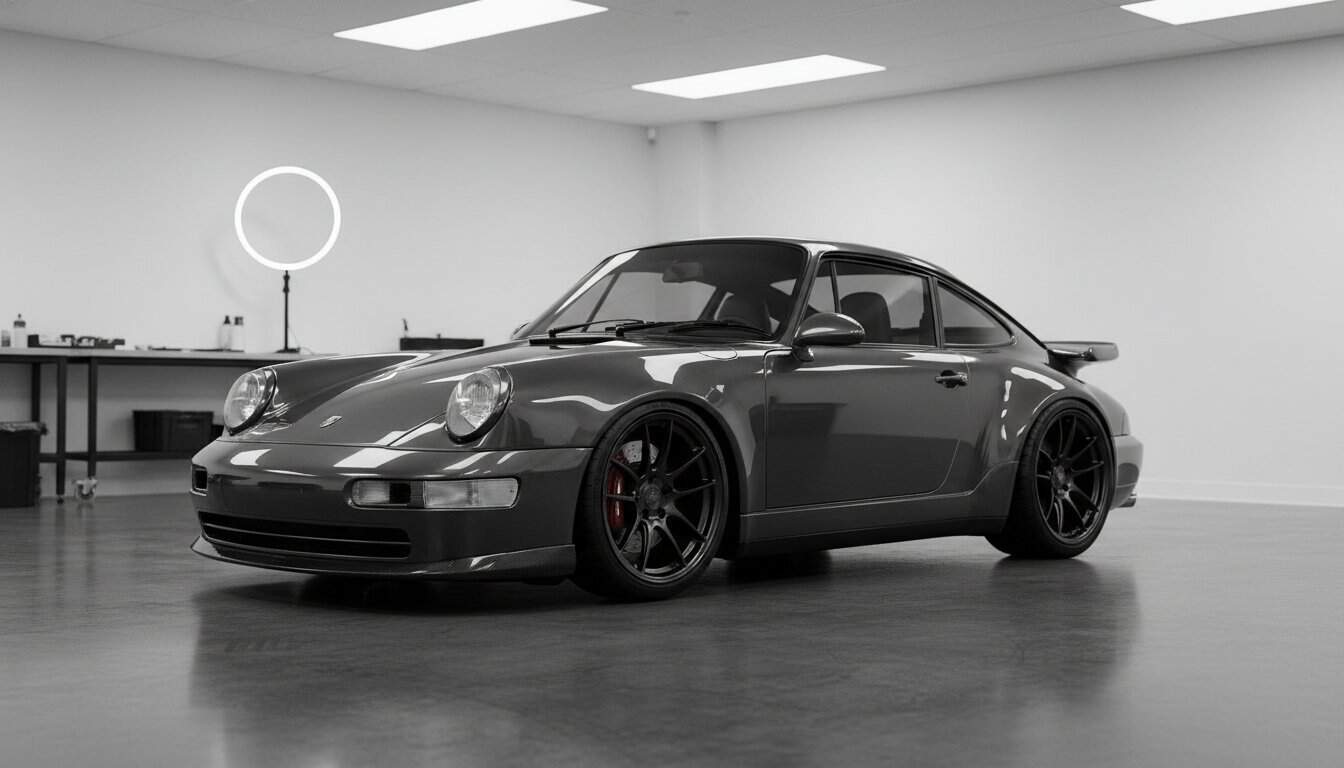
Why let a beautiful vintage silhouette sit gathering dust just because its original mechanicals can’t keep pace with the modern world? You’ve likely felt that pull toward the timeless lines of a vintage coupe, only to be held back by the reality of cramped engine bays and the rising cost of restoration, which has jumped as much as 35 percent in Western Europe since 2022. It’s frustrating to balance the desire for heritage with the practical need for reliability, especially when the fear of ruining a rare classic or battling structural rust looms over your garage.
The good news is that the right project can bridge that gap perfectly. This guide will help you identify the best classic european cars to restomod, ensuring your choice offers a viable foundation rather than a bottomless money pit. You’ll learn how to navigate the technical requirements of a build, from managing common steel corrosion to integrating modern performance components that respect the car’s soul. We are going to break down the most iconic donor platforms and the essential steps to help you start your build with absolute confidence.
Key Takeaways
- Identify the critical structural benchmarks and engine bay clearances that separate a viable donor from a liability.
- Explore a curated shortlist of the best classic european cars to restomod, focusing on iconic platforms like the BMW E30 and Porsche 911.
- Learn how to integrate modern performance through strategic engine swaps and safety upgrades without sacrificing the car’s original character.
- Master the Restomod Academy framework to establish a structured build roadmap and budget that prevents project creep.
The Appeal of the European Restomod: Heritage Meets Modern Performance
Grab your wrench and look closely at the lines of a vintage Alfa Romeo or a classic BMW. You aren’t just looking at shaped steel; you’re looking at a legacy of organic design that prioritizes the connection between the driver and the road. While American muscle focuses on raw power and Japanese engineering on modular efficiency, European marques emphasize a sculptural grace. However, that connection often breaks when 50 year old electrical systems fail or drum brakes fade under modern traffic conditions. Choosing the right classic european cars to restomod allows you to bridge this gap, blending that iconic vintage soul with the precision of 21st century performance.
A standard restoration aims to freeze a vehicle in time, but a restomod focuses on the journey ahead. Through Resto-modification, we preserve the aesthetic heritage while injecting modern reliability and safety. It’s the difference between a car that sits on a trailer and one that thrives on a coastal canyon run. There is an immense emotional reward in saving a piece of history and making it better than the day it left the factory.
To better understand how these builds are evolving, watch this helpful video featuring some of the most popular platforms in the current market:
The Evolution of the European Restomod Scene
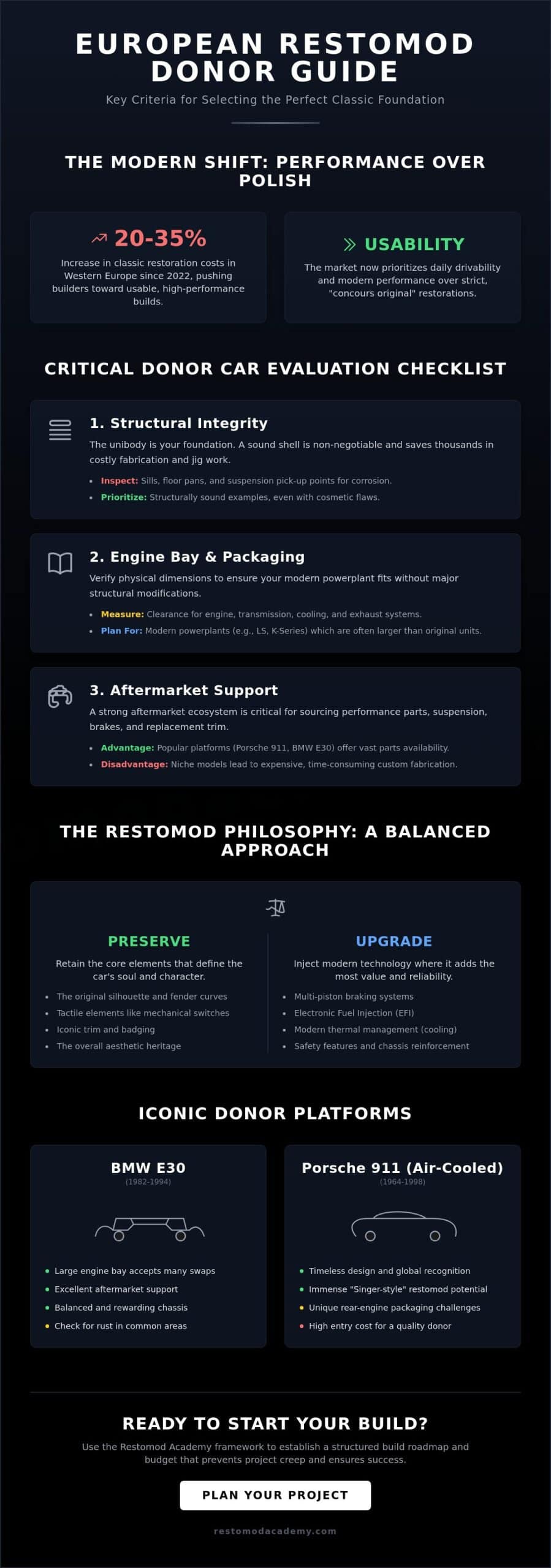
The market has shifted away from the rigid constraints of concours originalism toward high performance usability. By 2026, the global EV conversion market alone reached 45,000 completed retrofits, generating $850 million in revenue. This surge is driven by a desire for daily driver classics. Since restoration costs in Western Europe have increased by 20 percent to 35 percent since 2022, builders are now prioritizing projects that offer a tangible return in drivability. European marques have become the preferred canvas because their sophisticated chassis reward modern suspension tuning and engine swaps.
Balancing Vintage Soul with Modern Precision
Respect the DNA of your donor car while you upgrade its heart. Identify the core elements that define the car’s character, like the tactile click of a mechanical switch or the curve of a fender, and keep them intact. Use modern technology where it adds the most value: thermal management, multi piston braking, and electronic fuel injection. This guide focuses on the most rewarding classic european cars to restomod, ensuring you spend your time on upgrades that enhance the experience rather than fighting against the car’s inherent design. Build for the future while honoring the past.
Essential Criteria for Choosing Your European Donor Car
Before you turn a single bolt, evaluate your donor car with the clinical eye of an engineer. The most beautiful classic european cars to restomod can quickly become expensive nightmares if the structural foundation is compromised. Focus your initial inspection on the unibody. Look for signs of oxidation in the sills, floor pans, and suspension pick up points. While professional restoration costs in Western Europe have climbed by up to 35 percent since 2022, you can save thousands by starting with a structurally sound shell that doesn’t require extensive jig work or custom panel beating.
Next, consider the physical limits of the engine bay. A vintage BMW or Volvo might look spacious, but modern powerplants like an LS or a K-series demand significant clearance for cooling and exhaust routing. You can find inspiration among popular European restomod examples, but always verify the dimensions yourself. Ensure there is a healthy aftermarket ecosystem for your chosen model. You don’t want to spend six months fabricating a basic door handle or window regulator because the original production run was too small to support modern reproduction parts.
Technical Feasibility and Packaging
Assess the suspension geometry early in the process. Many European classics use unique trailing arm or torsion bar setups that are difficult to convert to modern coilovers without major structural cutting. Look at the electrical architecture too. Moving from a vintage 6V system to a modern 12V CAN-bus setup requires patience and a clear wiring map. If you are planning a high performance heart transplant, reviewing a roadmap for an LS engine swap can help you visualize the necessary modifications to the firewall and transmission tunnel.
Market Value and Project ROI
Avoid the two extremes of the collector market. A “basket case” car often costs more in labor than its eventual market value, while a mint, low mileage original is too precious to modify without destroying its collector status. Seek the “sweet spot” in the depreciation curve. Look for mid-tier cars with high production volumes. These donors allow you to cut, weld, and improve with a clear conscience. High quality component selection is the key to project ROI. By using premium parts and documented processes, you ensure the finished machine is an investment grade asset rather than just an expensive hobby.
The Best Classic European Cars to Restomod in 2026
Forget the half-million-pound price tags of boutique shops. While a professional Theon Design Porsche 964 might start at £430,000, the true spirit of the movement lives in the home garage where personal labor meets technical precision. You need a platform that balances iconic styling with mechanical accessibility. The following classic european cars to restomod represent the best intersection of heritage and modern potential, offering a clear path from a vintage donor to a high performance machine.
Start your search with these proven platforms:
- BMW E30: The gold standard for engine swaps and handling upgrades.
- Porsche 911 and 912: The ultimate investment grade restomod platforms.
- Volvo 240: An indestructible tank with a massive engine bay for sleeper builds.
- Alfa Romeo GTV and Spider: Timeless Italian design that rewards modern reliability upgrades.
- Mercedes-Benz W123 and W124: The foundation for a modern vintage luxury cruiser.
The German Icons: BMW and Porsche
The BMW E30 is the king of the workshop for a reason. It’s a balanced, rear wheel drive canvas that accepts modern power with minimal fuss. Whether you’re dropping in a high revving S54 or a turbocharged four cylinder, the documentation for this chassis is endless. If your heart is set on an air-cooled silhouette, look toward the Porsche 912. It offers the same iconic body as the 911 but often at a more approachable price point. You can modernize the suspension with contemporary coilovers or even explore EV conversions, with kits like the ESDI EV system starting at €44,990. These upgrades transform these cars from vintage cruisers into sharp, contemporary performers.
Alternative Classics: Volvo, Alfa Romeo, and Mercedes
Don’t let the boxy lines of the Volvo 240 fool you. It’s a builder’s dream. The engine bay volume is legendary, easily accommodating a $7,200 Chevrolet LS3 crate engine with room to spare. For those who prioritize Italian soul, the Alfa Romeo GTV provides an unmatched driving experience once you solve the historical electrical issues with modern wiring looms and ECUs. Finally, the Mercedes W124 offers a level of structural integrity that modern cars struggle to match. By upgrading the cooling and braking systems, you create a performance sedan that feels both grounded in tradition and ready for the future.
Choosing your donor is a major milestone, but success depends on your roadmap. At Restomod Academy, we provide the Premium Project Blueprints you need to navigate these specific builds. These resources ensure that your journey with classic european cars to restomod stays on track, helping you avoid project creep while achieving the precision your machine deserves.
Overcoming Engineering Challenges in European Modernization
Face the technical reality of your build with precision. Modernizing classic european cars to restomod is an exercise in creative problem solving. You aren’t just swapping parts; you’re re-engineering a machine designed in a different era. The primary challenge lies in packaging. European engine bays are notoriously tight, originally designed for compact inline fours or longitudinal sixes. Fitting a modern high performance engine requires more than just a big hammer. You must account for thermal management from the start. High horsepower engines generate immense heat that can quickly overwhelm a vintage engine bay. Plan for custom aluminum radiators and high CFM electric fans to keep your temperatures stable during spirited drives.
The engine swap debate is where your project’s identity is forged. You must decide between a purist friendly upgrade and high performance cross breeding. A Chevrolet LS3 6.2L V8 crate engine costs approximately $7,200 and offers 430 horsepower in a compact, reliable package. If you prefer the sophisticated overhead cams of a Ford 5.0-liter Coyote V8, expect to pay around $12,650. For those seeking a simpler path, a Blueprint BP3505CT Chevy 350 crate engine at £4,990 provides dependable power without the complexity of modern electronics. Regardless of your choice, your braking and safety systems must evolve. Moving beyond vintage drums to multi piston disc brakes is a mandatory step for any car pushing three times its original factory output.
Engine Swap Logistics for European Chassis
Managing the logistics of a heart transplant requires a structured approach. If you are leaning toward American muscle, our definitive guide to an LS engine swap breaks down the specific fabrication needs for European frames. For smaller bays, such as those in an Alfa Romeo or a BMW 2002, the Honda K-Series has become the go-to choice. Its high revving nature matches the European driving spirit while offering modern fuel injection efficiency. You will need custom fabricated mounts, headers, and drivelines to ensure the new powertrain sits low and centered for optimal weight distribution.
Modernizing the Driving Experience
A successful build feels as good as it looks. Replace vague vintage steering boxes with precise rack and pinion systems to sharpen your turn in. Integrate modern HVAC systems behind the dashboard to ensure you can enjoy the car in any weather without ruining the period correct aesthetic. To achieve a truly professional finish, focus on sound deadening and vibration isolation. You can find our favorite materials in our recommended gear list to help eliminate the rattles common in older steel. This level of attention to detail transforms classic european cars to restomod into refined modern cruisers that you can actually live with every day.
Ready to solve your specific engineering hurdles? Restomod Consulting Services can provide the expert guidance you need to keep your build moving forward with confidence.
Planning Your Build with the Restomod Academy Framework
Execution is the bridge between a dream and a drivable reality. You’ve identified the best classic european cars to restomod, but without a structured plan, even the most promising project can stall. Start by opening a dedicated project spreadsheet and setting a realistic budget. Restoration costs in Western Europe have climbed by 20 percent to 35 percent since 2022, with a full nut and bolt restoration for mainstream classics now ranging between €95,000 and €140,000. While your labor will offset some of these costs, you must account for specialized machining and high quality components from the outset. Acknowledging these financial realities early prevents the dreaded project creep that leaves so many shells unfinished in dark garages.
Sourcing your donor car in the 2026 market requires a strategic eye. The price gap between rough projects and ready to drive classics has widened, with restored cars often selling for two to four times the price of a project car. If you are importing a car over 30 years old into the UK from outside the EU, remember that a reduced VAT rate of 5 percent applies. This can significantly lower your initial acquisition cost. Look for a machine with a solid unibody and clear title, even if the mechanicals are tired. You are building for performance, so a running engine is less important than a straight frame and complete trim pieces.
The Ultimate Restomod Roadmap
Success in the workshop follows a methodical rhythm. Our framework begins with a complete teardown and cataloging of every fastener and bracket. This phase is about more than just disassembly; it’s about understanding the specific engineering DNA of your machine. You don’t have to reinvent the wheel during this process. By using our Premium Project Blueprints, you can save hundreds of hours of trial and error. These documents provide the precise measurements and component compatibility data you need to integrate modern systems into vintage steel. Build a support network of local specialists for tasks like paint or custom upholstery, but keep the core assembly under your own roof to maintain the integrity of the vision.
Finalizing Your Vision
Decide early if you want the hands on satisfaction of a DIY build or the streamlined progress of a professional managed project. Both paths lead to the same rewarding destination, but they require different levels of time commitment. If you choose to lead the build yourself, The Ultimate Restomod Guide acts as your silent mentor, ensuring your classic european cars to restomod stay on track through every technical hurdle. It’s time to transition from an admirer to a creator. Your first actionable step is simple: perform a local market search for your chosen donor car today. Whether it’s an E30 or a Volvo 240, the right foundation is waiting for you to begin.
If you find yourself stuck on a specific technical challenge, our Restomod Consulting Services offer the high level expertise needed to keep your project moving toward the finish line.
Take Command of Your Automotive Legacy
The transition from a passive admirer to an active creator begins the moment you decide to pick up a wrench. You now understand that the secret to a successful build lies in the balance between heritage and modern precision. By selecting the right classic european cars to restomod, you ensure that your project is built on a foundation of structural integrity and technical feasibility. Whether you are aiming for the balanced handling of a BMW E30 or the indestructible sleeper potential of a Volvo 240, your success depends on a methodical approach and a clear roadmap.
Don’t let the fear of technical hurdles or project creep keep your dream car in the shadows. You have access to comprehensive project blueprints for iconic European models and a curated list of recommended performance gear to guide every step. If you need a steady hand, direct consulting with seasoned restomod mentor Brook Walsh is available to help you navigate the most complex engineering challenges. It’s time to bring your vision to life in the workshop.
Download The Ultimate Restomod Guide and start your build today. The journey toward a precision-engineered classic is long and demanding, but the reward of that first turn of the key is worth every hour of labor. Your masterpiece is waiting.
Frequently Asked Questions
What is the easiest European classic car to restomod for a beginner?
The BMW E30 is widely considered the best entry point for a beginner looking for classic european cars to restomod. Its modular design and massive aftermarket support mean you can find bolt-on upgrades for almost every system. You won’t have to fabricate parts from scratch as often as you would with rarer marques, allowing you to focus on learning the fundamentals of assembly and tuning without the frustration of sourcing extinct parts.
How much does a typical European restomod project cost in 2026?
A typical project can range from $50,000 to over $150,000 depending on your choice of donor and powertrain. Since restoration costs in Western Europe have increased significantly since 2022, your budget must account for high quality components and specialized labor. DIY builders can save on assembly costs, but you should still plan for the rising prices of modern performance kits and the precision machining required for a reliable finish.
Can I swap an American V8 into a European classic car?
You can absolutely swap an American V8 into a European frame, provided the chassis can handle the torque. The Chevrolet LS3 is a favorite for the Volvo 240 and Mercedes W124 because of its relatively compact dimensions and massive power potential. You will need to modify the transmission tunnel and engine mounts, but the result is a reliable, high performance machine that combines European handling with American muscle.
Are restomodded European cars a good financial investment?
High quality restomods are becoming strong financial assets as the gap between project cars and finished builds continues to widen. A well executed project can sell for up to four times the price of a standard donor car. To maximize your ROI, focus on documented, professional grade work and avoid cutting corners on safety systems. The market in 2026 increasingly rewards builds that prioritize modern reliability alongside vintage aesthetics.
Where can I find modern performance parts for vintage European cars?
Look to dedicated aftermarket specialists who focus on specific marques like Porsche, BMW, or Alfa Romeo. Many companies now offer complete restomod kits that include everything from digital gauges to modern air conditioning systems. You can also source high performance components through curated gear lists that prioritize parts offering a true balance of vintage style and modern reliability, ensuring your classic european cars to restomod perform like modern machines.
Do I need custom fabrication skills to build a European restomod?
While many upgrades are bolt-on, a full modernization project usually requires at least basic welding and fabrication skills. You will likely need to create custom brackets for modern accessories or modify the floor pan to fit a newer gearbox. If you aren’t comfortable with a TIG welder yet, consider partnering with a local fabrication shop for the structural milestones. Learning these skills is part of the rewarding journey from enthusiast to creator.
What is the best modern engine for a small European classic like an Alfa or MG?
The Honda K-Series is the premier choice for smaller engine bays like those found in an Alfa Romeo GTV or an MGB. It provides the high revving character these cars were originally known for but with the reliability of modern fuel injection. Its compact size allows for better weight distribution, ensuring your car retains its nimble handling while gaining a significant boost in horsepower and modern drivability.
How do I handle the complex electrical systems in vintage European cars?
The most effective way to handle vintage electrical issues is to completely strip the original loom and install a modern wiring system. Old European wiring is notorious for corrosion and brittle insulation that can lead to intermittent failures. Using a simplified aftermarket harness or a CAN-bus system will make integrating modern ECUs and digital displays much easier. This provides the reliable electrical foundation necessary for a high performance modern vintage build.
Why let a beautiful vintage silhouette sit gathering dust just because its original mechanicals can’t keep pace with the modern world? You’ve likely felt that pull toward the timeless lines of a vintage coupe, only to be held back by the reality of cramped engine bays and the rising cost of restoration, which has jumped as much as 35 percent in Western Europe since 2022. It’s frustrating to balance the desire for heritage with the practical need for reliability, especially when the fear of ruining a rare classic or battling structural rust looms over your garage.
The good news is that the right project can bridge that gap perfectly. This guide will help you identify the best classic european cars to restomod, ensuring your choice offers a viable foundation rather than a bottomless money pit. You’ll learn how to navigate the technical requirements of a build, from managing common steel corrosion to integrating modern performance components that respect the car’s soul. We are going to break down the most iconic donor platforms and the essential steps to help you start your build with absolute confidence.
Key Takeaways
- Identify the critical structural benchmarks and engine bay clearances that separate a viable donor from a liability.
- Explore a curated shortlist of the best classic european cars to restomod, focusing on iconic platforms like the BMW E30 and Porsche 911.
- Learn how to integrate modern performance through strategic engine swaps and safety upgrades without sacrificing the car’s original character.
- Master the Restomod Academy framework to establish a structured build roadmap and budget that prevents project creep.
The Appeal of the European Restomod: Heritage Meets Modern Performance
Grab your wrench and look closely at the lines of a vintage Alfa Romeo or a classic BMW. You aren’t just looking at shaped steel; you’re looking at a legacy of organic design that prioritizes the connection between the driver and the road. While American muscle focuses on raw power and Japanese engineering on modular efficiency, European marques emphasize a sculptural grace. However, that connection often breaks when 50 year old electrical systems fail or drum brakes fade under modern traffic conditions. Choosing the right classic european cars to restomod allows you to bridge this gap, blending that iconic vintage soul with the precision of 21st century performance.
A standard restoration aims to freeze a vehicle in time, but a restomod focuses on the journey ahead. Through Resto-modification, we preserve the aesthetic heritage while injecting modern reliability and safety. It’s the difference between a car that sits on a trailer and one that thrives on a coastal canyon run. There is an immense emotional reward in saving a piece of history and making it better than the day it left the factory.
To better understand how these builds are evolving, watch this helpful video featuring some of the most popular platforms in the current market:
The Evolution of the European Restomod Scene
The market has shifted away from the rigid constraints of concours originalism toward high performance usability. By 2026, the global EV conversion market alone reached 45,000 completed retrofits, generating $850 million in revenue. This surge is driven by a desire for daily driver classics. Since restoration costs in Western Europe have increased by 20 percent to 35 percent since 2022, builders are now prioritizing projects that offer a tangible return in drivability. European marques have become the preferred canvas because their sophisticated chassis reward modern suspension tuning and engine swaps.
Balancing Vintage Soul with Modern Precision
Respect the DNA of your donor car while you upgrade its heart. Identify the core elements that define the car’s character, like the tactile click of a mechanical switch or the curve of a fender, and keep them intact. Use modern technology where it adds the most value: thermal management, multi piston braking, and electronic fuel injection. This guide focuses on the most rewarding classic european cars to restomod, ensuring you spend your time on upgrades that enhance the experience rather than fighting against the car’s inherent design. Build for the future while honoring the past.
Essential Criteria for Choosing Your European Donor Car
Before you turn a single bolt, evaluate your donor car with the clinical eye of an engineer. The most beautiful classic european cars to restomod can quickly become expensive nightmares if the structural foundation is compromised. Focus your initial inspection on the unibody. Look for signs of oxidation in the sills, floor pans, and suspension pick up points. While professional restoration costs in Western Europe have climbed by up to 35 percent since 2022, you can save thousands by starting with a structurally sound shell that doesn’t require extensive jig work or custom panel beating.
Next, consider the physical limits of the engine bay. A vintage BMW or Volvo might look spacious, but modern powerplants like an LS or a K-series demand significant clearance for cooling and exhaust routing. You can find inspiration among popular European restomod examples, but always verify the dimensions yourself. Ensure there is a healthy aftermarket ecosystem for your chosen model. You don’t want to spend six months fabricating a basic door handle or window regulator because the original production run was too small to support modern reproduction parts.
Technical Feasibility and Packaging
Assess the suspension geometry early in the process. Many European classics use unique trailing arm or torsion bar setups that are difficult to convert to modern coilovers without major structural cutting. Look at the electrical architecture too. Moving from a vintage 6V system to a modern 12V CAN-bus setup requires patience and a clear wiring map. If you are planning a high performance heart transplant, reviewing a roadmap for an LS engine swap can help you visualize the necessary modifications to the firewall and transmission tunnel.
Market Value and Project ROI
Avoid the two extremes of the collector market. A “basket case” car often costs more in labor than its eventual market value, while a mint, low mileage original is too precious to modify without destroying its collector status. Seek the “sweet spot” in the depreciation curve. Look for mid-tier cars with high production volumes. These donors allow you to cut, weld, and improve with a clear conscience. High quality component selection is the key to project ROI. By using premium parts and documented processes, you ensure the finished machine is an investment grade asset rather than just an expensive hobby.
The Best Classic European Cars to Restomod in 2026
Forget the half-million-pound price tags of boutique shops. While a professional Theon Design Porsche 964 might start at £430,000, the true spirit of the movement lives in the home garage where personal labor meets technical precision. You need a platform that balances iconic styling with mechanical accessibility. The following classic european cars to restomod represent the best intersection of heritage and modern potential, offering a clear path from a vintage donor to a high performance machine.
Start your search with these proven platforms:
- BMW E30: The gold standard for engine swaps and handling upgrades.
- Porsche 911 and 912: The ultimate investment grade restomod platforms.
- Volvo 240: An indestructible tank with a massive engine bay for sleeper builds.
- Alfa Romeo GTV and Spider: Timeless Italian design that rewards modern reliability upgrades.
- Mercedes-Benz W123 and W124: The foundation for a modern vintage luxury cruiser.
The German Icons: BMW and Porsche
The BMW E30 is the king of the workshop for a reason. It’s a balanced, rear wheel drive canvas that accepts modern power with minimal fuss. Whether you’re dropping in a high revving S54 or a turbocharged four cylinder, the documentation for this chassis is endless. If your heart is set on an air-cooled silhouette, look toward the Porsche 912. It offers the same iconic body as the 911 but often at a more approachable price point. You can modernize the suspension with contemporary coilovers or even explore EV conversions, with kits like the ESDI EV system starting at €44,990. These upgrades transform these cars from vintage cruisers into sharp, contemporary performers.
Alternative Classics: Volvo, Alfa Romeo, and Mercedes
Don’t let the boxy lines of the Volvo 240 fool you. It’s a builder’s dream. The engine bay volume is legendary, easily accommodating a $7,200 Chevrolet LS3 crate engine with room to spare. For those who prioritize Italian soul, the Alfa Romeo GTV provides an unmatched driving experience once you solve the historical electrical issues with modern wiring looms and ECUs. Finally, the Mercedes W124 offers a level of structural integrity that modern cars struggle to match. By upgrading the cooling and braking systems, you create a performance sedan that feels both grounded in tradition and ready for the future.
Choosing your donor is a major milestone, but success depends on your roadmap. At Restomod Academy, we provide the Premium Project Blueprints you need to navigate these specific builds. These resources ensure that your journey with classic european cars to restomod stays on track, helping you avoid project creep while achieving the precision your machine deserves.
Overcoming Engineering Challenges in European Modernization
Face the technical reality of your build with precision. Modernizing classic european cars to restomod is an exercise in creative problem solving. You aren’t just swapping parts; you’re re-engineering a machine designed in a different era. The primary challenge lies in packaging. European engine bays are notoriously tight, originally designed for compact inline fours or longitudinal sixes. Fitting a modern high performance engine requires more than just a big hammer. You must account for thermal management from the start. High horsepower engines generate immense heat that can quickly overwhelm a vintage engine bay. Plan for custom aluminum radiators and high CFM electric fans to keep your temperatures stable during spirited drives.
The engine swap debate is where your project’s identity is forged. You must decide between a purist friendly upgrade and high performance cross breeding. A Chevrolet LS3 6.2L V8 crate engine costs approximately $7,200 and offers 430 horsepower in a compact, reliable package. If you prefer the sophisticated overhead cams of a Ford 5.0-liter Coyote V8, expect to pay around $12,650. For those seeking a simpler path, a Blueprint BP3505CT Chevy 350 crate engine at £4,990 provides dependable power without the complexity of modern electronics. Regardless of your choice, your braking and safety systems must evolve. Moving beyond vintage drums to multi piston disc brakes is a mandatory step for any car pushing three times its original factory output.
Engine Swap Logistics for European Chassis
Managing the logistics of a heart transplant requires a structured approach. If you are leaning toward American muscle, our definitive guide to an LS engine swap breaks down the specific fabrication needs for European frames. For smaller bays, such as those in an Alfa Romeo or a BMW 2002, the Honda K-Series has become the go-to choice. Its high revving nature matches the European driving spirit while offering modern fuel injection efficiency. You will need custom fabricated mounts, headers, and drivelines to ensure the new powertrain sits low and centered for optimal weight distribution.
Modernizing the Driving Experience
A successful build feels as good as it looks. Replace vague vintage steering boxes with precise rack and pinion systems to sharpen your turn in. Integrate modern HVAC systems behind the dashboard to ensure you can enjoy the car in any weather without ruining the period correct aesthetic. To achieve a truly professional finish, focus on sound deadening and vibration isolation. You can find our favorite materials in our recommended gear list to help eliminate the rattles common in older steel. This level of attention to detail transforms classic european cars to restomod into refined modern cruisers that you can actually live with every day.
Ready to solve your specific engineering hurdles? Restomod Consulting Services can provide the expert guidance you need to keep your build moving forward with confidence.
Planning Your Build with the Restomod Academy Framework
Execution is the bridge between a dream and a drivable reality. You’ve identified the best classic european cars to restomod, but without a structured plan, even the most promising project can stall. Start by opening a dedicated project spreadsheet and setting a realistic budget. Restoration costs in Western Europe have climbed by 20 percent to 35 percent since 2022, with a full nut and bolt restoration for mainstream classics now ranging between €95,000 and €140,000. While your labor will offset some of these costs, you must account for specialized machining and high quality components from the outset. Acknowledging these financial realities early prevents the dreaded project creep that leaves so many shells unfinished in dark garages.
Sourcing your donor car in the 2026 market requires a strategic eye. The price gap between rough projects and ready to drive classics has widened, with restored cars often selling for two to four times the price of a project car. If you are importing a car over 30 years old into the UK from outside the EU, remember that a reduced VAT rate of 5 percent applies. This can significantly lower your initial acquisition cost. Look for a machine with a solid unibody and clear title, even if the mechanicals are tired. You are building for performance, so a running engine is less important than a straight frame and complete trim pieces.
The Ultimate Restomod Roadmap
Success in the workshop follows a methodical rhythm. Our framework begins with a complete teardown and cataloging of every fastener and bracket. This phase is about more than just disassembly; it’s about understanding the specific engineering DNA of your machine. You don’t have to reinvent the wheel during this process. By using our Premium Project Blueprints, you can save hundreds of hours of trial and error. These documents provide the precise measurements and component compatibility data you need to integrate modern systems into vintage steel. Build a support network of local specialists for tasks like paint or custom upholstery, but keep the core assembly under your own roof to maintain the integrity of the vision.
Finalizing Your Vision
Decide early if you want the hands on satisfaction of a DIY build or the streamlined progress of a professional managed project. Both paths lead to the same rewarding destination, but they require different levels of time commitment. If you choose to lead the build yourself, The Ultimate Restomod Guide acts as your silent mentor, ensuring your classic european cars to restomod stay on track through every technical hurdle. It’s time to transition from an admirer to a creator. Your first actionable step is simple: perform a local market search for your chosen donor car today. Whether it’s an E30 or a Volvo 240, the right foundation is waiting for you to begin.
If you find yourself stuck on a specific technical challenge, our Restomod Consulting Services offer the high level expertise needed to keep your project moving toward the finish line.
Take Command of Your Automotive Legacy
The transition from a passive admirer to an active creator begins the moment you decide to pick up a wrench. You now understand that the secret to a successful build lies in the balance between heritage and modern precision. By selecting the right classic european cars to restomod, you ensure that your project is built on a foundation of structural integrity and technical feasibility. Whether you are aiming for the balanced handling of a BMW E30 or the indestructible sleeper potential of a Volvo 240, your success depends on a methodical approach and a clear roadmap.
Don’t let the fear of technical hurdles or project creep keep your dream car in the shadows. You have access to comprehensive project blueprints for iconic European models and a curated list of recommended performance gear to guide every step. If you need a steady hand, direct consulting with seasoned restomod mentor Brook Walsh is available to help you navigate the most complex engineering challenges. It’s time to bring your vision to life in the workshop.
Download The Ultimate Restomod Guide and start your build today. The journey toward a precision-engineered classic is long and demanding, but the reward of that first turn of the key is worth every hour of labor. Your masterpiece is waiting.
Frequently Asked Questions
What is the easiest European classic car to restomod for a beginner?
The BMW E30 is widely considered the best entry point for a beginner looking for classic european cars to restomod. Its modular design and massive aftermarket support mean you can find bolt-on upgrades for almost every system. You won’t have to fabricate parts from scratch as often as you would with rarer marques, allowing you to focus on learning the fundamentals of assembly and tuning without the frustration of sourcing extinct parts.
How much does a typical European restomod project cost in 2026?
A typical project can range from $50,000 to over $150,000 depending on your choice of donor and powertrain. Since restoration costs in Western Europe have increased significantly since 2022, your budget must account for high quality components and specialized labor. DIY builders can save on assembly costs, but you should still plan for the rising prices of modern performance kits and the precision machining required for a reliable finish.
Can I swap an American V8 into a European classic car?
You can absolutely swap an American V8 into a European frame, provided the chassis can handle the torque. The Chevrolet LS3 is a favorite for the Volvo 240 and Mercedes W124 because of its relatively compact dimensions and massive power potential. You will need to modify the transmission tunnel and engine mounts, but the result is a reliable, high performance machine that combines European handling with American muscle.
Are restomodded European cars a good financial investment?
High quality restomods are becoming strong financial assets as the gap between project cars and finished builds continues to widen. A well executed project can sell for up to four times the price of a standard donor car. To maximize your ROI, focus on documented, professional grade work and avoid cutting corners on safety systems. The market in 2026 increasingly rewards builds that prioritize modern reliability alongside vintage aesthetics.
Where can I find modern performance parts for vintage European cars?
Look to dedicated aftermarket specialists who focus on specific marques like Porsche, BMW, or Alfa Romeo. Many companies now offer complete restomod kits that include everything from digital gauges to modern air conditioning systems. You can also source high performance components through curated gear lists that prioritize parts offering a true balance of vintage style and modern reliability, ensuring your classic european cars to restomod perform like modern machines.
Do I need custom fabrication skills to build a European restomod?
While many upgrades are bolt-on, a full modernization project usually requires at least basic welding and fabrication skills. You will likely need to create custom brackets for modern accessories or modify the floor pan to fit a newer gearbox. If you aren’t comfortable with a TIG welder yet, consider partnering with a local fabrication shop for the structural milestones. Learning these skills is part of the rewarding journey from enthusiast to creator.
What is the best modern engine for a small European classic like an Alfa or MG?
The Honda K-Series is the premier choice for smaller engine bays like those found in an Alfa Romeo GTV or an MGB. It provides the high revving character these cars were originally known for but with the reliability of modern fuel injection. Its compact size allows for better weight distribution, ensuring your car retains its nimble handling while gaining a significant boost in horsepower and modern drivability.
How do I handle the complex electrical systems in vintage European cars?
The most effective way to handle vintage electrical issues is to completely strip the original loom and install a modern wiring system. Old European wiring is notorious for corrosion and brittle insulation that can lead to intermittent failures. Using a simplified aftermarket harness or a CAN-bus system will make integrating modern ECUs and digital displays much easier. This provides the reliable electrical foundation necessary for a high performance modern vintage build.