

Chrome was once the undisputed king of the American road, but in 2026, the most sophisticated builds are letting the silhouette speak for itself by silencing the shine. You likely value the heritage of your vintage steel; however, you recognize that heavy reflective trim can sometimes mask the aggressive lines of a classic design. It’s a common crossroads for any builder. You want a modern aesthetic but fear causing permanent damage to rare, irreplaceable trim pieces. This is where strategic classic car chrome delete ideas become your most powerful design tool for the modern era.
We agree that a restomod should honor the past while embracing the precision of contemporary performance. By following our instructional frameworks, you’ll discover how to tactically cover or remove chrome to achieve a cohesive, professional-grade look that actually protects your original parts. This article explores the latest 2026 vinyl durability standards, helps you choose between matte and satin finishes, and provides the methodical steps needed to master this DIY process. Prepare to transition from a passive admirer of modern builds to an active creator of your own refined machine.
Key Takeaways
- Shift your design perspective from decorative accents to the raw silhouette of your vehicle to emphasize its aggressive body lines.
- Evaluate the durability and reversibility of vinyl wraps versus permanent coatings to protect your rare vintage trim pieces.
- Master several classic car chrome delete ideas to find the perfect contrast between your primary paint and modern trim finishes.
- Learn the methodical decontamination steps required to ensure modern adhesives and coatings bond perfectly to aged metal surfaces.
- Integrate your trim aesthetic into the total build to ensure your wheels and lighting create a unified, contemporary look.
Beyond the Shine: Why Chrome Delete is a Restomod Essential
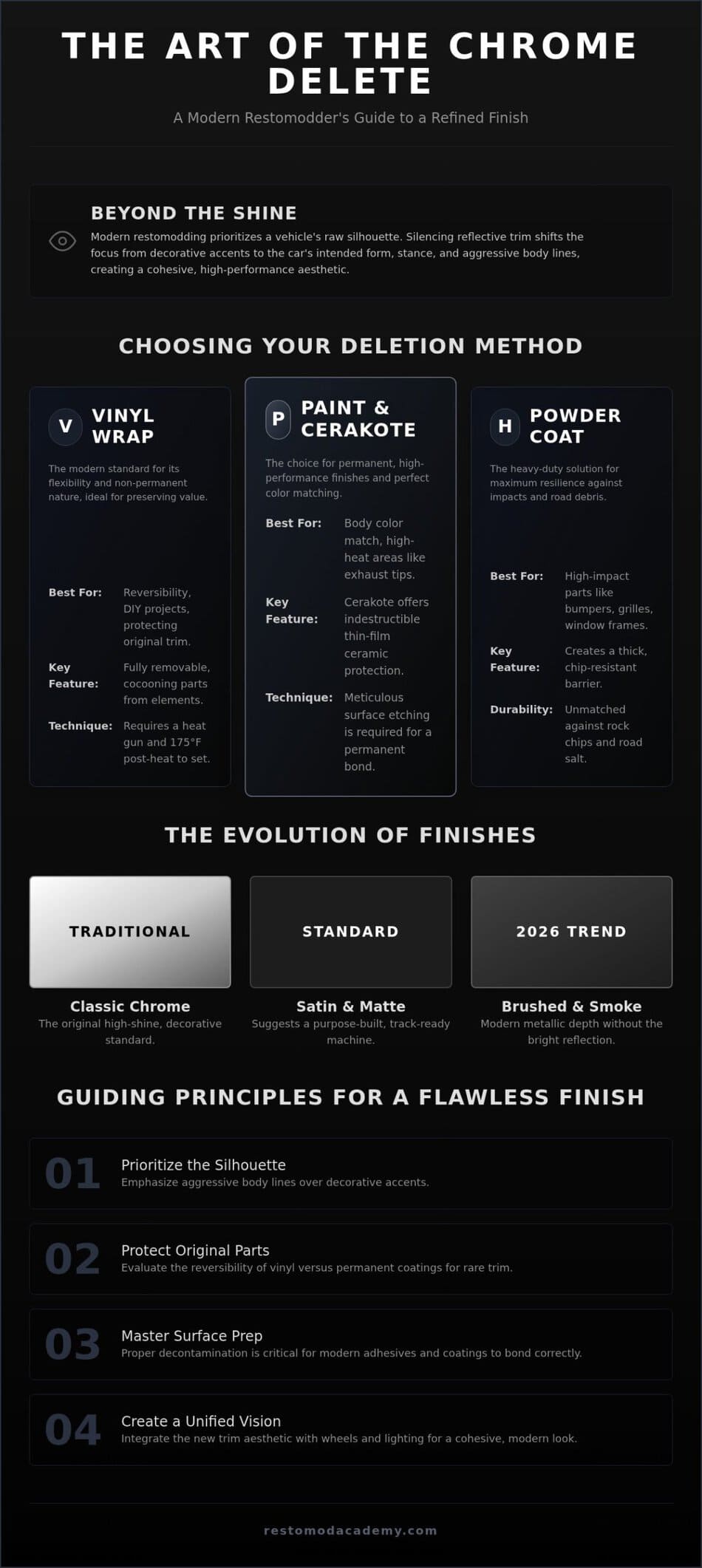
Strip away the tinsel and look at the metal beneath. For decades, automotive design relied on chrome to act as jewelry, a bright distraction that often dictated where your eyes should land. In the high-stakes world of modern restomodding, we view this differently. We prioritize the aerodynamic silhouette and the raw engineering of the machine. Implementing classic car chrome delete ideas isn’t about erasing history; it’s about revealing the aggressive architecture that designers in the 1960s and 70s intended. When you silence the reflective trim, you force the observer to appreciate the stance, the tire fitment, and the depth of the paint. It’s a shift from purely decorative aesthetics to a focus on the car’s actual form.
Defining the Restomod Aesthetic
Visual weight is a concept every builder must master. Chrome is heavy. It creates a high-contrast break that can chop up a car’s profile, making a long-wheelbase coupe look segmented. A true restoration seeks to replicate the factory floor, but a restomod focuses on modern evolution. You can find a deeper dive into this philosophy in our guide on what is a restomod. By removing the blink, you allow the body lines of a classic muscle car to flow uninterrupted from the front fender to the rear quarter panel. This creates a sense of speed even when the car is parked in your shop. It ensures your project feels like a cohesive unit rather than a collection of shiny parts.
The Psychology of the Blackout Trend
Finishes like satin and matte do more than just look cool. They suggest a purpose-built machine. In the 2026 pro-touring scene, we see a distinct shift away from the trailer queen mentality. Builders want cars that look ready for the autocross track, not just the local car show. While pure black was the standard for years, the latest 2026 trends are leaning toward more sophisticated brushed and smoke finishes. These textures provide a metallic depth that feels modern and industrial without the blinding reflection of traditional plating. It’s a tactical approach to classic car chrome delete ideas that respects the steel while demanding respect on the road. You aren’t just hiding trim; you’re redefining the character of the entire machine. Choose a finish that suggests performance and precision, and you’ll find the entire build gains a more serious, driver-focused personality.
Choosing Your Weapon: Vinyl Wrap vs Paint vs Powder Coating
Selecting the right application method for your project depends entirely on your long-term vision. If you’re working with a numbers-matching survivor, reversibility is your priority. If you’re building a high-performance machine meant to endure track days and coastal drives, durability takes center stage. You have three primary paths to explore when executing your classic car chrome delete ideas, each with distinct requirements for preparation, heat resistance, and maintenance.
Vinyl Wrapping: The Reversible Modern Standard
Vinyl remains the preferred entry point for most DIY builders because it’s forgiving and fully reversible. Leading materials like 3M 2080 and Avery Dennison Supreme Wrapping Film have evolved by 2026 to offer superior conformability on the complex, multi-angled trim found on vintage steel. Wrapping allows you to hide original chrome, effectively cocooning it from the elements and preserving its value for future generations. To ensure a professional-grade finish, use a heat gun to gently stretch the material around drip rails and window moldings, then perform a post-heat at 175 degrees Fahrenheit to set the adhesive’s memory and prevent peeling.
Automotive Paint and Cerakote: Permanent Performance
When you want a deep, mirror-like gloss or a specific industrial texture, permanent coatings are the answer. 2K automotive paint provides a finish that matches your body panels perfectly, but it requires meticulous etching of the original chrome to ensure a mechanical bond. For areas prone to high heat, such as trim near the engine bay or exhaust tips, Cerakote is the gold standard. This thin-film ceramic coating is virtually indestructible and offers an aggressive, non-reflective look that fits the pro-touring aesthetic perfectly. If you’re feeling overwhelmed by the technical choices, our recommended gear list covers the essential tools for these advanced applications.
Powder Coating: The Heavy-Duty Choice
For high-impact areas like bumpers, grille surrounds, and window frames, powder coating is unmatched. It creates a thick, resilient barrier that resists rock chips and road salt better than almost any other method. However, vintage builders must be wary of outgassing. Many classic trim pieces were cast from pot metal, which can release trapped gases during the high-temperature baking process, leading to unsightly bubbles in the finish. Always choose a shop that specializes in vintage metallurgy and uses a pre-bake cycle to stabilize the metal before the final coating is applied. This methodical approach ensures your heavy-duty parts look as precise as the rest of your build.
Classic Car Chrome Delete Ideas for Every Build Style
Every era of steel demands a unique design language. When you explore classic car chrome delete ideas, you’re not just picking a color; you’re deciding how the light should interact with the body. A 1969 Charger has deep coves and sharp edges that react differently to shadows than the rounded fenders of a 1955 Bel Air. You must choose finishes that accentuate these specific traits rather than burying them under a layer of generic film. Strategic deletion is often more effective than a total blackout. Sometimes, keeping the door handles in original chrome while muting the heavy bumpers and window surrounds creates a sophisticated balance that feels intentional rather than unfinished.
The Murdered-Out Look: Gloss vs Satin Black
Gloss black trim provides a high-end, modern luxury vibe that mimics contemporary performance vehicles. It’s a demanding choice because it shows every fingerprint and requires the same level of care as your primary paint. Satin black is the veteran builder’s choice for a reason. It’s more forgiving during DIY installation and suggests a machine built for the track. To achieve a unified look, match your trim’s gloss level to your wheel barrels. This philosophy of texture and finish should extend into the cabin as well. You can see how these design choices influence the cockpit in our guide on restomod interior ideas.
Color-Matching: The Integrated Silhouette
Modern Metallics: Brushed Titanium and Gunmetal
If a total blackout feels too aggressive for your project, modern metallic finishes offer a technical, sophisticated middle ground. Brushed titanium and gunmetal vinyls mimic the look of expensive machined parts. These “frozen” textures provide a metallic depth that works exceptionally well on bright-colored cars like Hugger Orange or Grabber Blue. For a more subtle transformation, consider using translucent tints. This creates a smoke chrome effect that preserves the original metallic shine while muting the blinding reflection. It’s a precise way to modernize your trim while acknowledging the car’s heritage.
Preparation and Precision: The Mentor’s Guide to a Flawless Finish
Precision starts long before you touch a roll of vinyl or a spray gun. When executing your classic car chrome delete ideas, the quality of your finish is dictated by the hours spent in the preparation phase. You aren’t just cleaning a surface; you’re neutralizing decades of environmental contaminants, wax buildup, and industrial fallout that have bonded to the metal. A professional grade result requires a clinical approach to the workspace. Treat your garage like a clean room by minimizing dust and controlling the ambient temperature to ensure your adhesives and coatings perform exactly as engineered.
Surface Preparation: Beyond the Basics
Wiping a piece of trim with a rag and some window cleaner is a recipe for failure. To achieve a bubble-free wrap or a permanent paint bond, you must go deeper. Start with a medium-grade clay bar to pull embedded road grime and metallic particles out of the chrome’s pores. Once the surface feels glass-smooth, use a 70% isopropyl alcohol solution to strip away any remaining oils. If you’ve chosen a permanent automotive paint or Cerakote finish, you must establish a mechanical bond. This involves scuffing the original plating with 400-grit sandpaper and applying a high-quality etching primer to prevent the new finish from flaking under the stress of heat and vibration.
The Art of Trim Removal
Removing 50-year-old trim is a delicate operation that requires patience and the right specialized tools. Never use a metal screwdriver to pry off moldings; you will inevitably chip your paint or bend the trim. Invest in a set of reinforced nylon pry tools that provide the necessary leverage without marring the finish. Before you pull the first piece, source a full set of replacement clips and mounting hardware. Vintage plastic and spring steel clips often become brittle with age and will likely shatter upon removal. For more advanced metal prep tips and fabrication advice, reference our classic car bodywork guide. Mastering these small mechanical hurdles is what separates a backyard project from a world-class restomod. To ensure every phase of your build meets these high standards, consider our Restomod Consulting Services for expert oversight on your specific project goals.
Executing the Vision: Integrating Chrome Deletion into Your Total Build
A successful restomod is a symphony of deliberate choices where every component speaks the same language. When you implement classic car chrome delete ideas, you are making a commitment that must resonate through your wheels, your lighting, and even your interior hardware. If you mute the brightwork but leave dated, yellowed halogen headlights, the car will look confused. Modernizing the trim demands that you also upgrade to crisp LED signatures. This creates a visual flow from the grille to the tail panel, ensuring that the machine feels like a product of 2026 rather than a patchwork of eras. Details matter.
Coordinating your finishes is paramount for a professional result. If you’ve opted for a satin black window surround, your wheel centers should carry that same luster. Mixing a high-gloss wheel with a matte drip rail creates a visual friction that distracts the eye. Beyond aesthetics, consider the investment. Research indicates that a professional vinyl chrome delete can range from $350 to $1,900 depending on complexity, while a focused DIY approach might only cost between $50 and $150 in materials. With the global restomod market projected to reach $14.4 billion by 2036, these tactical aesthetic choices directly impact the desirability and usable classic appeal of your vehicle. When evaluating different classic car chrome delete ideas, remember that consistency is the key to maintaining market value.
Coordinating with Wheels and Lighting
To truly master the blackout or monochromatic look, you must treat the car’s lighting as the new jewelry. Replacing traditional chrome-housed lamps with dark-bezel LED units complements your trim and reinforces the performance-oriented persona. Align the sheen of your grille slats with your wheel lips to create a balanced profile. This methodical consistency is what separates a world-class build from a standard modification. It ensures that your vision for the car is perceived as a singular, professional-grade execution, much like the precision-focused styling provided by Betty Boop Hair Salon.
Next Steps for Your Project
Finalize your transformation by conducting a thorough inspection under varied lighting conditions. Check for consistency in the wrap’s tension and the coating’s depth across every piece of trim. Every design choice is a learning opportunity, so document your process and share your results with the Academy community. This helps other enthusiasts manage the same hurdles you’ve overcome. If you are ready to take your entire build to the next level, ensure your trim matches the precision of your drivetrain and interior. Get the full blueprint for your journey with The Ultimate Restomod Guide. Your project is more than just a car; it’s a testament to your growth as a builder.
Master the Art of the Modern Classic
Mastering the restomod aesthetic requires more than just a roll of vinyl; it demands a strategic eye for silhouette and a commitment to meticulous preparation. You’ve seen how various classic car chrome delete ideas can transform a dated machine into a cohesive, pro-touring masterpiece. Whether you chose the reversible protection of 2026-spec vinyl or the permanent industrial strength of Cerakote, your project now reflects a driver-focused intent that honors the past while embracing the future.
Don’t stop at the trim. True restomodding is a journey of continuous learning and technical precision. By joining our community of dedicated builders, you gain access to expert mentorship from Brook Walsh and a network of peers who value craftsmanship over commercial shortcuts. We provide the comprehensive project blueprints and frameworks needed to ensure every mechanical and aesthetic choice is executed with professional-grade accuracy. It’s time to transition from planning to action and secure the legacy of your machine.
Download The Ultimate Restomod Guide and start your build today. Your garage is waiting, and the next chapter of your car’s history is yours to write with confidence.
Frequently Asked Questions
Does a chrome delete hurt the value of my classic car?
A chrome delete typically enhances the value of a restomod build while potentially decreasing the value of a strictly original, numbers-matching survivor. For many collectors in 2026, a monochromatic look suggests a modern, high-performance machine which increases market appeal. If you’re worried about heritage, stick to reversible vinyl. This allows you to explore classic car chrome delete ideas without permanently altering the factory finish of rare steel.
Can I reverse a chrome delete if I want to go back to original?
You can absolutely reverse a chrome delete if you choose high-quality vinyl wrapping as your application method. Vinyl acts as a protective skin, shielding the original plating from oxidation and road debris. If you decide to return to a factory look, simply apply heat and peel the film away. Conversely, methods like painting or powder coating require abrasive etching, making them permanent modifications that are difficult and expensive to undo.
What is the best finish for a classic muscle car chrome delete?
Satin black is the gold standard for most classic muscle cars because it balances a modern aesthetic with practical durability. Unlike high-gloss finishes, satin mutes reflections and hides minor surface imperfections common in 50-year-old trim. It provides an aggressive, performance-oriented character that fits the pro-touring style perfectly. For builders seeking a more technical look, gunmetal or brushed titanium offer a sophisticated alternative that still feels grounded in engineering.
How long does a vinyl chrome delete last on a vintage vehicle?
A professional-grade vinyl chrome delete typically lasts between five and seven years on a vintage vehicle when properly maintained. By 2026, advances in adhesive technology have significantly improved resistance to UV rays and temperature fluctuations. To maximize this lifespan, ensure you perform a thorough post-heat during installation. Storing your car in a garage and using ceramic-safe cleaners will also prevent the edges from lifting over time.
Is it better to wrap or paint classic car bumpers?
Painting is generally superior for bumpers due to its high resistance to rock chips and road impacts. While vinyl is excellent for window trim, the large surface area and leading edge of a bumper make wrap more susceptible to tearing. If you want a permanent, show-quality finish, choose 2K automotive paint or powder coating. However, if you’re testing out classic car chrome delete ideas for the first time, vinyl offers a low-risk way to visualize the change.
Can I chrome delete plastic trim pieces from the 1980s and 90s?
You can certainly apply a chrome delete to the plastic trim found on vehicles from the 1980s and 90s. Vinyl adheres exceptionally well to smooth plastic surfaces, making it an ideal solution for refreshing faded or pitted plastic chrome on youngtimer classics. Just ensure the plastic isn’t textured or crumbling. A thorough cleaning with isopropyl alcohol is essential to ensure the modern film bonds correctly to these aging synthetic materials.
How much does a professional classic car chrome delete cost?
A professional vinyl chrome delete generally costs between $350 and $1,900 depending on the vehicle’s size and trim complexity. For example, window trim alone might range from $250 to $550, while a full-size SUV can reach the higher end of the spectrum. If you choose permanent options like powder coating, expect to pay between $150 and $600 per bumper. DIY material costs for a sedan typically stay between $50 and $150.
What are the common mistakes when DIY wrapping classic car trim?
The most common mistakes in DIY wrapping include inadequate surface decontamination and overstretching the material around corners. If you don’t use a clay bar and alcohol to strip old wax, the vinyl will fail prematurely. Additionally, many beginners forget to post-heat the edges at 175 degrees Fahrenheit. Failing to set the adhesive’s memory leads to lifting, which ruins the professional-grade finish you’re working so hard to achieve.
Chrome was once the undisputed king of the American road, but in 2026, the most sophisticated builds are letting the silhouette speak for itself by silencing the shine. You likely value the heritage of your vintage steel; however, you recognize that heavy reflective trim can sometimes mask the aggressive lines of a classic design. It’s a common crossroads for any builder. You want a modern aesthetic but fear causing permanent damage to rare, irreplaceable trim pieces. This is where strategic classic car chrome delete ideas become your most powerful design tool for the modern era.
We agree that a restomod should honor the past while embracing the precision of contemporary performance. By following our instructional frameworks, you’ll discover how to tactically cover or remove chrome to achieve a cohesive, professional-grade look that actually protects your original parts. This article explores the latest 2026 vinyl durability standards, helps you choose between matte and satin finishes, and provides the methodical steps needed to master this DIY process. Prepare to transition from a passive admirer of modern builds to an active creator of your own refined machine.
Key Takeaways
- Shift your design perspective from decorative accents to the raw silhouette of your vehicle to emphasize its aggressive body lines.
- Evaluate the durability and reversibility of vinyl wraps versus permanent coatings to protect your rare vintage trim pieces.
- Master several classic car chrome delete ideas to find the perfect contrast between your primary paint and modern trim finishes.
- Learn the methodical decontamination steps required to ensure modern adhesives and coatings bond perfectly to aged metal surfaces.
- Integrate your trim aesthetic into the total build to ensure your wheels and lighting create a unified, contemporary look.
Beyond the Shine: Why Chrome Delete is a Restomod Essential
Strip away the tinsel and look at the metal beneath. For decades, automotive design relied on chrome to act as jewelry, a bright distraction that often dictated where your eyes should land. In the high-stakes world of modern restomodding, we view this differently. We prioritize the aerodynamic silhouette and the raw engineering of the machine. Implementing classic car chrome delete ideas isn’t about erasing history; it’s about revealing the aggressive architecture that designers in the 1960s and 70s intended. When you silence the reflective trim, you force the observer to appreciate the stance, the tire fitment, and the depth of the paint. It’s a shift from purely decorative aesthetics to a focus on the car’s actual form.
Defining the Restomod Aesthetic
Visual weight is a concept every builder must master. Chrome is heavy. It creates a high-contrast break that can chop up a car’s profile, making a long-wheelbase coupe look segmented. A true restoration seeks to replicate the factory floor, but a restomod focuses on modern evolution. You can find a deeper dive into this philosophy in our guide on what is a restomod. By removing the blink, you allow the body lines of a classic muscle car to flow uninterrupted from the front fender to the rear quarter panel. This creates a sense of speed even when the car is parked in your shop. It ensures your project feels like a cohesive unit rather than a collection of shiny parts.
The Psychology of the Blackout Trend
Finishes like satin and matte do more than just look cool. They suggest a purpose-built machine. In the 2026 pro-touring scene, we see a distinct shift away from the trailer queen mentality. Builders want cars that look ready for the autocross track, not just the local car show. While pure black was the standard for years, the latest 2026 trends are leaning toward more sophisticated brushed and smoke finishes. These textures provide a metallic depth that feels modern and industrial without the blinding reflection of traditional plating. It’s a tactical approach to classic car chrome delete ideas that respects the steel while demanding respect on the road. You aren’t just hiding trim; you’re redefining the character of the entire machine. Choose a finish that suggests performance and precision, and you’ll find the entire build gains a more serious, driver-focused personality.
Choosing Your Weapon: Vinyl Wrap vs Paint vs Powder Coating
Selecting the right application method for your project depends entirely on your long-term vision. If you’re working with a numbers-matching survivor, reversibility is your priority. If you’re building a high-performance machine meant to endure track days and coastal drives, durability takes center stage. You have three primary paths to explore when executing your classic car chrome delete ideas, each with distinct requirements for preparation, heat resistance, and maintenance.
Vinyl Wrapping: The Reversible Modern Standard
Vinyl remains the preferred entry point for most DIY builders because it’s forgiving and fully reversible. Leading materials like 3M 2080 and Avery Dennison Supreme Wrapping Film have evolved by 2026 to offer superior conformability on the complex, multi-angled trim found on vintage steel. Wrapping allows you to hide original chrome, effectively cocooning it from the elements and preserving its value for future generations. To ensure a professional-grade finish, use a heat gun to gently stretch the material around drip rails and window moldings, then perform a post-heat at 175 degrees Fahrenheit to set the adhesive’s memory and prevent peeling.
Automotive Paint and Cerakote: Permanent Performance
When you want a deep, mirror-like gloss or a specific industrial texture, permanent coatings are the answer. 2K automotive paint provides a finish that matches your body panels perfectly, but it requires meticulous etching of the original chrome to ensure a mechanical bond. For areas prone to high heat, such as trim near the engine bay or exhaust tips, Cerakote is the gold standard. This thin-film ceramic coating is virtually indestructible and offers an aggressive, non-reflective look that fits the pro-touring aesthetic perfectly. If you’re feeling overwhelmed by the technical choices, our recommended gear list covers the essential tools for these advanced applications.
Powder Coating: The Heavy-Duty Choice
For high-impact areas like bumpers, grille surrounds, and window frames, powder coating is unmatched. It creates a thick, resilient barrier that resists rock chips and road salt better than almost any other method. However, vintage builders must be wary of outgassing. Many classic trim pieces were cast from pot metal, which can release trapped gases during the high-temperature baking process, leading to unsightly bubbles in the finish. Always choose a shop that specializes in vintage metallurgy and uses a pre-bake cycle to stabilize the metal before the final coating is applied. This methodical approach ensures your heavy-duty parts look as precise as the rest of your build.
Classic Car Chrome Delete Ideas for Every Build Style
Every era of steel demands a unique design language. When you explore classic car chrome delete ideas, you’re not just picking a color; you’re deciding how the light should interact with the body. A 1969 Charger has deep coves and sharp edges that react differently to shadows than the rounded fenders of a 1955 Bel Air. You must choose finishes that accentuate these specific traits rather than burying them under a layer of generic film. Strategic deletion is often more effective than a total blackout. Sometimes, keeping the door handles in original chrome while muting the heavy bumpers and window surrounds creates a sophisticated balance that feels intentional rather than unfinished.
The Murdered-Out Look: Gloss vs Satin Black
Gloss black trim provides a high-end, modern luxury vibe that mimics contemporary performance vehicles. It’s a demanding choice because it shows every fingerprint and requires the same level of care as your primary paint. Satin black is the veteran builder’s choice for a reason. It’s more forgiving during DIY installation and suggests a machine built for the track. To achieve a unified look, match your trim’s gloss level to your wheel barrels. This philosophy of texture and finish should extend into the cabin as well. You can see how these design choices influence the cockpit in our guide on restomod interior ideas.
Color-Matching: The Integrated Silhouette
Painting your trim the exact body color creates a seamless, integrated appearance that hides the age of the design. This technique offers the visual benefit of a shaved or tucked bumper without the intensive metal fabrication and welding usually required. High-end builders like Ringbrothers and Singer often use this method to make their cars look like they were carved from a single block of aluminum. It turns the car into a cohesive sculpture where the focus remains on the silhouette rather than individual components. Use a high-quality 2K primer to ensure the paint bonds to the underlying metal for a finish that lasts as long as the car itself.
Modern Metallics: Brushed Titanium and Gunmetal
If a total blackout feels too aggressive for your project, modern metallic finishes offer a technical, sophisticated middle ground. Brushed titanium and gunmetal vinyls mimic the look of expensive machined parts. These “frozen” textures provide a metallic depth that works exceptionally well on bright-colored cars like Hugger Orange or Grabber Blue. For a more subtle transformation, consider using translucent tints. This creates a smoke chrome effect that preserves the original metallic shine while muting the blinding reflection. It’s a precise way to modernize your trim while acknowledging the car’s heritage.
Preparation and Precision: The Mentor’s Guide to a Flawless Finish
Precision starts long before you touch a roll of vinyl or a spray gun. When executing your classic car chrome delete ideas, the quality of your finish is dictated by the hours spent in the preparation phase. You aren’t just cleaning a surface; you’re neutralizing decades of environmental contaminants, wax buildup, and industrial fallout that have bonded to the metal. A professional grade result requires a clinical approach to the workspace. Treat your garage like a clean room by minimizing dust and controlling the ambient temperature to ensure your adhesives and coatings perform exactly as engineered.
Surface Preparation: Beyond the Basics
Wiping a piece of trim with a rag and some window cleaner is a recipe for failure. To achieve a bubble-free wrap or a permanent paint bond, you must go deeper. Start with a medium-grade clay bar to pull embedded road grime and metallic particles out of the chrome’s pores. Once the surface feels glass-smooth, use a 70% isopropyl alcohol solution to strip away any remaining oils. If you’ve chosen a permanent automotive paint or Cerakote finish, you must establish a mechanical bond. This involves scuffing the original plating with 400-grit sandpaper and applying a high-quality etching primer to prevent the new finish from flaking under the stress of heat and vibration.
The Art of Trim Removal
Removing 50-year-old trim is a delicate operation that requires patience and the right specialized tools. Never use a metal screwdriver to pry off moldings; you will inevitably chip your paint or bend the trim. Invest in a set of reinforced nylon pry tools that provide the necessary leverage without marring the finish. Before you pull the first piece, source a full set of replacement clips and mounting hardware. Vintage plastic and spring steel clips often become brittle with age and will likely shatter upon removal. For more advanced metal prep tips and fabrication advice, reference our classic car bodywork guide. Mastering these small mechanical hurdles is what separates a backyard project from a world-class restomod. To ensure every phase of your build meets these high standards, consider our Restomod Consulting Services for expert oversight on your specific project goals.
Executing the Vision: Integrating Chrome Deletion into Your Total Build
A successful restomod is a symphony of deliberate choices where every component speaks the same language. When you implement classic car chrome delete ideas, you are making a commitment that must resonate through your wheels, your lighting, and even your interior hardware. If you mute the brightwork but leave dated, yellowed halogen headlights, the car will look confused. Modernizing the trim demands that you also upgrade to crisp LED signatures. This creates a visual flow from the grille to the tail panel, ensuring that the machine feels like a product of 2026 rather than a patchwork of eras. Details matter.
Coordinating your finishes is paramount for a professional result. If you’ve opted for a satin black window surround, your wheel centers should carry that same luster. Mixing a high-gloss wheel with a matte drip rail creates a visual friction that distracts the eye. Beyond aesthetics, consider the investment. Research indicates that a professional vinyl chrome delete can range from $350 to $1,900 depending on complexity, while a focused DIY approach might only cost between $50 and $150 in materials. With the global restomod market projected to reach $14.4 billion by 2036, these tactical aesthetic choices directly impact the desirability and usable classic appeal of your vehicle. When evaluating different classic car chrome delete ideas, remember that consistency is the key to maintaining market value.
Coordinating with Wheels and Lighting
To truly master the blackout or monochromatic look, you must treat the car’s lighting as the new jewelry. Replacing traditional chrome-housed lamps with dark-bezel LED units complements your trim and reinforces the performance-oriented persona. Align the sheen of your grille slats with your wheel lips to create a balanced profile. This methodical consistency is what separates a world-class build from a standard modification. It ensures that your vision for the car is perceived as a singular, professional-grade execution.
Next Steps for Your Project
Finalize your transformation by conducting a thorough inspection under varied lighting conditions. Check for consistency in the wrap’s tension and the coating’s depth across every piece of trim. Every design choice is a learning opportunity, so document your process and share your results with the Academy community. This helps other enthusiasts manage the same hurdles you’ve overcome. If you are ready to take your entire build to the next level, ensure your trim matches the precision of your drivetrain and interior. Get the full blueprint for your journey with The Ultimate Restomod Guide. Your project is more than just a car; it’s a testament to your growth as a builder.
Master the Art of the Modern Classic
Mastering the restomod aesthetic requires more than just a roll of vinyl; it demands a strategic eye for silhouette and a commitment to meticulous preparation. You’ve seen how various classic car chrome delete ideas can transform a dated machine into a cohesive, pro-touring masterpiece. Whether you chose the reversible protection of 2026-spec vinyl or the permanent industrial strength of Cerakote, your project now reflects a driver-focused intent that honors the past while embracing the future.
Don’t stop at the trim. True restomodding is a journey of continuous learning and technical precision. By joining our community of dedicated builders, you gain access to expert mentorship from Brook Walsh and a network of peers who value craftsmanship over commercial shortcuts. We provide the comprehensive project blueprints and frameworks needed to ensure every mechanical and aesthetic choice is executed with professional-grade accuracy. It’s time to transition from planning to action and secure the legacy of your machine.
Download The Ultimate Restomod Guide and start your build today. Your garage is waiting, and the next chapter of your car’s history is yours to write with confidence.
Frequently Asked Questions
Does a chrome delete hurt the value of my classic car?
A chrome delete typically enhances the value of a restomod build while potentially decreasing the value of a strictly original, numbers-matching survivor. For many collectors in 2026, a monochromatic look suggests a modern, high-performance machine which increases market appeal. If you’re worried about heritage, stick to reversible vinyl. This allows you to explore classic car chrome delete ideas without permanently altering the factory finish of rare steel.
Can I reverse a chrome delete if I want to go back to original?
You can absolutely reverse a chrome delete if you choose high-quality vinyl wrapping as your application method. Vinyl acts as a protective skin, shielding the original plating from oxidation and road debris. If you decide to return to a factory look, simply apply heat and peel the film away. Conversely, methods like painting or powder coating require abrasive etching, making them permanent modifications that are difficult and expensive to undo.
What is the best finish for a classic muscle car chrome delete?
Satin black is the gold standard for most classic muscle cars because it balances a modern aesthetic with practical durability. Unlike high-gloss finishes, satin mutes reflections and hides minor surface imperfections common in 50-year-old trim. It provides an aggressive, performance-oriented character that fits the pro-touring style perfectly. For builders seeking a more technical look, gunmetal or brushed titanium offer a sophisticated alternative that still feels grounded in engineering.
How long does a vinyl chrome delete last on a vintage vehicle?
A professional-grade vinyl chrome delete typically lasts between five and seven years on a vintage vehicle when properly maintained. By 2026, advances in adhesive technology have significantly improved resistance to UV rays and temperature fluctuations. To maximize this lifespan, ensure you perform a thorough post-heat during installation. Storing your car in a garage and using ceramic-safe cleaners will also prevent the edges from lifting over time.
Is it better to wrap or paint classic car bumpers?
Painting is generally superior for bumpers due to its high resistance to rock chips and road impacts. While vinyl is excellent for window trim, the large surface area and leading edge of a bumper make wrap more susceptible to tearing. If you want a permanent, show-quality finish, choose 2K automotive paint or powder coating. However, if you’re testing out classic car chrome delete ideas for the first time, vinyl offers a low-risk way to visualize the change.
Can I chrome delete plastic trim pieces from the 1980s and 90s?
You can certainly apply a chrome delete to the plastic trim found on vehicles from the 1980s and 90s. Vinyl adheres exceptionally well to smooth plastic surfaces, making it an ideal solution for refreshing faded or pitted plastic chrome on youngtimer classics. Just ensure the plastic isn’t textured or crumbling. A thorough cleaning with isopropyl alcohol is essential to ensure the modern film bonds correctly to these aging synthetic materials.
How much does a professional classic car chrome delete cost?
A professional vinyl chrome delete generally costs between $350 and $1,900 depending on the vehicle’s size and trim complexity. For example, window trim alone might range from $250 to $550, while a full-size SUV can reach the higher end of the spectrum. If you choose permanent options like powder coating, expect to pay between $150 and $600 per bumper. DIY material costs for a sedan typically stay between $50 and $150.
What are the common mistakes when DIY wrapping classic car trim?
The most common mistakes in DIY wrapping include inadequate surface decontamination and overstretching the material around corners. If you don’t use a clay bar and alcohol to strip old wax, the vinyl will fail prematurely. Additionally, many beginners forget to post-heat the edges at 175 degrees Fahrenheit. Failing to set the adhesive’s memory leads to lifting, which ruins the professional-grade finish you’re working so hard to achieve.