
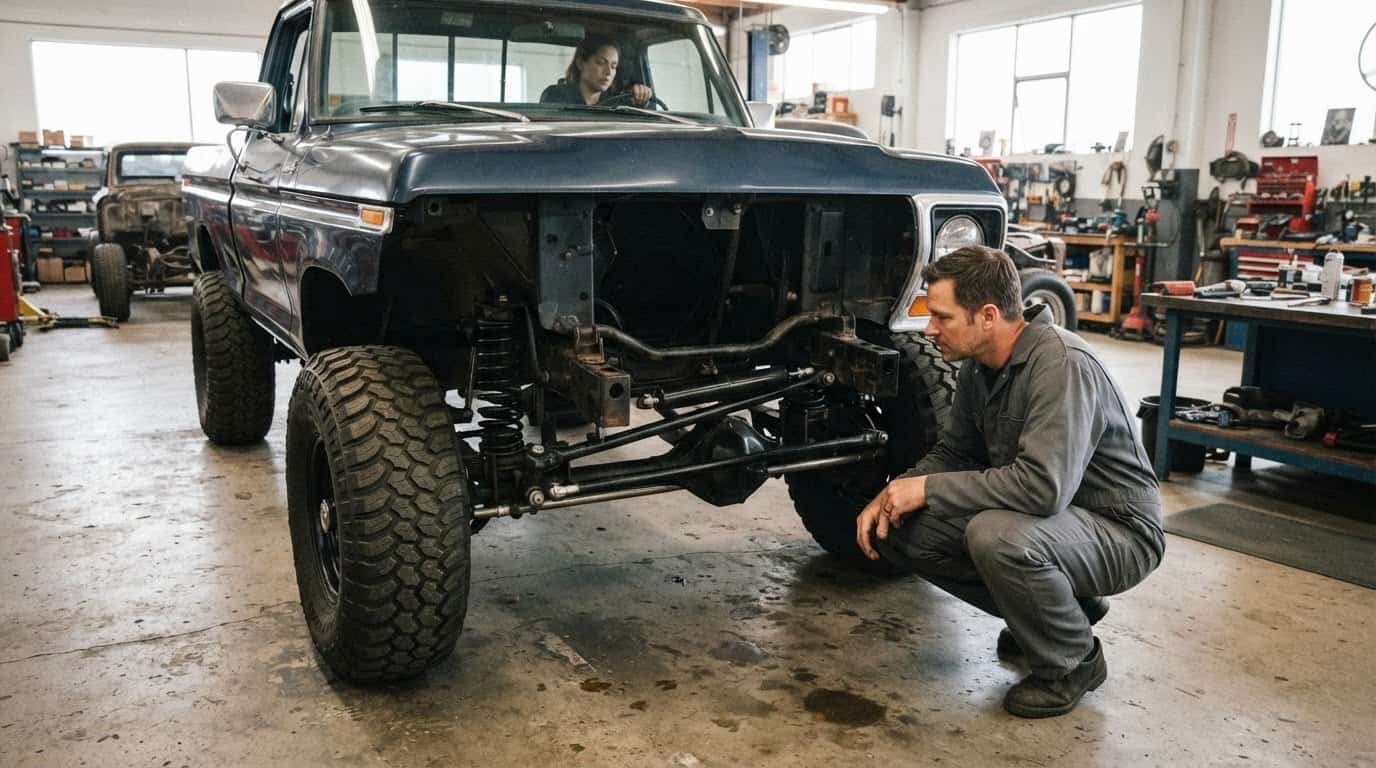
A violent front-axle shake after a bump is a warning to slow down, not fight the steering wheel. Diagnosing death wobble in a lifted classic truck means looking for the fault behind the oscillation, especially altered alignment or movement in the track bar and its mounts. Let the truck slow until the shaking stops, then pull over somewhere safe and inspect it before continuing.
If you’ve added a lift, larger tires, or other upgrades to a vintage truck, it’s natural to wonder whether the new setup changed how the front end behaves. This guide explains what death wobble is, how caster, toe, and track-bar faults can contribute, and which steering and suspension checks can help narrow down the cause. You’ll also learn why a stabilizer may mask symptoms without fixing the fault, and how to respond safely if wobble starts on the road. A careful diagnosis helps protect the truck’s character and your confidence behind the wheel.
Key Takeaways
- After a lift, assess how the changed geometry affects caster and toe before assuming a single worn part is to blame.
- Use a steering stabilizer as a dampener, not a substitute for finding and repairing the cause of the oscillation.
- Look for movement or damage at the track bar’s bolts, bushings, brackets, and mounting holes.
- If wobble starts on the road, let the truck slow, stop somewhere safe, and inspect it before continuing.
Alignment and caster after installing a lift
A suspension lift changes the angle between the front axle and chassis, which can alter caster and toe. These settings affect how the wheels track and return after a turn. Incorrect caster or toe after installation can contribute to death wobble, especially alongside another steering or suspension fault. Alignment on a lifted vehicle should account for its modified ride height, not simply assume the stock settings still apply.
Caster deserves careful attention. Lift, leveling, and lowering kits can change it, while caster cams may help restore alignment to specification. Check caster and camber during diagnosis, then compare toe with the vehicle’s alignment requirements. A visually straight steering wheel doesn’t prove the geometry is correct. The truck may track acceptably on smooth pavement, yet start oscillating after a bump.
One GM K-30 owner reported that changing the front caster shims from 4 degrees to 2 degrees eliminated wobble. Treat that as a vehicle-specific example, not a universal setting: the correct adjustment depends on the truck’s suspension and setup. During diagnosing death wobble in a lifted classic truck, note when the shake starts and whether it followed a lift or alignment change. Those details help connect symptoms to altered geometry.
Tire size, wheel offset, and balance also affect front-end behavior. Larger or differently positioned wheels can increase loads on the steering system, while imbalance or separated tire belts can add vibration. Check tire pressure and uneven wear, too. The doorjamb sticker provides a starting point for inflation pressure. Balance and inspect the wheels before attributing every shake to caster.
After replacing steering or suspension parts, get a post-repair alignment. Inspect the linkage, rod ends, and bolt holes for looseness or wear as well. Alignment can correct geometry, but it won’t repair damaged components. Repair cost depends on the fault; an inspection can establish what alignment work, replacement parts, and labor are needed.
Steering stabilizers and root-cause repairs
A violent shake through the steering wheel points to a system problem, not automatically a failed stabilizer. Identify the symptoms and inspect for underlying causes before replacing parts.
Steering and Suspension Causes
Death wobble can develop when tire-pressure differences, uneven wear, or play in steering and suspension components combine. Check both front tires for mismatched pressure and irregular wear, then look for looseness in steering links, ball joints, and bearings. Inspection and adjustment specifications depend on the truck’s make, model, and steering design. Use its factory service information to identify the correct checks and settings, accounting for modifications.
Dry Steering Inspection Under Load
A dry steering test reveals movement in steering and suspension parts while the truck’s weight rests on its tires. Park on firm, level ground and have a helper gently turn the steering wheel while you observe the linkage, joints, and front axle. Watch for delayed movement, shifting mounts, or a joint moving before the connected part responds. Keep your hands clear of pinch points.
For a home inspection, chock the wheels and never rely on a jack alone; use properly positioned jack stands if lifting a corner. Rock the raised tire at the 12- and 6-o’clock positions to check for ball-joint play. Stop if the truck shifts or a component looks damaged.
Steering Dampers and Steering-Box Wear
A steering stabilizer or damper can reduce felt movement, but it doesn’t repair the fault that triggers wobble. Replacing one alone may hide symptoms while loose joints or worn components remain. Inspect the steering box for looseness, leaks, or movement at its mounts, then trace play through the linkage. Don’t tighten the box by guesswork; follow the procedure specific to the truck’s model.
Repair cost depends on the cause, parts required, and labor involved; a quote request establishes the price for the specific truck. After a repair, recheck steering movement and alignment rather than treating a quieter steering wheel as proof that the root cause is fixed.
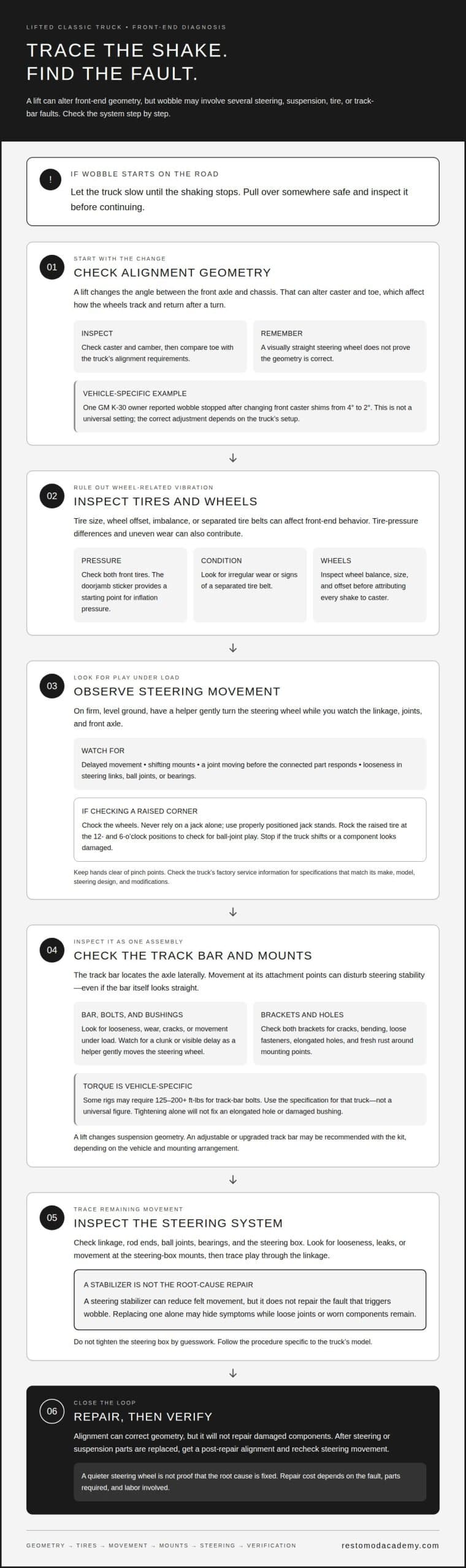
Track bar bolts, bushings, brackets, and mounting holes
A track bar locates the axle laterally, so movement at its mounts can disturb steering stability. Inspect the bar and its attachment points as one connected assembly.
Track Bar Bolts and Bushings
Check track-bar bolts and bushings for looseness, wear, cracking, or movement under load. A loose bolt or deteriorated bushing lets the bar shift instead of holding the axle in position. Look closely for elongated bolt holes or fresh rust, which can indicate movement around a fastener. These faults can contribute to death wobble even when the bar itself looks straight.
During inspection, watch the joints while a helper gently moves the steering wheel. Any clunk or visible delay needs attention. Don’t assume tightening a bolt will fix an elongated hole or damaged bushing; the affected parts need proper assessment.
Track Bar Brackets and Fasteners
Examine both track-bar brackets for cracks, bending, loose fasteners, and signs of movement. Pay special attention to the areas around bolt holes, where repeated movement can enlarge openings and weaken the mount. A lift changes suspension geometry, so an adjustable or upgraded track bar may be recommended with the kit. The right setup depends on the vehicle and its mounting arrangement.
Some rigs may require track-bar bolt torque specifications of 125-200+ ft-lbs, depending on the vehicle. Use the specification for that truck, not a universal figure; incorrect torque can leave hardware loose or damage components.
- Inspect the entire bar, both brackets, and each mounting point rather than focusing only on the visible bolt heads.
- Look for fresh rust around fasteners, which can mark movement between a bracket and its mounting surface.
- Check bushing condition and watch for side-to-side axle movement as the steering linkage moves.
- Don’t use a steering stabilizer to mask movement at a track-bar joint or bracket.
Record loose hardware, damaged bushings, or elongated bolt holes before repairs begin. After replacing a track bar or bracket, recheck fastener torque to the truck-specific specification and inspect the mounting points again. A sound upgrade starts with secure brackets and correctly fitted joints, not simply a heavier bar.
Driving safety during a wobble
If the front axle begins a violent shimmy at speed, treat it as an immediate safety problem. A road seam or bump can trigger oscillation, and the shaking may return without warning. Don’t keep driving at speed to see whether it happens again. Reduce speed gradually and maintain control of the steering wheel; avoid sudden inputs that could destabilize the truck further.
Let the truck slow until the vibration stops, then move to a safe place and stop. A wobble event at 50 mph after a road seam illustrates how quickly a normal drive can become difficult. Don’t resume the trip simply because the steering wheel feels calm again. A temporary pause in the shaking doesn’t show whether a loose drag link, worn ball joints, or another fault remains.
Once safely stopped, note what happened before the movement began. Record the road surface and speed, whether you were braking or turning, and any recent steering or suspension work. These details can help distinguish a bump-triggered shimmy from vibration that appears under different conditions. Don’t crawl beneath a truck stopped beside traffic or inspect steering parts while the vehicle is moving.
Death wobble can involve several faults acting together, so a roadside visual check cannot establish that the truck is safe. From a safe position, look for an obviously displaced wheel or damaged component, but don’t treat that glance as clearance to keep driving. If the wobble occurred at speed, stop driving and arrange recovery to a safe inspection location.
- Ease off speed and allow the oscillation to stop.
- Pull over somewhere safe before inspecting anything.
- Record the trigger and conditions for the later diagnosis.
- Don’t continue driving at speed after a wobble episode.
Protect the truck and everyone around it: a quiet steering wheel after the event doesn’t mean the problem is fixed. Resume driving only after the cause has been inspected and addressed.
Restomod Academy: The Ultimate Restomod Guide
Restomod Academy’s The Ultimate Restomod Guide offers broader guidance for planning classic-vehicle upgrades alongside this diagnosis. Use it when weighing how suspension, steering, and other modern enhancements fit into a coherent project, rather than treating each change in isolation.
For a build that needs a more tailored direction, Restomod Consulting Services can help you think through project decisions. Premium Project Blueprints offer another way to shape your plans before work begins. Neither replaces a hands-on inspection of a truck with active wobble; use the safety checks and repair findings to guide your mechanical next steps.
Keep the heritage that makes your truck special while planning upgrades with care. Visit Restomod Academy to explore The Ultimate Restomod Guide.
Build Confidence Into Your Next Upgrade
A classic truck becomes more rewarding to drive when each modification works as part of a considered whole. Treat diagnosing death wobble in a lifted classic truck as a chance to strengthen your build process: document changes, make one adjustment at a time, and note how each decision affects the vehicle’s character and control.
Carry that discipline into the next stage of your project. Before adding another upgrade, define what you want the truck to do, how you’ll use it, and which systems the change may affect. A clear plan helps preserve its vintage identity while balancing modern performance. It also gives you a stronger foundation for evaluating advice and choosing practical next steps.
For guidance as you shape your classic build, contact Restomod Academy. Keep learning, make thoughtful decisions, and enjoy the confidence that comes from understanding the machine you’re creating.
Frequently Asked Questions
What Is Death Wobble?
Death wobble is a violent, repeated oscillation of the front axle and steering, often triggered by a bump at speed. It can make the steering wheel shake sharply and the truck difficult to control. Unlike a brief jolt, the oscillation may continue until the vehicle slows. Treat it as a serious mechanical warning, not a normal characteristic of an older truck.
What causes death wobble in a lifted classic truck?
Death wobble usually develops when steering, suspension, tire, or alignment problems combine. A lift can alter front-end geometry, while loose track-bar hardware, worn bushings, or steering-joint play can let components move. Tire imbalance, damaged belts, mismatched pressure, and wheel offset can also contribute. A useful diagnostic clue is often a recent change, such as a lift installation, tire swap, or front-end repair.
How can you tell death wobble from tire imbalance or ordinary steering vibration?
Death wobble is typically a sudden, forceful oscillation that begins after a road disturbance and involves the front end moving back and forth. Tire imbalance more often causes recurring vibration as speed rises, without the same pronounced steering oscillation. These patterns help narrow down what to inspect, but don’t prove the cause. Note whether bumps trigger the wobble, whether it persists, and the speed conditions when it occurs.
What are the safest steps to diagnose death wobble on a lifted truck?
If wobble begins at speed, ease off and let the truck slow until the vibration stops. Pull over somewhere safe, then don’t continue driving until the vehicle has been inspected. Record the trigger, road surface, and driving conditions for diagnosis. Avoid inspecting beneath a vehicle beside traffic or one supported only by a jack. If you can’t inspect it safely, arrange transport to a safe location.
How do you inspect classic truck steering linkage, ball joints, and tie-rod ends for play?
With the truck parked securely, have a helper move the steering wheel gently while you watch each linkage joint for delayed movement, looseness, or a clunk. Check tie-rod ends where they connect to the steering linkage. To check ball-joint play, raise and properly support the corner, then rock the tire at the 12- and 6-o’clock positions. Keep clear of pinch points and stop if support shifts.
How do worn track bars, bushings, and steering-box mounts cause death wobble?
A worn track-bar bushing or loose mounting point can let the axle shift sideways instead of staying in position beneath the chassis. That movement feeds back through the steering and can help sustain oscillation. Worn steering-box mounts may let the box move against the frame, adding lost motion between steering input and wheel response. Inspect these connections as a system, since one loose mount can magnify play elsewhere.
A violent front-axle shake after a bump is a warning to slow down, not fight the steering wheel. Diagnosing death wobble in a lifted classic truck means looking for the fault behind the oscillation, especially altered alignment or movement in the track bar and its mounts. Let the truck slow until the shaking stops, then pull over somewhere safe and inspect it before continuing.
If you’ve added a lift, larger tires, or other upgrades to a vintage truck, it’s natural to wonder whether the new setup changed how the front end behaves. This guide explains what death wobble is, how caster, toe, and track-bar faults can contribute, and which steering and suspension checks can help narrow down the cause. You’ll also learn why a stabilizer may mask symptoms without fixing the fault, and how to respond safely if wobble starts on the road. A careful diagnosis helps protect the truck’s character and your confidence behind the wheel.
Key Takeaways
- After a lift, assess how the changed geometry affects caster and toe before assuming a single worn part is to blame.
- Use a steering stabilizer as a dampener, not a substitute for finding and repairing the cause of the oscillation.
- Look for movement or damage at the track bar’s bolts, bushings, brackets, and mounting holes.
- If wobble starts on the road, let the truck slow, stop somewhere safe, and inspect it before continuing.
Alignment and caster after installing a lift
A suspension lift changes the angle between the front axle and chassis, which can alter caster and toe. These settings affect how the wheels track and return after a turn. Incorrect caster or toe after installation can contribute to death wobble, especially alongside another steering or suspension fault. Alignment on a lifted vehicle should account for its modified ride height, not simply assume the stock settings still apply.
Caster deserves careful attention. Lift, leveling, and lowering kits can change it, while caster cams may help restore alignment to specification. Check caster and camber during diagnosis, then compare toe with the vehicle’s alignment requirements. A visually straight steering wheel doesn’t prove the geometry is correct. The truck may track acceptably on smooth pavement, yet start oscillating after a bump.
One GM K-30 owner reported that changing the front caster shims from 4 degrees to 2 degrees eliminated wobble. Treat that as a vehicle-specific example, not a universal setting: the correct adjustment depends on the truck’s suspension and setup. During diagnosing death wobble in a lifted classic truck, note when the shake starts and whether it followed a lift or alignment change. Those details help connect symptoms to altered geometry.
Tire size, wheel offset, and balance also affect front-end behavior. Larger or differently positioned wheels can increase loads on the steering system, while imbalance or separated tire belts can add vibration. Check tire pressure and uneven wear, too. The doorjamb sticker provides a starting point for inflation pressure. Balance and inspect the wheels before attributing every shake to caster.
After replacing steering or suspension parts, get a post-repair alignment. Inspect the linkage, rod ends, and bolt holes for looseness or wear as well. Alignment can correct geometry, but it won’t repair damaged components. Repair cost depends on the fault; an inspection can establish what alignment work, replacement parts, and labor are needed.
Steering stabilizers and root-cause repairs
A violent shake through the steering wheel points to a system problem, not automatically a failed stabilizer. Identify the symptoms and inspect for underlying causes before replacing parts.
Steering and Suspension Causes
Death wobble can develop when tire-pressure differences, uneven wear, or play in steering and suspension components combine. Check both front tires for mismatched pressure and irregular wear, then look for looseness in steering links, ball joints, and bearings. Inspection and adjustment specifications depend on the truck’s make, model, and steering design. Use its factory service information to identify the correct checks and settings, accounting for modifications.
Dry Steering Inspection Under Load
A dry steering test reveals movement in steering and suspension parts while the truck’s weight rests on its tires. Park on firm, level ground and have a helper gently turn the steering wheel while you observe the linkage, joints, and front axle. Watch for delayed movement, shifting mounts, or a joint moving before the connected part responds. Keep your hands clear of pinch points.
For a home inspection, chock the wheels and never rely on a jack alone; use properly positioned jack stands if lifting a corner. Rock the raised tire at the 12- and 6-o’clock positions to check for ball-joint play. Stop if the truck shifts or a component looks damaged.
Steering Dampers and Steering-Box Wear
A steering stabilizer or damper can reduce felt movement, but it doesn’t repair the fault that triggers wobble. Replacing one alone may hide symptoms while loose joints or worn components remain. Inspect the steering box for looseness, leaks, or movement at its mounts, then trace play through the linkage. Don’t tighten the box by guesswork; follow the procedure specific to the truck’s model.
Repair cost depends on the cause, parts required, and labor involved; a quote request establishes the price for the specific truck. After a repair, recheck steering movement and alignment rather than treating a quieter steering wheel as proof that the root cause is fixed.
Track bar bolts, bushings, brackets, and mounting holes
A track bar locates the axle laterally, so movement at its mounts can disturb steering stability. Inspect the bar and its attachment points as one connected assembly.
Track Bar Bolts and Bushings
Check track-bar bolts and bushings for looseness, wear, cracking, or movement under load. A loose bolt or deteriorated bushing lets the bar shift instead of holding the axle in position. Look closely for elongated bolt holes or fresh rust, which can indicate movement around a fastener. These faults can contribute to death wobble even when the bar itself looks straight.
During inspection, watch the joints while a helper gently moves the steering wheel. Any clunk or visible delay needs attention. Don’t assume tightening a bolt will fix an elongated hole or damaged bushing; the affected parts need proper assessment.
Track Bar Brackets and Fasteners
Examine both track-bar brackets for cracks, bending, loose fasteners, and signs of movement. Pay special attention to the areas around bolt holes, where repeated movement can enlarge openings and weaken the mount. A lift changes suspension geometry, so an adjustable or upgraded track bar may be recommended with the kit. The right setup depends on the vehicle and its mounting arrangement.
Some rigs may require track-bar bolt torque specifications of 125-200+ ft-lbs, depending on the vehicle. Use the specification for that truck, not a universal figure; incorrect torque can leave hardware loose or damage components.
- Inspect the entire bar, both brackets, and each mounting point rather than focusing only on the visible bolt heads.
- Look for fresh rust around fasteners, which can mark movement between a bracket and its mounting surface.
- Check bushing condition and watch for side-to-side axle movement as the steering linkage moves.
- Don’t use a steering stabilizer to mask movement at a track-bar joint or bracket.
Record loose hardware, damaged bushings, or elongated bolt holes before repairs begin. After replacing a track bar or bracket, recheck fastener torque to the truck-specific specification and inspect the mounting points again. A sound upgrade starts with secure brackets and correctly fitted joints, not simply a heavier bar.
Driving safety during a wobble
If the front axle begins a violent shimmy at speed, treat it as an immediate safety problem. A road seam or bump can trigger oscillation, and the shaking may return without warning. Don’t keep driving at speed to see whether it happens again. Reduce speed gradually and maintain control of the steering wheel; avoid sudden inputs that could destabilize the truck further.
Let the truck slow until the vibration stops, then move to a safe place and stop. A wobble event at 50 mph after a road seam illustrates how quickly a normal drive can become difficult. Don’t resume the trip simply because the steering wheel feels calm again. A temporary pause in the shaking doesn’t show whether a loose drag link, worn ball joints, or another fault remains.
Once safely stopped, note what happened before the movement began. Record the road surface and speed, whether you were braking or turning, and any recent steering or suspension work. These details can help distinguish a bump-triggered shimmy from vibration that appears under different conditions. Don’t crawl beneath a truck stopped beside traffic or inspect steering parts while the vehicle is moving.
Death wobble can involve several faults acting together, so a roadside visual check cannot establish that the truck is safe. From a safe position, look for an obviously displaced wheel or damaged component, but don’t treat that glance as clearance to keep driving. If the wobble occurred at speed, stop driving and arrange recovery to a safe inspection location.
- Ease off speed and allow the oscillation to stop.
- Pull over somewhere safe before inspecting anything.
- Record the trigger and conditions for the later diagnosis.
- Don’t continue driving at speed after a wobble episode.
Protect the truck and everyone around it: a quiet steering wheel after the event doesn’t mean the problem is fixed. Resume driving only after the cause has been inspected and addressed.
Restomod Academy: The Ultimate Restomod Guide
Restomod Academy’s The Ultimate Restomod Guide offers broader guidance for planning classic-vehicle upgrades alongside this diagnosis. Use it when weighing how suspension, steering, and other modern enhancements fit into a coherent project, rather than treating each change in isolation.
For a build that needs a more tailored direction, Restomod Consulting Services can help you think through project decisions. Premium Project Blueprints offer another way to shape your plans before work begins. Neither replaces a hands-on inspection of a truck with active wobble; use the safety checks and repair findings to guide your mechanical next steps.
Keep the heritage that makes your truck special while planning upgrades with care. Visit Restomod Academy to explore The Ultimate Restomod Guide.
Build Confidence Into Your Next Upgrade
A classic truck becomes more rewarding to drive when each modification works as part of a considered whole. Treat diagnosing death wobble in a lifted classic truck as a chance to strengthen your build process: document changes, make one adjustment at a time, and note how each decision affects the vehicle’s character and control.
Carry that discipline into the next stage of your project. Before adding another upgrade, define what you want the truck to do, how you’ll use it, and which systems the change may affect. A clear plan helps preserve its vintage identity while balancing modern performance. It also gives you a stronger foundation for evaluating advice and choosing practical next steps.
For guidance as you shape your classic build, contact Restomod Academy. Keep learning, make thoughtful decisions, and enjoy the confidence that comes from understanding the machine you’re creating.
Frequently Asked Questions
What Is Death Wobble?
Death wobble is a violent, repeated oscillation of the front axle and steering, often triggered by a bump at speed. It can make the steering wheel shake sharply and the truck difficult to control. Unlike a brief jolt, the oscillation may continue until the vehicle slows. Treat it as a serious mechanical warning, not a normal characteristic of an older truck.
What causes death wobble in a lifted classic truck?
Death wobble usually develops when steering, suspension, tire, or alignment problems combine. A lift can alter front-end geometry, while loose track-bar hardware, worn bushings, or steering-joint play can let components move. Tire imbalance, damaged belts, mismatched pressure, and wheel offset can also contribute. A useful diagnostic clue is often a recent change, such as a lift installation, tire swap, or front-end repair.
How can you tell death wobble from tire imbalance or ordinary steering vibration?
Death wobble is typically a sudden, forceful oscillation that begins after a road disturbance and involves the front end moving back and forth. Tire imbalance more often causes recurring vibration as speed rises, without the same pronounced steering oscillation. These patterns help narrow down what to inspect, but don’t prove the cause. Note whether bumps trigger the wobble, whether it persists, and the speed conditions when it occurs.
What are the safest steps to diagnose death wobble on a lifted truck?
If wobble begins at speed, ease off and let the truck slow until the vibration stops. Pull over somewhere safe, then don’t continue driving until the vehicle has been inspected. Record the trigger, road surface, and driving conditions for diagnosis. Avoid inspecting beneath a vehicle beside traffic or one supported only by a jack. If you can’t inspect it safely, arrange transport to a safe location.
How do you inspect classic truck steering linkage, ball joints, and tie-rod ends for play?
With the truck parked securely, have a helper move the steering wheel gently while you watch each linkage joint for delayed movement, looseness, or a clunk. Check tie-rod ends where they connect to the steering linkage. To check ball-joint play, raise and properly support the corner, then rock the tire at the 12- and 6-o’clock positions. Keep clear of pinch points and stop if support shifts.
How do worn track bars, bushings, and steering-box mounts cause death wobble?
A worn track-bar bushing or loose mounting point can let the axle shift sideways instead of staying in position beneath the chassis. That movement feeds back through the steering and can help sustain oscillation. Worn steering-box mounts may let the box move against the frame, adding lost motion between steering input and wheel response. Inspect these connections as a system, since one loose mount can magnify play elsewhere.