
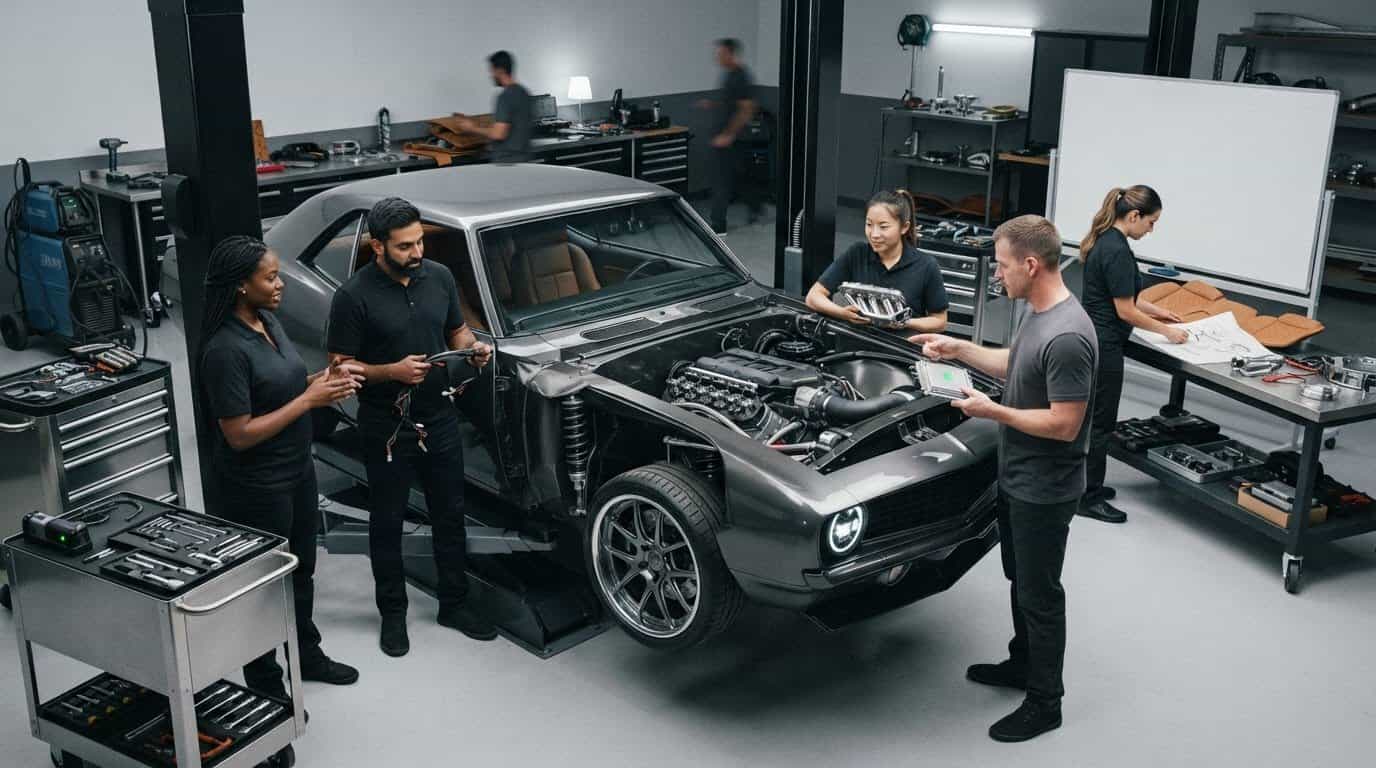
The biggest upgrade to your restomod may not be under the hood. It may be the people around your project. Finding a community of fellow restomod builders connects you with enthusiasts who understand the balance between classic character and modern performance, rather than treating every build like a period-correct restoration. If you’re new, asking a basic question or sorting through conflicting advice can feel harder than turning the first wrench.
The right community is more than a place to share photos. It’s a practical resource for learning from real builds, comparing approaches, and identifying when advice needs a closer look. Strong connections grow through reciprocity: explain your question, share what you learn, and credit the people who help you move forward.
In this guide, you’ll find ways to meet restomod builders online and in person, assess whether a group’s advice is relevant and trustworthy, and become a valued member even while you’re still learning. You’ll also learn how to turn conversations and inspiration into better-planned project decisions, one considered step at a time.
Key Takeaways
- Find relevant peers through marque clubs, restoration forums, social platforms, and in-person car events.
- Search using your vehicle model, build stage, and technical interest to find conversations closer to your project.
- Judge a group by the relevance and substance of its project discussions, not its follower count or polished photos.
- Build trust by introducing your project clearly, asking focused questions, and sharing what you learn.
- Make finding a community of fellow restomod builders the start of a deliberate process: record advice, compare perspectives, and turn useful insights into a considered build plan.
Why a Community of Fellow Restomod Builders Makes a Difference
A restomod-builder community is a group of peers who share experience from real projects: what they planned, what they discovered during teardown, which choices caused complications, and what they would do differently next time. That detail is more useful than general enthusiasm alone. When finding a community of fellow restomod builders, look for discussions that connect a specific question to a vehicle, system, or build goal.
Shared terminology helps, too. When members understand the difference between preserving original character and upgrading a car for modern usability, they can move beyond vague suggestions and discuss real trade-offs. One builder might prioritize comfortable highway driving; another may want to keep the cabin and engine bay visually period-inspired. Neither goal is automatically right for every project. A useful peer group helps you compare choices without assuming there’s one ideal restomod recipe.
Passive scrolling through finished-car photos has limits. A polished reveal can spark ideas, but it rarely explains the decisions behind the result: what was retained, what changed, and which compromises shaped the build. Project-specific questions and lessons turn inspiration into understanding, whether you’re weighing an upgrade or learning from someone else’s setback.
What makes a restomod community different from a general car group?
Restomod discussions sit at the meeting point of preservation and modernization. The restomod definition and overview explains the term in the context of combining a classic vehicle’s character with thoughtful updates; the broader Conservation and restoration of road vehicles topic helps place those choices within vehicle restoration. In a focused group, that blend shapes questions about appearance, drivability, reliability, and intended use.
A general car group can still be welcoming, but its conversations may span very different priorities. A restomod-focused exchange is more likely to discuss how a modern component fits an older platform while respecting that each builder sets their own balance of originality and change.
How shared build experience helps at every skill level
Beginners can use peer conversations to learn unfamiliar terms, understand which parts of a project depend on one another, and identify the next question worth researching. You don’t need to arrive with expert knowledge. Explain what you know, then use the answers to sharpen your understanding instead of treating the first suggestion as a final instruction.
Experienced builders benefit from comparing planning methods and troubleshooting approaches, especially when another person has worked with a similar vehicle, component combination, and set of goals. A useful restomod community is a place to exchange project-specific experience, questions, and lessons so each member can make more informed choices.
Keep safety in view. Peer advice can point you toward useful considerations, but it is one input for your research and judgment, not a substitute for qualified expertise on safety-critical work. For complex systems or decisions that affect safe operation, seek guidance from an appropriately qualified professional before proceeding.
Where to Find Fellow Restomod Builders Online and In Person
Start where people gather around your vehicle, its marque, or the work you want to tackle. Finding a community of fellow restomod builders might mean joining a model-specific forum, following restoration discussions on social platforms, or starting a conversation beside a project car at a local show. Explore a few spaces and check what members are discussing now to see which ones fit your project.
Which online spaces are worth exploring?
Model-specific forums can be useful for platform knowledge, while enthusiast groups on social media make it easy to follow active builds. Reddit communities can offer broad discussions and troubleshooting threads; Discord servers may support quicker back-and-forth conversation. Activity and group culture vary, so browse recent posts before joining in. Look for exchanges with context and follow-up, not just a stream of finished-car photos.
Search with a combination of details rather than the word “restomod” alone. Pair your vehicle model with its current build stage and the subject you’re researching, such as a model name plus “suspension rebuild” or “interior fabrication.” Try terms such as drivetrain, wiring, or chassis alongside the make and model. This can surface relevant conversations even in spaces that aren’t labeled as restomod groups.
Before posting, read pinned guidance and observe how members respond to questions. Do recent threads get thoughtful replies? Are people sharing project context, or are discussions mostly promotional? Browsing first helps you understand the group’s rhythm and decide where you can contribute.
How to meet builders through clubs, events, and local gatherings
Look beyond screens. Marque clubs, classic-car shows, swap meets, and hands-on workshops bring owners and builders together around shared interests. Conversations can start while you’re admiring an engine bay or asking about a fabrication detail. Attend with curiosity, while remembering that not everyone is looking to join a group or have a long technical discussion.
Prepare a brief introduction so you can explain what you’re building without recounting the full project history: name the car, describe your goal, and say what stage you’re at. Then ask a specific, open question about the other person’s experience. Listen first, respect their time, and follow up only if they welcome it. A useful connection can start with one good conversation, not a stack of business cards.
Use online and in-person discovery together. A club gathering might point you toward a forum thread, while a helpful online discussion can lead you to a local event where you can see a similar setup in person. For structured background alongside peer conversations, The Ultimate Restomod Guide can help you organize what you’re learning and prepare more focused questions for fellow builders.
How to Tell Whether a Restomod Builder Community Is Worth Joining
A group can have a large audience and still offer little help with your build. Judge it by the quality and relevance of its conversations, not follower counts, polished photos, or how confident its members sound. When finding a community of fellow restomod builders that can help over time, look for members discussing vehicles, project scope, skill levels, or technical questions close to yours.
Check recent discussions. Are questions getting thoughtful responses, or are posts mostly announcements and compliments? A useful exchange explains why an approach worked, what conditions shaped the result, and where it might not apply. Advice about a drivetrain change, for instance, should account for the vehicle and intended setup rather than present one build as a universal template.
Signs a group supports useful, respectful learning
Strong technical conversations include context and reasoning. Members distinguish what they’ve done firsthand from what they’ve heard, describe relevant trade-offs, and ask for missing details before recommending a fix. Respectful correction matters, too: experienced builders should be able to challenge an idea without belittling the person asking. Look for group norms that keep disagreements focused on the work.
Red flags in technical advice and group culture
Be cautious of absolute claims that ignore vehicle condition, intended use, or differences between builds. Pressure to copy a setup without understanding compatibility or safety implications is another warning sign. A sound community makes room for uncertainty and encourages further research when a question goes beyond someone’s experience.
Technical advice is strongest when its context and limits are clear. Use that standard to assess individual answers as well as the overall culture of a group.
| Useful signs | Caution signs | Questions to investigate |
|---|---|---|
| Recent, detailed replies tied to similar builds | Old threads or mostly promotional posts | Are members discussing projects like mine? |
| Advice explains reasoning and trade-offs | One-size-fits-all claims | What vehicle, setup, and goal does this advice assume? |
| Members state what they know firsthand | Hearsay presented as proven fact | Has the person tried this approach themselves? |
| Disagreements stay respectful and specific | Newcomers are mocked or pressured to comply | Can members question advice without being shut down? |
Use the table as a quick screening tool, not a demand for perfection. Even a healthy group will have unanswered questions or differing opinions. What matters is whether people help clarify the variables, acknowledge limits, and suggest sensible next steps. If advice could affect a safety-critical system, treat discussion as a starting point for further research and qualified guidance, not proof that a proposed change is appropriate for your car.

How to Join the Conversation and Build Trust with Other Builders
Trust grows through steady, useful participation, not a perfect first post. As you continue finding a community of fellow restomod builders, take time to understand the group before asking for help. Then make it easy for others to respond, and close the loop when their input helps you move forward.
- Observe how members share project details, respond to questions, and handle disagreement.
- Introduce your car, your build direction, and the stage you’ve reached.
- Ask one focused question, with the context someone would need to give a useful answer.
- Thank contributors and report what you learned or decided, even if you chose a different approach.
This approach respects the group’s time and shows members that you’re putting their experience to thoughtful use. It also gives you room to learn the group’s tone before joining a technical discussion.
How to introduce your car and project clearly
Keep your introduction concise but specific. Name the vehicle and year if known, describe the direction of the build, and say whether you’re planning, disassembling, assembling, or refining the car. Be honest about your experience level. That helps people tailor their replies without turning a beginner’s question into a test of expertise.
Add clear photos or measurements when they help answer a particular question. A wide view can show the overall layout; a close-up may clarify a bracket, clearance, or connection. Avoid posting a large batch of images without explanation. Include what you’ve already researched, measured, or tested so members don’t have to guess what you’ve ruled out.
How to ask questions that invite useful answers
Break a broad problem into one answerable question. Instead of asking, “What should I change on my car?”, explain the current setup, intended use, goal, and constraints. Then ask about a specific decision or the trade-offs between approaches. This gives experienced builders a clear starting point while leaving room for them to explain where their experience may not match your project.
For example, describe the symptom you’re investigating, the relevant components, and the checks you’ve completed. Ask what factors others considered before choosing their solution rather than requesting a universal recipe. Be open to follow-up questions; a request for more detail can mean someone is trying to give a careful answer.
When advice informs a decision, credit the people whose experience helped you think it through. Later, share what you did and what happened, including if the result differed from expectations. That follow-up gives future readers practical context and shows the group that contributions matter.
Build your technical foundation alongside peer learning. Organized knowledge can help you frame sharper questions and assess different answers. Explore The Ultimate Restomod Guide as a structured learning resource for your project.
Turn Community Advice into a More Confident Restomod Build
Good conversations can generate plenty of possibilities. The next step is turning them into a sequence of considered decisions that serves your car and your goals. As you continue finding a community of fellow restomod builders, treat advice as useful input, not an automatic instruction. A popular solution may still be wrong for a different vehicle condition, component combination, or intended use.
Keep project discussions connected to your build goals
Keep a simple project record for advice you may want to revisit. Note who shared it, the vehicle and setup they were describing, what they recommended, and what questions remain. Separate ideas to investigate from choices you’ve verified and tasks you’re ready to schedule. This prevents an interesting suggestion from becoming a build decision before you understand its implications.
Connect each possible change to your priorities. If you’re considering an upgrade for drivability, write down the goal and what else the change might affect. Advice about one component, for example, may prompt questions about fitment, supporting systems, or how the car will be used. Record those as research tasks instead of assuming one answer settles the entire plan.
A project roadmap helps put your notes in order. Group them into research, decisions, and future work, then identify which choices depend on earlier steps. A broader restomod project planning roadmap can help you organize the sequence. Revisit it as you learn; a plan should guide the project, not lock you into an idea that no longer fits.
Use structured learning to keep building with confidence
Peer discussions are especially helpful when you can connect them to a wider understanding of the systems involved. Organized learning can help you compare an answer with your build goals, identify assumptions, and recognize what you still need to research. It also gives you a stronger foundation for judging conflicting suggestions without dismissing experience or treating group agreement as proof.
Keep sources and decisions together. If several people recommend different approaches, write down the reason behind each one and the conditions that might explain the difference. Then look for reliable technical information relevant to your specific setup. For safety-critical work, use discussion to clarify questions, not as a substitute for qualified expertise. Once you’re satisfied that a choice fits the project, add it to your plan with the next practical step.
Community learning and structured resources work best side by side: builders share lived experience, while organized material helps you develop the context to apply it thoughtfully. Take your next step with The Ultimate Restomod Guide, and keep building your knowledge alongside the conversations that make the work more rewarding.
Make Your Next Build Step Count
A shared project can become a long sequence of small decisions: what to preserve, what to modernize, and how each change supports the car you want to drive. Finding a community of fellow restomod builders gives you people to learn alongside, but your own goals should stay at the center. Let each conversation sharpen your thinking, then choose one practical next step you can research, plan, or tackle in the workshop.
You don’t need every answer before you begin. Keep learning as the project unfolds, and let curiosity become careful progress. For a structured resource to build your knowledge beyond individual conversations, explore The Ultimate Restomod Guide. Bring what you learn back to your project and your peers, and keep moving forward with confidence. The right combination of heritage, thoughtful upgrades, and steady effort is yours to create.
Frequently Asked Questions
How do I find a local community of classic car builders?
Look for recurring gatherings as well as one-off events. Search local event calendars and enthusiast pages for marque club meetings, swap meets, restoration workshops, and classic-car shows, pairing your area with your vehicle model or project interest. If you’re new, attend first to get a feel for the group. Ask an organizer whether future gatherings focus on hands-on projects as well as display days.
Are online communities useful for beginner restomod builders?
Yes. Online groups can help you learn terminology and decide what to research next, even before you start turning wrenches. Keep a project notebook with unfamiliar terms, useful threads, and questions to verify. As your knowledge grows, you’ll be better prepared to distinguish someone’s personal setup from guidance that applies more broadly. For safety-critical decisions, use qualified expertise rather than relying on posts alone.
What should I include when asking a restomod group for technical advice?
Give members enough context to understand the problem without burying your question in a full build diary. State the vehicle and model year, describe the relevant system and current configuration, and explain the result you’re aiming for. Mention constraints such as parts already installed or work completed, then ask one clear question. If a photo helps show the issue, label what members should look at.
How can I tell whether car-building advice online is trustworthy?
Check whether the reply explains the conditions behind its recommendation and whether those conditions match your car. Look for details such as component combinations, vehicle use, and what the person has personally tested. For a major decision, compare the suggestion with technical documentation from relevant manufacturers or established repair references. If key facts conflict or remain unclear, pause and gather more evidence before changing the build.
Do I need to own a classic car before joining a restomod community?
No, you can often learn and take part while researching a future project. Be upfront that you’re planning rather than speaking from hands-on experience, and check any group rules about membership or posting. Follow discussions about the models you’re considering and note which skills, tools, or project choices come up repeatedly. That preparation can help you choose a car with a clearer sense of the work involved.
How do I handle conflicting advice from fellow builders?
Compare the assumptions behind each answer before deciding which one fits. One builder may be describing a car used for weekend drives, while another has different components or priorities. Ask what led them to their approach, then write down the remaining questions and evidence you need. Don’t decide by counting votes. If the disagreement concerns a safety-critical system, bring the specific issue to qualified expertise.
Can a restomod community help me plan a project before I start?
Yes, builders can help uncover questions to answer before you commit to a direction. If you’re finding a community of fellow restomod builders before buying a car, ask what they wish they had inspected or researched first, then verify those points for the vehicle you’re considering. Sort what you learn into decisions to make, unknowns to resolve, and tasks for later. That turns conversation into preparation without treating another build as a template.
The biggest upgrade to your restomod may not be under the hood. It may be the people around your project. Finding a community of fellow restomod builders connects you with enthusiasts who understand the balance between classic character and modern performance, rather than treating every build like a period-correct restoration. If you’re new, asking a basic question or sorting through conflicting advice can feel harder than turning the first wrench.
The right community is more than a place to share photos. It’s a practical resource for learning from real builds, comparing approaches, and identifying when advice needs a closer look. Strong connections grow through reciprocity: explain your question, share what you learn, and credit the people who help you move forward.
In this guide, you’ll find ways to meet restomod builders online and in person, assess whether a group’s advice is relevant and trustworthy, and become a valued member even while you’re still learning. You’ll also learn how to turn conversations and inspiration into better-planned project decisions, one considered step at a time.
Key Takeaways
- Find relevant peers through marque clubs, restoration forums, social platforms, and in-person car events.
- Search using your vehicle model, build stage, and technical interest to find conversations closer to your project.
- Judge a group by the relevance and substance of its project discussions, not its follower count or polished photos.
- Build trust by introducing your project clearly, asking focused questions, and sharing what you learn.
- Make finding a community of fellow restomod builders the start of a deliberate process: record advice, compare perspectives, and turn useful insights into a considered build plan.
Why a Community of Fellow Restomod Builders Makes a Difference
A restomod-builder community is a group of peers who share experience from real projects: what they planned, what they discovered during teardown, which choices caused complications, and what they would do differently next time. That detail is more useful than general enthusiasm alone. When finding a community of fellow restomod builders, look for discussions that connect a specific question to a vehicle, system, or build goal.
Shared terminology helps, too. When members understand the difference between preserving original character and upgrading a car for modern usability, they can move beyond vague suggestions and discuss real trade-offs. One builder might prioritize comfortable highway driving; another may want to keep the cabin and engine bay visually period-inspired. Neither goal is automatically right for every project. A useful peer group helps you compare choices without assuming there’s one ideal restomod recipe.
Passive scrolling through finished-car photos has limits. A polished reveal can spark ideas, but it rarely explains the decisions behind the result: what was retained, what changed, and which compromises shaped the build. Project-specific questions and lessons turn inspiration into understanding, whether you’re weighing an upgrade or learning from someone else’s setback.
What makes a restomod community different from a general car group?
Restomod discussions sit at the meeting point of preservation and modernization. The restomod definition and overview explains the term in the context of combining a classic vehicle’s character with thoughtful updates; the broader Conservation and restoration of road vehicles topic helps place those choices within vehicle restoration. In a focused group, that blend shapes questions about appearance, drivability, reliability, and intended use.
A general car group can still be welcoming, but its conversations may span very different priorities. A restomod-focused exchange is more likely to discuss how a modern component fits an older platform while respecting that each builder sets their own balance of originality and change.
How shared build experience helps at every skill level
Beginners can use peer conversations to learn unfamiliar terms, understand which parts of a project depend on one another, and identify the next question worth researching. You don’t need to arrive with expert knowledge. Explain what you know, then use the answers to sharpen your understanding instead of treating the first suggestion as a final instruction.
Experienced builders benefit from comparing planning methods and troubleshooting approaches, especially when another person has worked with a similar vehicle, component combination, and set of goals. A useful restomod community is a place to exchange project-specific experience, questions, and lessons so each member can make more informed choices.
Keep safety in view. Peer advice can point you toward useful considerations, but it is one input for your research and judgment, not a substitute for qualified expertise on safety-critical work. For complex systems or decisions that affect safe operation, seek guidance from an appropriately qualified professional before proceeding.
Where to Find Fellow Restomod Builders Online and In Person
Start where people gather around your vehicle, its marque, or the work you want to tackle. Finding a community of fellow restomod builders might mean joining a model-specific forum, following restoration discussions on social platforms, or starting a conversation beside a project car at a local show. Explore a few spaces and check what members are discussing now to see which ones fit your project.
Which online spaces are worth exploring?
Model-specific forums can be useful for platform knowledge, while enthusiast groups on social media make it easy to follow active builds. Reddit communities can offer broad discussions and troubleshooting threads; Discord servers may support quicker back-and-forth conversation. Activity and group culture vary, so browse recent posts before joining in. Look for exchanges with context and follow-up, not just a stream of finished-car photos.
Search with a combination of details rather than the word “restomod” alone. Pair your vehicle model with its current build stage and the subject you’re researching, such as a model name plus “suspension rebuild” or “interior fabrication.” Try terms such as drivetrain, wiring, or chassis alongside the make and model. This can surface relevant conversations even in spaces that aren’t labeled as restomod groups.
Before posting, read pinned guidance and observe how members respond to questions. Do recent threads get thoughtful replies? Are people sharing project context, or are discussions mostly promotional? Browsing first helps you understand the group’s rhythm and decide where you can contribute.
How to meet builders through clubs, events, and local gatherings
Look beyond screens. Marque clubs, classic-car shows, swap meets, and hands-on workshops bring owners and builders together around shared interests. Conversations can start while you’re admiring an engine bay or asking about a fabrication detail. Attend with curiosity, while remembering that not everyone is looking to join a group or have a long technical discussion.
Prepare a brief introduction so you can explain what you’re building without recounting the full project history: name the car, describe your goal, and say what stage you’re at. Then ask a specific, open question about the other person’s experience. Listen first, respect their time, and follow up only if they welcome it. A useful connection can start with one good conversation, not a stack of business cards.
Use online and in-person discovery together. A club gathering might point you toward a forum thread, while a helpful online discussion can lead you to a local event where you can see a similar setup in person. For structured background alongside peer conversations, The Ultimate Restomod Guide can help you organize what you’re learning and prepare more focused questions for fellow builders.
How to Tell Whether a Restomod Builder Community Is Worth Joining
A group can have a large audience and still offer little help with your build. Judge it by the quality and relevance of its conversations, not follower counts, polished photos, or how confident its members sound. When finding a community of fellow restomod builders that can help over time, look for members discussing vehicles, project scope, skill levels, or technical questions close to yours.
Check recent discussions. Are questions getting thoughtful responses, or are posts mostly announcements and compliments? A useful exchange explains why an approach worked, what conditions shaped the result, and where it might not apply. Advice about a drivetrain change, for instance, should account for the vehicle and intended setup rather than present one build as a universal template.
Signs a group supports useful, respectful learning
Strong technical conversations include context and reasoning. Members distinguish what they’ve done firsthand from what they’ve heard, describe relevant trade-offs, and ask for missing details before recommending a fix. Respectful correction matters, too: experienced builders should be able to challenge an idea without belittling the person asking. Look for group norms that keep disagreements focused on the work.
Red flags in technical advice and group culture
Be cautious of absolute claims that ignore vehicle condition, intended use, or differences between builds. Pressure to copy a setup without understanding compatibility or safety implications is another warning sign. A sound community makes room for uncertainty and encourages further research when a question goes beyond someone’s experience.
Technical advice is strongest when its context and limits are clear. Use that standard to assess individual answers as well as the overall culture of a group.
| Useful signs | Caution signs | Questions to investigate |
|---|---|---|
| Recent, detailed replies tied to similar builds | Old threads or mostly promotional posts | Are members discussing projects like mine? |
| Advice explains reasoning and trade-offs | One-size-fits-all claims | What vehicle, setup, and goal does this advice assume? |
| Members state what they know firsthand | Hearsay presented as proven fact | Has the person tried this approach themselves? |
| Disagreements stay respectful and specific | Newcomers are mocked or pressured to comply | Can members question advice without being shut down? |
Use the table as a quick screening tool, not a demand for perfection. Even a healthy group will have unanswered questions or differing opinions. What matters is whether people help clarify the variables, acknowledge limits, and suggest sensible next steps. If advice could affect a safety-critical system, treat discussion as a starting point for further research and qualified guidance, not proof that a proposed change is appropriate for your car.
How to Join the Conversation and Build Trust with Other Builders
Trust grows through steady, useful participation, not a perfect first post. As you continue finding a community of fellow restomod builders, take time to understand the group before asking for help. Then make it easy for others to respond, and close the loop when their input helps you move forward.
- Observe how members share project details, respond to questions, and handle disagreement.
- Introduce your car, your build direction, and the stage you’ve reached.
- Ask one focused question, with the context someone would need to give a useful answer.
- Thank contributors and report what you learned or decided, even if you chose a different approach.
This approach respects the group’s time and shows members that you’re putting their experience to thoughtful use. It also gives you room to learn the group’s tone before joining a technical discussion.
How to introduce your car and project clearly
Keep your introduction concise but specific. Name the vehicle and year if known, describe the direction of the build, and say whether you’re planning, disassembling, assembling, or refining the car. Be honest about your experience level. That helps people tailor their replies without turning a beginner’s question into a test of expertise.
Add clear photos or measurements when they help answer a particular question. A wide view can show the overall layout; a close-up may clarify a bracket, clearance, or connection. Avoid posting a large batch of images without explanation. Include what you’ve already researched, measured, or tested so members don’t have to guess what you’ve ruled out.
How to ask questions that invite useful answers
Break a broad problem into one answerable question. Instead of asking, “What should I change on my car?”, explain the current setup, intended use, goal, and constraints. Then ask about a specific decision or the trade-offs between approaches. This gives experienced builders a clear starting point while leaving room for them to explain where their experience may not match your project.
For example, describe the symptom you’re investigating, the relevant components, and the checks you’ve completed. Ask what factors others considered before choosing their solution rather than requesting a universal recipe. Be open to follow-up questions; a request for more detail can mean someone is trying to give a careful answer.
When advice informs a decision, credit the people whose experience helped you think it through. Later, share what you did and what happened, including if the result differed from expectations. That follow-up gives future readers practical context and shows the group that contributions matter.
Build your technical foundation alongside peer learning. Organized knowledge can help you frame sharper questions and assess different answers. Explore The Ultimate Restomod Guide as a structured learning resource for your project.
Turn Community Advice into a More Confident Restomod Build
Good conversations can generate plenty of possibilities. The next step is turning them into a sequence of considered decisions that serves your car and your goals. As you continue finding a community of fellow restomod builders, treat advice as useful input, not an automatic instruction. A popular solution may still be wrong for a different vehicle condition, component combination, or intended use.
Keep project discussions connected to your build goals
Keep a simple project record for advice you may want to revisit. Note who shared it, the vehicle and setup they were describing, what they recommended, and what questions remain. Separate ideas to investigate from choices you’ve verified and tasks you’re ready to schedule. This prevents an interesting suggestion from becoming a build decision before you understand its implications.
Connect each possible change to your priorities. If you’re considering an upgrade for drivability, write down the goal and what else the change might affect. Advice about one component, for example, may prompt questions about fitment, supporting systems, or how the car will be used. Record those as research tasks instead of assuming one answer settles the entire plan.
A project roadmap helps put your notes in order. Group them into research, decisions, and future work, then identify which choices depend on earlier steps. A broader restomod project planning roadmap can help you organize the sequence. Revisit it as you learn; a plan should guide the project, not lock you into an idea that no longer fits.
Use structured learning to keep building with confidence
Peer discussions are especially helpful when you can connect them to a wider understanding of the systems involved. Organized learning can help you compare an answer with your build goals, identify assumptions, and recognize what you still need to research. It also gives you a stronger foundation for judging conflicting suggestions without dismissing experience or treating group agreement as proof.
Keep sources and decisions together. If several people recommend different approaches, write down the reason behind each one and the conditions that might explain the difference. Then look for reliable technical information relevant to your specific setup. For safety-critical work, use discussion to clarify questions, not as a substitute for qualified expertise. Once you’re satisfied that a choice fits the project, add it to your plan with the next practical step.
Community learning and structured resources work best side by side: builders share lived experience, while organized material helps you develop the context to apply it thoughtfully. Take your next step with The Ultimate Restomod Guide, and keep building your knowledge alongside the conversations that make the work more rewarding.
Make Your Next Build Step Count
A shared project can become a long sequence of small decisions: what to preserve, what to modernize, and how each change supports the car you want to drive. Finding a community of fellow restomod builders gives you people to learn alongside, but your own goals should stay at the center. Let each conversation sharpen your thinking, then choose one practical next step you can research, plan, or tackle in the workshop.
You don’t need every answer before you begin. Keep learning as the project unfolds, and let curiosity become careful progress. For a structured resource to build your knowledge beyond individual conversations, explore The Ultimate Restomod Guide. Bring what you learn back to your project and your peers, and keep moving forward with confidence. The right combination of heritage, thoughtful upgrades, and steady effort is yours to create.
Frequently Asked Questions
How do I find a local community of classic car builders?
Look for recurring gatherings as well as one-off events. Search local event calendars and enthusiast pages for marque club meetings, swap meets, restoration workshops, and classic-car shows, pairing your area with your vehicle model or project interest. If you’re new, attend first to get a feel for the group. Ask an organizer whether future gatherings focus on hands-on projects as well as display days.
Are online communities useful for beginner restomod builders?
Yes. Online groups can help you learn terminology and decide what to research next, even before you start turning wrenches. Keep a project notebook with unfamiliar terms, useful threads, and questions to verify. As your knowledge grows, you’ll be better prepared to distinguish someone’s personal setup from guidance that applies more broadly. For safety-critical decisions, use qualified expertise rather than relying on posts alone.
What should I include when asking a restomod group for technical advice?
Give members enough context to understand the problem without burying your question in a full build diary. State the vehicle and model year, describe the relevant system and current configuration, and explain the result you’re aiming for. Mention constraints such as parts already installed or work completed, then ask one clear question. If a photo helps show the issue, label what members should look at.
How can I tell whether car-building advice online is trustworthy?
Check whether the reply explains the conditions behind its recommendation and whether those conditions match your car. Look for details such as component combinations, vehicle use, and what the person has personally tested. For a major decision, compare the suggestion with technical documentation from relevant manufacturers or established repair references. If key facts conflict or remain unclear, pause and gather more evidence before changing the build.
Do I need to own a classic car before joining a restomod community?
No, you can often learn and take part while researching a future project. Be upfront that you’re planning rather than speaking from hands-on experience, and check any group rules about membership or posting. Follow discussions about the models you’re considering and note which skills, tools, or project choices come up repeatedly. That preparation can help you choose a car with a clearer sense of the work involved.
How do I handle conflicting advice from fellow builders?
Compare the assumptions behind each answer before deciding which one fits. One builder may be describing a car used for weekend drives, while another has different components or priorities. Ask what led them to their approach, then write down the remaining questions and evidence you need. Don’t decide by counting votes. If the disagreement concerns a safety-critical system, bring the specific issue to qualified expertise.
Can a restomod community help me plan a project before I start?
Yes, builders can help uncover questions to answer before you commit to a direction. If you’re finding a community of fellow restomod builders before buying a car, ask what they wish they had inspected or researched first, then verify those points for the vehicle you’re considering. Sort what you learn into decisions to make, unknowns to resolve, and tasks for later. That turns conversation into preparation without treating another build as a template.