

Last Tuesday, a builder in Costa Mesa watched his 1972 Blazer fail its California BAR inspection because a shop misrouted one critical sensor during an LS3 swap. You’ve likely felt that same knot in your stomach when handing over your keys to a new shop. It’s a high-stakes gamble to trust your legacy to just any grease guys auto service when your vision involves blending vintage soul with 21st-century performance. You know that a standard repair shop often lacks the patience for delicate fabrication or the technical depth required for complex wiring harnesses.
We’re here to ensure your project doesn’t become another cautionary tale of cut wires and failed smog tests. This guide provides the exact blueprint you need to vet a mechanical partner who respects the craftsmanship of the past while mastering modern suspension geometry. You’ll learn the five non-negotiable questions to ask every shop foreman and how to spot the red flags that signal a lack of California compliance expertise. By the end of this session, you’ll have the confidence to choose a partner who treats your restomod with the meticulous care it deserves.
Key Takeaways
- Understand why your project requires more than a standard repair shop and how to identify professionals who bridge the gap between vintage soul and modern performance.
- Master our five-point checklist to vet a high-performance grease guys auto service, ensuring they possess the diagnostic tools and certifications needed for complex engine configurations.
- Learn how to strategically balance the expertise of local mechanics with specialized restoration houses to optimize your build’s budget without compromising on craftsmanship.
- Discover the critical steps to verify a shop’s portfolio and standing, ensuring they have the proven expertise to handle modern engine swaps and advanced wiring.
- Empower yourself as a project manager by using Academy-level frameworks to oversee professional work and ensure your vision is executed with absolute precision.
Beyond the Oil Change: Why Restomods Need Specialized Auto Service
Restoring a classic is a labor of love, but modernizing one is a complex engineering feat. You can’t expect a technician who spends their day resetting oil life monitors on lease-return SUVs to troubleshoot a custom wiring harness. A true grease guys auto service understands the soul of a vintage machine and the precision of modern performance. While a general repair shop focuses on factory specifications, a restomod specialist thrives in the world of custom fabrication and car tuning. They know that a 1970s chassis wasn’t built for 500 horsepower. They have the skills to bridge that gap safely. This isn’t just about making it run; it’s about making it reliable enough for a cross-country road trip.
To better understand how to select the right technician for your project, watch this helpful video:
The Complexity of Modern-Classic Fusion
Integrating modern fuel injection or a digital dashboard into a 50-year-old vehicle requires more than just a soldering iron. It demands a deep understanding of electrical load and signal interference. Standard OBD-II scanners are useless when you’re dealing with a bespoke harness. You need builders who don’t just swap parts but understand the “why” behind every modification. This includes mastering suspension geometry to ensure your car handles like a modern sports car rather than a boat. A “parts-changer” mechanic might bolt on a new control arm, but a restomod expert ensures the powertrain alignment and center of gravity are optimized for the road. They look at the vehicle as a complete system where every new bolt affects the old steel.
When to Step Away from the DIY Garage
Every builder reaches a point where home tools aren’t enough. Critical milestones, like final engine tuning or complex body alignment, often require professional-grade lifts and specialized diagnostic equipment. Bringing in a professional provides a set of “fresh eyes” on your build. They can spot a potential safety hazard in your brake line routing or a flaw in your fuel system before it becomes a disaster. If you’re still in the early stages, refer to our guide on what is a restomod to define your vision. Your project’s legacy depends on getting the foundation right. Expert intervention isn’t an admission of defeat; it’s a commitment to craftsmanship. Relying on a professional grease guys auto service ensures your vision translates from the garage floor to the open road without compromise.
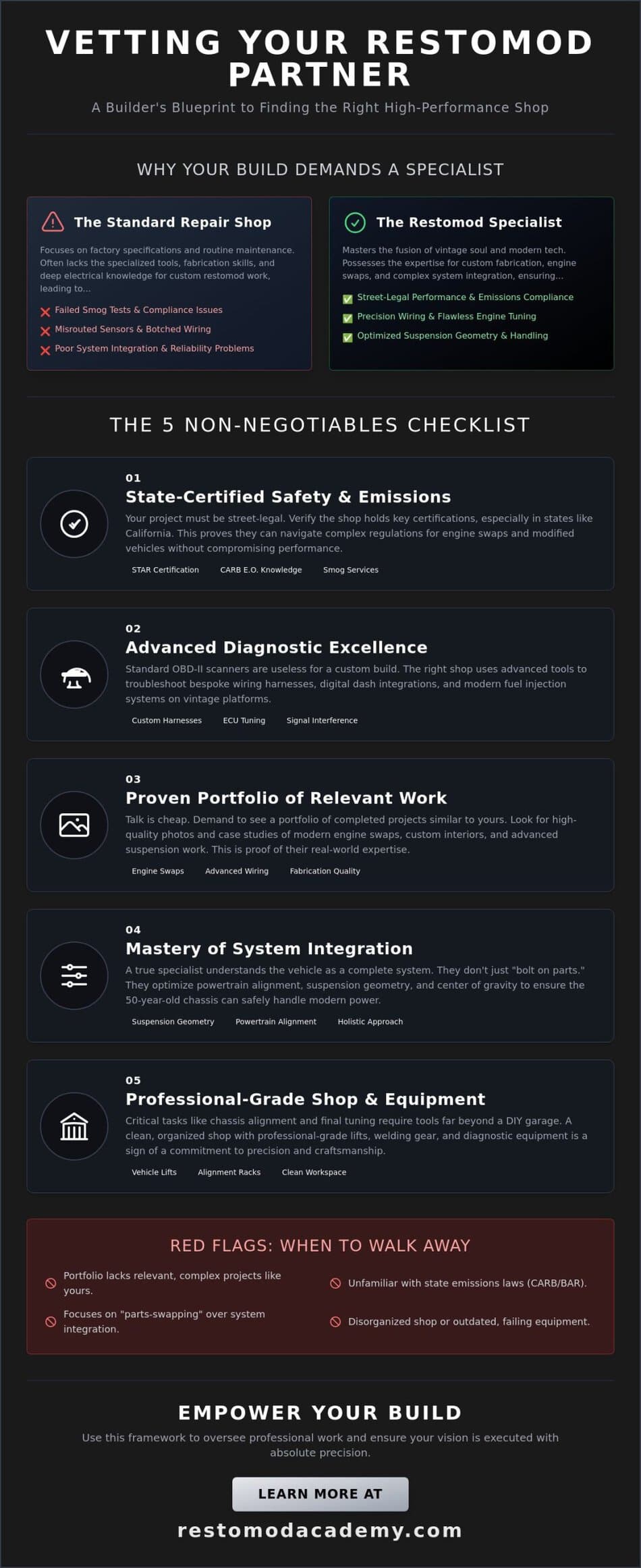
The Grease Guys Checklist: 5 Essentials of a High-Performance Shop
Selecting a partner for your build isn’t just about finding a mechanic; it’s about finding a team that respects the legacy of your vehicle. When you look for a grease guys auto service provider, you need a shop that balances technical mastery with a deep understanding of custom fabrication. Your restomod deserves more than a standard oil change facility. It requires a facility that treats your 1969 Mustang or 1972 C10 as a piece of performance art.
State-Certified Safety and Emissions
California enthusiasts face unique hurdles that demand specialized expertise. For those in West Sacramento, the 2024 “Clean Truck Check” (HD I/M) regulations mean even modified rigs must stay compliant with state law. A top-tier shop holds a STAR certification. This isn’t just a sticker on the window. It’s proof they meet the Bureau of Automotive Repair’s highest performance standards for smog services. These shops know how to handle emissions for modified diesel and petrol engines without compromising the power you’ve worked hard to build. They understand the nuances of CARB Executive Orders for aftermarket parts, ensuring your project remains street-legal while pushing high horsepower numbers.
Diagnostic Excellence for Custom Builds
Modern restomods often feature a blend of vintage iron and 21st-century electronics. Your chosen grease guys auto service must prove they can handle these digital handshakes. You need a shop equipped with high-end scanners capable of communicating with aftermarket ECUs like Holley EFI or Haltech systems. However, digital readouts don’t tell the whole story. Diagnostic precision is the intersection of modern telemetry and old-school troubleshooting. It’s the ability to hear a slight valve tick while simultaneously analyzing live fuel trim data. This dual-threat capability prevents the “parts-cannon” approach where mechanics swap components blindly until a problem disappears.
Transparency is your best defense against project creep. Before signing any work order, review the Auto Repair Basics provided by the Federal Trade Commission to ensure you understand how estimates and labor rates should be structured. A quality shop provides detailed documentation, including photographic evidence of the build process and clear line-item pricing. They don’t hide behind vague “miscellaneous shop fees.”
Finally, look for a “built-not-bought” philosophy. The shop should empower your vision, treating the car as a collaborative journey. They’ll respect your input on everything from suspension geometry to the stitch pattern on the seats. If you’re still defining the scope of your project, understanding exactly what is a restomod can help you communicate your goals more effectively to your builder. This shared language ensures that the grit of the garage perfectly matches the artistry of your original design.
Local Mechanic vs. Specialized Restomod Shop
Stop thinking you need a six-figure restoration boutique for every nut and bolt of your build. A neighborhood grease guys auto service often provides the mechanical backbone your project needs without the “concours” markup. These local experts excel at the heavy lifting, such as rebuilding transmissions, refreshing suspension geometry, or dialing in a crate motor. Using a local shop for specific phases allows you to keep the project moving while maintaining a manageable budget. Proximity is your greatest asset here. Being able to drop by on a Tuesday morning to discuss a clearance issue or inspect a new brake line routing builds a relationship that long-distance shops can’t replicate. Once your restomod is on the road, that same local service becomes your primary partner for routine maintenance and safety inspections.
Evaluating Shop Expertise in West Sacramento
Walk into a shop like Grease Guys Auto Service and look past the waiting room furniture. You want to see vintage metal on the lifts, not just late-model commuters. Ask the lead tech about their specific experience with custom wiring harnesses or 1960s steering boxes. Look for specialized equipment that indicates a higher level of precision. A modern alignment rack is non-negotiable if you’ve swapped in an independent rear suspension or upgraded to coil-overs. Check for heavy-duty lifts that handle the weight of an all-steel classic safely. For extra peace of mind, follow these tips for finding a reliable mechanic, which emphasize looking for ASE-certified technicians who understand the nuances of older platforms. A shop that welcomes your questions is a shop that respects your vision.
Balancing Budget and Craftsmanship
Negotiate a “project rate” or a block of hours dedicated to your build during the shop’s slower mid-week periods. Many local shops are willing to offer a more favorable rate for long-term work that keeps their bays full. While saving money is vital, avoid the trap of “cheap” service that lacks a paper trail. A poorly executed wiring job can cost 40% more to diagnose and fix later than doing it right the first time. Focus your spending on their high-end expertise and specialized tools. You can handle the basics yourself to keep costs down. Check our Recommended Gear list to see which tools belong in your home garage and which ones you should leave to the professionals. This balance ensures your project stays on track without draining your legacy fund on labor you could have performed yourself. Trust the experts with the precision tasks, but keep the soul of the build in your own hands.
How to Vet an Auto Service Provider for Engine Swaps and Tech
Finding a shop to handle your restomod requires a detective’s eye. You aren’t just looking for a mechanic; you’re looking for a specialist who understands how to blend decades-old steel with 21st-century silicon. When you evaluate a potential grease guys auto service, start with their portfolio. A reputable shop will have a digital or physical gallery of at least 15 to 20 past builds. Look for variety and complexity. If their “custom” work is limited to bolt-on parts, they might not have the expertise for a full-scale engine integration.
Verify their standing with state-certified inspection programs and insurance requirements. While a shop might be great at routine maintenance, an engine swap involves high-pressure fuel lines and complex electronics that demand a higher tier of accountability. Look for ASE Advanced Engine Performance Specialist (L1) certifications. This ensures the team understands the 12-volt architecture and PCM logic required for modern heart transplants. Before you sign a contract, interview the lead technician about your specific vehicle model. If they can’t discuss the common rust points or suspension quirks of your 1969 Camaro or 1972 C10, they haven’t done their homework.
Request a detailed walkthrough of their diagnostic and testing process. A shop that relies on trial and error will drain your budget and test your patience. Ask if they use data logging tools like HP Tuners or specialized oscilloscopes to verify sensor health before the first startup. Professional grease guys auto service providers should have a clear checklist for post-swap testing, including heat-cycle checks and road-load simulations to ensure everything is street-legal and safe.
Vetting for LS and Modern Engine Swaps
LS swaps are popular for a reason, but they aren’t “plug and play” in a vintage engine bay. Ask the technician about fuel system upgrades. A standard mechanical pump won’t work; you need a regulated 58 PSI supply and specific plumbing that handles EFI pressures. Inquire about transmission mounting. Modern 6L80 or 10R80 gearboxes are significantly larger than vintage units, often requiring tunnel modifications or custom crossmembers. For a deeper dive into these mechanical hurdles, read The Definitive Guide to an LS Engine Swap.
Assessing Fabrication and Bodywork Skill
High-performance engines demand a rigid foundation. If a shop suggests a 500-horsepower swap without mentioning subframe connectors or chassis stiffening, keep looking. Inspect their welds on current projects. You want to see “stacked dimes” with consistent penetration, not messy blobs or excessive grinding. Structural reinforcements must be integrated into the car’s geometry to prevent body torque or glass cracking. Our Classic Car Bodywork Guide details what high-quality metalwork looks like in a professional setting.
Build your knowledge base before you visit the shop by checking out our recommended gear for restomod inspections.
Building Your Legacy: Integrating Professional Service into Your Academy Journey
Your project isn’t just a car; it’s a testament to your dedication. When the time comes to bring in a professional grease guys auto service team, you aren’t surrendering your “built, not bought” badge. Instead, you’re stepping into the role of Project Manager. This transition requires you to lead with technical authority. Use your Restomod Academy guides to set specific milestones and verify every bolt turned. If a shop estimates eight hours for a suspension geometry setup, cross-reference that with our technical blueprints to ensure the quote aligns with industry standards.
Documentation is your most powerful tool for preserving the vehicle’s history. Keep a meticulous log of every professional intervention, from custom fabrication to final dyno tuning. According to data from major collector car auctions, builds with comprehensive service records can see a 20% increase in final sale price compared to undocumented projects. This paper trail proves the integrity of the work and builds trust with future buyers. Treat every shop visit as a masterclass. Watch the experts handle a TIG welder or shim a differential. These observations become the foundation for your next DIY phase, turning a service appointment into a personalized training session.
- Verify the work: Use Academy checklists to inspect welds, fluid levels, and torque marks before leaving the shop.
- Control the clock: Provide your grease guys auto service technicians with clear wiring diagrams to shave hours off their diagnostic labor.
- Build the file: Organize receipts, part numbers, and alignment sheets in a dedicated project binder.
The “Built, Not Bought” Partnership
The ideal relationship with a professional shop is a strategic alliance. You provide the vision and the primary labor, while the “Grease Guy” provides the specialized machinery and high-level fabrication skills you might not yet possess. To keep costs down, deliver your car with the interior stripped or the engine bay cleaned. This preparation allows the technician to focus on the technical tasks you’re paying for rather than basic prep work. A Legacy Build is the seamless collaboration between an enthusiast’s creative vision and the surgical precision of professional execution.
Next Steps for Your Restomod Project
Don’t wait for a breakdown to evaluate your progress. Perform a comprehensive safety audit on your current build today. Focus on your fuel system integrity and brake line clearances, as these are common failure points in high-performance conversions. If you’re still in the planning phase, start by understanding the core philosophy of this movement. Read our definitive guide on What is a Restomod? to define your build’s direction. Join the Academy now to access the deep technical blueprints you need to move from the passenger seat to the driver’s seat of your restoration journey.
Drive Your Vision from the Garage to the Pavement
Finding a reliable grease guys auto service transforms your restomod from a collection of parts into a high-performance legacy. You now have the tools to vet a shop based on the 5 essentials of restoration, ensuring they handle technical hurdles like suspension geometry and wiring with the precision your car deserves. Remember that specialized shops offer the fabrication expertise that general mechanics simply can’t match for custom engine swaps.
Success in the shop is only half the battle. You need the knowledge to oversee every bolt and weld with confidence. Brook Walsh has developed expert-led tutorials that break down complex builds into logical, achievable steps. Whether you’re following comprehensive project blueprints for 1965 to 1970 Mustangs or searching for community-vetted gear recommendations, the right guidance saves you time and prevents costly mistakes. Take the next step in your automotive journey today.
Master your build with The Ultimate Restomod Guide
The road is calling; it’s time to build the car you’ve always envisioned and prove that true craftsmanship never goes out of style.
Frequently Asked Questions
Is Grease Guys Auto Service capable of handling classic car restorations?
Yes, grease guys auto service shops can handle restorations if they possess specific fabrication tools and vintage-spec diagnostic equipment. Look for a facility that employs ASE-certified technicians with at least 10 years of experience in legacy systems. A shop capable of a full restomod will have dedicated bays for long-term projects rather than just quick-lube services. This ensures your 1969 Camaro receives the meticulous attention it deserves.
What is a Vehicle Safety Systems Inspection (VSSI) and do I need one?
A Vehicle Safety Systems Inspection (VSSI) is a comprehensive check of a car’s safety components mandated by the California Bureau of Automotive Repair. You need this if you’re reviving a salvaged title or clearing a law enforcement citation. As of July 2024, this protocol ensures that brakes, tires, and steering systems meet 100 percent of the manufacturer’s original safety specifications before the car returns to the road.
Can a standard auto service shop help with a CARB-compliant engine swap?
Most standard shops lack the specialized knowledge for a California Air Resources Board (CARB) compliant swap. You must find a technician who follows the BAR Engine Change Guidelines. These rules require the donor engine to be the same year or newer than the chassis. Successful swaps require 100 percent of the donor vehicle’s emissions equipment to be functional. This process often culminates in an inspection at a state-run Referee station.
How much should I expect to pay for professional restomod mechanical labor?
Professional labor rates for specialized restoration work typically range from 125 to 250 dollars per hour depending on the shop’s location and expertise. This exceeds the 80 to 110 dollar average for general maintenance reported by industry analysts in 2024. High-end restomod shops often require a 5,000 dollar initial deposit to secure a spot in their build queue. Budgeting for these rates ensures your project uses high-grade components and expert craftsmanship.
What are the benefits of using a STAR-certified smog station for my classic?
Using a STAR-certified station ensures your vehicle is tested at a facility that meets the highest performance standards set by the Bureau of Automotive Repair. These stations are required to maintain a 90 percent or higher accuracy rating on their inspections. For a classic car owner, this means the technicians are better equipped to handle the nuances of older emissions systems. It provides peace of mind that your vintage engine meets 1975 or newer state requirements.
How do I know if a mechanic understands modern suspension geometry?
A qualified mechanic should be able to explain how changing your ride height by 2 inches affects your roll center and bump steer. Ask them to show you a printout from a 4-wheel laser alignment system. If they can’t discuss the 3 stages of suspension travel or the benefits of 4-link setups over leaf springs, they aren’t ready for your restomod. True experts prioritize geometry over just bolting on parts.
Should I provide my own parts to an auto service shop for a restomod build?
Most professional grease guys auto service providers prefer to source their own parts to guarantee compatibility and offer a 12-month or 12,000-mile warranty. When you bring your own components, the shop can’t cover the labor costs if a part fails prematurely. Shops also rely on a 20 to 30 percent markup on parts to keep their lights on. Trust your builder’s expertise to select the right components for your specific vision.
What is a Clean Truck Check and does it apply to my vintage pickup?
The Clean Truck Check is a CARB program designed to ensure heavy-duty diesel vehicles with a Gross Vehicle Weight Rating over 14,000 pounds remain compliant. If your vintage pickup is a light-duty gas model, this 2023 regulation doesn’t apply to you. However, if you’ve swapped a modern Cummins diesel into a heavy-duty frame, you must register the vehicle in the Clean Truck Check database. This ensures your build meets current air quality standards.
Last Tuesday, a builder in Costa Mesa watched his 1972 Blazer fail its California BAR inspection because a shop misrouted one critical sensor during an LS3 swap. You’ve likely felt that same knot in your stomach when handing over your keys to a new shop. It’s a high-stakes gamble to trust your legacy to just any grease guys auto service when your vision involves blending vintage soul with 21st-century performance. You know that a standard repair shop often lacks the patience for delicate fabrication or the technical depth required for complex wiring harnesses.
We’re here to ensure your project doesn’t become another cautionary tale of cut wires and failed smog tests. This guide provides the exact blueprint you need to vet a mechanical partner who respects the craftsmanship of the past while mastering modern suspension geometry. You’ll learn the five non-negotiable questions to ask every shop foreman and how to spot the red flags that signal a lack of California compliance expertise. By the end of this session, you’ll have the confidence to choose a partner who treats your restomod with the meticulous care it deserves.
Key Takeaways
- Understand why your project requires more than a standard repair shop and how to identify professionals who bridge the gap between vintage soul and modern performance.
- Master our five-point checklist to vet a high-performance grease guys auto service, ensuring they possess the diagnostic tools and certifications needed for complex engine configurations.
- Learn how to strategically balance the expertise of local mechanics with specialized restoration houses to optimize your build’s budget without compromising on craftsmanship.
- Discover the critical steps to verify a shop’s portfolio and standing, ensuring they have the proven expertise to handle modern engine swaps and advanced wiring.
- Empower yourself as a project manager by using Academy-level frameworks to oversee professional work and ensure your vision is executed with absolute precision.
Beyond the Oil Change: Why Restomods Need Specialized Auto Service
Restoring a classic is a labor of love, but modernizing one is a complex engineering feat. You can’t expect a technician who spends their day resetting oil life monitors on lease-return SUVs to troubleshoot a custom wiring harness. A true grease guys auto service understands the soul of a vintage machine and the precision of modern performance. While a general repair shop focuses on factory specifications, a restomod specialist thrives in the world of custom fabrication and car tuning. They know that a 1970s chassis wasn’t built for 500 horsepower. They have the skills to bridge that gap safely. This isn’t just about making it run; it’s about making it reliable enough for a cross-country road trip.
To better understand how to select the right technician for your project, watch this helpful video:
The Complexity of Modern-Classic Fusion
Integrating modern fuel injection or a digital dashboard into a 50-year-old vehicle requires more than just a soldering iron. It demands a deep understanding of electrical load and signal interference. Standard OBD-II scanners are useless when you’re dealing with a bespoke harness. You need builders who don’t just swap parts but understand the “why” behind every modification. This includes mastering suspension geometry to ensure your car handles like a modern sports car rather than a boat. A “parts-changer” mechanic might bolt on a new control arm, but a restomod expert ensures the powertrain alignment and center of gravity are optimized for the road. They look at the vehicle as a complete system where every new bolt affects the old steel.
When to Step Away from the DIY Garage
Every builder reaches a point where home tools aren’t enough. Critical milestones, like final engine tuning or complex body alignment, often require professional-grade lifts and specialized diagnostic equipment. Bringing in a professional provides a set of “fresh eyes” on your build. They can spot a potential safety hazard in your brake line routing or a flaw in your fuel system before it becomes a disaster. If you’re still in the early stages, refer to our guide on what is a restomod to define your vision. Your project’s legacy depends on getting the foundation right. Expert intervention isn’t an admission of defeat; it’s a commitment to craftsmanship. Relying on a professional grease guys auto service ensures your vision translates from the garage floor to the open road without compromise.
The Grease Guys Checklist: 5 Essentials of a High-Performance Shop
Selecting a partner for your build isn’t just about finding a mechanic; it’s about finding a team that respects the legacy of your vehicle. When you look for a grease guys auto service provider, you need a shop that balances technical mastery with a deep understanding of custom fabrication. Your restomod deserves more than a standard oil change facility. It requires a facility that treats your 1969 Mustang or 1972 C10 as a piece of performance art.
State-Certified Safety and Emissions
California enthusiasts face unique hurdles that demand specialized expertise. For those in West Sacramento, the 2024 “Clean Truck Check” (HD I/M) regulations mean even modified rigs must stay compliant with state law. A top-tier shop holds a STAR certification. This isn’t just a sticker on the window. It’s proof they meet the Bureau of Automotive Repair’s highest performance standards for smog services. These shops know how to handle emissions for modified diesel and petrol engines without compromising the power you’ve worked hard to build. They understand the nuances of CARB Executive Orders for aftermarket parts, ensuring your project remains street-legal while pushing high horsepower numbers.
Diagnostic Excellence for Custom Builds
Modern restomods often feature a blend of vintage iron and 21st-century electronics. Your chosen grease guys auto service must prove they can handle these digital handshakes. You need a shop equipped with high-end scanners capable of communicating with aftermarket ECUs like Holley EFI or Haltech systems. However, digital readouts don’t tell the whole story. Diagnostic precision is the intersection of modern telemetry and old-school troubleshooting. It’s the ability to hear a slight valve tick while simultaneously analyzing live fuel trim data. This dual-threat capability prevents the “parts-cannon” approach where mechanics swap components blindly until a problem disappears.
Transparency is your best defense against project creep. Before signing any work order, review the Auto Repair Basics provided by the Federal Trade Commission to ensure you understand how estimates and labor rates should be structured. A quality shop provides detailed documentation, including photographic evidence of the build process and clear line-item pricing. They don’t hide behind vague “miscellaneous shop fees.”
Finally, look for a “built-not-bought” philosophy. The shop should empower your vision, treating the car as a collaborative journey. They’ll respect your input on everything from suspension geometry to the stitch pattern on the seats. If you’re still defining the scope of your project, understanding exactly what is a restomod can help you communicate your goals more effectively to your builder. This shared language ensures that the grit of the garage perfectly matches the artistry of your original design.
Local Mechanic vs. Specialized Restomod Shop
Stop thinking you need a six-figure restoration boutique for every nut and bolt of your build. A neighborhood grease guys auto service often provides the mechanical backbone your project needs without the “concours” markup. These local experts excel at the heavy lifting, such as rebuilding transmissions, refreshing suspension geometry, or dialing in a crate motor. Using a local shop for specific phases allows you to keep the project moving while maintaining a manageable budget. Proximity is your greatest asset here. Being able to drop by on a Tuesday morning to discuss a clearance issue or inspect a new brake line routing builds a relationship that long-distance shops can’t replicate. Once your restomod is on the road, that same local service becomes your primary partner for routine maintenance and safety inspections.
Evaluating Shop Expertise in West Sacramento
Walk into a shop like Grease Guys Auto Service and look past the waiting room furniture. You want to see vintage metal on the lifts, not just late-model commuters. Ask the lead tech about their specific experience with custom wiring harnesses or 1960s steering boxes. Look for specialized equipment that indicates a higher level of precision. A modern alignment rack is non-negotiable if you’ve swapped in an independent rear suspension or upgraded to coil-overs. Check for heavy-duty lifts that handle the weight of an all-steel classic safely. For extra peace of mind, follow these tips for finding a reliable mechanic, which emphasize looking for ASE-certified technicians who understand the nuances of older platforms. A shop that welcomes your questions is a shop that respects your vision.
Balancing Budget and Craftsmanship
Negotiate a “project rate” or a block of hours dedicated to your build during the shop’s slower mid-week periods. Many local shops are willing to offer a more favorable rate for long-term work that keeps their bays full. While saving money is vital, avoid the trap of “cheap” service that lacks a paper trail. A poorly executed wiring job can cost 40% more to diagnose and fix later than doing it right the first time. Focus your spending on their high-end expertise and specialized tools. You can handle the basics yourself to keep costs down. Check our Recommended Gear list to see which tools belong in your home garage and which ones you should leave to the professionals. This balance ensures your project stays on track without draining your legacy fund on labor you could have performed yourself. Trust the experts with the precision tasks, but keep the soul of the build in your own hands.
How to Vet an Auto Service Provider for Engine Swaps and Tech
Finding a shop to handle your restomod requires a detective’s eye. You aren’t just looking for a mechanic; you’re looking for a specialist who understands how to blend decades-old steel with 21st-century silicon. When you evaluate a potential grease guys auto service, start with their portfolio. A reputable shop will have a digital or physical gallery of at least 15 to 20 past builds. Look for variety and complexity. If their “custom” work is limited to bolt-on parts, they might not have the expertise for a full-scale engine integration.
Verify their standing with state-certified inspection programs and insurance requirements. While a shop might be great at routine maintenance, an engine swap involves high-pressure fuel lines and complex electronics that demand a higher tier of accountability. Look for ASE Advanced Engine Performance Specialist (L1) certifications. This ensures the team understands the 12-volt architecture and PCM logic required for modern heart transplants. Before you sign a contract, interview the lead technician about your specific vehicle model. If they can’t discuss the common rust points or suspension quirks of your 1969 Camaro or 1972 C10, they haven’t done their homework.
Request a detailed walkthrough of their diagnostic and testing process. A shop that relies on trial and error will drain your budget and test your patience. Ask if they use data logging tools like HP Tuners or specialized oscilloscopes to verify sensor health before the first startup. Professional grease guys auto service providers should have a clear checklist for post-swap testing, including heat-cycle checks and road-load simulations to ensure everything is street-legal and safe.
Vetting for LS and Modern Engine Swaps
LS swaps are popular for a reason, but they aren’t “plug and play” in a vintage engine bay. Ask the technician about fuel system upgrades. A standard mechanical pump won’t work; you need a regulated 58 PSI supply and specific plumbing that handles EFI pressures. Inquire about transmission mounting. Modern 6L80 or 10R80 gearboxes are significantly larger than vintage units, often requiring tunnel modifications or custom crossmembers. For a deeper dive into these mechanical hurdles, read The Definitive Guide to an LS Engine Swap.
Assessing Fabrication and Bodywork Skill
High-performance engines demand a rigid foundation. If a shop suggests a 500-horsepower swap without mentioning subframe connectors or chassis stiffening, keep looking. Inspect their welds on current projects. You want to see “stacked dimes” with consistent penetration, not messy blobs or excessive grinding. Structural reinforcements must be integrated into the car’s geometry to prevent body torque or glass cracking. Our Classic Car Bodywork Guide details what high-quality metalwork looks like in a professional setting.
Build your knowledge base before you visit the shop by checking out our recommended gear for restomod inspections.
Building Your Legacy: Integrating Professional Service into Your Academy Journey
Your project isn’t just a car; it’s a testament to your dedication. When the time comes to bring in a professional grease guys auto service team, you aren’t surrendering your “built, not bought” badge. Instead, you’re stepping into the role of Project Manager. This transition requires you to lead with technical authority. Use your Restomod Academy guides to set specific milestones and verify every bolt turned. If a shop estimates eight hours for a suspension geometry setup, cross-reference that with our technical blueprints to ensure the quote aligns with industry standards.
Documentation is your most powerful tool for preserving the vehicle’s history. Keep a meticulous log of every professional intervention, from custom fabrication to final dyno tuning. According to data from major collector car auctions, builds with comprehensive service records can see a 20% increase in final sale price compared to undocumented projects. This paper trail proves the integrity of the work and builds trust with future buyers. Treat every shop visit as a masterclass. Watch the experts handle a TIG welder or shim a differential. These observations become the foundation for your next DIY phase, turning a service appointment into a personalized training session.
- Verify the work: Use Academy checklists to inspect welds, fluid levels, and torque marks before leaving the shop.
- Control the clock: Provide your grease guys auto service technicians with clear wiring diagrams to shave hours off their diagnostic labor.
- Build the file: Organize receipts, part numbers, and alignment sheets in a dedicated project binder.
The “Built, Not Bought” Partnership
The ideal relationship with a professional shop is a strategic alliance. You provide the vision and the primary labor, while the “Grease Guy” provides the specialized machinery and high-level fabrication skills you might not yet possess. To keep costs down, deliver your car with the interior stripped or the engine bay cleaned. This preparation allows the technician to focus on the technical tasks you’re paying for rather than basic prep work. A Legacy Build is the seamless collaboration between an enthusiast’s creative vision and the surgical precision of professional execution.
Next Steps for Your Restomod Project
Don’t wait for a breakdown to evaluate your progress. Perform a comprehensive safety audit on your current build today. Focus on your fuel system integrity and brake line clearances, as these are common failure points in high-performance conversions. If you’re still in the planning phase, start by understanding the core philosophy of this movement. Read our definitive guide on What is a Restomod? to define your build’s direction. Join the Academy now to access the deep technical blueprints you need to move from the passenger seat to the driver’s seat of your restoration journey.
Drive Your Vision from the Garage to the Pavement
Finding a reliable grease guys auto service transforms your restomod from a collection of parts into a high-performance legacy. You now have the tools to vet a shop based on the 5 essentials of restoration, ensuring they handle technical hurdles like suspension geometry and wiring with the precision your car deserves. Remember that specialized shops offer the fabrication expertise that general mechanics simply can’t match for custom engine swaps.
Success in the shop is only half the battle. You need the knowledge to oversee every bolt and weld with confidence. Brook Walsh has developed expert-led tutorials that break down complex builds into logical, achievable steps. Whether you’re following comprehensive project blueprints for 1965 to 1970 Mustangs or searching for community-vetted gear recommendations, the right guidance saves you time and prevents costly mistakes. Take the next step in your automotive journey today.
Master your build with The Ultimate Restomod Guide
The road is calling; it’s time to build the car you’ve always envisioned and prove that true craftsmanship never goes out of style.
Frequently Asked Questions
Is Grease Guys Auto Service capable of handling classic car restorations?
Yes, grease guys auto service shops can handle restorations if they possess specific fabrication tools and vintage-spec diagnostic equipment. Look for a facility that employs ASE-certified technicians with at least 10 years of experience in legacy systems. A shop capable of a full restomod will have dedicated bays for long-term projects rather than just quick-lube services. This ensures your 1969 Camaro receives the meticulous attention it deserves.
What is a Vehicle Safety Systems Inspection (VSSI) and do I need one?
A Vehicle Safety Systems Inspection (VSSI) is a comprehensive check of a car’s safety components mandated by the California Bureau of Automotive Repair. You need this if you’re reviving a salvaged title or clearing a law enforcement citation. As of July 2024, this protocol ensures that brakes, tires, and steering systems meet 100 percent of the manufacturer’s original safety specifications before the car returns to the road.
Can a standard auto service shop help with a CARB-compliant engine swap?
Most standard shops lack the specialized knowledge for a California Air Resources Board (CARB) compliant swap. You must find a technician who follows the BAR Engine Change Guidelines. These rules require the donor engine to be the same year or newer than the chassis. Successful swaps require 100 percent of the donor vehicle’s emissions equipment to be functional. This process often culminates in an inspection at a state-run Referee station.
How much should I expect to pay for professional restomod mechanical labor?
Professional labor rates for specialized restoration work typically range from 125 to 250 dollars per hour depending on the shop’s location and expertise. This exceeds the 80 to 110 dollar average for general maintenance reported by industry analysts in 2024. High-end restomod shops often require a 5,000 dollar initial deposit to secure a spot in their build queue. Budgeting for these rates ensures your project uses high-grade components and expert craftsmanship.
What are the benefits of using a STAR-certified smog station for my classic?
Using a STAR-certified station ensures your vehicle is tested at a facility that meets the highest performance standards set by the Bureau of Automotive Repair. These stations are required to maintain a 90 percent or higher accuracy rating on their inspections. For a classic car owner, this means the technicians are better equipped to handle the nuances of older emissions systems. It provides peace of mind that your vintage engine meets 1975 or newer state requirements.
How do I know if a mechanic understands modern suspension geometry?
A qualified mechanic should be able to explain how changing your ride height by 2 inches affects your roll center and bump steer. Ask them to show you a printout from a 4-wheel laser alignment system. If they can’t discuss the 3 stages of suspension travel or the benefits of 4-link setups over leaf springs, they aren’t ready for your restomod. True experts prioritize geometry over just bolting on parts.
Should I provide my own parts to an auto service shop for a restomod build?
Most professional grease guys auto service providers prefer to source their own parts to guarantee compatibility and offer a 12-month or 12,000-mile warranty. When you bring your own components, the shop can’t cover the labor costs if a part fails prematurely. Shops also rely on a 20 to 30 percent markup on parts to keep their lights on. Trust your builder’s expertise to select the right components for your specific vision.
What is a Clean Truck Check and does it apply to my vintage pickup?
The Clean Truck Check is a CARB program designed to ensure heavy-duty diesel vehicles with a Gross Vehicle Weight Rating over 14,000 pounds remain compliant. If your vintage pickup is a light-duty gas model, this 2023 regulation doesn’t apply to you. However, if you’ve swapped a modern Cummins diesel into a heavy-duty frame, you must register the vehicle in the Clean Truck Check database. This ensures your build meets current air quality standards.