
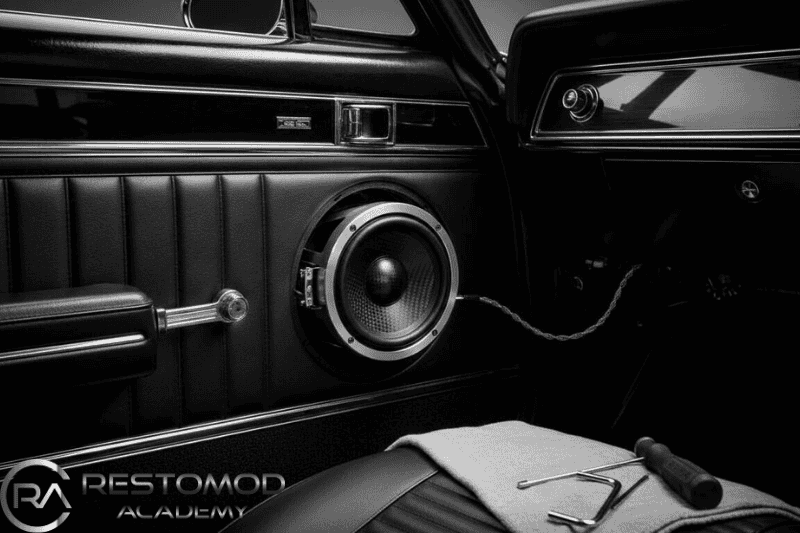
What if the only thing more immersive than the rumble of your big-block engine was a classic car audio system that delivered studio-grade sound at 70 miles per hour? You’ve spent countless hours in the garage perfecting the stance and the paint because you respect the legacy of your machine. It’s a common frustration to realize that while your car looks like a masterpiece, its 1960s speaker tech sounds like a tin can in a wind tunnel. You shouldn’t have to choose between a period-correct dashboard and the convenience of modern connectivity.
This Restomod Academy guide shows you how to bridge that gap with the precision of a master builder. You’ll learn to integrate high-fidelity components using stealthy fabrication techniques that keep your interior 100% authentic. We’re covering everything from 2026-spec hidden Bluetooth receivers to advanced sound deadening that cuts cabin noise by 15 decibels. By the end of this project, you’ll have a concert-quality setup that honors your car’s history while providing the modern reliability you deserve. Let’s get to work on your vision.
Key Takeaways
- Defeat the “noise floor” by preparing your chassis with high-quality materials that silence engine roar and wind whistle.
- Select high-efficiency components to build a powerful classic car audio system that delivers modern performance without straining your vintage electrical setup.
- Utilize stealth fabrication techniques to integrate premium sound while preserving your car’s timeless aesthetic and original door cards.
- Follow a logical, step-by-step roadmap to establish a dedicated power circuit and soundstage that brings modern reliability to your restoration.
- Master the art of tuning crossovers to eliminate distortion and find the acoustic sweet spot for your unique cabin geometry.
The Challenge of Sound in Vintage Steel
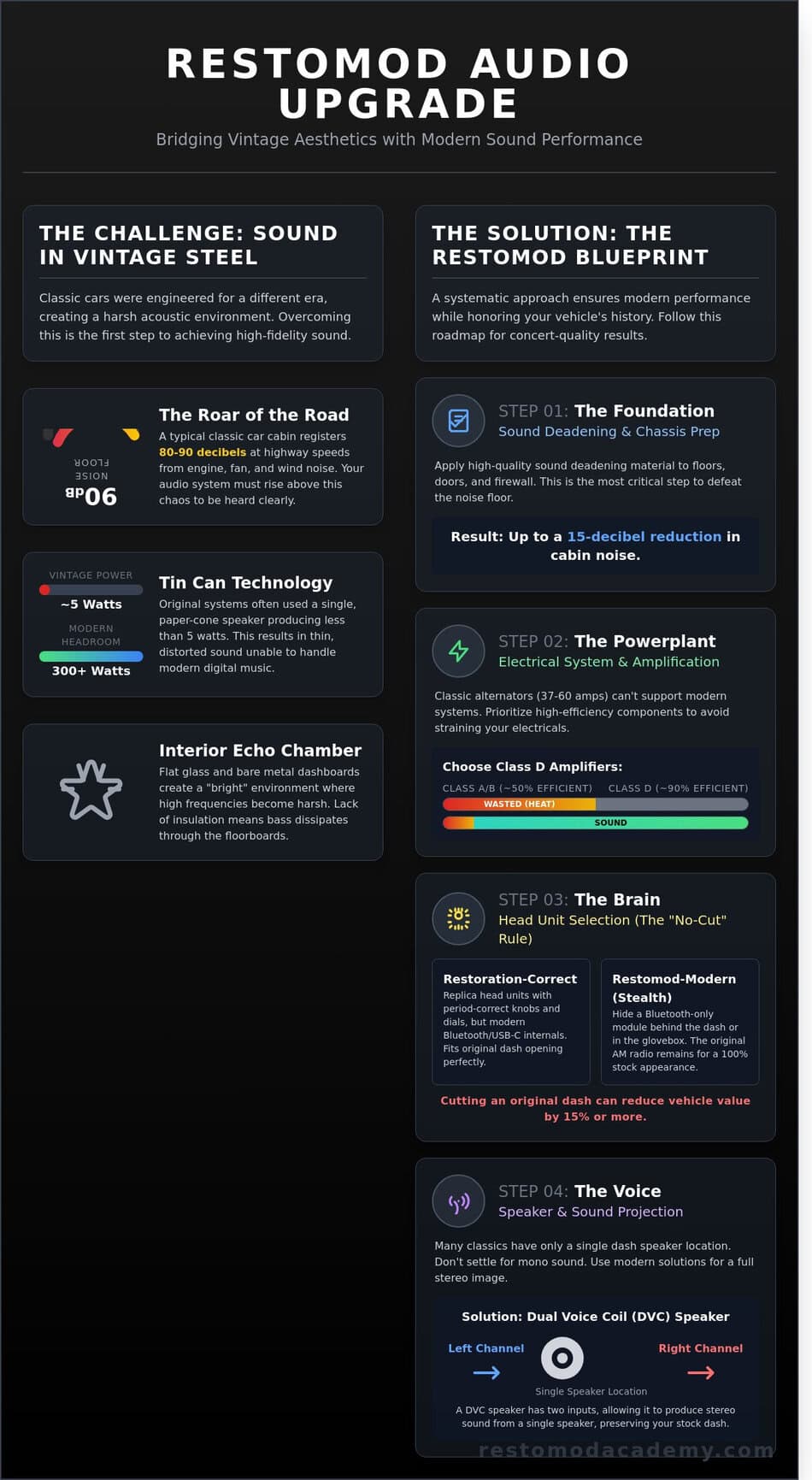
Your 1968 Mustang or 1970 Chevelle was never designed for the high-fidelity expectations of 2026. Original factory speakers from the mid-20th century were often limited to single, center-dash paper cones that struggled to produce even 5 watts of power. These components lack the frequency range to handle modern digital recordings, resulting in a thin, distorted sound that fails to do justice to your favorite tracks. When you get behind the wheel, you aren’t just listening to music; you are competing with a machine.
The primary obstacle is the noise floor. A typical classic car cabin registers between 80 and 90 decibels at highway speeds. This roar comes from carbureted engines, mechanical cooling fans, and wind whistling through aged weatherstripping. To hear your music clearly, your classic car audio system must provide enough clean power to rise above this acoustic chaos without clipping. This is where the Restomod Audio philosophy comes into play. We blend modern high-output performance with vintage soul, ensuring the tech remains invisible while the quality remains undeniable.
Before you turn a single wrench, define your project goals. Ask yourself if you are building a daily driver or a concours-level show car. A daily driver benefits from heavy sound dampening and visible modern conveniences. A show car requires a stealth approach, where every component is tucked away to maintain a factory-fresh appearance. Set your priorities now to avoid costly mid-build pivots.
Understanding the Acoustic Environment
Vintage interiors are essentially echo chambers. Flat glass windows and expansive metal dashboards create “bright” environments where high frequencies bounce and become harsh. Unlike modern cars that use 25 to 40 pounds of specialized sound-deadening material, classics often have nothing more than a thin layer of jute under the carpet. This lack of insulation causes bass notes to dissipate through the floorboards. You need a high-wattage system to overcome these inefficiencies. A 300-watt amplifier isn’t about volume; it provides the headroom necessary to maintain clarity against the vibration of a high-performance engine.
Preserving the Aesthetic Integrity
Respect the “No-Cut” rule at all costs. Hacking into an original steel dashboard to fit a modern head unit can reduce a vehicle’s resale value by 15% or more. You must choose between two distinct visual styles:
- Restoration-Correct: Uses replica head units that feature period-accurate knobs and analog dials but contain Bluetooth internals.
- Restomod-Modern: Features hidden components, such as a hidden classic car audio system controller in the glovebox or an under-seat amplifier.
Understanding what is a restomod helps you navigate these choices. It is about the marriage of heritage and hardware. Your objective is to create a cabin that looks like 1969 but performs with the precision of a modern studio.
Choosing Modern Components with a Classic Soul
Building a high-performance classic car audio system requires a delicate balance between vintage aesthetics and 21st-century signal processing. You don’t want a glowing neon head unit ruining the dashboard of a 1967 Mustang, but you certainly want the 100-decibel clarity that modern hardware provides. Start your project by auditing your electrical system. Most factory alternators from the 1960s produce only 37 to 60 amps, which is barely enough to run the headlights and ignition. To avoid a dead battery, prioritize high-efficiency Class D components. These amplifiers convert nearly 90% of their power into sound, whereas older Class A/B units waste half their energy as heat.
Head Units: The Brain of the System
Select a head unit that respects the history of your cockpit. Brands like RetroSound and Custom Autosound offer digital media receivers that utilize a “spindle and shaft” mounting system. This design allows you to fit a modern radio into a factory dash without cutting the original metal. The RetroSound Long Beach model, for instance, offers over 8,000 combinations of knobs and bezels to match your specific trim. If you demand a completely stock appearance, install a hidden Bluetooth-only controller. These modules hide behind the dash or under the seat, allowing you to stream high-fidelity audio directly from your phone while leaving the original AM radio in place as a decorative piece. Ensure your chosen unit includes USB-C inputs to maintain compatibility with the 2026 smartphone standards.
Speakers and Sound Projection
Classic interiors often have limited speaker locations. Many cars originally featured a single 4×10 speaker in the center of the dash. Don’t settle for mono sound. Use a Dual Voice Coil (DVC) speaker to project both left and right channels from that single location. For your kick panels, choose component sets if you’re willing to modify the interior, or coaxial speakers for a simpler drop-in fit. If you want to avoid cutting into your rear parcel shelf, look at surface-mount speaker pods. These units provide excellent staging without requiring permanent holes in your vintage upholstery. For more advice on selecting the right hardware for your build, check out our recommended gear list.
Power Management and Bass
Small cabins benefit immensely from a hidden amplifier. Modern “micro” amps are small enough to fit inside a glove box or behind a kick panel, keeping the install invisible. To round out the sound, look for compact subwoofer solutions. A slim 8-inch powered sub requires less than 3 inches of mounting depth and fits comfortably under most front seats. This preserves your entire trunk space for luggage or spare tires while providing the low-end punch that defines a professional build. Focus on the details and you’ll create a system that sounds as powerful as your engine looks.
Stealth Installation Strategies for the DIY Builder
Preserving the soul of a 1969 Camaro or a 1972 C10 means you don’t hack up the original dashboard. A high-end classic car audio system should be felt and heard, but never seen by a passerby. Start by leaving your factory radio in the dash as a non-functional “dummy” unit. You can wire a modern Bluetooth-enabled processor or a hidden head unit inside the glove box or center console. This approach preserves the 100% stock aesthetic while giving you 21st-century connectivity and high-fidelity output.
The Kick Panel Advantage
Kick panels are the most effective way to improve your soundstage without cutting into rare door cards. These panels sit in the footwells and offer a more balanced distance between the speakers and your ears. You can find pre-molded pods for over 75 different vintage models, or you can fabricate your own from fiberglass to match your carpet. Since these areas are prone to dirt, use speakers with poly cones and rubber surrounds to resist the 20% higher humidity levels often found near car floors. Installing a classic car audio system this way ensures the speakers are pointed toward the center of the cabin for better imaging.
Hiding the Bass
Low-end frequencies don’t need a massive, visible box to thrive. A 10-inch subwoofer mounted in the spare tire well can operate in as little as 0.65 cubic feet of air space. This keeps your trunk functional for long-distance road trips. If your car has a large rear deck, consider an infinite baffle setup. This uses the trunk itself as the enclosure, which saves about 30 pounds of weight compared to a traditional wooden box. Check our recommended gear for subwoofers designed specifically for small-volume enclosures.
Mount your amplifiers under the front seats using 0.5-inch spacers to ensure air circulates around the cooling fins. Modern Class-D amplifiers are roughly 50% smaller than their 1990s predecessors, so they fit easily in tight spaces like the area behind the rear seat or under the dash. For the ultimate stealth look, use a remote-mounted controller hidden in the ashtray to manage volume and track selection. This keeps the modern tech tucked away until you’re ready to use it, maintaining the timeless craftsmanship of your interior.
The Step-by-Step Installation Roadmap
Installing a classic car audio system requires a methodical approach that respects the vehicle’s heritage while demanding modern performance. You aren’t just swapping a radio; you’re re-engineering the cabin’s acoustic environment. Follow this five-step roadmap to ensure your build sounds as good as it looks.
- Step 1: Prepare the chassis. Strip the interior and apply high-quality butyl-based sound deadening to the floor pans and door skins. This lowers the noise floor by up to 10 decibels.
- Step 2: Build the power foundation. Run a dedicated 12V circuit directly from the battery. Use a fused 4-gauge or 8-gauge wire to handle the current demands of modern amplifiers.
- Step 3: Route the signals. Keep your RCA cables on the opposite side of the transmission tunnel from your power wires. This separation prevents electromagnetic interference from corrupting your audio signal.
- Step 4: Secure the hardware. Mount speakers using custom baffles to prevent air leaks. Ensure the head unit is braced firmly to avoid skips or rattles during spirited driving.
- Step 5: Acoustic tuning. Use a Real Time Analyzer app to identify frequency peaks caused by the small, reflective cabins of vintage steel. Adjust your EQ to flatten the response.
Wiring and Power Management
Never tap into the original factory radio harness for anything other than a turn-on signal. Those 50-year-old wires were designed for 5-watt mono speakers, not high-fidelity components. Drawing modern current through brittle vintage copper is a recipe for a blown fuse or a cabin fire. To eliminate the high-pitched alternator whine, establish a solid ground on the vehicle frame. Scrape away paint to expose bare metal and use a star washer for maximum conductivity. For the best results, check out our list of Recommended gear for electrical work to ensure your connections are professional grade.
The Foundation: Sound Deadening
Your classic car audio system will only sound as good as the room it’s in. Classic cars are essentially metal echo chambers. Apply butyl-based sheets to at least 60% of the flat metal surfaces to kill structural resonance. Follow this with a layer of closed-cell foam. This foam acts as a decoupler, preventing the speaker’s vibrations from rattling the door panels. This two-step process transforms a tinny cabin into a studio-grade listening space, allowing you to hear the subtle nuances of your favorite tracks even at highway speeds.
Tuning and Perfecting Your Restomod Soundstage
Installing the hardware is only half the battle. To truly master your classic car audio system, you must adopt the Academy approach: trust your senses. While data helps, your ears remain the most sensitive diagnostic tool in the garage. Sit in the driver’s seat, close your eyes, and listen for where the singer’s voice “sits” on your dashboard. If the sound feels like it’s coming from your feet, you need to adjust your timing and levels to lift that soundstage into your line of sight.
Set your crossover points before you crank the volume to prevent permanent damage. Most 6.5 inch door speakers struggle with frequencies below 80Hz. Use your amplifier’s high-pass filter to block those deep lows, directing them instead to your subwoofer. This prevents muddy distortion and protects your investment from thermal failure. Once the crossovers are set, adjust the fader and balance. A slight 5 percent shift toward the passenger side often centers the stereo image for the driver, creating a focused, immersive experience rather than a lopsided wall of sound.
Your final step is the “shake down” inspection. Classic cars are notorious for loose trim and metal-on-metal contact. Play a low-frequency sweep and hunt for rattles. Follow this quick checklist to ensure a clean finish:
- Tighten every screw on the door cards and dashboard panels.
- Apply Tesa tape to any modern wiring harnesses that might tap against vintage metal.
- Check the rear parcel shelf for vibrations caused by the subwoofer’s air pressure.
- Verify that the battery terminals and ground points are torqued to manufacturer specifications.
Fine-Tuning the EQ
Older vehicle interiors often suffer from “boxy” acoustics due to flat glass and hard metal surfaces. Use your equalizer to cut frequencies between 250Hz and 500Hz to remove that hollow, echoing sound. Don’t treat the gain dial like a volume knob. Set your head unit to 75 percent volume and slowly increase the gain until you hear the slightest hint of clipping, then back it off 10 percent. For professional results, download a Real-Time Analysis (RTA) app like Spectroid. These smartphone tools provide a visual map of your cabin’s frequency response, allowing you to identify and flatten harsh peaks with surgical precision.
Next Steps in Your Build
A high-end classic car audio system is just one piece of the modernization puzzle. Consider a Digital Dash upgrade to bring your instrumentation into the 21st century alongside your sound. This modification fits perfectly into a larger Restomod Interior project where comfort meets vintage style. If you hit a technical wall, join the Academy community. We offer pro-level support to help you navigate the complexities of fabrication and wiring, ensuring your build matches the vision in your head.
Bring Your Vision to Life on the Open Road
Building a classic car audio system that balances 2026 technology with vintage soul requires a meticulous approach to fabrication. You’ve learned how to combat the resonance of vintage steel and hide high-fidelity drivers behind factory-correct trim. These steps ensure your project maintains its heritage while delivering a concert-grade experience. Success in the garage comes down to the details. Focus on your wiring harness and the precision of your final DSP tuning to get the results you deserve.
Don’t let the complexity of a full restomod build stall your progress. Our community of over 10,000 active builders is ready to support your journey. You can access expert-led tutorials for every DIY stage and browse curated reviews of the latest 2026 hardware in our Product Reviews category. We’ve simplified the technical hurdles so you can focus on the craftsmanship.
Take the next step in your restoration journey today. Download The Ultimate Restomod Guide to Master Your Build and turn your vintage dream into a high-performance reality. Your car is waiting for its voice. Go out there and build it.
Frequently Asked Questions
Can I install a modern radio in my classic car without cutting the dashboard?
You can install a modern head unit without any permanent modifications by using a shaft-style radio designed for vintage vehicles. Brands like RetroSound offer modular systems that fit into the original dual-knob factory dash openings. This preserves the 100% stock appearance of your dashboard while giving you modern internal components. You won’t need a hacksaw or any invasive fabrication to enjoy your favorite tracks.
How do I get Bluetooth in my classic car while keeping the original radio look?
You can hide a Bluetooth receiver behind the dash or send your original unit for an internal digital conversion. A 1965 Mustang radio can be upgraded with an Aurora Design FMR-3 board to add Bluetooth 5.0 and 180 watts of power without changing a single button. Another option is a hidden amplifier that connects directly to your smartphone via a wireless signal. This keeps your cockpit looking exactly like it did on the showroom floor.
Do I need a special battery or alternator for a high-powered car audio system?
You’ll likely need a high-output alternator if your classic car audio system pulls more than 500 watts of peak power. Most factory alternators from the 1960s only produce 37 to 55 amps, which isn’t enough to handle modern amplifiers and ignition systems simultaneously. Upgrade to a 100-amp or 140-amp internal-regulated alternator to ensure steady voltage. Pair this with a 750 Cold Cranking Amp AGM battery to handle the increased electrical load.
What is the best speaker placement for a classic car with limited space?
Utilize custom kick panel pods and dual voice coil speakers in the factory center dash location for the best soundstage. Kick panels allow you to mount 6.5-inch component speakers at an angle that fires sound toward your ears rather than your ankles. This setup provides 40% better stereo separation than a single mono speaker. It’s a proven method to get high-fidelity audio without cutting into your original door cards or rear package tray.
How much does a complete classic car audio system cost in 2026?
Expect to invest between $1,200 and $4,500 for a comprehensive classic car audio system upgrade in 2026. A mid-range setup including a restomod head unit, four speakers, and a compact 4-channel amplifier typically costs about $2,200 for parts. Professional installation labor adds another $800 to $1,500 to the total. High-end builds with custom fiberglass enclosures and sound deadening will push the budget toward the $5,000 mark.
Will a modern audio system drain my classic car’s battery?
A modern system won’t drain your battery if you connect the main power lead to a switched 12V ignition source. Modern head units use a tiny 0.05-amp draw to maintain clock settings and radio presets when the car’s off. This is negligible for a healthy battery. However, if you wire the amplifier directly to a constant power source without a remote turn-on lead, it’ll kill a standard lead-acid battery within 48 hours.
What is the difference between a period-correct radio and a restomod radio?
A period-correct radio is an original or refurbished factory unit that only offers the features available when the car was new. In contrast, a restomod radio looks like the 1969 factory piece but contains a digital processor, USB ports, and pre-amp outputs. You get the 100% authentic aesthetic with 21st-century reliability. It’s the perfect solution for builders who value the soul of the car but want the convenience of modern streaming.
How do I stop my classic car from rattling when the bass hits?
Stop rattles by applying 80-mil thick butyl-based sound deadening material to the inner door skins and trunk floor. You don’t need to cover every inch; covering just 25% of a flat metal panel can reduce vibrations by 70%. Focus on the large, thin sections of sheet metal that act like drum skins. Add a layer of closed-cell foam over the butyl to decouple the plastic trim panels from the metal body.