

The car is finally back in the light, but the final bill is higher than you expected. Before frustration takes the wheel, gather the estimate, approval messages, and invoice. Knowing how to negotiate a final bill with a restoration shop starts with comparing the documented scope, not demanding a last-minute discount. Hidden rust or old repairs may justify a genuine scope change, but each added charge should connect to work you discussed and authorized.
It’s reasonable to question a balance that doesn’t line up with your records. You want to understand the charges and resolve any real discrepancy without turning a restoration relationship into a confrontation. A calm, specific conversation gives both sides a chance to review the work and explain where the numbers differ.
This guide shows you how to compare invoice line items with the agreed work, identify charges that need clarification, and raise concerns using clear records and steady language. You’ll also learn how to document a revised balance or next steps in writing, so you can close out the project with greater confidence and focus on the machine you’ve worked hard to bring back.
Key Takeaways
- Separate completed work and parts from approved scope changes before assessing why the final amount differs.
- Review the latest estimate, work order, approvals, and invoice line by line. Flag unclear descriptions or quantities for explanation.
- Distinguish newly discovered and approved work from unresolved charges. Don’t assume every unfamiliar item is an error.
- To understand how to negotiate a final bill with a restoration shop, request a focused review, point to specific entries, and hear the shop’s explanation before discussing options.
- Record the explanation, any revised balance, and agreed next steps, then keep those notes with the invoice and project records.
Why a restoration shop’s final bill can differ from the estimate
A larger-than-expected invoice can be jarring, especially after months of watching a classic car take shape. The difference doesn’t automatically mean the shop has acted improperly. Restoration work can reveal conditions that weren’t visible at the start, and project decisions can evolve as the build progresses. The key is to understand what the final bill covers and how each charge relates to the work you agreed to.
The final bill records charges for completed work, parts used, and scope changes approved during the project. A legitimate change might follow a discovery that affects the agreed plan. An unexplained line item is different: it needs clarification, but it isn’t automatically an error. Separate what you recognize from what you don’t, then trace each item back to the project records.
Estimate, work order, and final invoice: what each document tells you
An estimate outlines the work and expected charges based on what’s known at that stage. A work order can help show which tasks and terms were agreed to. The final invoice records what the shop is billing for work completed. Document names and shop practices vary, so focus on what each record actually says rather than assuming every shop uses the same format.
Read the documents as a sequence. The estimate captures the starting plan; later written approvals, messages, or revised work orders may show how it changed. The invoice should give you a way to connect billed work to that record. This timeline is especially useful when a task appears under different wording across documents. Note the date and source of each change so you can distinguish the original scope from later decisions.
Why restoration work changes after the car comes apart
Teardown can expose hidden corrosion beneath paint or upholstery, or mechanical wear inside an assembly that wasn’t apparent during an initial inspection. Custom fabrication may also become necessary when an original component is damaged or doesn’t fit the intended build. These discoveries can alter the work plan, but discovery alone doesn’t establish that added work was authorized.
Owner choices can expand the original scope, too. You might decide to address another system while the car is apart, select a different finish, or add a modern performance component to a heritage build. Those choices can affect parts, labor, and related tasks. Look for a clear record of the decision and the work it covered before treating the resulting charge as settled.
When an item doesn’t match your recollection, note the description, amount, and related approval or estimate entry. Ask what work the charge represents and when it became part of the plan. That keeps the discussion grounded in records rather than assumptions. A clear, cooperative exchange reflects the practical value of Negotiation strategies: understand the other side’s explanation while staying focused on the specific issue. That’s a sound starting point for how to negotiate a final bill with a restoration shop.
How to audit a restoration shop invoice before negotiating
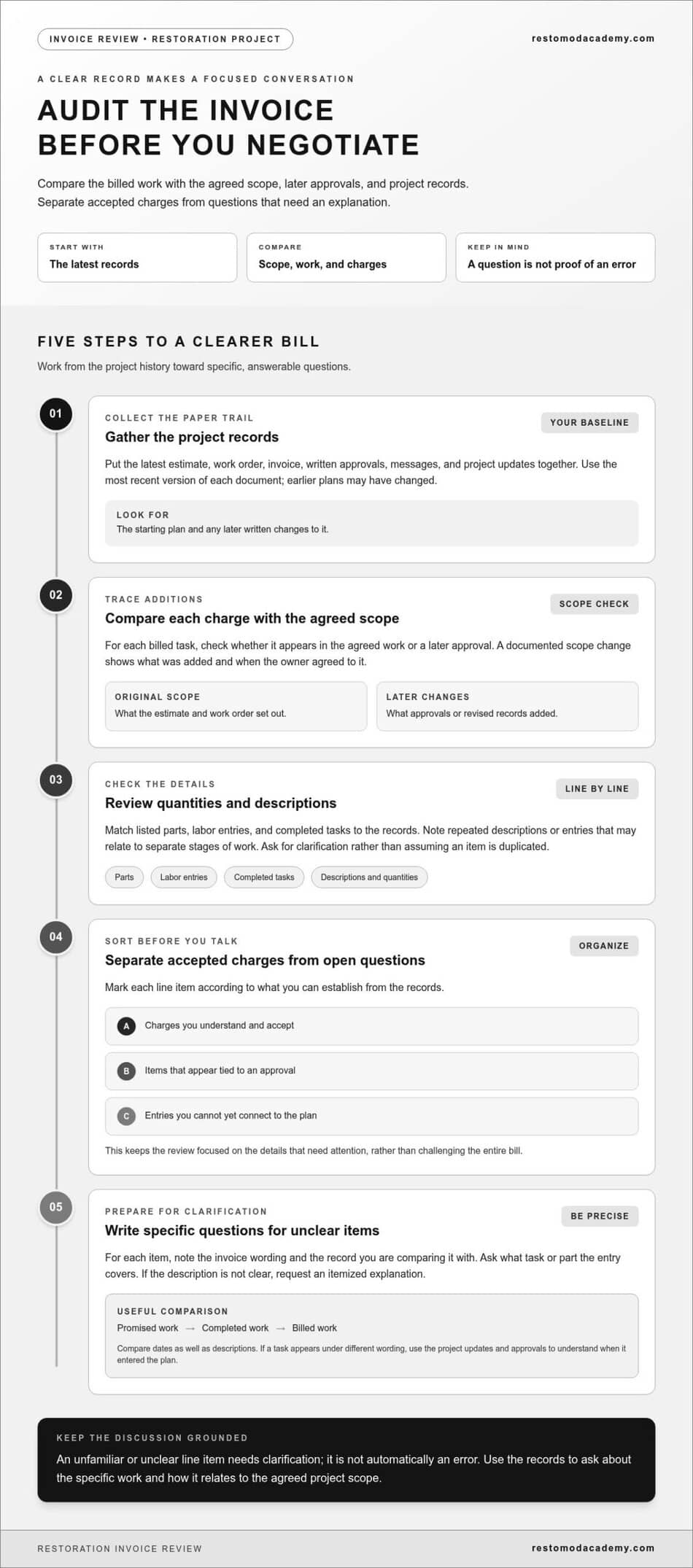
Before discussing the balance, build a clear record of what was planned, what changed, and what appears on the invoice. This turns a general concern into a short list of entries the shop can explain. Keep accepted charges separate from questions so the conversation stays focused on the actual differences.
- Gather the project records. Put the latest estimate, work order, invoice, written approvals, messages, and project updates together. Use the most recent version of each document, since earlier plans may have been revised.
- Compare the scope. For each billed task, check whether it appears in the agreed work or a later approval. A documented scope change is an addition to the project that the owner agreed to, with a record showing what was added and when.
- Check quantities and descriptions. Match listed parts, labor entries, and completed tasks to the records. Look for repeated descriptions or entries that may refer to separate stages of work, and note them for clarification rather than assuming they are duplicates.
- Sort the line items. Mark charges you understand and accept, items that appear tied to an approval, and entries you can’t yet connect to the plan. This helps you avoid challenging the entire bill when only a few details need review.
- Write specific questions. For each unclear item, note the invoice wording and the record you’re comparing it with. Ask what task or part the entry covers, and request an itemized explanation if the description doesn’t identify it clearly.
Match billed work to the agreed project scope
Make a simple side-by-side record of promised work, completed work, and billed work. Compare dates as well as descriptions: a project update may explain why an entry differs from the original estimate, while an approval message may establish when an addition entered the plan. If “assembly” appears twice, ask whether the entries cover distinct tasks or overlap. Treat unclear wording as a question, not proof of a mistake.
Check labor, parts, and added-work records
Check whether a labor entry names the task and whether a parts entry identifies the item clearly enough to compare with any approval or substitution discussed. If a charge is vague, request its supporting description rather than guessing what it means. A structured plan makes these comparisons easier; project-planning resources such as the LS engine swap guide can help builders think through how decisions and connected tasks fit within a larger build.
Keep your questions neutral and precise: “Can you show me which approval this part substitution relates to?” is more useful than “Why did you add this?” If you need California-specific information about consumer protection services related to automotive repair, the California Bureau of Automotive Repair provides relevant resources. Once your notes distinguish understood charges from unresolved entries, you’ll have a solid foundation for how to negotiate a final bill with a restoration shop.
How to tell a valid scope change from a bill discrepancy
Sort each questioned charge by its relationship to the project plan. An unfamiliar description deserves clarification, but it isn’t automatically an error. The useful distinction is whether the work was added and approved, whether it was part of the original agreement, or whether the records leave the charge unresolved.
| Category | What it means | What to look for |
|---|---|---|
| Agreed work | Tasks included in the original project plan. | A matching entry in the estimate or work order, plus a corresponding invoice description. |
| Newly discovered work | Additional work prompted by a condition found during the project. | A progress update or explanation describing the finding and the proposed response. |
| Owner-approved additions | Work added after the initial agreement at the owner’s request or with their approval. | A dated message, signed document, or other record that identifies the added task. |
| Unresolved charges | Entries that aren’t yet clearly connected to agreed work or a documented addition. | A question for the shop, not a conclusion that the charge is improper. |
A scope question concerns what was approved; a workmanship concern concerns what was delivered. Keep those issues separate. If you’re unsure whether a charge was authorized, focus on the approval record. If the work appears incomplete or different from the agreed result, describe that separately. This distinction gives the discussion a clear starting point and helps both sides respond to the issue actually in question.
Evidence that can clarify an added charge
Review dated messages, signed paperwork, progress updates, and approval records together. Note who approved the addition and what information was available at that point, such as a description of the task or a proposed change to the plan. Records may be incomplete, and a gap doesn’t establish either side’s position by itself. Use it to frame a neutral question about how the decision was made.
For example, if the invoice includes an added task but you can’t find an approval, ask when it was discussed and whether there’s a related update or record. If the shop has documentation you haven’t seen, it may help explain the charge. If neither side can locate a clear record, keep the item marked unresolved while you discuss possible next steps.
When the concern is workmanship rather than scope
Describe the result that differs from the agreed work or documented expectation. Be specific: identify the panel, finish, fit, or assembly at issue instead of saying the restoration “doesn’t look right.” Dated photos or inspection notes can help show what you’re referring to. Keep this quality concern apart from invoice questions so each can be reviewed on its own merits.
Clear categories make it easier to decide how to negotiate a final bill with a restoration shop without mixing questions about authorization with concerns about the finished build. Resolve the record first, then address separately whether the completed work matches the plan.
How to negotiate the final bill with the restoration shop
Bring your invoice review to a calm conversation with the person who knows the project history and approval records. Choose a time when you can discuss the specific entries without the pressure of a rushed handoff. Keep the goal clear: understand the charges, correct factual errors, and agree on practical next steps where something remains disputed.
- Request a focused review. Explain that you’ve compared the final invoice with the project records and would like to go through a few entries together. Share the relevant estimate, message, or approval so you’re both looking at the same information.
- Identify each question precisely. Refer to the invoice description and, where useful, the date of the related estimate or approval. Separate charges you understand from the ones you’re asking about.
- Listen to the explanation. Give the shop a chance to explain what work an entry covers and how it connects to the project. Take notes, and ask a follow-up if the explanation doesn’t resolve the mismatch.
- Discuss a resolution. If you find a factual billing error, ask how it can be corrected. If the work or approval remains disputed, discuss possible next steps without assuming the outcome in advance.
Use specific questions instead of accusations
Keep the conversation anchored to records, not memory or frustration. Try: “Could you help me understand how this charge connects to the agreed work and the approval dated [date]? I’m comparing it with [document or message], and I’m not seeing the link yet.” Then ask what task, part, or project change the line represents. The aim is clarity, not an automatic discount.
If the explanation is unfamiliar, pause and ask for the detail you need. A brief note of what was said can help you track which questions are settled and which still need attention. Stay courteous, but don’t agree to a revised balance until you understand what changed, why, and what the shop is proposing.
Discuss practical ways to resolve disputed items
Some conversations reveal a straightforward correction, such as a duplicate entry or a description that needs clarification. Other concerns may require a further review of the work or approval records. Keep those possibilities open. If you reach agreement on an adjustment, explanation, or follow-up action, ask for it in writing and review the wording before treating the matter as resolved.
Good project planning builds confidence for these discussions by keeping decisions and scope visible as a restoration evolves. Explore Restomod Academy’s project-planning resources to strengthen that foundation for future builds. For the current invoice, document what you and the shop agreed, including any remaining question and who will take the next step. A steady, record-based approach helps keep the conversation constructive.
What to do after the invoice discussion
Once you’ve talked through the invoice, capture the outcome while the details are fresh. A clear written record helps prevent the same question from resurfacing and gives the next phase of work a firmer foundation. Summarize what the shop explained, any revised amount or invoice, what remains unresolved, and who will take the next action. Keep the wording factual and make sure it reflects what you both understood.
Create a record that prevents repeat misunderstandings
Save the final scope, change approvals, progress updates, invoice, and discussion notes together in one project file. Record which questions were resolved and which still need follow-up, including the next step agreed for each open item. If an engine conversion changed the project scope, keep its related decisions with the rest of the build records. The LS engine swap guide can also help frame how that major system fits into the overall project.
Before closing the file, check that the final invoice matches the outcome you documented. If the shop agreed to revise an entry, retain the revised version alongside the earlier invoice rather than replacing the record of how the balance changed. Note any outstanding explanation or action without presenting it as settled. These habits make the project history easier to follow when you revisit the car’s systems, service history, or future build decisions.
Plan the next restoration phase with clearer expectations
Carry the lesson forward. Before another phase begins, define its milestones and the work each one covers. Agree on how proposed additions will be shared, what details an approval should include, and how the decision will be recorded. A short written update that identifies the task and the owner’s decision can keep the scope understandable as the project evolves.
Use that planning conversation to surface dependencies, too. A change to an engine, drivetrain, or electrical system may affect connected work, so discuss those links before treating an addition as a standalone task. Clear expectations don’t remove every surprise from restoration, but they make it easier to recognize when the plan has changed and to keep everyone aligned on what comes next.
If a disagreement remains unresolved and raises a contractual or legal question, don’t assume one answer applies everywhere. The relevant documents, circumstances, and location can matter, so seek guidance suited to your situation. For your next build, strengthen your planning foundation with The Ultimate Restomod Guide, a structured resource for classic-car restoration and modification.
Carry clearer decisions into your next build
A restoration doesn’t end with the final invoice. The habits you build while reviewing one project can shape the next, helping you enter each phase with sharper expectations and greater confidence in your decisions. Treat scope management as part of the craft: thoughtful planning protects the character of a classic while making room for modern upgrades that serve the build.
That’s the lasting value of learning how to negotiate a final bill with a restoration shop. You’re not just resolving a balance; you’re becoming a more informed partner in the work, better prepared to set expectations and keep future project decisions clear.
Restomod Academy focuses on education for classic-car restoration and modification, with The Ultimate Restomod Guide as its primary offering. Explore The Ultimate Restomod Guide to build your knowledge for the projects ahead. Keep learning, trust your attention to detail, and take pride in each step that brings your vision closer to the road.
Frequently Asked Questions
Can I negotiate a restoration shop bill after receiving the final invoice?
Yes. You can request a review after receiving the invoice, though a discussion doesn’t guarantee a lower balance. Identify the exact entry and explain what you expected to see instead. A practical starting point for how to negotiate a final bill with a restoration shop is to ask for an explanation tied to a specific record, then consider the response before proposing a resolution.
What should I do if the final restoration bill is higher than the estimate?
Compare the final amount with the most recent project plan and records of later decisions. A change may reflect work added as the build developed, but the difference should still be understandable. For instance, check whether an updated project note describes a related task that doesn’t appear in the original estimate. Write down what you can explain and what remains unclear, then raise only those open questions in your discussion.
Can a restoration shop charge for work I didn’t approve?
There isn’t one answer that applies to every project, agreement, or location. Gather the documents and communications that show what was proposed and decided, then ask the shop to explain how the questioned work was authorized. If the records don’t settle the issue, avoid treating that gap as proof of either side’s position. For a question about legal obligations, seek advice that accounts for your circumstances and jurisdiction.
How do I dispute an unclear line item on a restoration invoice?
Ask the shop to identify the work or part behind the exact entry. A phrase such as “additional fabrication” may need more detail before you can compare it with the project plan. Keep a note of the explanation, including any document or update the shop references. If you still can’t tell what the line covers, state precisely what information is missing and request a written clarification for your records.
Should I pay the undisputed part of a restoration bill?
Don’t assume you can separate or delay payment without considering the terms you agreed to and the rules that apply where you live. First, distinguish entries you understand from those you’re questioning. Then review your agreement and ask the shop how it proposes handling the unresolved portion. Keep that exchange in writing. If you’re uncertain about your payment obligations, get guidance based on your contract and location before deciding.
What if the restoration shop and I can’t agree on the final bill?
If discussion hasn’t resolved the issue, organize a timeline showing the project plan, relevant changes, invoice entries, and responses to your questions. Keep the account factual and avoid claims you can’t support. You might request a further review of the specific points still in dispute. If the disagreement remains substantial, consider independent guidance appropriate to your agreement and location before choosing your next step.
How can I avoid a surprise final bill on my next restoration project?
Before work begins, make the planned phase easy to understand: identify its goals, major tasks, and how proposed additions will be communicated. Set review points as the build progresses, especially before decisions that may affect connected systems or the finished direction. Keep approvals with the relevant project update. A clear process can’t predict every condition hidden beneath the surface, but it helps you track why the plan changes.
The car is finally back in the light, but the final bill is higher than you expected. Before frustration takes the wheel, gather the estimate, approval messages, and invoice. Knowing how to negotiate a final bill with a restoration shop starts with comparing the documented scope, not demanding a last-minute discount. Hidden rust or old repairs may justify a genuine scope change, but each added charge should connect to work you discussed and authorized.
It’s reasonable to question a balance that doesn’t line up with your records. You want to understand the charges and resolve any real discrepancy without turning a restoration relationship into a confrontation. A calm, specific conversation gives both sides a chance to review the work and explain where the numbers differ.
This guide shows you how to compare invoice line items with the agreed work, identify charges that need clarification, and raise concerns using clear records and steady language. You’ll also learn how to document a revised balance or next steps in writing, so you can close out the project with greater confidence and focus on the machine you’ve worked hard to bring back.
Key Takeaways
- Separate completed work and parts from approved scope changes before assessing why the final amount differs.
- Review the latest estimate, work order, approvals, and invoice line by line. Flag unclear descriptions or quantities for explanation.
- Distinguish newly discovered and approved work from unresolved charges. Don’t assume every unfamiliar item is an error.
- To understand how to negotiate a final bill with a restoration shop, request a focused review, point to specific entries, and hear the shop’s explanation before discussing options.
- Record the explanation, any revised balance, and agreed next steps, then keep those notes with the invoice and project records.
Why a restoration shop’s final bill can differ from the estimate
A larger-than-expected invoice can be jarring, especially after months of watching a classic car take shape. The difference doesn’t automatically mean the shop has acted improperly. Restoration work can reveal conditions that weren’t visible at the start, and project decisions can evolve as the build progresses. The key is to understand what the final bill covers and how each charge relates to the work you agreed to.
The final bill records charges for completed work, parts used, and scope changes approved during the project. A legitimate change might follow a discovery that affects the agreed plan. An unexplained line item is different: it needs clarification, but it isn’t automatically an error. Separate what you recognize from what you don’t, then trace each item back to the project records.
Estimate, work order, and final invoice: what each document tells you
An estimate outlines the work and expected charges based on what’s known at that stage. A work order can help show which tasks and terms were agreed to. The final invoice records what the shop is billing for work completed. Document names and shop practices vary, so focus on what each record actually says rather than assuming every shop uses the same format.
Read the documents as a sequence. The estimate captures the starting plan; later written approvals, messages, or revised work orders may show how it changed. The invoice should give you a way to connect billed work to that record. This timeline is especially useful when a task appears under different wording across documents. Note the date and source of each change so you can distinguish the original scope from later decisions.
Why restoration work changes after the car comes apart
Teardown can expose hidden corrosion beneath paint or upholstery, or mechanical wear inside an assembly that wasn’t apparent during an initial inspection. Custom fabrication may also become necessary when an original component is damaged or doesn’t fit the intended build. These discoveries can alter the work plan, but discovery alone doesn’t establish that added work was authorized.
Owner choices can expand the original scope, too. You might decide to address another system while the car is apart, select a different finish, or add a modern performance component to a heritage build. Those choices can affect parts, labor, and related tasks. Look for a clear record of the decision and the work it covered before treating the resulting charge as settled.
When an item doesn’t match your recollection, note the description, amount, and related approval or estimate entry. Ask what work the charge represents and when it became part of the plan. That keeps the discussion grounded in records rather than assumptions. A clear, cooperative exchange reflects the practical value of Negotiation strategies: understand the other side’s explanation while staying focused on the specific issue. That’s a sound starting point for how to negotiate a final bill with a restoration shop.
How to audit a restoration shop invoice before negotiating
Before discussing the balance, build a clear record of what was planned, what changed, and what appears on the invoice. This turns a general concern into a short list of entries the shop can explain. Keep accepted charges separate from questions so the conversation stays focused on the actual differences.
- Gather the project records. Put the latest estimate, work order, invoice, written approvals, messages, and project updates together. Use the most recent version of each document, since earlier plans may have been revised.
- Compare the scope. For each billed task, check whether it appears in the agreed work or a later approval. A documented scope change is an addition to the project that the owner agreed to, with a record showing what was added and when.
- Check quantities and descriptions. Match listed parts, labor entries, and completed tasks to the records. Look for repeated descriptions or entries that may refer to separate stages of work, and note them for clarification rather than assuming they are duplicates.
- Sort the line items. Mark charges you understand and accept, items that appear tied to an approval, and entries you can’t yet connect to the plan. This helps you avoid challenging the entire bill when only a few details need review.
- Write specific questions. For each unclear item, note the invoice wording and the record you’re comparing it with. Ask what task or part the entry covers, and request an itemized explanation if the description doesn’t identify it clearly.
Match billed work to the agreed project scope
Make a simple side-by-side record of promised work, completed work, and billed work. Compare dates as well as descriptions: a project update may explain why an entry differs from the original estimate, while an approval message may establish when an addition entered the plan. If “assembly” appears twice, ask whether the entries cover distinct tasks or overlap. Treat unclear wording as a question, not proof of a mistake.
Check labor, parts, and added-work records
Check whether a labor entry names the task and whether a parts entry identifies the item clearly enough to compare with any approval or substitution discussed. If a charge is vague, request its supporting description rather than guessing what it means. A structured plan makes these comparisons easier; project-planning resources such as the LS engine swap guide can help builders think through how decisions and connected tasks fit within a larger build.
Keep your questions neutral and precise: “Can you show me which approval this part substitution relates to?” is more useful than “Why did you add this?” If you need California-specific information about consumer protection services related to automotive repair, the California Bureau of Automotive Repair provides relevant resources. Once your notes distinguish understood charges from unresolved entries, you’ll have a solid foundation for how to negotiate a final bill with a restoration shop.
How to tell a valid scope change from a bill discrepancy
Sort each questioned charge by its relationship to the project plan. An unfamiliar description deserves clarification, but it isn’t automatically an error. The useful distinction is whether the work was added and approved, whether it was part of the original agreement, or whether the records leave the charge unresolved.
| Category | What it means | What to look for |
|---|---|---|
| Agreed work | Tasks included in the original project plan. | A matching entry in the estimate or work order, plus a corresponding invoice description. |
| Newly discovered work | Additional work prompted by a condition found during the project. | A progress update or explanation describing the finding and the proposed response. |
| Owner-approved additions | Work added after the initial agreement at the owner’s request or with their approval. | A dated message, signed document, or other record that identifies the added task. |
| Unresolved charges | Entries that aren’t yet clearly connected to agreed work or a documented addition. | A question for the shop, not a conclusion that the charge is improper. |
A scope question concerns what was approved; a workmanship concern concerns what was delivered. Keep those issues separate. If you’re unsure whether a charge was authorized, focus on the approval record. If the work appears incomplete or different from the agreed result, describe that separately. This distinction gives the discussion a clear starting point and helps both sides respond to the issue actually in question.
Evidence that can clarify an added charge
Review dated messages, signed paperwork, progress updates, and approval records together. Note who approved the addition and what information was available at that point, such as a description of the task or a proposed change to the plan. Records may be incomplete, and a gap doesn’t establish either side’s position by itself. Use it to frame a neutral question about how the decision was made.
For example, if the invoice includes an added task but you can’t find an approval, ask when it was discussed and whether there’s a related update or record. If the shop has documentation you haven’t seen, it may help explain the charge. If neither side can locate a clear record, keep the item marked unresolved while you discuss possible next steps.
When the concern is workmanship rather than scope
Describe the result that differs from the agreed work or documented expectation. Be specific: identify the panel, finish, fit, or assembly at issue instead of saying the restoration “doesn’t look right.” Dated photos or inspection notes can help show what you’re referring to. Keep this quality concern apart from invoice questions so each can be reviewed on its own merits.
Clear categories make it easier to decide how to negotiate a final bill with a restoration shop without mixing questions about authorization with concerns about the finished build. Resolve the record first, then address separately whether the completed work matches the plan.
How to negotiate the final bill with the restoration shop
Bring your invoice review to a calm conversation with the person who knows the project history and approval records. Choose a time when you can discuss the specific entries without the pressure of a rushed handoff. Keep the goal clear: understand the charges, correct factual errors, and agree on practical next steps where something remains disputed.
- Request a focused review. Explain that you’ve compared the final invoice with the project records and would like to go through a few entries together. Share the relevant estimate, message, or approval so you’re both looking at the same information.
- Identify each question precisely. Refer to the invoice description and, where useful, the date of the related estimate or approval. Separate charges you understand from the ones you’re asking about.
- Listen to the explanation. Give the shop a chance to explain what work an entry covers and how it connects to the project. Take notes, and ask a follow-up if the explanation doesn’t resolve the mismatch.
- Discuss a resolution. If you find a factual billing error, ask how it can be corrected. If the work or approval remains disputed, discuss possible next steps without assuming the outcome in advance.
Use specific questions instead of accusations
Keep the conversation anchored to records, not memory or frustration. Try: “Could you help me understand how this charge connects to the agreed work and the approval dated [date]? I’m comparing it with [document or message], and I’m not seeing the link yet.” Then ask what task, part, or project change the line represents. The aim is clarity, not an automatic discount.
If the explanation is unfamiliar, pause and ask for the detail you need. A brief note of what was said can help you track which questions are settled and which still need attention. Stay courteous, but don’t agree to a revised balance until you understand what changed, why, and what the shop is proposing.
Discuss practical ways to resolve disputed items
Some conversations reveal a straightforward correction, such as a duplicate entry or a description that needs clarification. Other concerns may require a further review of the work or approval records. Keep those possibilities open. If you reach agreement on an adjustment, explanation, or follow-up action, ask for it in writing and review the wording before treating the matter as resolved.
Good project planning builds confidence for these discussions by keeping decisions and scope visible as a restoration evolves. Explore Restomod Academy’s project-planning resources to strengthen that foundation for future builds. For the current invoice, document what you and the shop agreed, including any remaining question and who will take the next step. A steady, record-based approach helps keep the conversation constructive.
What to do after the invoice discussion
Once you’ve talked through the invoice, capture the outcome while the details are fresh. A clear written record helps prevent the same question from resurfacing and gives the next phase of work a firmer foundation. Summarize what the shop explained, any revised amount or invoice, what remains unresolved, and who will take the next action. Keep the wording factual and make sure it reflects what you both understood.
Create a record that prevents repeat misunderstandings
Save the final scope, change approvals, progress updates, invoice, and discussion notes together in one project file. Record which questions were resolved and which still need follow-up, including the next step agreed for each open item. If an engine conversion changed the project scope, keep its related decisions with the rest of the build records. The LS engine swap guide can also help frame how that major system fits into the overall project.
Before closing the file, check that the final invoice matches the outcome you documented. If the shop agreed to revise an entry, retain the revised version alongside the earlier invoice rather than replacing the record of how the balance changed. Note any outstanding explanation or action without presenting it as settled. These habits make the project history easier to follow when you revisit the car’s systems, service history, or future build decisions.
Plan the next restoration phase with clearer expectations
Carry the lesson forward. Before another phase begins, define its milestones and the work each one covers. Agree on how proposed additions will be shared, what details an approval should include, and how the decision will be recorded. A short written update that identifies the task and the owner’s decision can keep the scope understandable as the project evolves.
Use that planning conversation to surface dependencies, too. A change to an engine, drivetrain, or electrical system may affect connected work, so discuss those links before treating an addition as a standalone task. Clear expectations don’t remove every surprise from restoration, but they make it easier to recognize when the plan has changed and to keep everyone aligned on what comes next.
If a disagreement remains unresolved and raises a contractual or legal question, don’t assume one answer applies everywhere. The relevant documents, circumstances, and location can matter, so seek guidance suited to your situation. For your next build, strengthen your planning foundation with The Ultimate Restomod Guide, a structured resource for classic-car restoration and modification.
Carry clearer decisions into your next build
A restoration doesn’t end with the final invoice. The habits you build while reviewing one project can shape the next, helping you enter each phase with sharper expectations and greater confidence in your decisions. Treat scope management as part of the craft: thoughtful planning protects the character of a classic while making room for modern upgrades that serve the build.
That’s the lasting value of learning how to negotiate a final bill with a restoration shop. You’re not just resolving a balance; you’re becoming a more informed partner in the work, better prepared to set expectations and keep future project decisions clear.
Restomod Academy focuses on education for classic-car restoration and modification, with The Ultimate Restomod Guide as its primary offering. Explore The Ultimate Restomod Guide to build your knowledge for the projects ahead. Keep learning, trust your attention to detail, and take pride in each step that brings your vision closer to the road.
Frequently Asked Questions
Can I negotiate a restoration shop bill after receiving the final invoice?
Yes. You can request a review after receiving the invoice, though a discussion doesn’t guarantee a lower balance. Identify the exact entry and explain what you expected to see instead. A practical starting point for how to negotiate a final bill with a restoration shop is to ask for an explanation tied to a specific record, then consider the response before proposing a resolution.
What should I do if the final restoration bill is higher than the estimate?
Compare the final amount with the most recent project plan and records of later decisions. A change may reflect work added as the build developed, but the difference should still be understandable. For instance, check whether an updated project note describes a related task that doesn’t appear in the original estimate. Write down what you can explain and what remains unclear, then raise only those open questions in your discussion.
Can a restoration shop charge for work I didn’t approve?
There isn’t one answer that applies to every project, agreement, or location. Gather the documents and communications that show what was proposed and decided, then ask the shop to explain how the questioned work was authorized. If the records don’t settle the issue, avoid treating that gap as proof of either side’s position. For a question about legal obligations, seek advice that accounts for your circumstances and jurisdiction.
How do I dispute an unclear line item on a restoration invoice?
Ask the shop to identify the work or part behind the exact entry. A phrase such as “additional fabrication” may need more detail before you can compare it with the project plan. Keep a note of the explanation, including any document or update the shop references. If you still can’t tell what the line covers, state precisely what information is missing and request a written clarification for your records.
Should I pay the undisputed part of a restoration bill?
Don’t assume you can separate or delay payment without considering the terms you agreed to and the rules that apply where you live. First, distinguish entries you understand from those you’re questioning. Then review your agreement and ask the shop how it proposes handling the unresolved portion. Keep that exchange in writing. If you’re uncertain about your payment obligations, get guidance based on your contract and location before deciding.
What if the restoration shop and I can’t agree on the final bill?
If discussion hasn’t resolved the issue, organize a timeline showing the project plan, relevant changes, invoice entries, and responses to your questions. Keep the account factual and avoid claims you can’t support. You might request a further review of the specific points still in dispute. If the disagreement remains substantial, consider independent guidance appropriate to your agreement and location before choosing your next step.
How can I avoid a surprise final bill on my next restoration project?
Before work begins, make the planned phase easy to understand: identify its goals, major tasks, and how proposed additions will be communicated. Set review points as the build progresses, especially before decisions that may affect connected systems or the finished direction. Keep approvals with the relevant project update. A clear process can’t predict every condition hidden beneath the surface, but it helps you track why the plan changes.