
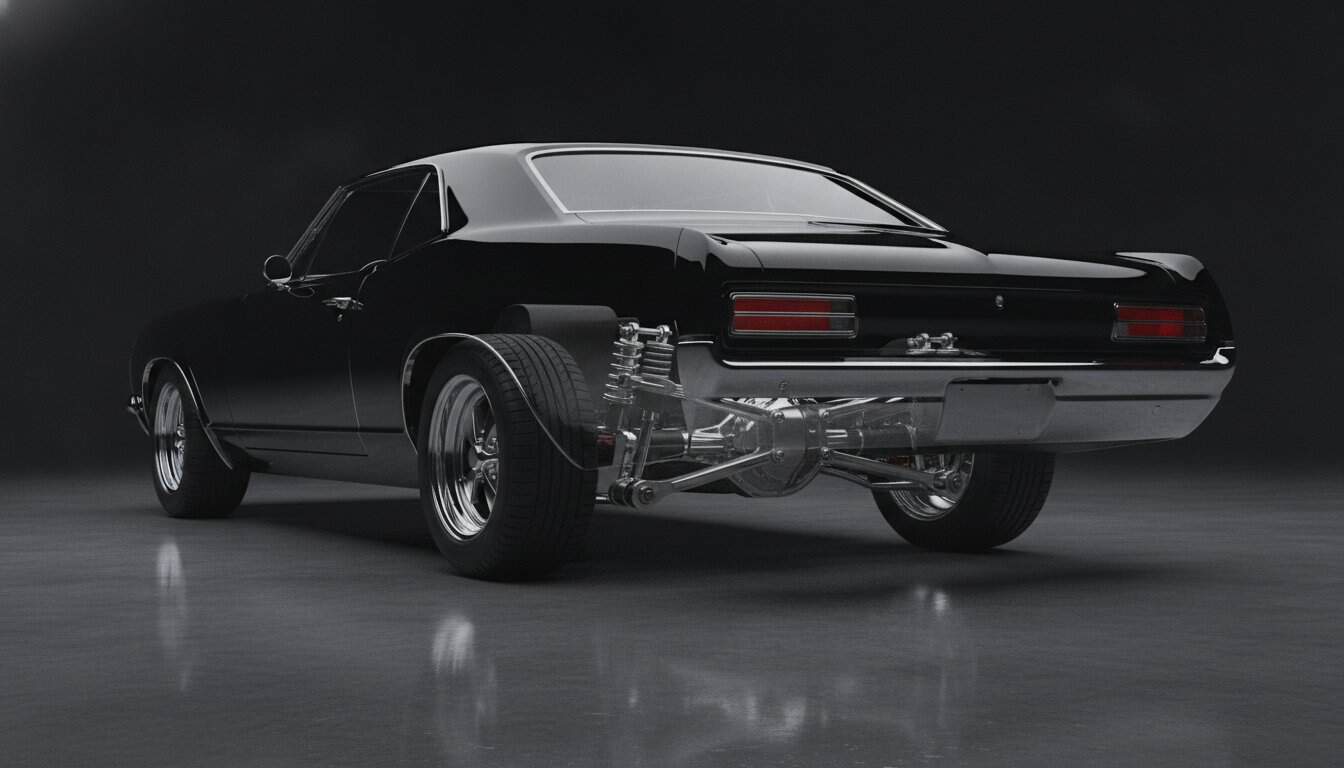
Why do we continue to settle for the jarring hop of a 1960s leaf spring setup when the rest of our build pushes 21st-century horsepower? You’ve likely felt that unsettling skip when hitting a mid-corner bump or the physical fatigue that comes from a rigid rear end fighting every imperfection in the pavement. It’s a common frustration for enthusiasts who want their vintage steel to handle with the same precision as a modern sportscar. You deserve a ride that matches your engine’s ambition, and that starts with upgrading to an independent rear suspension for classic cars.
We’re going to bridge the gap between nostalgia and technology. In this guide, you’ll learn how to transform your car’s handling by transitioning from a dated solid axle to a high-performance independent system. We’ll explore the geometry of legendary donor setups like the Jaguar and Corvette, break down the fabrication requirements for a professional-grade install, and provide a clear roadmap for your project. By the end, you’ll have the knowledge to move from a passive admirer of performance to an active creator of a machine that truly carves corners.
Key Takeaways
- Understand how allowing each wheel to react to the road independently eliminates the axle hop common in vintage setups, providing a smoother and more controlled ride.
- Evaluate the trade-offs between budget-friendly salvage yard donors like the C4 Corvette and the high-precision engineering of modern aftermarket kits.
- Master the benefits of independent rear suspension for classic cars by learning how dynamic camber gain keeps your tires planted through every turn.
- Identify the essential fabrication steps, including subframe integration and floor pan modifications, required to successfully merge modern geometry with a classic chassis.
- Determine if an IRS swap aligns with your specific build goals by comparing its performance impact against other common restomod upgrades.
The IRS Advantage: Why Classic Cars Need Modern Rear Geometry
Think of your classic rear end as a single, rigid beam. When you hit a pothole with the driver-side tire, that energy transfers directly through the housing to the passenger side. This creates the unsettling skipping sensation that makes high-speed cornering feel like a gamble. An Independent Suspension changes this dynamic entirely. By allowing each wheel to move vertically without affecting its partner, the car maintains a stable platform. Choosing to install an independent rear suspension for classic cars is about more than just modernizing a spec sheet; it’s about changing how your car communicates with the road.
The secret lies in the management of unsprung weight. In a traditional setup, the differential, gears, and heavy steel tubes all move up and down with the wheels. This high mass makes it difficult for the springs and shocks to keep the tires planted on uneven surfaces. By mounting the differential directly to the chassis, we convert that heavy iron into sprung weight. This allows the suspension to react with lightning speed to every crack in the asphalt. Maintaining a consistent tire contact patch is where the magic happens. As the car leans into a turn, modern geometry provides dynamic camber gain, tilting the tire inward to keep the tread flat against the road. This provides a level of lateral grip that a solid axle simply cannot match.
The Problem with the Vintage Solid Axle
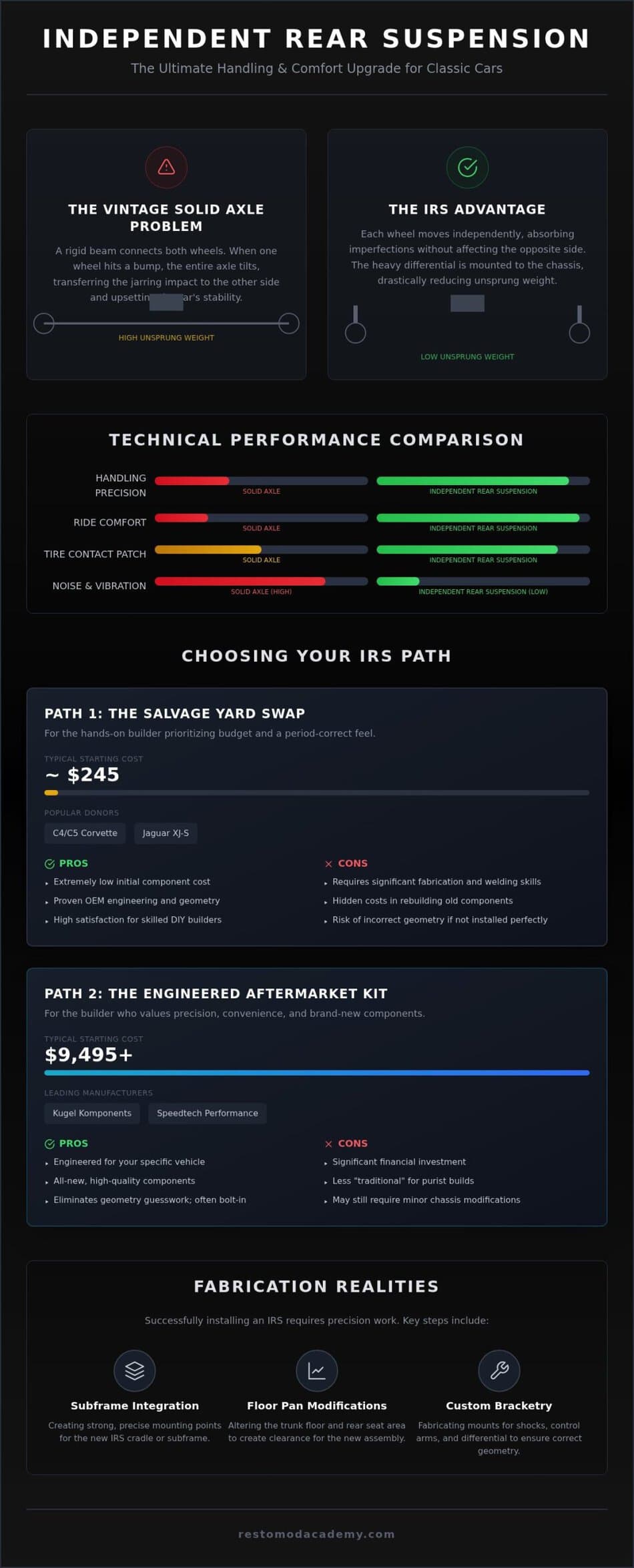
Heavy iron differential housings create massive unsprung weight that fights your suspension at every turn. This mass moves with the wheels, forcing shocks to work much harder to maintain tire contact. When one wheel hits a bump, the entire axle tilts, upsetting the opposite tire’s geometry and traction. Understanding these mechanical limits is a vital part of learning What is a Restomod? The Ultimate Guide.
Handling vs Ride Quality: The Dual Benefit
IRS mounts the differential to the frame, which allows you to run softer spring rates for a plush ride without sacrificing cornering stability. This setup also isolates the cabin from the harsh road noise and vibrations common in old leaf-spring systems. Wheel independence means that the vertical travel of one tire does not dictate the camber or toe of the opposite tire, allowing the chassis to stay level even on broken pavement. Investing in an independent rear suspension for classic cars is the most effective way to modernize a vintage chassis while preserving its soul.
Salvage Yard Swaps vs Aftermarket IRS Kits
Choosing the right independent rear suspension for classic cars often comes down to the balance between your fabrication skills and your project budget. For the DIY builder, the salvage yard remains a treasure trove of high-performance components that can be adapted with the right bracketry. The C4 and C5 Corvette systems are widely considered the gold standard for donor-based swaps because of their lightweight aluminum control arms and proven geometry. Alternatively, the Jaguar XJ-S unit offers a timeless aesthetic with its inboard brakes and twin-shock setup, making it a favorite for show-quality builds. While a used Jaguar assembly can be found for approximately $245.59, remember that the cost of refurbishing seals and bearings adds up quickly.
The Classic Corvette and Jaguar Donor Options
When you pull a C4 Corvette unit, you’re getting a compact package that fits many narrow classic frames. However, these systems require significant custom bracketry and a deep understanding of Suspension System Design and Analysis to ensure the roll center remains correct. The Jaguar IRS is legendary for its ride quality, but the inboard brakes can be a maintenance challenge since the rotors are tucked against the differential. Before hauling a unit home, inspect the half-shafts for play and look for stress cracks in the mounting cage. This path requires a high degree of personal labor, but the rewards of a period-correct performance upgrade are immense.
Engineered Aftermarket Solutions for Restomods
Modern aftermarket kits represent the peak of convenience for builders who prioritize shop time over salvage hunting. Manufacturers like Kugel Komponents and Speedtech Performance offer vehicle-specific subframes that often bolt directly into your existing chassis with minimal welding. A Kugel Komponents 9 inch Ford IRS kit starts at $9,495.00, providing a brand-new foundation that eliminates the guesswork of geometry. These kits utilize modern hubs and bearings, which are significantly easier to service than 40-year-old donor parts. Most aftermarket solutions for an independent rear suspension for classic cars also integrate coilovers, giving you the ability to tune your ride height and damping with a simple turn of a wrench.
This level of engineering ensures that your classic handles with the predictability of a modern machine. If you find yourself overwhelmed by the technical requirements of these systems, our Restomod Academy product reviews can help you identify which kit matches your specific performance goals.
IRS vs Solid Axle: A Technical Performance Comparison
The debate between a live axle and an independent rear suspension for classic cars often misses the mechanical nuance of how power actually reaches the ground. A solid axle is a simple, robust beam that excels at keeping tires parallel to each other, but it fails to keep them parallel to the road surface during body roll. When you transition to an independent system, you’re mounting the differential directly to the chassis. This shift transforms the rear end from a reactive weight that the springs must fight into a stable platform that manages power through articulating half-shafts. This layout is particularly crucial when you’re dropping in a high-output modern powerplant, as the added torque requires a chassis that stays composed under load. If you’re planning a high-horsepower build, consider how your suspension will handle the output described in the definitive guide to an LS engine swap.
Durability in an independent system is often questioned by those used to the literal iron-clad strength of a Ford 9-inch solid axle. However, modern engineering has closed this gap. High-performance independent kits now utilize heavy-duty center sections and CV axles capable of absorbing thousands of foot-pounds of torque. The difference lies in how that force is distributed. In a solid axle, the entire housing twists against the springs. In an independent setup, the torque is contained within the frame-mounted differential, allowing the suspension arms to focus solely on tire orientation and grip.
Cornering Dynamics and Camber Control
In a high-G turn, a solid axle forces the outside tire to tilt with the body, lifting the edge of the tread and reducing your contact patch. An independent system utilizes short and long arm geometry to provide dynamic camber gain. As the suspension compresses, the tire tilts inward at the top, effectively counteracting body roll to keep the tread flat against the pavement. You also gain control over toe settings. While a solid axle has fixed toe, an independent rear suspension for classic cars allows for precise adjustments that can induce slight toe-in under load, stabilizing the car as you power out of a corner. This level of control ensures that your vintage machine doesn’t just look fast, but actually maintains its composure through the most technical sections of the track.
Drag Racing and Straight-Line Stability
Many builders worry that an independent system is too fragile for the drag strip. While it’s true that a solid axle is inherently simpler for vertical launches, modern units are engineered to handle massive torque without failure. The primary enemy isn’t the strength of the gears but the phenomenon of wheel hop. This occurs when soft rubber bushings allow the differential to twist, causing the tires to lose and regain traction rapidly. By upgrading to polyurethane or solid bushings and using high-strength half-shafts, you can achieve world-class launches without sacrificing your ability to turn. The fundamental trade-off lies between the brute straight-line strength of a solid beam and the nuanced cornering finesse of independent articulation.
Fabrication Realities: Installing IRS in Your Classic Car
Fabrication is where the artistry of design meets the precision of engineering. Unlike a simple leaf spring swap, installing an independent rear suspension for classic cars requires a fundamental rethink of your chassis architecture. You’ll likely need to modify the floor pan to clear the upper control arms or the differential housing, a task that demands careful measurement before the first cut. Precision is your best friend here. Pinion angle must be set permanently since the differential is fixed to the frame; you don’t have the luxury of adjusting it with shims later. You must also ensure the half-shafts are parallel to the ground at ride height to prevent premature wear on the CV joints or u-joints.
You must also decide on your braking strategy early in the build. Inboard brakes, famously found on the Jaguar IRS, offer a clean look at the wheels and reduce unsprung weight even further. However, they’re notoriously difficult to service once the unit is tucked under your car. Outboard brakes, standard on Corvette and most modern kits, provide easier maintenance and better cooling for aggressive driving. This choice significantly impacts your plumbing and emergency brake cable routing, so plan your layout before welding your brackets. Understanding these complexities is a core part of learning what is a restomod and how to execute it properly.
Chassis Preparation and Stiffening
Your original frame wasn’t designed to handle the concentrated loads of a modern independent system. When you move the suspension pick-up points from the leaf spring hangers to a central subframe, you must reinforce the area. Subframe connectors are non-negotiable for unibody cars to prevent the chassis from twisting under torque. A custom rear crossmember must be fabricated to distribute these new forces into the main frame rails securely. This reinforcement ensures that the energy from the road is absorbed by the suspension, not the body of the car.
Alignment and Tuning the Independent Rear
Once the fabrication is complete, the work transitions to the alignment rack. An IRS-equipped classic requires a full four-wheel alignment to function correctly. You now have the power to tune toe and camber settings, allowing you to dial in the exact handling characteristics you want. Before your first test drive, follow this safety checklist:
- Verify all mounting bolts are torqued to spec and marked with paint pens.
- Check for suspension binding by cycling the rear through its full range of motion without springs.
- Ensure brake lines and fuel lines have adequate clearance from moving half-shafts.
- Confirm the differential is filled with the correct fluid and friction modifier.
To simplify the fabrication process and ensure your geometry is spot-on, consider utilizing our Premium Project Blueprints for your next build.
The Final Verdict: Is IRS Right for Your Restomod?
The decision to install an independent rear suspension for classic cars represents a significant crossroads in your restoration journey. It is a commitment to a specific philosophy of driving that values technical precision and modern road manners over the brute simplicity of a solid axle. While restomod builds are expected to account for 39.5% of the market in 2026, the choice to go independent remains a premium path reserved for those who want their vintage machine to behave like a world-class athlete. You must weigh the financial investment against your performance goals. For instance, a high-end Speedtech Performance IRS for a GM F-Body is priced at $17,938.96. If your budget is tighter, a used Jaguar unit might only cost $245.59 upfront, but the specialized labor and refurbishment parts will quickly bridge that gap.
Contrast this investment with other upgrades. A top-tier 4-link system paired with a big brake kit might offer similar straight-line performance for less complexity, but it will never match the refined damping and lateral grip of a true independent setup. Before you strike an arc with your welder, honestly evaluate your workshop capabilities and tool availability. This project requires advanced measurement tools, a high-output welder, and the patience to iterate on your geometry until it’s perfect. If you’re a builder who thrives on the challenge of fabrication and the reward of a perfectly executed weld, this is your ultimate project.
When to Choose Independent Rear Suspension
Pro-touring builds are the primary candidates for this upgrade, especially since muscle cars lead the restomod market with a 31.4% share in 2026. If you plan to participate in autocross events or enjoy long-distance touring on winding backroads, the added sophistication is worth every hour in the shop. Beyond performance, there is an undeniable aesthetic impact. A polished Kugel Komponents 9 inch Ford IRS kit, which can exceed $21,215.00 with show-quality options, becomes the centerpiece of your chassis. Choose this path if you want a machine that is as impressive on a lift as it is on the track.
Next Steps for Your Suspension Build
Your journey doesn’t end with choosing a kit; it begins with the execution. We recommend you explore The Ultimate Restomod Guide to see how a suspension swap fits into a comprehensive build roadmap. Once you have your plan, visit our Recommended Gear page to ensure your shop is equipped with the precision measuring tools and fabrication equipment necessary for a professional install. If you’re still unsure about your specific geometry plans, our Restomod Consulting Services can provide the expert oversight needed to ensure your independent rear suspension for classic cars handles exactly as you envisioned.
Build Your Legacy on a Modern Foundation
Transforming your vintage machine into a modern performer requires more than just a high-horsepower engine; it demands a chassis that can communicate with the pavement. You’ve explored the geometric advantages of independent rear suspension for classic cars and the meticulous fabrication needed to bring that vision to life. Whether you choose the rugged character of a Jaguar donor or the bolt-in precision of a modern aftermarket kit, the result is a vehicle that honors its heritage while embracing the future of performance.
This journey from a passive admirer to an active creator is about achieving mechanical excellence. You now have the technical insight to tackle the complex realities of subframe mounting and alignment. To ensure every weld and measurement meets the highest standard of safety, lean on the authoritative guidance of Brook Walsh. Master your suspension geometry with The Ultimate Restomod Guide and access detailed technical blueprints for your next chassis upgrade. Your project reflects your dedication to precision. Pick up your torch and start building something legendary.
Frequently Asked Questions
Is independent rear suspension better than a Ford 9-inch for a classic car?
Better is a subjective term in the workshop. A Ford 9-inch is the king of straight-line durability and simplicity, making it the right choice for pure drag builds. However, an independent rear suspension for classic cars is superior for any vehicle intended to turn or provide modern comfort. While the 9-inch handles brute force, the IRS manages the road. It provides the sophisticated articulation needed for pro-touring machines that face real-world road imperfections.
What is the best donor car for an independent rear suspension swap?
The C4 and C5 Corvette systems are widely considered the best donors due to their lightweight aluminum components and favorable geometry. These units offer a compact package that fits within many classic frame rails comfortably. For those seeking a classic aesthetic with inboard brakes, the Jaguar XJ-S remains a popular choice for show builds. Each donor requires specific bracketry, so your choice should align with your chassis width and intended wheel offset.
Can I install an IRS system without a car lift or professional welding equipment?
You cannot safely perform this swap without professional-grade welding equipment and a stable way to access the chassis. This isn’t a project for jack stands and a basic 110v welder. You’re making structural changes to the frame that support the entire weight and torque of the vehicle. Precision is paramount during this process. You need a flat surface and high-quality fabrication tools to ensure the rear subframe is square and the pinion angle is correct.
How much fabrication is required to fit a Corvette IRS into a classic Mustang?
Fitting a Corvette unit into a classic Mustang requires significant structural modification to the rear of the car. You must cut into the factory floor pan to clear the differential and upper control arms. You’ll also need to fabricate a custom rear crossmember and install subframe connectors to handle the new suspension loads. It’s a complex task that demands precise measuring to ensure the wheels remain centered in the wheel wells while maintaining proper half-shaft alignment.
Does independent rear suspension improve the ride quality of a vintage truck?
An independent rear suspension for classic cars will fundamentally transform a vintage truck’s ride quality. Most old trucks rely on heavy leaf springs designed for payload, not comfort. By moving to an independent setup, you eliminate the axle hop and harshness inherent in a solid beam. The truck will feel more like a modern vehicle, absorbing bumps with individual wheel movement rather than transmitting every jar through the entire frame and into the cabin.
Are there bolt-in independent rear suspension kits available for classic cars?
Yes, several manufacturers offer engineered bolt-in or weld-in kits for popular models like the Camaro or F-100. Companies like Speedtech Performance and Kugel Komponents provide subframes designed to work with your specific chassis. While these are more expensive than salvage yard donors, they eliminate the guesswork of suspension geometry. They often include modern coilovers and updated hubs, making the installation process more logical and the final results much more predictable for the home builder.
What are the maintenance requirements for a salvaged Jaguar IRS unit?
Salvaged Jaguar units require meticulous attention to the inboard brake system and the unique twin-shock setup. You’ll need to inspect the wheel bearings and universal joints for any play before installation. Replacing the rotors and pads on an inboard system is labor-intensive because they’re located next to the differential. Regular maintenance includes checking the hub carrier seals and ensuring the differential breather is clear to prevent oil leaks on the brake surfaces during operation.
Will an independent rear suspension setup handle high horsepower engine swaps?
Modern independent systems can definitely handle high-horsepower engine swaps when built with the right components. While older salvaged units might need upgraded half-shafts, aftermarket kits often use heavy-duty center sections like the Ford 9-inch or Dana 60. These setups are engineered to withstand the massive torque of an LS or Coyote engine. Success depends on using high-quality CV joints and ensuring your chassis stiffening is sufficient to prevent the differential from twisting under hard acceleration.
Why do we continue to settle for the jarring hop of a 1960s leaf spring setup when the rest of our build pushes 21st-century horsepower? You’ve likely felt that unsettling skip when hitting a mid-corner bump or the physical fatigue that comes from a rigid rear end fighting every imperfection in the pavement. It’s a common frustration for enthusiasts who want their vintage steel to handle with the same precision as a modern sportscar. You deserve a ride that matches your engine’s ambition, and that starts with upgrading to an independent rear suspension for classic cars.
We’re going to bridge the gap between nostalgia and technology. In this guide, you’ll learn how to transform your car’s handling by transitioning from a dated solid axle to a high-performance independent system. We’ll explore the geometry of legendary donor setups like the Jaguar and Corvette, break down the fabrication requirements for a professional-grade install, and provide a clear roadmap for your project. By the end, you’ll have the knowledge to move from a passive admirer of performance to an active creator of a machine that truly carves corners.
Key Takeaways
- Understand how allowing each wheel to react to the road independently eliminates the axle hop common in vintage setups, providing a smoother and more controlled ride.
- Evaluate the trade-offs between budget-friendly salvage yard donors like the C4 Corvette and the high-precision engineering of modern aftermarket kits.
- Master the benefits of independent rear suspension for classic cars by learning how dynamic camber gain keeps your tires planted through every turn.
- Identify the essential fabrication steps, including subframe integration and floor pan modifications, required to successfully merge modern geometry with a classic chassis.
- Determine if an IRS swap aligns with your specific build goals by comparing its performance impact against other common restomod upgrades.
The IRS Advantage: Why Classic Cars Need Modern Rear Geometry
Think of your classic rear end as a single, rigid beam. When you hit a pothole with the driver-side tire, that energy transfers directly through the housing to the passenger side. This creates the unsettling skipping sensation that makes high-speed cornering feel like a gamble. An Independent Suspension changes this dynamic entirely. By allowing each wheel to move vertically without affecting its partner, the car maintains a stable platform. Choosing to install an independent rear suspension for classic cars is about more than just modernizing a spec sheet; it’s about changing how your car communicates with the road.
The secret lies in the management of unsprung weight. In a traditional setup, the differential, gears, and heavy steel tubes all move up and down with the wheels. This high mass makes it difficult for the springs and shocks to keep the tires planted on uneven surfaces. By mounting the differential directly to the chassis, we convert that heavy iron into sprung weight. This allows the suspension to react with lightning speed to every crack in the asphalt. Maintaining a consistent tire contact patch is where the magic happens. As the car leans into a turn, modern geometry provides dynamic camber gain, tilting the tire inward to keep the tread flat against the road. This provides a level of lateral grip that a solid axle simply cannot match.
The Problem with the Vintage Solid Axle
Heavy iron differential housings create massive unsprung weight that fights your suspension at every turn. This mass moves with the wheels, forcing shocks to work much harder to maintain tire contact. When one wheel hits a bump, the entire axle tilts, upsetting the opposite tire’s geometry and traction. Understanding these mechanical limits is a vital part of learning What is a Restomod? The Ultimate Guide.
Handling vs Ride Quality: The Dual Benefit
IRS mounts the differential to the frame, which allows you to run softer spring rates for a plush ride without sacrificing cornering stability. This setup also isolates the cabin from the harsh road noise and vibrations common in old leaf-spring systems. Wheel independence means that the vertical travel of one tire does not dictate the camber or toe of the opposite tire, allowing the chassis to stay level even on broken pavement. Investing in an independent rear suspension for classic cars is the most effective way to modernize a vintage chassis while preserving its soul.
Salvage Yard Swaps vs Aftermarket IRS Kits
Choosing the right independent rear suspension for classic cars often comes down to the balance between your fabrication skills and your project budget. For the DIY builder, the salvage yard remains a treasure trove of high-performance components that can be adapted with the right bracketry. The C4 and C5 Corvette systems are widely considered the gold standard for donor-based swaps because of their lightweight aluminum control arms and proven geometry. Alternatively, the Jaguar XJ-S unit offers a timeless aesthetic with its inboard brakes and twin-shock setup, making it a favorite for show-quality builds. While a used Jaguar assembly can be found for approximately $245.59, remember that the cost of refurbishing seals and bearings adds up quickly.
The Classic Corvette and Jaguar Donor Options
When you pull a C4 Corvette unit, you’re getting a compact package that fits many narrow classic frames. However, these systems require significant custom bracketry and a deep understanding of Suspension System Design and Analysis to ensure the roll center remains correct. The Jaguar IRS is legendary for its ride quality, but the inboard brakes can be a maintenance challenge since the rotors are tucked against the differential. Before hauling a unit home, inspect the half-shafts for play and look for stress cracks in the mounting cage. This path requires a high degree of personal labor, but the rewards of a period-correct performance upgrade are immense.
Engineered Aftermarket Solutions for Restomods
Modern aftermarket kits represent the peak of convenience for builders who prioritize shop time over salvage hunting. Manufacturers like Kugel Komponents and Speedtech Performance offer vehicle-specific subframes that often bolt directly into your existing chassis with minimal welding. A Kugel Komponents 9 inch Ford IRS kit starts at $9,495.00, providing a brand-new foundation that eliminates the guesswork of geometry. These kits utilize modern hubs and bearings, which are significantly easier to service than 40-year-old donor parts. Most aftermarket solutions for an independent rear suspension for classic cars also integrate coilovers, giving you the ability to tune your ride height and damping with a simple turn of a wrench.
This level of engineering ensures that your classic handles with the predictability of a modern machine. If you find yourself overwhelmed by the technical requirements of these systems, our Restomod Academy product reviews can help you identify which kit matches your specific performance goals.
IRS vs Solid Axle: A Technical Performance Comparison
The debate between a live axle and an independent rear suspension for classic cars often misses the mechanical nuance of how power actually reaches the ground. A solid axle is a simple, robust beam that excels at keeping tires parallel to each other, but it fails to keep them parallel to the road surface during body roll. When you transition to an independent system, you’re mounting the differential directly to the chassis. This shift transforms the rear end from a reactive weight that the springs must fight into a stable platform that manages power through articulating half-shafts. This layout is particularly crucial when you’re dropping in a high-output modern powerplant, as the added torque requires a chassis that stays composed under load. If you’re planning a high-horsepower build, consider how your suspension will handle the output described in the definitive guide to an LS engine swap.
Durability in an independent system is often questioned by those used to the literal iron-clad strength of a Ford 9-inch solid axle. However, modern engineering has closed this gap. High-performance independent kits now utilize heavy-duty center sections and CV axles capable of absorbing thousands of foot-pounds of torque. The difference lies in how that force is distributed. In a solid axle, the entire housing twists against the springs. In an independent setup, the torque is contained within the frame-mounted differential, allowing the suspension arms to focus solely on tire orientation and grip.
Cornering Dynamics and Camber Control
In a high-G turn, a solid axle forces the outside tire to tilt with the body, lifting the edge of the tread and reducing your contact patch. An independent system utilizes short and long arm geometry to provide dynamic camber gain. As the suspension compresses, the tire tilts inward at the top, effectively counteracting body roll to keep the tread flat against the pavement. You also gain control over toe settings. While a solid axle has fixed toe, an independent rear suspension for classic cars allows for precise adjustments that can induce slight toe-in under load, stabilizing the car as you power out of a corner. This level of control ensures that your vintage machine doesn’t just look fast, but actually maintains its composure through the most technical sections of the track.
Drag Racing and Straight-Line Stability
Many builders worry that an independent system is too fragile for the drag strip. While it’s true that a solid axle is inherently simpler for vertical launches, modern units are engineered to handle massive torque without failure. The primary enemy isn’t the strength of the gears but the phenomenon of wheel hop. This occurs when soft rubber bushings allow the differential to twist, causing the tires to lose and regain traction rapidly. By upgrading to polyurethane or solid bushings and using high-strength half-shafts, you can achieve world-class launches without sacrificing your ability to turn. The fundamental trade-off lies between the brute straight-line strength of a solid beam and the nuanced cornering finesse of independent articulation.
Fabrication Realities: Installing IRS in Your Classic Car
Fabrication is where the artistry of design meets the precision of engineering. Unlike a simple leaf spring swap, installing an independent rear suspension for classic cars requires a fundamental rethink of your chassis architecture. You’ll likely need to modify the floor pan to clear the upper control arms or the differential housing, a task that demands careful measurement before the first cut. Precision is your best friend here. Pinion angle must be set permanently since the differential is fixed to the frame; you don’t have the luxury of adjusting it with shims later. You must also ensure the half-shafts are parallel to the ground at ride height to prevent premature wear on the CV joints or u-joints.
You must also decide on your braking strategy early in the build. Inboard brakes, famously found on the Jaguar IRS, offer a clean look at the wheels and reduce unsprung weight even further. However, they’re notoriously difficult to service once the unit is tucked under your car. Outboard brakes, standard on Corvette and most modern kits, provide easier maintenance and better cooling for aggressive driving. This choice significantly impacts your plumbing and emergency brake cable routing, so plan your layout before welding your brackets. Understanding these complexities is a core part of learning what is a restomod and how to execute it properly.
Chassis Preparation and Stiffening
Your original frame wasn’t designed to handle the concentrated loads of a modern independent system. When you move the suspension pick-up points from the leaf spring hangers to a central subframe, you must reinforce the area. Subframe connectors are non-negotiable for unibody cars to prevent the chassis from twisting under torque. A custom rear crossmember must be fabricated to distribute these new forces into the main frame rails securely. This reinforcement ensures that the energy from the road is absorbed by the suspension, not the body of the car.
Alignment and Tuning the Independent Rear
Once the fabrication is complete, the work transitions to the alignment rack. An IRS-equipped classic requires a full four-wheel alignment to function correctly. You now have the power to tune toe and camber settings, allowing you to dial in the exact handling characteristics you want. Before your first test drive, follow this safety checklist:
- Verify all mounting bolts are torqued to spec and marked with paint pens.
- Check for suspension binding by cycling the rear through its full range of motion without springs.
- Ensure brake lines and fuel lines have adequate clearance from moving half-shafts.
- Confirm the differential is filled with the correct fluid and friction modifier.
To simplify the fabrication process and ensure your geometry is spot-on, consider utilizing our Premium Project Blueprints for your next build.
The Final Verdict: Is IRS Right for Your Restomod?
The decision to install an independent rear suspension for classic cars represents a significant crossroads in your restoration journey. It is a commitment to a specific philosophy of driving that values technical precision and modern road manners over the brute simplicity of a solid axle. While restomod builds are expected to account for 39.5% of the market in 2026, the choice to go independent remains a premium path reserved for those who want their vintage machine to behave like a world-class athlete. You must weigh the financial investment against your performance goals. For instance, a high-end Speedtech Performance IRS for a GM F-Body is priced at $17,938.96. If your budget is tighter, a used Jaguar unit might only cost $245.59 upfront, but the specialized labor and refurbishment parts will quickly bridge that gap.
Contrast this investment with other upgrades. A top-tier 4-link system paired with a big brake kit might offer similar straight-line performance for less complexity, but it will never match the refined damping and lateral grip of a true independent setup. Before you strike an arc with your welder, honestly evaluate your workshop capabilities and tool availability. This project requires advanced measurement tools, a high-output welder, and the patience to iterate on your geometry until it’s perfect. If you’re a builder who thrives on the challenge of fabrication and the reward of a perfectly executed weld, this is your ultimate project.
When to Choose Independent Rear Suspension
Pro-touring builds are the primary candidates for this upgrade, especially since muscle cars lead the restomod market with a 31.4% share in 2026. If you plan to participate in autocross events or enjoy long-distance touring on winding backroads, the added sophistication is worth every hour in the shop. Beyond performance, there is an undeniable aesthetic impact. A polished Kugel Komponents 9 inch Ford IRS kit, which can exceed $21,215.00 with show-quality options, becomes the centerpiece of your chassis. Choose this path if you want a machine that is as impressive on a lift as it is on the track.
Next Steps for Your Suspension Build
Your journey doesn’t end with choosing a kit; it begins with the execution. We recommend you explore The Ultimate Restomod Guide to see how a suspension swap fits into a comprehensive build roadmap. Once you have your plan, visit our Recommended Gear page to ensure your shop is equipped with the precision measuring tools and fabrication equipment necessary for a professional install. If you’re still unsure about your specific geometry plans, our Restomod Consulting Services can provide the expert oversight needed to ensure your independent rear suspension for classic cars handles exactly as you envisioned.
Build Your Legacy on a Modern Foundation
Transforming your vintage machine into a modern performer requires more than just a high-horsepower engine; it demands a chassis that can communicate with the pavement. You’ve explored the geometric advantages of independent rear suspension for classic cars and the meticulous fabrication needed to bring that vision to life. Whether you choose the rugged character of a Jaguar donor or the bolt-in precision of a modern aftermarket kit, the result is a vehicle that honors its heritage while embracing the future of performance.
This journey from a passive admirer to an active creator is about achieving mechanical excellence. You now have the technical insight to tackle the complex realities of subframe mounting and alignment. To ensure every weld and measurement meets the highest standard of safety, lean on the authoritative guidance of Brook Walsh. Master your suspension geometry with The Ultimate Restomod Guide and access detailed technical blueprints for your next chassis upgrade. Your project reflects your dedication to precision. Pick up your torch and start building something legendary.
Frequently Asked Questions
Is independent rear suspension better than a Ford 9-inch for a classic car?
Better is a subjective term in the workshop. A Ford 9-inch is the king of straight-line durability and simplicity, making it the right choice for pure drag builds. However, an independent rear suspension for classic cars is superior for any vehicle intended to turn or provide modern comfort. While the 9-inch handles brute force, the IRS manages the road. It provides the sophisticated articulation needed for pro-touring machines that face real-world road imperfections.
What is the best donor car for an independent rear suspension swap?
The C4 and C5 Corvette systems are widely considered the best donors due to their lightweight aluminum components and favorable geometry. These units offer a compact package that fits within many classic frame rails comfortably. For those seeking a classic aesthetic with inboard brakes, the Jaguar XJ-S remains a popular choice for show builds. Each donor requires specific bracketry, so your choice should align with your chassis width and intended wheel offset.
Can I install an IRS system without a car lift or professional welding equipment?
You cannot safely perform this swap without professional-grade welding equipment and a stable way to access the chassis. This isn’t a project for jack stands and a basic 110v welder. You’re making structural changes to the frame that support the entire weight and torque of the vehicle. Precision is paramount during this process. You need a flat surface and high-quality fabrication tools to ensure the rear subframe is square and the pinion angle is correct.
How much fabrication is required to fit a Corvette IRS into a classic Mustang?
Fitting a Corvette unit into a classic Mustang requires significant structural modification to the rear of the car. You must cut into the factory floor pan to clear the differential and upper control arms. You’ll also need to fabricate a custom rear crossmember and install subframe connectors to handle the new suspension loads. It’s a complex task that demands precise measuring to ensure the wheels remain centered in the wheel wells while maintaining proper half-shaft alignment.
Does independent rear suspension improve the ride quality of a vintage truck?
An independent rear suspension for classic cars will fundamentally transform a vintage truck’s ride quality. Most old trucks rely on heavy leaf springs designed for payload, not comfort. By moving to an independent setup, you eliminate the axle hop and harshness inherent in a solid beam. The truck will feel more like a modern vehicle, absorbing bumps with individual wheel movement rather than transmitting every jar through the entire frame and into the cabin.
Are there bolt-in independent rear suspension kits available for classic cars?
Yes, several manufacturers offer engineered bolt-in or weld-in kits for popular models like the Camaro or F-100. Companies like Speedtech Performance and Kugel Komponents provide subframes designed to work with your specific chassis. While these are more expensive than salvage yard donors, they eliminate the guesswork of suspension geometry. They often include modern coilovers and updated hubs, making the installation process more logical and the final results much more predictable for the home builder.
What are the maintenance requirements for a salvaged Jaguar IRS unit?
Salvaged Jaguar units require meticulous attention to the inboard brake system and the unique twin-shock setup. You’ll need to inspect the wheel bearings and universal joints for any play before installation. Replacing the rotors and pads on an inboard system is labor-intensive because they’re located next to the differential. Regular maintenance includes checking the hub carrier seals and ensuring the differential breather is clear to prevent oil leaks on the brake surfaces during operation.
Will an independent rear suspension setup handle high horsepower engine swaps?
Modern independent systems can definitely handle high-horsepower engine swaps when built with the right components. While older salvaged units might need upgraded half-shafts, aftermarket kits often use heavy-duty center sections like the Ford 9-inch or Dana 60. These setups are engineered to withstand the massive torque of an LS or Coyote engine. Success depends on using high-quality CV joints and ensuring your chassis stiffening is sufficient to prevent the differential from twisting under hard acceleration.