
Choosing a project car is not about finding the perfect vehicle; it’s about selecting the specific mechanical problem you’re most excited to solve. If you’ve spent months scrolling through listings for 1972 Chevy C10s or 1995 Miatas only to close the tab in a cold sweat, you’re not alone. It’s easy to feel overwhelmed by the infinite combinations of modern fuel injection and classic steel, especially when the average collector car auction price has climbed to $75,000 as of June 2026. You’re likely stuck overcoming analysis paralysis when choosing a project car because the fear of a hidden rust nightmare or a financial misstep feels louder than your passion for the craft.
I understand that hesitation, but I also know that the most rewarding builds start with a single, confident decision. This article will provide you with a clear mental framework to filter out the noise and a technical vetting process that significantly reduces your financial risk. We’ll examine how to audit a potential donor car with the precision of a seasoned builder and how to align your mechanical skills with the reality of a restomod timeline. By the end of this guide, you’ll have the tools to stop being a passive admirer and finally pull the trigger on your dream project.
Key Takeaways
- Identify why the high financial stakes of custom builds often lead to mental stagnation and learn to prioritize progress over perfection.
- Navigate the paradox of choice by understanding how modern performance enhancements increase decision variables compared to traditional restorations.
- Apply the three-pillar Restomodder’s Decision Matrix to filter donor cars based on platform availability, community support, and your specific project goals.
- Master tactical strategies like the 80% Rule and the 72-Hour Rule for overcoming analysis paralysis when choosing a project car to ensure you secure a viable platform.
- Transition from a passive researcher to an active creator by embracing the meticulous journey of technical restoration as a rewarding learning experience.
Understanding Analysis Paralysis in the Restoration World
You’ve likely spent hours comparing the torque curves of different crate engines while your garage sits empty. This state of over-researching is a classic case of Analysis paralysis, where the sheer volume of data prevents you from ever turning the first wrench. In the restoration community, this often looks like fifty open tabs of classified ads and a browser history full of forum debates about bolt patterns, yet no actual car in the driveway. The process of overcoming analysis paralysis when choosing a project car requires you to acknowledge that while research is vital, it can quickly become a sophisticated form of procrastination.
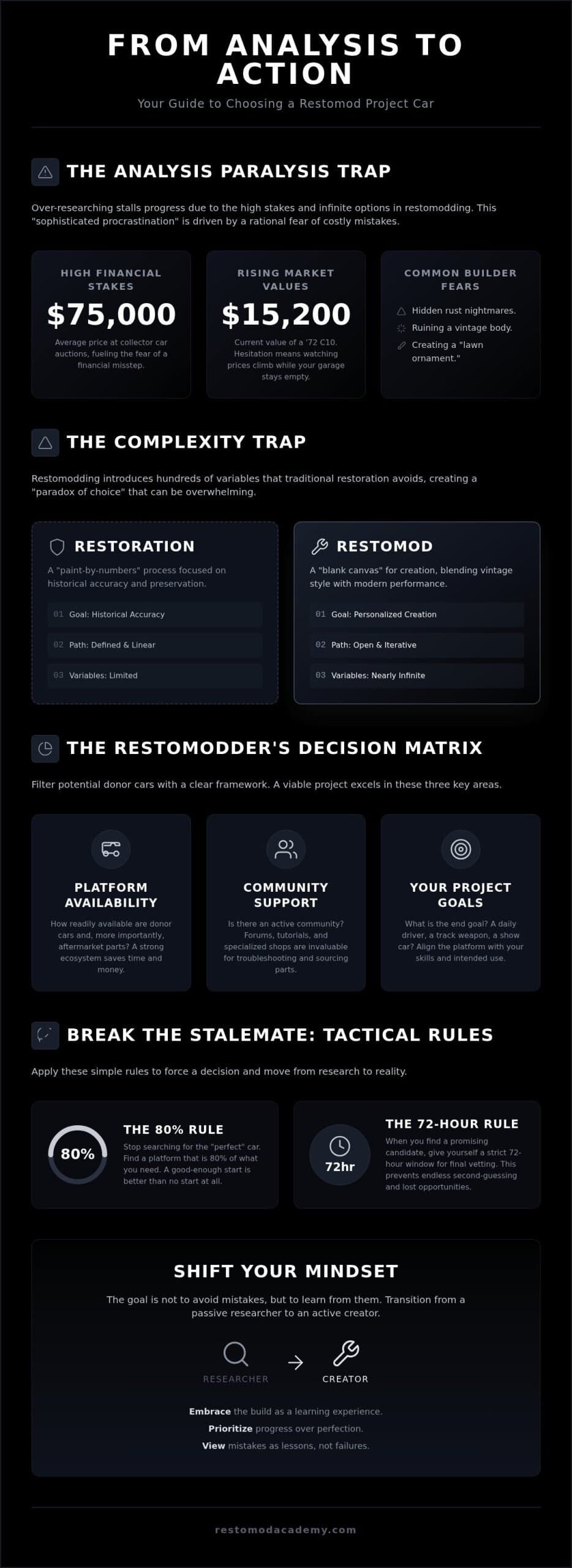
Enthusiasts are particularly prone to this mental block because the stakes are undeniably high. A project car isn’t just a hobby; it’s a significant financial and emotional investment. With the average sale price at collector auctions reaching $75,000 in June 2026, the fear of making a costly mistake is rational. However, the cost of inaction is often higher. While you hesitate, market values for popular platforms continue to climb. For instance, a 1972 Chevrolet C10 in good condition currently holds a value of $15,200 according to July 2026 data. Every month you spend stuck in the research phase is time lost that could have been spent on the actual build. Before you can master the technical nuances of what is a restomod, you must first clear the mental hurdles standing in your way.
The High Stakes of the Garage Floor
The psychological pressure of cutting into a piece of history can be paralyzing. You worry about ruining a vintage body or creating a permanent lawn ornament that your neighbors will eventually complain about. Stop viewing every choice as a potential catastrophe. Instead, frame your decisions as part of an educational journey. If you make a mistake on a floor pan or choose the wrong suspension kit, you haven’t failed. You’ve simply gained a deeper understanding of the machine. Trust in the process of technical restoration and the precision of modern engineering to guide you through the uncertainty. This shift in perspective turns an intimidating task into a manageable series of steps.
Recognizing Your Own Decision Fatigue
Decision fatigue sets in when you obsess over minor details before you even own the chassis. The digital age has made this worse by providing instant access to every part imaginable, from custom wiring harnesses to carbon fiber body panels. This abundance of choice creates a paradox that can stall even the most experienced builders. Accept right now that the perfect car does not exist. Every donor vehicle will have its quirks and hidden challenges. Your goal is to find a platform that is good enough to start. Focus on the core components and leave the minor aesthetic choices for later in the build. Embrace the character of the vintage machine and start your journey toward becoming an active creator.
The Complexity Trap Why Restomodding Overwhelms the Mind
Traditional restoration is a paint-by-numbers exercise where the goal is historical accuracy. Restomodding, however, is a blank canvas. This shift from preservation to creation introduces hundreds of variables that can stall your decision-making process. When you can technically mate a modern chassis to almost any vintage shell, the options become infinite. This freedom is exhilarating, but it’s also why many enthusiasts struggle with overcoming analysis paralysis when choosing a project car. You aren’t just choosing a vehicle; you’re designing an entire ecosystem of interconnected systems that must work in harmony.
Social media has complicated this further. High-budget builds on your feed often skip the years of grime and trial-and-error that define a true DIY project. These pro-touring masterpieces set an unrealistic bar for the first-time builder. You start believing that your project isn’t worth starting unless it features a six-figure parts list and a bespoke interior. Remember that the soul of this hobby is the intersection of classic heritage and your own mechanical ingenuity. Every permutation of modern reliability and vintage style is valid as long as it gets you into the garage.
The Paradox of Modern Performance
The availability of modern powerplants like the LS or Coyote creates a massive hurdle for the indecisive. Each choice dictates your wiring, fuel system, and transmission tunnel modifications. If you’re feeling stuck on the powerplant, consult the definitive guide to an LS engine swap to see how choosing a specific path simplifies the rest of the build. Modern suspension kits add another layer of complexity. You must decide if you want a comfortable cruiser or a track-day weapon before you ever buy the donor car. This decision dictates whether you need a simple coilover swap or a full aftermarket subframe.
Perfectionism vs Progress
Stop chasing a show-quality finish on your first outing. Perfectionism is the enemy of the wrench. I’ve seen too many brilliant projects sold as unfinished basket cases because the owner got bogged down in the minutiae of powder-coating brackets instead of getting the engine to fire. Prioritize a running, driving machine over a perfect one. Value your personal labor over commercial acquisition. The pride of a finished project comes from the journey and the precision of the build, not just the trophy at the end. If you need a structured roadmap to keep you on track, Restomod Academy offers the guidance to bridge that gap between dreaming and doing.
Evaluating the Platform and Community Support
Beginners should gravitate toward vehicles with massive aftermarket support. A 1969 Ford Mustang or a 1972 Chevrolet C10 are excellent starting points because their support networks are unparalleled. According to July 2026 Hagerty Price Guide data, a 1972 C10 in good condition holds a value of $15,200. While that entry price reflects its popularity, it also guarantees that every bolt, panel, and wiring harness is available in a catalog. Don’t waste your first build on a rare or obscure model that requires custom fabrication for every minor repair. Effective restomod project planning involves mapping out your support network early to ensure you aren’t stranded by a lack of parts or technical advice.
Defining the Mission of Your Machine
Define the mission of your machine before you spend a dime. Are you building a comfortable cruiser for weekend trips or a high-performance beast for the local autocross track? This choice dictates every mechanical decision you’ll make. A cruiser requires a focus on cabin insulation and overdrive transmissions, while a track weapon demands specialized suspension and cooling systems. A clear mission statement acts as a mechanical north star. It allows you to ignore irrelevant parts and stay focused on what actually improves the driving experience you desire. If a modification doesn’t serve the mission, it doesn’t belong on the car.
The Honest Budget Assessment
Be brutally honest about your finances. The purchase price of the donor is merely the entry fee for the hobby. For example, a 1969 Mustang at $13,700 is a solid investment, but you must account for the long-term build costs that follow. Hidden rust and specialized metal fabrication can easily double your initial estimate. Use a structured framework to calculate the real cost of ownership, including tools and safety equipment. If you’re unsure about the financial viability of a specific build, Restomod Consulting Services can help you verify your budget and reduce your risk. Mastering this matrix is the most effective way of overcoming analysis paralysis when choosing a project car and finally clearing space in your garage.
Tactical Decision-Making Strategies for Future Builders
To stop the endless scrolling, you need a set of hard rules that govern your behavior. The 72-Hour Rule is your best defense against hesitation. If a lead matches your core criteria, you have three days to pull the trigger or walk away. This prevents you from over-analyzing a deal until someone else buys it. Similarly, the 80% Rule acknowledges that a car meeting most of your needs is a far better investment than a perfect phantom car that may never materialize. By narrowing your focus to just three specific models, you reduce cognitive load and finally start overcoming analysis paralysis when choosing a project car.
Limiting the Scope of Your Search
Pick your decade and body style before you ever open a browser. Trying to decide between a 1950s truck and a 1990s coupe while looking at live listings is a recipe for mental exhaustion. Limit your search to three specific models. This constraint forces you to become an expert on those platforms rather than a novice on fifty. Focusing on a specific engine family simplifies your donor search because you can evaluate cars based on their compatibility with that powerplant. If you’ve decided on a modern V8 path, the definitive guide to an LS engine swap will show you exactly how a focused choice streamlines your entire build process.
The Technical Vetting Process
When you finally stand in front of a potential donor, look for structural integrity rather than cosmetic appeal. A restomodder views a vehicle differently than a traditional restorer. In our world, a blown engine or a shredded interior is often a blessing. You’re likely replacing those components with modern performance parts anyway, so why pay a premium for them? Focus your inspection on the foundation of the machine.
- Examine the frame rails for straightness and previous accident repairs.
- Check the floor pans and trunk floor for structural rot that exceeds your welding skills.
- Inspect the cowl and roof pillars for deep-seated rust.
- Verify that the title is clean and matches the VIN plate.
A straight frame and solid floors are the only non-negotiables. Everything else is just a part waiting to be upgraded. If you want to ensure your first purchase isn’t a mechanical nightmare, The Ultimate Restomod Guide provides the technical roadmap to secure a winning platform.
Taking the Leap From Digital Research to Physical Restoration
The transition from a passive admirer to an active creator is the most significant milestone in your automotive journey. You’ve spent enough time analyzing data and comparing specs from a distance. Overcoming analysis paralysis when choosing a project car is the final gate between you and the visceral experience of the workshop. The true satisfaction of this hobby doesn’t just come from the finished product parked at a show. It lives in the meticulous journey of technical restoration and the precision you bring to every assembly task. Embrace the fact that your first purchase is not just a transaction; it’s the beginning of a high-stakes adventure that will redefine your mechanical skills and creative intent.
Committing to the First Turn of the Wrench
Action is the ultimate antidote to anxiety. The moment you secure that donor car and pull it into your workspace, the heavy fog of paralysis begins to lift. You’ll feel an immediate emotional reward as the abstract concept of a build becomes a tangible machine with its own character and history. Action creates its own momentum. Once you start stripping a worn interior or degreasing a vintage chassis, the overwhelming scale of the project breaks down into achievable, logical steps. Remind yourself that every mechanical hurdle is a valuable learning opportunity rather than a failure. These challenges are the forge in which your expertise is built, transforming you from a novice into a knowledgeable peer in the DIY community.
Resources to Guide Your Journey
Preparation is the foundation of a successful build. Visit our recommended gear section to ensure your workshop is equipped with the precision tools needed to handle modern performance enhancements. If you’re struggling to narrow down your first round of upgrades, browse through our product reviews to find components that balance vintage style with modern reliability. Beyond tools and parts, the most valuable resource you have is a community of like-minded enthusiasts. Join the Restomod Academy to find mentorship and camaraderie among builders who prioritize personal labor and technical excellence over commercial acquisition.
Your journey into the world of custom building is just beginning, and you deserve a roadmap that prioritizes safety and quality. Position The Ultimate Restomod Guide as your essential companion for the road ahead. It acts as a safety net for those afraid of making high-stakes mistakes, providing the clarity needed to navigate the intersection of classic style and contemporary technology. Trust in your ability to overcome any mechanical obstacle with the right guidance. Stop scrolling through the digital noise and pick up the wrench. Your dream restomod is waiting for you to bring it to life.
Ignite Your Build Journey
You’ve moved past the complexity trap and armed yourself with the Decision Matrix. By prioritizing structural integrity over cosmetic perfection and limiting your scope to a specific platform, you’ve already done the hard work of clearing the mental clutter. Overcoming analysis paralysis when choosing a project car isn’t about eliminating every risk; it’s about accepting that the most valuable lessons are learned with a wrench in your hand. The market moves quickly, and every day spent in the digital research phase is a day lost to the satisfaction of the workshop.
Stop scrolling and start creating. You don’t have to navigate this path alone. Gain access to expert mentorship from Brook Walsh and comprehensive blueprints for modern performance. Take the first step toward your dream build with The Ultimate Restomod Guide and join a community dedicated to DIY precision. Your garage is empty, but it doesn’t have to stay that way. The road is calling; go find your machine and bring it home.
Frequently Asked Questions
What is the best classic car for a beginner to restomod?
Choose a platform with massive aftermarket support to simplify your first build. Models like the 1965 to 1970 Ford Mustang or the 1967 to 1972 Chevrolet C10 are ideal because every replacement part is readily available. These vehicles have established communities and documented swap paths for modern engines. Starting with a popular platform reduces the technical frustration of custom fabrication and ensures you can find help when you hit a mechanical hurdle.
How do I stop worrying about overpaying for a donor car?
Stop worrying about overpaying by referencing verified market data and focusing on structural value. Use tools like the Hagerty Price Guide to understand current values for specific conditions. Remember that a slightly higher purchase price for a rust-free body saves you thousands in specialized metal fabrication later. In the process of overcoming analysis paralysis when choosing a project car, prioritize a solid foundation over a low sticker price that hides expensive structural nightmares.
Should I buy a running car or a rolling shell for a restomod?
Buy a running car if you want to experience the vehicle before tearing it down; choose a shell only if you have a clear plan for a total rebuild. A running car allows you to verify the chassis dynamics and electrical basics. However, if your mission involves a complete modern engine swap and new suspension, paying extra for a tired original drivetrain is often a waste of capital. Assess your mechanical patience before committing.
How much of the work should I plan to do myself versus outsourcing?
Plan to do the mechanical assembly yourself while outsourcing high-stakes tasks like structural welding or precision paint if they exceed your current skill level. DIY labor is the soul of a restomod, but safety is paramount. Focus your personal efforts on bolt-on performance upgrades and interior customization. This balance allows you to maintain a high standard for quality while still enjoying the pride of creating a machine with your own hands.
What are the most common mistakes when choosing a project car?
The most common mistakes include ignoring deep-seated rust and choosing an obscure model with no aftermarket support. Many beginners get seduced by a low price only to find the cowl or frame rails are structurally compromised. Another error is starting without a clear mission statement, leading to a pile of incompatible parts. Avoid these pitfalls by using a technical vetting process that prioritizes structural integrity over cosmetic appeal and temporary engine health.
How do I know if a car is too far gone for a restomod?
A car is too far gone if the frame is twisted or the structural pillars are consumed by heavy rot. While modern technology can fix almost anything, the cost of extensive metal fabrication often exceeds the eventual value of the build. Inspect the VIN plate and title for discrepancies as well. If the foundation is compromised beyond your budget or skill, walk away and wait for a more viable platform to appear.
Does a restomod project always have to be an expensive V8 swap?
No, restomodding is about blending vintage style with modern reliability, which does not always require a V8 swap. You can achieve a significant performance gain by upgrading to modern disc brakes, electronic fuel injection, and coilover suspension on an original six-cylinder engine. Focus on safety and driveability first. High-stakes power modifications are exciting, but a reliable, well-handling cruiser often provides more long-term satisfaction than an overpowered project that never leaves the garage.
What should I do if I regret my choice after buying the car?
Pivot your strategy or sell the vehicle if you find it truly doesn’t align with your goals. Regret is often just another form of analysis paralysis that prevents you from moving forward. If the platform is viable, try to find a new mission for it that excites you. If not, sell it to someone whose mission it fits. Every purchase is an educational framework that makes you a more capable builder for your next project.
Choosing a project car is not about finding the perfect vehicle; it’s about selecting the specific mechanical problem you’re most excited to solve. If you’ve spent months scrolling through listings for 1972 Chevy C10s or 1995 Miatas only to close the tab in a cold sweat, you’re not alone. It’s easy to feel overwhelmed by the infinite combinations of modern fuel injection and classic steel, especially when the average collector car auction price has climbed to $75,000 as of June 2026. You’re likely stuck overcoming analysis paralysis when choosing a project car because the fear of a hidden rust nightmare or a financial misstep feels louder than your passion for the craft.
I understand that hesitation, but I also know that the most rewarding builds start with a single, confident decision. This article will provide you with a clear mental framework to filter out the noise and a technical vetting process that significantly reduces your financial risk. We’ll examine how to audit a potential donor car with the precision of a seasoned builder and how to align your mechanical skills with the reality of a restomod timeline. By the end of this guide, you’ll have the tools to stop being a passive admirer and finally pull the trigger on your dream project.
Key Takeaways
- Identify why the high financial stakes of custom builds often lead to mental stagnation and learn to prioritize progress over perfection.
- Navigate the paradox of choice by understanding how modern performance enhancements increase decision variables compared to traditional restorations.
- Apply the three-pillar Restomodder’s Decision Matrix to filter donor cars based on platform availability, community support, and your specific project goals.
- Master tactical strategies like the 80% Rule and the 72-Hour Rule for overcoming analysis paralysis when choosing a project car to ensure you secure a viable platform.
- Transition from a passive researcher to an active creator by embracing the meticulous journey of technical restoration as a rewarding learning experience.
Understanding Analysis Paralysis in the Restoration World
You’ve likely spent hours comparing the torque curves of different crate engines while your garage sits empty. This state of over-researching is a classic case of Analysis paralysis, where the sheer volume of data prevents you from ever turning the first wrench. In the restoration community, this often looks like fifty open tabs of classified ads and a browser history full of forum debates about bolt patterns, yet no actual car in the driveway. The process of overcoming analysis paralysis when choosing a project car requires you to acknowledge that while research is vital, it can quickly become a sophisticated form of procrastination.
Enthusiasts are particularly prone to this mental block because the stakes are undeniably high. A project car isn’t just a hobby; it’s a significant financial and emotional investment. With the average sale price at collector auctions reaching $75,000 in June 2026, the fear of making a costly mistake is rational. However, the cost of inaction is often higher. While you hesitate, market values for popular platforms continue to climb. For instance, a 1972 Chevrolet C10 in good condition currently holds a value of $15,200 according to July 2026 data. Every month you spend stuck in the research phase is time lost that could have been spent on the actual build. Before you can master the technical nuances of what is a restomod, you must first clear the mental hurdles standing in your way.
The High Stakes of the Garage Floor
The psychological pressure of cutting into a piece of history can be paralyzing. You worry about ruining a vintage body or creating a permanent lawn ornament that your neighbors will eventually complain about. Stop viewing every choice as a potential catastrophe. Instead, frame your decisions as part of an educational journey. If you make a mistake on a floor pan or choose the wrong suspension kit, you haven’t failed. You’ve simply gained a deeper understanding of the machine. Trust in the process of technical restoration and the precision of modern engineering to guide you through the uncertainty. This shift in perspective turns an intimidating task into a manageable series of steps.
Recognizing Your Own Decision Fatigue
Decision fatigue sets in when you obsess over minor details before you even own the chassis. The digital age has made this worse by providing instant access to every part imaginable, from custom wiring harnesses to carbon fiber body panels. This abundance of choice creates a paradox that can stall even the most experienced builders. Accept right now that the perfect car does not exist. Every donor vehicle will have its quirks and hidden challenges. Your goal is to find a platform that is good enough to start. Focus on the core components and leave the minor aesthetic choices for later in the build. Embrace the character of the vintage machine and start your journey toward becoming an active creator.
The Complexity Trap Why Restomodding Overwhelms the Mind
Traditional restoration is a paint-by-numbers exercise where the goal is historical accuracy. Restomodding, however, is a blank canvas. This shift from preservation to creation introduces hundreds of variables that can stall your decision-making process. When you can technically mate a modern chassis to almost any vintage shell, the options become infinite. This freedom is exhilarating, but it’s also why many enthusiasts struggle with overcoming analysis paralysis when choosing a project car. You aren’t just choosing a vehicle; you’re designing an entire ecosystem of interconnected systems that must work in harmony.
Social media has complicated this further. High-budget builds on your feed often skip the years of grime and trial-and-error that define a true DIY project. These pro-touring masterpieces set an unrealistic bar for the first-time builder. You start believing that your project isn’t worth starting unless it features a six-figure parts list and a bespoke interior. Remember that the soul of this hobby is the intersection of classic heritage and your own mechanical ingenuity. Every permutation of modern reliability and vintage style is valid as long as it gets you into the garage.
The Paradox of Modern Performance
The availability of modern powerplants like the LS or Coyote creates a massive hurdle for the indecisive. Each choice dictates your wiring, fuel system, and transmission tunnel modifications. If you’re feeling stuck on the powerplant, consult the definitive guide to an LS engine swap to see how choosing a specific path simplifies the rest of the build. Modern suspension kits add another layer of complexity. You must decide if you want a comfortable cruiser or a track-day weapon before you ever buy the donor car. This decision dictates whether you need a simple coilover swap or a full aftermarket subframe.
Perfectionism vs Progress
Stop chasing a show-quality finish on your first outing. Perfectionism is the enemy of the wrench. I’ve seen too many brilliant projects sold as unfinished basket cases because the owner got bogged down in the minutiae of powder-coating brackets instead of getting the engine to fire. Prioritize a running, driving machine over a perfect one. Value your personal labor over commercial acquisition. The pride of a finished project comes from the journey and the precision of the build, not just the trophy at the end. If you need a structured roadmap to keep you on track, Restomod Academy offers the guidance to bridge that gap between dreaming and doing.
Evaluating the Platform and Community Support
Beginners should gravitate toward vehicles with massive aftermarket support. A 1969 Ford Mustang or a 1972 Chevrolet C10 are excellent starting points because their support networks are unparalleled. According to July 2026 Hagerty Price Guide data, a 1972 C10 in good condition holds a value of $15,200. While that entry price reflects its popularity, it also guarantees that every bolt, panel, and wiring harness is available in a catalog. Don’t waste your first build on a rare or obscure model that requires custom fabrication for every minor repair. Effective restomod project planning involves mapping out your support network early to ensure you aren’t stranded by a lack of parts or technical advice.
Defining the Mission of Your Machine
Define the mission of your machine before you spend a dime. Are you building a comfortable cruiser for weekend trips or a high-performance beast for the local autocross track? This choice dictates every mechanical decision you’ll make. A cruiser requires a focus on cabin insulation and overdrive transmissions, while a track weapon demands specialized suspension and cooling systems. A clear mission statement acts as a mechanical north star. It allows you to ignore irrelevant parts and stay focused on what actually improves the driving experience you desire. If a modification doesn’t serve the mission, it doesn’t belong on the car.
The Honest Budget Assessment
Be brutally honest about your finances. The purchase price of the donor is merely the entry fee for the hobby. For example, a 1969 Mustang at $13,700 is a solid investment, but you must account for the long-term build costs that follow. Hidden rust and specialized metal fabrication can easily double your initial estimate. Use a structured framework to calculate the real cost of ownership, including tools and safety equipment. If you’re unsure about the financial viability of a specific build, Restomod Consulting Services can help you verify your budget and reduce your risk. Mastering this matrix is the most effective way of overcoming analysis paralysis when choosing a project car and finally clearing space in your garage.
Tactical Decision-Making Strategies for Future Builders
To stop the endless scrolling, you need a set of hard rules that govern your behavior. The 72-Hour Rule is your best defense against hesitation. If a lead matches your core criteria, you have three days to pull the trigger or walk away. This prevents you from over-analyzing a deal until someone else buys it. Similarly, the 80% Rule acknowledges that a car meeting most of your needs is a far better investment than a perfect phantom car that may never materialize. By narrowing your focus to just three specific models, you reduce cognitive load and finally start overcoming analysis paralysis when choosing a project car.
Limiting the Scope of Your Search
Pick your decade and body style before you ever open a browser. Trying to decide between a 1950s truck and a 1990s coupe while looking at live listings is a recipe for mental exhaustion. Limit your search to three specific models. This constraint forces you to become an expert on those platforms rather than a novice on fifty. Focusing on a specific engine family simplifies your donor search because you can evaluate cars based on their compatibility with that powerplant. If you’ve decided on a modern V8 path, the definitive guide to an LS engine swap will show you exactly how a focused choice streamlines your entire build process.
The Technical Vetting Process
When you finally stand in front of a potential donor, look for structural integrity rather than cosmetic appeal. A restomodder views a vehicle differently than a traditional restorer. In our world, a blown engine or a shredded interior is often a blessing. You’re likely replacing those components with modern performance parts anyway, so why pay a premium for them? Focus your inspection on the foundation of the machine.
- Examine the frame rails for straightness and previous accident repairs.
- Check the floor pans and trunk floor for structural rot that exceeds your welding skills.
- Inspect the cowl and roof pillars for deep-seated rust.
- Verify that the title is clean and matches the VIN plate.
A straight frame and solid floors are the only non-negotiables. Everything else is just a part waiting to be upgraded. If you want to ensure your first purchase isn’t a mechanical nightmare, The Ultimate Restomod Guide provides the technical roadmap to secure a winning platform.
Taking the Leap From Digital Research to Physical Restoration
The transition from a passive admirer to an active creator is the most significant milestone in your automotive journey. You’ve spent enough time analyzing data and comparing specs from a distance. Overcoming analysis paralysis when choosing a project car is the final gate between you and the visceral experience of the workshop. The true satisfaction of this hobby doesn’t just come from the finished product parked at a show. It lives in the meticulous journey of technical restoration and the precision you bring to every assembly task. Embrace the fact that your first purchase is not just a transaction; it’s the beginning of a high-stakes adventure that will redefine your mechanical skills and creative intent.
Committing to the First Turn of the Wrench
Action is the ultimate antidote to anxiety. The moment you secure that donor car and pull it into your workspace, the heavy fog of paralysis begins to lift. You’ll feel an immediate emotional reward as the abstract concept of a build becomes a tangible machine with its own character and history. Action creates its own momentum. Once you start stripping a worn interior or degreasing a vintage chassis, the overwhelming scale of the project breaks down into achievable, logical steps. Remind yourself that every mechanical hurdle is a valuable learning opportunity rather than a failure. These challenges are the forge in which your expertise is built, transforming you from a novice into a knowledgeable peer in the DIY community.
Resources to Guide Your Journey
Preparation is the foundation of a successful build. Visit our recommended gear section to ensure your workshop is equipped with the precision tools needed to handle modern performance enhancements. If you’re struggling to narrow down your first round of upgrades, browse through our product reviews to find components that balance vintage style with modern reliability. Beyond tools and parts, the most valuable resource you have is a community of like-minded enthusiasts. Join the Restomod Academy to find mentorship and camaraderie among builders who prioritize personal labor and technical excellence over commercial acquisition.
Your journey into the world of custom building is just beginning, and you deserve a roadmap that prioritizes safety and quality. Position The Ultimate Restomod Guide as your essential companion for the road ahead. It acts as a safety net for those afraid of making high-stakes mistakes, providing the clarity needed to navigate the intersection of classic style and contemporary technology. Trust in your ability to overcome any mechanical obstacle with the right guidance. Stop scrolling through the digital noise and pick up the wrench. Your dream restomod is waiting for you to bring it to life.
Ignite Your Build Journey
You’ve moved past the complexity trap and armed yourself with the Decision Matrix. By prioritizing structural integrity over cosmetic perfection and limiting your scope to a specific platform, you’ve already done the hard work of clearing the mental clutter. Overcoming analysis paralysis when choosing a project car isn’t about eliminating every risk; it’s about accepting that the most valuable lessons are learned with a wrench in your hand. The market moves quickly, and every day spent in the digital research phase is a day lost to the satisfaction of the workshop.
Stop scrolling and start creating. You don’t have to navigate this path alone. Gain access to expert mentorship from Brook Walsh and comprehensive blueprints for modern performance. Take the first step toward your dream build with The Ultimate Restomod Guide and join a community dedicated to DIY precision. Your garage is empty, but it doesn’t have to stay that way. The road is calling; go find your machine and bring it home.
Frequently Asked Questions
What is the best classic car for a beginner to restomod?
Choose a platform with massive aftermarket support to simplify your first build. Models like the 1965 to 1970 Ford Mustang or the 1967 to 1972 Chevrolet C10 are ideal because every replacement part is readily available. These vehicles have established communities and documented swap paths for modern engines. Starting with a popular platform reduces the technical frustration of custom fabrication and ensures you can find help when you hit a mechanical hurdle.
How do I stop worrying about overpaying for a donor car?
Stop worrying about overpaying by referencing verified market data and focusing on structural value. Use tools like the Hagerty Price Guide to understand current values for specific conditions. Remember that a slightly higher purchase price for a rust-free body saves you thousands in specialized metal fabrication later. In the process of overcoming analysis paralysis when choosing a project car, prioritize a solid foundation over a low sticker price that hides expensive structural nightmares.
Should I buy a running car or a rolling shell for a restomod?
Buy a running car if you want to experience the vehicle before tearing it down; choose a shell only if you have a clear plan for a total rebuild. A running car allows you to verify the chassis dynamics and electrical basics. However, if your mission involves a complete modern engine swap and new suspension, paying extra for a tired original drivetrain is often a waste of capital. Assess your mechanical patience before committing.
How much of the work should I plan to do myself versus outsourcing?
Plan to do the mechanical assembly yourself while outsourcing high-stakes tasks like structural welding or precision paint if they exceed your current skill level. DIY labor is the soul of a restomod, but safety is paramount. Focus your personal efforts on bolt-on performance upgrades and interior customization. This balance allows you to maintain a high standard for quality while still enjoying the pride of creating a machine with your own hands.
What are the most common mistakes when choosing a project car?
The most common mistakes include ignoring deep-seated rust and choosing an obscure model with no aftermarket support. Many beginners get seduced by a low price only to find the cowl or frame rails are structurally compromised. Another error is starting without a clear mission statement, leading to a pile of incompatible parts. Avoid these pitfalls by using a technical vetting process that prioritizes structural integrity over cosmetic appeal and temporary engine health.
How do I know if a car is too far gone for a restomod?
A car is too far gone if the frame is twisted or the structural pillars are consumed by heavy rot. While modern technology can fix almost anything, the cost of extensive metal fabrication often exceeds the eventual value of the build. Inspect the VIN plate and title for discrepancies as well. If the foundation is compromised beyond your budget or skill, walk away and wait for a more viable platform to appear.
Does a restomod project always have to be an expensive V8 swap?
No, restomodding is about blending vintage style with modern reliability, which does not always require a V8 swap. You can achieve a significant performance gain by upgrading to modern disc brakes, electronic fuel injection, and coilover suspension on an original six-cylinder engine. Focus on safety and driveability first. High-stakes power modifications are exciting, but a reliable, well-handling cruiser often provides more long-term satisfaction than an overpowered project that never leaves the garage.
What should I do if I regret my choice after buying the car?
Pivot your strategy or sell the vehicle if you find it truly doesn’t align with your goals. Regret is often just another form of analysis paralysis that prevents you from moving forward. If the platform is viable, try to find a new mission for it that excites you. If not, sell it to someone whose mission it fits. Every purchase is an educational framework that makes you a more capable builder for your next project.