

Why settle for a vintage car that looks like a dream but drives like a tractor when you can engineer a masterpiece that commands the road? You likely already feel that the true magic of a classic machine lies in its iconic silhouette and the heritage it represents, yet the reality of antiquated brakes and vague steering can quickly dampen your enthusiasm. Mastering restomod design is about more than just bolting on a shiny new intake or swapping in a modern crate engine. It’s the deliberate art of preserving the soul you love while integrating the mechanical precision of a contemporary performance machine. You want a build that feels cohesive and intentional, not a confusing collection of parts that loses its identity under a mountain of mismatched upgrades.
This guide provides the clarity you need to transition from a passive admirer to an active creator. We’ll explore the essential principles of restomod design so you can balance period-correct aesthetics with modern safety requirements and supercar-level handling. You’ll gain the knowledge to select the perfect performance-to-style ratio and develop a blueprint that ensures every hour in the workshop adds real value. From suspension geometry to interior refinement, we’re going to map out the logical steps to turn your high-stakes vision into a reliable, high-performance reality.
Key Takeaways
- Learn how to balance heritage aesthetics with contemporary engineering to ensure your build honors its history while delivering modern performance.
- Identify the critical role of stance and suspension geometry in your restomod design to achieve a cohesive look that eliminates the risk of a Frankenstein car.
- Compare Purist, Pro-Touring, and Outlaw styles to select the right performance-to-style ratio for your specific budget and driving expectations.
- Discover how to use digital rendering and structured project planning to validate your vision before the first bolt is turned on the shop floor.
- Master the transition from concept to execution by utilizing Premium Project Blueprints to reduce costly fabrication errors and ensure mechanical harmony.
The Philosophy of Restomod Design: Balancing Heritage and Innovation
Successful restomod design is a deliberate negotiation between the car’s original DNA and modern physics. It’s the point where the timeless artistry of the 1960s meets the relentless precision of 21st-century engineering. While traditional conservation and restoration of road vehicles focuses on returning a machine to its factory-born state, restomodding empowers you to improve the experience without erasing the history. You aren’t just fixing a car; you’re evolving it. This process requires a steady hand and a clear vision to avoid the dreaded Frankenstein build, where a collection of high-end parts fails to work as a cohesive unit. By prioritizing your creative intent and personal labor over simply buying a finished product, you ensure the machine carries your signature in every weld and wire tuck.
The Golden Rule of Restomodding
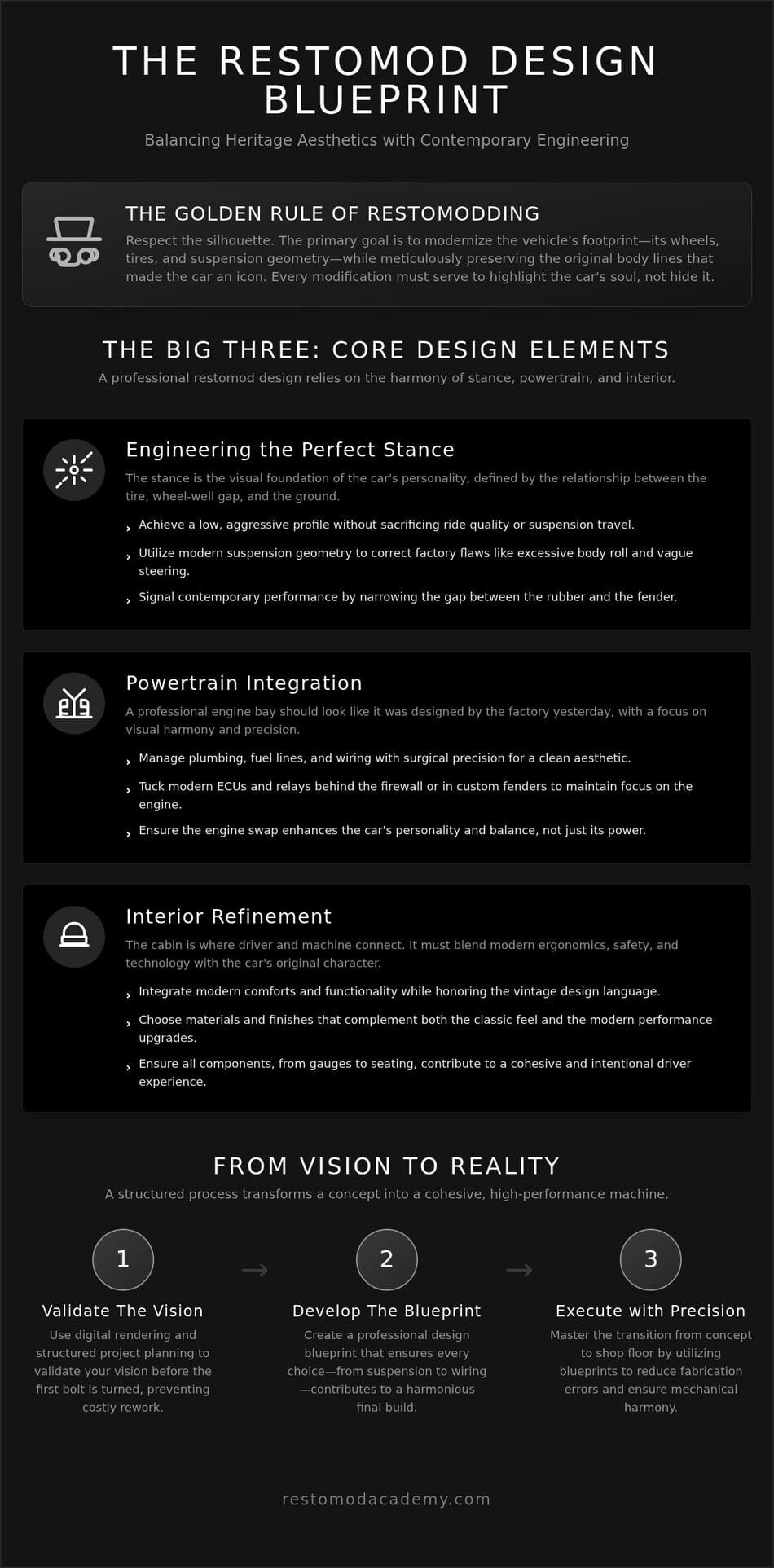
Respect the silhouette. This is the foundation of every professional build. Your goal is to modernize the footprint, specifically the wheels, tires, and suspension geometry, while keeping the body lines that made the car an icon in the first place. Before you cut into the metal, spend time understanding the original designer’s intent. Ask yourself what made a 1969 Charger or a 1974 911 special. Is it the aggressive roofline or the way the fenders catch the light? Once you identify that soul, every modern modification you make must serve to highlight it rather than hide it. If you want to dive deeper into the basics, check out our guide on what is a restomod to set your foundation.
Modern Performance vs. Vintage Character
The line between a restomod and a kit car is thin but vital. A kit car replaces the identity; a restomod enhances it. I’ve seen many builders rush into an engine swap without considering how it affects the car’s balance or personality. By integrating modern fuel injection, disc brakes, and rack-and-pinion steering, you transform a temperamental weekend toy into a reliable daily driver. You gain the confidence to take a cross-country road trip without a trunk full of spare parts and a prayer. Restomod design is the strategic integration of modern safety and performance components into a classic chassis to achieve a harmonious balance of vintage style and contemporary drivability.
Core Elements of a Professional Design Blueprint
Engineering the Perfect Stance
The stance is the visual foundation of your car’s personality. It is defined by the precise relationship between the tire, the wheel-well gap, and the ground. To master this, you must look beyond simple lowering springs. Modern suspension geometry allows you to achieve a low, aggressive profile without sacrificing the ride quality or suspension travel necessary for real-world driving. Use advanced suspension components to correct factory flaws, such as the excessive body roll and vague steering common in vintage muscle. By narrowing the gap between the rubber and the fender, you signal a commitment to contemporary performance while maintaining the car’s iconic silhouette.
Powertrain Integration and Engine Bay Aesthetics
Do not just drop an engine in and walk away. A professional engine bay should look like it was designed by the factory yesterday. This means managing your plumbing, fuel lines, and wiring with surgical precision. Whether you are performing a Ford Coyote conversion or following the definitive guide to an ls engine swap, focus on the visual harmony of the bay. Tuck modern ECUs and relays behind the firewall or within custom inner fenders to keep the focus on the mechanical heart of the machine. A clean, organized engine bay is the ultimate sign of a builder who values precision as much as power.
The interior is where you interface with your creation, so it must bridge the gap between the heritage of the past and the technology of 2026. Integrating modern features like digital dashes or climate control requires a subtle touch to avoid breaking the vintage vibe. You can use custom bezels to house high-resolution screens within original gauge pods, maintaining the period-correct look while gaining real-time diagnostic data. As highlighted in Inside the World of High-End Restomods, the distinction between a hobbyist project and a professional-grade build often comes down to how seamlessly these modern elements are integrated. If you are feeling overwhelmed by these technical choices, exploring Premium Project Blueprints can provide the structural roadmap you need to move forward with confidence.
Restomod Design Styles: Purist, Pro-Touring, and Outlaw
Before you pick up a wrench, you must decide which school of thought will guide your build. A clear direction prevents a project from becoming a confusing collection of parts that lacks a resale market or a clear purpose. Your choice of restomod design style will dictate everything from your suspension geometry to the grain of your leather seats. For those who value stealth, the Sleeper approach is a powerful option. This involves hiding a modern powertrain and chassis upgrades beneath a 100 percent stock exterior. It preserves the car’s original aesthetic and often its long-term value, as the modifications are felt through the seat of your pants rather than seen with the eye.
Pro-Touring: The Performance-First Framework
Pro-Touring is the ultimate expression of the performance half of the restomod equation. This style is built for the track, prioritizing lateral G-forces and stopping power over period correctness. You will recognize these builds by their aggressive, low-slung profiles, oversized multi-piston brakes, and wide-body flares designed to tuck massive tires. Because these machines are meant to be driven hard, they require intensive chassis stiffening and roll cages to handle the stress of modern torque. It is a high-reward path that demands precision in every weld and a significant investment in engineering. If you are planning a high-output build, review our definitive guide to an ls engine swap to understand the structural demands of this style.
The Outlaw Movement: Rebellious Heritage
The Outlaw movement began in the Porsche community but has since ignited a fire in the American muscle and classic truck scenes. This philosophy celebrates imperfection as a design choice and values the raw, mechanical nature of the machine. Expect to see exposed hardware, custom metalwork, and minimalist interiors that strip away the fluff of modern luxury. It is a style that favors personal labor and creative intent over commercial acquisition. If you want a car that feels like a gritty, purposeful tool rather than a polished museum piece, the Outlaw path is your calling. This approach often results in a unique restomod design that stands out at any show precisely because it refuses to follow traditional rules.
Choosing between these styles requires an honest assessment of your driving goals and your workshop capabilities. If you plan on cross-country tours, a Purist-Sleeper with a focus on reliability and comfort is ideal. If you want to dominate local autocross events, Pro-Touring is the only logical choice. Regardless of the path, staying true to a single design school ensures your project remains a respected piece of automotive history. To get started on the right foot, ensure you have the recommended gear to handle the specific fabrication needs of your chosen style.
Executing the Vision: From Concept Sketch to Shop Floor
Transitioning from a mental concept to a rolling chassis is where the majority of enthusiasts lose their way. You’ve studied the lines and picked your school of restomod design, but without a rigorous execution plan, your garage will quickly become a graveyard of expensive parts and half-finished ideas. Success in the workshop is 80 percent preparation and 20 percent perspiration. Before you turn a single bolt, you must validate every design choice against the realities of modern engineering and your specific performance goals. Utilizing digital rendering or detailed blueprints allows you to see how your chosen stance interacts with your wheel selection before you spend a dime on shipping.
The Planning and Budgeting Phase
Every successful build starts with a roadmap that accounts for the “while I’m at it” factor. This is the phenomenon where a simple brake upgrade spirals into a full chassis restoration because you decided to clean up the frame rails while the lines were off. To stay on track, create a structured project plan that separates your must-haves from your nice-to-haves. Allocate your funds wisely; prioritize safety and mechanical integrity over vanity. A car that stops and turns with supercar precision is far more rewarding than one with an expensive paint job and a stock suspension. Design changes mid-build are the primary cause of project failure, so lock in your vision early using Premium Project Blueprints to bridge the gap between your concept and the shop floor.
Sourcing Components and Gear
Professional-grade assembly requires professional-grade tools. You cannot expect modern reliability if you are using worn-out hand tools and guesswork. Meticulous assembly is the hallmark of a seasoned builder. Consult our recommended gear list to ensure your workshop is equipped for high-precision tasks like plumbing high-pressure fuel systems or wiring a modern ECU. Use our product reviews to select components that have been proven to fit vintage frames without excessive fabrication. Be honest about your skill level; identify which tasks you can master yourself and which require a specialist’s touch to ensure the final build meets your high standards for quality and safety. This methodical approach ensures that every hour you spend in the shop moves you closer to a finished, road-worthy masterpiece.
Mastering Your Build with Restomod Academy
The journey from a passive admirer to an active creator is a long, rewarding road that requires more than just passion. It demands a structured approach to every mechanical challenge you face in the garage. While other platforms focus on the glitz of finished builds or the chance to win a car, we focus on the builder. Joining our community means valuing the sweat and precision of personal craftsmanship over the simple act of commercial acquisition. You are here to learn the nuances of restomod design and to master the skills necessary to bring a vintage machine back to life with a modern edge.
The Ultimate Restomod Guide
Think of The Ultimate Restomod Guide as your personal mentor in digital form. Led by Brook Walsh, this curriculum takes you through every critical phase of a build, starting with the high-stakes task of donor selection and ending with the fine details of final tuning. By following a structured educational framework, you avoid the costly trial-and-error that plagues so many DIY projects. It’s common for builders to waste thousands on mismatched parts or incorrect fabrication. Our guide provides the roadmap to ensure that every dollar and hour you invest moves the needle forward. We empower you to take ownership of your project, providing the clarity needed to tackle complex tasks with calm confidence. This is where you learn to apply the principles of what is a restomod to your specific vehicle.
Consulting and Custom Blueprints
Even the most experienced builders encounter hurdles that require a second set of expert eyes. Whether you’re struggling with modern suspension integration or complex engine fitment, our Restomod Consulting Services provide the technical validation you need. We’ve seen how a single oversight in geometry can ruin the handling of a car. To prevent these setbacks, we offer Premium Project Blueprints that serve as the bridge between your initial vision and the final execution on the shop floor. These blueprints solve the puzzles of engine bay layout and chassis stiffening before you ever strike an arc or drill a hole.
If you’re ready to validate your restomod design and ensure your project stays on track, it’s time to take the next step. You can book a consultation to review your plan and gain the expert insight needed for a flawless build. This is your opportunity to join a community of like-minded enthusiasts who are dedicated to the art of the precision restomod.
Forge Your Path from Concept to Concrete
You’ve built the mental blueprint; now it’s time to get your hands dirty. Mastering restomod design is the difference between a car that looks good on a trailer and one that dominates the open road with contemporary reliability. You now understand the delicate balance of preserving an iconic silhouette while integrating the mechanical precision of a modern chassis. By following a structured path, you avoid the common pitfalls that stall so many high-stakes builds in the garage.
We are here to support your journey with expert mentorship from Brook Walsh and comprehensive blueprints for LS and Coyote swaps. Our community focused approach to DIY restoration ensures you have the guidance to achieve a professional result through your own labor. Stop being a spectator and start being a creator. The satisfaction of that first engine fire and the first corner carved with modern poise is closer than you think. Trust the process, respect the machine, and let’s get to work.
Download The Ultimate Restomod Guide and Start Your Build Today
Frequently Asked Questions
What is the difference between a restoration and a restomod design?
Restoration focuses on returning a vehicle to its exact factory specifications using original or period-correct parts. In contrast, restomod design prioritizes the integration of modern performance, reliability, and safety features into a vintage chassis. While a restored car is a museum piece, a restomod is a daily-driven machine. You are trading absolute historical accuracy for a car that handles, stops, and accelerates like a modern performance vehicle.
How do I choose the right donor car for a restomod project?
Focus on a donor car with a solid frame and extensive aftermarket support to simplify your journey. Avoid vehicles with deep structural rot unless you are prepared for months of intensive metalwork. Popular models like 1960s Mustangs or C10 trucks are ideal because you can find every nut and bolt in a catalog. Starting with a common platform ensures you spend more time building and less time hunting for rare parts.
Can any classic car be turned into a restomod?
Technically, any classic can be modified, but the lack of aftermarket parts for rare models makes the process much more difficult. If a vehicle doesn’t have a dedicated community or parts suppliers, you will have to fabricate every bracket and adapter by hand. This significantly increases the time and cost of the build. For your first project, choose a car that has established bolt-on solutions for modern engines and suspensions.
Is a restomod worth more than a numbers-matching restoration?
Numbers-matching cars are prized by purists, but high-quality restomods often command higher prices at modern auctions due to their drivability. A car you can actually drive to a show across the state is often more desirable than a trailer queen. The value of a restomod depends heavily on the quality of the execution and the choice of components. Professional builds with modern amenities like air conditioning and fuel injection are in high demand.
What are the most important safety upgrades in a restomod build?
Prioritize four-wheel disc brakes and a modern collapsible steering column to ensure your safety on today’s roads. Vintage drum brakes and rigid steering shafts are dangerous in high-speed traffic. You should also install three-point seatbelts and ensure your fuel system is upgraded with modern lines and a baffled tank. These updates provide the peace of mind necessary to truly enjoy the performance of your upgraded classic machine.
How do I plan a restomod budget without overspending?
Create a detailed project blueprint that lists every major component and add a 20 percent contingency fund for hidden issues. Most budgets fail because of the “while I’m at it” factor, where small tasks spiral into expensive sub-projects. Be disciplined about your goals and avoid changing your design mid-build. Tracking every expense in a dedicated log helps you stay within your financial limits while maintaining a high standard of quality.
Do I need professional engineering skills to design a restomod?
You do not need a degree in engineering, but you must follow a structured restomod design framework to ensure mechanical harmony. Many successful builders started with basic hand tools and a willingness to learn. By using professional blueprints and guides, you can navigate complex tasks like suspension geometry and wiring without making costly mistakes. Respect the precision required for safety-critical systems and always double-check your measurements before cutting or welding.
What modern engines are best for a first-time restomod project?
The Chevrolet LS series and Ford Coyote V8 are the most practical choices for beginners because of their massive aftermarket ecosystems. These engines offer incredible power-to-weight ratios and modern fuel-injected reliability. You can find pre-made wiring harnesses and engine mounts for almost any popular classic chassis. Choosing a well-documented engine swap allows you to focus on the craftsmanship of the build rather than troubleshooting obscure technical problems.
Why settle for a vintage car that looks like a dream but drives like a tractor when you can engineer a masterpiece that commands the road? You likely already feel that the true magic of a classic machine lies in its iconic silhouette and the heritage it represents, yet the reality of antiquated brakes and vague steering can quickly dampen your enthusiasm. Mastering restomod design is about more than just bolting on a shiny new intake or swapping in a modern crate engine. It’s the deliberate art of preserving the soul you love while integrating the mechanical precision of a contemporary performance machine. You want a build that feels cohesive and intentional, not a confusing collection of parts that loses its identity under a mountain of mismatched upgrades.
This guide provides the clarity you need to transition from a passive admirer to an active creator. We’ll explore the essential principles of restomod design so you can balance period-correct aesthetics with modern safety requirements and supercar-level handling. You’ll gain the knowledge to select the perfect performance-to-style ratio and develop a blueprint that ensures every hour in the workshop adds real value. From suspension geometry to interior refinement, we’re going to map out the logical steps to turn your high-stakes vision into a reliable, high-performance reality.
Key Takeaways
- Learn how to balance heritage aesthetics with contemporary engineering to ensure your build honors its history while delivering modern performance.
- Identify the critical role of stance and suspension geometry in your restomod design to achieve a cohesive look that eliminates the risk of a Frankenstein car.
- Compare Purist, Pro-Touring, and Outlaw styles to select the right performance-to-style ratio for your specific budget and driving expectations.
- Discover how to use digital rendering and structured project planning to validate your vision before the first bolt is turned on the shop floor.
- Master the transition from concept to execution by utilizing Premium Project Blueprints to reduce costly fabrication errors and ensure mechanical harmony.
The Philosophy of Restomod Design: Balancing Heritage and Innovation
Successful restomod design is a deliberate negotiation between the car’s original DNA and modern physics. It’s the point where the timeless artistry of the 1960s meets the relentless precision of 21st-century engineering. While traditional conservation and restoration of road vehicles focuses on returning a machine to its factory-born state, restomodding empowers you to improve the experience without erasing the history. You aren’t just fixing a car; you’re evolving it. This process requires a steady hand and a clear vision to avoid the dreaded Frankenstein build, where a collection of high-end parts fails to work as a cohesive unit. By prioritizing your creative intent and personal labor over simply buying a finished product, you ensure the machine carries your signature in every weld and wire tuck.
The Golden Rule of Restomodding
Respect the silhouette. This is the foundation of every professional build. Your goal is to modernize the footprint, specifically the wheels, tires, and suspension geometry, while keeping the body lines that made the car an icon in the first place. Before you cut into the metal, spend time understanding the original designer’s intent. Ask yourself what made a 1969 Charger or a 1974 911 special. Is it the aggressive roofline or the way the fenders catch the light? Once you identify that soul, every modern modification you make must serve to highlight it rather than hide it. If you want to dive deeper into the basics, check out our guide on what is a restomod to set your foundation.
Modern Performance vs. Vintage Character
The line between a restomod and a kit car is thin but vital. A kit car replaces the identity; a restomod enhances it. I’ve seen many builders rush into an engine swap without considering how it affects the car’s balance or personality. By integrating modern fuel injection, disc brakes, and rack-and-pinion steering, you transform a temperamental weekend toy into a reliable daily driver. You gain the confidence to take a cross-country road trip without a trunk full of spare parts and a prayer. Restomod design is the strategic integration of modern safety and performance components into a classic chassis to achieve a harmonious balance of vintage style and contemporary drivability.
Core Elements of a Professional Design Blueprint
A professional restomod design relies on the harmony of the Big Three: stance, powertrain, and interior. If you treat these as isolated projects, you will likely end up with a car that feels disjointed and lacks a clear identity. Instead, visualize how each choice impacts the others. For instance, your choice of modern wheels dictates your brake clearance, which in turn influences your suspension geometry and final ride height. This holistic approach ensures your vehicle does not just look the part but performs with the predictability and poise of a modern supercar. Mastery of these elements is what separates a collection of parts from a finished masterpiece.
Engineering the Perfect Stance
The stance is the visual foundation of your car’s personality. It is defined by the precise relationship between the tire, the wheel-well gap, and the ground. To master this, you must look beyond simple lowering springs. Modern suspension geometry allows you to achieve a low, aggressive profile without sacrificing the ride quality or suspension travel necessary for real-world driving. Use advanced suspension components to correct factory flaws, such as the excessive body roll and vague steering common in vintage muscle. By narrowing the gap between the rubber and the fender, you signal a commitment to contemporary performance while maintaining the car’s iconic silhouette.
Powertrain Integration and Engine Bay Aesthetics
Do not just drop an engine in and walk away. A professional engine bay should look like it was designed by the factory yesterday. This means managing your plumbing, fuel lines, and wiring with surgical precision. Whether you are performing a Ford Coyote conversion or following the definitive guide to an ls engine swap, focus on the visual harmony of the bay. Tuck modern ECUs and relays behind the firewall or within custom inner fenders to keep the focus on the mechanical heart of the machine. A clean, organized engine bay is the ultimate sign of a builder who values precision as much as power.
The interior is where you interface with your creation, so it must bridge the gap between the heritage of the past and the technology of 2026. Integrating modern features like digital dashes or climate control requires a subtle touch to avoid breaking the vintage vibe. You can use custom bezels to house high-resolution screens within original gauge pods, maintaining the period-correct look while gaining real-time diagnostic data. As highlighted in Inside the World of High-End Restomods, the distinction between a hobbyist project and a professional-grade build often comes down to how seamlessly these modern elements are integrated. If you are feeling overwhelmed by these technical choices, exploring Premium Project Blueprints can provide the structural roadmap you need to move forward with confidence.
Restomod Design Styles: Purist, Pro-Touring, and Outlaw
Before you pick up a wrench, you must decide which school of thought will guide your build. A clear direction prevents a project from becoming a confusing collection of parts that lacks a resale market or a clear purpose. Your choice of restomod design style will dictate everything from your suspension geometry to the grain of your leather seats. For those who value stealth, the Sleeper approach is a powerful option. This involves hiding a modern powertrain and chassis upgrades beneath a 100 percent stock exterior. It preserves the car’s original aesthetic and often its long-term value, as the modifications are felt through the seat of your pants rather than seen with the eye.
Pro-Touring: The Performance-First Framework
Pro-Touring is the ultimate expression of the performance half of the restomod equation. This style is built for the track, prioritizing lateral G-forces and stopping power over period correctness. You will recognize these builds by their aggressive, low-slung profiles, oversized multi-piston brakes, and wide-body flares designed to tuck massive tires. Because these machines are meant to be driven hard, they require intensive chassis stiffening and roll cages to handle the stress of modern torque. It is a high-reward path that demands precision in every weld and a significant investment in engineering. If you are planning a high-output build, review our definitive guide to an ls engine swap to understand the structural demands of this style.
The Outlaw Movement: Rebellious Heritage
The Outlaw movement began in the Porsche community but has since ignited a fire in the American muscle and classic truck scenes. This philosophy celebrates imperfection as a design choice and values the raw, mechanical nature of the machine. Expect to see exposed hardware, custom metalwork, and minimalist interiors that strip away the fluff of modern luxury. It is a style that favors personal labor and creative intent over commercial acquisition. If you want a car that feels like a gritty, purposeful tool rather than a polished museum piece, the Outlaw path is your calling. This approach often results in a unique restomod design that stands out at any show precisely because it refuses to follow traditional rules.
Choosing between these styles requires an honest assessment of your driving goals and your workshop capabilities. If you plan on cross-country tours, a Purist-Sleeper with a focus on reliability and comfort is ideal. If you want to dominate local autocross events, Pro-Touring is the only logical choice. Regardless of the path, staying true to a single design school ensures your project remains a respected piece of automotive history. To get started on the right foot, ensure you have the recommended gear to handle the specific fabrication needs of your chosen style.
Executing the Vision: From Concept Sketch to Shop Floor
Transitioning from a mental concept to a rolling chassis is where the majority of enthusiasts lose their way. You’ve studied the lines and picked your school of restomod design, but without a rigorous execution plan, your garage will quickly become a graveyard of expensive parts and half-finished ideas. Success in the workshop is 80 percent preparation and 20 percent perspiration. Before you turn a single bolt, you must validate every design choice against the realities of modern engineering and your specific performance goals. Utilizing digital rendering or detailed blueprints allows you to see how your chosen stance interacts with your wheel selection before you spend a dime on shipping.
The Planning and Budgeting Phase
Every successful build starts with a roadmap that accounts for the “while I’m at it” factor. This is the phenomenon where a simple brake upgrade spirals into a full chassis restoration because you decided to clean up the frame rails while the lines were off. To stay on track, create a structured project plan that separates your must-haves from your nice-to-haves. Allocate your funds wisely; prioritize safety and mechanical integrity over vanity. A car that stops and turns with supercar precision is far more rewarding than one with an expensive paint job and a stock suspension. Design changes mid-build are the primary cause of project failure, so lock in your vision early using Premium Project Blueprints to bridge the gap between your concept and the shop floor.
Sourcing Components and Gear
Professional-grade assembly requires professional-grade tools. You cannot expect modern reliability if you are using worn-out hand tools and guesswork. Meticulous assembly is the hallmark of a seasoned builder. Consult our recommended gear list to ensure your workshop is equipped for high-precision tasks like plumbing high-pressure fuel systems or wiring a modern ECU. Use our product reviews to select components that have been proven to fit vintage frames without excessive fabrication. Be honest about your skill level; identify which tasks you can master yourself and which require a specialist’s touch to ensure the final build meets your high standards for quality and safety. This methodical approach ensures that every hour you spend in the shop moves you closer to a finished, road-worthy masterpiece.
Mastering Your Build with Restomod Academy
The journey from a passive admirer to an active creator is a long, rewarding road that requires more than just passion. It demands a structured approach to every mechanical challenge you face in the garage. While other platforms focus on the glitz of finished builds or the chance to win a car, we focus on the builder. Joining our community means valuing the sweat and precision of personal craftsmanship over the simple act of commercial acquisition. You are here to learn the nuances of restomod design and to master the skills necessary to bring a vintage machine back to life with a modern edge.
The Ultimate Restomod Guide
Think of The Ultimate Restomod Guide as your personal mentor in digital form. Led by Brook Walsh, this curriculum takes you through every critical phase of a build, starting with the high-stakes task of donor selection and ending with the fine details of final tuning. By following a structured educational framework, you avoid the costly trial-and-error that plagues so many DIY projects. It’s common for builders to waste thousands on mismatched parts or incorrect fabrication. Our guide provides the roadmap to ensure that every dollar and hour you invest moves the needle forward. We empower you to take ownership of your project, providing the clarity needed to tackle complex tasks with calm confidence. This is where you learn to apply the principles of what is a restomod to your specific vehicle.
Consulting and Custom Blueprints
Even the most experienced builders encounter hurdles that require a second set of expert eyes. Whether you’re struggling with modern suspension integration or complex engine fitment, our Restomod Consulting Services provide the technical validation you need. We’ve seen how a single oversight in geometry can ruin the handling of a car. To prevent these setbacks, we offer Premium Project Blueprints that serve as the bridge between your initial vision and the final execution on the shop floor. These blueprints solve the puzzles of engine bay layout and chassis stiffening before you ever strike an arc or drill a hole.
If you’re ready to validate your restomod design and ensure your project stays on track, it’s time to take the next step. You can book a consultation to review your plan and gain the expert insight needed for a flawless build. This is your opportunity to join a community of like-minded enthusiasts who are dedicated to the art of the precision restomod.
Forge Your Path from Concept to Concrete
You’ve built the mental blueprint; now it’s time to get your hands dirty. Mastering restomod design is the difference between a car that looks good on a trailer and one that dominates the open road with contemporary reliability. You now understand the delicate balance of preserving an iconic silhouette while integrating the mechanical precision of a modern chassis. By following a structured path, you avoid the common pitfalls that stall so many high-stakes builds in the garage.
We are here to support your journey with expert mentorship from Brook Walsh and comprehensive blueprints for LS and Coyote swaps. Our community focused approach to DIY restoration ensures you have the guidance to achieve a professional result through your own labor. Stop being a spectator and start being a creator. The satisfaction of that first engine fire and the first corner carved with modern poise is closer than you think. Trust the process, respect the machine, and let’s get to work.
Download The Ultimate Restomod Guide and Start Your Build Today
Frequently Asked Questions
What is the difference between a restoration and a restomod design?
Restoration focuses on returning a vehicle to its exact factory specifications using original or period-correct parts. In contrast, restomod design prioritizes the integration of modern performance, reliability, and safety features into a vintage chassis. While a restored car is a museum piece, a restomod is a daily-driven machine. You are trading absolute historical accuracy for a car that handles, stops, and accelerates like a modern performance vehicle.
How do I choose the right donor car for a restomod project?
Focus on a donor car with a solid frame and extensive aftermarket support to simplify your journey. Avoid vehicles with deep structural rot unless you are prepared for months of intensive metalwork. Popular models like 1960s Mustangs or C10 trucks are ideal because you can find every nut and bolt in a catalog. Starting with a common platform ensures you spend more time building and less time hunting for rare parts.
Can any classic car be turned into a restomod?
Technically, any classic can be modified, but the lack of aftermarket parts for rare models makes the process much more difficult. If a vehicle doesn’t have a dedicated community or parts suppliers, you will have to fabricate every bracket and adapter by hand. This significantly increases the time and cost of the build. For your first project, choose a car that has established bolt-on solutions for modern engines and suspensions.
Is a restomod worth more than a numbers-matching restoration?
Numbers-matching cars are prized by purists, but high-quality restomods often command higher prices at modern auctions due to their drivability. A car you can actually drive to a show across the state is often more desirable than a trailer queen. The value of a restomod depends heavily on the quality of the execution and the choice of components. Professional builds with modern amenities like air conditioning and fuel injection are in high demand.
What are the most important safety upgrades in a restomod build?
Prioritize four-wheel disc brakes and a modern collapsible steering column to ensure your safety on today’s roads. Vintage drum brakes and rigid steering shafts are dangerous in high-speed traffic. You should also install three-point seatbelts and ensure your fuel system is upgraded with modern lines and a baffled tank. These updates provide the peace of mind necessary to truly enjoy the performance of your upgraded classic machine.
How do I plan a restomod budget without overspending?
Create a detailed project blueprint that lists every major component and add a 20 percent contingency fund for hidden issues. Most budgets fail because of the “while I’m at it” factor, where small tasks spiral into expensive sub-projects. Be disciplined about your goals and avoid changing your design mid-build. Tracking every expense in a dedicated log helps you stay within your financial limits while maintaining a high standard of quality.
Do I need professional engineering skills to design a restomod?
You do not need a degree in engineering, but you must follow a structured restomod design framework to ensure mechanical harmony. Many successful builders started with basic hand tools and a willingness to learn. By using professional blueprints and guides, you can navigate complex tasks like suspension geometry and wiring without making costly mistakes. Respect the precision required for safety-critical systems and always double-check your measurements before cutting or welding.
What modern engines are best for a first-time restomod project?
The Chevrolet LS series and Ford Coyote V8 are the most practical choices for beginners because of their massive aftermarket ecosystems. These engines offer incredible power-to-weight ratios and modern fuel-injected reliability. You can find pre-made wiring harnesses and engine mounts for almost any popular classic chassis. Choosing a well-documented engine swap allows you to focus on the craftsmanship of the build rather than troubleshooting obscure technical problems.