
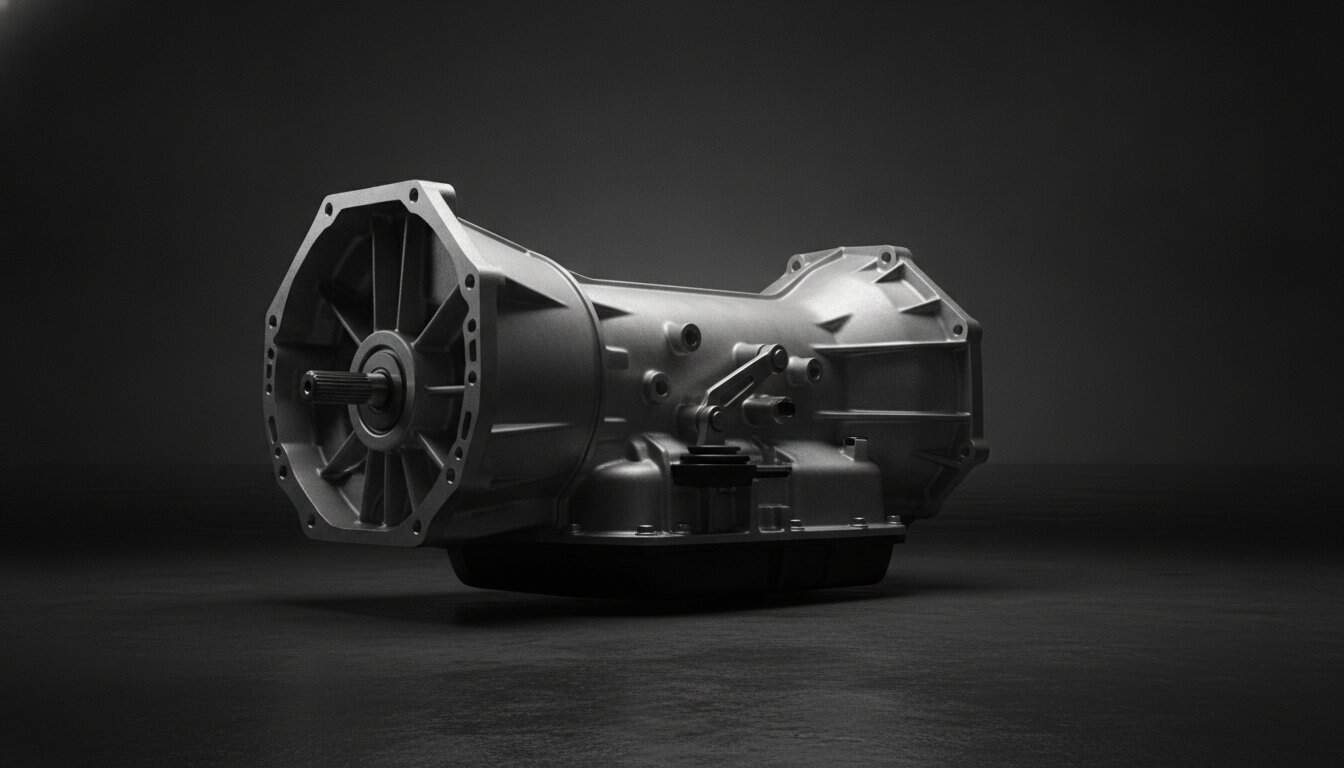
Your vintage machine deserves more than a screaming engine and a four-speed gearbox that struggles to keep up with modern traffic. The t56 isn’t just a transmission; it’s the definitive bridge that allows your car’s heritage soul to thrive on today’s highways. You likely already know that the right drivetrain swap can transform a temperamental classic into a reliable long-distance runner. It’s a project that demands precision, but the reward of clicking into that double overdrive gear for the first time is unmatched.
This guide will empower you to master the technical nuances and installation realities of this legendary 6-speed. We’ll clear up the confusion between original units and the 700 lb-ft rated T56 Magnum, address the common fear of cutting original floor pans, and simplify the transition to a modern hydraulic clutch. You’re going to learn exactly how to achieve that crisp, modern shift feel while dropping your highway RPMs for a more refined driving experience. Let’s get to work on making your restomod as capable as it is beautiful.
Key Takeaways
- Differentiate between factory pull-outs and the 700 lb-ft rated T56 Magnum to select the right strength for your specific performance goals.
- Identify the physical dimensions and tunnel modifications required to seat this modern gearbox into your vintage chassis with confidence.
- Calculate the ideal relationship between your first gear and rear-end ratio to maximize both low-end torque and high-speed efficiency.
- Master the installation nuances of the t56 including hydraulic clutch conversions to gain a crisp, modern shift feel in your classic ride.
- Integrate these transmission insights into your broader project strategy by utilizing the drivetrain planning principles found in the Ultimate Restomod Guide.
The Legend of the T56: Why This 6-Speed Defines the Modern Restomod
Think back to the last time you took your classic out on the interstate. If you were white-knuckled, watching the tachometer needle hover near the redline while modern SUVs hummed past you, you understand why the t56 became a legend. It is the gold standard for manual overdrive transmissions because it finally gave vintage car owners the one thing they lacked: a sixth gear. This upgrade is a cornerstone of what is a restomod, blending the soul of the past with the capability of the present. The story began with the Borg-Warner T-56 transmission in the early 1990s, but the real magic happened when TREMEC took over the design. This transition ensured that parts availability and engineering refinements would continue long after the original muscle cars left the assembly line.
Stepping into a cockpit equipped with a modern six-speed changes your entire relationship with the machine. There is a mechanical honesty to the shift feel that makes every trip an event. You aren’t just steering a relic; you are commanding a precision instrument that blends nostalgic aesthetics with contemporary reliability. To see how a modern drivetrain transformation looks in a real-world workshop setting, watch this helpful video:
The Evolution of the 6-Speed Manual
The t56 earned its stripes in high-performance icons like the Dodge Viper, the Chevrolet Corvette, and the Pontiac GTO. These cars proved that you could have massive power and a drivable highway gear in the same package. As the restomod movement grew, the aftermarket embraced this architecture. We transitioned from hunting through greasy salvage yards for F-Body pull-outs to ordering brand-new, purpose-built units. Today, the focus has shifted toward the T56 Magnum, which uses the internals of the TR-6060 to handle a verified 700 lb-ft of torque. This evolution means you can build a car with 600 horsepower and trust that your transmission won’t leave you stranded.
Benefits of the Double Overdrive
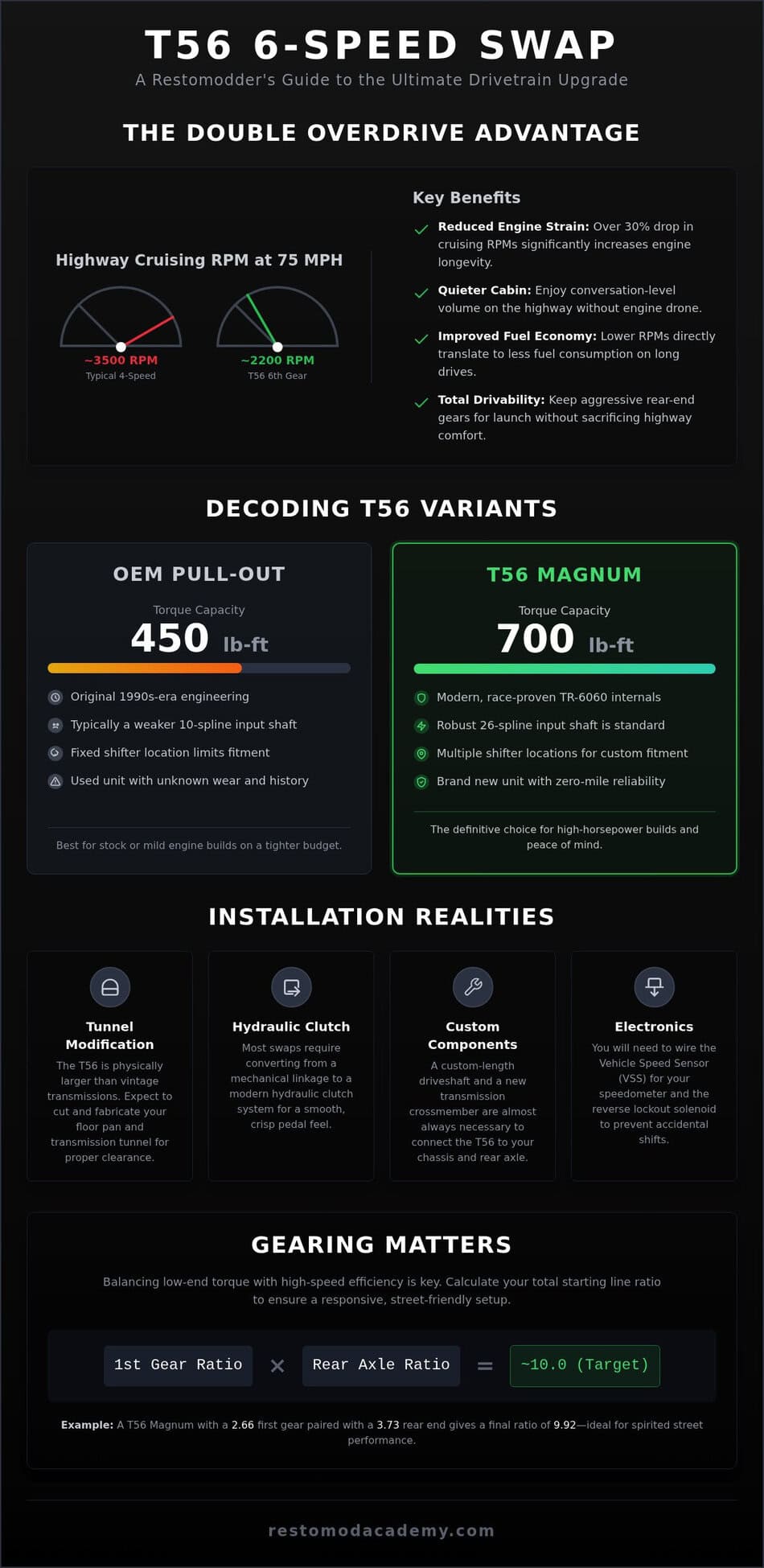
The double-overdrive configuration is a genuine game-changer for vintage iron. By providing two gears with ratios lower than 1:1, you gain incredible flexibility. The 5th gear serves as a traditional overdrive for spirited highway driving, while 6th gear acts as a cruising gear that can drop your engine speed by over 30 percent compared to a traditional four-speed. This reduction in cruising RPM does more than just save fuel; it significantly increases engine longevity by reducing heat and friction over thousands of miles. You can keep your 3.73 or 4.11 rear-end gears for that aggressive launch and still enjoy a calm, conversation-level cabin volume at 75 mph.
Decoding T56 Variants: Pull-Outs vs. The T56 Magnum
Choosing the right gearbox requires you to look beyond the surface. While the original t56 served as a revolutionary piece of engineering in the 1990s, the landscape has shifted toward more robust solutions. You basically have two paths: hunting for a used OEM pull-out or investing in the modern aftermarket king, the TREMEC T56 Magnum. Understanding the mechanical gap between these two is the difference between a car that cruises effortlessly and one that leaves you pulling the floorboards apart for repairs six months down the road. The original units found in F-Bodies and GTOs were designed for 350 to 450 lb-ft of torque; today’s performance builds often blow past those limits before the second gear shift.
The T56 Magnum: The King of Manual Swaps
Think of the T56 Magnum as a race-spec transmission refined for the street. It isn’t just a slightly better version of the old unit; it’s an entirely different beast that utilizes the high-strength internals of the TR-6060. This architecture allows the Magnum to handle up to 700 lb-ft of torque with absolute reliability. One of the greatest advantages for your custom build is the versatility of its shifter positions. Unlike OEM units with fixed locations, the Magnum offers multiple mounting points to ensure the handle pokes through your floor exactly where you want it. It also features a 26-spline input shaft as standard. This is a critical upgrade over the weaker 10-spline shafts found in many older units, providing significantly more surface area to distribute the load of a high-horsepower engine.
Sourcing a Used T56: What to Look For
If you decide to hunt for a used t56, prepare to navigate the “LS Swap Tax.” High-mileage units from early 2000s Camaros or Firebirds frequently command prices between $2,500 and $3,500. When you consider that a basic professional rebuild starts around $1,900 to $2,300, the math often favors buying new. If you do go the used route, inspect the synchronizers and look for excessive play in the input shaft. Be aware that different vehicles used different bellhousing patterns and tailshaft lengths. A unit from a 2004 Mustang Cobra won’t bolt directly to your Chevy small block without expensive adapter plates. If you’re mapping out your entire drivetrain and want to avoid these compatibility traps, check our definitive guide to an LS engine swap for a complete project blueprint. Precision planning now prevents frustration later.
Choosing the Right Gear Ratios for Your Engine and Rear End
Selecting the right internal gears for your t56 is just as critical as the installation itself. You need to view your drivetrain as a single, cohesive system where the transmission and rear-end work in harmony. If you pair a tall first gear with a high-speed rear-end ratio, you’ll end up with a car that’s sluggish off the line and prone to stalling. Conversely, matching an aggressive rear-end with a short first gear might make your first gear virtually useless for anything other than spinning tires. Your goal is to find the sweet spot where your engine stays in its powerband through every shift while maintaining a calm, low-RPM cruise at highway speeds.
Calculate your total gear reduction by multiplying your transmission’s first gear by your rear axle ratio. For most street-driven restomods, a final drive ratio between 9:1 and 10:1 provides the best balance of acceleration and drivability. If you’re running a 3.55 rear gear, a wide-ratio gearbox with a 2.97 first gear puts you right at 10.54, giving you plenty of punch for stoplight-to-stoplight fun. Always plan your rear-end ratio before finalizing your transmission choice to ensure the two components aren’t working against each other.
Close-Ratio vs. Wide-Ratio Breakdown
The t56 Magnum offers two primary configurations: the 2.66 close-ratio and the 2.97 wide-ratio. The 2.66 set is the weapon of choice for high-RPM engines and road course enthusiasts because it keeps the engine speed from dropping too far between shifts. For builders performing an LS engine swap, the 2.66 ratio often feels more natural, especially in lighter cars like a C10 or a first-gen Camaro. The 2.97 wide-ratio is better suited for heavier vehicles or builds utilizing “highway gears” like a 3.08 or 3.23 in the rear. A wide-ratio gearbox paired with a 3.55 rear gear offers the perfect balance of stoplight aggression and relaxed highway cruising for the modern street machine.
Matching Torque Capacity to Your Build
Over-specifying your transmission is a smart long-term investment that prevents expensive failures down the road. While a used unit might seem tempting, the modern T56 Magnum is rated for a verified 700 lb-ft of torque, providing a massive safety margin for most street builds. There is a significant difference between street torque and the violent shock loads experienced during track abuse or hard launches on drag radials. By choosing a unit that exceeds your engine’s output, you ensure that the transmission remains the strongest link in your drivetrain. If you’re pairing this gearbox with a modern powerhouse, our The Definitive Guide to an LS Engine Swap provides the blueprint for matching these components perfectly for maximum reliability.
Installation Realities: Making the T56 Fit Your Classic
Preparation is the difference between a smooth weekend swap and a project that stalls for months. When you step up to a t56, you are moving from a relatively compact four-speed like a Muncie to a modern, heavy-duty gearbox that weighs approximately 135 lbs dry. This transmission is significantly longer and wider than the vintage units it replaces. You cannot simply bolt it in and expect your existing driveshaft or shifter hole to line up perfectly. You must account for the increased physical footprint, the shift in weight distribution, and the transition to modern support systems that weren’t even a concept when your car was originally built.
Your driveshaft will almost certainly require modification. Most vintage applications need a shorter shaft to accommodate the length of the six-speed, along with a specific slip yoke. For a T56 Magnum, you’ll typically need a 31-spline yoke, which is a massive upgrade in strength over factory equipment. Additionally, you’ll need to decide on a speedometer solution. While older units used mechanical cables, modern gearboxes provide an electronic signal. You can either swap to modern electronic gauges or use a mechanical-to-electronic converter box to keep your original dashboard aesthetic intact.
Transmission Tunnel Modifications
Accept the reality that you might need to cut your floor pans. While some larger cars like late-60s B-bodies have generous tunnels, most classic muscle cars were designed around much smaller transmissions. You often need to enlarge the tunnel to provide adequate clearance for the top of the case and to maintain proper driveline angles. Don’t let this intimidate you. Using a dedicated tunnel patch kit allows you to maintain structural integrity while creating a clean, factory-like appearance. Focus on achieving at least a half-inch of clearance around the entire case to prevent vibrations and heat transfer to your interior.
The Hydraulic Clutch Transition
Modern shift precision requires a modern release system. Discard your old Z-bar and mechanical linkage in favor of a hydraulic setup. This transition involves mounting a master cylinder to your firewall and using a hydraulic throw-out bearing inside the bellhousing. When bleeding the system, be patient; air bubbles in a hydraulic clutch can lead to a soft pedal and poor gear engagement. For a curated list of components that match your specific build goals, visit our recommended gear page. If you want a complete roadmap for your entire drivetrain transformation, secure your copy of The Ultimate Restomod Guide to ensure every measurement is precise from the start.
Planning Your T56 Build with Restomod Academy Precision
Planning a transmission swap is where many builders lose their momentum. It’s easy to get caught up in the excitement of a 700 lb-ft torque rating, but the actual labor of the workshop requires a cold, calculated approach to your budget and timeline. You aren’t just buying a gearbox; you are engineering a system. A new TREMEC T56 Magnum consistently sits at a base price of $3,545.00, but your total investment for a complete installation kit including the bellhousing, clutch, and flywheel can easily exceed $6,300. Factor in these hidden costs early so your project doesn’t stall on the jack stands while you wait for extra parts.
The “measure twice, cut once” philosophy is your best friend here. Before you ever touch a reciprocating saw to your floorboards, verify your engine’s crankshaft centerline and your rear axle’s pinion angle. Integrating the t56 swap into your larger project timeline means doing this work while the interior is stripped and the engine is out. It is far easier to weld a tunnel patch when you aren’t worried about scorching fresh carpet or wiring harnesses. Once the unit is installed, follow a strict break-in procedure. Avoid full-throttle shifts or heavy track abuse for the first 500 miles to allow the internal gears and synchronizers to heat cycle and seat properly.
The Ultimate Restomod Roadmap
A balanced performance build treats the transmission as the primary touchpoint between the driver and the machine. While the engine provides the power, the gearbox defines how you experience that power. Understanding what is a restomod involves recognizing that every modern upgrade must serve the overall harmony of the car. If you’ve spent months perfecting your suspension and braking, don’t undermine that work with a clunky, poorly-planned drivetrain. Use our project blueprints to ensure your t56 installation aligns with your long-term goals for reliability and highway comfort.
Consulting and Community Resources
Success in custom building often comes down to the quality of your guidance. Whether you are leveraging our Premium Project Blueprints or seeking Restomod Consulting Services, remember that precision is a learned skill. Don’t hesitate to find a local mentor or a specialized fabrication shop if the tunnel modifications feel beyond your current comfort level. Every challenge you overcome in the garage is a valuable learning opportunity that adds to your expertise. You are building more than a fast car; you are building a legacy of mechanical mastery and personal labor. Take your time, focus on the details, and enjoy the satisfaction of achieving a perfect shift in a machine you built with your own hands.
Shift Your Project Into High Gear
The t56 represents the ultimate upgrade for any enthusiast looking to combine vintage aesthetics with modern performance. You now understand the critical differences between older OEM units and the 700 lb-ft capacity of the Magnum, as well as the importance of matching your gear ratios to your rear-end for the perfect cruise. These technical nuances are the foundation of a reliable build that stands the test of time. Mastering the installation, from hydraulic clutch conversions to precision tunnel work, is a rewarding journey that pays dividends every time you click into sixth gear on the open road.
To help you navigate the complexities of your drivetrain swap and ensure every component works in harmony, Download the Ultimate Restomod Guide to plan your drivetrain swap. You’ll gain access to expert-led project blueprints, comprehensive LS swap documentation, and curated product reviews for performance parts. Take the next step with confidence and precision. Your dream machine is waiting, and with a methodical approach, you’ll build a legacy that performs as beautifully as it looks. Get into the garage and make it happen.
Common Questions About T56 Swaps
Does a T56 require cutting the floor of my classic car?
Cutting the floor is usually necessary because vintage transmission tunnels were designed for much smaller four-speed gearboxes. You will likely need to expand the tunnel to maintain proper driveline angles and provide enough clearance for the larger t56 case. Use a dedicated tunnel patch kit to maintain structural integrity while achieving a professional, factory-like appearance in your cockpit.
What is the difference between a T56 and a T56 Magnum?
The T56 Magnum is the modern aftermarket successor to the original gearbox, utilizing the significantly stronger internals found in the TR-6060. While original OEM units were generally rated for 350 to 450 lb-ft of torque, the Magnum carries a verified rating of 700 lb-ft. It also offers multiple shifter locations and a standard 26-spline input shaft for superior durability.
Can I use a T56 behind a non-LS engine like a Big Block Chevy?
You can certainly mate this six-speed to a Big Block Chevy or other traditional engines by using specific aftermarket bellhousings and flywheels. Ensure your input shaft length and spline count are compatible with your chosen clutch and pilot bearing. This versatility makes the t56 a favorite for enthusiasts who want modern overdrive benefits without switching to a modern engine platform.
How much horsepower can a stock T56 handle?
A stock OEM unit is typically rated to handle between 350 and 450 lb-ft of torque, which is the metric that truly matters for transmission longevity. If your build pushes beyond these limits, you risk stripping gears or snapping the input shaft during hard launches. For high-horsepower applications, stepping up to the Magnum version ensures your drivetrain can survive the shock loads of performance driving.
What rear-end gear ratio works best with a T56 6-speed?
A rear-end ratio between 3.55 and 4.11 provides the best balance of aggressive acceleration and highway cruising for most street-driven cars. This range allows you to take full advantage of the double overdrive without the engine lugging in sixth gear at highway speeds. If you use a taller gear like a 3.08, you may find that sixth gear is only usable well above legal speed limits.
Is a hydraulic clutch conversion necessary for a T56 swap?
A hydraulic clutch conversion is highly recommended because it solves the clearance issues often created by bulky mechanical Z-bars and linkages. This modern setup provides a consistent, lighter pedal feel and simplifies the installation process within the cramped confines of a classic engine bay. Most builders find that the precision of a hydraulic release bearing is well worth the extra effort during the assembly phase.
Can I use my original mechanical speedometer with a T56?
You cannot connect a mechanical speedometer cable directly to these transmissions because they utilize electronic speed sensors. To keep your original dashboard look, you must install an electronic-to-mechanical converter box or upgrade your cluster to modern electronic gauges. Planning for this early prevents the frustration of having a finished car with a non-functioning speedometer.
What is the average cost of a complete T56 Magnum swap kit?
A comprehensive installation kit for a new T56 Magnum typically costs upwards of $6,300. This total accounts for the transmission itself, which carries a base price of approximately $3,545, plus the essential bellhousing, clutch kit, flywheel, and crossmember. Budgeting for a complete kit is the most efficient way to ensure you have every specific bolt and shim required to finish your project without delay.
Your vintage machine deserves more than a screaming engine and a four-speed gearbox that struggles to keep up with modern traffic. The t56 isn’t just a transmission; it’s the definitive bridge that allows your car’s heritage soul to thrive on today’s highways. You likely already know that the right drivetrain swap can transform a temperamental classic into a reliable long-distance runner. It’s a project that demands precision, but the reward of clicking into that double overdrive gear for the first time is unmatched.
This guide will empower you to master the technical nuances and installation realities of this legendary 6-speed. We’ll clear up the confusion between original units and the 700 lb-ft rated T56 Magnum, address the common fear of cutting original floor pans, and simplify the transition to a modern hydraulic clutch. You’re going to learn exactly how to achieve that crisp, modern shift feel while dropping your highway RPMs for a more refined driving experience. Let’s get to work on making your restomod as capable as it is beautiful.
Key Takeaways
- Differentiate between factory pull-outs and the 700 lb-ft rated T56 Magnum to select the right strength for your specific performance goals.
- Identify the physical dimensions and tunnel modifications required to seat this modern gearbox into your vintage chassis with confidence.
- Calculate the ideal relationship between your first gear and rear-end ratio to maximize both low-end torque and high-speed efficiency.
- Master the installation nuances of the t56 including hydraulic clutch conversions to gain a crisp, modern shift feel in your classic ride.
- Integrate these transmission insights into your broader project strategy by utilizing the drivetrain planning principles found in the Ultimate Restomod Guide.
The Legend of the T56: Why This 6-Speed Defines the Modern Restomod
Think back to the last time you took your classic out on the interstate. If you were white-knuckled, watching the tachometer needle hover near the redline while modern SUVs hummed past you, you understand why the t56 became a legend. It is the gold standard for manual overdrive transmissions because it finally gave vintage car owners the one thing they lacked: a sixth gear. This upgrade is a cornerstone of what is a restomod, blending the soul of the past with the capability of the present. The story began with the Borg-Warner T-56 transmission in the early 1990s, but the real magic happened when TREMEC took over the design. This transition ensured that parts availability and engineering refinements would continue long after the original muscle cars left the assembly line.
Stepping into a cockpit equipped with a modern six-speed changes your entire relationship with the machine. There is a mechanical honesty to the shift feel that makes every trip an event. You aren’t just steering a relic; you are commanding a precision instrument that blends nostalgic aesthetics with contemporary reliability. To see how a modern drivetrain transformation looks in a real-world workshop setting, watch this helpful video:
The Evolution of the 6-Speed Manual
The t56 earned its stripes in high-performance icons like the Dodge Viper, the Chevrolet Corvette, and the Pontiac GTO. These cars proved that you could have massive power and a drivable highway gear in the same package. As the restomod movement grew, the aftermarket embraced this architecture. We transitioned from hunting through greasy salvage yards for F-Body pull-outs to ordering brand-new, purpose-built units. Today, the focus has shifted toward the T56 Magnum, which uses the internals of the TR-6060 to handle a verified 700 lb-ft of torque. This evolution means you can build a car with 600 horsepower and trust that your transmission won’t leave you stranded.
Benefits of the Double Overdrive
The double-overdrive configuration is a genuine game-changer for vintage iron. By providing two gears with ratios lower than 1:1, you gain incredible flexibility. The 5th gear serves as a traditional overdrive for spirited highway driving, while 6th gear acts as a cruising gear that can drop your engine speed by over 30 percent compared to a traditional four-speed. This reduction in cruising RPM does more than just save fuel; it significantly increases engine longevity by reducing heat and friction over thousands of miles. You can keep your 3.73 or 4.11 rear-end gears for that aggressive launch and still enjoy a calm, conversation-level cabin volume at 75 mph.
Decoding T56 Variants: Pull-Outs vs. The T56 Magnum
Choosing the right gearbox requires you to look beyond the surface. While the original t56 served as a revolutionary piece of engineering in the 1990s, the landscape has shifted toward more robust solutions. You basically have two paths: hunting for a used OEM pull-out or investing in the modern aftermarket king, the TREMEC T56 Magnum. Understanding the mechanical gap between these two is the difference between a car that cruises effortlessly and one that leaves you pulling the floorboards apart for repairs six months down the road. The original units found in F-Bodies and GTOs were designed for 350 to 450 lb-ft of torque; today’s performance builds often blow past those limits before the second gear shift.
The T56 Magnum: The King of Manual Swaps
Think of the T56 Magnum as a race-spec transmission refined for the street. It isn’t just a slightly better version of the old unit; it’s an entirely different beast that utilizes the high-strength internals of the TR-6060. This architecture allows the Magnum to handle up to 700 lb-ft of torque with absolute reliability. One of the greatest advantages for your custom build is the versatility of its shifter positions. Unlike OEM units with fixed locations, the Magnum offers multiple mounting points to ensure the handle pokes through your floor exactly where you want it. It also features a 26-spline input shaft as standard. This is a critical upgrade over the weaker 10-spline shafts found in many older units, providing significantly more surface area to distribute the load of a high-horsepower engine.
Sourcing a Used T56: What to Look For
If you decide to hunt for a used t56, prepare to navigate the “LS Swap Tax.” High-mileage units from early 2000s Camaros or Firebirds frequently command prices between $2,500 and $3,500. When you consider that a basic professional rebuild starts around $1,900 to $2,300, the math often favors buying new. If you do go the used route, inspect the synchronizers and look for excessive play in the input shaft. Be aware that different vehicles used different bellhousing patterns and tailshaft lengths. A unit from a 2004 Mustang Cobra won’t bolt directly to your Chevy small block without expensive adapter plates. If you’re mapping out your entire drivetrain and want to avoid these compatibility traps, check our definitive guide to an LS engine swap for a complete project blueprint. Precision planning now prevents frustration later.
Choosing the Right Gear Ratios for Your Engine and Rear End
Selecting the right internal gears for your t56 is just as critical as the installation itself. You need to view your drivetrain as a single, cohesive system where the transmission and rear-end work in harmony. If you pair a tall first gear with a high-speed rear-end ratio, you’ll end up with a car that’s sluggish off the line and prone to stalling. Conversely, matching an aggressive rear-end with a short first gear might make your first gear virtually useless for anything other than spinning tires. Your goal is to find the sweet spot where your engine stays in its powerband through every shift while maintaining a calm, low-RPM cruise at highway speeds.
Calculate your total gear reduction by multiplying your transmission’s first gear by your rear axle ratio. For most street-driven restomods, a final drive ratio between 9:1 and 10:1 provides the best balance of acceleration and drivability. If you’re running a 3.55 rear gear, a wide-ratio gearbox with a 2.97 first gear puts you right at 10.54, giving you plenty of punch for stoplight-to-stoplight fun. Always plan your rear-end ratio before finalizing your transmission choice to ensure the two components aren’t working against each other.
Close-Ratio vs. Wide-Ratio Breakdown
The t56 Magnum offers two primary configurations: the 2.66 close-ratio and the 2.97 wide-ratio. The 2.66 set is the weapon of choice for high-RPM engines and road course enthusiasts because it keeps the engine speed from dropping too far between shifts. For builders performing an LS engine swap, the 2.66 ratio often feels more natural, especially in lighter cars like a C10 or a first-gen Camaro. The 2.97 wide-ratio is better suited for heavier vehicles or builds utilizing “highway gears” like a 3.08 or 3.23 in the rear. A wide-ratio gearbox paired with a 3.55 rear gear offers the perfect balance of stoplight aggression and relaxed highway cruising for the modern street machine.
Matching Torque Capacity to Your Build
Over-specifying your transmission is a smart long-term investment that prevents expensive failures down the road. While a used unit might seem tempting, the modern T56 Magnum is rated for a verified 700 lb-ft of torque, providing a massive safety margin for most street builds. There is a significant difference between street torque and the violent shock loads experienced during track abuse or hard launches on drag radials. By choosing a unit that exceeds your engine’s output, you ensure that the transmission remains the strongest link in your drivetrain. If you’re pairing this gearbox with a modern powerhouse, our The Definitive Guide to an LS Engine Swap provides the blueprint for matching these components perfectly for maximum reliability.
Installation Realities: Making the T56 Fit Your Classic
Preparation is the difference between a smooth weekend swap and a project that stalls for months. When you step up to a t56, you are moving from a relatively compact four-speed like a Muncie to a modern, heavy-duty gearbox that weighs approximately 135 lbs dry. This transmission is significantly longer and wider than the vintage units it replaces. You cannot simply bolt it in and expect your existing driveshaft or shifter hole to line up perfectly. You must account for the increased physical footprint, the shift in weight distribution, and the transition to modern support systems that weren’t even a concept when your car was originally built.
Your driveshaft will almost certainly require modification. Most vintage applications need a shorter shaft to accommodate the length of the six-speed, along with a specific slip yoke. For a T56 Magnum, you’ll typically need a 31-spline yoke, which is a massive upgrade in strength over factory equipment. Additionally, you’ll need to decide on a speedometer solution. While older units used mechanical cables, modern gearboxes provide an electronic signal. You can either swap to modern electronic gauges or use a mechanical-to-electronic converter box to keep your original dashboard aesthetic intact.
Transmission Tunnel Modifications
Accept the reality that you might need to cut your floor pans. While some larger cars like late-60s B-bodies have generous tunnels, most classic muscle cars were designed around much smaller transmissions. You often need to enlarge the tunnel to provide adequate clearance for the top of the case and to maintain proper driveline angles. Don’t let this intimidate you. Using a dedicated tunnel patch kit allows you to maintain structural integrity while creating a clean, factory-like appearance. Focus on achieving at least a half-inch of clearance around the entire case to prevent vibrations and heat transfer to your interior.
The Hydraulic Clutch Transition
Modern shift precision requires a modern release system. Discard your old Z-bar and mechanical linkage in favor of a hydraulic setup. This transition involves mounting a master cylinder to your firewall and using a hydraulic throw-out bearing inside the bellhousing. When bleeding the system, be patient; air bubbles in a hydraulic clutch can lead to a soft pedal and poor gear engagement. For a curated list of components that match your specific build goals, visit our recommended gear page. If you want a complete roadmap for your entire drivetrain transformation, secure your copy of The Ultimate Restomod Guide to ensure every measurement is precise from the start.
Planning Your T56 Build with Restomod Academy Precision
Planning a transmission swap is where many builders lose their momentum. It’s easy to get caught up in the excitement of a 700 lb-ft torque rating, but the actual labor of the workshop requires a cold, calculated approach to your budget and timeline. You aren’t just buying a gearbox; you are engineering a system. A new TREMEC T56 Magnum consistently sits at a base price of $3,545.00, but your total investment for a complete installation kit including the bellhousing, clutch, and flywheel can easily exceed $6,300. Factor in these hidden costs early so your project doesn’t stall on the jack stands while you wait for extra parts.
The “measure twice, cut once” philosophy is your best friend here. Before you ever touch a reciprocating saw to your floorboards, verify your engine’s crankshaft centerline and your rear axle’s pinion angle. Integrating the t56 swap into your larger project timeline means doing this work while the interior is stripped and the engine is out. It is far easier to weld a tunnel patch when you aren’t worried about scorching fresh carpet or wiring harnesses. Once the unit is installed, follow a strict break-in procedure. Avoid full-throttle shifts or heavy track abuse for the first 500 miles to allow the internal gears and synchronizers to heat cycle and seat properly.
The Ultimate Restomod Roadmap
A balanced performance build treats the transmission as the primary touchpoint between the driver and the machine. While the engine provides the power, the gearbox defines how you experience that power. Understanding what is a restomod involves recognizing that every modern upgrade must serve the overall harmony of the car. If you’ve spent months perfecting your suspension and braking, don’t undermine that work with a clunky, poorly-planned drivetrain. Use our project blueprints to ensure your t56 installation aligns with your long-term goals for reliability and highway comfort.
Consulting and Community Resources
Success in custom building often comes down to the quality of your guidance. Whether you are leveraging our Premium Project Blueprints or seeking Restomod Consulting Services, remember that precision is a learned skill. Don’t hesitate to find a local mentor or a specialized fabrication shop if the tunnel modifications feel beyond your current comfort level. Every challenge you overcome in the garage is a valuable learning opportunity that adds to your expertise. You are building more than a fast car; you are building a legacy of mechanical mastery and personal labor. Take your time, focus on the details, and enjoy the satisfaction of achieving a perfect shift in a machine you built with your own hands.
Shift Your Project Into High Gear
The t56 represents the ultimate upgrade for any enthusiast looking to combine vintage aesthetics with modern performance. You now understand the critical differences between older OEM units and the 700 lb-ft capacity of the Magnum, as well as the importance of matching your gear ratios to your rear-end for the perfect cruise. These technical nuances are the foundation of a reliable build that stands the test of time. Mastering the installation, from hydraulic clutch conversions to precision tunnel work, is a rewarding journey that pays dividends every time you click into sixth gear on the open road.
To help you navigate the complexities of your drivetrain swap and ensure every component works in harmony, Download the Ultimate Restomod Guide to plan your drivetrain swap. You’ll gain access to expert-led project blueprints, comprehensive LS swap documentation, and curated product reviews for performance parts. Take the next step with confidence and precision. Your dream machine is waiting, and with a methodical approach, you’ll build a legacy that performs as beautifully as it looks. Get into the garage and make it happen.
Common Questions About T56 Swaps
Does a T56 require cutting the floor of my classic car?
Cutting the floor is usually necessary because vintage transmission tunnels were designed for much smaller four-speed gearboxes. You will likely need to expand the tunnel to maintain proper driveline angles and provide enough clearance for the larger t56 case. Use a dedicated tunnel patch kit to maintain structural integrity while achieving a professional, factory-like appearance in your cockpit.
What is the difference between a T56 and a T56 Magnum?
The T56 Magnum is the modern aftermarket successor to the original gearbox, utilizing the significantly stronger internals found in the TR-6060. While original OEM units were generally rated for 350 to 450 lb-ft of torque, the Magnum carries a verified rating of 700 lb-ft. It also offers multiple shifter locations and a standard 26-spline input shaft for superior durability.
Can I use a T56 behind a non-LS engine like a Big Block Chevy?
You can certainly mate this six-speed to a Big Block Chevy or other traditional engines by using specific aftermarket bellhousings and flywheels. Ensure your input shaft length and spline count are compatible with your chosen clutch and pilot bearing. This versatility makes the t56 a favorite for enthusiasts who want modern overdrive benefits without switching to a modern engine platform.
How much horsepower can a stock T56 handle?
A stock OEM unit is typically rated to handle between 350 and 450 lb-ft of torque, which is the metric that truly matters for transmission longevity. If your build pushes beyond these limits, you risk stripping gears or snapping the input shaft during hard launches. For high-horsepower applications, stepping up to the Magnum version ensures your drivetrain can survive the shock loads of performance driving.
What rear-end gear ratio works best with a T56 6-speed?
A rear-end ratio between 3.55 and 4.11 provides the best balance of aggressive acceleration and highway cruising for most street-driven cars. This range allows you to take full advantage of the double overdrive without the engine lugging in sixth gear at highway speeds. If you use a taller gear like a 3.08, you may find that sixth gear is only usable well above legal speed limits.
Is a hydraulic clutch conversion necessary for a T56 swap?
A hydraulic clutch conversion is highly recommended because it solves the clearance issues often created by bulky mechanical Z-bars and linkages. This modern setup provides a consistent, lighter pedal feel and simplifies the installation process within the cramped confines of a classic engine bay. Most builders find that the precision of a hydraulic release bearing is well worth the extra effort during the assembly phase.
Can I use my original mechanical speedometer with a T56?
You cannot connect a mechanical speedometer cable directly to these transmissions because they utilize electronic speed sensors. To keep your original dashboard look, you must install an electronic-to-mechanical converter box or upgrade your cluster to modern electronic gauges. Planning for this early prevents the frustration of having a finished car with a non-functioning speedometer.
What is the average cost of a complete T56 Magnum swap kit?
A comprehensive installation kit for a new T56 Magnum typically costs upwards of $6,300. This total accounts for the transmission itself, which carries a base price of approximately $3,545, plus the essential bellhousing, clutch kit, flywheel, and crossmember. Budgeting for a complete kit is the most efficient way to ensure you have every specific bolt and shim required to finish your project without delay.