

You can spend $60,000 on a modern sports car today, but it will never command the same gravity as a 1969 chevelle pulling into a crowded parking lot. You likely recognize this year as the high-water mark for GM muscle; a perfect storm of aggressive coke-bottle styling and legendary big-block power. However, the path to owning this icon is often blocked by the fear of buying a disguised rust-bucket or a counterfeit SS model that doesn’t justify its premium price tag.
We’re here to ensure your vision doesn’t stall out in the research phase. This guide provides a comprehensive roadmap to master the history, market value, and restoration potential of this legendary platform. You’ll learn how to identify a solid donor car, navigate a market where prices fluctuate between $10,000 and $180,000, and develop a clear plan for modernizing the 60-year-old suspension technology. We’ll examine the specific steps to transform a vintage frame into a reliable, high-performance machine that’s built to be driven, not just admired.
Key Takeaways
- Master the design elements of the second-gen A-body and learn why its signature “Coke bottle” styling remains the gold standard for modern builders.
- Understand the mechanical reality of vintage suspension and identify the specific upgrades needed to transform a “floaty” stock ride into a precision machine.
- Navigate the current market with confidence by analyzing the latest valuation data for the 1969 chevelle across three distinct buyer tiers.
- Follow our restomod roadmap to bridge the gap between classic soul and modern performance, starting with the essentials of an LS or LT engine swap.
- Discover why the “built, not bought” approach offers the best return on investment and how to forge a personal connection with your ultimate project car.
The 1969 Chevelle: Anatomy of an American Muscle Icon
The 1969 Chevelle represents the absolute peak of the second-generation GM A-body platform. While the 1968 model introduced the shorter 112-inch wheelbase for coupes, the ’69 refined that foundation into the “Coke bottle” silhouette we obsess over today. This curvaceous profile, with its flared fenders and tucked-in midsection, provides the perfect canvas for modern suspension geometry and aggressive wheel fitments. You can trace the Chevrolet Chevelle history through several iterations, but the 1969 remains the definitive choice for builders who value a balance of aggressive stance and classic proportions.
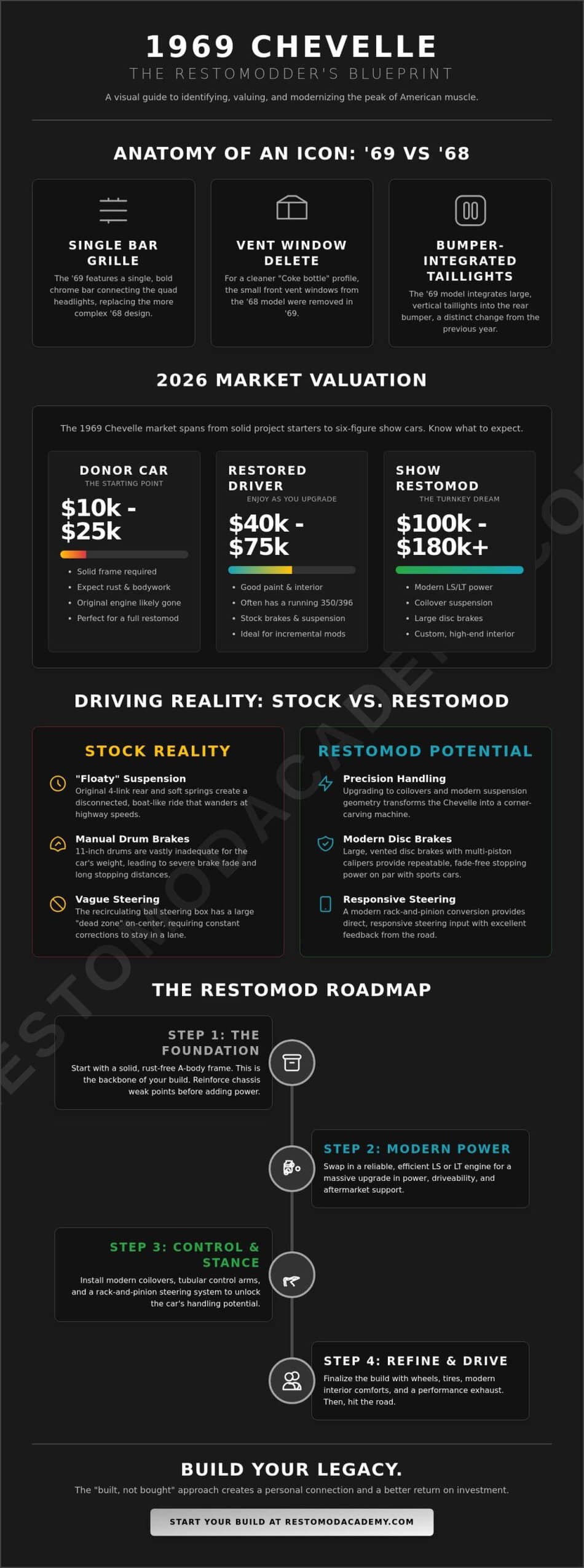
Spotting a 1969 chevelle at a distance requires a keen eye for three specific changes from the previous year. First, look at the front; the 1969 features a single chrome bar across the grille that connects the quad headlights. Second, the vent windows found on the 1968 doors were deleted in favor of a cleaner, one-piece glass design. Finally, the taillights moved from a wrap-around style to large, vertical units integrated into the rear bumper. These subtle tweaks shifted the car’s personality from experimental to established, cementing its role in culture from local drag strips to modern cinema.
To better understand the physical presence and design of this machine, watch this helpful video:
Trims and Factory Packages: From Malibu to SS 396
You’ll encounter three primary levels when hunting for a project: the base 300 Deluxe, the popular Malibu, and the performance-heavy SS 396. The 300 Deluxe was the “stripper” model, often favored by drag racers for its lower curb weight. The Malibu served as the volume seller, offering more interior refinement. For those seeking unicorn status, the Central Office Production Order (COPO) 427 Chevelles represent the pinnacle of rarity; only about 323 units were produced with the L72 engine. Identifying a “True SS” is tricky because in 1969, the SS was an option package (RPO Z25) rather than a standalone series. This means the VIN will not explicitly prove it is an SS; you must hunt for a Build Sheet or Protect-O-Plate to verify its pedigree against modern clones.
Original Engine Options and Specifications
The 1969 engine lineup catered to everyone from grocery getters to weekend warriors. Base models carried the 230 or 250 cubic inch Straight-Six, while V8 options started with the 307 and moved up to the 327 and 350 small blocks. The big-block 396 was the star, offered in 325, 350, and 375 horsepower configurations. While these gross horsepower ratings sound impressive, they often feel underwhelming compared to a modern LS engine swap
Driving Reality: Style vs. Substance in a Stock 1969 Chevelle
If you ask any enthusiast on a classic car forum what it’s like to drive a bone-stock 1969 Chevelle, the answers usually fall into two camps: pure nostalgia or terrifying reality. Behind the wheel, the car feels massive. You sit on a flat vinyl bench seat that offers zero lateral support, peering over a hood that seems to stretch for miles. It looks like a predator, but without modern intervention, it handles more like a luxury barge than a precision instrument.
The original recirculating ball steering box is the primary culprit. With roughly 4.5 turns from lock-to-lock, there is a significant “dead zone” in the center where the car simply doesn’t react to input. When you combine this with the factory 4-link rear suspension, you get a floaty, disconnected sensation. At 65 mph, the car tends to wander across the lane, requiring constant micro-corrections. You don’t drive a stock 1969 Chevelle so much as you suggest a general direction and wait for the chassis to catch up.
Stopping is an even bigger challenge. While the 1969 Chevelle SS 396 performance numbers were impressive for the era, the factory 11-inch manual drum brakes were not designed for modern traffic. Attempting to stop 3,500 pounds of American iron from highway speeds results in immediate brake fade. The pedal gets hard, the drums get hot, and your stopping distance can easily exceed 160 feet. It’s a visceral experience, filled with the roar of the engine and the whistle of wind through aging A-pillar seals, but the vibration through the floorboards reminds you that this is 1960s technology at its limit.
The “Death Trap” Dilemma: Safety in the Modern Age
Safety was an afterthought in 1969. Many survivors still run their original single-reservoir master cylinders. If a single brake line leaks, you lose all braking pressure instantly. Modern builders prioritize upgrading to dual-reservoir systems for this reason. Non-collapsible steering columns also pose a major risk, acting as a rigid spear in a front-end collision. If you’re planning to drive in traffic, replacing the original lap belts with three-point harnesses and adding headrests should be your first priority. You can understand the restomod philosophy by seeing how these safety gaps are bridged with modern parts.
Common Mechanical Failures and Maintenance
Keeping a stock 1969 Chevelle on the road requires a meticulous maintenance schedule. The transmissions of the era, specifically the 2-speed Powerglide and the 3-speed TH350, are prone to front pump leaks and overheating when pushed. Modern stop-and-go traffic is particularly hard on the factory cooling systems. The original copper-brass radiators often struggle to keep temperatures below 210 degrees when idling on a hot afternoon.
- Rear Control Arm Bushings: These rubber components dry rot over 50 years, leading to “rear-end steer” and clunking noises.
- Point Ignition: Original distributors require frequent adjustment; most owners swap these for electronic units to avoid stalling.
- Fuel System: Modern ethanol-blended fuel eats through original rubber fuel lines and needle valves in Quadrajet carburetors.
Before you hit the autocross track, it’s vital to inspect the frame horns and suspension mounting points for stress cracks. If you want to transform this floaty ride into a corner-carver, you should check out our recommended gear for suspension tuning.
Market Guide: Finding and Evaluating a 1969 Chevelle in 2026
The market for the 1969 chevelle remains a powerhouse in 2026. Current data shows an average sale price of $66,512, though this number fluctuates wildly based on the build’s soul and mechanical pedigree. When you’re scouting the classifieds, you’ll find three distinct buyer profiles. The Purist hunts for factory chalk marks and original smog pumps. The Weekend Cruiser wants a turn-key experience for Saturday night meets. The Restomod Builder looks for a solid skeleton to host modern performance. Understanding the Chevy Chevelle evolution helps you identify which trim level fits your vision and your wallet.
Don’t get blinded by “Numbers Matching” claims if your goal is a high-performance transformation. A verified, original big-block engine adds a 25% premium to the price tag. If you plan to perform an LS swap, that original engine is a financial burden you don’t need. Focus on the integrity of the shell instead. If you’re new to this world, learning what is a restomod will help you decide if you’re chasing a museum piece or a modern street machine.
The Rust Hunt: Where 1969 Chevelles Die
Metal doesn’t lie. You must inspect the “Big Three” failure points with a critical eye. Start at the lower rear window channel; water traps here and rots the metal from the inside out. Move to the trunk pan and the rear wheel arches next. These are the most common surgery sites for any 1969 chevelle. Examine the frame rails near the rear torque boxes for structural thinning. Patching a small hole costs about $500 in materials, but replacing full quarter panels can easily exceed $4,500 in professional labor and parts. Inspect these areas before you talk price.
Valuation Tiers: What Your Money Buys
Your budget dictates your starting line. Tier 1 ($10,000 to $25,000) gets you a project car. Expect missing trim, a tired interior, and a non-running drivetrain. It’s a blank canvas for the brave. Tier 2 ($30,000 to $60,000) is the “Driver” category. These cars have solid mechanics and presentable paint but need cosmetic refinement. Tier 3 ($75,000 and up) represents the Show Stoppers or elite Pro-Touring builds. These command a premium because the engineering is already finished, saving you years of shop time and fabrication stress.
On-Site Inspection Checklist:
- Verify the VIN and Cowl Tag to confirm the original factory options.
- Run a magnet along the lower fenders to detect thick body filler.
- Check for “crabbing” or uneven tire wear that suggests a tweaked frame.
- Inspect the wiring harness for brittle insulation or dangerous “rat’s nest” repairs.
- Confirm the title matches the VIN plate on the dashboard exactly.
The 1969 Chevelle Restomod Roadmap: Modernizing the A-Body
The restomod philosophy isn’t about erasing history; it’s about preserving the iconic silhouette of the 1969 chevelle while injecting it with modern reliability and supercar performance. You want a car that starts every time, stops on a dime, and carves corners like a modern sports coupe. This transformation requires a methodical approach to upgrading the aging A-body platform. Follow this roadmap to turn your vintage iron into a daily-drivable masterpiece.
- Step 1: Swap the heavy factory iron block for a lightweight LS or LT engine to gain modern fuel injection and efficiency.
- Step 2: Correct the dated suspension geometry by installing aftermarket tubular control arms that improve the camber curve.
- Step 3: Replace the three-speed automatic or four-speed manual with a 5 or 6-speed overdrive transmission for comfortable highway cruising.
- Step 4: Seal the cabin with premium sound deadening and install a high-output HVAC system for year-round comfort.
Power Delivery: The LS Swap Advantage
The LS engine platform is the gold standard for the 1969 chevelle because it offers an unbeatable power-to-weight ratio and massive aftermarket support. Swapping in a modern small block sheds nearly 100 pounds from the front end, which immediately improves weight distribution. To manage the power, integrate a modern EFI system like the Holley Terminator X. This setup allows for self-tuning capabilities and real-time data monitoring, ensuring your engine runs perfectly in any weather. If you’re ready to commit to the swap, check out The Definitive Guide to an LS Engine Swap for a deep dive into the technical requirements.
Handling and Braking: Making it Turn and Stop
Stock A-body frames were designed for bias-ply tires and 1960s driving standards. To bring the handling into the modern era, you must choose between a coilover conversion or an air ride setup. Coilovers offer precise, mechanical tuning for the track, while air ride provides adjustable ride height for show-stopping looks. Regardless of your spring choice, a disc brake conversion is mandatory. Moving to 12-inch or larger rotors with multi-piston calipers can reduce stopping distances by over 40 percent compared to factory drums, providing the confidence needed for spirited driving.
Interior Comfort: Restomod Interior Ideas
The cabin is where you spend your time, so don’t neglect the “daily driver” experience. Start by applying 80-mil butyl-based sound deadening to the floor pans and doors; this can lower interior noise levels by up to 15 decibels. Replace the sagging factory springs with modern bucket seats that offer side bolstering for better support during cornering. For the dashboard, Dakota Digital gauges provide a seamless fit into the factory 1969 bezels while offering the precision of digital sensors. These upgrades bridge the gap between vintage aesthetics and the luxury of a modern cockpit.
Ready to master the art of the modern classic? Learn more about the restomod movement and start planning your dream build today.
Building Your Legacy: Why the 1969 Chevelle is the Ultimate Project
The 1969 chevelle isn’t just a car; it’s a blue-chip investment in your personal history and mechanical skill. With over 450,000 units produced for the 1969 model year, sourcing a solid project car is more achievable than chasing rarer, six-figure exotics. This high production volume ensures the “bang for buck” ratio stays in your favor because you aren’t paying a “rarity tax” on every trim piece or quarter panel. Instead, you’re investing in a 112-inch wheelbase platform that’s widely considered the gold standard of muscle car proportions and road presence.
Choose the “built, not bought” path to ensure the highest quality and a deep personal connection. Buying a turn-key car is a simple transaction, but building it yourself creates a bond that survives every mile. When you’re the one who installed the modern LS engine or dialed in the suspension geometry, you gain mastery over the machine. The massive aftermarket support for the GM A-body means you can practically build an entire 1969 chevelle from a catalog. Every bracket, bushing, and bolt is available from major vendors, making this the most beginner-friendly project in the muscle car world. Recent 2023 auction data from Barrett-Jackson shows that high-quality Chevelle restomods frequently hammer for between $120,000 and $185,000, proving that your sweat equity translates into a high-value asset.
Planning Your Build with Restomod Academy
Success in the garage starts at the desk. Our Premium Project Blueprints for GM A-body cars eliminate the guesswork that drains bank accounts and stalls progress. Consulting with seasoned experts helps you avoid the common pitfall of buying incompatible parts that don’t fit the first time. You’ll save thousands by getting your drivetrain alignment and wiring harnesses right during the initial phase. Check out our Restomod Project Planning: The Ultimate Roadmap to see how we structure a world-class build from the frame up.
Final Call to Action: Start Your Build Today
Your garage is waiting for its centerpiece. A 1969 chevelle build is more than a hobby; it’s a legacy you’ll pass down to the next generation. Don’t let another year pass with an empty stall or a car under a dusty tarp. The best time to start was yesterday; the second best time is now. Grab your tools, set your vision, and begin the transformation. Download the Ultimate Restomod Guide and take the first step toward turning your dream into a high-performance reality.
Claim Your Piece of Automotive History
The journey from a garage find to a street-shredding masterpiece is a marathon of precision and passion. You’ve explored how the 1969 chevelle balances its iconic 112-inch wheelbase with the potential for modern suspension geometry. We’ve dissected the 2026 market landscape to help you identify a solid foundation for your build. Now, it’s time to transition from a student of history to a master of the craft. Transforming this A-body legend requires a vision that respects classic aesthetics while seizing the reliability of modern performance upgrades. Don’t let your project stall on the jack stands. You can access premium project blueprints and expert consulting from seasoned builders who’ve spent decades perfecting the restomod process. Our team provides comprehensive product reviews for A-body parts to ensure your investment delivers maximum results. Start Your 1969 Chevelle Project with the Ultimate Restomod Guide and bring your vision to life. The shop floor is waiting, and your legacy is ready to be built.
Frequently Asked Questions
Is a 1969 Chevelle a good daily driver?
A stock 1969 Chevelle is a challenging daily driver because it lacks modern safety features like crumple zones and anti-lock brakes. You’ll likely see fuel economy between 8 and 12 miles per gallon with an original big block engine. However, converting to an electronic fuel injection system and a modern overdrive transmission makes it a reliable commuter. These upgrades allow the car to maintain highway speeds comfortably while keeping engine temperatures stable in heavy traffic.
How can I tell if a 1969 Chevelle is a real SS?
Verification is difficult because the 1969 VIN doesn’t explicitly identify an SS model like the 1966 or 1968 versions did. You must look for a “136” VIN prefix and check for specific mechanical markers like a 12-bolt rear end and a reinforced frame. Authentic Super Sports also featured a blacked-out rear tail panel and unique hood louvers. Always demand the original Build Sheet or Protect-O-Plate to confirm the car’s pedigree before you commit to a purchase.
What is the most popular engine swap for a 1969 Chevelle?
The GM LS3 crate engine is the gold standard for a 1969 chevelle engine swap due to its 430 horsepower baseline and modern reliability. This swap sheds nearly 200 pounds compared to an old iron big block, which significantly improves your front-to-rear weight distribution. You’ll need specific conversion oil pans and engine mounts to clear the factory crossmember. Pairing this engine with a T56 six-speed manual transmission creates a driving experience that rivals modern performance cars.
How much does it cost to restomod a 1969 Chevelle?
Restoration costs fluctuate based on the depth of the build and your willingness to do the labor yourself. According to industry data from SEMA, a comprehensive restomod project typically ranges from $30,000 for a DIY “rolling restoration” to over $150,000 for a professional rotisserie build. Your budget should allocate 30 percent to the powertrain and 25 percent to bodywork and paint. Planning your component list early prevents the common 20 percent budget overrun seen in most garage projects.
Why is the 1969 model more popular than the 1968 or 1970?
The 1969 model is the favorite because it refined the 1968 fastback styling by removing the bulky vent windows and adding a cleaner, more aggressive grille. Chevrolet produced roughly 519,000 Chevelles in 1969, making parts more accessible and affordable than the rarer 1970 variants. This specific year represents the peak of the muscle car era’s aesthetic before the 1971 compression ratio drops and the shift toward heavy impact bumpers changed the car’s profile.
Where are the most common places to find rust on a 1969 Chevelle?
Rust typically attacks the lower rear quarter panels and the trunk floor pans first. Inspect the base of the rear window channel, as water often traps there and rots the metal from the inside out. You should also check the “A-pillars” and the area behind the front wheels for bubbling paint. If you find holes in these spots, expect to perform significant metal fabrication to restore the structural integrity of the 1969 chevelle frame.
Can I fit modern wheels and tires on a stock 1969 Chevelle?
You can fit 18×8 inch wheels in the front and 18×9.5 inch wheels in the rear without modifying the factory wheel wells. A 275/40R18 tire is the maximum width for the rear before you risk rubbing against the inner fender lip. Always measure your backspacing carefully; 5.25 to 5.5 inches is usually the sweet spot for the A-body chassis. Upgrading to larger wheels also allows you to install 13-inch disc brake rotors for superior stopping power.
What is the difference between a Chevelle and a Malibu in 1969?
The Malibu was actually a premium trim level of the Chevelle, not a separate model. While the base 300 Deluxe featured a utilitarian interior with rubber floor mats, the Malibu offered upgraded vinyl upholstery, woodgrain accents, and extra exterior chrome trim. In 1969, the SS 396 package was an option specifically available on the Malibu series. Understanding this distinction helps you decode the trim tags and ensures you’re buying the correct interior components for your restoration project.
You can spend $60,000 on a modern sports car today, but it will never command the same gravity as a 1969 chevelle pulling into a crowded parking lot. You likely recognize this year as the high-water mark for GM muscle; a perfect storm of aggressive coke-bottle styling and legendary big-block power. However, the path to owning this icon is often blocked by the fear of buying a disguised rust-bucket or a counterfeit SS model that doesn’t justify its premium price tag.
We’re here to ensure your vision doesn’t stall out in the research phase. This guide provides a comprehensive roadmap to master the history, market value, and restoration potential of this legendary platform. You’ll learn how to identify a solid donor car, navigate a market where prices fluctuate between $10,000 and $180,000, and develop a clear plan for modernizing the 60-year-old suspension technology. We’ll examine the specific steps to transform a vintage frame into a reliable, high-performance machine that’s built to be driven, not just admired.
Key Takeaways
- Master the design elements of the second-gen A-body and learn why its signature “Coke bottle” styling remains the gold standard for modern builders.
- Understand the mechanical reality of vintage suspension and identify the specific upgrades needed to transform a “floaty” stock ride into a precision machine.
- Navigate the current market with confidence by analyzing the latest valuation data for the 1969 chevelle across three distinct buyer tiers.
- Follow our restomod roadmap to bridge the gap between classic soul and modern performance, starting with the essentials of an LS or LT engine swap.
- Discover why the “built, not bought” approach offers the best return on investment and how to forge a personal connection with your ultimate project car.
The 1969 Chevelle: Anatomy of an American Muscle Icon
The 1969 Chevelle represents the absolute peak of the second-generation GM A-body platform. While the 1968 model introduced the shorter 112-inch wheelbase for coupes, the ’69 refined that foundation into the “Coke bottle” silhouette we obsess over today. This curvaceous profile, with its flared fenders and tucked-in midsection, provides the perfect canvas for modern suspension geometry and aggressive wheel fitments. You can trace the Chevrolet Chevelle history through several iterations, but the 1969 remains the definitive choice for builders who value a balance of aggressive stance and classic proportions.
Spotting a 1969 chevelle at a distance requires a keen eye for three specific changes from the previous year. First, look at the front; the 1969 features a single chrome bar across the grille that connects the quad headlights. Second, the vent windows found on the 1968 doors were deleted in favor of a cleaner, one-piece glass design. Finally, the taillights moved from a wrap-around style to large, vertical units integrated into the rear bumper. These subtle tweaks shifted the car’s personality from experimental to established, cementing its role in culture from local drag strips to modern cinema.
To better understand the physical presence and design of this machine, watch this helpful video:
Trims and Factory Packages: From Malibu to SS 396
You’ll encounter three primary levels when hunting for a project: the base 300 Deluxe, the popular Malibu, and the performance-heavy SS 396. The 300 Deluxe was the “stripper” model, often favored by drag racers for its lower curb weight. The Malibu served as the volume seller, offering more interior refinement. For those seeking unicorn status, the Central Office Production Order (COPO) 427 Chevelles represent the pinnacle of rarity; only about 323 units were produced with the L72 engine. Identifying a “True SS” is tricky because in 1969, the SS was an option package (RPO Z25) rather than a standalone series. This means the VIN will not explicitly prove it is an SS; you must hunt for a Build Sheet or Protect-O-Plate to verify its pedigree against modern clones.
Original Engine Options and Specifications
The 1969 engine lineup catered to everyone from grocery getters to weekend warriors. Base models carried the 230 or 250 cubic inch Straight-Six, while V8 options started with the 307 and moved up to the 327 and 350 small blocks. The big-block 396 was the star, offered in 325, 350, and 375 horsepower configurations. While these gross horsepower ratings sound impressive, they often feel underwhelming compared to a modern LS engine swap
Driving Reality: Style vs. Substance in a Stock 1969 Chevelle
If you ask any enthusiast on a classic car forum what it’s like to drive a bone-stock 1969 Chevelle, the answers usually fall into two camps: pure nostalgia or terrifying reality. Behind the wheel, the car feels massive. You sit on a flat vinyl bench seat that offers zero lateral support, peering over a hood that seems to stretch for miles. It looks like a predator, but without modern intervention, it handles more like a luxury barge than a precision instrument.
The original recirculating ball steering box is the primary culprit. With roughly 4.5 turns from lock-to-lock, there is a significant “dead zone” in the center where the car simply doesn’t react to input. When you combine this with the factory 4-link rear suspension, you get a floaty, disconnected sensation. At 65 mph, the car tends to wander across the lane, requiring constant micro-corrections. You don’t drive a stock 1969 Chevelle so much as you suggest a general direction and wait for the chassis to catch up.
Stopping is an even bigger challenge. While the 1969 Chevelle SS 396 performance numbers were impressive for the era, the factory 11-inch manual drum brakes were not designed for modern traffic. Attempting to stop 3,500 pounds of American iron from highway speeds results in immediate brake fade. The pedal gets hard, the drums get hot, and your stopping distance can easily exceed 160 feet. It’s a visceral experience, filled with the roar of the engine and the whistle of wind through aging A-pillar seals, but the vibration through the floorboards reminds you that this is 1960s technology at its limit.
The “Death Trap” Dilemma: Safety in the Modern Age
Safety was an afterthought in 1969. Many survivors still run their original single-reservoir master cylinders. If a single brake line leaks, you lose all braking pressure instantly. Modern builders prioritize upgrading to dual-reservoir systems for this reason. Non-collapsible steering columns also pose a major risk, acting as a rigid spear in a front-end collision. If you’re planning to drive in traffic, replacing the original lap belts with three-point harnesses and adding headrests should be your first priority. You can understand the restomod philosophy by seeing how these safety gaps are bridged with modern parts.
Common Mechanical Failures and Maintenance
Keeping a stock 1969 Chevelle on the road requires a meticulous maintenance schedule. The transmissions of the era, specifically the 2-speed Powerglide and the 3-speed TH350, are prone to front pump leaks and overheating when pushed. Modern stop-and-go traffic is particularly hard on the factory cooling systems. The original copper-brass radiators often struggle to keep temperatures below 210 degrees when idling on a hot afternoon.
- Rear Control Arm Bushings: These rubber components dry rot over 50 years, leading to “rear-end steer” and clunking noises.
- Point Ignition: Original distributors require frequent adjustment; most owners swap these for electronic units to avoid stalling.
- Fuel System: Modern ethanol-blended fuel eats through original rubber fuel lines and needle valves in Quadrajet carburetors.
Before you hit the autocross track, it’s vital to inspect the frame horns and suspension mounting points for stress cracks. If you want to transform this floaty ride into a corner-carver, you should check out our recommended gear for suspension tuning.
Market Guide: Finding and Evaluating a 1969 Chevelle in 2026
The market for the 1969 chevelle remains a powerhouse in 2026. Current data shows an average sale price of $66,512, though this number fluctuates wildly based on the build’s soul and mechanical pedigree. When you’re scouting the classifieds, you’ll find three distinct buyer profiles. The Purist hunts for factory chalk marks and original smog pumps. The Weekend Cruiser wants a turn-key experience for Saturday night meets. The Restomod Builder looks for a solid skeleton to host modern performance. Understanding the Chevy Chevelle evolution helps you identify which trim level fits your vision and your wallet.
Don’t get blinded by “Numbers Matching” claims if your goal is a high-performance transformation. A verified, original big-block engine adds a 25% premium to the price tag. If you plan to perform an LS swap, that original engine is a financial burden you don’t need. Focus on the integrity of the shell instead. If you’re new to this world, learning what is a restomod will help you decide if you’re chasing a museum piece or a modern street machine.
The Rust Hunt: Where 1969 Chevelles Die
Metal doesn’t lie. You must inspect the “Big Three” failure points with a critical eye. Start at the lower rear window channel; water traps here and rots the metal from the inside out. Move to the trunk pan and the rear wheel arches next. These are the most common surgery sites for any 1969 chevelle. Examine the frame rails near the rear torque boxes for structural thinning. Patching a small hole costs about $500 in materials, but replacing full quarter panels can easily exceed $4,500 in professional labor and parts. Inspect these areas before you talk price.
Valuation Tiers: What Your Money Buys
Your budget dictates your starting line. Tier 1 ($10,000 to $25,000) gets you a project car. Expect missing trim, a tired interior, and a non-running drivetrain. It’s a blank canvas for the brave. Tier 2 ($30,000 to $60,000) is the “Driver” category. These cars have solid mechanics and presentable paint but need cosmetic refinement. Tier 3 ($75,000 and up) represents the Show Stoppers or elite Pro-Touring builds. These command a premium because the engineering is already finished, saving you years of shop time and fabrication stress.
On-Site Inspection Checklist:
- Verify the VIN and Cowl Tag to confirm the original factory options.
- Run a magnet along the lower fenders to detect thick body filler.
- Check for “crabbing” or uneven tire wear that suggests a tweaked frame.
- Inspect the wiring harness for brittle insulation or dangerous “rat’s nest” repairs.
- Confirm the title matches the VIN plate on the dashboard exactly.
The 1969 Chevelle Restomod Roadmap: Modernizing the A-Body
The restomod philosophy isn’t about erasing history; it’s about preserving the iconic silhouette of the 1969 chevelle while injecting it with modern reliability and supercar performance. You want a car that starts every time, stops on a dime, and carves corners like a modern sports coupe. This transformation requires a methodical approach to upgrading the aging A-body platform. Follow this roadmap to turn your vintage iron into a daily-drivable masterpiece.
- Step 1: Swap the heavy factory iron block for a lightweight LS or LT engine to gain modern fuel injection and efficiency.
- Step 2: Correct the dated suspension geometry by installing aftermarket tubular control arms that improve the camber curve.
- Step 3: Replace the three-speed automatic or four-speed manual with a 5 or 6-speed overdrive transmission for comfortable highway cruising.
- Step 4: Seal the cabin with premium sound deadening and install a high-output HVAC system for year-round comfort.
Power Delivery: The LS Swap Advantage
The LS engine platform is the gold standard for the 1969 chevelle because it offers an unbeatable power-to-weight ratio and massive aftermarket support. Swapping in a modern small block sheds nearly 100 pounds from the front end, which immediately improves weight distribution. To manage the power, integrate a modern EFI system like the Holley Terminator X. This setup allows for self-tuning capabilities and real-time data monitoring, ensuring your engine runs perfectly in any weather. If you’re ready to commit to the swap, check out The Definitive Guide to an LS Engine Swap for a deep dive into the technical requirements.
Handling and Braking: Making it Turn and Stop
Stock A-body frames were designed for bias-ply tires and 1960s driving standards. To bring the handling into the modern era, you must choose between a coilover conversion or an air ride setup. Coilovers offer precise, mechanical tuning for the track, while air ride provides adjustable ride height for show-stopping looks. Regardless of your spring choice, a disc brake conversion is mandatory. Moving to 12-inch or larger rotors with multi-piston calipers can reduce stopping distances by over 40 percent compared to factory drums, providing the confidence needed for spirited driving.
Interior Comfort: Restomod Interior Ideas
The cabin is where you spend your time, so don’t neglect the “daily driver” experience. Start by applying 80-mil butyl-based sound deadening to the floor pans and doors; this can lower interior noise levels by up to 15 decibels. Replace the sagging factory springs with modern bucket seats that offer side bolstering for better support during cornering. For the dashboard, Dakota Digital gauges provide a seamless fit into the factory 1969 bezels while offering the precision of digital sensors. These upgrades bridge the gap between vintage aesthetics and the luxury of a modern cockpit.
Ready to master the art of the modern classic? Learn more about the restomod movement and start planning your dream build today.
Building Your Legacy: Why the 1969 Chevelle is the Ultimate Project
The 1969 chevelle isn’t just a car; it’s a blue-chip investment in your personal history and mechanical skill. With over 450,000 units produced for the 1969 model year, sourcing a solid project car is more achievable than chasing rarer, six-figure exotics. This high production volume ensures the “bang for buck” ratio stays in your favor because you aren’t paying a “rarity tax” on every trim piece or quarter panel. Instead, you’re investing in a 112-inch wheelbase platform that’s widely considered the gold standard of muscle car proportions and road presence.
Choose the “built, not bought” path to ensure the highest quality and a deep personal connection. Buying a turn-key car is a simple transaction, but building it yourself creates a bond that survives every mile. When you’re the one who installed the modern LS engine or dialed in the suspension geometry, you gain mastery over the machine. The massive aftermarket support for the GM A-body means you can practically build an entire 1969 chevelle from a catalog. Every bracket, bushing, and bolt is available from major vendors, making this the most beginner-friendly project in the muscle car world. Recent 2023 auction data from Barrett-Jackson shows that high-quality Chevelle restomods frequently hammer for between $120,000 and $185,000, proving that your sweat equity translates into a high-value asset.
Planning Your Build with Restomod Academy
Success in the garage starts at the desk. Our Premium Project Blueprints for GM A-body cars eliminate the guesswork that drains bank accounts and stalls progress. Consulting with seasoned experts helps you avoid the common pitfall of buying incompatible parts that don’t fit the first time. You’ll save thousands by getting your drivetrain alignment and wiring harnesses right during the initial phase. Check out our Restomod Project Planning: The Ultimate Roadmap to see how we structure a world-class build from the frame up.
Final Call to Action: Start Your Build Today
Your garage is waiting for its centerpiece. A 1969 chevelle build is more than a hobby; it’s a legacy you’ll pass down to the next generation. Don’t let another year pass with an empty stall or a car under a dusty tarp. The best time to start was yesterday; the second best time is now. Grab your tools, set your vision, and begin the transformation. Download the Ultimate Restomod Guide and take the first step toward turning your dream into a high-performance reality.
Claim Your Piece of Automotive History
The journey from a garage find to a street-shredding masterpiece is a marathon of precision and passion. You’ve explored how the 1969 chevelle balances its iconic 112-inch wheelbase with the potential for modern suspension geometry. We’ve dissected the 2026 market landscape to help you identify a solid foundation for your build. Now, it’s time to transition from a student of history to a master of the craft. Transforming this A-body legend requires a vision that respects classic aesthetics while seizing the reliability of modern performance upgrades. Don’t let your project stall on the jack stands. You can access premium project blueprints and expert consulting from seasoned builders who’ve spent decades perfecting the restomod process. Our team provides comprehensive product reviews for A-body parts to ensure your investment delivers maximum results. Start Your 1969 Chevelle Project with the Ultimate Restomod Guide and bring your vision to life. The shop floor is waiting, and your legacy is ready to be built.
Frequently Asked Questions
Is a 1969 Chevelle a good daily driver?
A stock 1969 Chevelle is a challenging daily driver because it lacks modern safety features like crumple zones and anti-lock brakes. You’ll likely see fuel economy between 8 and 12 miles per gallon with an original big block engine. However, converting to an electronic fuel injection system and a modern overdrive transmission makes it a reliable commuter. These upgrades allow the car to maintain highway speeds comfortably while keeping engine temperatures stable in heavy traffic.
How can I tell if a 1969 Chevelle is a real SS?
Verification is difficult because the 1969 VIN doesn’t explicitly identify an SS model like the 1966 or 1968 versions did. You must look for a “136” VIN prefix and check for specific mechanical markers like a 12-bolt rear end and a reinforced frame. Authentic Super Sports also featured a blacked-out rear tail panel and unique hood louvers. Always demand the original Build Sheet or Protect-O-Plate to confirm the car’s pedigree before you commit to a purchase.
What is the most popular engine swap for a 1969 Chevelle?
The GM LS3 crate engine is the gold standard for a 1969 chevelle engine swap due to its 430 horsepower baseline and modern reliability. This swap sheds nearly 200 pounds compared to an old iron big block, which significantly improves your front-to-rear weight distribution. You’ll need specific conversion oil pans and engine mounts to clear the factory crossmember. Pairing this engine with a T56 six-speed manual transmission creates a driving experience that rivals modern performance cars.
How much does it cost to restomod a 1969 Chevelle?
Restoration costs fluctuate based on the depth of the build and your willingness to do the labor yourself. According to industry data from SEMA, a comprehensive restomod project typically ranges from $30,000 for a DIY “rolling restoration” to over $150,000 for a professional rotisserie build. Your budget should allocate 30 percent to the powertrain and 25 percent to bodywork and paint. Planning your component list early prevents the common 20 percent budget overrun seen in most garage projects.
Why is the 1969 model more popular than the 1968 or 1970?
The 1969 model is the favorite because it refined the 1968 fastback styling by removing the bulky vent windows and adding a cleaner, more aggressive grille. Chevrolet produced roughly 519,000 Chevelles in 1969, making parts more accessible and affordable than the rarer 1970 variants. This specific year represents the peak of the muscle car era’s aesthetic before the 1971 compression ratio drops and the shift toward heavy impact bumpers changed the car’s profile.
Where are the most common places to find rust on a 1969 Chevelle?
Rust typically attacks the lower rear quarter panels and the trunk floor pans first. Inspect the base of the rear window channel, as water often traps there and rots the metal from the inside out. You should also check the “A-pillars” and the area behind the front wheels for bubbling paint. If you find holes in these spots, expect to perform significant metal fabrication to restore the structural integrity of the 1969 chevelle frame.
Can I fit modern wheels and tires on a stock 1969 Chevelle?
You can fit 18×8 inch wheels in the front and 18×9.5 inch wheels in the rear without modifying the factory wheel wells. A 275/40R18 tire is the maximum width for the rear before you risk rubbing against the inner fender lip. Always measure your backspacing carefully; 5.25 to 5.5 inches is usually the sweet spot for the A-body chassis. Upgrading to larger wheels also allows you to install 13-inch disc brake rotors for superior stopping power.
What is the difference between a Chevelle and a Malibu in 1969?
The Malibu was actually a premium trim level of the Chevelle, not a separate model. While the base 300 Deluxe featured a utilitarian interior with rubber floor mats, the Malibu offered upgraded vinyl upholstery, woodgrain accents, and extra exterior chrome trim. In 1969, the SS 396 package was an option specifically available on the Malibu series. Understanding this distinction helps you decode the trim tags and ensures you’re buying the correct interior components for your restoration project.