
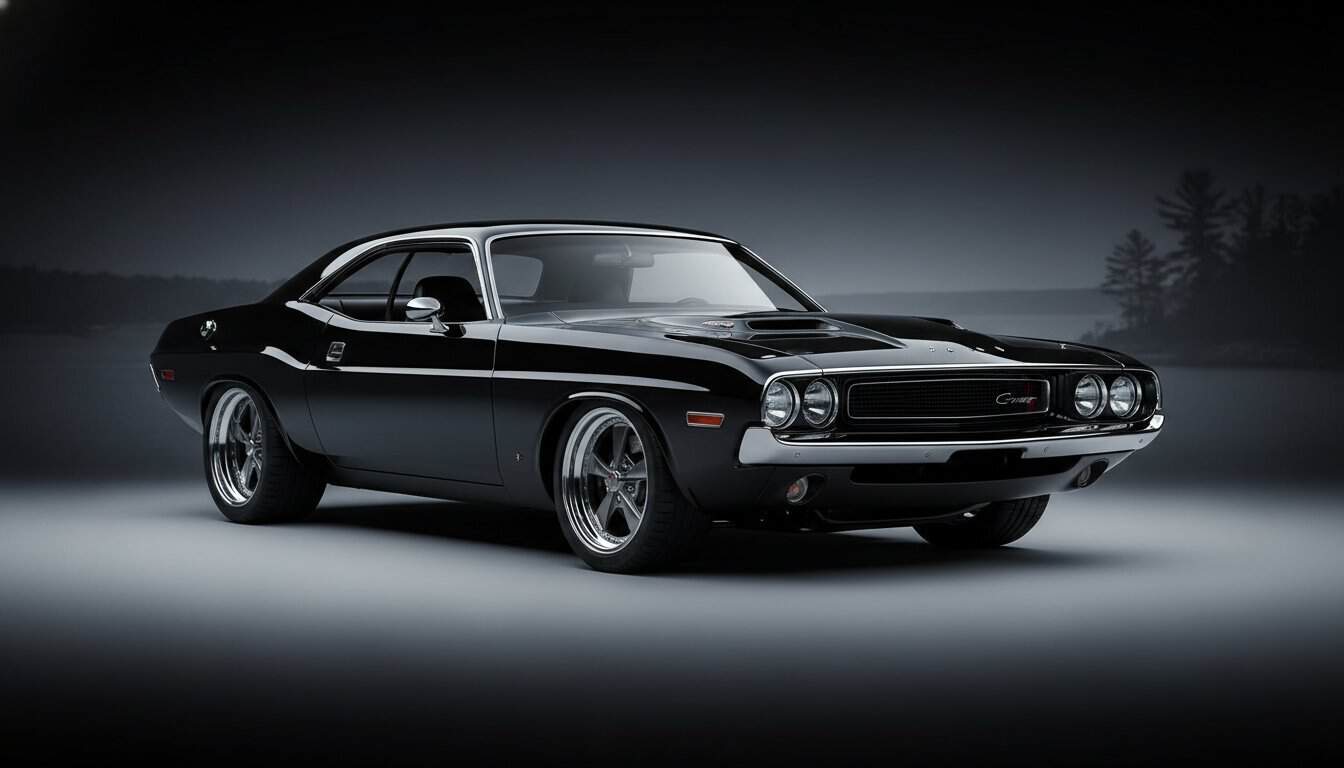
The factory-spec 1970 Dodge Challenger is a visual masterpiece, but its mechanical reality is often a 3,800-pound liability in modern traffic. You’ve likely felt that surge of adrenaline turn into a moment of pure panic when those original drum brakes fail to bite at 60 mph. It’s frustrating to own a piece of automotive history that you’re actually afraid to drive because the steering feels disconnected and rare trim parts are impossible to find.
At The Restomod Academy, we believe your car should perform as well as it looks. We’re going to hand you the keys to a modern transformation, starting with a comprehensive roadmap for a 485-horsepower Gen III Hemi swap. You’ll discover which specific suspension kits finally eliminate that infamous Mopar body roll and gain the technical confidence to tackle your project head-on. This guide breaks down complex fabrication and wiring into logical steps, ensuring your build is as safe as it is fast. Let’s move past the era of vintage compromises and start your journey toward a build that sets a new standard for Mopar excellence.
Key Takeaways
- Evaluate the leap from vintage blocks to Gen III Hemi power, selecting the perfect modern engine to anchor your high-performance vision.
- Eliminate the legendary “boat” feel by mastering the transition to coilover suspension for modern handling and braking precision.
- Discover how to seamlessly integrate digital technology into the 1970 dodge challenger cockpit without sacrificing its iconic vintage aesthetic.
- Develop a professional blueprint for your build that balances ambitious performance goals with a realistic restomod budget for 2026.
- Analyze the styling cues that make the E-body an icon to ensure every modification honors the aggressive stance of this Mopar legend.
The 1970 Dodge Challenger: Why This Mopar Remains an Icon
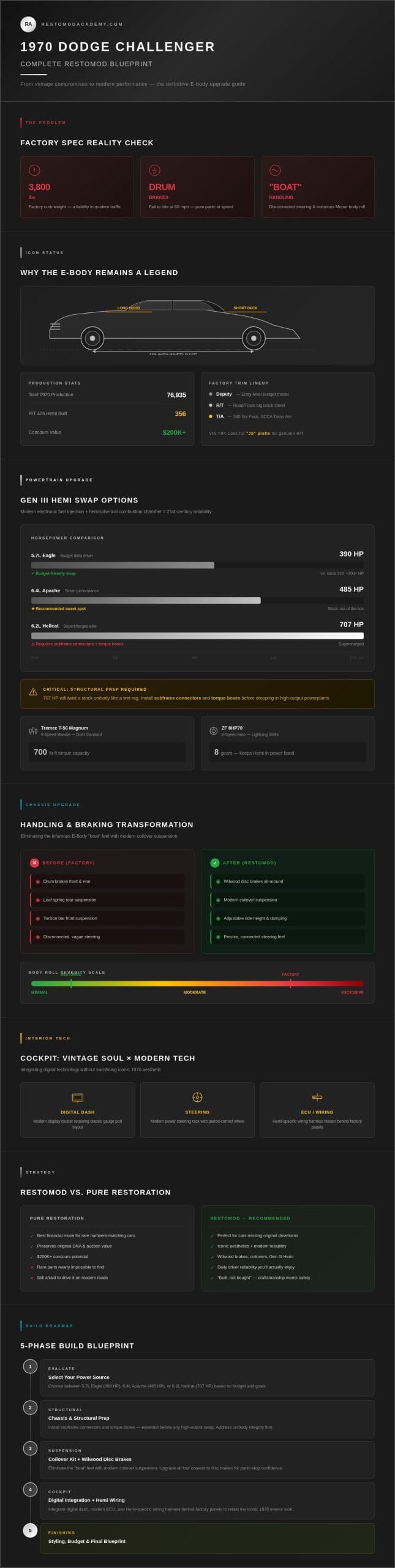
The 1970 dodge challenger arrived late to the party, but it made the loudest entrance. While Ford and Chevy had been battling for pony car supremacy since 1964 and 1967, Chrysler waited until the 1970 model year to launch its E-body contender. This delay allowed Dodge designers to perfect a silhouette that still defines the muscle car era. You can’t ignore the aggressive stance, created by a 110-inch wheelbase and that unmistakable long hood paired with a short rear deck. It didn’t just compete; it dominated the visual landscape of the American highway with a wider, more muscular presence than its Plymouth Barracuda cousin.
Study the 1970 Dodge Challenger history and you’ll see a lineup built for every type of driver. The Deputy served as the entry point for the budget-conscious, while the R/T (Road/Track) brought heavy-hitting big blocks to the street. For those craving racing pedigree, the T/A offered a 340 Six Pack engine and side-exit exhaust designed specifically for SCCA Trans Am competition. This variety ensured the Challenger wasn’t just a car; it was a customizable performance platform right from the factory floor. Look at the sheet metal and you’ll find a masterclass in automotive design, from the deeply recessed grille to the flush-mounted door handles.
To better understand the raw appeal of these machines, watch this helpful video showcasing a legendary T/A model:
Historical Significance and Market Value
Collectors prize the 1970 model year because it represents the peak of Mopar performance before emissions regulations stifled horsepower in 1971. Total production reached 76,935 units, but rarity varies wildly by engine code. A base slant-six car is a common find, yet only 356 R/T hardtops left the factory with a 426 Hemi. This scarcity drives current market trends. While a pristine, concours-level restoration can fetch over $200,000 at auction, a solid project car provides the perfect canvas for your own vision. Focus on the “JS” VIN prefix if you’re hunting for a true R/T, as these remain the most sought-after investments for serious builders.
Restomod vs. Pure Restoration: Making the Choice
Deciding between a factory-correct build and a modern upgrade requires a clear strategy. If you find a rare, numbers-matching 1970 dodge challenger, preserving its original DNA is often the best financial move. However, most enthusiasts face a different reality. Many survivors lack their original drivetrains, making them the ideal candidates for what is a restomod. You can keep the iconic aesthetics while integrating Wilwood disc brakes, modern coilover suspension, and a Gen III Hemi. This path lets you enjoy the soul of a classic with the reliability of a daily driver. Don’t let the fear of “ruining” a classic stop you from building a machine you can actually drive. The “built, not bought” philosophy thrives here, where craftsmanship meets modern safety.
Modern Power: Gen III Hemi Swaps for the 1970 Challenger
Ditching the original 318 or 440 big block is a bold move, but the benefits of modern Hemi architecture are undeniable. You gain the reliability of electronic fuel injection and the efficiency of a hemispherical combustion chamber designed for the 21st century. Choose the 5.7L Eagle for a budget-friendly 390 horsepower daily driver, or step up to the 6.4L Apache for 485 horsepower straight out of the box. For those chasing elite performance, the 6.2L Supercharged Hellcat delivers a staggering 707 horsepower. This level of output will twist a stock 1970 dodge challenger unibody like a wet rag. You must install subframe connectors and torque boxes to maintain structural integrity before dropping in these modern powerplants.
Pairing this power requires a gearbox that won’t shred under load. The Tremec T-56 Magnum 6-speed manual is the gold standard for three-pedal setups, offering a torque capacity of 700 lb-ft. If you prefer an automatic, the ZF-sourced 8HP70 8-speed offers lightning-fast shifts that keep the Hemi in its power band. Look at the “Reverence” build featured on DodgeGarage, which serves as a prime example of a modern Mopar restomod that pushes these boundaries. Before you start turning wrenches, make sure you understand the core philosophy of what is a restomod to keep your project on track.
The Gen III Hemi Swap Roadmap
Start with the foundation. You’ll need Gen III-specific motor mounts and a mid-sump oil pan from manufacturers like Milodon or Holley to clear the factory K-member. TTI headers are the industry standard for squeezing these wide engines into the tight engine bay of the 1970 dodge challenger. Your fuel system needs an upgrade to a high-pressure EFI setup capable of maintaining a steady 58 psi. Cooling is equally critical; a 700+ horsepower Hellcat generates massive thermal loads that require a high-capacity aluminum radiator and dual 12-inch electric fans to prevent heat soak.
Wiring and ECU Management
Don’t let the electronics intimidate you. Mopar “Crate Hemi” kits offer a plug-and-play experience that simplifies the wiring harness into a few key connections. For builders who want total control over fuel maps and timing, standalone ECUs like the Holley Terminator X Max provide the flexibility to tune for specific modifications. These systems manage everything from drive-by-wire throttle bodies to variable cam timing with precision. Adhering to the “Mopar or No Car” philosophy in a modern context means honoring the heritage of the classic E-body while demanding the surgical performance and reliability of 21st-century engineering.
Handling and Braking: Fixing the Vintage E-Body “Boat” Feel
You love the aggressive silhouette of the 1970 dodge challenger, but driving a stock survivor often feels like piloting a barge in a heavy swell. The original torsion bar suspension was a clever space-saving solution for the engine bay, yet it creates a vague, disconnected feeling at high speeds. If you want to push your Mopar through a canyon road without white-knuckling the steering wheel, you need to move beyond 1970s technology. Modernizing the footwork of an E-body isn’t just about comfort; it’s about making the car predictable and safe under the pressure of a high-horsepower build.
The official history of the 1970 Challenger reveals a car designed for the drag strip and the boulevard, not the autocross track. To fix this, a coilover conversion is your most effective weapon. Swapping those dated torsion bars for adjustable coilovers allows you to fine-tune your ride height and spring rates with surgical precision. This upgrade eliminates the “nose-dive” during hard braking and keeps the car flat through tight corners. When you combine this with a set of 18 or 19-inch wheels wrapped in 275mm or wider performance tires, the transformation is immediate. You’ll gain a planted stance and the mechanical grip necessary to handle modern traffic speeds.
Suspension Geometry and Chassis Stiffening
Chassis flex is the silent enemy of the 1970 dodge challenger. Because these are unibody cars, the middle of the chassis tends to twist under torque. You must install weld-in subframe connectors to tie the front and rear frame rails together. This simple addition increases torsional rigidity by over 50 percent, ensuring your suspension actually does its job instead of the body acting like a giant spring. For the ultimate setup, ditch the factory stamped-steel components for a tubular K-member. This reduces front-end weight by up to 40 pounds and provides vastly improved suspension geometry. For a deeper dive into these technical specifications, check out our suspension upgrades for cars guide.
Steering and Braking Upgrades
Vague steering is a hallmark of the vintage E-body experience. The original recirculating ball power steering boxes often have several inches of “dead zone” at the center. Converting to a modern rack-and-pinion system provides a 15:1 or 14:1 steering ratio, giving you the razor-sharp feedback of a modern sports car. Stopping power is equally critical. If you’re running a 500-plus horsepower engine, those factory drums or small discs won’t cut it. You need a big brake kit featuring 14-inch rotors and 6-piston calipers from Wilwood or Baer. These systems provide consistent, fade-free stopping power. When selecting your kit, match your master cylinder bore size to your pedal assembly. A 1-inch bore is typically ideal for manual setups, while power-assisted systems require a larger 1.125-inch bore to maintain a firm, responsive pedal feel.
The 1970 Cockpit: Blending Vintage Style with Modern Tech
The interior of your 1970 dodge challenger is where the connection between driver and machine becomes tangible. Don’t sacrifice the soul of the E-body by gutting it for a generic modern setup. Instead, focus on a stealth approach. Start with the iconic Rallye dash. You can keep the original four-pod layout while swapping the mechanical internals for digital gauges from manufacturers like Dakota Digital. These units communicate directly with a Gen III Hemi ECU via CAN bus, giving you pinpoint accuracy without ruining the 1970 aesthetic.
Seating is your next priority. Original buckets look great but offer zero lateral support during spirited cornering. Look for frames that utilize the original floor bolt patterns but feature aggressive 4-inch bolsters. These provide the support of a modern sports car while maintaining a footprint that fits the tight cabin. For climate control, dump the vacuum-operated factory heater. Install a compact, electronic system. These units are 30% smaller than the original boxes, freeing up space behind the dash while ensuring your cabin stays at a crisp 68 degrees during 2026 summers.
Silence the road before you crank the engine. Apply a 2mm thick butyl-based vibration dampener across the entire floor pan and roof skin. Layering this with a 1/2-inch closed-cell foam liner can reduce cabin noise by up to 12 decibels. This creates the foundation for a luxury restomod feel that separates a simple project from a professional build.
Modern Comfort in a Classic Shell
Sourcing the right materials is critical for authenticity. Use automotive-grade leather that features the same Boar Grain texture found in high-trim 1970 models. This keeps the visual heritage intact while providing the scent and feel of a modern exotic. For audio, hide a Bluetooth-controlled amplifier behind the glovebox. You can stream high-fidelity audio directly from your phone, leaving the original thumb-wheel radio in the dash for looks. If you need more inspiration, check out our restomod guide to see how others balance these elements.
Digital Integration and Custom Fabrication
Integrating a Gen III Hemi requires a dash that speaks its language. Use a digital interface that plugs into the OBD-II port to monitor oil pressure, coolant temp, and intake air temperatures in real-time. If you’ve upgraded to a modern TKX 5-speed or an 8HP70 automatic, the stock console won’t fit. Fabricate a custom center section that houses the new shifter and adds functional cup holders. Finally, swap your exterior lighting for LED conversions. Modern LED boards for 1970 dodge challenger tail lights are 200% brighter than incandescent bulbs and fire instantly, improving safety without changing the car’s iconic silhouette.
Blueprinting Your Build: Planning the 1970 Challenger Project
Every legendary 1970 dodge challenger starts with a clear vision. You must decide if your build is a weekend street cruiser, a corner-carving pro-tourer, or a dedicated track monster. This choice dictates every component you buy. Street cruisers prioritize sound deadening and modern air conditioning. Pro-touring builds require a heavy focus on suspension geometry and braking performance. Dedicated track monsters demand roll cages and fuel cells. Pick your lane early to avoid wasting thousands of dollars on incompatible parts.
Finding the right donor car is your first major hurdle. Inspect the rear quarters, trunk floor, and cowl area with extreme care. These are notorious rust spots for Mopar E-bodies. Replacing a full quarter panel can take 40 hours of professional labor. If the frame rails are soft or show signs of previous poor repairs, walk away. The “Built, Not Bought” mentality is the heartbeat of the Restomod Academy. It’s about the grit in the garage and the pride of craftsmanship. Joining our community gives you access to a brotherhood of builders who’ve already solved the technical problems you’ll face.
Budgeting and Time Management
By 2026, a high-end Mopar restomod can easily exceed a $120,000 investment. The “Mopar Tax” is a real factor you can’t ignore. Expect to pay 25% more for E-body trim and interior pieces compared to GM or Ford equivalents. Divide your project into three distinct phases: chassis and powertrain, body and paint, then interior and final assembly. This prevents “project creep” and helps you manage cash flow effectively. Use a dedicated project management tool to track every bolt and hour spent in the garage to stay on schedule.
Professional Resources and Consultation
Know your limits before you start cutting metal. You can likely handle the wiring and bolt-on parts, but you should leave complex chassis fabrication to the pros. Use our blueprints to communicate clearly with your local shop. This ensures they follow your vision without costly misunderstandings. Before you turn that first wrench on your 1970 dodge challenger, verify you have the recommended gear and a climate-controlled space. A clean, organized shop is the foundation of a successful build. Follow this final checklist:
- Secure a title-cleared donor car with solid frame rails and a straight pillars.
- Finalize your engine and transmission choice to ensure the tunnel fits.
- Establish a dedicated bank account to track every cent of the build.
- Inventory your tools and upgrade your welding equipment if necessary.
Take the Wheel of Your 1970 Challenger Project
Building a 1970 dodge challenger is about more than just restoration; it’s about engineering a legacy that performs as well as it looks. You’ve seen how a Gen III Hemi swap replaces the 1970-era iron with 485 horsepower or more of fuel-injected reliability. We’ve addressed the E-body’s notorious weight distribution by modernizing the suspension geometry to eliminate that 50-year-old “boat” feel. Success in the garage starts with a rigid blueprint that accounts for every wiring harness and fabrication detail before the first bolt turns. Don’t settle for a trailer queen when you can build a street-shredding masterpiece.
The Restomod Academy provides the expert-led blueprints and step-by-step Gen III Hemi swap tutorials you need to succeed. You’ll join a community of professional builders dedicated to the “built, not bought” philosophy. Grab your tools and prepare to transform your vision into steel and speed. Your journey from enthusiast to master builder starts with a single, calculated step. We’re here to ensure every turn of the wrench brings you closer to the perfect drive.
Start your 1970 Challenger build with The Ultimate Restomod Guide
Frequently Asked Questions
Is a 1970 Dodge Challenger a good investment as a restomod?
Yes, a 1970 Dodge Challenger represents a premier investment because demand for E-body Mopars remains at an all-time high. Hagerty’s 2024 valuation tools indicate that high-quality restomods often sell for 150% of their original build cost at major auctions. You’re building more than a car; you’re securing a tangible asset. Focus on high-quality fabrication to ensure your project retains its market value for decades.
What is the most powerful engine you can put in a 1970 Challenger?
The Mopar Hellephant 426 Supercharged Crate Engine stands as the most powerful “plug and play” option available today. It delivers exactly 1,000 horsepower and 950 lb-ft of torque straight from the crate. Installing this beast requires a heavy-duty cooling system and a reinforced drivetrain. It’s the ultimate way to bring 21st-century violence to your classic 1970 Dodge Challenger project.
How much does it cost to restomod a 1970 Dodge Challenger in 2026?
High-end professional builds for 2026 are projected to cost between $175,000 and $300,000 based on current inflation and labor trends reported by SEMA. This budget covers a complete rotisserie restoration, a modern HEMI powertrain, and bespoke interior work. If you’re performing the labor yourself, expect to spend at least $60,000 on high-quality components and materials. Precision costs money, so plan your budget meticulously before turning the first wrench.
Can I install a modern Hellcat engine in a stock 1970 Challenger chassis?
You cannot safely install a 707-horsepower Hellcat engine into a factory-spec chassis without significant structural upgrades. The original 1970 unibody lacks the torsional rigidity to handle modern torque loads. You must install subframe connectors and torque boxes to prevent the body from twisting. Most builders opt for a full aftermarket chassis from companies like Roadster Shop to provide a stable foundation for that modern power.
What are the common rust areas on a 1970 Dodge Challenger?
Inspect the lower rear quarter panels, the trunk floor, and the windshield cowl area for hidden rot. Data from Mopar restoration specialists suggests that 85% of original E-bodies require metal replacement in the rear wheel wells. Don’t ignore the floor pans or the battery tray area either. Grab a magnet and a flashlight to verify the integrity of the steel before you commit to a purchase.
Are 1970 Dodge Challenger parts still being manufactured?
Yes, the aftermarket support for this platform is massive, with companies like Auto Metal Direct (AMD) manufacturing 95% of the necessary body steel. You can practically build a new car from a catalog today. From wiring harnesses by American Autowire to complete interior kits from Legendary Auto Interiors, parts availability is not an issue. This accessibility makes the build an ideal candidate for a long-term restoration.
What is the difference between a Challenger R/T and a Challenger T/A?
The R/T (Road/Track) was the high-performance street variant, while the T/A (Trans Am) was a limited-run homologation special built for SCCA racing. Dodge only produced 2,399 T/A models in 1970, featuring a unique 340 Six-Pack engine and side-exit exhausts. The R/T models offered larger engine options like the 440 Magnum or the 426 Hemi. Choose the T/A for agility or the R/T for raw straight-line dominance.
How long does a full restomod project typically take?
A comprehensive restomod project requires between 1,500 and 2,500 man-hours of dedicated labor. For a solo builder working on weekends, this timeline usually stretches across 24 to 48 months. Professional shops might complete the task in 12 months, but quality takes time. Respect the process and don’t rush the assembly phase. Every hour you spend on the details ensures a safer, more reliable machine when you finally hit the road.
The factory-spec 1970 Dodge Challenger is a visual masterpiece, but its mechanical reality is often a 3,800-pound liability in modern traffic. You’ve likely felt that surge of adrenaline turn into a moment of pure panic when those original drum brakes fail to bite at 60 mph. It’s frustrating to own a piece of automotive history that you’re actually afraid to drive because the steering feels disconnected and rare trim parts are impossible to find.
At The Restomod Academy, we believe your car should perform as well as it looks. We’re going to hand you the keys to a modern transformation, starting with a comprehensive roadmap for a 485-horsepower Gen III Hemi swap. You’ll discover which specific suspension kits finally eliminate that infamous Mopar body roll and gain the technical confidence to tackle your project head-on. This guide breaks down complex fabrication and wiring into logical steps, ensuring your build is as safe as it is fast. Let’s move past the era of vintage compromises and start your journey toward a build that sets a new standard for Mopar excellence.
Key Takeaways
- Evaluate the leap from vintage blocks to Gen III Hemi power, selecting the perfect modern engine to anchor your high-performance vision.
- Eliminate the legendary “boat” feel by mastering the transition to coilover suspension for modern handling and braking precision.
- Discover how to seamlessly integrate digital technology into the 1970 dodge challenger cockpit without sacrificing its iconic vintage aesthetic.
- Develop a professional blueprint for your build that balances ambitious performance goals with a realistic restomod budget for 2026.
- Analyze the styling cues that make the E-body an icon to ensure every modification honors the aggressive stance of this Mopar legend.
The 1970 Dodge Challenger: Why This Mopar Remains an Icon
The 1970 dodge challenger arrived late to the party, but it made the loudest entrance. While Ford and Chevy had been battling for pony car supremacy since 1964 and 1967, Chrysler waited until the 1970 model year to launch its E-body contender. This delay allowed Dodge designers to perfect a silhouette that still defines the muscle car era. You can’t ignore the aggressive stance, created by a 110-inch wheelbase and that unmistakable long hood paired with a short rear deck. It didn’t just compete; it dominated the visual landscape of the American highway with a wider, more muscular presence than its Plymouth Barracuda cousin.
Study the 1970 Dodge Challenger history and you’ll see a lineup built for every type of driver. The Deputy served as the entry point for the budget-conscious, while the R/T (Road/Track) brought heavy-hitting big blocks to the street. For those craving racing pedigree, the T/A offered a 340 Six Pack engine and side-exit exhaust designed specifically for SCCA Trans Am competition. This variety ensured the Challenger wasn’t just a car; it was a customizable performance platform right from the factory floor. Look at the sheet metal and you’ll find a masterclass in automotive design, from the deeply recessed grille to the flush-mounted door handles.
To better understand the raw appeal of these machines, watch this helpful video showcasing a legendary T/A model:
Historical Significance and Market Value
Collectors prize the 1970 model year because it represents the peak of Mopar performance before emissions regulations stifled horsepower in 1971. Total production reached 76,935 units, but rarity varies wildly by engine code. A base slant-six car is a common find, yet only 356 R/T hardtops left the factory with a 426 Hemi. This scarcity drives current market trends. While a pristine, concours-level restoration can fetch over $200,000 at auction, a solid project car provides the perfect canvas for your own vision. Focus on the “JS” VIN prefix if you’re hunting for a true R/T, as these remain the most sought-after investments for serious builders.
Restomod vs. Pure Restoration: Making the Choice
Deciding between a factory-correct build and a modern upgrade requires a clear strategy. If you find a rare, numbers-matching 1970 dodge challenger, preserving its original DNA is often the best financial move. However, most enthusiasts face a different reality. Many survivors lack their original drivetrains, making them the ideal candidates for what is a restomod. You can keep the iconic aesthetics while integrating Wilwood disc brakes, modern coilover suspension, and a Gen III Hemi. This path lets you enjoy the soul of a classic with the reliability of a daily driver. Don’t let the fear of “ruining” a classic stop you from building a machine you can actually drive. The “built, not bought” philosophy thrives here, where craftsmanship meets modern safety.
Modern Power: Gen III Hemi Swaps for the 1970 Challenger
Ditching the original 318 or 440 big block is a bold move, but the benefits of modern Hemi architecture are undeniable. You gain the reliability of electronic fuel injection and the efficiency of a hemispherical combustion chamber designed for the 21st century. Choose the 5.7L Eagle for a budget-friendly 390 horsepower daily driver, or step up to the 6.4L Apache for 485 horsepower straight out of the box. For those chasing elite performance, the 6.2L Supercharged Hellcat delivers a staggering 707 horsepower. This level of output will twist a stock 1970 dodge challenger unibody like a wet rag. You must install subframe connectors and torque boxes to maintain structural integrity before dropping in these modern powerplants.
Pairing this power requires a gearbox that won’t shred under load. The Tremec T-56 Magnum 6-speed manual is the gold standard for three-pedal setups, offering a torque capacity of 700 lb-ft. If you prefer an automatic, the ZF-sourced 8HP70 8-speed offers lightning-fast shifts that keep the Hemi in its power band. Look at the “Reverence” build featured on DodgeGarage, which serves as a prime example of a modern Mopar restomod that pushes these boundaries. Before you start turning wrenches, make sure you understand the core philosophy of what is a restomod to keep your project on track.
The Gen III Hemi Swap Roadmap
Start with the foundation. You’ll need Gen III-specific motor mounts and a mid-sump oil pan from manufacturers like Milodon or Holley to clear the factory K-member. TTI headers are the industry standard for squeezing these wide engines into the tight engine bay of the 1970 dodge challenger. Your fuel system needs an upgrade to a high-pressure EFI setup capable of maintaining a steady 58 psi. Cooling is equally critical; a 700+ horsepower Hellcat generates massive thermal loads that require a high-capacity aluminum radiator and dual 12-inch electric fans to prevent heat soak.
Wiring and ECU Management
Don’t let the electronics intimidate you. Mopar “Crate Hemi” kits offer a plug-and-play experience that simplifies the wiring harness into a few key connections. For builders who want total control over fuel maps and timing, standalone ECUs like the Holley Terminator X Max provide the flexibility to tune for specific modifications. These systems manage everything from drive-by-wire throttle bodies to variable cam timing with precision. Adhering to the “Mopar or No Car” philosophy in a modern context means honoring the heritage of the classic E-body while demanding the surgical performance and reliability of 21st-century engineering.
Handling and Braking: Fixing the Vintage E-Body “Boat” Feel
You love the aggressive silhouette of the 1970 dodge challenger, but driving a stock survivor often feels like piloting a barge in a heavy swell. The original torsion bar suspension was a clever space-saving solution for the engine bay, yet it creates a vague, disconnected feeling at high speeds. If you want to push your Mopar through a canyon road without white-knuckling the steering wheel, you need to move beyond 1970s technology. Modernizing the footwork of an E-body isn’t just about comfort; it’s about making the car predictable and safe under the pressure of a high-horsepower build.
The official history of the 1970 Challenger reveals a car designed for the drag strip and the boulevard, not the autocross track. To fix this, a coilover conversion is your most effective weapon. Swapping those dated torsion bars for adjustable coilovers allows you to fine-tune your ride height and spring rates with surgical precision. This upgrade eliminates the “nose-dive” during hard braking and keeps the car flat through tight corners. When you combine this with a set of 18 or 19-inch wheels wrapped in 275mm or wider performance tires, the transformation is immediate. You’ll gain a planted stance and the mechanical grip necessary to handle modern traffic speeds.
Suspension Geometry and Chassis Stiffening
Chassis flex is the silent enemy of the 1970 dodge challenger. Because these are unibody cars, the middle of the chassis tends to twist under torque. You must install weld-in subframe connectors to tie the front and rear frame rails together. This simple addition increases torsional rigidity by over 50 percent, ensuring your suspension actually does its job instead of the body acting like a giant spring. For the ultimate setup, ditch the factory stamped-steel components for a tubular K-member. This reduces front-end weight by up to 40 pounds and provides vastly improved suspension geometry. For a deeper dive into these technical specifications, check out our suspension upgrades for cars guide.
Steering and Braking Upgrades
Vague steering is a hallmark of the vintage E-body experience. The original recirculating ball power steering boxes often have several inches of “dead zone” at the center. Converting to a modern rack-and-pinion system provides a 15:1 or 14:1 steering ratio, giving you the razor-sharp feedback of a modern sports car. Stopping power is equally critical. If you’re running a 500-plus horsepower engine, those factory drums or small discs won’t cut it. You need a big brake kit featuring 14-inch rotors and 6-piston calipers from Wilwood or Baer. These systems provide consistent, fade-free stopping power. When selecting your kit, match your master cylinder bore size to your pedal assembly. A 1-inch bore is typically ideal for manual setups, while power-assisted systems require a larger 1.125-inch bore to maintain a firm, responsive pedal feel.
The 1970 Cockpit: Blending Vintage Style with Modern Tech
The interior of your 1970 dodge challenger is where the connection between driver and machine becomes tangible. Don’t sacrifice the soul of the E-body by gutting it for a generic modern setup. Instead, focus on a stealth approach. Start with the iconic Rallye dash. You can keep the original four-pod layout while swapping the mechanical internals for digital gauges from manufacturers like Dakota Digital. These units communicate directly with a Gen III Hemi ECU via CAN bus, giving you pinpoint accuracy without ruining the 1970 aesthetic.
Seating is your next priority. Original buckets look great but offer zero lateral support during spirited cornering. Look for frames that utilize the original floor bolt patterns but feature aggressive 4-inch bolsters. These provide the support of a modern sports car while maintaining a footprint that fits the tight cabin. For climate control, dump the vacuum-operated factory heater. Install a compact, electronic system. These units are 30% smaller than the original boxes, freeing up space behind the dash while ensuring your cabin stays at a crisp 68 degrees during 2026 summers.
Silence the road before you crank the engine. Apply a 2mm thick butyl-based vibration dampener across the entire floor pan and roof skin. Layering this with a 1/2-inch closed-cell foam liner can reduce cabin noise by up to 12 decibels. This creates the foundation for a luxury restomod feel that separates a simple project from a professional build.
Modern Comfort in a Classic Shell
Sourcing the right materials is critical for authenticity. Use automotive-grade leather that features the same Boar Grain texture found in high-trim 1970 models. This keeps the visual heritage intact while providing the scent and feel of a modern exotic. For audio, hide a Bluetooth-controlled amplifier behind the glovebox. You can stream high-fidelity audio directly from your phone, leaving the original thumb-wheel radio in the dash for looks. If you need more inspiration, check out our restomod guide to see how others balance these elements.
Digital Integration and Custom Fabrication
Integrating a Gen III Hemi requires a dash that speaks its language. Use a digital interface that plugs into the OBD-II port to monitor oil pressure, coolant temp, and intake air temperatures in real-time. If you’ve upgraded to a modern TKX 5-speed or an 8HP70 automatic, the stock console won’t fit. Fabricate a custom center section that houses the new shifter and adds functional cup holders. Finally, swap your exterior lighting for LED conversions. Modern LED boards for 1970 dodge challenger tail lights are 200% brighter than incandescent bulbs and fire instantly, improving safety without changing the car’s iconic silhouette.
Blueprinting Your Build: Planning the 1970 Challenger Project
Every legendary 1970 dodge challenger starts with a clear vision. You must decide if your build is a weekend street cruiser, a corner-carving pro-tourer, or a dedicated track monster. This choice dictates every component you buy. Street cruisers prioritize sound deadening and modern air conditioning. Pro-touring builds require a heavy focus on suspension geometry and braking performance. Dedicated track monsters demand roll cages and fuel cells. Pick your lane early to avoid wasting thousands of dollars on incompatible parts.
Finding the right donor car is your first major hurdle. Inspect the rear quarters, trunk floor, and cowl area with extreme care. These are notorious rust spots for Mopar E-bodies. Replacing a full quarter panel can take 40 hours of professional labor. If the frame rails are soft or show signs of previous poor repairs, walk away. The “Built, Not Bought” mentality is the heartbeat of the Restomod Academy. It’s about the grit in the garage and the pride of craftsmanship. Joining our community gives you access to a brotherhood of builders who’ve already solved the technical problems you’ll face.
Budgeting and Time Management
By 2026, a high-end Mopar restomod can easily exceed a $120,000 investment. The “Mopar Tax” is a real factor you can’t ignore. Expect to pay 25% more for E-body trim and interior pieces compared to GM or Ford equivalents. Divide your project into three distinct phases: chassis and powertrain, body and paint, then interior and final assembly. This prevents “project creep” and helps you manage cash flow effectively. Use a dedicated project management tool to track every bolt and hour spent in the garage to stay on schedule.
Professional Resources and Consultation
Know your limits before you start cutting metal. You can likely handle the wiring and bolt-on parts, but you should leave complex chassis fabrication to the pros. Use our blueprints to communicate clearly with your local shop. This ensures they follow your vision without costly misunderstandings. Before you turn that first wrench on your 1970 dodge challenger, verify you have the recommended gear and a climate-controlled space. A clean, organized shop is the foundation of a successful build. Follow this final checklist:
- Secure a title-cleared donor car with solid frame rails and a straight pillars.
- Finalize your engine and transmission choice to ensure the tunnel fits.
- Establish a dedicated bank account to track every cent of the build.
- Inventory your tools and upgrade your welding equipment if necessary.
Take the Wheel of Your 1970 Challenger Project
Building a 1970 dodge challenger is about more than just restoration; it’s about engineering a legacy that performs as well as it looks. You’ve seen how a Gen III Hemi swap replaces the 1970-era iron with 485 horsepower or more of fuel-injected reliability. We’ve addressed the E-body’s notorious weight distribution by modernizing the suspension geometry to eliminate that 50-year-old “boat” feel. Success in the garage starts with a rigid blueprint that accounts for every wiring harness and fabrication detail before the first bolt turns. Don’t settle for a trailer queen when you can build a street-shredding masterpiece.
The Restomod Academy provides the expert-led blueprints and step-by-step Gen III Hemi swap tutorials you need to succeed. You’ll join a community of professional builders dedicated to the “built, not bought” philosophy. Grab your tools and prepare to transform your vision into steel and speed. Your journey from enthusiast to master builder starts with a single, calculated step. We’re here to ensure every turn of the wrench brings you closer to the perfect drive.
Start your 1970 Challenger build with The Ultimate Restomod Guide
Frequently Asked Questions
Is a 1970 Dodge Challenger a good investment as a restomod?
Yes, a 1970 Dodge Challenger represents a premier investment because demand for E-body Mopars remains at an all-time high. Hagerty’s 2024 valuation tools indicate that high-quality restomods often sell for 150% of their original build cost at major auctions. You’re building more than a car; you’re securing a tangible asset. Focus on high-quality fabrication to ensure your project retains its market value for decades.
What is the most powerful engine you can put in a 1970 Challenger?
The Mopar Hellephant 426 Supercharged Crate Engine stands as the most powerful “plug and play” option available today. It delivers exactly 1,000 horsepower and 950 lb-ft of torque straight from the crate. Installing this beast requires a heavy-duty cooling system and a reinforced drivetrain. It’s the ultimate way to bring 21st-century violence to your classic 1970 Dodge Challenger project.
How much does it cost to restomod a 1970 Dodge Challenger in 2026?
High-end professional builds for 2026 are projected to cost between $175,000 and $300,000 based on current inflation and labor trends reported by SEMA. This budget covers a complete rotisserie restoration, a modern HEMI powertrain, and bespoke interior work. If you’re performing the labor yourself, expect to spend at least $60,000 on high-quality components and materials. Precision costs money, so plan your budget meticulously before turning the first wrench.
Can I install a modern Hellcat engine in a stock 1970 Challenger chassis?
You cannot safely install a 707-horsepower Hellcat engine into a factory-spec chassis without significant structural upgrades. The original 1970 unibody lacks the torsional rigidity to handle modern torque loads. You must install subframe connectors and torque boxes to prevent the body from twisting. Most builders opt for a full aftermarket chassis from companies like Roadster Shop to provide a stable foundation for that modern power.
What are the common rust areas on a 1970 Dodge Challenger?
Inspect the lower rear quarter panels, the trunk floor, and the windshield cowl area for hidden rot. Data from Mopar restoration specialists suggests that 85% of original E-bodies require metal replacement in the rear wheel wells. Don’t ignore the floor pans or the battery tray area either. Grab a magnet and a flashlight to verify the integrity of the steel before you commit to a purchase.
Are 1970 Dodge Challenger parts still being manufactured?
Yes, the aftermarket support for this platform is massive, with companies like Auto Metal Direct (AMD) manufacturing 95% of the necessary body steel. You can practically build a new car from a catalog today. From wiring harnesses by American Autowire to complete interior kits from Legendary Auto Interiors, parts availability is not an issue. This accessibility makes the build an ideal candidate for a long-term restoration.
What is the difference between a Challenger R/T and a Challenger T/A?
The R/T (Road/Track) was the high-performance street variant, while the T/A (Trans Am) was a limited-run homologation special built for SCCA racing. Dodge only produced 2,399 T/A models in 1970, featuring a unique 340 Six-Pack engine and side-exit exhausts. The R/T models offered larger engine options like the 440 Magnum or the 426 Hemi. Choose the T/A for agility or the R/T for raw straight-line dominance.
How long does a full restomod project typically take?
A comprehensive restomod project requires between 1,500 and 2,500 man-hours of dedicated labor. For a solo builder working on weekends, this timeline usually stretches across 24 to 48 months. Professional shops might complete the task in 12 months, but quality takes time. Respect the process and don’t rush the assembly phase. Every hour you spend on the details ensures a safer, more reliable machine when you finally hit the road.