
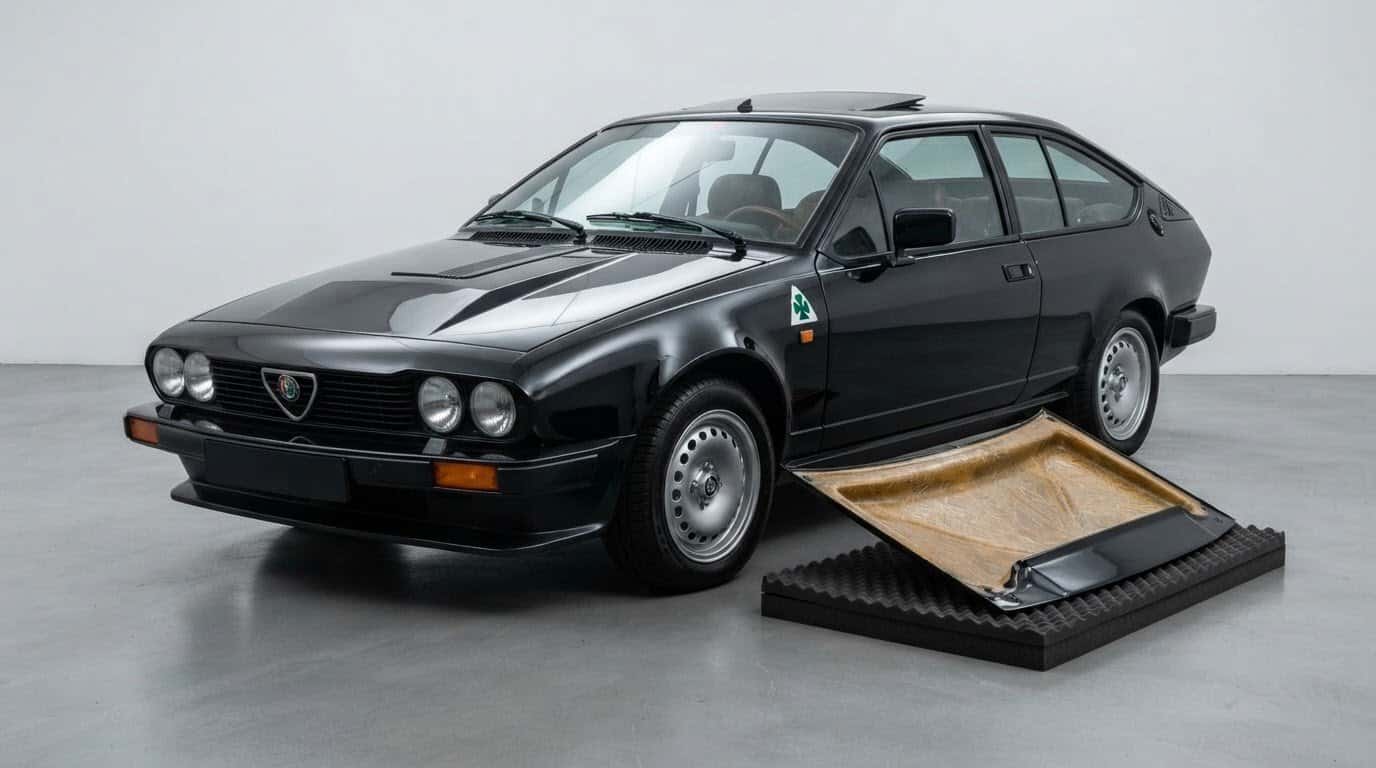
Strong Alfa Romeo GTV restomod inspiration starts with a clear choice: preserve the car’s original character or selectively update it. An original restoration aims to return the GTV to its former specification, while a restomod blends heritage design with considered changes. The 1300 Junior offers a distinctive design reference, and fibreglass panels present one route to reducing weight.
Let Alfa Romeo GTV restomod inspiration guide your decisions without dictating a single formula. The right approach depends on what you want from the finished car and which details matter most. Explore how Junior cues can shape the design, how restomod choices differ from a faithful restoration, and where fibreglass fits into a coherent build. Treat each modification as part of the whole, balancing classic presence with your performance goals.
Key Takeaways
- Decide whether your priority is returning the GTV to original specification or preserving its character while updating selected systems.
- Use the 1300 Junior as a design reference, then choose carefully which heritage details belong in your build.
- Consider fibreglass panels as one way to reduce weight, while treating fit and overall build balance as part of the decision.
- Compare restomod examples and upgrades to shape a coherent plan for the engine, suspension, drivetrain and styling.
Original restoration versus restomod changes
First decide whether your goal is preservation or reinterpretation. A faithful restoration brings an Alfa Romeo GTV closer to its factory specification, repairing the body and retaining original components where possible. A restomod preserves the classic identity while selectively changing mechanical or design elements. Make that distinction before removing or modifying parts.
For a matching-numbers restoration, one participant recommended properly repairing the GTV’s body and retaining its original colour. This approach prioritizes the car’s existing identity over personal redesign. Document the condition of the body, drivetrain, trim, and paint before setting the project scope. That record helps distinguish necessary repairs from optional modifications.
The featured 1975 Alfa Romeo GTV shows how a build can preserve key original hardware. It retains a rebuilt original 5-speed gearbox, even as other areas receive attention. Its original engine produces 130 bhp. Keeping the gearbox demonstrates that restomodding does not require replacing every period component.
Use the 1300 Junior as a reference point when shaping a GTV’s character. The original Alfa Romeo GTV 1300 Junior produced 89 horsepower, offering a distinct performance baseline within the model family. A builder can draw on that smaller-engined heritage through restrained styling or a focus on balanced road manners, without claiming the finished car is factory-original.
Before committing, divide the plan into three groups: preserve, repair, and modify. Preserve sound original pieces, repair worn or damaged parts, and modify only where the intended result justifies the change. The difference between a restoration and a restomod comes down to that deliberate balance. For an Alfa Romeo GTV restomod, inspiration should guide the choices, not replace a clear build plan.
Performance can also help define what should remain faithful and what a restomod aims to change. The original Alfa Romeo GTV has a top speed of around 120 mph and accelerates from 0 to 60 mph in 9.0 seconds. These figures offer a reference for considering the car’s character, rather than a requirement to improve every aspect of it. A build can retain the qualities that matter to its owner while making selective changes, with the original performance serving as context for the decisions.
Fibreglass panels and weight reduction
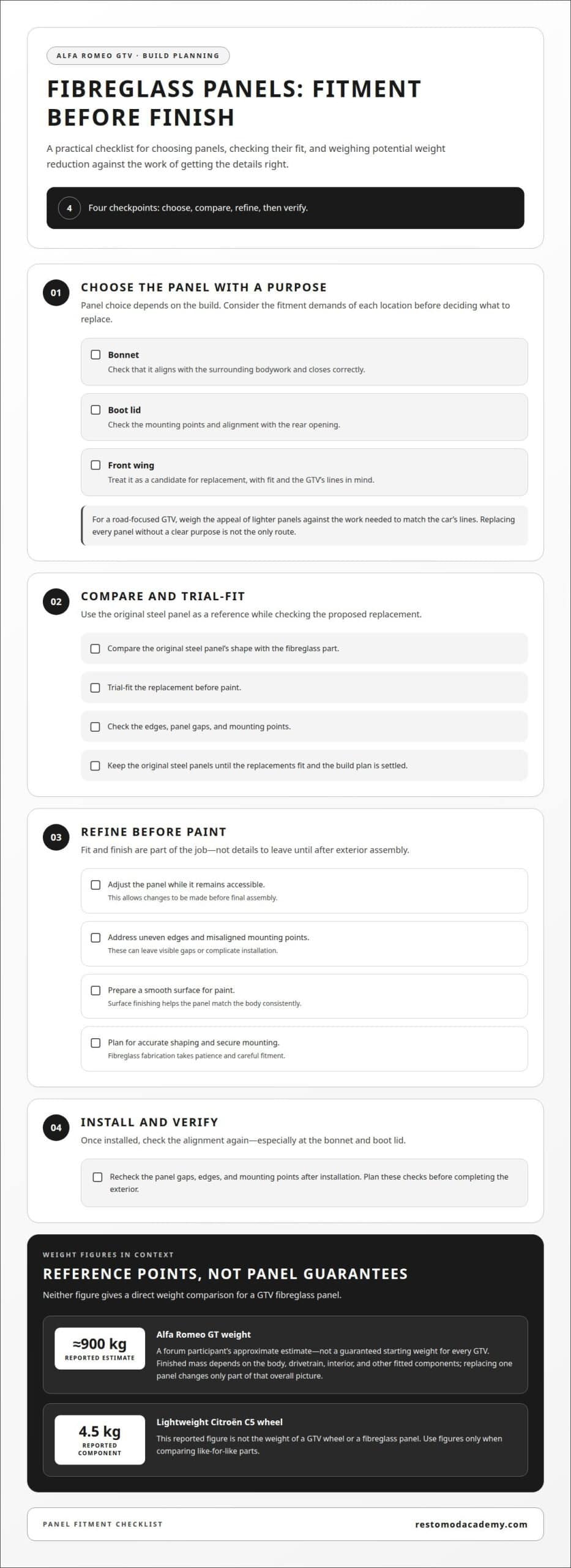
Fibreglass panels can reduce an Alfa Romeo GTV’s weight, but the outcome depends on which steel panels they replace and how well the finished parts fit. Key fabrication challenges include accurate shaping, secure mounting, consistent panel gaps, and a smooth surface ready for paint.
A forum participant estimated that the Alfa Romeo GT weighs approximately 900 kgs. Treat that as a project reference, not a guaranteed starting weight for every GTV. A finished car’s mass depends on its body, drivetrain, interior, and other fitted components. Replacing a panel only changes part of that overall picture.
Choose panel locations to suit the build’s purpose. A bonnet, boot lid, or front wing might be a candidate for replacement, but each brings different fitment demands. A bonnet must align with the surrounding bodywork and close correctly. A boot lid needs suitable mounting points and reliable alignment with the rear opening.
- Compare the original steel panel’s shape with the proposed fibreglass part.
- Trial-fit the replacement before paint, checking edges, gaps, and mounting points.
- Make necessary adjustments while the panel remains accessible.
- Recheck alignment after installation, especially around the bonnet and boot lid.
Fibreglass fabrication takes patience. Uneven edges can leave visible gaps, while misaligned mounting points can complicate installation. Surface preparation matters too: a panel may need finishing before it can be painted to match the GTV’s body consistently. Plan these steps before final assembly, not after completing the exterior.
Keep the original steel panels until the replacements fit and the build plan is settled. They preserve a useful reference for shape and attachment points. For a road-focused GTV, weigh the appeal of lighter panels against the work required to match the car’s lines. A thoughtful selection will usually serve the design better than replacing every panel without a clear purpose.
One reported component figure offers context, but not a direct panel comparison: a lightweight Citroën C5 wheel was described as weighing 4.5 kg. It does not establish the weight of any GTV wheel or fibreglass panel. Use such figures only when comparing like-for-like parts, and assess the completed build rather than assuming a single replacement determines the outcome.
What are examples of Alfa Romeo GTV restomod builds and their specifications?
Totem’s GTSuper Jarama takes the Alfa Romeo 105/115 coupe in a bold direction. Its twin-turbocharged 2.8-liter V6 comes from Italtecnica Engineering. The model commemorates the Alfa Romeo 1300 Junior’s victory at the 1972 Jarama 4 Hours endurance race. The Junior finished fourth overall. That history connects contemporary performance with a specific moment in the marque’s competition heritage.
A separate featured GTV build illustrates a more restrained approach to upgrades. Its original engine produced 130 bhp, while its upgraded engine produces 185 bhp. That represents more than 40% more power than its original factory output. The figures show how a build can retain the GTV’s familiar shape while making a substantial change beneath the bonnet.
Donor identity matters when comparing specifications. Photographs can help distinguish one build’s starting point from another’s. The featured GTV discussed in the earlier restoration example is a 1975 model. Keep those cars distinct when assessing their configurations; similar names do not mean identical starting points or specifications.
Drivetrain choices can shape the result as much as engine output. The featured upgraded GTV received a 2-litre rear axle with a Quaife limited-slip differential. Its owner also considered widening original Alfa Romeo 105 2000 GTV wheels to 14 x 6.5 inches. Those details show how builders can pair added power with changes to traction and wheel fitment.
Use these examples as contrasting project philosophies, not a parts checklist. Totem’s GTSuper Jarama combines a competition tribute with a twin-turbo V6, while the other GTV pairs an engine upgrade with a revised rear axle. Set priorities in sequence: choose the character, define the powertrain, then align supporting components. A 1973 Super 1300 donor, a 1975 GTV, and the 105/115 platform each point toward different build decisions.
What performance upgrades work well for an Alfa Romeo GTV restomod?
Assess the GTV’s condition before choosing performance parts. Worn suspension can undermine the benefits of added engine power, while tired bushes can affect the chassis’s response. One participant reported better Alfa handling after replacing worn suspension components with a fast-road kit. This example makes suspension condition a practical priority, not an afterthought.
Build around the road behaviour you want. For a responsive road car, consider the suspension as a system: springs, dampers, bushes, and alignment all influence how the Alfa Romeo turns and settles. Replacing just one worn component may leave the rest of the setup mismatched. Assess each part’s condition, then choose compatible upgrades for the GTV’s intended use.
Next, match braking and tyre choices to your powertrain plan. More engine output changes the demands on the rest of the car, so your upgrade list should account for stopping response and grip. Treat these systems as one package rather than isolated purchases. A balanced setup helps you make useful progress without letting one modification dictate the entire build.
For a measured project sequence, work through these decisions:
- Define whether the GTV is intended for relaxed road use or sharper fast-road driving.
- Inspect suspension components, springs, and bushes before selecting replacement parts.
- Choose a suspension setup that suits the planned power and handling character.
- Review braking and tyre requirements alongside the engine and chassis changes.
- Test the completed setup progressively, refining alignment and component choices as needed.
The fast-road kit example shows why a carefully chosen chassis upgrade can matter as much as a headline engine modification. Keep the Alfa Romeo’s intended character in view, and prioritize upgrades that work together. If you’re shaping a complete upgrade sequence, plan your GTV performance upgrades around the way you want the car to drive.
Restomod Academy
When you’re ready to turn GTV inspiration into a workable project plan, Restomod Academy’s educational resources can help you structure decisions around originality, body modifications, power, and handling. Keep each choice connected to your intended result.
The Ultimate Restomod Guide, Restomod Consulting Services, and Premium Project Blueprints offer different ways to develop your approach. Use them to build knowledge, work through project-specific decisions, or bring clearer structure to your planning. Choose the support that suits your stage, from early research to weighing major modifications or organizing a build direction.
Clarify your Alfa Romeo GTV goals and priorities before taking inspiration into the workshop. Contact Restomod Academy to discuss the next step for your project.
Make Your GTV Vision a Build Plan
Turn your Alfa Romeo GTV restomod inspiration into choices you can stand behind. Define the character you want the finished car to express, then shape the project around that goal. Every decision, from preserving a period detail to changing a component, should support the same vision.
Give the plan room to develop. A considered build isn’t a race to fit every upgrade; it’s an opportunity to understand the car’s systems and make each change with intent. Keep its heritage visible, choose performance upgrades that work together, and bring the design to life with your own hands.
When you’re ready to turn those ideas into a practical direction, contact Restomod Academy to discuss your project. The Ultimate Restomod Guide, Restomod Consulting Services, and Premium Project Blueprints can support different stages of planning. Choose your next step, then build with patience, precision, and a clear sense of what makes your GTV yours.
Frequently Asked Questions
How does an Alfa Romeo GTV restomod compare with a restored original or a restomod Porsche 911?
An Alfa Romeo GTV restomod retains the GTV’s 105/115-series identity while allowing selected updates; a restored original prioritizes factory specification. Compared with a restomod Porsche 911, the key distinction is the donor car and its engineering baseline, not a universal ranking. For either project, define the character you want, then assess how each proposed change affects fit, drivability, and period design.
What interior, exterior, and paint options suit an Alfa Romeo GTV restomod?
For a matching-numbers approach, retain the original colour and preserve sound original parts. For a restomod, use restrained 1300 Junior design cues and consider carefully fitted fibreglass panels for selected exterior parts.
Strong Alfa Romeo GTV restomod inspiration starts with a clear choice: preserve the car’s original character or selectively update it. An original restoration aims to return the GTV to its former specification, while a restomod blends heritage design with considered changes. The 1300 Junior offers a distinctive design reference, and fibreglass panels present one route to reducing weight.
Let Alfa Romeo GTV restomod inspiration guide your decisions without dictating a single formula. The right approach depends on what you want from the finished car and which details matter most. Explore how Junior cues can shape the design, how restomod choices differ from a faithful restoration, and where fibreglass fits into a coherent build. Treat each modification as part of the whole, balancing classic presence with your performance goals.
Key Takeaways
- Decide whether your priority is returning the GTV to original specification or preserving its character while updating selected systems.
- Use the 1300 Junior as a design reference, then choose carefully which heritage details belong in your build.
- Consider fibreglass panels as one way to reduce weight, while treating fit and overall build balance as part of the decision.
- Compare restomod examples and upgrades to shape a coherent plan for the engine, suspension, drivetrain and styling.
Original restoration versus restomod changes
First decide whether your goal is preservation or reinterpretation. A faithful restoration brings an Alfa Romeo GTV closer to its factory specification, repairing the body and retaining original components where possible. A restomod preserves the classic identity while selectively changing mechanical or design elements. Make that distinction before removing or modifying parts.
For a matching-numbers restoration, one participant recommended properly repairing the GTV’s body and retaining its original colour. This approach prioritizes the car’s existing identity over personal redesign. Document the condition of the body, drivetrain, trim, and paint before setting the project scope. That record helps distinguish necessary repairs from optional modifications.
The featured 1975 Alfa Romeo GTV shows how a build can preserve key original hardware. It retains a rebuilt original 5-speed gearbox, even as other areas receive attention. Its original engine produces 130 bhp. Keeping the gearbox demonstrates that restomodding does not require replacing every period component.
Use the 1300 Junior as a reference point when shaping a GTV’s character. The original Alfa Romeo GTV 1300 Junior produced 89 horsepower, offering a distinct performance baseline within the model family. A builder can draw on that smaller-engined heritage through restrained styling or a focus on balanced road manners, without claiming the finished car is factory-original.
Before committing, divide the plan into three groups: preserve, repair, and modify. Preserve sound original pieces, repair worn or damaged parts, and modify only where the intended result justifies the change. The difference between a restoration and a restomod comes down to that deliberate balance. For an Alfa Romeo GTV restomod, inspiration should guide the choices, not replace a clear build plan.
Performance can also help define what should remain faithful and what a restomod aims to change. The original Alfa Romeo GTV has a top speed of around 120 mph and accelerates from 0 to 60 mph in 9.0 seconds. These figures offer a reference for considering the car’s character, rather than a requirement to improve every aspect of it. A build can retain the qualities that matter to its owner while making selective changes, with the original performance serving as context for the decisions.
Fibreglass panels and weight reduction
Fibreglass panels can reduce an Alfa Romeo GTV’s weight, but the outcome depends on which steel panels they replace and how well the finished parts fit. Key fabrication challenges include accurate shaping, secure mounting, consistent panel gaps, and a smooth surface ready for paint.
A forum participant estimated that the Alfa Romeo GT weighs approximately 900 kgs. Treat that as a project reference, not a guaranteed starting weight for every GTV. A finished car’s mass depends on its body, drivetrain, interior, and other fitted components. Replacing a panel only changes part of that overall picture.
Choose panel locations to suit the build’s purpose. A bonnet, boot lid, or front wing might be a candidate for replacement, but each brings different fitment demands. A bonnet must align with the surrounding bodywork and close correctly. A boot lid needs suitable mounting points and reliable alignment with the rear opening.
- Compare the original steel panel’s shape with the proposed fibreglass part.
- Trial-fit the replacement before paint, checking edges, gaps, and mounting points.
- Make necessary adjustments while the panel remains accessible.
- Recheck alignment after installation, especially around the bonnet and boot lid.
Fibreglass fabrication takes patience. Uneven edges can leave visible gaps, while misaligned mounting points can complicate installation. Surface preparation matters too: a panel may need finishing before it can be painted to match the GTV’s body consistently. Plan these steps before final assembly, not after completing the exterior.
Keep the original steel panels until the replacements fit and the build plan is settled. They preserve a useful reference for shape and attachment points. For a road-focused GTV, weigh the appeal of lighter panels against the work required to match the car’s lines. A thoughtful selection will usually serve the design better than replacing every panel without a clear purpose.
One reported component figure offers context, but not a direct panel comparison: a lightweight Citroën C5 wheel was described as weighing 4.5 kg. It does not establish the weight of any GTV wheel or fibreglass panel. Use such figures only when comparing like-for-like parts, and assess the completed build rather than assuming a single replacement determines the outcome.
What are examples of Alfa Romeo GTV restomod builds and their specifications?
Totem’s GTSuper Jarama takes the Alfa Romeo 105/115 coupe in a bold direction. Its twin-turbocharged 2.8-liter V6 comes from Italtecnica Engineering. The model commemorates the Alfa Romeo 1300 Junior’s victory at the 1972 Jarama 4 Hours endurance race. The Junior finished fourth overall. That history connects contemporary performance with a specific moment in the marque’s competition heritage.
A separate featured GTV build illustrates a more restrained approach to upgrades. Its original engine produced 130 bhp, while its upgraded engine produces 185 bhp. That represents more than 40% more power than its original factory output. The figures show how a build can retain the GTV’s familiar shape while making a substantial change beneath the bonnet.
Donor identity matters when comparing specifications. Photographs can help distinguish one build’s starting point from another’s. The featured GTV discussed in the earlier restoration example is a 1975 model. Keep those cars distinct when assessing their configurations; similar names do not mean identical starting points or specifications.
Drivetrain choices can shape the result as much as engine output. The featured upgraded GTV received a 2-litre rear axle with a Quaife limited-slip differential. Its owner also considered widening original Alfa Romeo 105 2000 GTV wheels to 14 x 6.5 inches. Those details show how builders can pair added power with changes to traction and wheel fitment.
Use these examples as contrasting project philosophies, not a parts checklist. Totem’s GTSuper Jarama combines a competition tribute with a twin-turbo V6, while the other GTV pairs an engine upgrade with a revised rear axle. Set priorities in sequence: choose the character, define the powertrain, then align supporting components. A 1973 Super 1300 donor, a 1975 GTV, and the 105/115 platform each point toward different build decisions.
What performance upgrades work well for an Alfa Romeo GTV restomod?
Assess the GTV’s condition before choosing performance parts. Worn suspension can undermine the benefits of added engine power, while tired bushes can affect the chassis’s response. One participant reported better Alfa handling after replacing worn suspension components with a fast-road kit. This example makes suspension condition a practical priority, not an afterthought.
Build around the road behaviour you want. For a responsive road car, consider the suspension as a system: springs, dampers, bushes, and alignment all influence how the Alfa Romeo turns and settles. Replacing just one worn component may leave the rest of the setup mismatched. Assess each part’s condition, then choose compatible upgrades for the GTV’s intended use.
Next, match braking and tyre choices to your powertrain plan. More engine output changes the demands on the rest of the car, so your upgrade list should account for stopping response and grip. Treat these systems as one package rather than isolated purchases. A balanced setup helps you make useful progress without letting one modification dictate the entire build.
For a measured project sequence, work through these decisions:
- Define whether the GTV is intended for relaxed road use or sharper fast-road driving.
- Inspect suspension components, springs, and bushes before selecting replacement parts.
- Choose a suspension setup that suits the planned power and handling character.
- Review braking and tyre requirements alongside the engine and chassis changes.
- Test the completed setup progressively, refining alignment and component choices as needed.
The fast-road kit example shows why a carefully chosen chassis upgrade can matter as much as a headline engine modification. Keep the Alfa Romeo’s intended character in view, and prioritize upgrades that work together. If you’re shaping a complete upgrade sequence, plan your GTV performance upgrades around the way you want the car to drive.
Restomod Academy
When you’re ready to turn GTV inspiration into a workable project plan, Restomod Academy’s educational resources can help you structure decisions around originality, body modifications, power, and handling. Keep each choice connected to your intended result.
The Ultimate Restomod Guide, Restomod Consulting Services, and Premium Project Blueprints offer different ways to develop your approach. Use them to build knowledge, work through project-specific decisions, or bring clearer structure to your planning. Choose the support that suits your stage, from early research to weighing major modifications or organizing a build direction.
Clarify your Alfa Romeo GTV goals and priorities before taking inspiration into the workshop. Contact Restomod Academy to discuss the next step for your project.
Make Your GTV Vision a Build Plan
Turn your Alfa Romeo GTV restomod inspiration into choices you can stand behind. Define the character you want the finished car to express, then shape the project around that goal. Every decision, from preserving a period detail to changing a component, should support the same vision.
Give the plan room to develop. A considered build isn’t a race to fit every upgrade; it’s an opportunity to understand the car’s systems and make each change with intent. Keep its heritage visible, choose performance upgrades that work together, and bring the design to life with your own hands.
When you’re ready to turn those ideas into a practical direction, contact Restomod Academy to discuss your project. The Ultimate Restomod Guide, Restomod Consulting Services, and Premium Project Blueprints can support different stages of planning. Choose your next step, then build with patience, precision, and a clear sense of what makes your GTV yours.
Frequently Asked Questions
How does an Alfa Romeo GTV restomod compare with a restored original or a restomod Porsche 911?
An Alfa Romeo GTV restomod retains the GTV’s 105/115-series identity while allowing selected updates; a restored original prioritizes factory specification. Compared with a restomod Porsche 911, the key distinction is the donor car and its engineering baseline, not a universal ranking. For either project, define the character you want, then assess how each proposed change affects fit, drivability, and period design.
What interior, exterior, and paint options suit an Alfa Romeo GTV restomod?
For a matching-numbers approach, retain the original colour and preserve sound original parts. For a restomod, use restrained 1300 Junior design cues and consider carefully fitted fibreglass panels for selected exterior parts.