
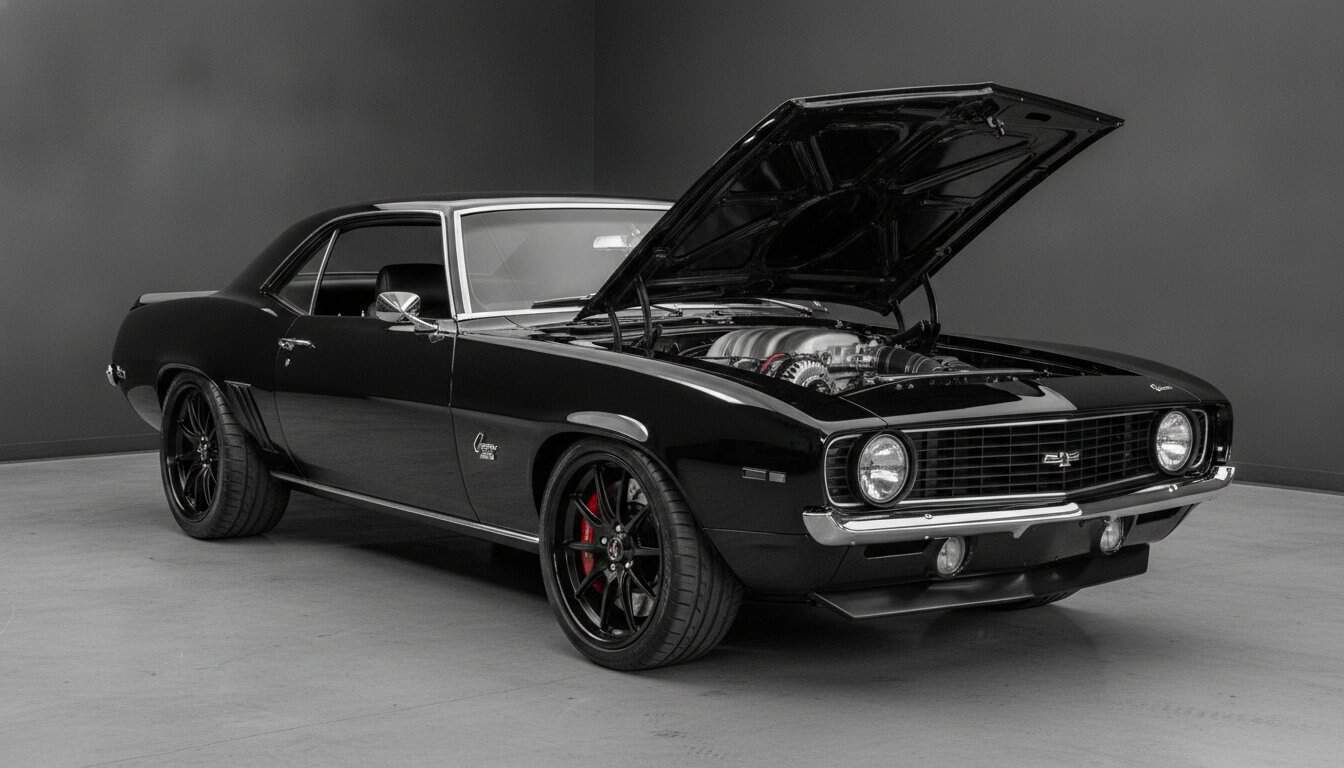
Why do we settle for the “it’s just a classic” excuse when our vintage machines fail us in modern traffic? Imagine turning the key on a crisp October morning and hearing your fuel-injected V8 bark to life instantly, every single time. If you want to know how to build a restomod for reliability, you have to stop thinking like a restorer and start thinking like an engineer. You love the heritage of these machines, but the constant anxiety of a breakdown or the fear of inadequate brakes can ruin the drive. You deserve a car that captures the nostalgia of 1965 while delivering the dependability of 2026.
This guide provides the systematic framework to bridge that gap. We will explore the essential blueprints for success, including why a $10,620 Chevrolet LS3 crate engine or a modern $15,000 drivetrain package is often the smartest investment for your peace of mind. By following a methodical approach to cooling, wiring, and suspension geometry, you’ll learn to eliminate vintage failure points. We are going to break down the high-impact upgrades that transform your project into a turn-key masterpiece, giving you the confidence to tackle long-distance tours with total precision.
Key Takeaways
- Shift your project mindset from chasing peak horsepower to prioritizing a robust mechanical infrastructure that ensures your classic car is ready for any journey.
- Master how to build a restomod for reliability by integrating modern electronic fuel injection and high-efficiency cooling systems that thrive in today’s stop-and-go traffic.
- Protect your vintage investment by replacing antiquated wiring with modern, fused electrical backbones that eliminate fire hazards and simplify troubleshooting.
- Upgrade your chassis with power disc brake conversions and precision bushings to achieve the predictable handling and stopping power required on contemporary roads.
- Utilize structured blueprints and expert mentorship to avoid the common pitfalls of trial-and-error, ensuring your project moves from the garage to the open road with precision.
Defining the Reliability-First Restomod Philosophy
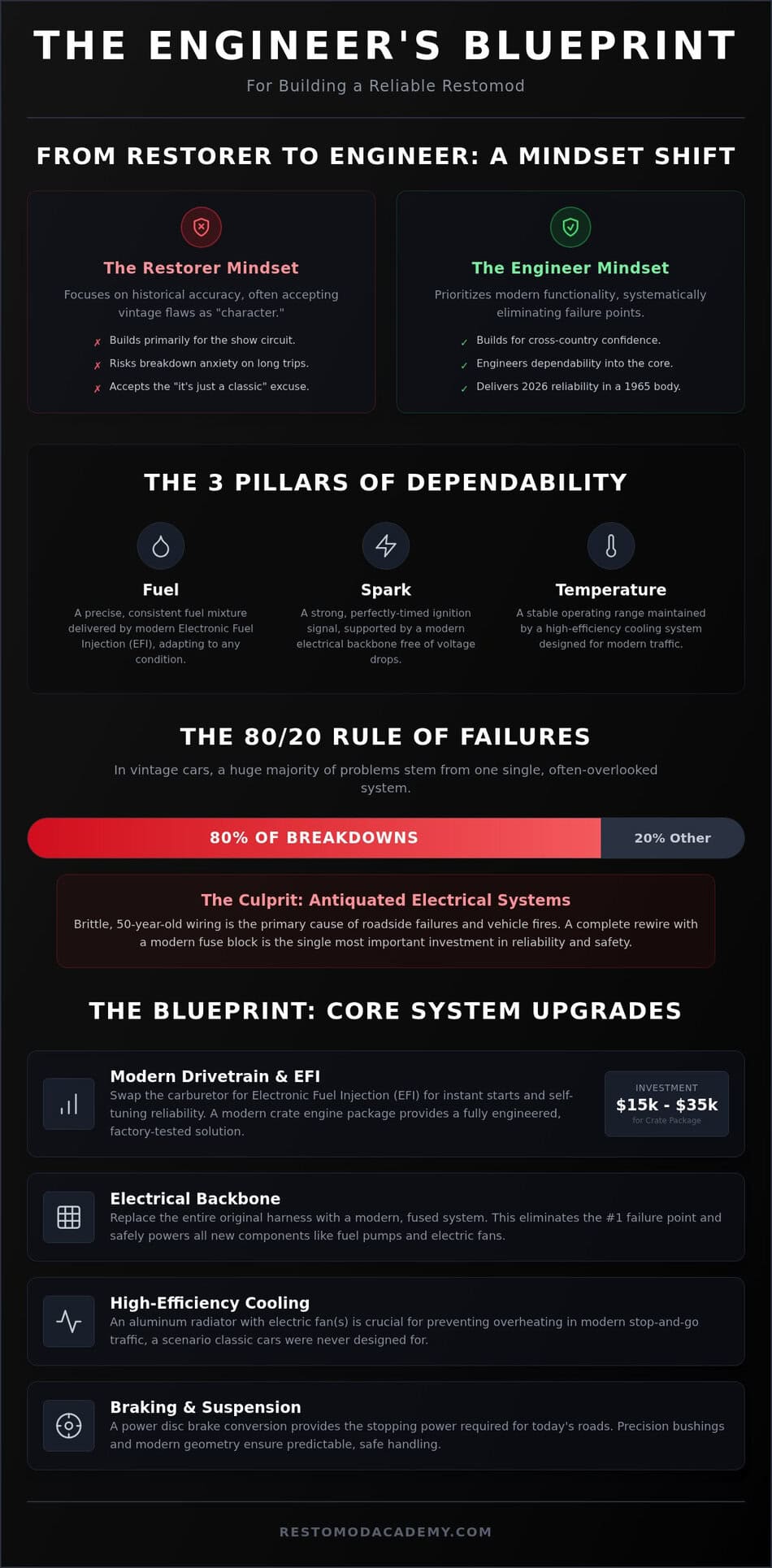
Restomodding is more than just swapping parts; it’s about a fundamental shift in how you view your vehicle. Many builders fall into the trap of buying shiny components without considering how they work together. True reliability is an engineered outcome. It’s the result of deliberate choices made during the assembly phase. While a traditional restoration focuses on historical accuracy, the Restomod Philosophy prioritizes modern functionality. If you are still asking what is a restomod, it is the marriage of vintage soul and contemporary heart. To understand how to build a restomod for reliability, you must first accept that a car designed for the show circuit is rarely the same car you’d trust for a cross-country tour.
Focus your energy on the three pillars of dependability: fuel, spark, and temperature. If your engine receives a precise fuel mixture, a strong ignition signal, and stays within a safe thermal range, it will run forever. High horsepower numbers look great on a dyno sheet, but consistent infrastructure performance is what gets you home. You want a machine that feels as steady on a highway at 70 mph as it does sitting in your driveway. This requires a transition from being a passive admirer of your car to becoming an active creator of its mechanical destiny.
Infrastructure vs. Performance Upgrades
It’s tempting to spend your budget on a high-lift camshaft that gives your engine a nasty lope at idle. However, for a reliable driver, a high-flow aluminum radiator is a far superior investment. You can’t enjoy a performance cam if you’re pulled over on the shoulder with steam billowing from the hood. Prioritize the systems that keep the engine running over the ones that simply make it go fast. This includes using modern Viton seals and high-quality gaskets. These small components prevent the classic drip on your garage floor and keep vital fluids where they belong, ensuring your garage stays clean and your engine stays lubricated.
The 80/20 Rule of Restomod Reliability
In the world of vintage machines, twenty percent of your car’s systems will cause eighty percent of your headaches. The electrical system is almost always the culprit. Brittle, fifty-year-old wires are the primary cause of roadside failures and, in worst-case scenarios, vehicle fires. When learning how to build a restomod for reliability, your first major move should be a complete rewire with a modern fuse block. This creates a stable foundation for everything else. You can maintain the heritage look of your interior while hiding modern mechanical integrity beneath the skin. It’s about building a car that respects its past but embraces a dependable future through methodical, logical steps.
Modernizing the Drivetrain for Turn-Key Dependability
Building a vintage car that starts on the first crank requires a departure from 1960s fuel delivery methods. If you want to master how to build a restomod for reliability, the drivetrain is where you must demand the most precision. You can’t trust a fifty-year-old carburetor to handle the varying ethanol content of modern fuels or the thin air of a mountain pass. Modernizing these systems isn’t just about convenience; it’s about engineering a vehicle that respects your time and effort. While a modern crate engine and transmission package generally falls between $15,000 and $35,000, the peace of mind it provides on a long-distance tour is invaluable.
The Case for Electronic Fuel Injection
Electronic Fuel Injection (EFI) is the single most effective way to achieve turn-key dependability. Unlike carburetors, EFI systems use sensors to adjust fuel delivery based on real-time data like air temperature and altitude. You can choose a simple throttle body injection for a classic look or a multi-port system for maximum efficiency. If you’re considering a complete heart transplant, our definitive guide to an LS engine swap covers how modern crate engines provide a factory-tested solution. Remember that these high-pressure systems require upgrading your muscle car’s electrical system to support the fuel pump and ECU without failure.
Cooling Infrastructure for the Modern World
Your classic was designed for open roads, not the gridlock of modern urban traffic. To prevent the dreaded overheat, swap your old copper-brass radiator for a high-capacity aluminum unit. These modern radiators offer superior heat dissipation in a lighter package. Pair this with thermostatically controlled electric fans that pull air through the core even when you’re at a dead stop. You should also upgrade your water pump to a high-flow model. This ensures that coolant moves through the block quickly enough to shed heat at low RPM, which is vital for maintaining engine health during a summer cruise. For a deeper look at the parts that make this possible, explore our recommended gear for professional-grade builds.
Transmission and Driveline Synergy
A reliable restomod must be comfortable at highway speeds. Installing a modern transmission with an overdrive gear reduces engine RPM by as much as 30 percent at 70 mph. This significantly lowers engine wear and internal heat. You must also match your rear-end gear ratio to your new transmission’s output for optimal performance. While you’re under the car, replace those crusty vintage U-joints with high-strength modern equivalents and have your driveshaft professionally balanced. This eliminates the vibrations that can slowly shake a build apart over time. When you follow The Ultimate Restomod Guide, you ensure every component in the driveline works in perfect harmony.
Overhauling the Electrical Backbone to Prevent Failures
Electrical failures are the silent killers of the classic car experience. While we focused on drivetrain modernization in the previous chapter, those high-tech components are useless if your wiring is a brittle, fifty-year-old fire hazard. Learning how to build a restomod for reliability requires you to treat the electrical system as the vehicle’s nervous system. It must be precise, protected, and powerful enough to support modern technology without compromise. By stripping away antiquated looms and starting fresh, you eliminate the primary cause of roadside breakdowns and vehicle fires.
Why You Must Replace the Entire Wiring Harness
Don’t fall for the trap of patching an old harness to save a few dollars. Half a century of heat cycles makes original copper brittle and turns vintage insulation into dust. A full replacement using a modern fuse block with blade-style fuses is a non-negotiable step for any serious builder. Vehicle-specific kits offer a streamlined installation, while universal harnesses provide the flexibility needed for custom layouts. These modern systems include dedicated, integrated circuits for accessories like power windows and EFI controllers, ensuring your vintage aesthetic doesn’t come with the risk of electrical smoke. Using our product reviews can help you identify which harness kits offer the best terminal quality for your specific project.
Modern Charging and High-Output Alternators
A factory 35-amp alternator was never designed to power electric cooling fans, high-intensity LED lights, or modern audio systems. You must upgrade to a 100-amp or higher alternator to maintain stable voltage across all systems, especially at idle. Pair this increased output with correctly sized battery cables, typically 2-gauge or larger, to ensure current flows without resistance. Switching to a high-torque mini-starter also provides a significant reliability boost. These units are smaller, more heat-resistant, and provide more cranking power than bulky original starters, ensuring your engine fires up even after a long, hot run.
The Science of Proper Grounding
Phantom electrical issues like flickering gauges, sensor noise, or erratic idling almost always stem from poor grounding. Establish a central ground point and ensure that the engine block, frame, and body all share a common, clean path back to the battery. Use modern weather-pack connectors to seal out the moisture and corrosion that inevitably plague vintage bullet connectors. This methodical approach to grounding guarantees that every circuit has a clean return path. It is this level of precision, often detailed in our Premium Project Blueprints, that transforms a temperamental classic into a machine with the dependable soul of a modern daily driver.
Suspension and Braking Systems for Predictable Control
Reliability on the road isn’t just about whether your engine starts; it’s about whether you can safely navigate a sudden stop in modern traffic. When you learn how to build a restomod for reliability, the chassis demands as much attention as the engine bay. Vintage cars were designed for bias-ply tires and empty highways. Today, you are surrounded by distracted drivers and high-grip radial tires. Your suspension and braking systems must be engineered to handle these modern stresses with total confidence. A reliable car is a predictable car, and that predictability starts where the rubber meets the road.
Disc Brake Conversions and Dual-Reservoir Masters
Replace your four-wheel drum brakes immediately. Drum brakes are prone to heat fade, which can leave you with a terrifyingly soft pedal after just a few hard stops in heavy traffic. Power disc conversions provide consistent, predictable stopping power that doesn’t disappear when the rotors get hot. You must also upgrade to a dual-reservoir master cylinder. Original single-pot units are a dangerous single point of failure; if one brake line leaks, you lose all braking force. A dual-reservoir system splits the front and rear circuits, ensuring you always have a way to bring the machine to a halt. Balancing your brake bias with an adjustable proportioning valve is the final step in achieving professional-grade safety and control.
Modern Suspension Geometry and Handling
Eliminate the vague, floating sensation of a vintage ride by updating your suspension components. Swap out perished rubber bushings for polyurethane or Delrin versions to sharpen steering response and eliminate unwanted deflection. Modern coilovers allow you to fine-tune your ride height and spring rates, providing a controlled experience that vintage leaf springs simply cannot match. Don’t be fooled by the myth that simply bolting on larger wheels constitutes a suspension upgrade. Without addressing the underlying geometry, you are just masking old problems with new rubber. You can find high-quality components for these upgrades in our list of recommended gear, which focuses on parts that bridge the gap between classic style and modern performance.
Steering Precision and Feedback
Steering play is the enemy of confidence and makes long-distance driving exhausting. Replace your worn factory steering box with a modern quick-ratio unit to gain a direct, mechanical connection to the road. For those seeking a cleaner engine bay and reduced parasitic drag, electric power steering (EPS) is a fantastic upgrade. It eliminates the need for hydraulic pumps, brackets, and messy hoses while providing adjustable assistance tailored to your driving style. Finally, ensure your alignment is set for modern radial tires. Vintage factory specs often lack the positive caster required for high-speed stability on modern rubber. If you are ready to master how to build a restomod for reliability, our Premium Project Blueprints provide the exact specifications needed for a professional-grade chassis.
Executing Your Build with the Restomod Academy Roadmap
The Importance of the Planning Phase
Grab your notepad and clear the workbench before you turn a single wrench. A reliable build starts with a realistic budget that prioritizes hidden infrastructure over aesthetic flourishes. It is easy to spend your funds on custom upholstery, but a seasoned mentor knows those dollars are better spent on high-quality cooling and fuel delivery systems. Create a system-by-system build order that allows you to test and validate each stage of the project. This methodical approach ensures that you aren’t burying a leaky brake line under a finished interior. By following a structured roadmap, you maintain the momentum needed to move your project from the jack stands to the open road.
Quality Over Quantity in Part Selection
Resist the urge to cut corners with bargain-bin components. A cheap electronic fuel injection kit or a budget wiring harness will eventually cost you more in troubleshooting time and replacement parts. Invest in components from reputable manufacturers who offer local support and available replacement pieces. You want a car that can be serviced at any parts store, not one that is sidelined for weeks waiting for a proprietary sensor. Use our product reviews to research manufacturer reputations and real-world performance data. Choosing the right parts the first time is the cornerstone of long-term dependability and safety.
Your Next Steps with The Ultimate Restomod Guide
Document every modification you make, from wiring diagrams to alignment specifications. This creates a maintenance bridge between vintage standards and modern precision, ensuring you can troubleshoot issues years down the road. If the world of custom building feels intimidating, remember that every mechanical hurdle is a valuable learning opportunity. Our Premium Project Blueprints and Restomod Consulting Services are designed to provide the specific technical data you need to succeed. Embrace the journey of restoration and the satisfaction of achieving mechanical excellence. Join our community of enthusiasts who value the pride of personal labor as much as the character of a vintage machine. Start your build today by exploring our recommended gear and taking the first step toward a turn-key classic experience.
Building Your Legacy on the Open Road
The journey from a temperamental vintage machine to a dependable masterpiece requires a fundamental shift in mindset. You’ve learned that true dependability isn’t found in a single box of parts; it is forged through system synergy and meticulous engineering. By modernizing your drivetrain with EFI and overhauling your electrical backbone, you transform a beautiful relic into a confident driver. When you understand how to build a restomod for reliability, you stop worrying about the next breakdown and start focusing on the next horizon. Every mechanical challenge you overcome is a brick in the foundation of your automotive legacy.
Don’t let the complexity of a build stall your progress. You can master the art of the build with Brook Walsh’s expert mentorship and access pro-level blueprints that eliminate mechanical guesswork. Join thousands of builders who have modernized their classics for safety and speed using our proven educational framework. Whether you are chasing the thrill of contemporary technology or the nostalgia of heritage aesthetics, the right guidance makes every hurdle achievable. Take the first step toward a turn-key classic with The Ultimate Restomod Guide and bring your vision to life with precision and pride. Your vintage machine is waiting to be reborn.
Frequently Asked Questions
How long does it typically take to build a reliable restomod?
Professional concours-level builds often require 4,000 to 5,000 hours of meticulous labor. For a DIY enthusiast working in a home garage, expect a timeline of eighteen months to three years depending on your project’s complexity. Rushing the assembly leads to oversights that compromise safety. Take your time to ensure every bolt is torqued and every wire is crimped with professional precision to avoid future mechanical headaches.
Can I make my classic car reliable without an engine swap?
You can achieve remarkable dependability by modernizing the infrastructure of your original engine. Focus on installing an electronic fuel injection kit, a modern electronic distributor, and a high-capacity aluminum radiator. These upgrades address the core failure points of vintage blocks without the complexity of a full transplant. While a modern crate engine offers a turn-key experience, a well-engineered original heart can still handle modern roads with confidence.
What is the most common failure point in a newly finished restomod?
Electrical grounding issues and cooling system air pockets are the most frequent culprits during the initial shake-down period. Many builders forget to establish a central ground point, leading to flickering gauges or erratic sensor data. Always vacuum-fill your cooling system to eliminate trapped air that causes localized hotspots. Addressing these small details during the assembly phase is essential when learning how to build a restomod for reliability.
Is fuel injection really better than a well-tuned carburetor for reliability?
Electronic fuel injection is objectively superior for a driver-focused car because it self-adjusts for altitude and temperature changes. A carburetor is a mechanical compromise that requires manual tuning for different environments. EFI provides consistent starting and better fuel atomization, which reduces engine wear over time. If your goal is a turn-key experience that starts every morning without drama, EFI is the only logical choice for your project.
How much should I budget for the electrical and cooling systems specifically?
Allocate between $4,000 and $7,000 for a professional-grade electrical and cooling overhaul. This budget covers a complete wiring harness, a high-output alternator, a high-capacity aluminum radiator, and thermostatically controlled electric fans. Don’t skimp on these components to save money for paint or upholstery. These systems are the lifeblood of your vehicle and determine whether your car stays on the road or ends up on a trailer. For professional auto repairs or comprehensive towing, Orange Auto Services offers the expertise needed to ensure your classic vehicle is always handled with care.
Do I need to upgrade my classic car’s frame for a high-performance restomod?
You should reinforce your factory frame if you plan to exceed 400 horsepower or install high-grip modern tires. Vintage frames often flex under the torque of a modern V8, which can lead to cracked body mounts or poor handling. Installing frame stiffeners or a complete aftermarket chassis ensures your suspension geometry remains stable. This structural integrity is a key component of how to build a restomod for reliability.
What maintenance does a restomod require compared to a modern car?
A restomod requires more frequent visual inspections than a modern daily driver, but less mechanical tinkering than a stock classic. You should check fluid levels and suspension torque specs every 3,000 miles. Because you have integrated modern seals and electronic systems, you won’t be adjusting points or clearing clogged carburetor jets. It’s a hybrid maintenance schedule that rewards the proactive builder with years of trouble-free performance and mechanical pride.
Will restomodding my car for reliability decrease its resale value?
Modernizing a common classic car generally increases its market value because buyers prioritize safety and drivability. While a rare, numbers-matching survivor should be preserved, most enthusiasts want a car they can actually use. A build that features professional-grade blueprints and high-impact reliability upgrades often commands a premium. It transitions the vehicle from a static museum piece to a viable, exciting alternative to a modern performance machine.
Why do we settle for the “it’s just a classic” excuse when our vintage machines fail us in modern traffic? Imagine turning the key on a crisp October morning and hearing your fuel-injected V8 bark to life instantly, every single time. If you want to know how to build a restomod for reliability, you have to stop thinking like a restorer and start thinking like an engineer. You love the heritage of these machines, but the constant anxiety of a breakdown or the fear of inadequate brakes can ruin the drive. You deserve a car that captures the nostalgia of 1965 while delivering the dependability of 2026.
This guide provides the systematic framework to bridge that gap. We will explore the essential blueprints for success, including why a $10,620 Chevrolet LS3 crate engine or a modern $15,000 drivetrain package is often the smartest investment for your peace of mind. By following a methodical approach to cooling, wiring, and suspension geometry, you’ll learn to eliminate vintage failure points. We are going to break down the high-impact upgrades that transform your project into a turn-key masterpiece, giving you the confidence to tackle long-distance tours with total precision.
Key Takeaways
- Shift your project mindset from chasing peak horsepower to prioritizing a robust mechanical infrastructure that ensures your classic car is ready for any journey.
- Master how to build a restomod for reliability by integrating modern electronic fuel injection and high-efficiency cooling systems that thrive in today’s stop-and-go traffic.
- Protect your vintage investment by replacing antiquated wiring with modern, fused electrical backbones that eliminate fire hazards and simplify troubleshooting.
- Upgrade your chassis with power disc brake conversions and precision bushings to achieve the predictable handling and stopping power required on contemporary roads.
- Utilize structured blueprints and expert mentorship to avoid the common pitfalls of trial-and-error, ensuring your project moves from the garage to the open road with precision.
Defining the Reliability-First Restomod Philosophy
Restomodding is more than just swapping parts; it’s about a fundamental shift in how you view your vehicle. Many builders fall into the trap of buying shiny components without considering how they work together. True reliability is an engineered outcome. It’s the result of deliberate choices made during the assembly phase. While a traditional restoration focuses on historical accuracy, the Restomod Philosophy prioritizes modern functionality. If you are still asking what is a restomod, it is the marriage of vintage soul and contemporary heart. To understand how to build a restomod for reliability, you must first accept that a car designed for the show circuit is rarely the same car you’d trust for a cross-country tour.
Focus your energy on the three pillars of dependability: fuel, spark, and temperature. If your engine receives a precise fuel mixture, a strong ignition signal, and stays within a safe thermal range, it will run forever. High horsepower numbers look great on a dyno sheet, but consistent infrastructure performance is what gets you home. You want a machine that feels as steady on a highway at 70 mph as it does sitting in your driveway. This requires a transition from being a passive admirer of your car to becoming an active creator of its mechanical destiny.
Infrastructure vs. Performance Upgrades
It’s tempting to spend your budget on a high-lift camshaft that gives your engine a nasty lope at idle. However, for a reliable driver, a high-flow aluminum radiator is a far superior investment. You can’t enjoy a performance cam if you’re pulled over on the shoulder with steam billowing from the hood. Prioritize the systems that keep the engine running over the ones that simply make it go fast. This includes using modern Viton seals and high-quality gaskets. These small components prevent the classic drip on your garage floor and keep vital fluids where they belong, ensuring your garage stays clean and your engine stays lubricated.
The 80/20 Rule of Restomod Reliability
In the world of vintage machines, twenty percent of your car’s systems will cause eighty percent of your headaches. The electrical system is almost always the culprit. Brittle, fifty-year-old wires are the primary cause of roadside failures and, in worst-case scenarios, vehicle fires. When learning how to build a restomod for reliability, your first major move should be a complete rewire with a modern fuse block. This creates a stable foundation for everything else. You can maintain the heritage look of your interior while hiding modern mechanical integrity beneath the skin. It’s about building a car that respects its past but embraces a dependable future through methodical, logical steps.
Modernizing the Drivetrain for Turn-Key Dependability
Building a vintage car that starts on the first crank requires a departure from 1960s fuel delivery methods. If you want to master how to build a restomod for reliability, the drivetrain is where you must demand the most precision. You can’t trust a fifty-year-old carburetor to handle the varying ethanol content of modern fuels or the thin air of a mountain pass. Modernizing these systems isn’t just about convenience; it’s about engineering a vehicle that respects your time and effort. While a modern crate engine and transmission package generally falls between $15,000 and $35,000, the peace of mind it provides on a long-distance tour is invaluable.
The Case for Electronic Fuel Injection
Electronic Fuel Injection (EFI) is the single most effective way to achieve turn-key dependability. Unlike carburetors, EFI systems use sensors to adjust fuel delivery based on real-time data like air temperature and altitude. You can choose a simple throttle body injection for a classic look or a multi-port system for maximum efficiency. If you’re considering a complete heart transplant, our definitive guide to an LS engine swap covers how modern crate engines provide a factory-tested solution. Remember that these high-pressure systems require upgrading your muscle car’s electrical system to support the fuel pump and ECU without failure.
Cooling Infrastructure for the Modern World
Your classic was designed for open roads, not the gridlock of modern urban traffic. To prevent the dreaded overheat, swap your old copper-brass radiator for a high-capacity aluminum unit. These modern radiators offer superior heat dissipation in a lighter package. Pair this with thermostatically controlled electric fans that pull air through the core even when you’re at a dead stop. You should also upgrade your water pump to a high-flow model. This ensures that coolant moves through the block quickly enough to shed heat at low RPM, which is vital for maintaining engine health during a summer cruise. For a deeper look at the parts that make this possible, explore our recommended gear for professional-grade builds.
Transmission and Driveline Synergy
A reliable restomod must be comfortable at highway speeds. Installing a modern transmission with an overdrive gear reduces engine RPM by as much as 30 percent at 70 mph. This significantly lowers engine wear and internal heat. You must also match your rear-end gear ratio to your new transmission’s output for optimal performance. While you’re under the car, replace those crusty vintage U-joints with high-strength modern equivalents and have your driveshaft professionally balanced. This eliminates the vibrations that can slowly shake a build apart over time. When you follow The Ultimate Restomod Guide, you ensure every component in the driveline works in perfect harmony.
Overhauling the Electrical Backbone to Prevent Failures
Electrical failures are the silent killers of the classic car experience. While we focused on drivetrain modernization in the previous chapter, those high-tech components are useless if your wiring is a brittle, fifty-year-old fire hazard. Learning how to build a restomod for reliability requires you to treat the electrical system as the vehicle’s nervous system. It must be precise, protected, and powerful enough to support modern technology without compromise. By stripping away antiquated looms and starting fresh, you eliminate the primary cause of roadside breakdowns and vehicle fires.
Why You Must Replace the Entire Wiring Harness
Don’t fall for the trap of patching an old harness to save a few dollars. Half a century of heat cycles makes original copper brittle and turns vintage insulation into dust. A full replacement using a modern fuse block with blade-style fuses is a non-negotiable step for any serious builder. Vehicle-specific kits offer a streamlined installation, while universal harnesses provide the flexibility needed for custom layouts. These modern systems include dedicated, integrated circuits for accessories like power windows and EFI controllers, ensuring your vintage aesthetic doesn’t come with the risk of electrical smoke. Using our product reviews can help you identify which harness kits offer the best terminal quality for your specific project.
Modern Charging and High-Output Alternators
A factory 35-amp alternator was never designed to power electric cooling fans, high-intensity LED lights, or modern audio systems. You must upgrade to a 100-amp or higher alternator to maintain stable voltage across all systems, especially at idle. Pair this increased output with correctly sized battery cables, typically 2-gauge or larger, to ensure current flows without resistance. Switching to a high-torque mini-starter also provides a significant reliability boost. These units are smaller, more heat-resistant, and provide more cranking power than bulky original starters, ensuring your engine fires up even after a long, hot run.
The Science of Proper Grounding
Phantom electrical issues like flickering gauges, sensor noise, or erratic idling almost always stem from poor grounding. Establish a central ground point and ensure that the engine block, frame, and body all share a common, clean path back to the battery. Use modern weather-pack connectors to seal out the moisture and corrosion that inevitably plague vintage bullet connectors. This methodical approach to grounding guarantees that every circuit has a clean return path. It is this level of precision, often detailed in our Premium Project Blueprints, that transforms a temperamental classic into a machine with the dependable soul of a modern daily driver.
Suspension and Braking Systems for Predictable Control
Reliability on the road isn’t just about whether your engine starts; it’s about whether you can safely navigate a sudden stop in modern traffic. When you learn how to build a restomod for reliability, the chassis demands as much attention as the engine bay. Vintage cars were designed for bias-ply tires and empty highways. Today, you are surrounded by distracted drivers and high-grip radial tires. Your suspension and braking systems must be engineered to handle these modern stresses with total confidence. A reliable car is a predictable car, and that predictability starts where the rubber meets the road.
Disc Brake Conversions and Dual-Reservoir Masters
Replace your four-wheel drum brakes immediately. Drum brakes are prone to heat fade, which can leave you with a terrifyingly soft pedal after just a few hard stops in heavy traffic. Power disc conversions provide consistent, predictable stopping power that doesn’t disappear when the rotors get hot. You must also upgrade to a dual-reservoir master cylinder. Original single-pot units are a dangerous single point of failure; if one brake line leaks, you lose all braking force. A dual-reservoir system splits the front and rear circuits, ensuring you always have a way to bring the machine to a halt. Balancing your brake bias with an adjustable proportioning valve is the final step in achieving professional-grade safety and control.
Modern Suspension Geometry and Handling
Eliminate the vague, floating sensation of a vintage ride by updating your suspension components. Swap out perished rubber bushings for polyurethane or Delrin versions to sharpen steering response and eliminate unwanted deflection. Modern coilovers allow you to fine-tune your ride height and spring rates, providing a controlled experience that vintage leaf springs simply cannot match. Don’t be fooled by the myth that simply bolting on larger wheels constitutes a suspension upgrade. Without addressing the underlying geometry, you are just masking old problems with new rubber. You can find high-quality components for these upgrades in our list of recommended gear, which focuses on parts that bridge the gap between classic style and modern performance.
Steering Precision and Feedback
Steering play is the enemy of confidence and makes long-distance driving exhausting. Replace your worn factory steering box with a modern quick-ratio unit to gain a direct, mechanical connection to the road. For those seeking a cleaner engine bay and reduced parasitic drag, electric power steering (EPS) is a fantastic upgrade. It eliminates the need for hydraulic pumps, brackets, and messy hoses while providing adjustable assistance tailored to your driving style. Finally, ensure your alignment is set for modern radial tires. Vintage factory specs often lack the positive caster required for high-speed stability on modern rubber. If you are ready to master how to build a restomod for reliability, our Premium Project Blueprints provide the exact specifications needed for a professional-grade chassis.
Executing Your Build with the Restomod Academy Roadmap
The transition from a passive admirer to an active creator requires more than just a toolbox; it requires a disciplined execution strategy. You have already learned the technical requirements for modernizing your drivetrain, electrical, and chassis systems. Now, you must integrate those components into a cohesive project plan. The most common reason for a mid-build stall is not a lack of passion, but a lack of structure. When you focus on how to build a restomod for reliability, you must realize that your time and budget are finite resources that demand professional management. Precision in the planning phase prevents expensive trial-and-error in the assembly phase.
The Importance of the Planning Phase
Grab your notepad and clear the workbench before you turn a single wrench. A reliable build starts with a realistic budget that prioritizes hidden infrastructure over aesthetic flourishes. It is easy to spend your funds on custom upholstery, but a seasoned mentor knows those dollars are better spent on high-quality cooling and fuel delivery systems. Create a system-by-system build order that allows you to test and validate each stage of the project. This methodical approach ensures that you aren’t burying a leaky brake line under a finished interior. By following a structured roadmap, you maintain the momentum needed to move your project from the jack stands to the open road.
Quality Over Quantity in Part Selection
Resist the urge to cut corners with bargain-bin components. A cheap electronic fuel injection kit or a budget wiring harness will eventually cost you more in troubleshooting time and replacement parts. Invest in components from reputable manufacturers who offer local support and available replacement pieces. You want a car that can be serviced at any parts store, not one that is sidelined for weeks waiting for a proprietary sensor. Use our product reviews to research manufacturer reputations and real-world performance data. Choosing the right parts the first time is the cornerstone of long-term dependability and safety.
Your Next Steps with The Ultimate Restomod Guide
Document every modification you make, from wiring diagrams to alignment specifications. This creates a maintenance bridge between vintage standards and modern precision, ensuring you can troubleshoot issues years down the road. If the world of custom building feels intimidating, remember that every mechanical hurdle is a valuable learning opportunity. Our Premium Project Blueprints and Restomod Consulting Services are designed to provide the specific technical data you need to succeed. Embrace the journey of restoration and the satisfaction of achieving mechanical excellence. Join our community of enthusiasts who value the pride of personal labor as much as the character of a vintage machine. Start your build today by exploring our recommended gear and taking the first step toward a turn-key classic experience.
Building Your Legacy on the Open Road
The journey from a temperamental vintage machine to a dependable masterpiece requires a fundamental shift in mindset. You’ve learned that true dependability isn’t found in a single box of parts; it is forged through system synergy and meticulous engineering. By modernizing your drivetrain with EFI and overhauling your electrical backbone, you transform a beautiful relic into a confident driver. When you understand how to build a restomod for reliability, you stop worrying about the next breakdown and start focusing on the next horizon. Every mechanical challenge you overcome is a brick in the foundation of your automotive legacy.
Don’t let the complexity of a build stall your progress. You can master the art of the build with Brook Walsh’s expert mentorship and access pro-level blueprints that eliminate mechanical guesswork. Join thousands of builders who have modernized their classics for safety and speed using our proven educational framework. Whether you are chasing the thrill of contemporary technology or the nostalgia of heritage aesthetics, the right guidance makes every hurdle achievable. Take the first step toward a turn-key classic with The Ultimate Restomod Guide and bring your vision to life with precision and pride. Your vintage machine is waiting to be reborn.
Frequently Asked Questions
How long does it typically take to build a reliable restomod?
Professional concours-level builds often require 4,000 to 5,000 hours of meticulous labor. For a DIY enthusiast working in a home garage, expect a timeline of eighteen months to three years depending on your project’s complexity. Rushing the assembly leads to oversights that compromise safety. Take your time to ensure every bolt is torqued and every wire is crimped with professional precision to avoid future mechanical headaches.
Can I make my classic car reliable without an engine swap?
You can achieve remarkable dependability by modernizing the infrastructure of your original engine. Focus on installing an electronic fuel injection kit, a modern electronic distributor, and a high-capacity aluminum radiator. These upgrades address the core failure points of vintage blocks without the complexity of a full transplant. While a modern crate engine offers a turn-key experience, a well-engineered original heart can still handle modern roads with confidence.
What is the most common failure point in a newly finished restomod?
Electrical grounding issues and cooling system air pockets are the most frequent culprits during the initial shake-down period. Many builders forget to establish a central ground point, leading to flickering gauges or erratic sensor data. Always vacuum-fill your cooling system to eliminate trapped air that causes localized hotspots. Addressing these small details during the assembly phase is essential when learning how to build a restomod for reliability.
Is fuel injection really better than a well-tuned carburetor for reliability?
Electronic fuel injection is objectively superior for a driver-focused car because it self-adjusts for altitude and temperature changes. A carburetor is a mechanical compromise that requires manual tuning for different environments. EFI provides consistent starting and better fuel atomization, which reduces engine wear over time. If your goal is a turn-key experience that starts every morning without drama, EFI is the only logical choice for your project.
How much should I budget for the electrical and cooling systems specifically?
Allocate between $4,000 and $7,000 for a professional-grade electrical and cooling overhaul. This budget covers a complete wiring harness, a high-output alternator, a high-capacity aluminum radiator, and thermostatically controlled electric fans. Don’t skimp on these components to save money for paint or upholstery. These systems are the lifeblood of your vehicle and determine whether your car stays on the road or ends up on a trailer.
Do I need to upgrade my classic car’s frame for a high-performance restomod?
You should reinforce your factory frame if you plan to exceed 400 horsepower or install high-grip modern tires. Vintage frames often flex under the torque of a modern V8, which can lead to cracked body mounts or poor handling. Installing frame stiffeners or a complete aftermarket chassis ensures your suspension geometry remains stable. This structural integrity is a key component of how to build a restomod for reliability.
What maintenance does a restomod require compared to a modern car?
A restomod requires more frequent visual inspections than a modern daily driver, but less mechanical tinkering than a stock classic. You should check fluid levels and suspension torque specs every 3,000 miles. Because you have integrated modern seals and electronic systems, you won’t be adjusting points or clearing clogged carburetor jets. It’s a hybrid maintenance schedule that rewards the proactive builder with years of trouble-free performance and mechanical pride.
Will restomodding my car for reliability decrease its resale value?
Modernizing a common classic car generally increases its market value because buyers prioritize safety and drivability. While a rare, numbers-matching survivor should be preserved, most enthusiasts want a car they can actually use. A build that features professional-grade blueprints and high-impact reliability upgrades often commands a premium. It transitions the vehicle from a static museum piece to a viable, exciting alternative to a modern performance machine.