
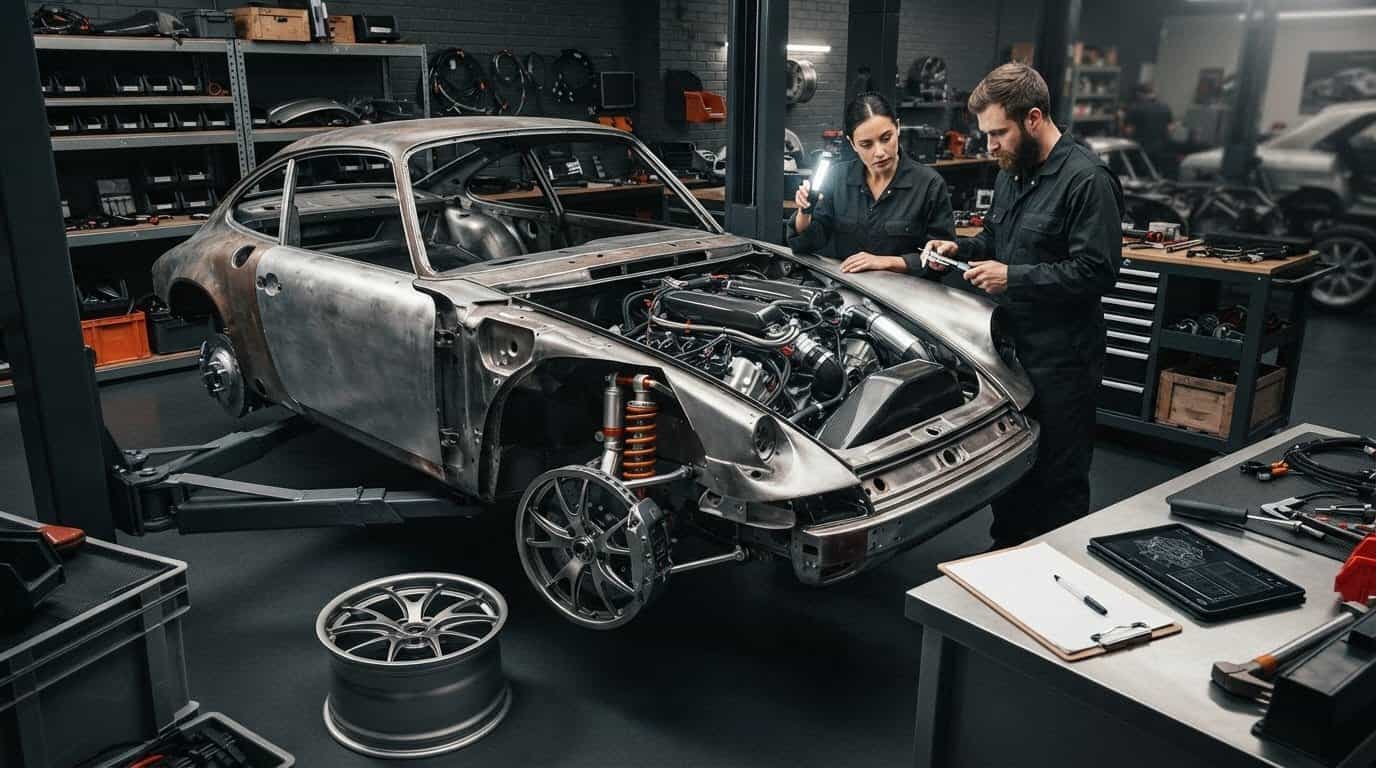
Did you know that an abandoned build often sells for a 40% to 70% discount compared to the actual cost of its parts? While that sounds like a steal, buying an unfinished project car is a high-stakes forensic investigation where you’re essentially auditing another person’s mistakes. It’s easy to fall in love with the vintage silhouette and overlook the fact that a car described as nearly finished usually requires hundreds of hours of corrective labor.
You’re likely feeling that familiar mix of excitement and hesitation as you look at a garage full of boxes and a bare metal shell. It’s a daunting prospect to wonder if critical trim pieces are missing or if the engine assembly was handled with the precision it deserves. I’m here to help you move past that uncertainty. You’ll learn how to separate the legitimate bargains from the mechanical nightmares so you can secure the right financing and execute a professional-grade completion.
We’ll break down a comprehensive audit checklist for stalled projects, examine unsecured lending strategies for 2026, and provide the technical roadmap needed to transform someone else’s abandoned dream into your own restomod masterpiece.
Key Takeaways
- Learn to perform a forensic audit on previous metalwork and mechanical assembly to ensure you aren’t inheriting hidden structural failures or poor engine swaps.
- Discover why traditional lenders shy away from non-operational vehicles and how to secure unsecured financing to keep your build moving.
- Master the paperwork trail by verifying VIN status and establishing a rigorous Bill of Sale to protect your investment in a sea of loose parts.
- Gain the confidence needed when buying an unfinished project car by drafting a new build roadmap that prioritizes safety upgrades like brakes and suspension over aesthetics.
- Transition from a passive admirer to an active creator by using professional blueprints to organize the chaos of an abandoned restoration.
The Lure and Legend of the Unfinished Project Car
Every enthusiast has scrolled through the classifieds and paused at the sight of a half-disassembled icon. It’s usually a high-end chassis sitting on jack stands, surrounded by plastic bins of varying organization. The lure is simple: you’re getting a head start on the labor and a massive discount on the hardware. But buying an unfinished project car requires you to shed the skin of a casual buyer and adopt the mindset of a forensic investigator. You aren’t just purchasing a vehicle; you’re acquiring a set of decisions made by the previous owner, some of which may be brilliant, while others are potentially dangerous.
To better understand this concept, watch this helpful video:
A stalled project represents the perfect canvas for a restomod transformation because the heavy lifting of disassembly is often already done. Instead of feeling restricted by a survivor’s original components, you can view the bare frame as an opportunity to integrate modern suspension and high-performance drivetrains. The Sweet Spot usually occurs when the previous owner has completed the expensive, unglamorous work like media blasting or initial rust repair but hasn’t yet reached the rewarding assembly phase. This allows you to step in just as the build transitions from messy labor to creative engineering.
Decoding the Project Abandonment Cycle
Most builds hit a terminal wall at the 50 percent completion mark. This is the messy middle where the initial excitement of teardown evaporates and the reality of technical complexity sets in. Scope creep is the primary killer. A simple weekend engine refresh often spirals into a full frame-off restoration that exceeds the owner’s skill set or financial reserves. If you notice mismatched fastener grades or a wiring harness that looks like a bird’s nest, you’re likely looking at a project cursed by poor initial planning and a lack of a clear roadmap.
The ‘Half-Done’ Discount: Real Value vs. Perceived Savings
The financial reality is stark. According to Hagerty Valuation Services, incomplete builds typically sell at a 40% to 70% discount compared to the sum of the parts already purchased. This reflects the inherent risk of missing hardware and the cost of undoing prior assembly mistakes. When calculating value, focus strictly on the inventory of hard parts like the block, transmission, and body panels. Never pay for the previous owner’s labor hours. Their time was a hobby expense, not an asset you should subsidize. For those just starting their journey, understanding what is a restomod can help you decide if the current parts list aligns with your ultimate vision for modern reliability and performance.
Forensic Auditing: Evaluating Someone Else’s Work
When you commit to buying an unfinished project car, you’re stepping into the role of a quality control manager for a build you didn’t start. It’s a meticulous process that requires looking past the fresh primer to see the structural reality beneath. You must verify every mechanical choice made by the previous owner, from the grade of the bolts to the integrity of the engine mounts. If an engine swap is already seated, don’t assume it was done correctly. Check for firewall clearance and proper oil pan fitment. For those tackling a popular powertrain upgrade, reviewing the definitive guide to an ls engine swap provides a benchmark for what a professional installation should look like.
Assessing Metalwork and Fabrication Quality
Modern builders in 2026 use digital tools to peel back the layers of a stalled project. Bring an ultrasonic paint depth gauge to detect excessive body filler that might be hiding catastrophic rust or poor metalwork. Inspect the chassis welds with a critical eye. You’re looking for clean, consistent beads, not “bird poop” welds that lack penetration. If the previous owner used a borescope camera to document the internal condition of the frame rails, that’s a sign of a disciplined builder. If not, perform that audit yourself to ensure the foundation of your build isn’t compromised by hidden corrosion.
The Inventory Nightmare: Auditing the Boxes
The phrase “90 percent complete” is a red flag in the restoration world. In reality, that remaining 10 percent often represents half of the build time and the most expensive specialty components. Sourcing missing vintage trim or unique brackets piecemeal is significantly more costly than buying a complete donor vehicle. Use a systematic approach to audit the boxes of parts. Cross-reference every crate against a factory assembly manual. If you find yourself overwhelmed by the chaos of someone else’s disorganized storage, Restomod Consulting Services can help you inventory the project before you sign the bill of sale.
- Check for modular aftermarket wiring harnesses rather than spliced factory looms.
- Verify that suspension components use high-quality bushings and modern geometry.
- Inspect the quality of disc brake conversions for proper caliper alignment and master cylinder compatibility.
For a list of the specific inspection tools I use in the field, check out my recommended gear for professional-grade audits. Taking the time to verify these details now prevents expensive corrective labor once the build enters the final assembly phase.
Financing a Partially Completed Project Car: Practical Paths
Securing the capital to finish a build is often more challenging than the actual fabrication. When you’re buying an unfinished project car, you’re essentially asking a lender to bet on your ability to complete a technical marathon that someone else already abandoned. Most traditional institutions see a chassis on jack stands as a liability rather than an asset. To overcome this hurdle, you must transition from a hobbyist to a project manager. You need a financing strategy that treats your build like a professional engineering project, backed by a clear restoration roadmap and concrete valuation data.
Why Traditional Banks Say No
Standard auto lenders rely on the vehicle as collateral. If you default, they need to be able to sell the car quickly to recover their investment. A non-running project car in pieces has a near-zero liquidation value in the eyes of a bank’s risk department. Banks hate uncertainty. They utilize databases like NADA to establish a loan-to-value ratio, but those tools are useless for an unfinished build. A bank cannot verify if the engine in the crate actually runs or if the custom chassis work meets safety standards. Until the vehicle can be registered and insured for the road, it doesn’t exist as a viable financial asset in their ledger.
Alternative Funding Options for the Builder
Since traditional liens are usually off the table for non-runners, digital unsecured lending has emerged as the primary path for builders in 2026. Lenders like LightStream by Truist offer unsecured personal loans that deposit cash directly into your account without requiring vehicle inspections. As of September 2026, these rates generally range from 7.74% to 17.74% APR for borrowers with prime credit. This is often a better alternative to standard used vehicle loans, which currently average between 10.6% and 11.6% APR. When you are buying an unfinished project car, having immediate access to liquid capital allows you to pounce on rare parts the moment they hit the market.
Another strategic move is obtaining a professional appraisal of the project as it sits, combined with a projected “as-completed” value. Showing a lender that your finished restomod will be worth significantly more than the loan amount can open doors at credit unions. While a Home Equity Line of Credit (HELOC) remains a popular alternative due to lower interest rates, it requires leveraging your primary residence. To prove project viability, I always recommend presenting a detailed build plan. Using our Premium Project Blueprints shows lenders you’ve accounted for the 800 to 2,500 labor hours required for a high-end completion, transforming you from a dreamer into a calculated creator.
- Unsecured loans provide cash for parts without bank inspections.
- Professional appraisals help establish the future value of your restomod.
- A detailed restoration roadmap proves to lenders that the project is viable.

The Paperwork Trail and Logistical Realities
Buying an unfinished project car is a high-stakes transaction that extends far beyond the mechanical audit. You are essentially purchasing a legal identity and a massive inventory of loose components. If the paperwork is flawed, you could end up with an expensive collection of lawn art that can never be legally driven. Treat the documentation process with the same level of precision you apply to a cylinder head rebuild. Secure a clear title or a path to one before you ever arrange for transport.
Securing the Title and Legal Ownership
Don’t assume a bill of sale is sufficient for a non-running vehicle. The classic car world changed significantly on July 1, 2023, when the Vermont DMV permanently ended the mail-in registration loophole. Under Act 165, enforced as of July 2024, you can no longer use out-of-state mail-in services to establish ownership for titleless barn finds. If the seller lacks a title, you must investigate your state’s requirements for a bonded title. In many jurisdictions, this requires a surety bond equal to 1.5 times the vehicle’s appraised value. Verify that the VIN on the frame matches the body and any engine block included in the sale. Understanding what is a restomod is helpful here, as heavily modified vehicles may fall under different registration categories like “assembled vehicle” depending on your local laws.
The Logistics of the ‘Basket Case’
Moving a car in pieces is a logistical marathon. Standard open carriers generally charge between $0.55 and $2.00 per mile depending on the distance, but they rarely handle loose parts. Because the vehicle is likely inoperable, expect a mandatory winch surcharge or inoperable vehicle fee ranging from $150 to $300. If the project has seized brakes or missing suspension, you will need a flatbed rollback service equipped with wheel skates or dollies. These specialized services ensure the chassis isn’t damaged during the winching process.
Organize the inventory before the truck arrives. Label every box with a permanent marker and create a master manifest. Use heavy-duty plastic bins for small hardware and zip-tie loose trim pieces together. This prevents the “missing part” syndrome that kills build momentum. If the car is in bare metal or primer, prioritize enclosed transport to prevent flash rust during transit. This adds 30% to 60% to your shipping costs but protects the thousands of dollars already invested in bodywork. If you need a professional to review the inventory and title status before you pull the trigger, schedule our Restomod Consulting Services to ensure your investment is legally sound.
- Verify the VIN in at least three locations on the vehicle.
- Obtain a notarized Bill of Sale that lists every major component.
- Factor in the $150 to $300 winch fee for non-running transport.
- Check with your insurance provider about “builder’s risk” coverage during transit.
Restarting the Momentum: From Abandoned to Iconic
Once you have the title in hand and the boxes organized, the real work begins. Buying an unfinished project car is a commitment to precision, but it’s also a rare opportunity to redefine a vehicle’s purpose without the guilt of cutting up a survivor. Don’t feel obligated to follow the path the previous owner set. If they wanted a numbers-matching restoration but you envision a high-performance canyon carver, pivot now. Your first priority must be the foundation. Before you worry about paint depth or period-correct interior trim, focus on the mechanical systems that ensure safety and long-term reliability.
Overhaul the braking system and suspension geometry immediately. A project that has sat for years likely has perished rubber bushings, seized calipers, and corroded lines. Upgrading to modern disc brakes and adjustable coilovers provides the confidence needed to handle modern traffic. If you prefer to have trusted professionals handle critical maintenance and safety checks, you can learn more about My Auto Shop to find qualified mechanics for specialized repair work. This stage is where you transform a vintage machine into a reliable performer. It’s about the pride of a finished project and the character of a machine that finally behaves as well as it looks.
Creating Your New Roadmap
Burnout happens when builders focus on the finish line instead of the next bolt. Break your build into logical, achievable phases that mirror the methodical flow of a professional restoration. Start with the rolling phase to ensure the chassis is stiff and the steering is tight. Then, move to the running phase. If you’ve decided to ditch the original, finicky powertrain for something more efficient, consult our classic car modern engine swap guide to understand the fuel system and wiring requirements. This shift toward contemporary technology ensures your project won’t just sit in the garage; it will be a car you actually enjoy driving. Setting realistic milestones helps you maintain the same infectious enthusiasm you felt on day one.
Leveraging Expert Guidance
There is no shame in calling for backup when the technical hurdles feel insurmountable. Complex tasks like custom modular wiring harnesses or structural fabrication often require a second set of expert eyes to ensure safety standards are met. Using our Premium Project Blueprints ensures that modern components like late-model steering racks or oversized radiators fit correctly without endless cutting. This precision saves you from the cycle of rework that stalled the previous owner. Buying an unfinished project car is an accessible, shared adventure when you have the right mentor in your corner. If you find yourself staring at a pile of parts with no clear way forward, Restomod Consulting Services can provide the technical clarity you need to restart your momentum.
Ready to finish what they started? Get The Ultimate Restomod Guide today and turn that stalled dream into your own restomod masterpiece.
Own the Journey and Finish the Build
Turning a garage full of parts into a high-performance masterpiece is a transition from being a spectator to a creator. We’ve covered the critical steps for buying an unfinished project car, from the technical forensic audit of previous metalwork to the specific unsecured lending paths available in 2026. You now have the framework to handle the logistics of a basket case move and the legal requirements for a clear title. Remember that every stalled project is simply a learning opportunity waiting for a new set of hands and a better plan.
You don’t have to navigate this technical marathon alone. With expert mentorship from Brook Walsh and our comprehensive blueprints for modern engine swaps, you can join a dedicated community of DIY builders and professional restorers. It’s time to stop looking at someone else’s abandoned dream and start driving your own. Take control of your build with The Ultimate Restomod Guide and bring your vision to life. The character of a vintage machine is earned through your labor; pick up your tools and get started.
Frequently Asked Questions
Is financing a partially completed project car possible through a credit union?
Credit unions can finance these builds, but they typically require an unsecured personal loan rather than a standard auto lien. Since a non-running vehicle cannot serve as collateral, traditional auto loans are off the table. As of 2026, interest rates for these unsecured loans generally range from 7.74% to 17.74% for prime borrowers. Presenting a detailed build plan to your loan officer can help demonstrate the project’s eventual value and your commitment to completion.
What are the biggest red flags when buying an unfinished project?
Look for structural compromises such as poor weld quality or excessive body filler hidden under fresh primer. A significant red flag is a total lack of organization, specifically if the seller cannot produce a manifest for the boxed components. If you see mismatched fastener grades or spliced wiring harnesses, it suggests a lack of precision. These issues often indicate that you will spend more time correcting errors than making progress on your own vision.
How do I value a car that is currently in boxes and pieces?
Focus strictly on the market value of the major components and the shell itself. Use factory assembly manuals to cross-reference the inventory in the crates and verify that high-value trim is present. You should never pay for the previous owner’s labor hours, as that time carries no market value. When buying an unfinished project car, calculate the replacement cost of missing specialty hardware, as sourcing these individually can quickly exceed the initial savings.
Do I need a special type of insurance for a non-running project car?
You need a specialized policy often called Builder’s Risk or Restoration Insurance from a collector car provider. Standard carriers usually won’t cover a vehicle that isn’t registered or roadworthy. These policies protect your investment against fire, theft, or damage while the car is in pieces in your garage. Ensure the coverage limit increases as you add expensive modern components like high-performance crate engines or custom suspension systems to the build over time.
Should I redo the previous owner’s work just to be safe?
Prioritize an audit of all safety-critical systems, including the braking system and chassis welds. If you cannot verify the quality of the previous owner’s internal engine assembly or electrical work, it is safer to disassemble and inspect it now. Redoing a suspicious wiring harness or a poorly seated engine mount prevents catastrophic failures later. It is much easier to achieve precision while the car is still in the teardown phase than after final assembly.
What is the best way to transport a non-running car and its parts?
Use a specialized flatbed rollback service equipped with a winch and wheel skates for local moves—professional haulers like Done Wright Towing & Transport illustrate the type of specialized vehicle handling required to transport rolling shells and inoperable chassis safely. For long-distance transport, expect a mandatory inoperable vehicle surcharge between $150 and $300. If the project includes loose body panels or crates of parts, you may need to hire an enclosed trailer or a dedicated parts hauler. This prevents flash rust on bare metal and ensures that rare trim pieces aren’t lost or damaged during the journey.
Can I get a title for a project car if the seller lost the original?
You can establish ownership through a bonded title process, which typically requires a surety bond equal to 150% of the vehicle’s appraised value. Be aware that the Vermont mail-in loophole was permanently closed in 2023. You must now follow your specific state’s statutes for titleless vehicles or abandoned property. Always verify the VIN against national databases to ensure the chassis hasn’t been reported stolen or salvaged before committing any funds to the purchase.
How much of a discount should I expect on an unfinished project compared to a finished one?
Expect a discount ranging from 40% to 70% compared to the total cost of the parts already purchased and the original builder’s receipts. This price reduction accounts for the inherent risk of missing hardware and the labor required to audit the previous work. While the initial price seems low, remember that a project described as nearly done often represents half of the remaining financial investment and hundreds of shop labor hours to complete.
Did you know that an abandoned build often sells for a 40% to 70% discount compared to the actual cost of its parts? While that sounds like a steal, buying an unfinished project car is a high-stakes forensic investigation where you’re essentially auditing another person’s mistakes. It’s easy to fall in love with the vintage silhouette and overlook the fact that a car described as nearly finished usually requires hundreds of hours of corrective labor.
You’re likely feeling that familiar mix of excitement and hesitation as you look at a garage full of boxes and a bare metal shell. It’s a daunting prospect to wonder if critical trim pieces are missing or if the engine assembly was handled with the precision it deserves. I’m here to help you move past that uncertainty. You’ll learn how to separate the legitimate bargains from the mechanical nightmares so you can secure the right financing and execute a professional-grade completion.
We’ll break down a comprehensive audit checklist for stalled projects, examine unsecured lending strategies for 2026, and provide the technical roadmap needed to transform someone else’s abandoned dream into your own restomod masterpiece.
Key Takeaways
- Learn to perform a forensic audit on previous metalwork and mechanical assembly to ensure you aren’t inheriting hidden structural failures or poor engine swaps.
- Discover why traditional lenders shy away from non-operational vehicles and how to secure unsecured financing to keep your build moving.
- Master the paperwork trail by verifying VIN status and establishing a rigorous Bill of Sale to protect your investment in a sea of loose parts.
- Gain the confidence needed when buying an unfinished project car by drafting a new build roadmap that prioritizes safety upgrades like brakes and suspension over aesthetics.
- Transition from a passive admirer to an active creator by using professional blueprints to organize the chaos of an abandoned restoration.
The Lure and Legend of the Unfinished Project Car
Every enthusiast has scrolled through the classifieds and paused at the sight of a half-disassembled icon. It’s usually a high-end chassis sitting on jack stands, surrounded by plastic bins of varying organization. The lure is simple: you’re getting a head start on the labor and a massive discount on the hardware. But buying an unfinished project car requires you to shed the skin of a casual buyer and adopt the mindset of a forensic investigator. You aren’t just purchasing a vehicle; you’re acquiring a set of decisions made by the previous owner, some of which may be brilliant, while others are potentially dangerous.
To better understand this concept, watch this helpful video:
A stalled project represents the perfect canvas for a restomod transformation because the heavy lifting of disassembly is often already done. Instead of feeling restricted by a survivor’s original components, you can view the bare frame as an opportunity to integrate modern suspension and high-performance drivetrains. The Sweet Spot usually occurs when the previous owner has completed the expensive, unglamorous work like media blasting or initial rust repair but hasn’t yet reached the rewarding assembly phase. This allows you to step in just as the build transitions from messy labor to creative engineering.
Decoding the Project Abandonment Cycle
Most builds hit a terminal wall at the 50 percent completion mark. This is the messy middle where the initial excitement of teardown evaporates and the reality of technical complexity sets in. Scope creep is the primary killer. A simple weekend engine refresh often spirals into a full frame-off restoration that exceeds the owner’s skill set or financial reserves. If you notice mismatched fastener grades or a wiring harness that looks like a bird’s nest, you’re likely looking at a project cursed by poor initial planning and a lack of a clear roadmap.
The ‘Half-Done’ Discount: Real Value vs. Perceived Savings
The financial reality is stark. According to Hagerty Valuation Services, incomplete builds typically sell at a 40% to 70% discount compared to the sum of the parts already purchased. This reflects the inherent risk of missing hardware and the cost of undoing prior assembly mistakes. When calculating value, focus strictly on the inventory of hard parts like the block, transmission, and body panels. Never pay for the previous owner’s labor hours. Their time was a hobby expense, not an asset you should subsidize. For those just starting their journey, understanding what is a restomod can help you decide if the current parts list aligns with your ultimate vision for modern reliability and performance.
Forensic Auditing: Evaluating Someone Else’s Work
When you commit to buying an unfinished project car, you’re stepping into the role of a quality control manager for a build you didn’t start. It’s a meticulous process that requires looking past the fresh primer to see the structural reality beneath. You must verify every mechanical choice made by the previous owner, from the grade of the bolts to the integrity of the engine mounts. If an engine swap is already seated, don’t assume it was done correctly. Check for firewall clearance and proper oil pan fitment. For those tackling a popular powertrain upgrade, reviewing the definitive guide to an ls engine swap provides a benchmark for what a professional installation should look like.
Assessing Metalwork and Fabrication Quality
Modern builders in 2026 use digital tools to peel back the layers of a stalled project. Bring an ultrasonic paint depth gauge to detect excessive body filler that might be hiding catastrophic rust or poor metalwork. Inspect the chassis welds with a critical eye. You’re looking for clean, consistent beads, not “bird poop” welds that lack penetration. If the previous owner used a borescope camera to document the internal condition of the frame rails, that’s a sign of a disciplined builder. If not, perform that audit yourself to ensure the foundation of your build isn’t compromised by hidden corrosion.
The Inventory Nightmare: Auditing the Boxes
The phrase “90 percent complete” is a red flag in the restoration world. In reality, that remaining 10 percent often represents half of the build time and the most expensive specialty components. Sourcing missing vintage trim or unique brackets piecemeal is significantly more costly than buying a complete donor vehicle. Use a systematic approach to audit the boxes of parts. Cross-reference every crate against a factory assembly manual. If you find yourself overwhelmed by the chaos of someone else’s disorganized storage, Restomod Consulting Services can help you inventory the project before you sign the bill of sale.
- Check for modular aftermarket wiring harnesses rather than spliced factory looms.
- Verify that suspension components use high-quality bushings and modern geometry.
- Inspect the quality of disc brake conversions for proper caliper alignment and master cylinder compatibility.
For a list of the specific inspection tools I use in the field, check out my recommended gear for professional-grade audits. Taking the time to verify these details now prevents expensive corrective labor once the build enters the final assembly phase.
Financing a Partially Completed Project Car: Practical Paths
Securing the capital to finish a build is often more challenging than the actual fabrication. When you’re buying an unfinished project car, you’re essentially asking a lender to bet on your ability to complete a technical marathon that someone else already abandoned. Most traditional institutions see a chassis on jack stands as a liability rather than an asset. To overcome this hurdle, you must transition from a hobbyist to a project manager. You need a financing strategy that treats your build like a professional engineering project, backed by a clear restoration roadmap and concrete valuation data.
Why Traditional Banks Say No
Standard auto lenders rely on the vehicle as collateral. If you default, they need to be able to sell the car quickly to recover their investment. A non-running project car in pieces has a near-zero liquidation value in the eyes of a bank’s risk department. Banks hate uncertainty. They utilize databases like NADA to establish a loan-to-value ratio, but those tools are useless for an unfinished build. A bank cannot verify if the engine in the crate actually runs or if the custom chassis work meets safety standards. Until the vehicle can be registered and insured for the road, it doesn’t exist as a viable financial asset in their ledger.
Alternative Funding Options for the Builder
Since traditional liens are usually off the table for non-runners, digital unsecured lending has emerged as the primary path for builders in 2026. Lenders like LightStream by Truist offer unsecured personal loans that deposit cash directly into your account without requiring vehicle inspections. As of September 2026, these rates generally range from 7.74% to 17.74% APR for borrowers with prime credit. This is often a better alternative to standard used vehicle loans, which currently average between 10.6% and 11.6% APR. When you are buying an unfinished project car, having immediate access to liquid capital allows you to pounce on rare parts the moment they hit the market.
Another strategic move is obtaining a professional appraisal of the project as it sits, combined with a projected “as-completed” value. Showing a lender that your finished restomod will be worth significantly more than the loan amount can open doors at credit unions. While a Home Equity Line of Credit (HELOC) remains a popular alternative due to lower interest rates, it requires leveraging your primary residence. To prove project viability, I always recommend presenting a detailed build plan. Using our Premium Project Blueprints shows lenders you’ve accounted for the 800 to 2,500 labor hours required for a high-end completion, transforming you from a dreamer into a calculated creator.
- Unsecured loans provide cash for parts without bank inspections.
- Professional appraisals help establish the future value of your restomod.
- A detailed restoration roadmap proves to lenders that the project is viable.
The Paperwork Trail and Logistical Realities
Buying an unfinished project car is a high-stakes transaction that extends far beyond the mechanical audit. You are essentially purchasing a legal identity and a massive inventory of loose components. If the paperwork is flawed, you could end up with an expensive collection of lawn art that can never be legally driven. Treat the documentation process with the same level of precision you apply to a cylinder head rebuild. Secure a clear title or a path to one before you ever arrange for transport.
Securing the Title and Legal Ownership
Don’t assume a bill of sale is sufficient for a non-running vehicle. The classic car world changed significantly on July 1, 2023, when the Vermont DMV permanently ended the mail-in registration loophole. Under Act 165, enforced as of July 2024, you can no longer use out-of-state mail-in services to establish ownership for titleless barn finds. If the seller lacks a title, you must investigate your state’s requirements for a bonded title. In many jurisdictions, this requires a surety bond equal to 1.5 times the vehicle’s appraised value. Verify that the VIN on the frame matches the body and any engine block included in the sale. Understanding what is a restomod is helpful here, as heavily modified vehicles may fall under different registration categories like “assembled vehicle” depending on your local laws.
The Logistics of the ‘Basket Case’
Moving a car in pieces is a logistical marathon. Standard open carriers generally charge between $0.55 and $2.00 per mile depending on the distance, but they rarely handle loose parts. Because the vehicle is likely inoperable, expect a mandatory winch surcharge or inoperable vehicle fee ranging from $150 to $300. If the project has seized brakes or missing suspension, you will need a flatbed rollback service equipped with wheel skates or dollies. These specialized services ensure the chassis isn’t damaged during the winching process.
Organize the inventory before the truck arrives. Label every box with a permanent marker and create a master manifest. Use heavy-duty plastic bins for small hardware and zip-tie loose trim pieces together. This prevents the “missing part” syndrome that kills build momentum. If the car is in bare metal or primer, prioritize enclosed transport to prevent flash rust during transit. This adds 30% to 60% to your shipping costs but protects the thousands of dollars already invested in bodywork. If you need a professional to review the inventory and title status before you pull the trigger, schedule our Restomod Consulting Services to ensure your investment is legally sound.
- Verify the VIN in at least three locations on the vehicle.
- Obtain a notarized Bill of Sale that lists every major component.
- Factor in the $150 to $300 winch fee for non-running transport.
- Check with your insurance provider about “builder’s risk” coverage during transit.
Restarting the Momentum: From Abandoned to Iconic
Once you have the title in hand and the boxes organized, the real work begins. Buying an unfinished project car is a commitment to precision, but it’s also a rare opportunity to redefine a vehicle’s purpose without the guilt of cutting up a survivor. Don’t feel obligated to follow the path the previous owner set. If they wanted a numbers-matching restoration but you envision a high-performance canyon carver, pivot now. Your first priority must be the foundation. Before you worry about paint depth or period-correct interior trim, focus on the mechanical systems that ensure safety and long-term reliability.
Overhaul the braking system and suspension geometry immediately. A project that has sat for years likely has perished rubber bushings, seized calipers, and corroded lines. Upgrading to modern disc brakes and adjustable coilovers provides the confidence needed to handle modern traffic. This stage is where you transform a vintage machine into a reliable performer. It’s about the pride of a finished project and the character of a machine that finally behaves as well as it looks.
Creating Your New Roadmap
Burnout happens when builders focus on the finish line instead of the next bolt. Break your build into logical, achievable phases that mirror the methodical flow of a professional restoration. Start with the rolling phase to ensure the chassis is stiff and the steering is tight. Then, move to the running phase. If you’ve decided to ditch the original, finicky powertrain for something more efficient, consult our classic car modern engine swap guide to understand the fuel system and wiring requirements. This shift toward contemporary technology ensures your project won’t just sit in the garage; it will be a car you actually enjoy driving. Setting realistic milestones helps you maintain the same infectious enthusiasm you felt on day one.
Leveraging Expert Guidance
There is no shame in calling for backup when the technical hurdles feel insurmountable. Complex tasks like custom modular wiring harnesses or structural fabrication often require a second set of expert eyes to ensure safety standards are met. Using our Premium Project Blueprints ensures that modern components like late-model steering racks or oversized radiators fit correctly without endless cutting. This precision saves you from the cycle of rework that stalled the previous owner. Buying an unfinished project car is an accessible, shared adventure when you have the right mentor in your corner. If you find yourself staring at a pile of parts with no clear way forward, Restomod Consulting Services can provide the technical clarity you need to restart your momentum.
Ready to finish what they started? Get The Ultimate Restomod Guide today and turn that stalled dream into your own restomod masterpiece.
Own the Journey and Finish the Build
Turning a garage full of parts into a high-performance masterpiece is a transition from being a spectator to a creator. We’ve covered the critical steps for buying an unfinished project car, from the technical forensic audit of previous metalwork to the specific unsecured lending paths available in 2026. You now have the framework to handle the logistics of a basket case move and the legal requirements for a clear title. Remember that every stalled project is simply a learning opportunity waiting for a new set of hands and a better plan.
You don’t have to navigate this technical marathon alone. With expert mentorship from Brook Walsh and our comprehensive blueprints for modern engine swaps, you can join a dedicated community of DIY builders and professional restorers. It’s time to stop looking at someone else’s abandoned dream and start driving your own. Take control of your build with The Ultimate Restomod Guide and bring your vision to life. The character of a vintage machine is earned through your labor; pick up your tools and get started.
Frequently Asked Questions
Is financing a partially completed project car possible through a credit union?
Credit unions can finance these builds, but they typically require an unsecured personal loan rather than a standard auto lien. Since a non-running vehicle cannot serve as collateral, traditional auto loans are off the table. As of 2026, interest rates for these unsecured loans generally range from 7.74% to 17.74% for prime borrowers. Presenting a detailed build plan to your loan officer can help demonstrate the project’s eventual value and your commitment to completion.
What are the biggest red flags when buying an unfinished project?
Look for structural compromises such as poor weld quality or excessive body filler hidden under fresh primer. A significant red flag is a total lack of organization, specifically if the seller cannot produce a manifest for the boxed components. If you see mismatched fastener grades or spliced wiring harnesses, it suggests a lack of precision. These issues often indicate that you will spend more time correcting errors than making progress on your own vision.
How do I value a car that is currently in boxes and pieces?
Focus strictly on the market value of the major components and the shell itself. Use factory assembly manuals to cross-reference the inventory in the crates and verify that high-value trim is present. You should never pay for the previous owner’s labor hours, as that time carries no market value. When buying an unfinished project car, calculate the replacement cost of missing specialty hardware, as sourcing these individually can quickly exceed the initial savings.
Do I need a special type of insurance for a non-running project car?
You need a specialized policy often called Builder’s Risk or Restoration Insurance from a collector car provider. Standard carriers usually won’t cover a vehicle that isn’t registered or roadworthy. These policies protect your investment against fire, theft, or damage while the car is in pieces in your garage. Ensure the coverage limit increases as you add expensive modern components like high-performance crate engines or custom suspension systems to the build over time.
Should I redo the previous owner’s work just to be safe?
Prioritize an audit of all safety-critical systems, including the braking system and chassis welds. If you cannot verify the quality of the previous owner’s internal engine assembly or electrical work, it is safer to disassemble and inspect it now. Redoing a suspicious wiring harness or a poorly seated engine mount prevents catastrophic failures later. It is much easier to achieve precision while the car is still in the teardown phase than after final assembly.
What is the best way to transport a non-running car and its parts?
Use a specialized flatbed rollback service equipped with a winch and wheel skates for local moves. For long-distance transport, expect a mandatory inoperable vehicle surcharge between $150 and $300. If the project includes loose body panels or crates of parts, you may need to hire an enclosed trailer or a dedicated parts hauler. This prevents flash rust on bare metal and ensures that rare trim pieces aren’t lost or damaged during the journey.
Can I get a title for a project car if the seller lost the original?
You can establish ownership through a bonded title process, which typically requires a surety bond equal to 150% of the vehicle’s appraised value. Be aware that the Vermont mail-in loophole was permanently closed in 2023. You must now follow your specific state’s statutes for titleless vehicles or abandoned property. Always verify the VIN against national databases to ensure the chassis hasn’t been reported stolen or salvaged before committing any funds to the purchase.
How much of a discount should I expect on an unfinished project compared to a finished one?
Expect a discount ranging from 40% to 70% compared to the total cost of the parts already purchased and the original builder’s receipts. This price reduction accounts for the inherent risk of missing hardware and the labor required to audit the previous work. While the initial price seems low, remember that a project described as nearly done often represents half of the remaining financial investment and hundreds of shop labor hours to complete.