The most expensive paint job in the world is worthless if the chemical bond beneath it fails six months after the final clear coat. You have likely spent hundreds of hours stripping panels and perfecting body lines, so the fear of rust bubbling back up through your investment is a legitimate concern. It’s a common frustration in the workshop, especially when you are trying to bridge the gap between fifty year old steel and 21st century coating technology. With restomods now making up 39.5 percent of the restoration market in 2026, the pressure to deliver modern durability on vintage metal has never been higher.
Mastering the process of choosing the right primer for classic cars is the only way to guarantee a flawless, corrosion-resistant finish that stands the test of time. You deserve a foundation that is chemically stable and perfectly level. This guide walks you through the technical nuances of epoxy versus etch primers, explains how to remain compliant with the latest 2026 VOC emission standards, and provides a logical framework for layering materials over body filler and bare metal. Let’s get to work on building a project that carries your legacy for decades.
Key Takeaways
- Understand how to bridge the gap between vintage metal and modern coatings by treating primer as a critical chemical interface; it’s more than just a prep step.
- Simplify the complex process of choosing the right primer for classic cars by identifying why epoxy remains the superior choice for long-term corrosion resistance compared to self-etching alternatives.
- Master the specific techniques required for mixed-material builds to ensure a permanent bond across steel, aluminum, and composite panels.
- Learn the exact layering sequence and flash time protocols needed to prevent solvent trap so you don’t compromise your foundation.
- Transition from a passive admirer to an active creator by applying a professional-grade strategy that protects your heritage project for decades.
Understanding the Role of Primer in a High-End Restomod
Think of your primer as the critical handshake between 1960s craftsmanship and modern chemical engineering. It is the vital interface that anchors your expensive topcoat to the raw substrate, ensuring the two become a single, inseparable unit. While a standard collision shop might use a generic product for a quick insurance repair, a high-end restomod requires a level of performance that prioritizes decades of durability over a quick turnaround. Understanding the hierarchy of automotive paint layers is the first step in ensuring your project doesn’t just look good today, but remains flawless for the next generation of enthusiasts.
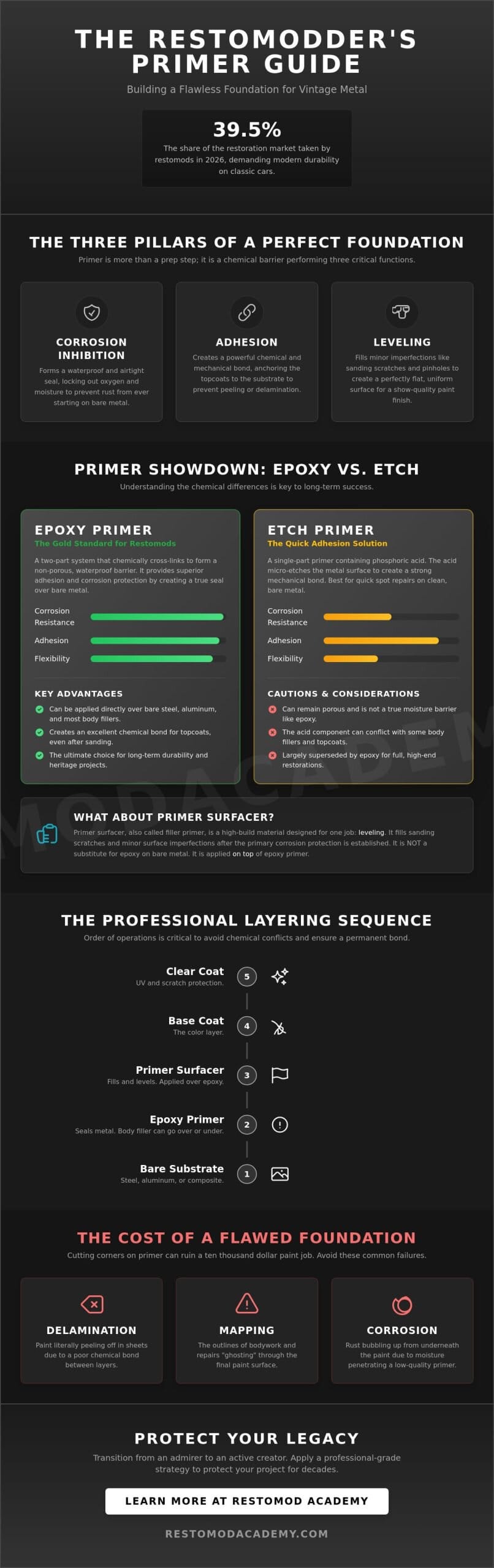
The process of choosing the right primer for classic cars involves more than just picking a brand you recognize. You are selecting a chemical barrier that performs three non-negotiable functions: it provides a surface for paint to grab onto (adhesion), it stops oxygen and moisture from reaching the metal (corrosion inhibition), and it fills minor imperfections to create a flat plane (leveling). Because a what is a restomod project often involves pushing a vehicle harder than its original designers intended, your foundation must be robust enough to handle the vibrations and heat cycles of a modern high-performance drivetrain.
To better understand this concept, watch this helpful video:
When preparing your panels, you must balance chemical and mechanical bonding. Mechanical bonding relies on a “tooth” or scratch pattern created by sandpaper, while chemical bonding occurs when the primer molecules actually fuse with the surface or the subsequent layers. High-performance epoxy primers are the gold standard here because they offer superior cross-linking, creating a waterproof seal that mechanical-only primers simply cannot match.
Why Classic Steel Demands Specialized Primers
Vintage metal is inherently different from the galvanized, zinc-coated steel found on modern assembly lines. Older panels are more porous and prone to microscopic pits where rust can hide. Without a specialized moisture barrier, humidity can actually wick through the paint layers from the outside in, or even from the backside of the panel. Choosing the right primer for classic cars means selecting a product that acts as a true sealant, locking out the environment during long-term storage or high-stakes show use.
The Consequences of Choosing the Wrong Foundation
Cutting corners on your foundation is a recipe for heartbreak. Using a cheap, low-solids primer on a high-value build often leads to mapping, where the outlines of your bodywork repairs “ghost” through the finished paint. You might also face solvent pop or delamination, where the paint literally peels away because the primer couldn’t handle the chemical load of the basecoat. Don’t let a fifty dollar saving on a gallon of primer ruin a ten thousand dollar paint job; demand a foundation that matches your ambition.
Comparing the Core Primer Types: Epoxy vs. Etch vs. Surfacer
Selecting the correct chemistry for your project is where your restoration either gains momentum or begins a slow descent toward failure. Choosing the right primer for classic cars requires you to look past the marketing on the can and understand the chemical personality of each product. While many old school builders still reach for a self-etching primer by habit, the modern restomod landscape has largely shifted toward epoxy as the superior foundation for high-value builds. Each type of primer serves a specific purpose in the layering process, and using them out of order can lead to expensive chemical conflicts.
Epoxy primer is widely considered the gold standard for long-term corrosion resistance. It creates a waterproof, airtight seal that prevents oxygen from reaching the vintage steel. Self-etching primer, on the other hand, uses a phosphoric acid component to bite into the metal for adhesion. While it’s useful for quick spot repairs on bare steel, it has significant limitations; you should never apply body filler over it because the acid can react with the filler and cause delamination. Once your metal is sealed, you transition to high-build urethane surfacers. These products are designed to be sanded away, leaving behind a laser-straight surface. Finally, a primer sealer is applied just before the color coat to provide a uniform color and texture, ensuring the basecoat lays down perfectly.
Epoxy Primer: The Restomodder’s Best Friend
The magic of epoxy lies in its two-part chemical cure. Unlike single-component primers that dry through solvent evaporation, epoxy undergoes a molecular cross-linking process that creates an incredibly durable barrier. This versatility allows you to apply it over bare metal, existing sanded paint, or even body filler without fear of lifting. Pay close attention to the induction time specified by the manufacturer. This is the period you must wait after mixing the parts before spraying. Skipping this step can lead to a soft cure that never fully hardens, compromising the entire build. For a complete list of the supplies you will need for this stage, take a look at our recommended gear for the workshop.
High-Build Surfacers: Leveling the Playing Field
High-build surfacers are the heavy lifters of the body shop. They contain a high volume of solids that allow you to fill sand scratches and microscopic lows in the panels. However, you must respect the build thickness. Applying it too heavy in one session increases the risk of the material shrinking months later, which reveals the very scratches you tried to hide. Use a guide coat, a thin layer of contrasting dry powder or spray, over your surfacer. As you sand with a long block, the guide coat will remain in the low spots, showing you exactly where the panel needs more work before moving to the paint booth. Choosing the right primer for classic cars means knowing when to stop building and start leveling.
Substrate Matching: Priming Steel, Aluminum, and Composites
Mastering the nuances of substrate matching is what separates a backyard project from a professional grade build. Modern restomodding often involves a hybrid of materials, where a vintage steel chassis might support a fiberglass hood or aluminum door skins. Each material reacts differently to chemical coatings. For instance, aluminum develops an invisible layer of oxidation almost instantly upon exposure to air, which can compromise the bond of your primer. Choosing the right primer for classic cars in a multi-material build means selecting a high quality epoxy that is specifically rated for adhesion to both ferrous and non ferrous metals.
To streamline your workflow, consider the wet on wet technique. This involves applying your primer sealer and then moving directly to your basecoat within a specific time window, usually 30 to 60 minutes depending on the product. This creates a chemical bond between the layers, saving you hours of sanding while ensuring maximum durability. This approach is common in high end shops where time and precision are equally valued. It allows the layers to fuse at a molecular level, creating a finish that is far less likely to chip or flake under stress.
Prepping Bare Metal for Maximum Adhesion
Scuff your metal surfaces to create a mechanical tooth that the primer can bite into. For areas receiving body filler, 80 grit is the standard; for general priming, move to 180 grit. Once the sanding is done, clean the panel thoroughly with a high quality wax and grease remover. Do not let the bare metal sit for long. In many climates, you have a window of opportunity of less than 24 hours before flash rust begins to form. If you miss this window, you must scuff the metal again before choosing the right primer for classic cars to ensure the bond remains permanent. For more detailed metal prep strategies, explore our Classic Car Bodywork Guide.
Handling Modern Composites in a Classic Build
Fiberglass and carbon fiber panels require a different mindset than steel. These materials are porous and can trap solvents or moisture, leading to bubbles in your finished paint. If you are working with raw resin or older fiberglass, you must allow the panel to outgas. This often involves placing the part in a heated environment to force any trapped gasses to the surface before you seal it. Gel coats should be scuffed with 220 grit to ensure the primer doesn’t just sit on top of the slick surface. Always use an epoxy formula that is compatible with composites to avoid the risk of the primer shrinking into the weave of the fabric over time.
Application Strategy: Environment, Flash Times, and Safety
The most sophisticated chemistry in the world won’t save a project if the application environment is working against you. When you are choosing the right primer for classic cars, you must account for the variables of your workshop just as much as the contents of the paint can. High performance coatings are sensitive to their surroundings. If you spray in a garage that is too cold or too humid, you risk a catastrophic failure that might not show up until months after the car is polished. Precision in the application stage is what separates a hobbyist effort from a professional restomod foundation.
The Perfect Spray Environment
Consistency is your best friend when pulling the trigger. Aim for a stable temperature between 70 and 75 degrees Fahrenheit for optimal flow and leveling. If the metal is too cold, the primer will go on “dry” and orange-peeled; if it’s too hot, the solvents will evaporate before the product can lay flat. Humidity is another silent killer. High moisture levels can cause blushing or poor adhesion. You must manage your air supply with the same care you give your bodywork. Use high quality desiccants and moisture traps to ensure the air hitting your panel is bone dry. For a breakdown of the filtration systems used in top tier shops, consult our guide on recommended gear.
Mastering the Recoat Window
Every primer has a specific chemical window during which it will accept a topcoat without the need for mechanical sanding. For many epoxy primers, this window lasts between 24 and 72 hours. If you apply your next layer within this timeframe, the two materials will fuse together chemically. If you miss this window, the primer “closes up,” and you must scuff the entire surface to create a mechanical tooth for the next layer. Don’t guess on this. Check the technical data sheet for your specific product and use a timer. This discipline prevents the dreaded solvent trap, where trapped gasses from the lower layers cause bubbles or “solvent pop” in your finished clear coat.
Safety is not an area for compromise. Most modern 2K (two component) primers contain isocyanates, which are hazardous if inhaled. A simple dust mask is useless here. You must use a NIOSH approved respirator with fresh organic vapor cartridges, or better yet, a supplied air system. When choosing the right primer for classic cars, also consider your delivery method. While a high volume low pressure (HVLP) spray gun is ideal for large panels, high quality 2K aerosol cans with an internal activator button are excellent for small brackets and engine bay components. They offer the same chemical durability as a spray gun without the extensive cleanup.
Ready to move from the planning phase to the paint booth? Master every technical nuance of your build by downloading our Premium Project Blueprints today.
The Restomod Academy Path to a Show-Quality Finish
Achieving a show quality finish is less about a single miraculous product and more about the discipline of your layering sequence. In the world of high end builds, we view the bodywork phase as a patient, educational journey where every hour spent block sanding pays dividends in the final reflection. Choosing the right primer for classic cars requires a commitment to a multi stage foundation that protects your labor for decades. By following a logical, chemically stable path, you transition from a passive admirer of great paint to the creator of a masterpiece. This methodical approach is the hallmark of the modern restomod movement, ensuring that the heritage aesthetics you love are backed by contemporary durability.
Layering for Longevity
We advocate for the Epoxy Sandwich method as the ultimate safeguard against the return of rust. This involves sealing the bare metal with epoxy, performing your bodywork with high quality fillers, and then sealing that filler again with another coat of epoxy. This technique ensures that your filler is locked between two waterproof barriers, preventing it from absorbing moisture or wicking solvents. This level of detail is especially critical when preparing an engine bay for modern powerplants. If you are planning a high performance heart transplant, see The Definitive Guide to an LS Engine Swap for specific tips on creating a durable, show ready engine compartment that stands up to the heat of a modern V8.
Your Next Steps in the Workshop
Don’t feel pressured to spray your entire car on day one. Mastery comes through deliberate practice. Start with a small test panel, such as a trunk lid or a spare fender, to dial in your spray gun settings and get a feel for the overlap and flow of the material. This is where you learn the nuances of choosing the right primer for classic cars in real world conditions. As you progress, share your results with the community for peer reviews; there is immense value in the camaraderie of builders who share your high standards. Your personal labor is the most valuable component of this build. Embrace the meticulous pace of restoration, and take pride in the fact that you are building something that will last a lifetime.
When you are ready to commit to the full project roadmap, The Ultimate Restomod Guide provides the comprehensive framework you need to move forward with confidence. We are here to help you navigate every technical hurdle, from the first spray of epoxy to the final assembly of your dream machine. The journey is long, but the satisfaction of a precision finish is a reward that never fades.
Build Your Legacy on a Solid Foundation
You have navigated the technical complexities of chemical bonding and substrate matching. Now, it’s time to apply that knowledge in your own workshop. Remember that choosing the right primer for classic cars is the single most important decision you’ll make to protect your metalwork from the elements. By prioritizing a high-quality epoxy sealer and respecting the necessary flash times, you ensure your project features a finish that remains show-ready for decades. This meticulous attention to detail is what separates a standard restoration from a professional-grade restomod.
Brook Walsh, a seasoned restomod expert, has refined these processes through years of hands-on technical restoration to ensure professional-grade results and workshop safety. You don’t have to guess your way through the next stage of your build. Comprehensive project blueprints are available to guide every step of your transformation. Ready to build your dream machine? Download The Ultimate Restomod Guide and start your journey today.
Your vision for a perfect machine is within reach. Pick up the spray gun with confidence, trust the process, and take pride in the heritage you’re preserving for the future.
Frequently Asked Questions
Can I apply body filler directly over epoxy primer?
Yes, you can and should apply body filler directly over a cured and scuffed layer of epoxy primer. This method, often called the epoxy sandwich, ensures the metal remains sealed even if the filler absorbs moisture. Ensure the epoxy has fully cured according to the manufacturer’s data sheet, then scuff it with 80 grit sandpaper to create the necessary mechanical tooth for the filler to bond properly.
How long does epoxy primer need to dry before I can sand it?
Most epoxy primers require 24 to 48 hours of dry time at 70 degrees Fahrenheit before they are stable enough for sanding. If your workshop is cooler, this window extends significantly. Attempting to sand too early will result in the sandpaper loading up with soft material, which ruins the abrasive and can pull the primer away from the substrate. Always perform a small thumb-nail test in a discreet area to check for hardness.
Is it okay to use self-etching primer under epoxy primer?
No, you should avoid using self-etching primer underneath epoxy primer because the acid in the etch can interfere with the epoxy’s chemical cure. Choosing the right primer for classic cars means sticking to one compatible system rather than mixing technologies. If you have bare steel, a high-quality epoxy primer provides all the adhesion and corrosion resistance you need without the risks associated with acid-based products.
What is the difference between a primer surfacer and a primer sealer?
A primer surfacer is a high-solids product designed to be sanded away to level the bodywork, while a primer sealer is a non-sanding final barrier. Think of the surfacer as your sculpting tool and the sealer as your uniform foundation for the color coat. The sealer prevents the topcoat from soaking into the porous surfacer, ensuring a consistent gloss and color across the entire vehicle.
Do I need to prime my car if I am just doing a scuff and shoot paint job?
Yes, you still need to apply a primer sealer even during a scuff and shoot paint job to ensure uniform adhesion and color holdout. While you aren’t stripping to bare metal, the sealer acts as a chemical bridge between the old sanded finish and your new basecoat. This step prevents the new solvents from reacting with the old paint, which often leads to lifting or wrinkling at the edges.
Can I leave my car in primer for a long period of time?
You can only leave a car in primer for extended periods if you use a non-porous epoxy primer. Standard urethane surfacers are porous and will allow moisture to reach the metal, leading to rust beneath the surface. If your project is going into long-term storage, apply two full coats of epoxy to seal the metal. When you return to the project, you must scuff the surface before adding more layers.
What grit sandpaper should I use to sand high-build primer?
Start your block sanding with 180 or 220 grit sandpaper to level the high spots in your high-build primer. Once the panels are straight, transition to a finer 400 to 600 grit for your final wet sand before the sealer coat. This progression ensures you remove the coarse scratches while maintaining the flat plane required for a show-quality finish. Always use a guide coat to track your progress through the sanding stages.
How many coats of primer do I actually need for a classic car?
Most restomod projects require two coats of epoxy to seal the metal and three full coats of high-build surfacer for leveling. Choosing the right primer for classic cars involves building enough thickness to sand the panels flat without breaking through to the metal. If you find yourself sanding through the layers frequently, apply an additional coat of surfacer to give yourself more material to work with during the blocking stage.
The most expensive paint job in the world is worthless if the chemical bond beneath it fails six months after the final clear coat. You have likely spent hundreds of hours stripping panels and perfecting body lines, so the fear of rust bubbling back up through your investment is a legitimate concern. It’s a common frustration in the workshop, especially when you are trying to bridge the gap between fifty year old steel and 21st century coating technology. With restomods now making up 39.5 percent of the restoration market in 2026, the pressure to deliver modern durability on vintage metal has never been higher.
Mastering the process of choosing the right primer for classic cars is the only way to guarantee a flawless, corrosion-resistant finish that stands the test of time. You deserve a foundation that is chemically stable and perfectly level. This guide walks you through the technical nuances of epoxy versus etch primers, explains how to remain compliant with the latest 2026 VOC emission standards, and provides a logical framework for layering materials over body filler and bare metal. Let’s get to work on building a project that carries your legacy for decades.
Key Takeaways
- Understand how to bridge the gap between vintage metal and modern coatings by treating primer as a critical chemical interface; it’s more than just a prep step.
- Simplify the complex process of choosing the right primer for classic cars by identifying why epoxy remains the superior choice for long-term corrosion resistance compared to self-etching alternatives.
- Master the specific techniques required for mixed-material builds to ensure a permanent bond across steel, aluminum, and composite panels.
- Learn the exact layering sequence and flash time protocols needed to prevent solvent trap so you don’t compromise your foundation.
- Transition from a passive admirer to an active creator by applying a professional-grade strategy that protects your heritage project for decades.
Understanding the Role of Primer in a High-End Restomod
Think of your primer as the critical handshake between 1960s craftsmanship and modern chemical engineering. It is the vital interface that anchors your expensive topcoat to the raw substrate, ensuring the two become a single, inseparable unit. While a standard collision shop might use a generic product for a quick insurance repair, a high-end restomod requires a level of performance that prioritizes decades of durability over a quick turnaround. Understanding the hierarchy of automotive paint layers is the first step in ensuring your project doesn’t just look good today, but remains flawless for the next generation of enthusiasts.
The process of choosing the right primer for classic cars involves more than just picking a brand you recognize. You are selecting a chemical barrier that performs three non-negotiable functions: it provides a surface for paint to grab onto (adhesion), it stops oxygen and moisture from reaching the metal (corrosion inhibition), and it fills minor imperfections to create a flat plane (leveling). Because a what is a restomod project often involves pushing a vehicle harder than its original designers intended, your foundation must be robust enough to handle the vibrations and heat cycles of a modern high-performance drivetrain.
To better understand this concept, watch this helpful video:
When preparing your panels, you must balance chemical and mechanical bonding. Mechanical bonding relies on a “tooth” or scratch pattern created by sandpaper, while chemical bonding occurs when the primer molecules actually fuse with the surface or the subsequent layers. High-performance epoxy primers are the gold standard here because they offer superior cross-linking, creating a waterproof seal that mechanical-only primers simply cannot match.
Why Classic Steel Demands Specialized Primers
Vintage metal is inherently different from the galvanized, zinc-coated steel found on modern assembly lines. Older panels are more porous and prone to microscopic pits where rust can hide. Without a specialized moisture barrier, humidity can actually wick through the paint layers from the outside in, or even from the backside of the panel. Choosing the right primer for classic cars means selecting a product that acts as a true sealant, locking out the environment during long-term storage or high-stakes show use.
The Consequences of Choosing the Wrong Foundation
Cutting corners on your foundation is a recipe for heartbreak. Using a cheap, low-solids primer on a high-value build often leads to mapping, where the outlines of your bodywork repairs “ghost” through the finished paint. You might also face solvent pop or delamination, where the paint literally peels away because the primer couldn’t handle the chemical load of the basecoat. Don’t let a fifty dollar saving on a gallon of primer ruin a ten thousand dollar paint job; demand a foundation that matches your ambition.
Comparing the Core Primer Types: Epoxy vs. Etch vs. Surfacer
Selecting the correct chemistry for your project is where your restoration either gains momentum or begins a slow descent toward failure. Choosing the right primer for classic cars requires you to look past the marketing on the can and understand the chemical personality of each product. While many old school builders still reach for a self-etching primer by habit, the modern restomod landscape has largely shifted toward epoxy as the superior foundation for high-value builds. Each type of primer serves a specific purpose in the layering process, and using them out of order can lead to expensive chemical conflicts.
Epoxy primer is widely considered the gold standard for long-term corrosion resistance. It creates a waterproof, airtight seal that prevents oxygen from reaching the vintage steel. Self-etching primer, on the other hand, uses a phosphoric acid component to bite into the metal for adhesion. While it’s useful for quick spot repairs on bare steel, it has significant limitations; you should never apply body filler over it because the acid can react with the filler and cause delamination. Once your metal is sealed, you transition to high-build urethane surfacers. These products are designed to be sanded away, leaving behind a laser-straight surface. Finally, a primer sealer is applied just before the color coat to provide a uniform color and texture, ensuring the basecoat lays down perfectly.
Epoxy Primer: The Restomodder’s Best Friend
The magic of epoxy lies in its two-part chemical cure. Unlike single-component primers that dry through solvent evaporation, epoxy undergoes a molecular cross-linking process that creates an incredibly durable barrier. This versatility allows you to apply it over bare metal, existing sanded paint, or even body filler without fear of lifting. Pay close attention to the induction time specified by the manufacturer. This is the period you must wait after mixing the parts before spraying. Skipping this step can lead to a soft cure that never fully hardens, compromising the entire build. For a complete list of the supplies you will need for this stage, take a look at our recommended gear for the workshop.
High-Build Surfacers: Leveling the Playing Field
High-build surfacers are the heavy lifters of the body shop. They contain a high volume of solids that allow you to fill sand scratches and microscopic lows in the panels. However, you must respect the build thickness. Applying it too heavy in one session increases the risk of the material shrinking months later, which reveals the very scratches you tried to hide. Use a guide coat, a thin layer of contrasting dry powder or spray, over your surfacer. As you sand with a long block, the guide coat will remain in the low spots, showing you exactly where the panel needs more work before moving to the paint booth. Choosing the right primer for classic cars means knowing when to stop building and start leveling.
Substrate Matching: Priming Steel, Aluminum, and Composites
Mastering the nuances of substrate matching is what separates a backyard project from a professional grade build. Modern restomodding often involves a hybrid of materials, where a vintage steel chassis might support a fiberglass hood or aluminum door skins. Each material reacts differently to chemical coatings. For instance, aluminum develops an invisible layer of oxidation almost instantly upon exposure to air, which can compromise the bond of your primer. Choosing the right primer for classic cars in a multi-material build means selecting a high quality epoxy that is specifically rated for adhesion to both ferrous and non ferrous metals.
To streamline your workflow, consider the wet on wet technique. This involves applying your primer sealer and then moving directly to your basecoat within a specific time window, usually 30 to 60 minutes depending on the product. This creates a chemical bond between the layers, saving you hours of sanding while ensuring maximum durability. This approach is common in high end shops where time and precision are equally valued. It allows the layers to fuse at a molecular level, creating a finish that is far less likely to chip or flake under stress.
Prepping Bare Metal for Maximum Adhesion
Scuff your metal surfaces to create a mechanical tooth that the primer can bite into. For areas receiving body filler, 80 grit is the standard; for general priming, move to 180 grit. Once the sanding is done, clean the panel thoroughly with a high quality wax and grease remover. Do not let the bare metal sit for long. In many climates, you have a window of opportunity of less than 24 hours before flash rust begins to form. If you miss this window, you must scuff the metal again before choosing the right primer for classic cars to ensure the bond remains permanent. For more detailed metal prep strategies, explore our Classic Car Bodywork Guide.
Handling Modern Composites in a Classic Build
Fiberglass and carbon fiber panels require a different mindset than steel. These materials are porous and can trap solvents or moisture, leading to bubbles in your finished paint. If you are working with raw resin or older fiberglass, you must allow the panel to outgas. This often involves placing the part in a heated environment to force any trapped gasses to the surface before you seal it. Gel coats should be scuffed with 220 grit to ensure the primer doesn’t just sit on top of the slick surface. Always use an epoxy formula that is compatible with composites to avoid the risk of the primer shrinking into the weave of the fabric over time.
Application Strategy: Environment, Flash Times, and Safety
The most sophisticated chemistry in the world won’t save a project if the application environment is working against you. When you are choosing the right primer for classic cars, you must account for the variables of your workshop just as much as the contents of the paint can. High performance coatings are sensitive to their surroundings. If you spray in a garage that is too cold or too humid, you risk a catastrophic failure that might not show up until months after the car is polished. Precision in the application stage is what separates a hobbyist effort from a professional restomod foundation.
The Perfect Spray Environment
Consistency is your best friend when pulling the trigger. Aim for a stable temperature between 70 and 75 degrees Fahrenheit for optimal flow and leveling. If the metal is too cold, the primer will go on “dry” and orange-peeled; if it’s too hot, the solvents will evaporate before the product can lay flat. Humidity is another silent killer. High moisture levels can cause blushing or poor adhesion. You must manage your air supply with the same care you give your bodywork. Use high quality desiccants and moisture traps to ensure the air hitting your panel is bone dry. For a breakdown of the filtration systems used in top tier shops, consult our guide on recommended gear.
Mastering the Recoat Window
Every primer has a specific chemical window during which it will accept a topcoat without the need for mechanical sanding. For many epoxy primers, this window lasts between 24 and 72 hours. If you apply your next layer within this timeframe, the two materials will fuse together chemically. If you miss this window, the primer “closes up,” and you must scuff the entire surface to create a mechanical tooth for the next layer. Don’t guess on this. Check the technical data sheet for your specific product and use a timer. This discipline prevents the dreaded solvent trap, where trapped gasses from the lower layers cause bubbles or “solvent pop” in your finished clear coat.
Safety is not an area for compromise. Most modern 2K (two component) primers contain isocyanates, which are hazardous if inhaled. A simple dust mask is useless here. You must use a NIOSH approved respirator with fresh organic vapor cartridges, or better yet, a supplied air system. When choosing the right primer for classic cars, also consider your delivery method. While a high volume low pressure (HVLP) spray gun is ideal for large panels, high quality 2K aerosol cans with an internal activator button are excellent for small brackets and engine bay components. They offer the same chemical durability as a spray gun without the extensive cleanup.
Ready to move from the planning phase to the paint booth? Master every technical nuance of your build by downloading our Premium Project Blueprints today.
The Restomod Academy Path to a Show-Quality Finish
Achieving a show quality finish is less about a single miraculous product and more about the discipline of your layering sequence. In the world of high end builds, we view the bodywork phase as a patient, educational journey where every hour spent block sanding pays dividends in the final reflection. Choosing the right primer for classic cars requires a commitment to a multi stage foundation that protects your labor for decades. By following a logical, chemically stable path, you transition from a passive admirer of great paint to the creator of a masterpiece. This methodical approach is the hallmark of the modern restomod movement, ensuring that the heritage aesthetics you love are backed by contemporary durability.
Layering for Longevity
We advocate for the Epoxy Sandwich method as the ultimate safeguard against the return of rust. This involves sealing the bare metal with epoxy, performing your bodywork with high quality fillers, and then sealing that filler again with another coat of epoxy. This technique ensures that your filler is locked between two waterproof barriers, preventing it from absorbing moisture or wicking solvents. This level of detail is especially critical when preparing an engine bay for modern powerplants. If you are planning a high performance heart transplant, see The Definitive Guide to an LS Engine Swap for specific tips on creating a durable, show ready engine compartment that stands up to the heat of a modern V8.
Your Next Steps in the Workshop
Don’t feel pressured to spray your entire car on day one. Mastery comes through deliberate practice. Start with a small test panel, such as a trunk lid or a spare fender, to dial in your spray gun settings and get a feel for the overlap and flow of the material. This is where you learn the nuances of choosing the right primer for classic cars in real world conditions. As you progress, share your results with the community for peer reviews; there is immense value in the camaraderie of builders who share your high standards. Your personal labor is the most valuable component of this build. Embrace the meticulous pace of restoration, and take pride in the fact that you are building something that will last a lifetime.
When you are ready to commit to the full project roadmap, The Ultimate Restomod Guide provides the comprehensive framework you need to move forward with confidence. We are here to help you navigate every technical hurdle, from the first spray of epoxy to the final assembly of your dream machine. The journey is long, but the satisfaction of a precision finish is a reward that never fades.
Build Your Legacy on a Solid Foundation
You have navigated the technical complexities of chemical bonding and substrate matching. Now, it’s time to apply that knowledge in your own workshop. Remember that choosing the right primer for classic cars is the single most important decision you’ll make to protect your metalwork from the elements. By prioritizing a high-quality epoxy sealer and respecting the necessary flash times, you ensure your project features a finish that remains show-ready for decades. This meticulous attention to detail is what separates a standard restoration from a professional-grade restomod.
Brook Walsh, a seasoned restomod expert, has refined these processes through years of hands-on technical restoration to ensure professional-grade results and workshop safety. You don’t have to guess your way through the next stage of your build. Comprehensive project blueprints are available to guide every step of your transformation. Ready to build your dream machine? Download The Ultimate Restomod Guide and start your journey today.
Your vision for a perfect machine is within reach. Pick up the spray gun with confidence, trust the process, and take pride in the heritage you’re preserving for the future.
Frequently Asked Questions
Can I apply body filler directly over epoxy primer?
Yes, you can and should apply body filler directly over a cured and scuffed layer of epoxy primer. This method, often called the epoxy sandwich, ensures the metal remains sealed even if the filler absorbs moisture. Ensure the epoxy has fully cured according to the manufacturer’s data sheet, then scuff it with 80 grit sandpaper to create the necessary mechanical tooth for the filler to bond properly.
How long does epoxy primer need to dry before I can sand it?
Most epoxy primers require 24 to 48 hours of dry time at 70 degrees Fahrenheit before they are stable enough for sanding. If your workshop is cooler, this window extends significantly. Attempting to sand too early will result in the sandpaper loading up with soft material, which ruins the abrasive and can pull the primer away from the substrate. Always perform a small thumb-nail test in a discreet area to check for hardness.
Is it okay to use self-etching primer under epoxy primer?
No, you should avoid using self-etching primer underneath epoxy primer because the acid in the etch can interfere with the epoxy’s chemical cure. Choosing the right primer for classic cars means sticking to one compatible system rather than mixing technologies. If you have bare steel, a high-quality epoxy primer provides all the adhesion and corrosion resistance you need without the risks associated with acid-based products.
What is the difference between a primer surfacer and a primer sealer?
A primer surfacer is a high-solids product designed to be sanded away to level the bodywork, while a primer sealer is a non-sanding final barrier. Think of the surfacer as your sculpting tool and the sealer as your uniform foundation for the color coat. The sealer prevents the topcoat from soaking into the porous surfacer, ensuring a consistent gloss and color across the entire vehicle.
Do I need to prime my car if I am just doing a scuff and shoot paint job?
Yes, you still need to apply a primer sealer even during a scuff and shoot paint job to ensure uniform adhesion and color holdout. While you aren’t stripping to bare metal, the sealer acts as a chemical bridge between the old sanded finish and your new basecoat. This step prevents the new solvents from reacting with the old paint, which often leads to lifting or wrinkling at the edges.
Can I leave my car in primer for a long period of time?
You can only leave a car in primer for extended periods if you use a non-porous epoxy primer. Standard urethane surfacers are porous and will allow moisture to reach the metal, leading to rust beneath the surface. If your project is going into long-term storage, apply two full coats of epoxy to seal the metal. When you return to the project, you must scuff the surface before adding more layers.
What grit sandpaper should I use to sand high-build primer?
Start your block sanding with 180 or 220 grit sandpaper to level the high spots in your high-build primer. Once the panels are straight, transition to a finer 400 to 600 grit for your final wet sand before the sealer coat. This progression ensures you remove the coarse scratches while maintaining the flat plane required for a show-quality finish. Always use a guide coat to track your progress through the sanding stages.
How many coats of primer do I actually need for a classic car?
Most restomod projects require two coats of epoxy to seal the metal and three full coats of high-build surfacer for leveling. Choosing the right primer for classic cars involves building enough thickness to sand the panels flat without breaking through to the metal. If you find yourself sanding through the layers frequently, apply an additional coat of surfacer to give yourself more material to work with during the blocking stage.