
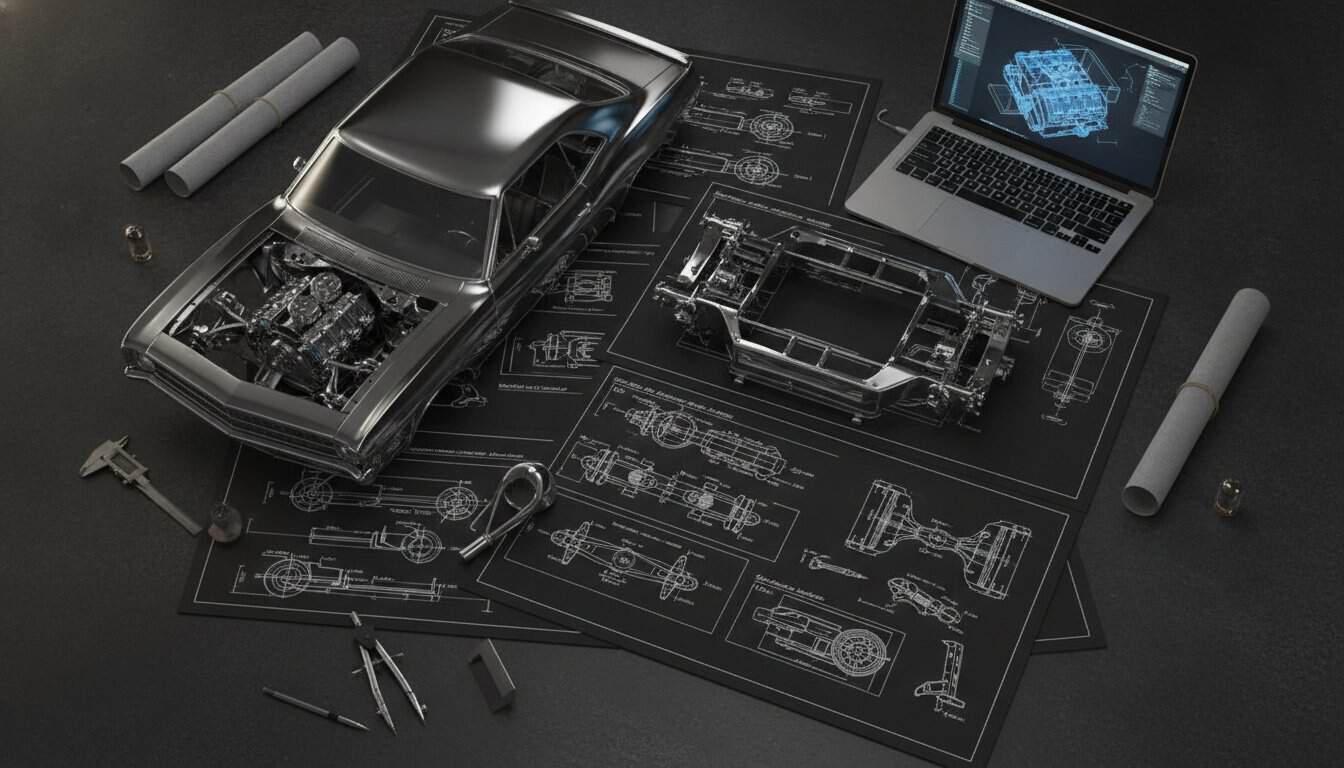
The most expensive tool in your garage isn’t the TIG welder or the hydraulic lift; it’s the costly mistake you didn’t see coming on page one of your build. You’ve likely spent hours staring at a vintage engine bay, dreaming of a high-output crate motor while simultaneously dreading the nightmare of wiring harnesses and clearance issues. It’s a common crossroads where the romance of classic lines meets the cold reality of modern engineering. You deserve the confidence that your vision will actually work when the rubber finally meets the road.
This guide will show you how to master the technical planning phase using professional restomod project blueprints that ensure every component works in harmony. By bridging the gap between heritage aesthetics and contemporary performance, you can eliminate the fear of incompatible parts and suspension geometry failures. We will walk through the process of creating a technical roadmap for your specific vehicle, providing you with a professional plan to present to shops or inspectors. Get ready to transition from a passive admirer to an active creator with a strategy that respects the past while embracing the future of speed.
Key Takeaways
- Understand why standard restoration manuals fall short and how restomod project blueprints serve as a necessary technical roadmap for modernizing vintage steel.
- Identify the essential engineering data required for a safe build, including precise engine mounting coordinates and critical suspension geometry like roll center and scrub radius.
- Evaluate the benefits of using professional-grade blueprints over the risks of DIY measurement to save time and prevent expensive part mismatches.
- Follow a structured workflow that transitions your project from a creative concept into a detailed technical plan ready for the workshop or inspector.
- Gain the confidence to execute your build by leveraging specialized guides that simplify the most daunting electrical and mechanical hurdles.
Understanding the Role of Restomod Project Blueprints
A successful restomod is more than a collection of expensive parts bolted onto a vintage chassis. It’s a complex exercise in engineering that requires a definitive technical roadmap. While many enthusiasts begin with a vision of classic lines and modern speed, the transition from dream to reality often fails without professional-grade restomod project blueprints. These documents act as the bridge between the analog soul of a vintage machine and the digital precision of contemporary performance systems.
Standard factory service manuals are invaluable for original restorations, but they offer little guidance when you decide to swap a carbureted small block for a direct-injected powerhouse. A factory manual tells you how to maintain the past; a blueprint tells you how to build the future. By establishing a clear plan before the first bolt is turned, you eliminate the guesswork that leads to project creep and the frustration of ordering parts that simply don’t fit. You are essentially acting as the architect of your own automotive masterpiece.
Restoration vs. Restomod Planning
Traditional restoration focuses on fidelity to the original build sheet, using factory specifications as a strict limit. Restomodding uses those same specifications as a baseline for improvement. You must identify where modern components will demand structural changes to the original metal. If you’re curious about the deeper distinctions, you can explore our detailed breakdown of what is a restomod. Documenting every deviation from the factory setup is crucial for safety and future maintenance, ensuring that any shop can understand the custom logic behind your build.
The Anatomy of a Modern Build Plan
A professional plan goes beyond simple sketches. It includes a deep analysis of chassis modification zones and potential stress points that occur when you double or triple the original horsepower. Your plan must account for several critical factors:
- Precise coordinates for engine and transmission mounts to maintain optimal weight distribution.
- Clearance requirements for modern, wider transmissions that often necessitate tunnel modifications.
- Routing paths for advanced electrical systems and fuel lines that were never part of the original design.
Mapping these elements early prevents the common headache of finding out your steering column interferes with your exhaust headers only after the engine is in the car. Precision is the difference between a project that sits in the garage and one that conquers the open road. When you treat your build with the respect of a professional engineer, you ensure that every modification contributes to a safer, faster, and more reliable machine.
Core Elements of a Professional Build Blueprint
A professional blueprint isn’t a mere sketch to hang on your wall; it’s a living engineering document. While many online resources offer pretty side profiles, true restomod project blueprints provide the data needed to ensure your car handles as well as it looks. You need to account for every millimeter of space to avoid the build-day surprises that stall so many projects in the workshop. Precision here is the difference between a car that tracks straight and one that fights you at every corner.
Powertrain Integration and Fitment
Start with the heart of the machine. When planning a high-performance swap, calculating firewall setbacks is essential for proper weight distribution and cooling fan clearance. Modern 6-speed gearboxes are significantly bulkier than vintage units, often requiring you to map out transmission tunnel expansions before you even cut the floor. Powertrain fitment requires meticulous planning to ensure that oil pan depth and crossmember clearance do not compromise ground clearance or engine angle. If you’re tackling a popular engine swap, using The Ultimate Restomod Guide can help you visualize these clearances before you make your first cut.
Suspension and Chassis Geometry
Upgrading to an independent rear suspension requires more than just welding in a subframe. You must map the mounting points to maintain correct suspension kinematics. This includes calculating the roll center and scrub radius to ensure the car remains stable under high-speed cornering. Pay close attention to steering rack alignment; even a small deviation can cause dangerous bump steer. Finally, identify chassis stiffening points. Vintage frames weren’t designed for 500 horsepower, so your restomod project blueprints should include torque boxes or subframe connectors to prevent the body from twisting under load.
Brakes, Wiring, and Ergonomics
Don’t overlook the systems that make the car drivable. Your blueprint should detail brake system plumbing, ensuring the master cylinder is positioned for optimal pedal leverage. For electrical systems, map the routing for EFI harnesses and infotainment wiring away from heat sources like exhaust headers. Inside the cabin, use ergonomic mapping to place custom seating and digital dashes within a comfortable reach. This level of detail transforms a pile of parts into a cohesive, high-performance machine that feels as intentional as a modern supercar.
Sourcing vs. Creating Your Project Blueprints
Every builder eventually faces a critical decision: do you spend weeks with a tape measure and CAD software, or do you invest in a proven roadmap? Sourcing restomod project blueprints isn’t just about getting a piece of paper; it’s about acquiring the collective experience of engineers who have already solved the clearance and geometry puzzles you’re currently facing. While the DIY spirit is the backbone of our community, there’s no shame in standing on the shoulders of giants to ensure your build is safe and precise. You have to decide if your time is better spent drafting or turning wrenches.
The Case for Premium Pre-Made Plans
Choosing Premium Project Blueprints for specific models gives you immediate access to verified engineering data. These plans aren’t just drawings; they’re the result of scanning original chassis and testing modern component fitment in the real world. You save hundreds of hours by skipping the trial-and-error phase that often leads to “clearancing” parts with a sledgehammer. When you integrate these plans with your overall restomod project planning roadmaps, you create a seamless transition from the design phase to the assembly line. It’s the professional standard for those who value their time and the structural integrity of their vehicle.
DIY Drafting: Tools and Techniques
If you’re building something truly unique where a pre-made plan doesn’t exist, you’ll need to master the art of manual measurement. This path requires a high level of discipline and the right equipment. You can’t rely on a standard hardware store tape measure for suspension geometry. Check our recommended gear list for the precision calipers, angle finders, and laser levels necessary for this task.
Start with cardboard mockups. It’s a low-cost, physical blueprinting step that allows you to visualize engine placement and steering sweep before you commit to metal fabrication. Don’t trust everything you read on internet forums. One builder’s “perfect fit” might be another’s “rubbing tire” due to slight manufacturing variances in vintage frames. Always verify forum-sourced data against your own physical measurements to avoid costly mistakes.
For those tackling highly complex custom fabrications, don’t hesitate to seek a professional opinion. Our Restomod Consulting Services can provide a safety net, helping you review your DIY drafts before they become permanent. Whether you buy a plan or build one, the goal remains the same: a vehicle that performs with modern reliability while retaining its vintage soul. Precision is your best friend in the workshop, so don’t cut corners on the document that guides your entire project.
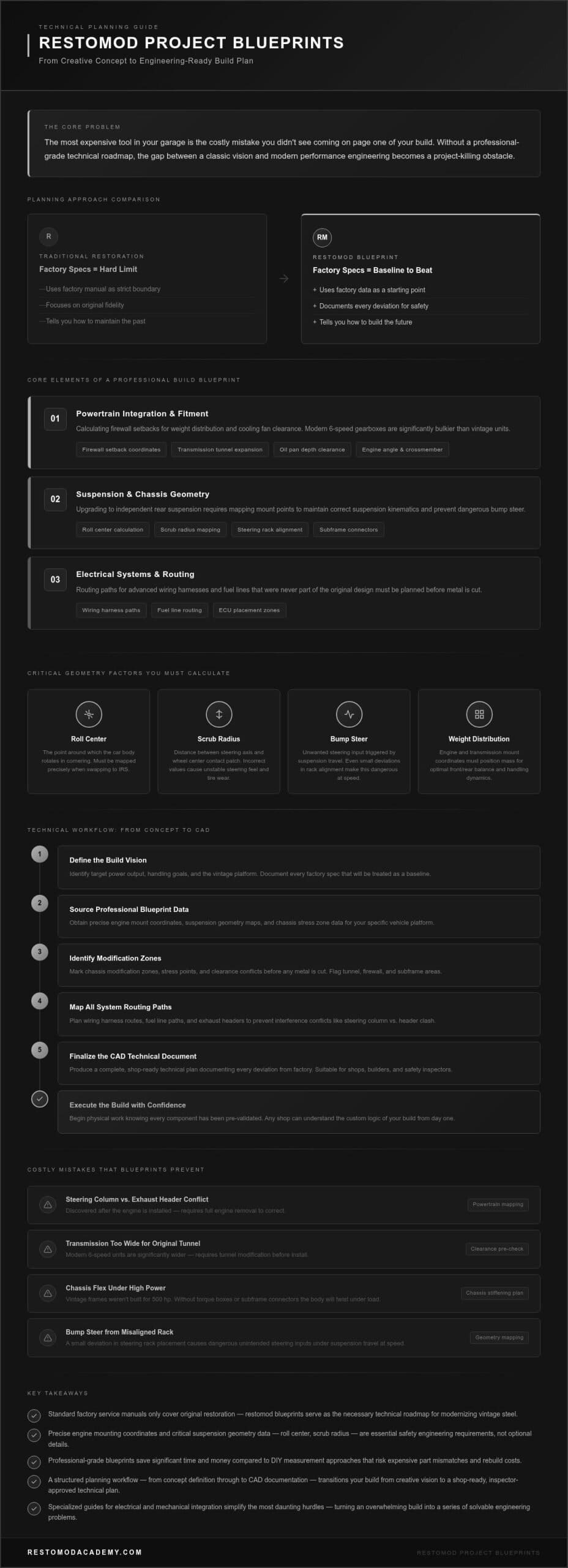
The Technical Workflow: From Concept to CAD
Transitioning from a creative vision to a technical document requires a disciplined workflow. You can’t just wing it when you’re dealing with modern horsepower and vintage metal. The process starts by establishing the specific performance goals for your vehicle. Are you building a long-distance grand tourer or a dedicated track machine? This decision dictates the specific suspension geometry and powertrain choices you’ll eventually layer into your restomod project blueprints.
Once the goal is clear, you must capture the physical reality of your car. This involves scanning or meticulously measuring the original chassis and body lines. You’re looking for the hard points; the locations that cannot move without significant structural surgery. By creating a digital or physical twin of your car’s dimensions, you can overlay modern component data to see exactly where the conflicts will arise.
Digital Drafting for the Home Builder
Accessible CAD software has revolutionized how we approach restomod design. You no longer need a degree in mechanical engineering to use 3D scans for checking engine swap clearances. This digital environment allows you to rotate a modern powertrain within your virtual engine bay to identify header interference or oil pan conflicts. It’s also the ideal place to draft complex wiring diagrams. You must carefully map how vintage dashboard switches will communicate with modern ECU inputs to ensure a seamless driving experience.
Validating the Blueprint Before Fabrication
The most dangerous part of the build is assuming the digital data is 100% accurate. Cross-reference your blueprints with the actual dimensions of the parts sitting on your shop floor. Manufacturers sometimes update casting shapes or accessory drive offsets without notice. Pay close attention to the relationship between your suspension at full compression and your exhaust routing. Validate steering geometry by plotting the pivot points on a 1:1 scale drawing to ensure the tie-rod arcs follow the control arm paths perfectly. If you’re unsure about which tools to use for these critical measurements, our recommended gear list features the precision instruments used by professional builders.
Finalizing your build order is the last step in the workflow. Component interdependence is a reality of custom building. You can’t finish the interior until the wiring is routed, and you can’t route the wiring until the steering column and pedal box are permanently mounted. A well-constructed set of restomod project blueprints respects this sequence, saving you from the frustration of taking the car apart to fix something you missed in phase one.
Executing Your Build with Restomod Academy
The transition from the drafting table to the garage floor is where the real adventure begins. Having a set of restomod project blueprints is your first victory, but the actual assembly requires a different set of skills and a reliable safety net. Restomod Academy was built to provide that framework, ensuring that every hour you spend in the workshop moves you closer to a finished project rather than deeper into a mechanical dead end. We believe in the power of the DIY builder, but we also know that even the most experienced creators benefit from a structured approach to complex modernization.
Our resources are designed to work in tandem with your technical plans. For instance, The Ultimate Restomod Guide provides the procedural depth needed to execute the high-level goals outlined in your blueprints. When you reach the stage of selecting specific hardware, our product reviews offer unbiased analysis of the components that actually deliver on their performance promises. By choosing parts that align with your engineering data, you protect your investment and ensure that the final assembly functions as a cohesive system.
Specialized Guides for Complex Systems
Some phases of a build require more than general knowledge. If your plan involves the most popular modern powertrain, the definitive guide to an ls engine swap offers a deep dive into the specific plumbing, wiring, and mounting challenges of that platform. Beyond the engine bay, we help you manage the delicate balance of integrating modern comfort into a vintage interior. If you find yourself facing a truly unique challenge with a rare vehicle, our Restomod Consulting Services provide direct access to expert advice to refine your custom fabrication strategy.
Your Next Steps in the Workshop
Don’t let the complexity of a modern build keep you on the sidelines. Join the Restomod Academy community today to access the mentorship and technical resources you need to bring your vision to life. Whether you are a novice looking for a guiding hand or an experienced builder seeking a knowledgeable peer, we are here to ensure your project reaches the finish line with the quality and safety it deserves.
Building Your Legacy with Precision
You’ve seen how the right technical roadmap transforms a daunting pile of parts into a cohesive, high-performance machine. By mastering the use of restomod project blueprints, you’ve moved beyond the guesswork that stalls so many builds. You now understand that mapping out engine fitment, suspension geometry, and electrical integration isn’t just about avoiding mistakes; it’s about the pride of creating a vehicle that functions as perfectly as it looks. Precision is your most valuable asset in the garage.
Success in the workshop requires a blend of vision and verified engineering data. Whether you are drafting your own plans or utilizing professional resources, the goal is a safe and reliable machine that honors its heritage while dominating the modern road. You don’t have to navigate this complex journey alone. With access to Premium Project Blueprints, expert mentorship from Brook Walsh, and our comprehensive library of technical tutorials, you have the safety net needed to achieve professional results.
Start your build with The Ultimate Restomod Guide and take the first step toward a finished project you can be proud of. Your garage is waiting; let’s get to work and build something legendary.
Frequently Asked Questions
Where can I find reliable blueprints for my specific classic car model?
You can find reliable engineering data through specialized providers like Restomod Academy, which offers Premium Project Blueprints for popular classic models. These restomod project blueprints provide the precise measurements needed to integrate modern performance parts without the guesswork. While some community forums offer sketches, they often lack the technical accuracy required for safe fabrication. Stick to professional sources to ensure your chassis and suspension modifications are based on real-world scans.
Do I need CAD software to create a restomod project blueprint?
You don’t need expensive CAD software to draft a plan, but it certainly helps visualize clearances for engine swaps. Many builders successfully use manual drafting techniques, cardboard templates, and 1:1 scale drawings on the shop floor. If you choose the digital route, accessible programs allow you to overlay modern component data on vintage chassis dimensions. The goal is clarity and accuracy, whether you use a computer or a drafting table.
How accurate do my measurements need to be for an engine swap?
Your measurements must be precise, often within three to five millimeters, to ensure proper clearance for headers, steering shafts, and cooling fans. Even a slight error in engine placement can ruin your weight distribution or cause vibration issues. Use high-quality calipers and laser levels rather than a standard tape measure. Accurate planning prevents the frustration of finding a conflict only after the mounts are permanently welded into place.
What is the most important part of a restomod build plan?
The intersection of suspension geometry and powertrain placement is the most vital part of any build plan. You must ensure the car handles safely while accommodating the physical size of modern engines and transmissions. If the steering rack doesn’t align with the suspension pivot points, you’ll face dangerous bump steer. A successful plan treats the car as a single, unified system rather than a collection of separate parts.
Can I use original factory blueprints for a restomod project?
Original factory blueprints are excellent baselines for identifying original hard points and structural zones, but they are insufficient for the modernization process. You should use them to understand the car’s original design intent before layering in modern engineering data. Since restomodding involves significant deviations from the factory build sheet, your plan needs to document every new component. Think of the factory specs as the foundation for your custom technical roadmap.
How do I account for modern safety features in my project blueprint?
Integrate safety features like roll cages, upgraded braking systems, and three-point harnesses directly into your structural drawings by identifying where reinforcements are needed. Your blueprint should also detail the plumbing for modern power braking systems and the placement of the master cylinder. Don’t treat safety as an afterthought; it must be part of the initial engineering phase. This ensures that every performance gain is matched by a corresponding increase in occupant protection.
What are the common mistakes when drafting a restomod plan?
The most frequent errors include ignoring component interdependence and failing to check clearances at full suspension compression or steering lock. Another common error is routing exhaust pipes before you’ve finalized the location of your fuel lines or wiring harnesses. Professional restomod project blueprints help you visualize these conflicts on paper. Take your time during the drafting stage to avoid the expensive cycle of cutting and welding twice in the workshop.
How much time should I spend on the blueprinting phase?
You should dedicate significant time to planning, as every hour spent on the blueprint saves roughly five hours of labor in the garage. For a complex build, this phase can take several weeks of measuring, researching, and drafting. Don’t rush into the fabrication stage just because you’re excited to see progress. A methodical approach ensures that when you finally pick up the torch, every move is calculated and every part fits perfectly.
The most expensive tool in your garage isn’t the TIG welder or the hydraulic lift; it’s the costly mistake you didn’t see coming on page one of your build. You’ve likely spent hours staring at a vintage engine bay, dreaming of a high-output crate motor while simultaneously dreading the nightmare of wiring harnesses and clearance issues. It’s a common crossroads where the romance of classic lines meets the cold reality of modern engineering. You deserve the confidence that your vision will actually work when the rubber finally meets the road.
This guide will show you how to master the technical planning phase using professional restomod project blueprints that ensure every component works in harmony. By bridging the gap between heritage aesthetics and contemporary performance, you can eliminate the fear of incompatible parts and suspension geometry failures. We will walk through the process of creating a technical roadmap for your specific vehicle, providing you with a professional plan to present to shops or inspectors. Get ready to transition from a passive admirer to an active creator with a strategy that respects the past while embracing the future of speed.
Key Takeaways
- Understand why standard restoration manuals fall short and how restomod project blueprints serve as a necessary technical roadmap for modernizing vintage steel.
- Identify the essential engineering data required for a safe build, including precise engine mounting coordinates and critical suspension geometry like roll center and scrub radius.
- Evaluate the benefits of using professional-grade blueprints over the risks of DIY measurement to save time and prevent expensive part mismatches.
- Follow a structured workflow that transitions your project from a creative concept into a detailed technical plan ready for the workshop or inspector.
- Gain the confidence to execute your build by leveraging specialized guides that simplify the most daunting electrical and mechanical hurdles.
Understanding the Role of Restomod Project Blueprints
A successful restomod is more than a collection of expensive parts bolted onto a vintage chassis. It’s a complex exercise in engineering that requires a definitive technical roadmap. While many enthusiasts begin with a vision of classic lines and modern speed, the transition from dream to reality often fails without professional-grade restomod project blueprints. These documents act as the bridge between the analog soul of a vintage machine and the digital precision of contemporary performance systems.
Standard factory service manuals are invaluable for original restorations, but they offer little guidance when you decide to swap a carbureted small block for a direct-injected powerhouse. A factory manual tells you how to maintain the past; a blueprint tells you how to build the future. By establishing a clear plan before the first bolt is turned, you eliminate the guesswork that leads to project creep and the frustration of ordering parts that simply don’t fit. You are essentially acting as the architect of your own automotive masterpiece.
Restoration vs. Restomod Planning
Traditional restoration focuses on fidelity to the original build sheet, using factory specifications as a strict limit. Restomodding uses those same specifications as a baseline for improvement. You must identify where modern components will demand structural changes to the original metal. If you’re curious about the deeper distinctions, you can explore our detailed breakdown of what is a restomod. Documenting every deviation from the factory setup is crucial for safety and future maintenance, ensuring that any shop can understand the custom logic behind your build.
The Anatomy of a Modern Build Plan
A professional plan goes beyond simple sketches. It includes a deep analysis of chassis modification zones and potential stress points that occur when you double or triple the original horsepower. Your plan must account for several critical factors:
- Precise coordinates for engine and transmission mounts to maintain optimal weight distribution.
- Clearance requirements for modern, wider transmissions that often necessitate tunnel modifications.
- Routing paths for advanced electrical systems and fuel lines that were never part of the original design.
Mapping these elements early prevents the common headache of finding out your steering column interferes with your exhaust headers only after the engine is in the car. Precision is the difference between a project that sits in the garage and one that conquers the open road. When you treat your build with the respect of a professional engineer, you ensure that every modification contributes to a safer, faster, and more reliable machine.
Core Elements of a Professional Build Blueprint
A professional blueprint isn’t a mere sketch to hang on your wall; it’s a living engineering document. While many online resources offer pretty side profiles, true restomod project blueprints provide the data needed to ensure your car handles as well as it looks. You need to account for every millimeter of space to avoid the build-day surprises that stall so many projects in the workshop. Precision here is the difference between a car that tracks straight and one that fights you at every corner.
Powertrain Integration and Fitment
Start with the heart of the machine. When planning a high-performance swap, calculating firewall setbacks is essential for proper weight distribution and cooling fan clearance. Modern 6-speed gearboxes are significantly bulkier than vintage units, often requiring you to map out transmission tunnel expansions before you even cut the floor. Powertrain fitment requires meticulous planning to ensure that oil pan depth and crossmember clearance do not compromise ground clearance or engine angle. If you’re tackling a popular engine swap, using The Ultimate Restomod Guide can help you visualize these clearances before you make your first cut.
Suspension and Chassis Geometry
Upgrading to an independent rear suspension requires more than just welding in a subframe. You must map the mounting points to maintain correct suspension kinematics. This includes calculating the roll center and scrub radius to ensure the car remains stable under high-speed cornering. Pay close attention to steering rack alignment; even a small deviation can cause dangerous bump steer. Finally, identify chassis stiffening points. Vintage frames weren’t designed for 500 horsepower, so your restomod project blueprints should include torque boxes or subframe connectors to prevent the body from twisting under load.
Brakes, Wiring, and Ergonomics
Don’t overlook the systems that make the car drivable. Your blueprint should detail brake system plumbing, ensuring the master cylinder is positioned for optimal pedal leverage. For electrical systems, map the routing for EFI harnesses and infotainment wiring away from heat sources like exhaust headers. Inside the cabin, use ergonomic mapping to place custom seating and digital dashes within a comfortable reach. This level of detail transforms a pile of parts into a cohesive, high-performance machine that feels as intentional as a modern supercar.
Sourcing vs. Creating Your Project Blueprints
Every builder eventually faces a critical decision: do you spend weeks with a tape measure and CAD software, or do you invest in a proven roadmap? Sourcing restomod project blueprints isn’t just about getting a piece of paper; it’s about acquiring the collective experience of engineers who have already solved the clearance and geometry puzzles you’re currently facing. While the DIY spirit is the backbone of our community, there’s no shame in standing on the shoulders of giants to ensure your build is safe and precise. You have to decide if your time is better spent drafting or turning wrenches.
The Case for Premium Pre-Made Plans
Choosing Premium Project Blueprints for specific models gives you immediate access to verified engineering data. These plans aren’t just drawings; they’re the result of scanning original chassis and testing modern component fitment in the real world. You save hundreds of hours by skipping the trial-and-error phase that often leads to “clearancing” parts with a sledgehammer. When you integrate these plans with your overall restomod project planning roadmaps, you create a seamless transition from the design phase to the assembly line. It’s the professional standard for those who value their time and the structural integrity of their vehicle.
DIY Drafting: Tools and Techniques
If you’re building something truly unique where a pre-made plan doesn’t exist, you’ll need to master the art of manual measurement. This path requires a high level of discipline and the right equipment. You can’t rely on a standard hardware store tape measure for suspension geometry. Check our recommended gear list for the precision calipers, angle finders, and laser levels necessary for this task.
Start with cardboard mockups. It’s a low-cost, physical blueprinting step that allows you to visualize engine placement and steering sweep before you commit to metal fabrication. Don’t trust everything you read on internet forums. One builder’s “perfect fit” might be another’s “rubbing tire” due to slight manufacturing variances in vintage frames. Always verify forum-sourced data against your own physical measurements to avoid costly mistakes.
For those tackling highly complex custom fabrications, don’t hesitate to seek a professional opinion. Our Restomod Consulting Services can provide a safety net, helping you review your DIY drafts before they become permanent. Whether you buy a plan or build one, the goal remains the same: a vehicle that performs with modern reliability while retaining its vintage soul. Precision is your best friend in the workshop, so don’t cut corners on the document that guides your entire project.
The Technical Workflow: From Concept to CAD
Transitioning from a creative vision to a technical document requires a disciplined workflow. You can’t just wing it when you’re dealing with modern horsepower and vintage metal. The process starts by establishing the specific performance goals for your vehicle. Are you building a long-distance grand tourer or a dedicated track machine? This decision dictates the specific suspension geometry and powertrain choices you’ll eventually layer into your restomod project blueprints.
Once the goal is clear, you must capture the physical reality of your car. This involves scanning or meticulously measuring the original chassis and body lines. You’re looking for the hard points; the locations that cannot move without significant structural surgery. By creating a digital or physical twin of your car’s dimensions, you can overlay modern component data to see exactly where the conflicts will arise.
Digital Drafting for the Home Builder
Accessible CAD software has revolutionized how we approach restomod design. You no longer need a degree in mechanical engineering to use 3D scans for checking engine swap clearances. This digital environment allows you to rotate a modern powertrain within your virtual engine bay to identify header interference or oil pan conflicts. It’s also the ideal place to draft complex wiring diagrams. You must carefully map how vintage dashboard switches will communicate with modern ECU inputs to ensure a seamless driving experience.
Validating the Blueprint Before Fabrication
The most dangerous part of the build is assuming the digital data is 100% accurate. Cross-reference your blueprints with the actual dimensions of the parts sitting on your shop floor. Manufacturers sometimes update casting shapes or accessory drive offsets without notice. Pay close attention to the relationship between your suspension at full compression and your exhaust routing. Validate steering geometry by plotting the pivot points on a 1:1 scale drawing to ensure the tie-rod arcs follow the control arm paths perfectly. If you’re unsure about which tools to use for these critical measurements, our recommended gear list features the precision instruments used by professional builders.
Finalizing your build order is the last step in the workflow. Component interdependence is a reality of custom building. You can’t finish the interior until the wiring is routed, and you can’t route the wiring until the steering column and pedal box are permanently mounted. A well-constructed set of restomod project blueprints respects this sequence, saving you from the frustration of taking the car apart to fix something you missed in phase one.
Executing Your Build with Restomod Academy
The transition from the drafting table to the garage floor is where the real adventure begins. Having a set of restomod project blueprints is your first victory, but the actual assembly requires a different set of skills and a reliable safety net. Restomod Academy was built to provide that framework, ensuring that every hour you spend in the workshop moves you closer to a finished project rather than deeper into a mechanical dead end. We believe in the power of the DIY builder, but we also know that even the most experienced creators benefit from a structured approach to complex modernization.
Our resources are designed to work in tandem with your technical plans. For instance, The Ultimate Restomod Guide provides the procedural depth needed to execute the high-level goals outlined in your blueprints. When you reach the stage of selecting specific hardware, our product reviews offer unbiased analysis of the components that actually deliver on their performance promises. By choosing parts that align with your engineering data, you protect your investment and ensure that the final assembly functions as a cohesive system.
Specialized Guides for Complex Systems
Some phases of a build require more than general knowledge. If your plan involves the most popular modern powertrain, the definitive guide to an ls engine swap offers a deep dive into the specific plumbing, wiring, and mounting challenges of that platform. Beyond the engine bay, we help you manage the delicate balance of integrating modern comfort into a vintage interior. If you find yourself facing a truly unique challenge with a rare vehicle, our Restomod Consulting Services provide direct access to expert advice to refine your custom fabrication strategy.
Your Next Steps in the Workshop
Organization is the silent partner of precision. As you move from the design phase to the garage, take the time to organize your workspace for a multi-year technical project. Label every harness, photograph every sub-assembly, and keep your restomod project blueprints prominently displayed as your north star. This methodical pace prevents the burnout that often plagues long-term builds. Remember that you aren’t just building a car; you’re developing a set of professional-grade skills that will serve you for a lifetime of automotive creation.
Don’t let the complexity of a modern build keep you on the sidelines. Join the Restomod Academy community today to access the mentorship and technical resources you need to bring your vision to life. Whether you are a novice looking for a guiding hand or an experienced builder seeking a knowledgeable peer, we are here to ensure your project reaches the finish line with the quality and safety it deserves.
Building Your Legacy with Precision
You’ve seen how the right technical roadmap transforms a daunting pile of parts into a cohesive, high-performance machine. By mastering the use of restomod project blueprints, you’ve moved beyond the guesswork that stalls so many builds. You now understand that mapping out engine fitment, suspension geometry, and electrical integration isn’t just about avoiding mistakes; it’s about the pride of creating a vehicle that functions as perfectly as it looks. Precision is your most valuable asset in the garage.
Success in the workshop requires a blend of vision and verified engineering data. Whether you are drafting your own plans or utilizing professional resources, the goal is a safe and reliable machine that honors its heritage while dominating the modern road. You don’t have to navigate this complex journey alone. With access to Premium Project Blueprints, expert mentorship from Brook Walsh, and our comprehensive library of technical tutorials, you have the safety net needed to achieve professional results.
Start your build with The Ultimate Restomod Guide and take the first step toward a finished project you can be proud of. Your garage is waiting; let’s get to work and build something legendary.
Frequently Asked Questions
Where can I find reliable blueprints for my specific classic car model?
You can find reliable engineering data through specialized providers like Restomod Academy, which offers Premium Project Blueprints for popular classic models. These restomod project blueprints provide the precise measurements needed to integrate modern performance parts without the guesswork. While some community forums offer sketches, they often lack the technical accuracy required for safe fabrication. Stick to professional sources to ensure your chassis and suspension modifications are based on real-world scans.
Do I need CAD software to create a restomod project blueprint?
You don’t need expensive CAD software to draft a plan, but it certainly helps visualize clearances for engine swaps. Many builders successfully use manual drafting techniques, cardboard templates, and 1:1 scale drawings on the shop floor. If you choose the digital route, accessible programs allow you to overlay modern component data on vintage chassis dimensions. The goal is clarity and accuracy, whether you use a computer or a drafting table.
How accurate do my measurements need to be for an engine swap?
Your measurements must be precise, often within three to five millimeters, to ensure proper clearance for headers, steering shafts, and cooling fans. Even a slight error in engine placement can ruin your weight distribution or cause vibration issues. Use high-quality calipers and laser levels rather than a standard tape measure. Accurate planning prevents the frustration of finding a conflict only after the mounts are permanently welded into place.
What is the most important part of a restomod build plan?
The intersection of suspension geometry and powertrain placement is the most vital part of any build plan. You must ensure the car handles safely while accommodating the physical size of modern engines and transmissions. If the steering rack doesn’t align with the suspension pivot points, you’ll face dangerous bump steer. A successful plan treats the car as a single, unified system rather than a collection of separate parts.
Can I use original factory blueprints for a restomod project?
Original factory blueprints are excellent baselines for identifying original hard points and structural zones, but they are insufficient for the modernization process. You should use them to understand the car’s original design intent before layering in modern engineering data. Since restomodding involves significant deviations from the factory build sheet, your plan needs to document every new component. Think of the factory specs as the foundation for your custom technical roadmap.
How do I account for modern safety features in my project blueprint?
Integrate safety features like roll cages, upgraded braking systems, and three-point harnesses directly into your structural drawings by identifying where reinforcements are needed. Your blueprint should also detail the plumbing for modern power braking systems and the placement of the master cylinder. Don’t treat safety as an afterthought; it must be part of the initial engineering phase. This ensures that every performance gain is matched by a corresponding increase in occupant protection.
What are the common mistakes when drafting a restomod plan?
The most frequent errors include ignoring component interdependence and failing to check clearances at full suspension compression or steering lock. Another common error is routing exhaust pipes before you’ve finalized the location of your fuel lines or wiring harnesses. Professional restomod project blueprints help you visualize these conflicts on paper. Take your time during the drafting stage to avoid the expensive cycle of cutting and welding twice in the workshop.
How much time should I spend on the blueprinting phase?
You should dedicate significant time to planning, as every hour spent on the blueprint saves roughly five hours of labor in the garage. For a complex build, this phase can take several weeks of measuring, researching, and drafting. Don’t rush into the fabrication stage just because you’re excited to see progress. A methodical approach ensures that when you finally pick up the torch, every move is calculated and every part fits perfectly.