

Classic Jaguar XJS V12 reliability mods work best when they address how the engine breathes and fuels, not just how much power it makes. A large-bore exhaust can add 10-15 b.h.p., while an applicable large-throttle kit can add 20-25 b.h.p. at the top of the speed range when paired with the specified ECU modification. Those gains don’t automatically make a V12 more reliable.
The temptation to fit bigger pipes, freer induction or modern fuel injection is easy to understand: the XJS V12 has a distinctive character, and thoughtful upgrades can sharpen it. But each change has limits, and a modification that improves top-end output may not improve everyday torque, drivability or dependability.
Learn how exhaust, induction, fuel injection and inlet upgrades affect V12 running, torque and performance, and where their compromises begin. We’ll also look at why short tubular branches of about 15 inches provide no benefit, and how to think through an upgrade in the context of the whole engine rather than as an isolated part.
Key Takeaways
- Judge an exhaust upgrade by its design and fit, not pipe diameter alone; consider catalyst and emissions-test requirements as part of the system.
- Large-throttle induction can favor high-rpm output, so weigh that gain against the torque and drivability you want in normal use.
- Short tubular manifold branches and camshaft changes have limitations; match component choices to the V12’s operating range.
- Electronic fuel injection can replace a carburettor setup, but the conversion calls for compatible engine-management components and careful fuel-system planning.
- Use inlet trumpet length to shape the engine’s torque delivery, and assess each modification as part of a balanced combination rather than in isolation.
1. Large-bore exhaust systems and catalysts
A large-bore exhaust can help the Jaguar V12 breathe, but diameter alone doesn’t determine the result. A well-matched system is reported to add about 10-15 b.h.p.; the gain depends on how the pipes, manifolds, catalysts and engine work together. For a road-going XJS, retain a sound catalyst and treat exhaust and intake changes as a coordinated tuning decision, not isolated bolt-ons.
Long tubular multi-branch pipes matter because they help manage exhaust pulses. Effective Jaguar V12 tubular branches need to be 3 to 4 feet (90-120 cm) long. A compact extractor isn’t automatically an improvement, since branch design matters. A TT extractor system should be judged by its actual branch length, collector arrangement and fit with the rest of the exhaust, rather than its label.
Silencer-substitute pipes and large-bore systems can change both exhaust sound and flow. Before fitting either, inspect the existing pipes, joints and catalyst for leaks or damage. The United States Environmental Protection Agency states that vehicles with leaking exhaust systems fail its emissions test. A leak-free installation is therefore a practical priority for road use and emissions testing.
Which classic Jaguar XJS V12 model years are most reliable? Enthusiasts identify the 1995-1996 model years as strong choices, while XJS build quality was said to have improved substantially by 1989. Treat those opinions as starting points; a particular car’s condition and service history still matter.
How does XJS V12 reliability compare with the XJS six-cylinder and other classic GTs? The V12 offers a different ownership proposition, with greater cooling and fuel-system complexity than the six-cylinder XJS. A well-maintained V12 can be robust, but comparisons with other GTs depend on condition and upkeep, not engine reputation alone.
How reliable is a stock Jaguar XJS V12 in everyday use? Owners report dependable running when the car is driven regularly, while an XJ-12C owner reported problems after leaving the car sitting for a month. Regular use doesn’t replace maintenance, but a stock engine’s condition matters more than exhaust modifications.
What preventative maintenance does a classic XJS V12 need? Keep the cooling system in sound condition, confirm coolant circulation and address overheating promptly. Cooling problems can contribute to dropped valve seats, so monitor temperature and investigate changes before adding performance parts.
What should buyers inspect before purchasing a classic Jaguar XJS V12? Check that it warms up without overheating and has sufficient coolant circulation. Inspect concealed body cavities for rust, then assess the exhaust for leaks and the catalyst for damage. Those checks reveal more about the car than a large-bore system’s claimed power gain.
2. Large-throttle induction upgrades
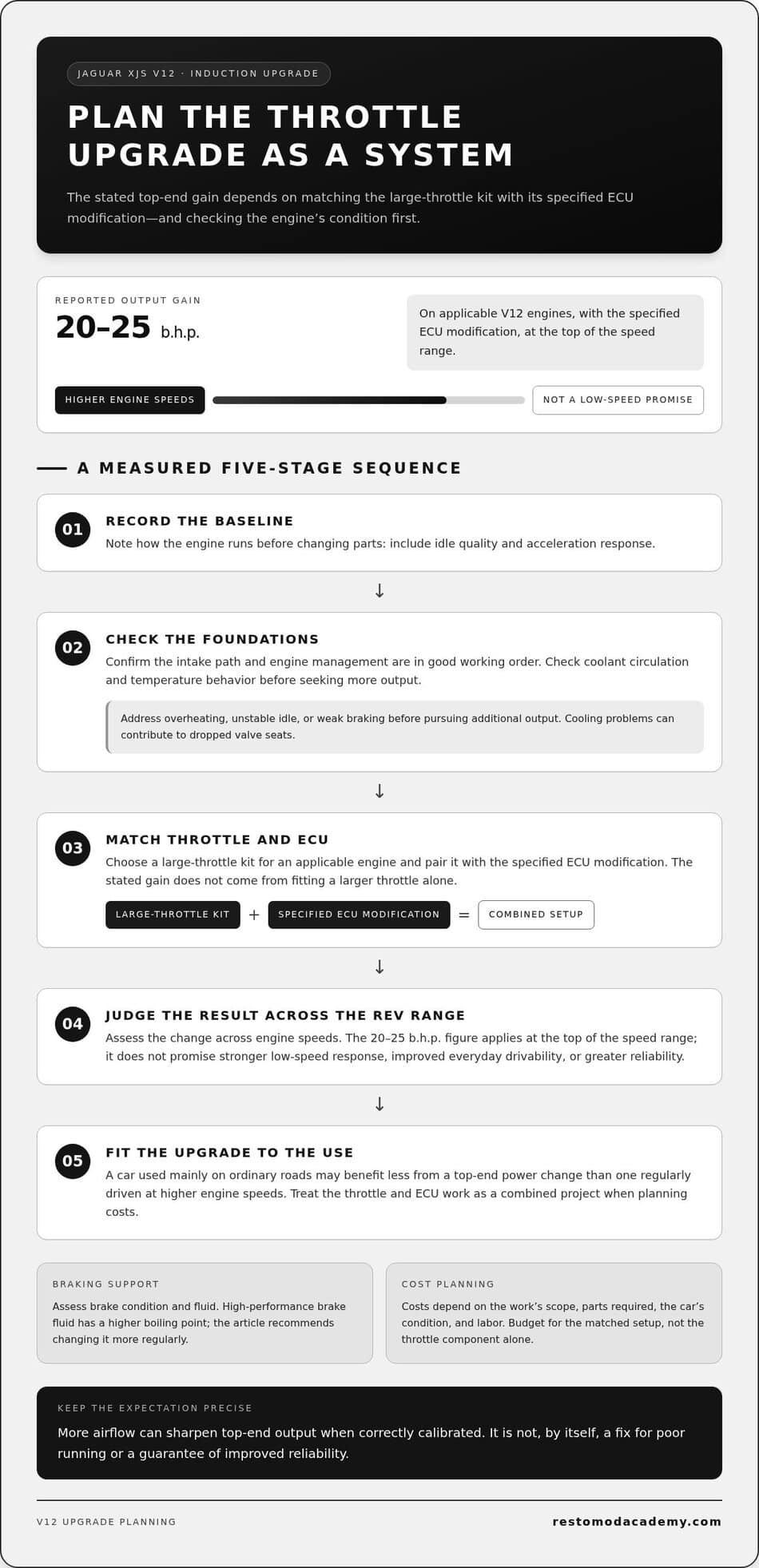
A large-throttle induction kit targets airflow at the engine’s inlet, but its benefit depends on calibration. On applicable Jaguar V12 engines, a large-throttle kit combined with the specified ECU modification can add 20-25 b.h.p. at the top of the speed range. That gain is concentrated at higher engine speeds, so it doesn’t automatically improve low-speed response or reliability. Treat it as one option among classic Jaguar XJS V12 reliability mods, chosen to suit how you drive.
Plan the throttle and ECU changes as one system. The ECU modification must suit the engine and increased airflow; fitting a larger throttle alone doesn’t produce the stated gain. Before choosing parts, establish how the XJS is used. A car driven mainly on ordinary roads may benefit less from top-end power than one regularly driven at higher engine speeds. This distinction helps keep classic Jaguar XJS V12 reliability mods focused on useful results.
Follow a measured sequence. First, record how the engine runs, including idle quality and acceleration response. Next, confirm that the intake path and engine management are in good working order. Then match the throttle upgrade to its specified ECU change and assess the result across the rev range. This baseline helps distinguish the modification’s effects from existing faults.
More airflow also makes supporting systems part of the decision. The Jaguar V12’s cooling condition matters because cooling problems can contribute to dropped valve seats. Check coolant circulation and temperature behavior before increasing performance. For braking, assess the existing system’s condition and fluid. High-performance brake fluid has a higher boiling point, and the author recommends changing it more regularly. That maintenance supports braking performance, but it doesn’t replace sound brakes or careful inspection.
What do common XJS V12 reliability repairs and upgrades cost in the US? Costs depend on the work’s scope, parts required, the car’s condition and labor, so an induction conversion, cooling repair and brake service can differ substantially. Treat the throttle kit and ECU modification as a combined project when planning the work, rather than budgeting for the throttle component alone.
Keep expectations precise. The 20-25 b.h.p. figure applies to the large-throttle kit with its specified ECU modification, and describes output at the top of the speed range. It isn’t a promise of stronger torque everywhere or a cure for poor running. If the XJS has an overheating concern, unstable idle or weak braking, address those underlying conditions before pursuing additional output. A balanced build respects the V12’s cooling, engine management and braking as much as its intake airflow.
3. Camshaft and tubular manifold limitations
Camshaft changes and tubular manifolds can reshape a Jaguar V12’s power delivery, but they need to work as a matched combination. A cam profile affects valve timing and overlap, influencing idle quality, low-speed torque and performance higher in the rev range. A setup aimed at high-rpm output may feel less flexible in ordinary driving. Choose the engine’s intended use first, then assess whether the supporting exhaust and induction can suit that goal.
Short branches are a clear limitation: tubular exhaust branches of about 15” (40 cm) provide no benefit on the Jaguar V12. Manifold design depends on more than appearance or diameter. Branch length and collector arrangement affect how exhaust pulses leave the cylinders, so a compact design shouldn’t be assumed to improve flow. Compare the actual layout with the engine’s intended operating range before committing to a camshaft or manifold combination.
Head design also shapes the decision. Early flat-head Jaguar V12 engines built before 1981 are considered a better choice for high-power ambitions than HE-type heads. That distinction doesn’t make a camshaft upgrade automatically suitable for either engine. The existing head, induction system and exhaust all influence the result, while a change optimized for peak output can compromise the character of a road-driven XJS.
Set a practical baseline before changing valve timing. Record how the engine idles, responds at low speed and pulls through acceleration, then compare those observations after the work. If the car already runs unevenly, identify the cause before attributing symptoms to the camshaft. This step matters on a multi-cylinder Jaguar V12, where a tuning change can make an existing imbalance harder to diagnose.
Consider the entire airflow path. A camshaft designed to improve breathing at higher rpm needs a manifold and exhaust that support that behavior; a restrictive or poorly matched part can limit the combination. But choosing every component for maximum flow does not guarantee useful road performance. Decide whether you prioritize tractable torque, smooth cruising or higher-rpm power, then select parts to suit.
For a classic XJS, restraint can be a sound engineering choice. Preserve the current camshaft when the engine already meets the car’s needs, and focus changes on a clearly identified limitation. If pursuing a high-power build, start with the V12 head type and intended use, then assess the camshaft and tubular manifold together. That sequence helps keep an ambitious modification grounded in the engine’s actual configuration.
4. Converting early V12 carburettors to electronic fuel injection
Converting an early carburetted Jaguar V12 to electronic fuel injection changes fuel delivery and adds engine-management hardware. The conversion can modernize control, but it isn’t simply a carburettor swap. Plan the fuel rails, injectors, sensors, wiring and ECU together, then verify that each component suits the engine configuration.
Fuel consumption is a major consideration with pre-HE Jaguar V12s; owners have described it as very high. Early XJS fuel rails can also use at least 40 hose clamps, creating numerous potential leak points. A forum member warned that this arrangement can be prone to leaks and fire. Inspect the existing fuel system carefully before planning work, and treat leak prevention as central to the conversion.
A practical parts route is to source conversion components from a mid-1980s XJS or XJ12 HE. Those cars can provide a useful reference for fuel-injection hardware, but the engine-management system still needs to match the converted engine. The planned upgrade includes a 3-bar MAP sensor. Include that sensor in the ECU and wiring plan, rather than treating it as an isolated component.
Work methodically. First, document the carburettor setup and existing fuel plumbing. Next, plan the fuel rails, injector arrangement, sensor connections and ECU as a complete system. Inspect hoses and connections, replace unsuitable fuel-system components, and secure the wiring. Before starting the engine, check every fuel connection for leaks and confirm that the ECU receives consistent sensor signals.
Common engine concerns include high fuel consumption in pre-HE V12s and cooling-related problems that can contribute to dropped valve seats. On the electrical side, an EFI conversion depends on compatible ECU wiring and sensor connections; faults in those circuits can disrupt engine management. Diagnose the system as a whole instead of assuming every poor-running symptom comes from the injectors.
Keep the conversion’s purpose clear. Electronic fuel injection may provide more controlled fuel delivery, but the result depends on the calibration and condition of the complete setup. A 3-bar MAP sensor, appropriate ECU, sound wiring and leak-free fuel rails must work together. Preserve the original parts where practical, document changes, and test the engine methodically after installation. That record helps future troubleshooting and keeps the Jaguar V12’s character connected to a carefully engineered update.
The project concerns a 1989 Jaguar XJS V12 convertible. A forum member said the pre-HE Jaguar V12 was more robust than the HE version, which was leaned out for better fuel economy and more prone to valve failure. The page identifies 8 litre conversions as a possible radical modification; Jaguar XJ-S V12 engines with early flat cylinder heads can be tuned to over 600 bhp, at great expense.
These examples show why condition, intended use and budget should guide EFI hardware choices.
5. Extended inlet trumpets and mid-range torque
On a Jaguar XJS V12, inlet trumpets guide air from the plenum toward each intake port. Their length influences the pressure waves traveling through the intake, which helps shape where the engine develops torque. Extended trumpets are therefore a tuning choice, not a universal reliability fix. For a 5.3-litre V12 used on the road, prioritize the torque range that makes ordinary acceleration feel responsive.
Begin by defining the goal. If the XJS feels weak during mid-range acceleration, note the engine speed and throttle position where its response fades. Before changing trumpet length, inspect the intake for leaks, restrictions and uneven airflow. A worn or poorly sealed part can mimic a tuning problem. Fix those faults first, so a trumpet change addresses the engine’s breathing instead of masking another issue.
Trumpet length affects intake resonance, while the plenum and throttle arrangement influence how air reaches the runners. Longer trumpets shift the tuning effect toward a lower engine-speed range; shorter trumpets favor higher-speed breathing. The result depends on the complete intake layout and engine specification. Don’t select an extended design by appearance alone. Confirm that its length and entry shape suit the V12 configuration and intended driving range.
Record the XJS’s baseline behavior before fitting parts. Note idle stability, response from a steady cruise and mid-range acceleration. Change one intake variable at a time, then repeat the same road test in similar conditions. This makes it easier to tell whether trumpet length improved the response you wanted or simply shifted where the engine pulls strongest.
Check the physical fit before installation. The trumpets must clear nearby components, seal correctly and sit consistently across the intake. Uneven positioning can undermine an otherwise well-chosen setup. During assembly, inspect the plenum joints and throttle operation, then confirm that the engine idles cleanly and responds smoothly. If the XJS has modified induction or engine management, factor those changes into your assessment of the trumpet design.
Keep the goal realistic: extended inlet trumpets are intended to shape torque delivery, not guarantee a power increase or cure poor running. A road-focused Jaguar V12 benefits from a broad, usable response more than a narrow peak that rarely suits normal driving. Record the final configuration, including trumpet design and related intake changes. That build note gives future maintenance and tuning work a clear reference point, preserving the logic behind each modification.
Restomod Academy: The Ultimate Restomod Guide
Restomod Academy’s The Ultimate Restomod Guide helps you turn upgrade research into a considered classic-car project. Use it to weigh exhaust, induction or fuel-injection changes within a broader restoration plan.
For a Jaguar XJS V12 build, map the goal before choosing components: define the desired driving character, note the engine’s current condition, and sequence supporting work alongside performance changes. Restomod Consulting Services can help you think through project decisions, while Premium Project Blueprints offer structured guidance for planning a build. These educational resources suit owners who want to understand the work and make deliberate choices, rather than chase modifications without a clear purpose.
Explore The Ultimate Restomod Guide or visit restomodacademy.com to keep planning your project.
Build the XJS You Want to Drive
Make your next step a clear project brief. Write down how you use your Jaguar, what feels lacking and which changes would preserve the character you value. Then rank each proposed modification by its purpose, the systems it affects and how you’ll assess the result. This simple discipline turns a collection of parts into a coherent build.
A thoughtful plan for classic Jaguar XJS V12 reliability mods should also leave room to learn. Keep notes as you work, record changes to the engine and supporting systems, and assess each adjustment before adding another. The result is more than a modified car: it’s a machine whose response reflects your priorities and your care.
Restomod Academy’s The Ultimate Restomod Guide, Restomod Consulting Services, and Premium Project Blueprints can support different stages of that planning process. Contact Restomod Academy about your XJS and take the next step with purpose. Your XJS has a remarkable heritage; build on it thoughtfully, and enjoy the drive you’ve shaped.
Frequently Asked Questions
Which Jaguar XJS V12 reliability upgrades are most effective?
Start with upgrades that address a specific fault or weakness, rather than adding performance parts first. If the car runs hot, for example, investigate the cooling system before changing airflow components. If fuel delivery is the concern, assess the whole fuel system and its connections. Prioritize work according to symptoms, condition and intended use, then make one change at a time to see what actually improves the car.
How can the XJS V12 cooling system be upgraded to prevent overheating?
Assess the cooling system before replacing parts. Check for leaks, restricted coolant flow and components that aren’t working correctly, then monitor temperature during warm-up and normal driving. Confirm that the radiator, pump, thermostat, hoses and fan work as a system. Fix any faults before pursuing extra power, and record repairs and temperature observations to help identify recurring problems.
Are XJS V12 fuel injection and ignition upgrades worth doing?
Fuel injection can make sense when replacing an early carburettor setup with electronic fuel control, provided the ECU, sensors, wiring and fuel hardware are planned together. An ignition upgrade is appropriate when inspection identifies a fault or when it needs to integrate with a broader engine-management plan. Define the running problem first, document the existing setup, and assess each change by its effect on starting, idle and response.
Classic Jaguar XJS V12 reliability mods work best when they address how the engine breathes and fuels, not just how much power it makes. A large-bore exhaust can add 10-15 b.h.p., while an applicable large-throttle kit can add 20-25 b.h.p. at the top of the speed range when paired with the specified ECU modification. Those gains don’t automatically make a V12 more reliable.
The temptation to fit bigger pipes, freer induction or modern fuel injection is easy to understand: the XJS V12 has a distinctive character, and thoughtful upgrades can sharpen it. But each change has limits, and a modification that improves top-end output may not improve everyday torque, drivability or dependability.
Learn how exhaust, induction, fuel injection and inlet upgrades affect V12 running, torque and performance, and where their compromises begin. We’ll also look at why short tubular branches of about 15 inches provide no benefit, and how to think through an upgrade in the context of the whole engine rather than as an isolated part.
Key Takeaways
- Judge an exhaust upgrade by its design and fit, not pipe diameter alone; consider catalyst and emissions-test requirements as part of the system.
- Large-throttle induction can favor high-rpm output, so weigh that gain against the torque and drivability you want in normal use.
- Short tubular manifold branches and camshaft changes have limitations; match component choices to the V12’s operating range.
- Electronic fuel injection can replace a carburettor setup, but the conversion calls for compatible engine-management components and careful fuel-system planning.
- Use inlet trumpet length to shape the engine’s torque delivery, and assess each modification as part of a balanced combination rather than in isolation.
1. Large-bore exhaust systems and catalysts
A large-bore exhaust can help the Jaguar V12 breathe, but diameter alone doesn’t determine the result. A well-matched system is reported to add about 10-15 b.h.p.; the gain depends on how the pipes, manifolds, catalysts and engine work together. For a road-going XJS, retain a sound catalyst and treat exhaust and intake changes as a coordinated tuning decision, not isolated bolt-ons.
Long tubular multi-branch pipes matter because they help manage exhaust pulses. Effective Jaguar V12 tubular branches need to be 3 to 4 feet (90-120 cm) long. A compact extractor isn’t automatically an improvement, since branch design matters. A TT extractor system should be judged by its actual branch length, collector arrangement and fit with the rest of the exhaust, rather than its label.
Silencer-substitute pipes and large-bore systems can change both exhaust sound and flow. Before fitting either, inspect the existing pipes, joints and catalyst for leaks or damage. The United States Environmental Protection Agency states that vehicles with leaking exhaust systems fail its emissions test. A leak-free installation is therefore a practical priority for road use and emissions testing.
Which classic Jaguar XJS V12 model years are most reliable? Enthusiasts identify the 1995-1996 model years as strong choices, while XJS build quality was said to have improved substantially by 1989. Treat those opinions as starting points; a particular car’s condition and service history still matter.
How does XJS V12 reliability compare with the XJS six-cylinder and other classic GTs? The V12 offers a different ownership proposition, with greater cooling and fuel-system complexity than the six-cylinder XJS. A well-maintained V12 can be robust, but comparisons with other GTs depend on condition and upkeep, not engine reputation alone.
How reliable is a stock Jaguar XJS V12 in everyday use? Owners report dependable running when the car is driven regularly, while an XJ-12C owner reported problems after leaving the car sitting for a month. Regular use doesn’t replace maintenance, but a stock engine’s condition matters more than exhaust modifications.
What preventative maintenance does a classic XJS V12 need? Keep the cooling system in sound condition, confirm coolant circulation and address overheating promptly. Cooling problems can contribute to dropped valve seats, so monitor temperature and investigate changes before adding performance parts.
What should buyers inspect before purchasing a classic Jaguar XJS V12? Check that it warms up without overheating and has sufficient coolant circulation. Inspect concealed body cavities for rust, then assess the exhaust for leaks and the catalyst for damage. Those checks reveal more about the car than a large-bore system’s claimed power gain.
2. Large-throttle induction upgrades
A large-throttle induction kit targets airflow at the engine’s inlet, but its benefit depends on calibration. On applicable Jaguar V12 engines, a large-throttle kit combined with the specified ECU modification can add 20-25 b.h.p. at the top of the speed range. That gain is concentrated at higher engine speeds, so it doesn’t automatically improve low-speed response or reliability. Treat it as one option among classic Jaguar XJS V12 reliability mods, chosen to suit how you drive.
Plan the throttle and ECU changes as one system. The ECU modification must suit the engine and increased airflow; fitting a larger throttle alone doesn’t produce the stated gain. Before choosing parts, establish how the XJS is used. A car driven mainly on ordinary roads may benefit less from top-end power than one regularly driven at higher engine speeds. This distinction helps keep classic Jaguar XJS V12 reliability mods focused on useful results.
Follow a measured sequence. First, record how the engine runs, including idle quality and acceleration response. Next, confirm that the intake path and engine management are in good working order. Then match the throttle upgrade to its specified ECU change and assess the result across the rev range. This baseline helps distinguish the modification’s effects from existing faults.
More airflow also makes supporting systems part of the decision. The Jaguar V12’s cooling condition matters because cooling problems can contribute to dropped valve seats. Check coolant circulation and temperature behavior before increasing performance. For braking, assess the existing system’s condition and fluid. High-performance brake fluid has a higher boiling point, and the author recommends changing it more regularly. That maintenance supports braking performance, but it doesn’t replace sound brakes or careful inspection.
What do common XJS V12 reliability repairs and upgrades cost in the US? Costs depend on the work’s scope, parts required, the car’s condition and labor, so an induction conversion, cooling repair and brake service can differ substantially. Treat the throttle kit and ECU modification as a combined project when planning the work, rather than budgeting for the throttle component alone.
Keep expectations precise. The 20-25 b.h.p. figure applies to the large-throttle kit with its specified ECU modification, and describes output at the top of the speed range. It isn’t a promise of stronger torque everywhere or a cure for poor running. If the XJS has an overheating concern, unstable idle or weak braking, address those underlying conditions before pursuing additional output. A balanced build respects the V12’s cooling, engine management and braking as much as its intake airflow.
3. Camshaft and tubular manifold limitations
Camshaft changes and tubular manifolds can reshape a Jaguar V12’s power delivery, but they need to work as a matched combination. A cam profile affects valve timing and overlap, influencing idle quality, low-speed torque and performance higher in the rev range. A setup aimed at high-rpm output may feel less flexible in ordinary driving. Choose the engine’s intended use first, then assess whether the supporting exhaust and induction can suit that goal.
Short branches are a clear limitation: tubular exhaust branches of about 15” (40 cm) provide no benefit on the Jaguar V12. Manifold design depends on more than appearance or diameter. Branch length and collector arrangement affect how exhaust pulses leave the cylinders, so a compact design shouldn’t be assumed to improve flow. Compare the actual layout with the engine’s intended operating range before committing to a camshaft or manifold combination.
Head design also shapes the decision. Early flat-head Jaguar V12 engines built before 1981 are considered a better choice for high-power ambitions than HE-type heads. That distinction doesn’t make a camshaft upgrade automatically suitable for either engine. The existing head, induction system and exhaust all influence the result, while a change optimized for peak output can compromise the character of a road-driven XJS.
Set a practical baseline before changing valve timing. Record how the engine idles, responds at low speed and pulls through acceleration, then compare those observations after the work. If the car already runs unevenly, identify the cause before attributing symptoms to the camshaft. This step matters on a multi-cylinder Jaguar V12, where a tuning change can make an existing imbalance harder to diagnose.
Consider the entire airflow path. A camshaft designed to improve breathing at higher rpm needs a manifold and exhaust that support that behavior; a restrictive or poorly matched part can limit the combination. But choosing every component for maximum flow does not guarantee useful road performance. Decide whether you prioritize tractable torque, smooth cruising or higher-rpm power, then select parts to suit.
For a classic XJS, restraint can be a sound engineering choice. Preserve the current camshaft when the engine already meets the car’s needs, and focus changes on a clearly identified limitation. If pursuing a high-power build, start with the V12 head type and intended use, then assess the camshaft and tubular manifold together. That sequence helps keep an ambitious modification grounded in the engine’s actual configuration.
4. Converting early V12 carburettors to electronic fuel injection
Converting an early carburetted Jaguar V12 to electronic fuel injection changes fuel delivery and adds engine-management hardware. The conversion can modernize control, but it isn’t simply a carburettor swap. Plan the fuel rails, injectors, sensors, wiring and ECU together, then verify that each component suits the engine configuration.
Fuel consumption is a major consideration with pre-HE Jaguar V12s; owners have described it as very high. Early XJS fuel rails can also use at least 40 hose clamps, creating numerous potential leak points. A forum member warned that this arrangement can be prone to leaks and fire. Inspect the existing fuel system carefully before planning work, and treat leak prevention as central to the conversion.
A practical parts route is to source conversion components from a mid-1980s XJS or XJ12 HE. Those cars can provide a useful reference for fuel-injection hardware, but the engine-management system still needs to match the converted engine. The planned upgrade includes a 3-bar MAP sensor. Include that sensor in the ECU and wiring plan, rather than treating it as an isolated component.
Work methodically. First, document the carburettor setup and existing fuel plumbing. Next, plan the fuel rails, injector arrangement, sensor connections and ECU as a complete system. Inspect hoses and connections, replace unsuitable fuel-system components, and secure the wiring. Before starting the engine, check every fuel connection for leaks and confirm that the ECU receives consistent sensor signals.
Common engine concerns include high fuel consumption in pre-HE V12s and cooling-related problems that can contribute to dropped valve seats. On the electrical side, an EFI conversion depends on compatible ECU wiring and sensor connections; faults in those circuits can disrupt engine management. Diagnose the system as a whole instead of assuming every poor-running symptom comes from the injectors.
Keep the conversion’s purpose clear. Electronic fuel injection may provide more controlled fuel delivery, but the result depends on the calibration and condition of the complete setup. A 3-bar MAP sensor, appropriate ECU, sound wiring and leak-free fuel rails must work together. Preserve the original parts where practical, document changes, and test the engine methodically after installation. That record helps future troubleshooting and keeps the Jaguar V12’s character connected to a carefully engineered update.
The project concerns a 1989 Jaguar XJS V12 convertible. A forum member said the pre-HE Jaguar V12 was more robust than the HE version, which was leaned out for better fuel economy and more prone to valve failure. The page identifies 8 litre conversions as a possible radical modification; Jaguar XJ-S V12 engines with early flat cylinder heads can be tuned to over 600 bhp, at great expense.
These examples show why condition, intended use and budget should guide EFI hardware choices.
5. Extended inlet trumpets and mid-range torque
On a Jaguar XJS V12, inlet trumpets guide air from the plenum toward each intake port. Their length influences the pressure waves traveling through the intake, which helps shape where the engine develops torque. Extended trumpets are therefore a tuning choice, not a universal reliability fix. For a 5.3-litre V12 used on the road, prioritize the torque range that makes ordinary acceleration feel responsive.
Begin by defining the goal. If the XJS feels weak during mid-range acceleration, note the engine speed and throttle position where its response fades. Before changing trumpet length, inspect the intake for leaks, restrictions and uneven airflow. A worn or poorly sealed part can mimic a tuning problem. Fix those faults first, so a trumpet change addresses the engine’s breathing instead of masking another issue.
Trumpet length affects intake resonance, while the plenum and throttle arrangement influence how air reaches the runners. Longer trumpets shift the tuning effect toward a lower engine-speed range; shorter trumpets favor higher-speed breathing. The result depends on the complete intake layout and engine specification. Don’t select an extended design by appearance alone. Confirm that its length and entry shape suit the V12 configuration and intended driving range.
Record the XJS’s baseline behavior before fitting parts. Note idle stability, response from a steady cruise and mid-range acceleration. Change one intake variable at a time, then repeat the same road test in similar conditions. This makes it easier to tell whether trumpet length improved the response you wanted or simply shifted where the engine pulls strongest.
Check the physical fit before installation. The trumpets must clear nearby components, seal correctly and sit consistently across the intake. Uneven positioning can undermine an otherwise well-chosen setup. During assembly, inspect the plenum joints and throttle operation, then confirm that the engine idles cleanly and responds smoothly. If the XJS has modified induction or engine management, factor those changes into your assessment of the trumpet design.
Keep the goal realistic: extended inlet trumpets are intended to shape torque delivery, not guarantee a power increase or cure poor running. A road-focused Jaguar V12 benefits from a broad, usable response more than a narrow peak that rarely suits normal driving. Record the final configuration, including trumpet design and related intake changes. That build note gives future maintenance and tuning work a clear reference point, preserving the logic behind each modification.
Restomod Academy: The Ultimate Restomod Guide
Restomod Academy’s The Ultimate Restomod Guide helps you turn upgrade research into a considered classic-car project. Use it to weigh exhaust, induction or fuel-injection changes within a broader restoration plan.
For a Jaguar XJS V12 build, map the goal before choosing components: define the desired driving character, note the engine’s current condition, and sequence supporting work alongside performance changes. Restomod Consulting Services can help you think through project decisions, while Premium Project Blueprints offer structured guidance for planning a build. These educational resources suit owners who want to understand the work and make deliberate choices, rather than chase modifications without a clear purpose.
Explore The Ultimate Restomod Guide or visit restomodacademy.com to keep planning your project.
Build the XJS You Want to Drive
Make your next step a clear project brief. Write down how you use your Jaguar, what feels lacking and which changes would preserve the character you value. Then rank each proposed modification by its purpose, the systems it affects and how you’ll assess the result. This simple discipline turns a collection of parts into a coherent build.
A thoughtful plan for classic Jaguar XJS V12 reliability mods should also leave room to learn. Keep notes as you work, record changes to the engine and supporting systems, and assess each adjustment before adding another. The result is more than a modified car: it’s a machine whose response reflects your priorities and your care.
Restomod Academy’s The Ultimate Restomod Guide, Restomod Consulting Services, and Premium Project Blueprints can support different stages of that planning process. Contact Restomod Academy about your XJS and take the next step with purpose. Your XJS has a remarkable heritage; build on it thoughtfully, and enjoy the drive you’ve shaped.
Frequently Asked Questions
Which Jaguar XJS V12 reliability upgrades are most effective?
Start with upgrades that address a specific fault or weakness, rather than adding performance parts first. If the car runs hot, for example, investigate the cooling system before changing airflow components. If fuel delivery is the concern, assess the whole fuel system and its connections. Prioritize work according to symptoms, condition and intended use, then make one change at a time to see what actually improves the car.
How can the XJS V12 cooling system be upgraded to prevent overheating?
Assess the cooling system before replacing parts. Check for leaks, restricted coolant flow and components that aren’t working correctly, then monitor temperature during warm-up and normal driving. Confirm that the radiator, pump, thermostat, hoses and fan work as a system. Fix any faults before pursuing extra power, and record repairs and temperature observations to help identify recurring problems.
Are XJS V12 fuel injection and ignition upgrades worth doing?
Fuel injection can make sense when replacing an early carburettor setup with electronic fuel control, provided the ECU, sensors, wiring and fuel hardware are planned together. An ignition upgrade is appropriate when inspection identifies a fault or when it needs to integrate with a broader engine-management plan. Define the running problem first, document the existing setup, and assess each change by its effect on starting, idle and response.