
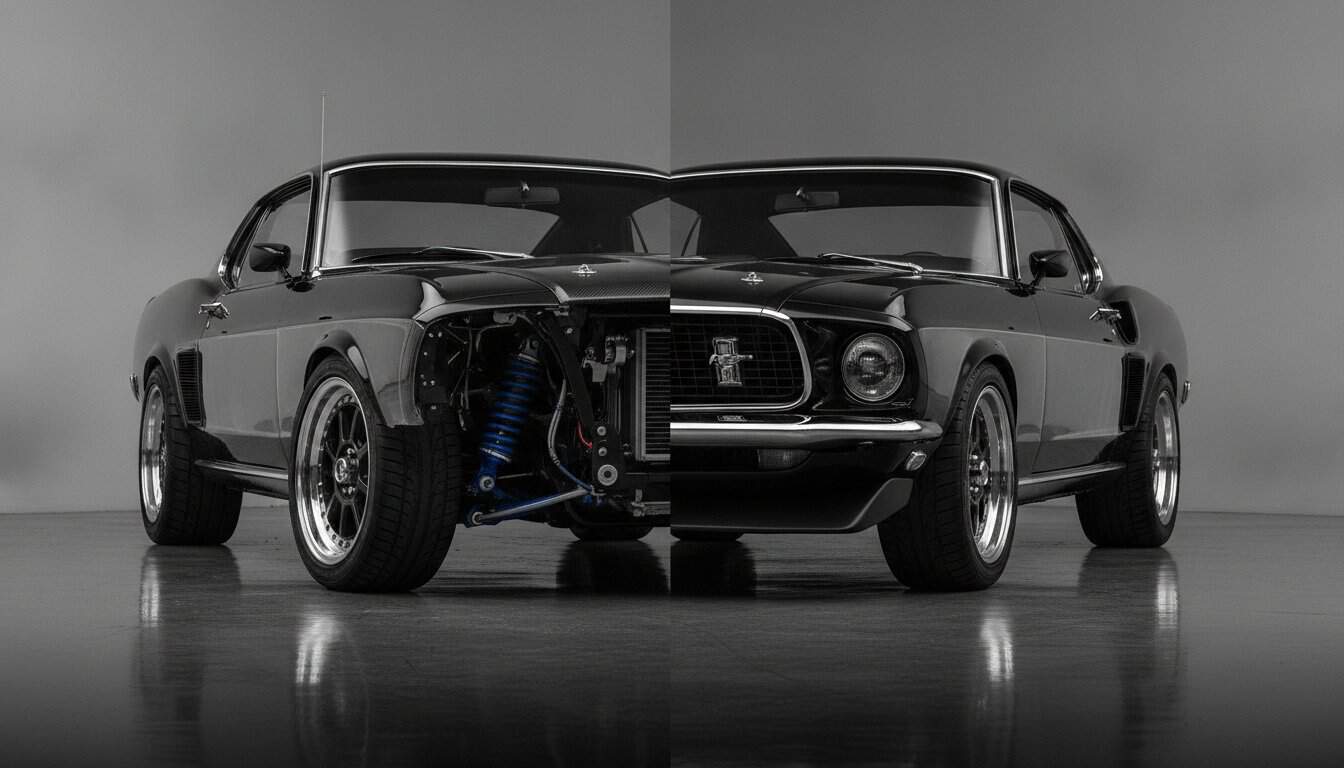
Your suspension choice is the single most important decision you’ll make for your restomod because it dictates whether you’ll actually enjoy driving the machine you’ve spent months building. It’s the bridge between vintage aesthetics and modern performance, yet many builders find themselves paralyzed at the crossroads of coilover vs air suspension. You want that perfect stance, but you’re likely worried about a bone-jarring ride or the nightmare of a blown air bag on a long-distance cruise. It’s natural to feel anxious about cutting into a classic frame or choosing a system that might fail miles from home.
I understand that tension because I’ve seen how the wrong setup can turn a dream project into a garage ornament. This article will help you master the technical trade-offs between mechanical purity and pneumatic versatility so you can select the setup that aligns with your project’s mission. We’ll examine the fabrication requirements for vintage frames, compare real-world handling characteristics, and provide the clarity you need to move forward with confidence. By the end, you’ll know exactly which system fits your build goals and how to execute the installation with precision.
Key Takeaways
- Identify the core mechanical differences between fixed-rate springs and adjustable air membranes to determine which system aligns with your driving style.
- Evaluate the coilover vs air suspension debate through the lens of unsprung weight and steering precision to ensure your vintage frame handles modern power.
- Discover how modern air ride technology provides the flexibility to transition from a slammed show stance to a comfortable highway cruiser at the touch of a button.
- Understand the weight-saving advantages and mechanical simplicity of coilover systems for builders prioritizing track performance and consistent feedback.
- Align your suspension choice with your specific build archetype, whether you are crafting a high-performance Pro-Touring machine or a refined weekend cruiser.
The Restomod Suspension Dilemma: Coilovers or Air Bags?
The stance of your vehicle is the visual and physical handshake of your entire project. It’s the moment where the rubber literally meets the road, and the decision between the mechanical consistency of a steel spring or the pneumatic adaptability of a pressurized air membrane will define every mile you drive. This coilover vs air suspension debate is a central pillar of the restomod movement, representing the bridge between the heritage of vintage steel and the precision of 21st-century engineering. You aren’t just choosing parts; you’re choosing how your car communicates with you through the steering wheel and the seat of your pants.
Defining the Modern Standard for Vintage Steel
Restomodding is a philosophy of balance. We preserve the iconic silhouettes of the 1960s and 70s while replacing archaic leaf springs and stamped control arms with systems that actually provide feedback. Transitioning to modern geometry does more than just lower the center of gravity; it transforms a vague, floating ride into a predictable, sharp-handling machine. These upgrades are a significant investment that directly impacts the market value and desirability of your build. However, remember that high-performance suspension requires a stable foundation. You should prioritize chassis rigidity through subframe connectors or boxing the rails to ensure your new components can perform their job without being undermined by frame flex.
Why Stock Suspension Just Won’t Cut It
Driving a car with 50-year-old suspension in today’s environment is a calculated risk. Original components were designed for bias-ply tires and much lower traffic speeds than we experience on modern interstates. The limitations of original steering geometry, characterized by excessive body roll and unpredictable bump steer, make emergency maneuvers difficult and tiring. Modern roads demand modern responses. If you want to understand the technical evolution of these systems and how they integrate into a complete build, explore our comprehensive look at suspension upgrades for cars.
To master this choice, you must evaluate your project against five key factors that dictate the daily reality of ownership. Think about the initial cost of the components versus the potential long-term maintenance of sensors, lines, and compressors. Consider how track-ready performance and unsprung weight compare to the sheer luxury of on-the-fly adjustability. You must also be honest about your fabrication skills; the complexity of installation varies greatly between a bolt-in coilover kit and a full air management system. Finally, weigh the long-term reliability required for cross-country trips or power tours. While coilovers offer a focused, mechanical purity, Modern Air Ride technology has matured into a robust alternative for builders who refuse to compromise on versatility. Every build has a mission. Your job is to decide if that mission involves carving corners with surgical precision or cruising the coast with adjustable elegance.
Mechanical Purity: The Case for Coilover Systems
If you value mechanical honesty and surgical precision, the coilover system is your primary weapon. At its core, a coilover is a coil spring wrapped around a shock absorber, functioning as a single, integrated unit. This design is a massive leap forward from the archaic setup of separate shocks and heavy leaf springs found on most vintage chassis. By consolidating these components, you eliminate the friction and binding common in old-school leaf packs. This leads to a more responsive ride that communicates exactly what the tires are doing on the pavement.
One of the most immediate benefits of choosing coilovers is the reduction in unsprung weight. When you remove those heavy steel leaves and replace them with lightweight aluminum-bodied coilovers, your suspension reacts faster to every bump and dip. This is critical for maintaining tire contact and improving overall grip. While some builders worry about the complexity of the coilover vs air suspension choice, coilovers offer a level of simplicity that many DIYers find reassuring. There are no tanks, no compressors, and no air lines to route through your frame rails. You get a direct, mechanical connection to the road that is hard to replicate with any other system.
Fixed Precision and Handling Dynamics
Predictability is the greatest asset of a well-tuned coilover. Because the spring rate remains constant, the car’s behavior is repeatable and reliable. This is why track-focused builds and high-performance Pro-Touring machines almost exclusively utilize this technology. You can dive into a corner with the confidence that the suspension won’t change its characteristics mid-turn. Modern kits also feature adjustable dampening, allowing you to click the shocks into a softer setting for the drive to the show and then stiffen them up for a weekend at the autocross track. If you’re still curious about the alternative, understanding how air suspension systems work will help you appreciate the mechanical focus of the coilover approach.
Tuning Your Ride Without the Electronics
Adjusting your ride height with coilovers is a tactile, hands-on process. You use a spanner wrench to move the threaded spring perch up or down the shock body. It’s a set it and forget it mentality that appeals to the purist who wants a clean engine bay and an empty trunk. You don’t have to worry about electronics failing or bags leaking during a long-distance cruise. For those who want to ensure their geometry is perfect before they start turning wrenches, our Premium Project Blueprints can provide the necessary technical roadmap. This mechanical focus keeps your build grounded in the tradition of hot-rodding while embracing modern performance standards.
Ultimate Versatility: The Evolution of Modern Air Ride
If coilovers represent mechanical purity, air ride represents the ultimate in operational flexibility. By replacing traditional steel springs with flexible rubber air bags, you gain the ability to manipulate your vehicle’s height and spring rate through air pressure alone. This technology has moved far beyond the clunky, slow systems of the past. Today’s setups offer a level of sophistication that allows a vintage muscle car to behave like a modern luxury cruiser one moment and a slammed showpiece the next. You’re essentially installing a variable-rate spring that adapts to your needs in real time.
The air bag itself acts as a pressurized membrane. As you increase pressure, the bag expands and stiffens, raising the car and increasing its load capacity. When you vent that air, the car settles toward the pavement. This dynamic range is the primary driver behind the coilover vs air suspension debate for many enthusiasts who want their car to look aggressive at a standstill without sacrificing the ability to actually drive it on real-world roads. It’s about having your cake and eating it too, provided you’re willing to manage the added complexity of the system.
On-the-Fly Adjustability and Stance
Imagine approaching a steep driveway or a massive speed bump and simply pressing a button to lift your front valance out of harm’s way. That is the daily reality of a modern air system. Digital controllers have replaced manual paddle valves, allowing you to save specific presets for different scenarios. You can have a ride height for the highway, a park height for the local meet, and a lift height for navigating obstacles. These systems often use pressure sensors or height sensors at each corner to ensure the car stays level, regardless of how many passengers or how much fuel you’re carrying. It’s a psychological shift; you no longer have to plan your route based on the height of the pavement.
Managing Complexity: Tanks, Lines, and Compressors
While the benefits are undeniable, you must be prepared for the logistical challenge of the support hardware. An air system requires a dedicated management suite, including at least one air compressor, a storage tank, and a manifold to distribute the air. In smaller classic cars like a first-generation Mustang or a compact Chevy II, finding room for a five-gallon tank and dual compressors can be a puzzle. You’ll need to get creative with your trunk layout or look for under-car mounting solutions that don’t compromise ground clearance.
Precision in installation is paramount here. You must route your air lines away from heat sources like exhaust pipes and sharp edges on the frame. Using high-quality nickel-plated fittings and ensuring clean, square cuts on your lines will prevent the frustrating morning lean where one corner of the car drops overnight due to a slow leak. It’s a more complex path than the bolt-on nature of coilovers, but for the builder who demands total control over their stance, the effort is well worth the reward. If you’re planning a complex installation, our recommended gear list includes the specialized tools you’ll need to ensure your connections are leak-free and secure.
Performance vs. Practicality: The Head-to-Head Breakdown
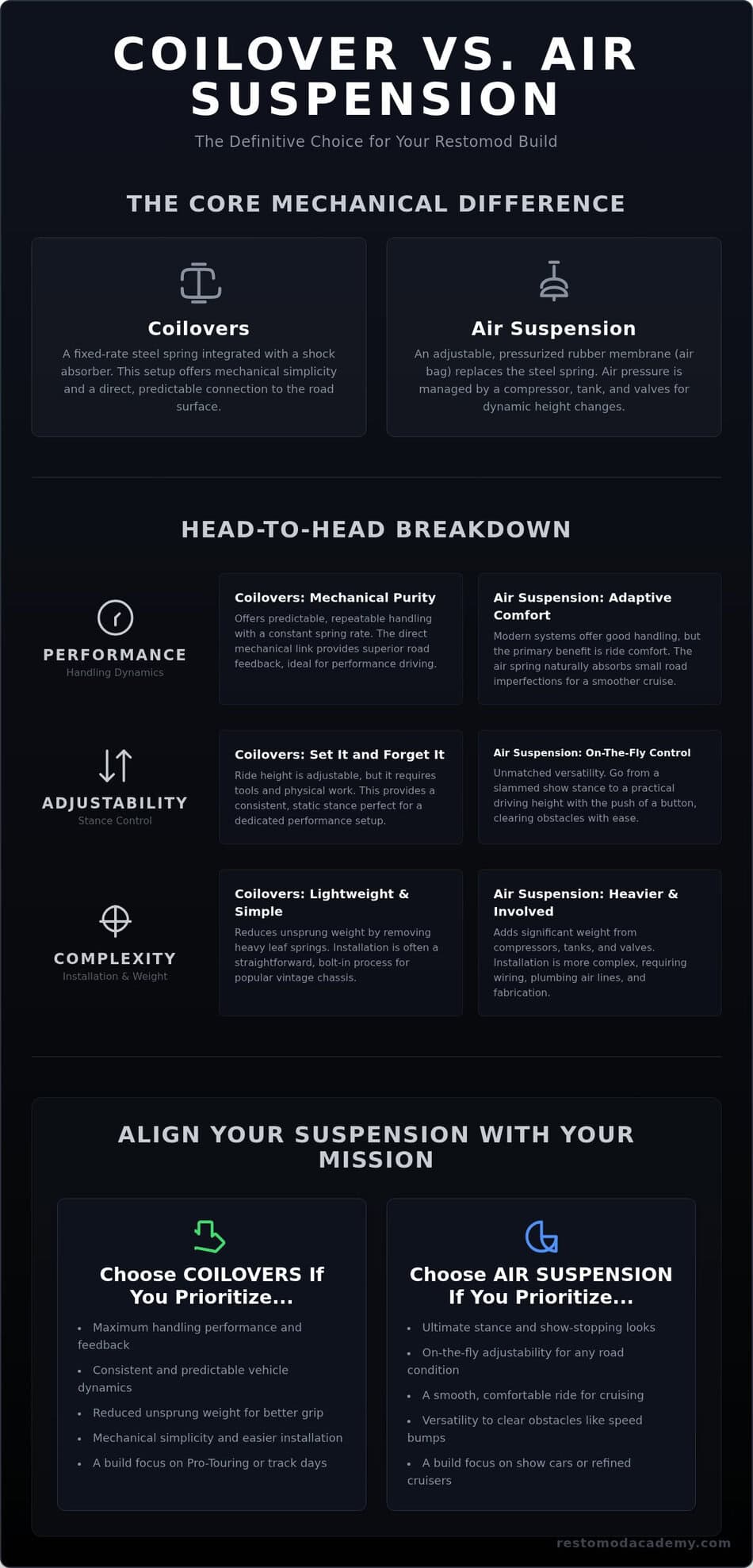
Choosing between these systems isn’t just about the parts; it’s about the mission of your build. You must weigh the mechanical simplicity of a fixed spring against the high-tech versatility of a pneumatic setup. While coilovers typically command a lower initial purchase price, air systems require a larger upfront investment for the management suite. Long-term, coilovers are virtually maintenance-free. Air systems, however, demand periodic inspections of lines and fittings to prevent leaks. You’re trading a bit of weekend garage time for the luxury of adjustable ride height.
The difference in steering feel is often the deciding factor for purists. Coilovers excel in reducing unsprung weight, which allows the suspension to react faster to the road. Air bags are inherently heavier and add mass directly to the suspension arms. This extra weight can slightly dull the feedback through the steering wheel, making the car feel more like a modern grand tourer than a raw corner-carver. You also need to consider the environment inside the cabin. A coilover setup is silent. An air system introduces the hum of a compressor and the hiss of valves, which might detract from the vintage atmosphere you’re trying to preserve.
Track Day Hero vs. Highway Cruiser
Be honest about your 80% use case. If you plan to spend your weekends chasing lap times at an autocross event, coilovers are the superior choice. They provide the consistent, repeatable spring rates required for high-speed cornering. However, if your goal is to drive 300 miles to a national show, air suspension wins for its superior vibration dampening. It soaks up the harshness of expansion joints and rough pavement in a way that even the best-tuned coilovers struggle to match. It’s the difference between a car that’s built for the limit and one that’s built for the journey.
Installation Hurdles in Classic Chassis
Neither path is a simple bolt-in affair for a vintage frame. Coilovers often require you to reinforce original shock towers or spring pockets to handle the concentrated loads. On the other hand, getting an air-equipped car to sit truly low usually requires C-notching the rear frame rails and potentially clearancing the inner wheel wells. These structural changes require careful thought before you ever strike an arc with a welder. To help you budget for these modifications and map out your timeline, I recommend reviewing our guide on Restomod Project Planning. Making the right choice in the coilover vs air suspension debate starts with knowing exactly how much fabrication you’re willing to undertake. If you feel overwhelmed by the technical geometry involved, our Restomod Consulting Services can help you finalize your chassis design with expert precision.
Executing Your Vision: Choosing for Your Specific Build
Your suspension choice is the final signature on your build’s personality. It is the foundation that supports every other modification, from the wheels you’ve tucked into the fenders to the power plant under the hood. Choosing between coilover vs air suspension is not a decision you should make in a vacuum. It requires a deep look at your project’s primary mission. I always tell builders to envision the car’s worst-case scenario. If that involves a 1,000-mile road trip through varying terrain, your needs will differ greatly from someone building a dedicated weekend autocross warrior.
Before you strike an arc with a welder or cut into a vintage frame, consider the value of expert consultation. Modern suspension geometry is a complex science of roll centers, scrub radii, and anti-dive characteristics. Using professional-level blueprints or seeking a second opinion ensures that your expensive new components actually work in harmony with your chassis. You are building a machine that should be both safe and exhilarating. Treat the suspension as the identity of the car, not just a way to fill the wheel wells.
Matching Suspension to Your Restomod Goals
Your build archetype dictates the mechanical path forward. If you are executing a high-performance Pro-Touring build with a modern engine swap, the precision of a coilover system is almost non-negotiable. High-horsepower builds, like those featured in our definitive guide to an LS engine swap, require the consistent spring rates and mechanical feedback that only a steel coil can provide. You need to know exactly how the car will react when you feed it 500 horsepower coming out of a corner.
Conversely, a luxury-focused cruiser or a classic lead sled finds its soul in the plush, adaptable nature of air bags. These builds prioritize the ability to glide over road imperfections and achieve that perfect, ground-hugging stance at the show. If you are still mapping out your project’s overall direction, I recommend referencing the Ultimate Restomod Guide to see how suspension fits into a holistic build plan. Your goal is a cohesive machine where the engine, brakes, and stance all speak the same language.
Safety, Reliability, and Long-Term Maintenance
Longevity in a restomod comes from meticulous maintenance. For coilovers, this means an annual inspection of the shock seals and a thorough cleaning of the threaded bodies to prevent road grime from seizing the perches. For air systems, you must be more proactive. I suggest a monthly check of all air lines for signs of chafing and a weekly draining of the air tank to remove moisture that can corrode valves. Always prioritize professional-grade hardware and consider adding safety loops or bump stops to ensure that even a total system failure won’t leave you stranded or out of control. When you are ready to select your components, check our recommended gear for the suspension kits that have proven their worth in real-world conditions. Precision in the workshop leads to pride on the pavement.
Master Your Machine’s Foundation
Choosing between the mechanical precision of coilovers and the pneumatic versatility of air ride is a defining moment for any builder. You’ve seen how coilovers provide the predictable feedback necessary for high-speed cornering while air systems offer the luxury of on-the-fly height adjustment. The right path in the coilover vs air suspension debate ultimately depends on your project’s specific mission and how you intend to spend your time behind the wheel. Whether you’re carving canyons or cruising the coast, your suspension is the heartbeat of your car’s character.
Success in restomodding comes from pairing your passion with technical accuracy. By leveraging the expert guidance of seasoned builder Brook Walsh and utilizing comprehensive blueprints for suspension geometry, you can avoid costly fabrication errors. Our curated reviews of the industry’s best performance parts ensure you’re investing in hardware that lasts. Ready to lock in your build’s stance? Download The Ultimate Restomod Guide to plan your perfect suspension setup and move forward with confidence. Your dream build is within reach; it’s time to get to work in the shop and bring that vision to life.
Frequently Asked Questions
Are coilovers better than air suspension for daily driving?
Daily driving preference usually comes down to your local road conditions and how much you value mechanical feedback. Coilovers offer a steady, communicative connection that many enthusiasts find more reassuring for everyday commutes. Air suspension excels at absorbing the harshness of potholes and expansion joints, providing a level of comfort that can make a vintage car feel like a modern luxury sedan.
Is air suspension reliable enough for a long-distance classic car road trip?
Modern air systems are remarkably robust and can easily handle thousands of miles if installed with precision. The key is to use high-quality fittings and route your lines away from heat and sharp edges. Carrying a small emergency kit with extra air line and a few push-to-connect fittings provides peace of mind when you’re far from your home garage.
How much does it cost to install air suspension vs coilovers?
Coilovers typically require a smaller initial investment because they are self-contained units. When comparing the total cost of coilover vs air suspension, air systems are more expensive due to the need for compressors, tanks, and digital management. You also have to account for the extra labor hours required to plumb the lines and wire the electronics for a clean installation.
Can I track a car that has air suspension?
You certainly can, as modern air management has closed the performance gap significantly. While coilovers are the traditional choice for their consistent spring rates and lower unsprung weight, high-end air systems can hold their own on an autocross course. The choice depends on whether you’re chasing every tenth of a second or want a car that can drive to the track in comfort.
Do I need to cut my classic car’s frame to install coilovers?
Most popular restomod platforms have bolt-in coilover kits that don’t require major frame modifications. You might need to perform some minor clearancing or reinforce the shock towers to handle the new loads, but it’s rarely a destructive process. Always check the specific requirements of your kit before you begin, as some extreme drops might require more invasive work.
Which suspension system adds more value to a restomod?
Both systems increase a car’s marketability by replacing outdated technology with modern performance. Coilovers tend to attract buyers interested in the Pro-Touring aesthetic and raw handling. Air suspension often adds more value to builds destined for the show circuit or high-end cruising where adjustable stance is a premium feature. The quality of the installation is what ultimately preserves the vehicle’s value.
How long do air bags typically last before they need replacement?
A quality set of air bags can last 10 to 15 years with proper care. The rubber is designed to be incredibly durable, but it can be compromised by road debris or improper alignment that causes the bag to rub against the frame. Regular inspections during your oil changes will help you spot any potential issues before they lead to a failure on the road.
Do coilovers make a classic car ride too rough?
A harsh ride is usually the result of poor spring selection rather than the coilover design itself. When you choose the correct spring rate for your car’s weight and utilize adjustable dampening, the ride is often much smoother than the original factory suspension. This is a common point of confusion in the coilover vs air suspension debate, but modern valving allows for a very compliant street ride.
Your suspension choice is the single most important decision you’ll make for your restomod because it dictates whether you’ll actually enjoy driving the machine you’ve spent months building. It’s the bridge between vintage aesthetics and modern performance, yet many builders find themselves paralyzed at the crossroads of coilover vs air suspension. You want that perfect stance, but you’re likely worried about a bone-jarring ride or the nightmare of a blown air bag on a long-distance cruise. It’s natural to feel anxious about cutting into a classic frame or choosing a system that might fail miles from home.
I understand that tension because I’ve seen how the wrong setup can turn a dream project into a garage ornament. This article will help you master the technical trade-offs between mechanical purity and pneumatic versatility so you can select the setup that aligns with your project’s mission. We’ll examine the fabrication requirements for vintage frames, compare real-world handling characteristics, and provide the clarity you need to move forward with confidence. By the end, you’ll know exactly which system fits your build goals and how to execute the installation with precision.
Key Takeaways
- Identify the core mechanical differences between fixed-rate springs and adjustable air membranes to determine which system aligns with your driving style.
- Evaluate the coilover vs air suspension debate through the lens of unsprung weight and steering precision to ensure your vintage frame handles modern power.
- Discover how modern air ride technology provides the flexibility to transition from a slammed show stance to a comfortable highway cruiser at the touch of a button.
- Understand the weight-saving advantages and mechanical simplicity of coilover systems for builders prioritizing track performance and consistent feedback.
- Align your suspension choice with your specific build archetype, whether you are crafting a high-performance Pro-Touring machine or a refined weekend cruiser.
The Restomod Suspension Dilemma: Coilovers or Air Bags?
The stance of your vehicle is the visual and physical handshake of your entire project. It’s the moment where the rubber literally meets the road, and the decision between the mechanical consistency of a steel spring or the pneumatic adaptability of a pressurized air membrane will define every mile you drive. This coilover vs air suspension debate is a central pillar of the restomod movement, representing the bridge between the heritage of vintage steel and the precision of 21st-century engineering. You aren’t just choosing parts; you’re choosing how your car communicates with you through the steering wheel and the seat of your pants.
Defining the Modern Standard for Vintage Steel
Restomodding is a philosophy of balance. We preserve the iconic silhouettes of the 1960s and 70s while replacing archaic leaf springs and stamped control arms with systems that actually provide feedback. Transitioning to modern geometry does more than just lower the center of gravity; it transforms a vague, floating ride into a predictable, sharp-handling machine. These upgrades are a significant investment that directly impacts the market value and desirability of your build. However, remember that high-performance suspension requires a stable foundation. You should prioritize chassis rigidity through subframe connectors or boxing the rails to ensure your new components can perform their job without being undermined by frame flex.
Why Stock Suspension Just Won’t Cut It
Driving a car with 50-year-old suspension in today’s environment is a calculated risk. Original components were designed for bias-ply tires and much lower traffic speeds than we experience on modern interstates. The limitations of original steering geometry, characterized by excessive body roll and unpredictable bump steer, make emergency maneuvers difficult and tiring. Modern roads demand modern responses. If you want to understand the technical evolution of these systems and how they integrate into a complete build, explore our comprehensive look at suspension upgrades for cars.
To master this choice, you must evaluate your project against five key factors that dictate the daily reality of ownership. Think about the initial cost of the components versus the potential long-term maintenance of sensors, lines, and compressors. Consider how track-ready performance and unsprung weight compare to the sheer luxury of on-the-fly adjustability. You must also be honest about your fabrication skills; the complexity of installation varies greatly between a bolt-in coilover kit and a full air management system. Finally, weigh the long-term reliability required for cross-country trips or power tours. While coilovers offer a focused, mechanical purity, Modern Air Ride technology has matured into a robust alternative for builders who refuse to compromise on versatility. Every build has a mission. Your job is to decide if that mission involves carving corners with surgical precision or cruising the coast with adjustable elegance.
Mechanical Purity: The Case for Coilover Systems
If you value mechanical honesty and surgical precision, the coilover system is your primary weapon. At its core, a coilover is a coil spring wrapped around a shock absorber, functioning as a single, integrated unit. This design is a massive leap forward from the archaic setup of separate shocks and heavy leaf springs found on most vintage chassis. By consolidating these components, you eliminate the friction and binding common in old-school leaf packs. This leads to a more responsive ride that communicates exactly what the tires are doing on the pavement.
One of the most immediate benefits of choosing coilovers is the reduction in unsprung weight. When you remove those heavy steel leaves and replace them with lightweight aluminum-bodied coilovers, your suspension reacts faster to every bump and dip. This is critical for maintaining tire contact and improving overall grip. While some builders worry about the complexity of the coilover vs air suspension choice, coilovers offer a level of simplicity that many DIYers find reassuring. There are no tanks, no compressors, and no air lines to route through your frame rails. You get a direct, mechanical connection to the road that is hard to replicate with any other system.
Fixed Precision and Handling Dynamics
Predictability is the greatest asset of a well-tuned coilover. Because the spring rate remains constant, the car’s behavior is repeatable and reliable. This is why track-focused builds and high-performance Pro-Touring machines almost exclusively utilize this technology. You can dive into a corner with the confidence that the suspension won’t change its characteristics mid-turn. Modern kits also feature adjustable dampening, allowing you to click the shocks into a softer setting for the drive to the show and then stiffen them up for a weekend at the autocross track. If you’re still curious about the alternative, understanding how air suspension systems work will help you appreciate the mechanical focus of the coilover approach.
Tuning Your Ride Without the Electronics
Adjusting your ride height with coilovers is a tactile, hands-on process. You use a spanner wrench to move the threaded spring perch up or down the shock body. It’s a set it and forget it mentality that appeals to the purist who wants a clean engine bay and an empty trunk. You don’t have to worry about electronics failing or bags leaking during a long-distance cruise. For those who want to ensure their geometry is perfect before they start turning wrenches, our Premium Project Blueprints can provide the necessary technical roadmap. This mechanical focus keeps your build grounded in the tradition of hot-rodding while embracing modern performance standards.
Ultimate Versatility: The Evolution of Modern Air Ride
If coilovers represent mechanical purity, air ride represents the ultimate in operational flexibility. By replacing traditional steel springs with flexible rubber air bags, you gain the ability to manipulate your vehicle’s height and spring rate through air pressure alone. This technology has moved far beyond the clunky, slow systems of the past. Today’s setups offer a level of sophistication that allows a vintage muscle car to behave like a modern luxury cruiser one moment and a slammed showpiece the next. You’re essentially installing a variable-rate spring that adapts to your needs in real time.
The air bag itself acts as a pressurized membrane. As you increase pressure, the bag expands and stiffens, raising the car and increasing its load capacity. When you vent that air, the car settles toward the pavement. This dynamic range is the primary driver behind the coilover vs air suspension debate for many enthusiasts who want their car to look aggressive at a standstill without sacrificing the ability to actually drive it on real-world roads. It’s about having your cake and eating it too, provided you’re willing to manage the added complexity of the system.
On-the-Fly Adjustability and Stance
Imagine approaching a steep driveway or a massive speed bump and simply pressing a button to lift your front valance out of harm’s way. That is the daily reality of a modern air system. Digital controllers have replaced manual paddle valves, allowing you to save specific presets for different scenarios. You can have a ride height for the highway, a park height for the local meet, and a lift height for navigating obstacles. These systems often use pressure sensors or height sensors at each corner to ensure the car stays level, regardless of how many passengers or how much fuel you’re carrying. It’s a psychological shift; you no longer have to plan your route based on the height of the pavement.
Managing Complexity: Tanks, Lines, and Compressors
While the benefits are undeniable, you must be prepared for the logistical challenge of the support hardware. An air system requires a dedicated management suite, including at least one air compressor, a storage tank, and a manifold to distribute the air. In smaller classic cars like a first-generation Mustang or a compact Chevy II, finding room for a five-gallon tank and dual compressors can be a puzzle. You’ll need to get creative with your trunk layout or look for under-car mounting solutions that don’t compromise ground clearance.
Precision in installation is paramount here. You must route your air lines away from heat sources like exhaust pipes and sharp edges on the frame. Using high-quality nickel-plated fittings and ensuring clean, square cuts on your lines will prevent the frustrating morning lean where one corner of the car drops overnight due to a slow leak. It’s a more complex path than the bolt-on nature of coilovers, but for the builder who demands total control over their stance, the effort is well worth the reward. If you’re planning a complex installation, our recommended gear list includes the specialized tools you’ll need to ensure your connections are leak-free and secure.
Performance vs. Practicality: The Head-to-Head Breakdown
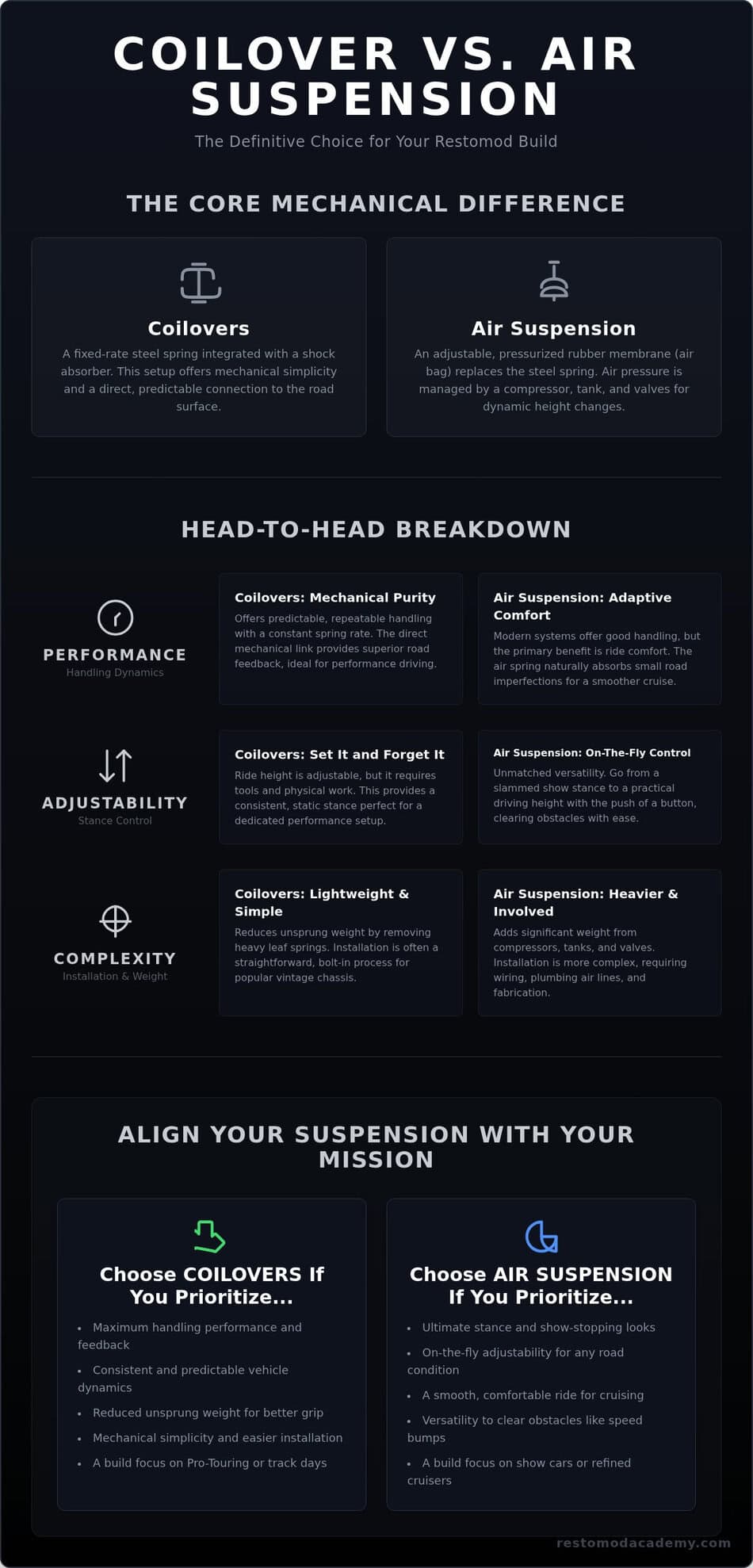
Choosing between these systems isn’t just about the parts; it’s about the mission of your build. You must weigh the mechanical simplicity of a fixed spring against the high-tech versatility of a pneumatic setup. While coilovers typically command a lower initial purchase price, air systems require a larger upfront investment for the management suite. Long-term, coilovers are virtually maintenance-free. Air systems, however, demand periodic inspections of lines and fittings to prevent leaks. You’re trading a bit of weekend garage time for the luxury of adjustable ride height.
The difference in steering feel is often the deciding factor for purists. Coilovers excel in reducing unsprung weight, which allows the suspension to react faster to the road. Air bags are inherently heavier and add mass directly to the suspension arms. This extra weight can slightly dull the feedback through the steering wheel, making the car feel more like a modern grand tourer than a raw corner-carver. You also need to consider the environment inside the cabin. A coilover setup is silent. An air system introduces the hum of a compressor and the hiss of valves, which might detract from the vintage atmosphere you’re trying to preserve.
Track Day Hero vs. Highway Cruiser
Be honest about your 80% use case. If you plan to spend your weekends chasing lap times at an autocross event, coilovers are the superior choice. They provide the consistent, repeatable spring rates required for high-speed cornering. However, if your goal is to drive 300 miles to a national show, air suspension wins for its superior vibration dampening. It soaks up the harshness of expansion joints and rough pavement in a way that even the best-tuned coilovers struggle to match. It’s the difference between a car that’s built for the limit and one that’s built for the journey.
Installation Hurdles in Classic Chassis
Neither path is a simple bolt-in affair for a vintage frame. Coilovers often require you to reinforce original shock towers or spring pockets to handle the concentrated loads. On the other hand, getting an air-equipped car to sit truly low usually requires C-notching the rear frame rails and potentially clearancing the inner wheel wells. These structural changes require careful thought before you ever strike an arc with a welder. To help you budget for these modifications and map out your timeline, I recommend reviewing our guide on Restomod Project Planning. Making the right choice in the coilover vs air suspension debate starts with knowing exactly how much fabrication you’re willing to undertake. If you feel overwhelmed by the technical geometry involved, our Restomod Consulting Services can help you finalize your chassis design with expert precision.
Executing Your Vision: Choosing for Your Specific Build
Your suspension choice is the final signature on your build’s personality. It is the foundation that supports every other modification, from the wheels you’ve tucked into the fenders to the power plant under the hood. Choosing between coilover vs air suspension is not a decision you should make in a vacuum. It requires a deep look at your project’s primary mission. I always tell builders to envision the car’s worst-case scenario. If that involves a 1,000-mile road trip through varying terrain, your needs will differ greatly from someone building a dedicated weekend autocross warrior.
Before you strike an arc with a welder or cut into a vintage frame, consider the value of expert consultation. Modern suspension geometry is a complex science of roll centers, scrub radii, and anti-dive characteristics. Using professional-level blueprints or seeking a second opinion ensures that your expensive new components actually work in harmony with your chassis. You are building a machine that should be both safe and exhilarating. Treat the suspension as the identity of the car, not just a way to fill the wheel wells.
Matching Suspension to Your Restomod Goals
Your build archetype dictates the mechanical path forward. If you are executing a high-performance Pro-Touring build with a modern engine swap, the precision of a coilover system is almost non-negotiable. High-horsepower builds, like those featured in our definitive guide to an LS engine swap, require the consistent spring rates and mechanical feedback that only a steel coil can provide. You need to know exactly how the car will react when you feed it 500 horsepower coming out of a corner.
Conversely, a luxury-focused cruiser or a classic lead sled finds its soul in the plush, adaptable nature of air bags. These builds prioritize the ability to glide over road imperfections and achieve that perfect, ground-hugging stance at the show. If you are still mapping out your project’s overall direction, I recommend referencing the Ultimate Restomod Guide to see how suspension fits into a holistic build plan. Your goal is a cohesive machine where the engine, brakes, and stance all speak the same language.
Safety, Reliability, and Long-Term Maintenance
Longevity in a restomod comes from meticulous maintenance. For coilovers, this means an annual inspection of the shock seals and a thorough cleaning of the threaded bodies to prevent road grime from seizing the perches. For air systems, you must be more proactive. I suggest a monthly check of all air lines for signs of chafing and a weekly draining of the air tank to remove moisture that can corrode valves. Always prioritize professional-grade hardware and consider adding safety loops or bump stops to ensure that even a total system failure won’t leave you stranded or out of control. When you are ready to select your components, check our recommended gear for the suspension kits that have proven their worth in real-world conditions. Precision in the workshop leads to pride on the pavement.
Master Your Machine’s Foundation
Choosing between the mechanical precision of coilovers and the pneumatic versatility of air ride is a defining moment for any builder. You’ve seen how coilovers provide the predictable feedback necessary for high-speed cornering while air systems offer the luxury of on-the-fly height adjustment. The right path in the coilover vs air suspension debate ultimately depends on your project’s specific mission and how you intend to spend your time behind the wheel. Whether you’re carving canyons or cruising the coast, your suspension is the heartbeat of your car’s character.
Success in restomodding comes from pairing your passion with technical accuracy. By leveraging the expert guidance of seasoned builder Brook Walsh and utilizing comprehensive blueprints for suspension geometry, you can avoid costly fabrication errors. Our curated reviews of the industry’s best performance parts ensure you’re investing in hardware that lasts. Ready to lock in your build’s stance? Download The Ultimate Restomod Guide to plan your perfect suspension setup and move forward with confidence. Your dream build is within reach; it’s time to get to work in the shop and bring that vision to life.
Frequently Asked Questions
Are coilovers better than air suspension for daily driving?
Daily driving preference usually comes down to your local road conditions and how much you value mechanical feedback. Coilovers offer a steady, communicative connection that many enthusiasts find more reassuring for everyday commutes. Air suspension excels at absorbing the harshness of potholes and expansion joints, providing a level of comfort that can make a vintage car feel like a modern luxury sedan.
Is air suspension reliable enough for a long-distance classic car road trip?
Modern air systems are remarkably robust and can easily handle thousands of miles if installed with precision. The key is to use high-quality fittings and route your lines away from heat and sharp edges. Carrying a small emergency kit with extra air line and a few push-to-connect fittings provides peace of mind when you’re far from your home garage.
How much does it cost to install air suspension vs coilovers?
Coilovers typically require a smaller initial investment because they are self-contained units. When comparing the total cost of coilover vs air suspension, air systems are more expensive due to the need for compressors, tanks, and digital management. You also have to account for the extra labor hours required to plumb the lines and wire the electronics for a clean installation.
Can I track a car that has air suspension?
You certainly can, as modern air management has closed the performance gap significantly. While coilovers are the traditional choice for their consistent spring rates and lower unsprung weight, high-end air systems can hold their own on an autocross course. The choice depends on whether you’re chasing every tenth of a second or want a car that can drive to the track in comfort.
Do I need to cut my classic car’s frame to install coilovers?
Most popular restomod platforms have bolt-in coilover kits that don’t require major frame modifications. You might need to perform some minor clearancing or reinforce the shock towers to handle the new loads, but it’s rarely a destructive process. Always check the specific requirements of your kit before you begin, as some extreme drops might require more invasive work.
Which suspension system adds more value to a restomod?
Both systems increase a car’s marketability by replacing outdated technology with modern performance. Coilovers tend to attract buyers interested in the Pro-Touring aesthetic and raw handling. Air suspension often adds more value to builds destined for the show circuit or high-end cruising where adjustable stance is a premium feature. The quality of the installation is what ultimately preserves the vehicle’s value.
How long do air bags typically last before they need replacement?
A quality set of air bags can last 10 to 15 years with proper care. The rubber is designed to be incredibly durable, but it can be compromised by road debris or improper alignment that causes the bag to rub against the frame. Regular inspections during your oil changes will help you spot any potential issues before they lead to a failure on the road.
Do coilovers make a classic car ride too rough?
A harsh ride is usually the result of poor spring selection rather than the coilover design itself. When you choose the correct spring rate for your car’s weight and utilize adjustable dampening, the ride is often much smoother than the original factory suspension. This is a common point of confusion in the coilover vs air suspension debate, but modern valving allows for a very compliant street ride.