
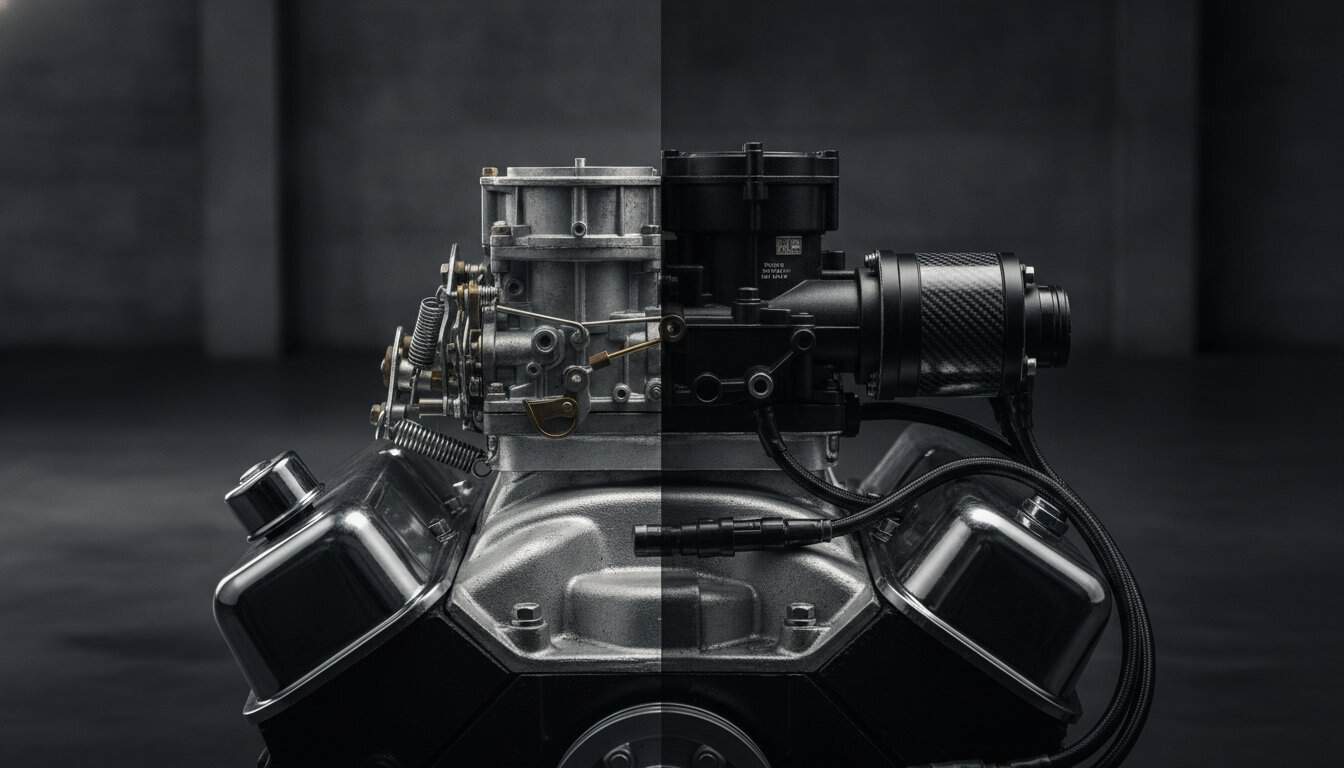
Treat your EFI conversion as 10 percent throttle body installation and 90 percent supporting system engineering. You have likely spent weeks dreaming of turn-key reliability and crisp throttle response, only to find yourself frustrated by a self-learning system that refuses to learn or an engine that surges at every stoplight. It’s a common hurdle that many enthusiasts face when they expect a simple bolt-on miracle. Identifying the root causes of carburetor to efi conversion problems is the first step toward reclaiming the joy of the drive.
We understand the pride that comes from personal labor and the desire for a vintage machine that starts every single time. This article empowers you to master the technical details of fuel injection swaps to ensure your classic car runs with modern reliability and precision. We’ll examine how to stabilize fuel pressure, eliminate electrical interference, and properly set up your sensors. By the end, you’ll have a clear, logical path to a smooth-running engine and the confidence to handle any wiring challenge that comes your way. Let’s get to work on perfecting your build.
Key Takeaways
- Shift your perspective from a simple component swap to a holistic system engineering project to ensure your modern upgrades harmonize with vintage iron.
- Eliminate vapor lock and fuel delivery failures by designing a high-pressure plumbing system that features a dedicated return line and specialized hoses.
- Protect your ECU from the silent killers of ignition noise and electromagnetic interference through meticulous grounding and strategic wire routing.
- Identify the root causes of carburetor to efi conversion problems by mastering the initial setup parameters that allow self-learning systems to function accurately.
- Follow a logical, step-by-step roadmap that prioritizes an electrical system audit and fuel delivery installation before you ever touch the old hardware.
Why Most Carburetor to EFI Conversions Fail: Setting Realistic Expectations
Many enthusiasts dive into an EFI swap expecting a simple weekend project that cures every engine ailment. However, most carburetor to efi conversion problems stem from a fundamental misunderstanding of the task. You aren’t just swapping a mechanical fuel mixer for a digital one; you’re installing a complete digital management system. This requires a shift in how you view your vehicle’s architecture. While a carburetor relies on atmospheric pressure and physical orifices, mastering Fuel Injection Principles means recognizing that the ECU needs perfect data to make millisecond adjustments. If the foundation is shaky, the digital brain cannot do its job.
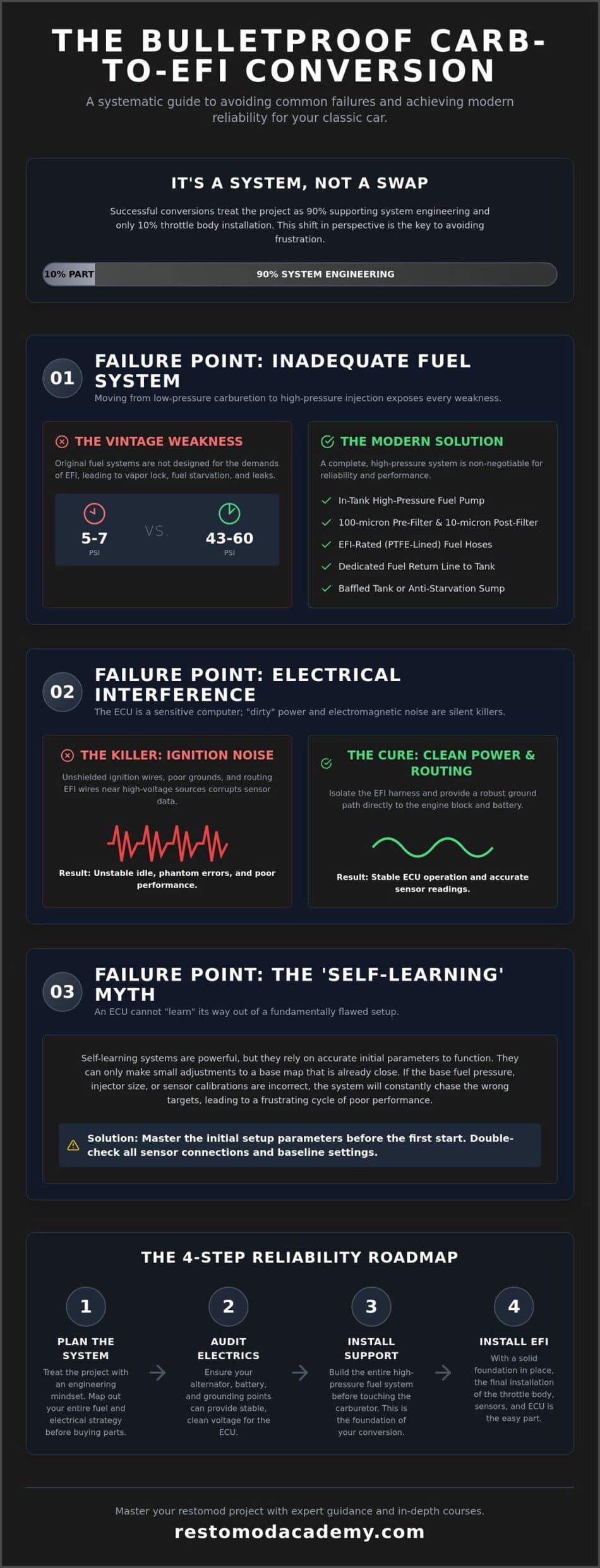
Success requires addressing three primary failure categories: fuel delivery, electrical noise, and improper sensor data. You’re moving from a low-pressure environment of 5 to 7 psi to a high-intensity system requiring 43 to 60 psi of constant, regulated pressure. This jump in intensity exposes every weakness in your old fuel lines and requires a psychological transition. You must move from mechanical intuition to electronic diagnostic thinking. Instead of just listening for a vacuum leak, you’ll learn to analyze oxygen sensor voltages and manifold pressure maps to understand what your engine is telling you.
The Difference Between a Part Swap and a System Conversion
The throttle body sitting on your intake manifold is only the tip of the iceberg in a high-quality build. To truly succeed, you should view this project within the broader scope of what is a restomod. It’s about bringing vintage aesthetics into harmony with modern performance through a meticulous educational framework. Treat every sensor placement and wire terminal as a critical engineering decision. If you treat this like a simple bolt-on part, you’ll likely face the same frustrations that lead others to give up on modern fuel management.
The Hidden Costs of EFI Reliability
Budgeting for a conversion often stops at the price of the main kit, but that’s where the real engineering begins. To avoid common carburetor to efi conversion problems, you must invest in the supporting cast of components that ensure long-term success. These often include:
- Baffled fuel tanks or specialized pump modules to prevent starvation during cornering.
- High-pressure PTFE-lined hoses that resist degradation from modern ethanol-blended fuels.
- Dedicated return lines and high-flow filters that can handle increased volume.
- Upgraded electrical grounds and high-output alternators to provide stable voltage.
Don’t let the desire for a quick fix compromise your safety. Cutting corners on a cheap fuel pump or reusing old, brittle wiring leads to immediate failure. Reliability should always outweigh the initial kit cost. Precision requires an investment in quality hardware, but it pays dividends when you finally turn the key and experience the thrill of a perfectly tuned machine.
Fuel System Gremlins: Plumbing Your Classic for High Pressure
Transitioning from a mechanical pump to high-pressure electronic fuel injection is often where the most persistent carburetor to efi conversion problems begin. You’re no longer pushing a gentle stream of fuel at 5 psi; you’re managing a pressurized circuit reaching up to 60 psi. Your vintage hardlines and rubber hoses weren’t designed for this intensity. Using standard fuel-grade rubber is a recipe for disaster, as the high pressure can cause leaks or even complete hose failure. Invest in PTFE-lined lines or hardlines that can withstand both the pressure and the corrosive nature of modern ethanol blends.
Vapor lock is another ghost that haunts classic builds. In a traditional carbureted setup, fuel can sit in the lines and boil under engine bay heat. A proper return system solves this by constantly circulating fuel back to the tank, keeping the liquid cool and the pressure stable. According to Holley’s EFI Conversion Guide, managing these temperatures is vital for consistent performance. To ensure your build stays reliable, use this essential component checklist:
- High-pressure EFI fuel pump (in-tank or external)
- 10-micron post-filter and 100-micron pre-filter
- EFI-rated fuel lines and AN fittings
- Adjustable fuel pressure regulator
- Baffled fuel tank or fuel sump
Starvation is a silent killer for EFI pumps. Unlike a carburetor bowl that holds a reserve of fuel, an EFI system requires an uninterrupted supply. A baffled fuel tank or a dedicated fuel sump is necessary to prevent the pump from sucking air during hard cornering or acceleration. If the pump loses prime for even a split second, the engine will stumble, and the pump’s lifespan will drop significantly. Precision in your plumbing is the foundation of a reliable restomod.
The Return Line vs. Returnless Debate
You’ll often hear about returnless systems that use Pulse-Width Modulation (PWM) to control pump speed. While these reduce plumbing complexity, they can be finicky in high-horsepower restomod projects. A true return system remains the gold standard for reliability. It provides a constant cooling effect by sending excess fuel away from the hot engine. This cycle prevents the fuel from picking up too much heat, ensuring your engine gets a dense, cool charge every time you mash the pedal.
Fuel Pump Selection and Placement
Choosing between an in-tank and an external pump is a matter of longevity and noise. In-tank pumps are submerged in fuel, which acts as a natural coolant and sound dampener. If you must use an external pump, mount it below the lowest point of the fuel tank. These pumps are excellent at pushing fuel but terrible at pulling it. For those looking to source the right hardware, checking out our recommended gear can help you find components that match your horsepower goals. Remember, your fuel pump is the heart of the system; don’t settle for anything less than perfection.
Electrical Interference and Grounding: The Silent EFI Killers
Electrical noise is the ghost in the machine that turns a promising restomod into a diagnostic nightmare. Unlike a mechanical fuel leak that you can see or smell, Radio Frequency Interference (RFI) and Electromagnetic Interference (EMI) are invisible. They corrupt the data flowing through your ECU, leading to the most frustrating carburetor to efi conversion problems. When your spark plug wires or alternator dump electrical garbage into the signal lines, the ECU interprets this as real engine data. The result is a chaotic mess of erratic idling, random engine shutdowns, and massive sensor spikes that make tuning impossible.
Stop relying on your vehicle’s frame as a primary ground. Modern EFI systems require a clean, stable reference point that only a direct-to-battery connection can provide. Route both your main power and main ground wires directly to the battery terminals. This simple step eliminates the resistance and noise inherent in an old chassis, ensuring your ECU sees a steady voltage. For a deeper look at creating a resilient setup, refer to this guide on a Trouble-Free EFI Conversion to see how professional builders isolate their electronics from the rest of the vehicle’s systems.
The Golden Rules of EFI Wiring
Separation is your best defense. Keep your high-current wires, such as those for the fuel pump and alternator, at least six inches away from sensitive sensor leads. If they must cross, do so at a 90-degree angle to minimize interference. Twist your wire pairs for the injectors and sensors; this creates a self-canceling magnetic field that rejects external noise. For critical components like the tachometer signal or oxygen sensor, always use shielded cabling with the drain wire grounded only at the ECU side to prevent ground loops.
Ignition System Compatibility
Old technology often clashes with new digital brains. Points-style distributors and cheap HEI units are notorious for emitting massive amounts of RFI that can blind an ECU. Upgrading to a Capacitive Discharge (CD) ignition box provides a cleaner, more controlled spark that plays well with modern electronics. It’s a vital step in bridging the gap between heritage aesthetics and contemporary performance. You can find several proven, compatible options in our list of recommended gear to ensure your ignition system doesn’t sabotage your swap through electrical interference.
The Self-Learning Myth: Why Your EFI System Is Not Tuning Itself
Stop thinking of your new ECU as a magic wand that fixes every mechanical flaw. The term self-learning is one of the most misunderstood concepts in the performance world. In reality, it refers to closed-loop fuel correction. This means the computer monitors the exhaust gases and makes small, real-time adjustments to the fuel map to hit a target air-fuel ratio. It doesn’t fix your ignition timing, it doesn’t solve vacuum leaks, and it certainly won’t overcome the most common carburetor to efi conversion problems if your base settings are wrong.
Your ECU is only as smart as the data you provide. If you enter the wrong engine displacement or provide inaccurate camshaft specifications during the initial setup, the base fuel map will be fundamentally flawed. The self-learning process can only trim a certain percentage of fuel; it cannot rewrite the entire logic of the system. You must ensure your initial parameters are 100 percent accurate to give the digital brain a fighting chance. Precision starts with the person holding the handheld controller, not the software inside it.
Exhaust leaks are the arch-nemesis of a self-tuning system. If air enters the exhaust stream before it reaches the Oxygen (O2) sensor, the sensor will report a false lean condition. The ECU responds by dumping massive amounts of fuel into the engine to compensate, leading to fouled plugs and a surging idle. This is particularly troublesome with radical camshafts that have high overlap. At low RPM, these cams naturally pull fresh air into the exhaust, confusing the sensor and making the car nearly undriveable without manual intervention.
O2 Sensor Placement and Accuracy
Properly installing your feedback hardware is a non-negotiable step for a reliable build. You must clock the O2 sensor between the 10 o’clock and 2 o’clock positions to prevent moisture from pooling on the element and causing premature failure. Ensure the sensor is at least 18 inches away from the exhaust exit to avoid atmospheric air contamination, which causes false lean readings. The O2 sensor is the primary feedback loop for the entire EFI brain.
When to Move Beyond the Handheld Controller
Handheld controllers are excellent for getting your project on the road, but they have distinct limitations. Laptop tuning is often necessary to perfect cold start enrichment and acceleration enrichment, which are the nuances that make a car feel modern. While you can do a lot in your own garage, a professional dyno tune is the final step for a truly perfect restomod. For those looking to dive deeper into complex setups, our LS engine swap guide offers advanced engine management insights that apply to any high-performance fuel injection project. If you want a smooth-running machine, you must be willing to transition from a passive user to an active tuner. You can start by exploring The Ultimate Restomod Guide to see how professional calibration transforms the driving experience.
The Bulletproof EFI Roadmap: Planning for Long-Term Reliability
Achieving a flawless transition requires more than just high-quality parts; it demands a disciplined, step-by-step approach. Most carburetor to efi conversion problems are born from a lack of sequence. If you install the throttle body before your fuel system is ready, you’re looking at unnecessary rework and a car that sits idle. Follow this bulletproof roadmap to ensure your project moves from the workbench to the open road with precision and confidence.
First, audit your electrical heart. Your vintage charging system was never designed to power a high-pressure fuel pump and a digital ECU simultaneously. Upgrade to a high-output alternator to maintain stable voltage at idle, which is critical for sensor accuracy. Second, design and install your complete fuel delivery system while the carburetor is still on the car. This allows you to test for leaks and ensure the pump is primed before you ever touch the intake. Third, correct every exhaust leak and weld in your O2 bung. Fourth, execute a clean-room wiring installation. This means using heat-shrink terminals, proper looming, and routing wires far away from heat sources and ignition noise. Finally, perform your initial startup and verify every sensor reading on your handheld before you attempt your first drive.
Pre-Installation Checklist
Before you turn the first wrench, verify these critical items to avoid common pitfalls:
- Test battery health and ensure your charging system can handle the added 15 to 20 amp load of the new fuel pump.
- Refresh your ignition system with new spark plugs and high-quality, suppressed wires to prevent RFI.
- Check your throttle linkage for smooth, bind-free operation through its full range of motion.
Post-Swap Maintenance and Monitoring
Once you’re on the road, your job isn’t finished. Change your fuel filters more frequently during the first 500 miles. Modern EFI systems are incredibly sensitive to debris, and an old tank often sheds years of sediment once high-pressure fuel begins to circulate. Keep a close eye on your handheld display for any error codes or sensor anomalies. This is a learning opportunity for both you and the machine. If you run into a hurdle, join our community at Restomod Academy to share your progress or consider our The Ultimate Restomod Guide for a deeper dive into professional-grade assembly. We also offer Premium Project Blueprints to help you map out every wire and hose before you start. Precision is a journey, and with the right roadmap, any mechanical hurdle can be overcome.
Master the Precision of Modern Fuel Management
Your journey from a mechanical carburetor to a high-performance electronic system is about more than just parts; it’s about the satisfaction of engineering a machine that starts with modern reliability. You’ve learned that success lies in the meticulous details of high-pressure plumbing, the isolation of sensitive electronics from interference, and the discipline of setting accurate base parameters. Addressing carburetor to efi conversion problems requires a methodical approach, but the reward of a perfectly idling, responsive classic V8 makes every hour in the garage worth the effort.
Don’t let technical hurdles stall your project. With expert guidance from Brook Walsh and comprehensive project blueprints for classic V8s, you can navigate the most complex swaps with confidence. Our community-vetted troubleshooting steps ensure you’re never working in isolation. Download The Ultimate Restomod Guide to master your engine conversion today and join a group of like-minded enthusiasts dedicated to the art of the restomod. Your vintage machine has a bright, digital future ahead of it. Pick up your tools and let’s make that vision a reality.
Frequently Asked Questions
Do I really need a return line for an EFI conversion?
Yes, you should install a dedicated return line for any serious street machine. While some returnless systems exist, a return line constantly circulates fuel back to the tank to keep it cool. This cycle is your best defense against vapor lock in high-temperature engine bays. It ensures the injectors always have a steady supply of liquid fuel at the correct pressure, providing the reliability your restomod deserves.
Why is my EFI system stalling when I come to a stop?
Stalling is usually caused by an improperly adjusted Idle Air Control (IAC) motor or a simple vacuum leak. If your throttle blades are closed too far, the ECU cannot move the IAC valve fast enough to catch the falling RPM when you lift off the gas. Set your base idle screw so the IAC sits within the manufacturer’s recommended step range. This gives the computer enough room to stabilize the engine effectively.
Can I use my stock fuel tank with a new EFI kit?
You can use a stock tank only if you add an external surge tank or a specialized baffled pump module. Standard vintage tanks lack the internal baffling required to keep the fuel pickup submerged during hard cornering or acceleration. Without these baffles, the pump will suck air as the fuel sloshes away. This leads to immediate engine stumbling and can cause permanent damage to your high-pressure fuel pump over time.
How do I stop electrical noise from affecting my EFI ECU?
Grounding your ECU directly to the battery terminals is the most effective way to eliminate electrical noise. Never rely on the chassis or the firewall for these critical connections. Keep your sensitive sensor wires at least six inches away from high-voltage sources like spark plug wires and alternator leads. These simple wiring habits prevent electromagnetic interference from corrupting the data signals that your engine needs to run smoothly.
Will an EFI conversion significantly improve my fuel economy?
You will likely see a modest improvement, but the primary gain is in overall drivability and cold-start consistency. While a perfectly tuned carburetor can be efficient at a specific cruise speed, EFI maintains peak efficiency across all temperatures and altitudes. You won’t have to worry about running rich on a hot afternoon or struggling with a choke on a cold morning. The system adjusts itself to provide the best possible burn every second.
What is the best O2 sensor location for a classic car with headers?
Install your O2 sensor in the header collector, at least 18 inches away from the exhaust exit. You must angle the sensor between the 10 o’clock and 2 o’clock positions to prevent condensation from pooling on the element. If moisture hits the heated sensor, it can crack the ceramic internal structure. Proper placement ensures the ECU receives an accurate air-fuel ratio reading without being fooled by atmospheric air or water damage.
Does a carburetor to EFI swap require a high-output alternator?
Most conversions require an alternator upgrade because electric fuel pumps and ECUs add a significant electrical load. A stock 60-amp alternator often fails to provide enough current at idle, which is when the fuel pump is still working hard. This voltage drop is a leading cause of carburetor to efi conversion problems. Upgrading to a 100-amp or 140-amp unit ensures your electronics receive the stable 13.5 to 14.2 volts they require.
Why won’t my EFI system “learn” the idle correctly?
Self-learning fails when the initial setup parameters are inaccurate. If you entered the wrong engine displacement or used incorrect camshaft specifications, the ECU’s learning window will be too small to compensate for the error. The computer can only adjust the fuel map within a certain percentage of the base calibration. Check your initial settings and ensure you have no exhaust leaks before expecting the system to fine-tune your idle quality.
Treat your EFI conversion as 10 percent throttle body installation and 90 percent supporting system engineering. You have likely spent weeks dreaming of turn-key reliability and crisp throttle response, only to find yourself frustrated by a self-learning system that refuses to learn or an engine that surges at every stoplight. It’s a common hurdle that many enthusiasts face when they expect a simple bolt-on miracle. Identifying the root causes of carburetor to efi conversion problems is the first step toward reclaiming the joy of the drive.
We understand the pride that comes from personal labor and the desire for a vintage machine that starts every single time. This article empowers you to master the technical details of fuel injection swaps to ensure your classic car runs with modern reliability and precision. We’ll examine how to stabilize fuel pressure, eliminate electrical interference, and properly set up your sensors. By the end, you’ll have a clear, logical path to a smooth-running engine and the confidence to handle any wiring challenge that comes your way. Let’s get to work on perfecting your build.
Key Takeaways
- Shift your perspective from a simple component swap to a holistic system engineering project to ensure your modern upgrades harmonize with vintage iron.
- Eliminate vapor lock and fuel delivery failures by designing a high-pressure plumbing system that features a dedicated return line and specialized hoses.
- Protect your ECU from the silent killers of ignition noise and electromagnetic interference through meticulous grounding and strategic wire routing.
- Identify the root causes of carburetor to efi conversion problems by mastering the initial setup parameters that allow self-learning systems to function accurately.
- Follow a logical, step-by-step roadmap that prioritizes an electrical system audit and fuel delivery installation before you ever touch the old hardware.
Why Most Carburetor to EFI Conversions Fail: Setting Realistic Expectations
Many enthusiasts dive into an EFI swap expecting a simple weekend project that cures every engine ailment. However, most carburetor to efi conversion problems stem from a fundamental misunderstanding of the task. You aren’t just swapping a mechanical fuel mixer for a digital one; you’re installing a complete digital management system. This requires a shift in how you view your vehicle’s architecture. While a carburetor relies on atmospheric pressure and physical orifices, mastering Fuel Injection Principles means recognizing that the ECU needs perfect data to make millisecond adjustments. If the foundation is shaky, the digital brain cannot do its job.
Success requires addressing three primary failure categories: fuel delivery, electrical noise, and improper sensor data. You’re moving from a low-pressure environment of 5 to 7 psi to a high-intensity system requiring 43 to 60 psi of constant, regulated pressure. This jump in intensity exposes every weakness in your old fuel lines and requires a psychological transition. You must move from mechanical intuition to electronic diagnostic thinking. Instead of just listening for a vacuum leak, you’ll learn to analyze oxygen sensor voltages and manifold pressure maps to understand what your engine is telling you.
The Difference Between a Part Swap and a System Conversion
The throttle body sitting on your intake manifold is only the tip of the iceberg in a high-quality build. To truly succeed, you should view this project within the broader scope of what is a restomod. It’s about bringing vintage aesthetics into harmony with modern performance through a meticulous educational framework. Treat every sensor placement and wire terminal as a critical engineering decision. If you treat this like a simple bolt-on part, you’ll likely face the same frustrations that lead others to give up on modern fuel management.
The Hidden Costs of EFI Reliability
Budgeting for a conversion often stops at the price of the main kit, but that’s where the real engineering begins. To avoid common carburetor to efi conversion problems, you must invest in the supporting cast of components that ensure long-term success. These often include:
- Baffled fuel tanks or specialized pump modules to prevent starvation during cornering.
- High-pressure PTFE-lined hoses that resist degradation from modern ethanol-blended fuels.
- Dedicated return lines and high-flow filters that can handle increased volume.
- Upgraded electrical grounds and high-output alternators to provide stable voltage.
Don’t let the desire for a quick fix compromise your safety. Cutting corners on a cheap fuel pump or reusing old, brittle wiring leads to immediate failure. Reliability should always outweigh the initial kit cost. Precision requires an investment in quality hardware, but it pays dividends when you finally turn the key and experience the thrill of a perfectly tuned machine.
Fuel System Gremlins: Plumbing Your Classic for High Pressure
Transitioning from a mechanical pump to high-pressure electronic fuel injection is often where the most persistent carburetor to efi conversion problems begin. You’re no longer pushing a gentle stream of fuel at 5 psi; you’re managing a pressurized circuit reaching up to 60 psi. Your vintage hardlines and rubber hoses weren’t designed for this intensity. Using standard fuel-grade rubber is a recipe for disaster, as the high pressure can cause leaks or even complete hose failure. Invest in PTFE-lined lines or hardlines that can withstand both the pressure and the corrosive nature of modern ethanol blends.
Vapor lock is another ghost that haunts classic builds. In a traditional carbureted setup, fuel can sit in the lines and boil under engine bay heat. A proper return system solves this by constantly circulating fuel back to the tank, keeping the liquid cool and the pressure stable. According to Holley’s EFI Conversion Guide, managing these temperatures is vital for consistent performance. To ensure your build stays reliable, use this essential component checklist:
- High-pressure EFI fuel pump (in-tank or external)
- 10-micron post-filter and 100-micron pre-filter
- EFI-rated fuel lines and AN fittings
- Adjustable fuel pressure regulator
- Baffled fuel tank or fuel sump
Starvation is a silent killer for EFI pumps. Unlike a carburetor bowl that holds a reserve of fuel, an EFI system requires an uninterrupted supply. A baffled fuel tank or a dedicated fuel sump is necessary to prevent the pump from sucking air during hard cornering or acceleration. If the pump loses prime for even a split second, the engine will stumble, and the pump’s lifespan will drop significantly. Precision in your plumbing is the foundation of a reliable restomod.
The Return Line vs. Returnless Debate
You’ll often hear about returnless systems that use Pulse-Width Modulation (PWM) to control pump speed. While these reduce plumbing complexity, they can be finicky in high-horsepower restomod projects. A true return system remains the gold standard for reliability. It provides a constant cooling effect by sending excess fuel away from the hot engine. This cycle prevents the fuel from picking up too much heat, ensuring your engine gets a dense, cool charge every time you mash the pedal.
Fuel Pump Selection and Placement
Choosing between an in-tank and an external pump is a matter of longevity and noise. In-tank pumps are submerged in fuel, which acts as a natural coolant and sound dampener. If you must use an external pump, mount it below the lowest point of the fuel tank. These pumps are excellent at pushing fuel but terrible at pulling it. For those looking to source the right hardware, checking out our recommended gear can help you find components that match your horsepower goals. Remember, your fuel pump is the heart of the system; don’t settle for anything less than perfection.
Electrical Interference and Grounding: The Silent EFI Killers
Electrical noise is the ghost in the machine that turns a promising restomod into a diagnostic nightmare. Unlike a mechanical fuel leak that you can see or smell, Radio Frequency Interference (RFI) and Electromagnetic Interference (EMI) are invisible. They corrupt the data flowing through your ECU, leading to the most frustrating carburetor to efi conversion problems. When your spark plug wires or alternator dump electrical garbage into the signal lines, the ECU interprets this as real engine data. The result is a chaotic mess of erratic idling, random engine shutdowns, and massive sensor spikes that make tuning impossible.
Stop relying on your vehicle’s frame as a primary ground. Modern EFI systems require a clean, stable reference point that only a direct-to-battery connection can provide. Route both your main power and main ground wires directly to the battery terminals. This simple step eliminates the resistance and noise inherent in an old chassis, ensuring your ECU sees a steady voltage. For a deeper look at creating a resilient setup, refer to this guide on a Trouble-Free EFI Conversion to see how professional builders isolate their electronics from the rest of the vehicle’s systems.
The Golden Rules of EFI Wiring
Separation is your best defense. Keep your high-current wires, such as those for the fuel pump and alternator, at least six inches away from sensitive sensor leads. If they must cross, do so at a 90-degree angle to minimize interference. Twist your wire pairs for the injectors and sensors; this creates a self-canceling magnetic field that rejects external noise. For critical components like the tachometer signal or oxygen sensor, always use shielded cabling with the drain wire grounded only at the ECU side to prevent ground loops.
Ignition System Compatibility
Old technology often clashes with new digital brains. Points-style distributors and cheap HEI units are notorious for emitting massive amounts of RFI that can blind an ECU. Upgrading to a Capacitive Discharge (CD) ignition box provides a cleaner, more controlled spark that plays well with modern electronics. It’s a vital step in bridging the gap between heritage aesthetics and contemporary performance. You can find several proven, compatible options in our list of recommended gear to ensure your ignition system doesn’t sabotage your swap through electrical interference.
The Self-Learning Myth: Why Your EFI System Is Not Tuning Itself
Stop thinking of your new ECU as a magic wand that fixes every mechanical flaw. The term self-learning is one of the most misunderstood concepts in the performance world. In reality, it refers to closed-loop fuel correction. This means the computer monitors the exhaust gases and makes small, real-time adjustments to the fuel map to hit a target air-fuel ratio. It doesn’t fix your ignition timing, it doesn’t solve vacuum leaks, and it certainly won’t overcome the most common carburetor to efi conversion problems if your base settings are wrong.
Your ECU is only as smart as the data you provide. If you enter the wrong engine displacement or provide inaccurate camshaft specifications during the initial setup, the base fuel map will be fundamentally flawed. The self-learning process can only trim a certain percentage of fuel; it cannot rewrite the entire logic of the system. You must ensure your initial parameters are 100 percent accurate to give the digital brain a fighting chance. Precision starts with the person holding the handheld controller, not the software inside it.
Exhaust leaks are the arch-nemesis of a self-tuning system. If air enters the exhaust stream before it reaches the Oxygen (O2) sensor, the sensor will report a false lean condition. The ECU responds by dumping massive amounts of fuel into the engine to compensate, leading to fouled plugs and a surging idle. This is particularly troublesome with radical camshafts that have high overlap. At low RPM, these cams naturally pull fresh air into the exhaust, confusing the sensor and making the car nearly undriveable without manual intervention.
O2 Sensor Placement and Accuracy
Properly installing your feedback hardware is a non-negotiable step for a reliable build. You must clock the O2 sensor between the 10 o’clock and 2 o’clock positions to prevent moisture from pooling on the element and causing premature failure. Ensure the sensor is at least 18 inches away from the exhaust exit to avoid atmospheric air contamination, which causes false lean readings. The O2 sensor is the primary feedback loop for the entire EFI brain.
When to Move Beyond the Handheld Controller
Handheld controllers are excellent for getting your project on the road, but they have distinct limitations. Laptop tuning is often necessary to perfect cold start enrichment and acceleration enrichment, which are the nuances that make a car feel modern. While you can do a lot in your own garage, a professional dyno tune is the final step for a truly perfect restomod. For those looking to dive deeper into complex setups, our LS engine swap guide offers advanced engine management insights that apply to any high-performance fuel injection project. If you want a smooth-running machine, you must be willing to transition from a passive user to an active tuner. You can start by exploring The Ultimate Restomod Guide to see how professional calibration transforms the driving experience.
The Bulletproof EFI Roadmap: Planning for Long-Term Reliability
Achieving a flawless transition requires more than just high-quality parts; it demands a disciplined, step-by-step approach. Most carburetor to efi conversion problems are born from a lack of sequence. If you install the throttle body before your fuel system is ready, you’re looking at unnecessary rework and a car that sits idle. Follow this bulletproof roadmap to ensure your project moves from the workbench to the open road with precision and confidence.
First, audit your electrical heart. Your vintage charging system was never designed to power a high-pressure fuel pump and a digital ECU simultaneously. Upgrade to a high-output alternator to maintain stable voltage at idle, which is critical for sensor accuracy. Second, design and install your complete fuel delivery system while the carburetor is still on the car. This allows you to test for leaks and ensure the pump is primed before you ever touch the intake. Third, correct every exhaust leak and weld in your O2 bung. Fourth, execute a clean-room wiring installation. This means using heat-shrink terminals, proper looming, and routing wires far away from heat sources and ignition noise. Finally, perform your initial startup and verify every sensor reading on your handheld before you attempt your first drive.
Pre-Installation Checklist
Before you turn the first wrench, verify these critical items to avoid common pitfalls:
- Test battery health and ensure your charging system can handle the added 15 to 20 amp load of the new fuel pump.
- Refresh your ignition system with new spark plugs and high-quality, suppressed wires to prevent RFI.
- Check your throttle linkage for smooth, bind-free operation through its full range of motion.
Post-Swap Maintenance and Monitoring
Once you’re on the road, your job isn’t finished. Change your fuel filters more frequently during the first 500 miles. Modern EFI systems are incredibly sensitive to debris, and an old tank often sheds years of sediment once high-pressure fuel begins to circulate. Keep a close eye on your handheld display for any error codes or sensor anomalies. This is a learning opportunity for both you and the machine. If you run into a hurdle, join our community at Restomod Academy to share your progress or consider our The Ultimate Restomod Guide for a deeper dive into professional-grade assembly. We also offer Premium Project Blueprints to help you map out every wire and hose before you start. Precision is a journey, and with the right roadmap, any mechanical hurdle can be overcome.
Master the Precision of Modern Fuel Management
Your journey from a mechanical carburetor to a high-performance electronic system is about more than just parts; it’s about the satisfaction of engineering a machine that starts with modern reliability. You’ve learned that success lies in the meticulous details of high-pressure plumbing, the isolation of sensitive electronics from interference, and the discipline of setting accurate base parameters. Addressing carburetor to efi conversion problems requires a methodical approach, but the reward of a perfectly idling, responsive classic V8 makes every hour in the garage worth the effort.
Don’t let technical hurdles stall your project. With expert guidance from Brook Walsh and comprehensive project blueprints for classic V8s, you can navigate the most complex swaps with confidence. Our community-vetted troubleshooting steps ensure you’re never working in isolation. Download The Ultimate Restomod Guide to master your engine conversion today and join a group of like-minded enthusiasts dedicated to the art of the restomod. Your vintage machine has a bright, digital future ahead of it. Pick up your tools and let’s make that vision a reality.
Frequently Asked Questions
Do I really need a return line for an EFI conversion?
Yes, you should install a dedicated return line for any serious street machine. While some returnless systems exist, a return line constantly circulates fuel back to the tank to keep it cool. This cycle is your best defense against vapor lock in high-temperature engine bays. It ensures the injectors always have a steady supply of liquid fuel at the correct pressure, providing the reliability your restomod deserves.
Why is my EFI system stalling when I come to a stop?
Stalling is usually caused by an improperly adjusted Idle Air Control (IAC) motor or a simple vacuum leak. If your throttle blades are closed too far, the ECU cannot move the IAC valve fast enough to catch the falling RPM when you lift off the gas. Set your base idle screw so the IAC sits within the manufacturer’s recommended step range. This gives the computer enough room to stabilize the engine effectively.
Can I use my stock fuel tank with a new EFI kit?
You can use a stock tank only if you add an external surge tank or a specialized baffled pump module. Standard vintage tanks lack the internal baffling required to keep the fuel pickup submerged during hard cornering or acceleration. Without these baffles, the pump will suck air as the fuel sloshes away. This leads to immediate engine stumbling and can cause permanent damage to your high-pressure fuel pump over time.
How do I stop electrical noise from affecting my EFI ECU?
Grounding your ECU directly to the battery terminals is the most effective way to eliminate electrical noise. Never rely on the chassis or the firewall for these critical connections. Keep your sensitive sensor wires at least six inches away from high-voltage sources like spark plug wires and alternator leads. These simple wiring habits prevent electromagnetic interference from corrupting the data signals that your engine needs to run smoothly.
Will an EFI conversion significantly improve my fuel economy?
You will likely see a modest improvement, but the primary gain is in overall drivability and cold-start consistency. While a perfectly tuned carburetor can be efficient at a specific cruise speed, EFI maintains peak efficiency across all temperatures and altitudes. You won’t have to worry about running rich on a hot afternoon or struggling with a choke on a cold morning. The system adjusts itself to provide the best possible burn every second.
What is the best O2 sensor location for a classic car with headers?
Install your O2 sensor in the header collector, at least 18 inches away from the exhaust exit. You must angle the sensor between the 10 o’clock and 2 o’clock positions to prevent condensation from pooling on the element. If moisture hits the heated sensor, it can crack the ceramic internal structure. Proper placement ensures the ECU receives an accurate air-fuel ratio reading without being fooled by atmospheric air or water damage.
Does a carburetor to EFI swap require a high-output alternator?
Most conversions require an alternator upgrade because electric fuel pumps and ECUs add a significant electrical load. A stock 60-amp alternator often fails to provide enough current at idle, which is when the fuel pump is still working hard. This voltage drop is a leading cause of carburetor to efi conversion problems. Upgrading to a 100-amp or 140-amp unit ensures your electronics receive the stable 13.5 to 14.2 volts they require.
Why won’t my EFI system “learn” the idle correctly?
Self-learning fails when the initial setup parameters are inaccurate. If you entered the wrong engine displacement or used incorrect camshaft specifications, the ECU’s learning window will be too small to compensate for the error. The computer can only adjust the fuel map within a certain percentage of the base calibration. Check your initial settings and ensure you have no exhaust leaks before expecting the system to fine-tune your idle quality.