

A car you build yourself has to do more than look right in the workshop. It has to feel dependable on the road. The satisfaction of driving a car you built yourself comes from combining personal craftsmanship with a machine you can trust, tune, and enjoy. Consumer Reports says owner satisfaction reflects five categories: driving experience, comfort, value, styling, and dashboard controls.
A striking restomod can lose its appeal if reliability problems keep it off the road. A well-sorted build, by contrast, makes every drive a reminder of the skill and patience behind it. You’ll learn how reliability shapes owner satisfaction, which choices make a custom build more rewarding to drive, and how to approach the work methodically. From the character of classic mechanicals to the precision of modern upgrades, every decision can bring your vision closer to a car that’s satisfying to drive.
Key Takeaways
- Plan reliability into the build from the start by matching components and upgrades to how you intend to drive the car.
- Judge a satisfying drive by more than acceleration or appearance; comfort, controls, and how the car responds all shape the experience.
- Compare a self-built car with a factory-built one by weighing personal fit and hands-on knowledge against the integration and refinement of a production vehicle.
- Use careful testing and methodical adjustments to turn early problems into useful lessons and improve confidence behind the wheel.
- Use The Ultimate Restomod Guide, Restomod Consulting Services, or Premium Project Blueprints to support the stage of your build that needs direction.
Vehicle reliability and owner satisfaction
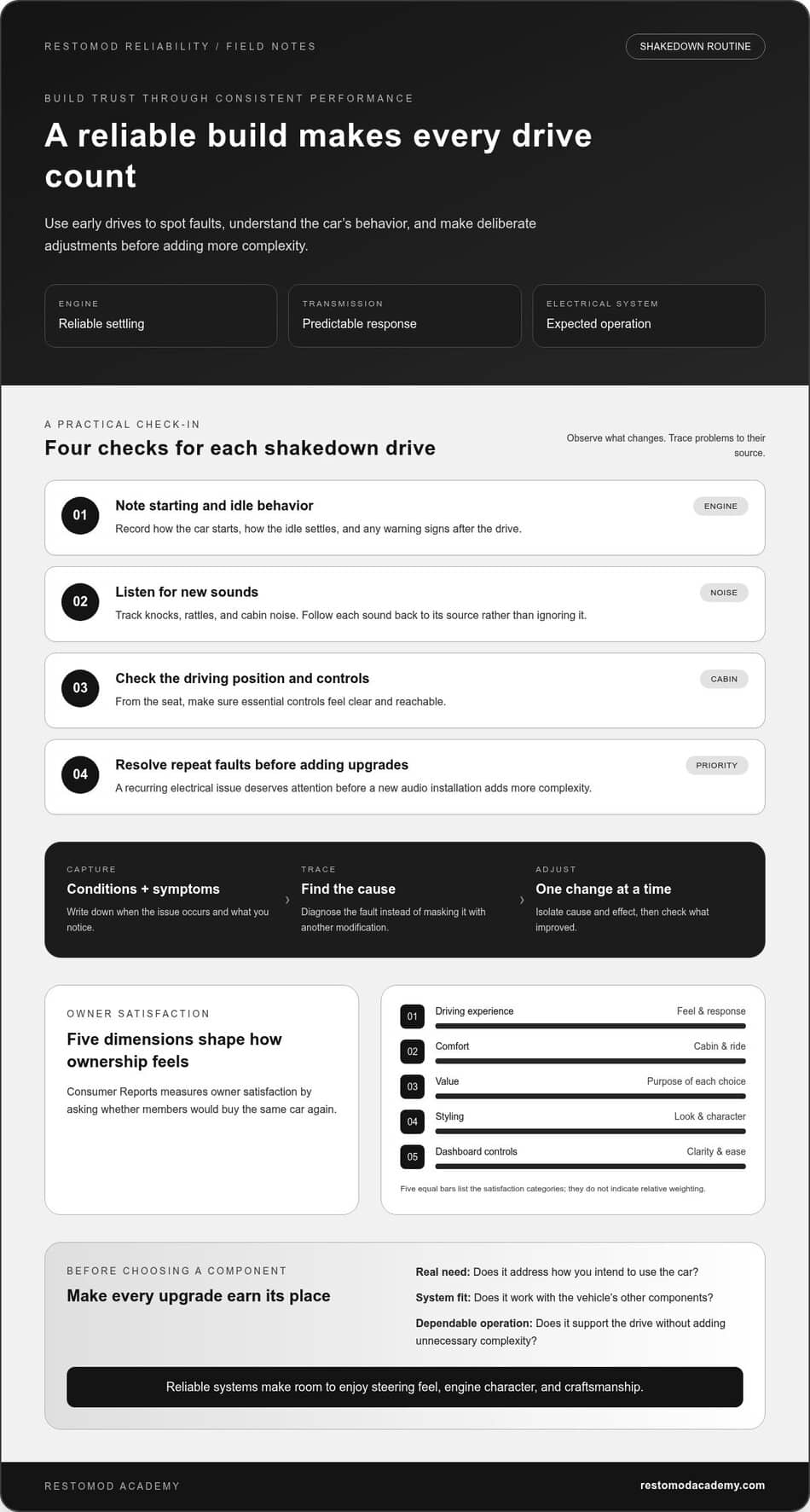
A build earns trust through consistent performance, not a flawless first start. The engine should settle reliably, the transmission respond predictably, and the electrical system work as expected in ordinary use. These details determine whether the finished car feels rewarding on a short drive or dependable enough for regular journeys. Reliability is part of enjoyment: it gives you room to appreciate the steering feel, engine character, and craftsmanship.
Owner satisfaction measures more than mechanical dependability. Consumer Reports bases its owner satisfaction score on five categories: driving experience, comfort, value, styling, and dashboard controls. Its survey data covers more than 420,000 vehicles. Consumer Reports members are asked whether they would buy the same car again, making that question a useful shorthand for how ownership feels over time.
To see how a one-off machine can inspire devotion, watch this video:
That owner question matters for builders, too. A custom car can look magnificent yet frustrate its driver through recurring faults, heat, vibration, or awkward controls. Consumer Reports calculates its owner satisfaction ratings by analyzing responses on about 380,000 vehicles. Consumer Reports asks members every year whether they would buy or lease their vehicle again. These measures connect satisfaction with lived experience, rather than appearance alone.
Reliability supports the driving experience in practical ways. A dependable charging system helps prevent interruptions. A well-matched engine and transmission make acceleration feel deliberate rather than unpredictable. Thoughtful cabin layout keeps essential controls intuitive. Consumer Reports says owners commonly complain about poor reliability, noisy cabins, and overly complicated controls. Each complaint points to a build decision worth addressing before final assembly.
Use a simple evaluation routine as the project develops:
- Record starting behavior, idle quality, and warning signs after each shakedown drive.
- Listen for new knocks, rattles, or cabin noise, then trace each sound to its source.
- Check whether the controls feel clear and reachable from the driving position.
- Review repeated faults before adding performance or comfort upgrades.
Use early drives to gather useful feedback. Diagnose a recurring electrical fault before adding a new audio installation and more complexity. A cabin rattle can also mask engine sounds that might help you identify other changes. Record the conditions and symptoms, then make one adjustment at a time. This helps you isolate cause and effect instead of masking one problem with another modification.
Consumer Reports found that people are more likely to be satisfied with a car as they spend more on it. That does not mean spending alone creates satisfaction. In a self-built car, value depends on whether each choice serves the intended use. An expensive upgrade that adds complexity without improving the drive may weaken the result. Prioritize components that address a real need, suit the vehicle’s systems, and support dependable operation.
Consumer Reports says the cars inspiring the strongest loyalty are fun to drive, reliable, fuel-efficient or fully electric, and offer a high-tech, luxurious driving environment. It also reports that hybrid models satisfy owners more than their gas-only counterparts, while plug-in hybrids with a short electric-only range disappoint owners. Sports cars, electric vehicles, and minivans that deliver on their promise satisfy owners even when unreliable. These findings show that expectations shape satisfaction alongside dependability.
Consumer Reports members in the Midwest were happiest with the Chevy Bolt, members in the South with the Ford Expedition, and members in the North with the Toyota Avalon. Owners also cited low ownership costs and strong fuel economy as reasons to keep their cars. For a builder, the lesson is to define the car’s purpose clearly. Match reliability, comfort, controls, and character to that purpose, and the finished car becomes more than a collection of upgrades.
Reliability also belongs beside safety in any assessment of a vehicle. Vehicle crashes cause 1.19 million deaths worldwide every year, a reminder that predictable operation matters beyond convenience. About 92% of occupied U.S. housing units have access to at least one vehicle, making dependable transportation part of everyday life.
Careful shakedown checks can reveal problems before regular use. Consistent starting, stable operation, and controls that respond as expected help build confidence behind the wheel. A satisfying car is not only distinctive, but also ready for the demands of ownership.
Driving satisfaction
A satisfying drive starts with a clear idea of how the car should feel. Imagine a classic coupe that keeps its original character but responds more cleanly through a corner. Steering, throttle, brakes, seating position, and sound all shape that experience. Choose upgrades for the whole drive, not just a headline figure. A powerful engine means little if the clutch feels heavy or the cabin becomes tiring.
Define the car’s purpose before changing parts. A weekend cruiser needs different priorities from a car for winding roads or regular commuting. A long-distance build, for example, benefits from comfortable seating, clear gauges, and easy-to-use controls. A corner-focused project may prioritize predictable steering response and balanced handling. Write down how you intend to use the car, then assess each modification against that plan.
Fit matters as much as mechanical response. Adjust the seat and steering wheel so you can reach the pedals and read the instruments without stretching. Check that the shifter falls naturally to hand, especially in a manual car. A period-style dashboard can preserve a vintage cabin’s character, while carefully chosen modern controls can simplify everyday use. The right balance keeps the design personal without making routine tasks awkward.
Consider how the systems work together. An engine change can alter the car’s sound, throttle response, and balance. The transmission affects how you engage with that power. Even a new exhaust note can change the character of a familiar chassis. An LS engine swap, for example, calls for planning around the transmission, cooling, and intended use so the finished car feels coherent, not like a set of disconnected upgrades.
Use each test drive to evaluate one part of the experience at a time:
- On a quiet route, note throttle response and whether power arrives smoothly.
- On familiar turns, observe steering feel and how confidently the car follows its line.
- During ordinary stops, assess pedal feel and whether braking remains predictable.
- After the drive, record cabin noise, seat comfort, and any control that felt misplaced.
Keep your notes specific. “The car feels off” offers little direction; “the shifter feels vague when changing gears” points to a system to inspect. Make one adjustment, then repeat the same route under similar conditions. This connects each change to its effect and prevents several simultaneous upgrades from obscuring which choice improved the drive.
Let the car teach you. A small hesitation during acceleration, a vibration through the steering wheel, or a hard-to-read gauge can show where the driving experience needs refinement. Treat each observation as useful feedback, not a reason to abandon the design. The satisfaction of driving a car you built yourself grows as you recognize a problem, understand its cause, and make a deliberate improvement.
Pay deliberate attention to sound and ride feel, too. A classic engine’s note can be part of its appeal, but excessive cabin noise may make conversation difficult or a longer trip tiring. Firm suspension can sharpen responses, but may not suit the roads you regularly travel. Compare the car’s behavior with your original purpose, then adjust for the balance you want. A successful build feels intentional in motion, not merely impressive at a standstill.
Choose a repeatable route that includes the conditions your car will encounter. Use the same stretch to assess response, comfort, and ease of control after each change. This steady process turns craftsmanship into a more personal connection with the machine. Each well-judged adjustment brings the car closer to your vision while preserving the pleasure of driving something shaped by your own hands.
How does driving a self-built car compare with driving a factory-built car?
A factory-built car arrives as an integrated package. Its engine, transmission, suspension, cabin, and controls are designed to work together. A self-built car reflects its owner’s choices, from the sound of a vintage engine to the feel of the steering wheel. That difference shapes the driving experience: one follows a coordinated production design, while the other can express a personal vision.
Consider a classic coupe with a modern engine. The factory version may offer predictable responses shaped around its original powertrain. A restomod can pair the familiar body with contemporary performance, but the result depends on how carefully the components work together. The builder can prioritize the desired character, then refine the car through testing. That involvement can make each drive feel connected to a decision made in the workshop.
Factory integration has a practical advantage: the major systems were developed as one vehicle. In a custom project, parts chosen at different times must work together as a whole. Changing an engine, for example, may affect transmission behavior, cooling demands, cabin sound, and the car’s balance. A modification that improves one quality can affect another. Judge the whole package rather than assuming every upgrade automatically improves the drive.
The ownership experience differs, too. A factory-built car gives the driver a finished configuration to learn. In a self-built car, the owner may understand how a particular choice shapes the machine because they researched, installed, or refined it. If a control feels awkward, they can trace the design decision behind it. That knowledge adds a hands-on dimension, while making careful documentation and methodical adjustments valuable parts of ownership.
Compare the two approaches against the way you plan to use the car:
- For regular commuting, consider seating comfort, clear controls, and how easily the car handles routine driving.
- For relaxed weekend trips, weigh engine character, cabin sound, and the feel of the original design.
- For spirited back-road driving, pay attention to predictable steering, braking response, and how the powertrain behaves together.
- For a show-focused build, decide whether the finished car should prioritize visual authenticity or modern usability.
These are priorities, not guarantees. A factory car may suit a driver who values a cohesive, finished design. A carefully planned build may better match a specific preference, such as preserving classic styling while changing the driving character. Decide what “better” means before choosing parts. Compare actual driving qualities rather than treating factory or custom as a measure of quality in itself.
Use a simple comparison drive to evaluate your project against a familiar factory car. Choose a similar route, then note how each vehicle responds during acceleration, cornering, braking, and ordinary cruising. Record specific observations, such as abrupt throttle response or a seat that becomes tiring. Repeat the route after making one adjustment. This gives you a practical way to see whether the custom setup is moving closer to the experience you want.
There is an emotional difference, too. A production car reflects the design intent of its engineers and stylists. A self-built car carries its owner’s decisions, mistakes, corrections, and craft. That personal history can make the satisfaction of driving a car you built yourself distinct from enjoying one designed by someone else. The machine becomes both transportation and a record of learning.
To shape a classic car around modern preferences, explore what defines a restomod and use that framework to clarify your build’s balance of heritage and updated driving character.
A carefully planned build can better match a specific set of priorities, but the right choice also depends on how often you expect to drive and what role the car will play. A project intended for occasional enjoyment may leave more room for personal preferences than one expected to handle many everyday trips. In a typical week, relying on a car for more than 50% of out-of-home activities was associated with lower life satisfaction among surveyed U.S. adults. This association does not show that driving caused lower satisfaction, but it is a reminder to consider whether a car-centered routine fits your needs. For either kind of car, assess the driving experience alongside the place it will occupy in daily life, and choose a design that feels right without assuming that greater customization or factory integration alone guarantees satisfaction.
Restomod Academy: The Ultimate Restomod Guide
Restomod Academy’s The Ultimate Restomod Guide helps you turn a classic-car vision into a considered build plan. Use it when weighing heritage character against modern performance and looking for a clearer framework for your decisions. For more tailored direction, Restomod Consulting Services can support your planning, while Premium Project Blueprints provide a structured starting point. These resources help connect choices about the car’s systems and intended use, so each step serves the driving experience you want. Start with the guide if you’re still shaping the concept, or explore consulting and blueprints when you’re ready to make the plan more specific. Contact Restomod Academy to take the next step with your project.
Shape the Next Stage of Your Build
Give your project a next step that reflects the work already invested. Define the feeling you want from the driver’s seat, then turn that vision into a clear build priority. It might be a more connected response, a cabin true to the car’s heritage, or a thoughtful blend of vintage character and modern refinement. A focused direction helps keep future choices aligned with the experience you want to create.
The satisfaction of driving a car you built yourself grows from making the choices your own and bringing them together with care. You don’t need to solve every detail at once. Choose the next decision that will move the project forward, and give it the same attention you’d give the finished machine.
If you’re ready to discuss that next step, contact Restomod Academy to discuss your build. Keep learning, trust the process, and let each careful improvement bring your vision closer to the road.
Frequently Asked Questions
What is satisfying about building and driving your own car?
Building and driving your own car is satisfying because you experience the results of your decisions and hands-on learning. Diagnose a rough idle, correct the cause, then hear the engine settle on the next start: that connects workshop effort to the drive. You also learn how specific adjustments affect the machine, making each trip a chance to notice, understand, and appreciate details that might otherwise go unseen.
What skills and tools are needed to build a car?
Building a dependable car takes craftsmanship, careful observation, and a methodical approach to diagnosing faults and making one adjustment at a time.
A car you build yourself has to do more than look right in the workshop. It has to feel dependable on the road. The satisfaction of driving a car you built yourself comes from combining personal craftsmanship with a machine you can trust, tune, and enjoy. Consumer Reports says owner satisfaction reflects five categories: driving experience, comfort, value, styling, and dashboard controls.
A striking restomod can lose its appeal if reliability problems keep it off the road. A well-sorted build, by contrast, makes every drive a reminder of the skill and patience behind it. You’ll learn how reliability shapes owner satisfaction, which choices make a custom build more rewarding to drive, and how to approach the work methodically. From the character of classic mechanicals to the precision of modern upgrades, every decision can bring your vision closer to a car that’s satisfying to drive.
Key Takeaways
- Plan reliability into the build from the start by matching components and upgrades to how you intend to drive the car.
- Judge a satisfying drive by more than acceleration or appearance; comfort, controls, and how the car responds all shape the experience.
- Compare a self-built car with a factory-built one by weighing personal fit and hands-on knowledge against the integration and refinement of a production vehicle.
- Use careful testing and methodical adjustments to turn early problems into useful lessons and improve confidence behind the wheel.
- Use The Ultimate Restomod Guide, Restomod Consulting Services, or Premium Project Blueprints to support the stage of your build that needs direction.
Vehicle reliability and owner satisfaction
A build earns trust through consistent performance, not a flawless first start. The engine should settle reliably, the transmission respond predictably, and the electrical system work as expected in ordinary use. These details determine whether the finished car feels rewarding on a short drive or dependable enough for regular journeys. Reliability is part of enjoyment: it gives you room to appreciate the steering feel, engine character, and craftsmanship.
Owner satisfaction measures more than mechanical dependability. Consumer Reports bases its owner satisfaction score on five categories: driving experience, comfort, value, styling, and dashboard controls. Its survey data covers more than 420,000 vehicles. Consumer Reports members are asked whether they would buy the same car again, making that question a useful shorthand for how ownership feels over time.
To see how a one-off machine can inspire devotion, watch this video:
That owner question matters for builders, too. A custom car can look magnificent yet frustrate its driver through recurring faults, heat, vibration, or awkward controls. Consumer Reports calculates its owner satisfaction ratings by analyzing responses on about 380,000 vehicles. Consumer Reports asks members every year whether they would buy or lease their vehicle again. These measures connect satisfaction with lived experience, rather than appearance alone.
Reliability supports the driving experience in practical ways. A dependable charging system helps prevent interruptions. A well-matched engine and transmission make acceleration feel deliberate rather than unpredictable. Thoughtful cabin layout keeps essential controls intuitive. Consumer Reports says owners commonly complain about poor reliability, noisy cabins, and overly complicated controls. Each complaint points to a build decision worth addressing before final assembly.
Use a simple evaluation routine as the project develops:
- Record starting behavior, idle quality, and warning signs after each shakedown drive.
- Listen for new knocks, rattles, or cabin noise, then trace each sound to its source.
- Check whether the controls feel clear and reachable from the driving position.
- Review repeated faults before adding performance or comfort upgrades.
Use early drives to gather useful feedback. Diagnose a recurring electrical fault before adding a new audio installation and more complexity. A cabin rattle can also mask engine sounds that might help you identify other changes. Record the conditions and symptoms, then make one adjustment at a time. This helps you isolate cause and effect instead of masking one problem with another modification.
Consumer Reports found that people are more likely to be satisfied with a car as they spend more on it. That does not mean spending alone creates satisfaction. In a self-built car, value depends on whether each choice serves the intended use. An expensive upgrade that adds complexity without improving the drive may weaken the result. Prioritize components that address a real need, suit the vehicle’s systems, and support dependable operation.
Consumer Reports says the cars inspiring the strongest loyalty are fun to drive, reliable, fuel-efficient or fully electric, and offer a high-tech, luxurious driving environment. It also reports that hybrid models satisfy owners more than their gas-only counterparts, while plug-in hybrids with a short electric-only range disappoint owners. Sports cars, electric vehicles, and minivans that deliver on their promise satisfy owners even when unreliable. These findings show that expectations shape satisfaction alongside dependability.
Consumer Reports members in the Midwest were happiest with the Chevy Bolt, members in the South with the Ford Expedition, and members in the North with the Toyota Avalon. Owners also cited low ownership costs and strong fuel economy as reasons to keep their cars. For a builder, the lesson is to define the car’s purpose clearly. Match reliability, comfort, controls, and character to that purpose, and the finished car becomes more than a collection of upgrades.
Reliability also belongs beside safety in any assessment of a vehicle. Vehicle crashes cause 1.19 million deaths worldwide every year, a reminder that predictable operation matters beyond convenience. About 92% of occupied U.S. housing units have access to at least one vehicle, making dependable transportation part of everyday life.
Careful shakedown checks can reveal problems before regular use. Consistent starting, stable operation, and controls that respond as expected help build confidence behind the wheel. A satisfying car is not only distinctive, but also ready for the demands of ownership.
Driving satisfaction
A satisfying drive starts with a clear idea of how the car should feel. Imagine a classic coupe that keeps its original character but responds more cleanly through a corner. Steering, throttle, brakes, seating position, and sound all shape that experience. Choose upgrades for the whole drive, not just a headline figure. A powerful engine means little if the clutch feels heavy or the cabin becomes tiring.
Define the car’s purpose before changing parts. A weekend cruiser needs different priorities from a car for winding roads or regular commuting. A long-distance build, for example, benefits from comfortable seating, clear gauges, and easy-to-use controls. A corner-focused project may prioritize predictable steering response and balanced handling. Write down how you intend to use the car, then assess each modification against that plan.
Fit matters as much as mechanical response. Adjust the seat and steering wheel so you can reach the pedals and read the instruments without stretching. Check that the shifter falls naturally to hand, especially in a manual car. A period-style dashboard can preserve a vintage cabin’s character, while carefully chosen modern controls can simplify everyday use. The right balance keeps the design personal without making routine tasks awkward.
Consider how the systems work together. An engine change can alter the car’s sound, throttle response, and balance. The transmission affects how you engage with that power. Even a new exhaust note can change the character of a familiar chassis. An LS engine swap, for example, calls for planning around the transmission, cooling, and intended use so the finished car feels coherent, not like a set of disconnected upgrades.
Use each test drive to evaluate one part of the experience at a time:
- On a quiet route, note throttle response and whether power arrives smoothly.
- On familiar turns, observe steering feel and how confidently the car follows its line.
- During ordinary stops, assess pedal feel and whether braking remains predictable.
- After the drive, record cabin noise, seat comfort, and any control that felt misplaced.
Keep your notes specific. “The car feels off” offers little direction; “the shifter feels vague when changing gears” points to a system to inspect. Make one adjustment, then repeat the same route under similar conditions. This connects each change to its effect and prevents several simultaneous upgrades from obscuring which choice improved the drive.
Let the car teach you. A small hesitation during acceleration, a vibration through the steering wheel, or a hard-to-read gauge can show where the driving experience needs refinement. Treat each observation as useful feedback, not a reason to abandon the design. The satisfaction of driving a car you built yourself grows as you recognize a problem, understand its cause, and make a deliberate improvement.
Pay deliberate attention to sound and ride feel, too. A classic engine’s note can be part of its appeal, but excessive cabin noise may make conversation difficult or a longer trip tiring. Firm suspension can sharpen responses, but may not suit the roads you regularly travel. Compare the car’s behavior with your original purpose, then adjust for the balance you want. A successful build feels intentional in motion, not merely impressive at a standstill.
Choose a repeatable route that includes the conditions your car will encounter. Use the same stretch to assess response, comfort, and ease of control after each change. This steady process turns craftsmanship into a more personal connection with the machine. Each well-judged adjustment brings the car closer to your vision while preserving the pleasure of driving something shaped by your own hands.
How does driving a self-built car compare with driving a factory-built car?
A factory-built car arrives as an integrated package. Its engine, transmission, suspension, cabin, and controls are designed to work together. A self-built car reflects its owner’s choices, from the sound of a vintage engine to the feel of the steering wheel. That difference shapes the driving experience: one follows a coordinated production design, while the other can express a personal vision.
Consider a classic coupe with a modern engine. The factory version may offer predictable responses shaped around its original powertrain. A restomod can pair the familiar body with contemporary performance, but the result depends on how carefully the components work together. The builder can prioritize the desired character, then refine the car through testing. That involvement can make each drive feel connected to a decision made in the workshop.
Factory integration has a practical advantage: the major systems were developed as one vehicle. In a custom project, parts chosen at different times must work together as a whole. Changing an engine, for example, may affect transmission behavior, cooling demands, cabin sound, and the car’s balance. A modification that improves one quality can affect another. Judge the whole package rather than assuming every upgrade automatically improves the drive.
The ownership experience differs, too. A factory-built car gives the driver a finished configuration to learn. In a self-built car, the owner may understand how a particular choice shapes the machine because they researched, installed, or refined it. If a control feels awkward, they can trace the design decision behind it. That knowledge adds a hands-on dimension, while making careful documentation and methodical adjustments valuable parts of ownership.
Compare the two approaches against the way you plan to use the car:
- For regular commuting, consider seating comfort, clear controls, and how easily the car handles routine driving.
- For relaxed weekend trips, weigh engine character, cabin sound, and the feel of the original design.
- For spirited back-road driving, pay attention to predictable steering, braking response, and how the powertrain behaves together.
- For a show-focused build, decide whether the finished car should prioritize visual authenticity or modern usability.
These are priorities, not guarantees. A factory car may suit a driver who values a cohesive, finished design. A carefully planned build may better match a specific preference, such as preserving classic styling while changing the driving character. Decide what “better” means before choosing parts. Compare actual driving qualities rather than treating factory or custom as a measure of quality in itself.
Use a simple comparison drive to evaluate your project against a familiar factory car. Choose a similar route, then note how each vehicle responds during acceleration, cornering, braking, and ordinary cruising. Record specific observations, such as abrupt throttle response or a seat that becomes tiring. Repeat the route after making one adjustment. This gives you a practical way to see whether the custom setup is moving closer to the experience you want.
There is an emotional difference, too. A production car reflects the design intent of its engineers and stylists. A self-built car carries its owner’s decisions, mistakes, corrections, and craft. That personal history can make the satisfaction of driving a car you built yourself distinct from enjoying one designed by someone else. The machine becomes both transportation and a record of learning.
To shape a classic car around modern preferences, explore what defines a restomod and use that framework to clarify your build’s balance of heritage and updated driving character.
A carefully planned build can better match a specific set of priorities, but the right choice also depends on how often you expect to drive and what role the car will play. A project intended for occasional enjoyment may leave more room for personal preferences than one expected to handle many everyday trips. In a typical week, relying on a car for more than 50% of out-of-home activities was associated with lower life satisfaction among surveyed U.S. adults. This association does not show that driving caused lower satisfaction, but it is a reminder to consider whether a car-centered routine fits your needs. For either kind of car, assess the driving experience alongside the place it will occupy in daily life, and choose a design that feels right without assuming that greater customization or factory integration alone guarantees satisfaction.
Restomod Academy: The Ultimate Restomod Guide
Restomod Academy’s The Ultimate Restomod Guide helps you turn a classic-car vision into a considered build plan. Use it when weighing heritage character against modern performance and looking for a clearer framework for your decisions. For more tailored direction, Restomod Consulting Services can support your planning, while Premium Project Blueprints provide a structured starting point. These resources help connect choices about the car’s systems and intended use, so each step serves the driving experience you want. Start with the guide if you’re still shaping the concept, or explore consulting and blueprints when you’re ready to make the plan more specific. Contact Restomod Academy to take the next step with your project.
Shape the Next Stage of Your Build
Give your project a next step that reflects the work already invested. Define the feeling you want from the driver’s seat, then turn that vision into a clear build priority. It might be a more connected response, a cabin true to the car’s heritage, or a thoughtful blend of vintage character and modern refinement. A focused direction helps keep future choices aligned with the experience you want to create.
The satisfaction of driving a car you built yourself grows from making the choices your own and bringing them together with care. You don’t need to solve every detail at once. Choose the next decision that will move the project forward, and give it the same attention you’d give the finished machine.
If you’re ready to discuss that next step, contact Restomod Academy to discuss your build. Keep learning, trust the process, and let each careful improvement bring your vision closer to the road.
Frequently Asked Questions
What is satisfying about building and driving your own car?
Building and driving your own car is satisfying because you experience the results of your decisions and hands-on learning. Diagnose a rough idle, correct the cause, then hear the engine settle on the next start: that connects workshop effort to the drive. You also learn how specific adjustments affect the machine, making each trip a chance to notice, understand, and appreciate details that might otherwise go unseen.
What skills and tools are needed to build a car?
Building a dependable car takes craftsmanship, careful observation, and a methodical approach to diagnosing faults and making one adjustment at a time.