
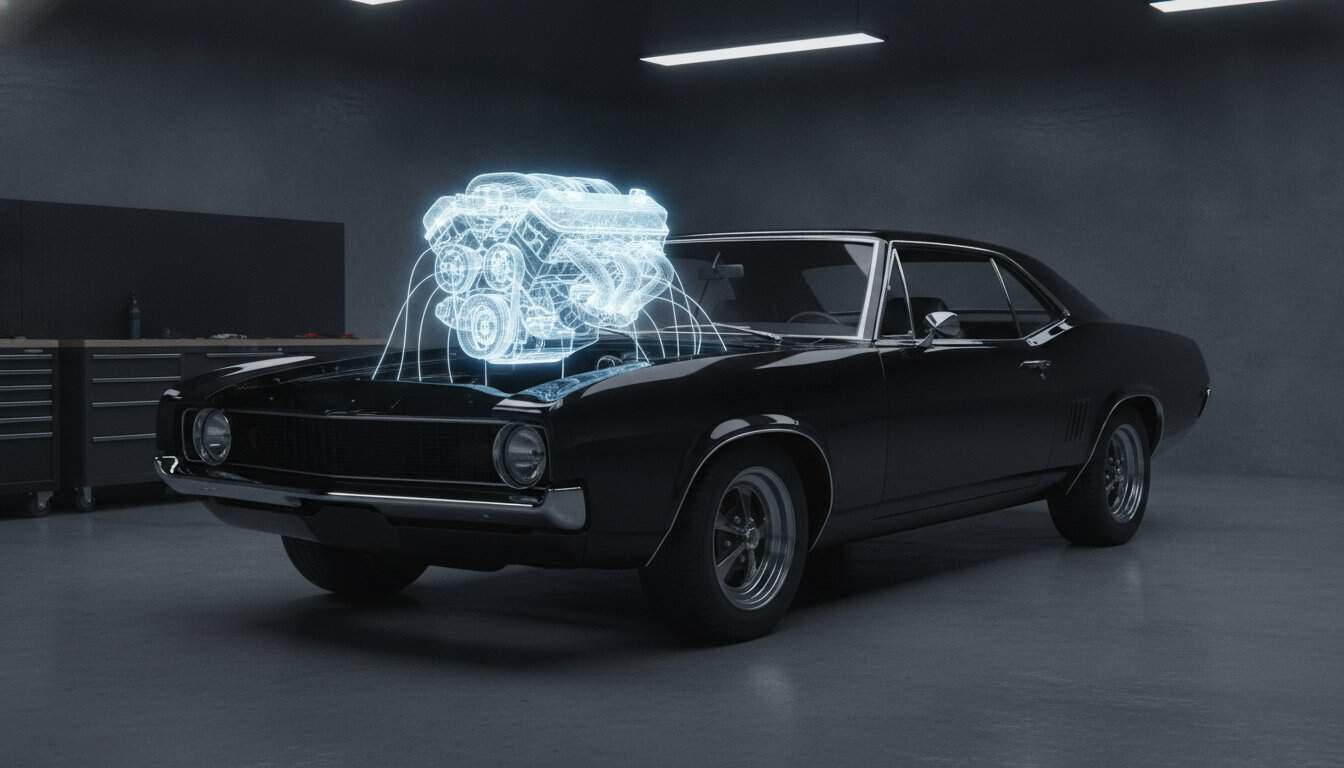
The most expensive component of your restomod isn’t that high-performance crate engine; it is the time and money wasted when you realize your parts are incompatible with your chassis. It’s a common heartbreaker in the garage. You buy a modern powerplant only to find the steering rack is in the way, or the ECU refuses to talk to your vintage gauges. Relying on fragmented forum advice often leads to wiring headaches and mid-project fabrication that stalls your progress for months. Using professional engine swap project blueprints allows you to solve these technical puzzles on paper before you ever pick up a wrench.
We understand the deep satisfaction of blending classic aesthetics with the heart of a modern machine. You want a car that handles today’s traffic with ease and starts with a turn of the key every single time. This guide shows you how to act as the master architect of your build. We will walk through the logical steps to ensure your chosen engine fits safely, functions legally under current regulations, and delivers the performance you’ve dreamed of. It is time to move past the guesswork and build with the confidence of a seasoned pro.
Key Takeaways
- Understand why technical planning replaces trial and error to prevent costly compatibility errors before you buy your first part.
- Identify the essential technical components needed in your engine swap project blueprints to ensure precise fitment and functional reliability.
- Evaluate the trade-offs between predictable modern crate engines and the variable quality of donor-car builds to choose your path.
- Master the logical sequence of operations for your installation, emphasizing the importance of a thorough mock-up phase before final assembly.
- Discover how structured educational resources can simplify complex wiring and ECU integration for a finished project that starts every time.
The Role of Blueprints in Modern Engine Swaps
Stop treating your garage time like a series of expensive guesses. In the past, builders relied on a “cut until it fits” mentality that often turned vintage steel into a collection of mismatched parts. Today, the standard has shifted toward precision. Professional engine swap project blueprints serve as your master roadmap, ensuring every component from the oil pan to the wiring harness works in harmony. This isn’t just about making the car faster; it’s about transforming a machine that might feel like a death trap into a reliable, high-performance vehicle you can trust on a cross-country haul.
A well-researched engine swap overview shows that while the concept is simple, the execution is where most enthusiasts stumble. Modern engines bring complex electronics and tighter tolerances that don’t play well with vintage frames. A true blueprint is a comprehensive document that maps out physical dimensions, electronic integration, and fluid plumbing before you ever buy a crate engine. It’s the difference between a project that stalls in the mock-up phase and one that dominates the local car show.
To better understand how a master plan comes together in the workshop, watch this helpful video:
Why Your Classic Car Needs a Master Plan
Identify common failure points before they identify your wallet. Oil pan interference with the steering rack is a classic project-killer that a good plan catches early. When you’re doubling or even tripling the original horsepower of a vintage chassis, safety isn’t optional. Engine swap project blueprints mitigate these risks by providing the technical data you need to ensure your brakes, suspension, and cooling systems are capable of handling modern torque. Planning also accounts for the shifting legal landscape. As of July 2026, the EPA has increased enforcement of the Clean Air Act, making it critical that your swap remains federally compliant by retaining necessary emissions equipment.
Transitioning from Restoration to Restomodding
Embrace the restomod philosophy by blending the lines of the past with the reliability of the future. You aren’t just restoring a vehicle; you’re evolving it. This transition requires a mindset shift from “part-swapper” to “system-integrator.” If you’re still curious about the nuances of this approach, check out our guide on what is a restomod to see how it differs from a standard rebuild. By choosing to build with a master plan, you’re engineering a new legacy for a vintage machine rather than just keeping it on life support.
Anatomy of a Professional Engine Swap Blueprint
A professional blueprint is far more than a simple parts list; it is a structural logic document that governs how every system in your car interacts. In the same way that a general contractor like River City Construction Inc uses detailed architectural plans to ensure a home remodel is structurally sound, high-quality engine swap project blueprints must account for the physical footprint of the engine, the routing of fluid lines, and the complex web of modern electronics. Think of it as the DNA of your build. Without this technical foundation, you are likely to encounter “project creep,” where solving one problem creates three new ones. Precision planning allows you to identify these conflicts on paper, saving your budget for performance upgrades rather than corrective fabrication.
This strategic approach to budgeting is common in high-end design; for example, Kitchen Renovations Perfected allows clients to explore Project-Based Renovation and Installation Fees to ensure total project clarity before starting a luxury remodel.
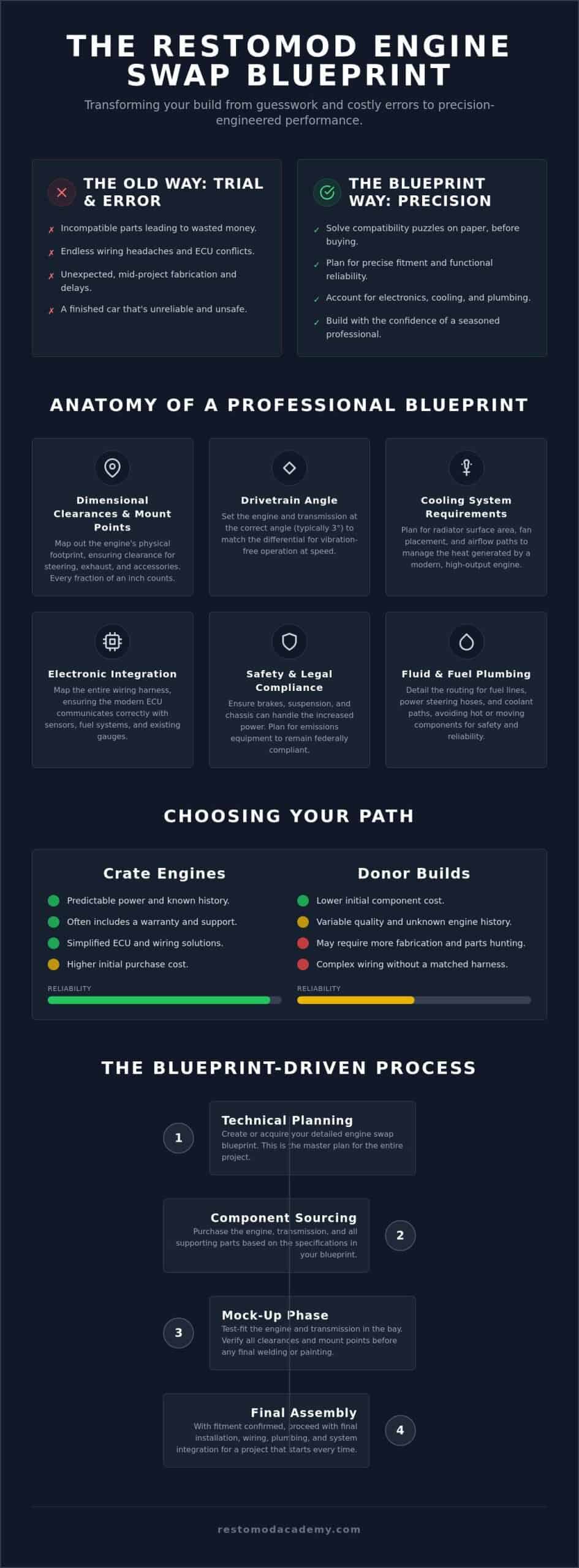
One of the most overlooked aspects of a successful swap is the drivetrain angle. To ensure vibration-free operation at highway speeds, your engine and transmission must be set at a specific angle, typically three degrees downward toward the rear, to match the pinion angle of the differential. Your blueprint should also detail the cooling system requirements. Modern high-output engines generate significant heat and require specific airflow paths and radiator surface areas that vintage grill openings weren’t originally designed to provide. If you want to dive deeper into the technical specifics of a popular platform, you can explore the definitive guide to an LS engine swap for a closer look at component integration.
Dimensional Clearances and Mount Points
Space is your most valuable commodity. When fitting a wide engine like a modern Coyote V8 into a vintage Mustang, every fraction of an inch counts. You must map out the clearance between the oil pan and the steering rack, as well as the distance from the cylinder heads to the shock towers. Often, these modern powerplants require you to modify or replace the factory crossmember. Don’t forget the transmission tunnel. Modern six-speed gearboxes are significantly bulkier than vintage four-speeds, and your engine swap project blueprints should clearly indicate where the floor pan needs relief to maintain proper ground clearance and drivetrain alignment.
Wiring Schematics and ECU Integration
The jump from a mechanical carburetor to modern electronic fuel injection is the most daunting part of a restomod for many builders. Your blueprint must serve as a translation layer between the vintage chassis wiring and the modern engine control unit (ECU). This includes planning for a stand-alone wiring harness that handles fuel delivery, ignition timing, and sensor feedback. You also need to account for modern gauge signals. Since vintage mechanical speedometers don’t talk to modern electronic transmissions, your plan should include solutions like digital dash integration or GPS-based conversion modules. Beyond just making it run, you must ensure it remains legal. Following California engine change guidelines provides a solid framework for emissions compliance that is respected by inspectors across the country. If you find these technical hurdles intimidating, remember that our Premium Project Blueprints are designed to walk you through every wire and bolt with expert precision.
Crate Engines vs Junkyard Builds Choosing Your Path
Sourcing your powertrain is a pivotal decision that dictates the entire trajectory of your build. You’re either choosing the clinical precision of a factory fresh unit or the rewarding, often greasy, scavenger hunt of a donor car. Both methods have their place in the workshop, but your engine swap project blueprints must be tailored to the specific variables of your chosen path. A crate engine arrives with known dimensions and documented wiring, while a junkyard find requires you to document every missing sensor and modified bracket yourself. Choosing the right source early prevents your project from turning into a collection of incompatible parts that drain your budget without moving the needle.
Your blueprint serves as the bridge between your chosen engine and your vintage chassis. When you source a used engine, your planning must account for the unknown history of that machine. Conversely, a crate engine allows your plan to focus more on the “how” of the installation rather than the “if” of the engine’s health. Regardless of the path you take, the goal remains the same: a finished restomod that starts with a turn of the key and handles modern traffic with the confidence of a contemporary daily driver. Using detailed engine swap project blueprints ensures that your choice in power is matched by a logical, safe, and efficient installation process.
The Crate Engine Advantage for Restomods
When your goal is modern reliability without the headache of previous owners’ mistakes, a crate engine is the gold standard. These units offer a zero mile fresh start and often come with a manufacturer warranty that provides immense peace of mind when you’re pushing a vintage chassis to its limits. Integration is streamlined because many manufacturers offer control packs that include the ECU, harness, and sensors designed to work together right out of the box. Professional builders prefer this route because it eliminates the variable of engine health, allowing them to focus entirely on the artistry of the installation and the precision of the fitment.
Navigating the Junkyard Swap Successfully
Scouring the local yards for a donor engine is a rite of passage for many DIY builders. It’s a cost effective way to get high performance architecture, but it demands a higher level of technical scrutiny. Before you pull a donor engine, check for signs of oil leaks or coolant staining on the block and rotate the crank by hand to ensure it isn’t seized. Pull the spark plugs to inspect for fouling or moisture and always verify the VIN to confirm the exact year and model for emissions compliance. Remember that the initial purchase price is just the beginning. Used engines often require new gaskets, water pumps, and a host of sensors that might have been damaged during removal. If you’re leaning toward the most popular donor platform in history, study the definitive guide to an LS engine swap to understand exactly what you’re getting into. Your plan for a used engine must include a thorough refresh phase where you address these wear items before the engine ever meets the frame rails.
Executing the Plan From Bench to Bay
Execution is where the precision of your planning pays off. It is time to transition from the role of Master Architect to that of Lead Technician. The mock-up phase is the most critical step in this journey. You must drop the engine and transmission into the bay multiple times to verify that every clearance documented in your engine swap project blueprints holds true in three dimensions. This is when you trim the firewall, adjust the motor mounts, and ensure the headers don’t vibrate against the steering shaft. Never commit to final paint or permanent welding until the entire drivetrain sits exactly where it belongs. This patient, methodical approach separates a professional build from a frustrated project that never leaves the jack stands.
A successful first start requires more than just fuel and a spark; it requires a systematic check of every fluid connection and electronic ground. Modern ECUs are incredibly sensitive to voltage drops and electrical noise, so your wiring must be robust and properly shielded. Once the engine breathes for the first time, follow a strict break-in procedure. Monitor oil pressure and coolant temperatures with a hawk’s eye. This methodical approach ensures that your finished restomod isn’t just a showpiece, but a reliable machine capable of handling the rigors of modern driving. If you want to ensure your project stays on track, you can find the structured guidance you need with our Premium Project Blueprints.
Essential Tools for the DIY Builder
Quality work requires the right equipment. You cannot achieve professional results with a budget hoist that flexes under the weight of a modern V8. A heavy-duty engine hoist and a load leveler are non-negotiable for the multiple mock-up sessions you will perform. Precision is key, so keep a digital angle finder handy to verify your drivetrain alignment. Beyond the heavy steel, you need modern diagnostic tools. An OBD-II scanner or a laptop with the appropriate tuning software is essential for troubleshooting the new ECU and verifying that all sensors are communicating correctly. For a complete list of what you need to outfit your workshop, check out our recommended gear page.
The Critical Sequence of Operations
The engine installation doesn’t happen in a vacuum. You must plan your fuel system and brake upgrades alongside the powerplant. Modern fuel-injected engines require high-pressure pumps and return lines that your vintage tank wasn’t built for. Similarly, doubling your horsepower without upgrading your stopping power is a recipe for disaster. Once the engine is physically mounted, begin the final plumbing for power steering and air conditioning. Use high-quality AN fittings and braided lines to ensure leak-free operation. Your engine swap project blueprints should dictate this sequence, ensuring that you don’t have to disassemble the front of the car just to reach a single hidden bolt. Finish with a systematic test drive, starting with short heat cycles in the driveway before venturing onto the open road.
Premium Blueprints and The Ultimate Restomod Guide
Building a high-performance machine requires more than just mechanical skill; it requires a disciplined strategy. At Restomod Academy, we’ve distilled decades of workshop experience into structured resources designed to help you succeed. Our Premium Project Blueprints serve as the definitive technical foundation for your build, providing model-specific data that removes the traditional barriers of custom fabrication. These aren’t just generic sketches. They are precise engineering documents that solve the hard problems of engine placement, cooling efficiency, and electronic integration before you ever turn a bolt. When you use professional engine swap project blueprints, you aren’t just following a guide; you’re adopting a proven system for success.
The Ultimate Restomod Guide acts as your comprehensive roadmap, covering the entire lifecycle of a build from the initial concept to the final shakedown. It bridges the gap between vintage charm and modern performance, ensuring that your project maintains its heritage while delivering the reliability of a contemporary vehicle. We invite you to join a community of creators who value precision over guesswork and labor over simple acquisition. This is where your journey from admirer to master builder truly begins. By following a structured path, you ensure that your time in the garage is productive and your results are professional.
Why Professional Guidance Beats Forum Guesswork
Forum threads and social media groups can be a goldmine of information, but they are often fragmented and contradictory. One builder’s success might be another’s catastrophic failure due to a single missing detail. Our structured educational modules replace that confusion with a clear, logical sequence of operations. Having a seasoned mentor guide you through the process ensures that you maintain a high standard for quality and safety throughout the build. Investing in a professional blueprint is an investment in the final value of your car. It ensures that every hour you spend in the garage moves you closer to a finished project rather than deeper into a technical hole. If you’re still deciding on the scope of your build, revisit our explanation of what is a restomod to align your goals with your master plan.
Taking the Next Step in Your Build
It is time to stop dreaming and start building. Explore our digital guides to find the technical data specific to your platform. If you’re planning a build around the most popular modern powerplant, our the definitive guide to an LS engine swap is an essential resource. For those with unique project needs that go beyond our standard offerings, our Restomod Consulting Services provide the direct expert feedback you need to overcome specific mechanical hurdles. Completing a high-performance build is one of the most rewarding experiences a gearhead can have. The pride of that first start, the character of the machine you’ve created, and the thrill of modern power in a vintage body are well worth the effort. Grab your tools, follow the plan, and let’s get that engine in the bay.
Master Your Build with Precision
The transition from a passive admirer to an active creator begins with a single, calculated step. You’ve learned that a successful restomod isn’t just about the parts you buy, but how you integrate them into a cohesive, safe machine. By prioritizing dimensional accuracy and electronic harmony, you eliminate the guesswork that often stalls complex builds. Using professional engine swap project blueprints ensures that your vision for modern reliability doesn’t get lost in a sea of wiring headaches or firewall interference. This methodical approach turns the daunting labor of the workshop into a rewarding adventure in design.
Restomod Academy provides the expert mentorship and comprehensive guides you need to navigate these complex modifications. Founded by seasoned builder Brook Walsh, our curriculum focuses on the specific intersection of vintage style and modern safety. We provide the full build strategy for your entire car, ensuring every component works in unison. It’s time to stop second-guessing your measurements and start executing your master plan. Secure your project’s success with our Premium Project Blueprints and join a community of builders who value precision as much as performance. Your vintage machine is waiting for its new heart. Let’s get to work.
Frequently Asked Questions
What should be included in an engine swap blueprint?
A comprehensive blueprint includes dimensional clearances for the oil pan and steering rack, detailed wiring schematics for ECU integration, and fluid plumbing maps for cooling and fuel. It must also document the drivetrain angle to prevent highway vibrations. Think of it as a master technical document that solves system conflicts before they happen in the bay. This level of detail transforms a pile of parts into a cohesive, high-performance machine.
Can I perform an engine swap without professional plans?
You can attempt a swap without professional plans, but you risk significant financial waste and project fatigue. Trial and error often leads to buying incompatible components or making irreversible cuts to your chassis. Professional engine swap project blueprints eliminate this guesswork by providing a verified roadmap. While some builders enjoy the challenge of figuring it out as they go, having a plan ensures you spend more time driving and less time troubleshooting.
How do I ensure a modern engine will fit in my classic car chassis?
Ensuring a precise fit requires taking accurate measurements of your engine bay and comparing them to the footprint of the new engine. You must check for interference with the crossmember, steering shaft, and firewall. Using engine swap project blueprints allows you to map these clearances on paper or digitally. This prevents the heart-wrenching moment when you realize your expensive new crate engine physically cannot occupy the same space as your steering rack.
What is the most difficult part of a modern engine swap?
Electronic integration is widely considered the most daunting hurdle in modern swaps. Communicating between a vintage chassis and a modern ECU requires a deep understanding of wiring harnesses and sensor signals. You have to translate mechanical inputs into digital data for gauges and fuel management. While the physical mounting is labor intensive, getting the electronics to function with factory-level reliability is where many DIY builders seek expert guidance to avoid endless diagnostic loops.
Are engine swap project blueprints specific to each car and engine combo?
Yes, blueprints must be specific to your unique car and engine combination to be effective. A blueprint for an LS swap into a C10 truck won’t help you fit a Coyote engine into a vintage Mustang because the mounting points and clearances are entirely different. Each combination requires a unique technical strategy to handle the specific plumbing, wiring, and structural needs of that pairing. Generic advice is rarely enough to achieve a professional-level finish.
How much time does a typical engine swap take to complete?
A typical engine swap for a DIY builder often takes between 100 and 250 hours of actual labor. This timeline depends heavily on the complexity of the electronics and how much custom fabrication is required. If you’re using a well-documented plan, you can significantly reduce this time by avoiding backtracking and part returns. Remember that the goal is precision, so don’t rush the mock-up phase; it’s better to spend time planning than fixing mistakes.
Do I need to upgrade my brakes and suspension when swapping an engine?
Upgrading your supporting systems is mandatory when you significantly increase the power output of a vintage machine. Factory brakes and suspension from the 1960s weren’t designed to handle the torque and speed of a modern V8. You need to ensure your car can stop and turn as well as it accelerates. A balanced build prioritizes safety by matching the performance of the engine with modern disc brakes and reinforced suspension components that can handle the extra stress.
Where can I find reliable blueprints for my specific restomod project?
Restomod Academy is the premier source for reliable, expert-led technical plans for your build. We offer Premium Project Blueprints that take the complexity out of specific model and engine combinations. These resources replace fragmented forum advice with structured, professional guidance designed to get you on the road faster. By choosing a verified roadmap, you’re investing in the final quality and safety of your vehicle while learning from seasoned builders who have faced these challenges before.
The most expensive component of your restomod isn’t that high-performance crate engine; it is the time and money wasted when you realize your parts are incompatible with your chassis. It’s a common heartbreaker in the garage. You buy a modern powerplant only to find the steering rack is in the way, or the ECU refuses to talk to your vintage gauges. Relying on fragmented forum advice often leads to wiring headaches and mid-project fabrication that stalls your progress for months. Using professional engine swap project blueprints allows you to solve these technical puzzles on paper before you ever pick up a wrench.
We understand the deep satisfaction of blending classic aesthetics with the heart of a modern machine. You want a car that handles today’s traffic with ease and starts with a turn of the key every single time. This guide shows you how to act as the master architect of your build. We will walk through the logical steps to ensure your chosen engine fits safely, functions legally under current regulations, and delivers the performance you’ve dreamed of. It is time to move past the guesswork and build with the confidence of a seasoned pro.
Key Takeaways
- Understand why technical planning replaces trial and error to prevent costly compatibility errors before you buy your first part.
- Identify the essential technical components needed in your engine swap project blueprints to ensure precise fitment and functional reliability.
- Evaluate the trade-offs between predictable modern crate engines and the variable quality of donor-car builds to choose your path.
- Master the logical sequence of operations for your installation, emphasizing the importance of a thorough mock-up phase before final assembly.
- Discover how structured educational resources can simplify complex wiring and ECU integration for a finished project that starts every time.
The Role of Blueprints in Modern Engine Swaps
Stop treating your garage time like a series of expensive guesses. In the past, builders relied on a “cut until it fits” mentality that often turned vintage steel into a collection of mismatched parts. Today, the standard has shifted toward precision. Professional engine swap project blueprints serve as your master roadmap, ensuring every component from the oil pan to the wiring harness works in harmony. This isn’t just about making the car faster; it’s about transforming a machine that might feel like a death trap into a reliable, high-performance vehicle you can trust on a cross-country haul.
A well-researched engine swap overview shows that while the concept is simple, the execution is where most enthusiasts stumble. Modern engines bring complex electronics and tighter tolerances that don’t play well with vintage frames. A true blueprint is a comprehensive document that maps out physical dimensions, electronic integration, and fluid plumbing before you ever buy a crate engine. It’s the difference between a project that stalls in the mock-up phase and one that dominates the local car show.
To better understand how a master plan comes together in the workshop, watch this helpful video:
Why Your Classic Car Needs a Master Plan
Identify common failure points before they identify your wallet. Oil pan interference with the steering rack is a classic project-killer that a good plan catches early. When you’re doubling or even tripling the original horsepower of a vintage chassis, safety isn’t optional. Engine swap project blueprints mitigate these risks by providing the technical data you need to ensure your brakes, suspension, and cooling systems are capable of handling modern torque. Planning also accounts for the shifting legal landscape. As of July 2026, the EPA has increased enforcement of the Clean Air Act, making it critical that your swap remains federally compliant by retaining necessary emissions equipment.
Transitioning from Restoration to Restomodding
Embrace the restomod philosophy by blending the lines of the past with the reliability of the future. You aren’t just restoring a vehicle; you’re evolving it. This transition requires a mindset shift from “part-swapper” to “system-integrator.” If you’re still curious about the nuances of this approach, check out our guide on what is a restomod to see how it differs from a standard rebuild. By choosing to build with a master plan, you’re engineering a new legacy for a vintage machine rather than just keeping it on life support.
Anatomy of a Professional Engine Swap Blueprint
A professional blueprint is far more than a simple parts list; it is a structural logic document that governs how every system in your car interacts. In the same way that a general contractor like River City Construction Inc uses detailed architectural plans to ensure a home remodel is structurally sound, high-quality engine swap project blueprints must account for the physical footprint of the engine, the routing of fluid lines, and the complex web of modern electronics. Think of it as the DNA of your build. Without this technical foundation, you are likely to encounter “project creep,” where solving one problem creates three new ones. Precision planning allows you to identify these conflicts on paper, saving your budget for performance upgrades rather than corrective fabrication.
This strategic approach to budgeting is common in high-end design; for example, Kitchen Renovations Perfected allows clients to explore Project-Based Renovation and Installation Fees to ensure total project clarity before starting a luxury remodel.
One of the most overlooked aspects of a successful swap is the drivetrain angle. To ensure vibration-free operation at highway speeds, your engine and transmission must be set at a specific angle, typically three degrees downward toward the rear, to match the pinion angle of the differential. Your blueprint should also detail the cooling system requirements. Modern high-output engines generate significant heat and require specific airflow paths and radiator surface areas that vintage grill openings weren’t originally designed to provide. If you want to dive deeper into the technical specifics of a popular platform, you can explore the definitive guide to an LS engine swap for a closer look at component integration.
Dimensional Clearances and Mount Points
Space is your most valuable commodity. When fitting a wide engine like a modern Coyote V8 into a vintage Mustang, every fraction of an inch counts. You must map out the clearance between the oil pan and the steering rack, as well as the distance from the cylinder heads to the shock towers. Often, these modern powerplants require you to modify or replace the factory crossmember. Don’t forget the transmission tunnel. Modern six-speed gearboxes are significantly bulkier than vintage four-speeds, and your engine swap project blueprints should clearly indicate where the floor pan needs relief to maintain proper ground clearance and drivetrain alignment.
Wiring Schematics and ECU Integration
The jump from a mechanical carburetor to modern electronic fuel injection is the most daunting part of a restomod for many builders. Your blueprint must serve as a translation layer between the vintage chassis wiring and the modern engine control unit (ECU). This includes planning for a stand-alone wiring harness that handles fuel delivery, ignition timing, and sensor feedback. You also need to account for modern gauge signals. Since vintage mechanical speedometers don’t talk to modern electronic transmissions, your plan should include solutions like digital dash integration or GPS-based conversion modules. Beyond just making it run, you must ensure it remains legal. Following California engine change guidelines provides a solid framework for emissions compliance that is respected by inspectors across the country. If you find these technical hurdles intimidating, remember that our Premium Project Blueprints are designed to walk you through every wire and bolt with expert precision.
Crate Engines vs Junkyard Builds Choosing Your Path
Sourcing your powertrain is a pivotal decision that dictates the entire trajectory of your build. You’re either choosing the clinical precision of a factory fresh unit or the rewarding, often greasy, scavenger hunt of a donor car. Both methods have their place in the workshop, but your engine swap project blueprints must be tailored to the specific variables of your chosen path. A crate engine arrives with known dimensions and documented wiring, while a junkyard find requires you to document every missing sensor and modified bracket yourself. Choosing the right source early prevents your project from turning into a collection of incompatible parts that drain your budget without moving the needle.
Your blueprint serves as the bridge between your chosen engine and your vintage chassis. When you source a used engine, your planning must account for the unknown history of that machine. Conversely, a crate engine allows your plan to focus more on the “how” of the installation rather than the “if” of the engine’s health. Regardless of the path you take, the goal remains the same: a finished restomod that starts with a turn of the key and handles modern traffic with the confidence of a contemporary daily driver. Using detailed engine swap project blueprints ensures that your choice in power is matched by a logical, safe, and efficient installation process.
The Crate Engine Advantage for Restomods
When your goal is modern reliability without the headache of previous owners’ mistakes, a crate engine is the gold standard. These units offer a zero mile fresh start and often come with a manufacturer warranty that provides immense peace of mind when you’re pushing a vintage chassis to its limits. Integration is streamlined because many manufacturers offer control packs that include the ECU, harness, and sensors designed to work together right out of the box. Professional builders prefer this route because it eliminates the variable of engine health, allowing them to focus entirely on the artistry of the installation and the precision of the fitment.
Navigating the Junkyard Swap Successfully
Scouring the local yards for a donor engine is a rite of passage for many DIY builders. It’s a cost effective way to get high performance architecture, but it demands a higher level of technical scrutiny. Before you pull a donor engine, check for signs of oil leaks or coolant staining on the block and rotate the crank by hand to ensure it isn’t seized. Pull the spark plugs to inspect for fouling or moisture and always verify the VIN to confirm the exact year and model for emissions compliance. Remember that the initial purchase price is just the beginning. Used engines often require new gaskets, water pumps, and a host of sensors that might have been damaged during removal. If you’re leaning toward the most popular donor platform in history, study the definitive guide to an LS engine swap to understand exactly what you’re getting into. Your plan for a used engine must include a thorough refresh phase where you address these wear items before the engine ever meets the frame rails.
Executing the Plan From Bench to Bay
Execution is where the precision of your planning pays off. It is time to transition from the role of Master Architect to that of Lead Technician. The mock-up phase is the most critical step in this journey. You must drop the engine and transmission into the bay multiple times to verify that every clearance documented in your engine swap project blueprints holds true in three dimensions. This is when you trim the firewall, adjust the motor mounts, and ensure the headers don’t vibrate against the steering shaft. Never commit to final paint or permanent welding until the entire drivetrain sits exactly where it belongs. This patient, methodical approach separates a professional build from a frustrated project that never leaves the jack stands.
A successful first start requires more than just fuel and a spark; it requires a systematic check of every fluid connection and electronic ground. Modern ECUs are incredibly sensitive to voltage drops and electrical noise, so your wiring must be robust and properly shielded. Once the engine breathes for the first time, follow a strict break-in procedure. Monitor oil pressure and coolant temperatures with a hawk’s eye. This methodical approach ensures that your finished restomod isn’t just a showpiece, but a reliable machine capable of handling the rigors of modern driving. If you want to ensure your project stays on track, you can find the structured guidance you need with our Premium Project Blueprints.
Essential Tools for the DIY Builder
Quality work requires the right equipment. You cannot achieve professional results with a budget hoist that flexes under the weight of a modern V8. A heavy-duty engine hoist and a load leveler are non-negotiable for the multiple mock-up sessions you will perform. Precision is key, so keep a digital angle finder handy to verify your drivetrain alignment. Beyond the heavy steel, you need modern diagnostic tools. An OBD-II scanner or a laptop with the appropriate tuning software is essential for troubleshooting the new ECU and verifying that all sensors are communicating correctly. For a complete list of what you need to outfit your workshop, check out our recommended gear page.
The Critical Sequence of Operations
The engine installation doesn’t happen in a vacuum. You must plan your fuel system and brake upgrades alongside the powerplant. Modern fuel-injected engines require high-pressure pumps and return lines that your vintage tank wasn’t built for. Similarly, doubling your horsepower without upgrading your stopping power is a recipe for disaster. Once the engine is physically mounted, begin the final plumbing for power steering and air conditioning. Use high-quality AN fittings and braided lines to ensure leak-free operation. Your engine swap project blueprints should dictate this sequence, ensuring that you don’t have to disassemble the front of the car just to reach a single hidden bolt. Finish with a systematic test drive, starting with short heat cycles in the driveway before venturing onto the open road.
Premium Blueprints and The Ultimate Restomod Guide
Building a high-performance machine requires more than just mechanical skill; it requires a disciplined strategy. At Restomod Academy, we’ve distilled decades of workshop experience into structured resources designed to help you succeed. Our Premium Project Blueprints serve as the definitive technical foundation for your build, providing model-specific data that removes the traditional barriers of custom fabrication. These aren’t just generic sketches. They are precise engineering documents that solve the hard problems of engine placement, cooling efficiency, and electronic integration before you ever turn a bolt. When you use professional engine swap project blueprints, you aren’t just following a guide; you’re adopting a proven system for success.
The Ultimate Restomod Guide acts as your comprehensive roadmap, covering the entire lifecycle of a build from the initial concept to the final shakedown. It bridges the gap between vintage charm and modern performance, ensuring that your project maintains its heritage while delivering the reliability of a contemporary vehicle. We invite you to join a community of creators who value precision over guesswork and labor over simple acquisition. This is where your journey from admirer to master builder truly begins. By following a structured path, you ensure that your time in the garage is productive and your results are professional.
Why Professional Guidance Beats Forum Guesswork
Forum threads and social media groups can be a goldmine of information, but they are often fragmented and contradictory. One builder’s success might be another’s catastrophic failure due to a single missing detail. Our structured educational modules replace that confusion with a clear, logical sequence of operations. Having a seasoned mentor guide you through the process ensures that you maintain a high standard for quality and safety throughout the build. Investing in a professional blueprint is an investment in the final value of your car. It ensures that every hour you spend in the garage moves you closer to a finished project rather than deeper into a technical hole. If you’re still deciding on the scope of your build, revisit our explanation of what is a restomod to align your goals with your master plan.
Taking the Next Step in Your Build
It is time to stop dreaming and start building. Explore our digital guides to find the technical data specific to your platform. If you’re planning a build around the most popular modern powerplant, our the definitive guide to an LS engine swap is an essential resource. For those with unique project needs that go beyond our standard offerings, our Restomod Consulting Services provide the direct expert feedback you need to overcome specific mechanical hurdles. Completing a high-performance build is one of the most rewarding experiences a gearhead can have. The pride of that first start, the character of the machine you’ve created, and the thrill of modern power in a vintage body are well worth the effort. Grab your tools, follow the plan, and let’s get that engine in the bay.
Master Your Build with Precision
The transition from a passive admirer to an active creator begins with a single, calculated step. You’ve learned that a successful restomod isn’t just about the parts you buy, but how you integrate them into a cohesive, safe machine. By prioritizing dimensional accuracy and electronic harmony, you eliminate the guesswork that often stalls complex builds. Using professional engine swap project blueprints ensures that your vision for modern reliability doesn’t get lost in a sea of wiring headaches or firewall interference. This methodical approach turns the daunting labor of the workshop into a rewarding adventure in design.
Restomod Academy provides the expert mentorship and comprehensive guides you need to navigate these complex modifications. Founded by seasoned builder Brook Walsh, our curriculum focuses on the specific intersection of vintage style and modern safety. We provide the full build strategy for your entire car, ensuring every component works in unison. It’s time to stop second-guessing your measurements and start executing your master plan. Secure your project’s success with our Premium Project Blueprints and join a community of builders who value precision as much as performance. Your vintage machine is waiting for its new heart. Let’s get to work.
Frequently Asked Questions
What should be included in an engine swap blueprint?
A comprehensive blueprint includes dimensional clearances for the oil pan and steering rack, detailed wiring schematics for ECU integration, and fluid plumbing maps for cooling and fuel. It must also document the drivetrain angle to prevent highway vibrations. Think of it as a master technical document that solves system conflicts before they happen in the bay. This level of detail transforms a pile of parts into a cohesive, high-performance machine.
Can I perform an engine swap without professional plans?
You can attempt a swap without professional plans, but you risk significant financial waste and project fatigue. Trial and error often leads to buying incompatible components or making irreversible cuts to your chassis. Professional engine swap project blueprints eliminate this guesswork by providing a verified roadmap. While some builders enjoy the challenge of figuring it out as they go, having a plan ensures you spend more time driving and less time troubleshooting.
How do I ensure a modern engine will fit in my classic car chassis?
Ensuring a precise fit requires taking accurate measurements of your engine bay and comparing them to the footprint of the new engine. You must check for interference with the crossmember, steering shaft, and firewall. Using engine swap project blueprints allows you to map these clearances on paper or digitally. This prevents the heart-wrenching moment when you realize your expensive new crate engine physically cannot occupy the same space as your steering rack.
What is the most difficult part of a modern engine swap?
Electronic integration is widely considered the most daunting hurdle in modern swaps. Communicating between a vintage chassis and a modern ECU requires a deep understanding of wiring harnesses and sensor signals. You have to translate mechanical inputs into digital data for gauges and fuel management. While the physical mounting is labor intensive, getting the electronics to function with factory-level reliability is where many DIY builders seek expert guidance to avoid endless diagnostic loops.
Are engine swap project blueprints specific to each car and engine combo?
Yes, blueprints must be specific to your unique car and engine combination to be effective. A blueprint for an LS swap into a C10 truck won’t help you fit a Coyote engine into a vintage Mustang because the mounting points and clearances are entirely different. Each combination requires a unique technical strategy to handle the specific plumbing, wiring, and structural needs of that pairing. Generic advice is rarely enough to achieve a professional-level finish.
How much time does a typical engine swap take to complete?
A typical engine swap for a DIY builder often takes between 100 and 250 hours of actual labor. This timeline depends heavily on the complexity of the electronics and how much custom fabrication is required. If you’re using a well-documented plan, you can significantly reduce this time by avoiding backtracking and part returns. Remember that the goal is precision, so don’t rush the mock-up phase; it’s better to spend time planning than fixing mistakes.
Do I need to upgrade my brakes and suspension when swapping an engine?
Upgrading your supporting systems is mandatory when you significantly increase the power output of a vintage machine. Factory brakes and suspension from the 1960s weren’t designed to handle the torque and speed of a modern V8. You need to ensure your car can stop and turn as well as it accelerates. A balanced build prioritizes safety by matching the performance of the engine with modern disc brakes and reinforced suspension components that can handle the extra stress.
Where can I find reliable blueprints for my specific restomod project?
Restomod Academy is the premier source for reliable, expert-led technical plans for your build. We offer Premium Project Blueprints that take the complexity out of specific model and engine combinations. These resources replace fragmented forum advice with structured, professional guidance designed to get you on the road faster. By choosing a verified roadmap, you’re investing in the final quality and safety of your vehicle while learning from seasoned builders who have faced these challenges before.