
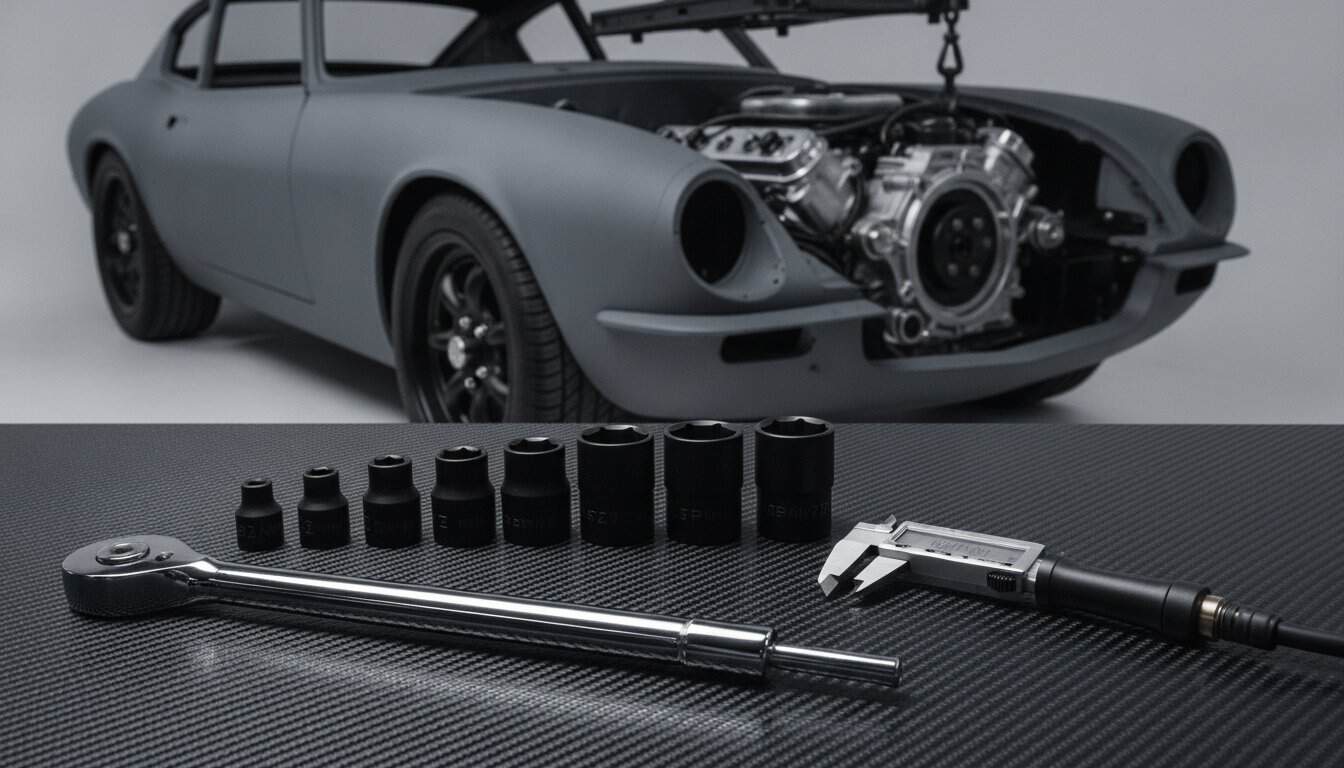
What if the most dangerous tool in your garage isn’t the one you’re using, but the one you’re missing? Building a restomod in 2026 requires more than just a set of inherited sockets; it demands a bridge between mid-century mechanical soul and modern engineering precision. You likely feel the weight of nostalgia for your project car, yet you’re haunted by the fear of a costly mistake during a complex engine swap or suspension upgrade. It is common to feel overwhelmed by the sheer volume of equipment available, especially when you are working with limited garage space and a strict budget.
I understand that tension because I’ve lived it. You want the reliability of a contemporary daily driver without losing the character of a vintage machine. This guide will empower you to master the hybrid toolkit required to blend vintage aesthetics with modern performance. We’ll identify the essential tools for classic car restoration that actually matter for a restomod build, distinguishing between basic upkeep and the precision instruments needed for high-stakes fabrication. You’ll gain a curated list of equipment, from MIG welders to HVLP spray guns, giving you the steady confidence to finally turn that dream project into a rolling reality.
Key Takeaways
- Prioritize your safety by establishing a secure workspace and investing in high-quality protective gear before turning a single bolt.
- Learn to select the essential tools for classic car restoration that protect vintage fasteners while providing the modern power needed for complex engine swaps.
- Master the specialized equipment required to integrate modern electronics and custom metalwork into your heritage chassis.
- Maintain project momentum by using professional organization and measurement techniques that ensure custom-engineered parts fit correctly the first time.
- Understand why expert guidance and strategic blueprints are more valuable for your budget than a garage full of expensive, specialized hardware.
Building Your Restomod Foundation: Safety Gear and Essential Workshop Equipment
Before you pick up a wrench, you must build a sanctuary for your vision. The automotive restoration process is a marathon, not a sprint; your workshop environment dictates your pace. Establishing a safe workspace ensures that your focus remains on the precision of the build rather than the risk of injury. These foundational pieces are the essential tools for classic car restoration that prevent a project from becoming a tragedy. You are not just preserving metal; you are protecting the person who will bring it back to life.
To better visualize the layout of a functional and safe workspace, watch this helpful video:
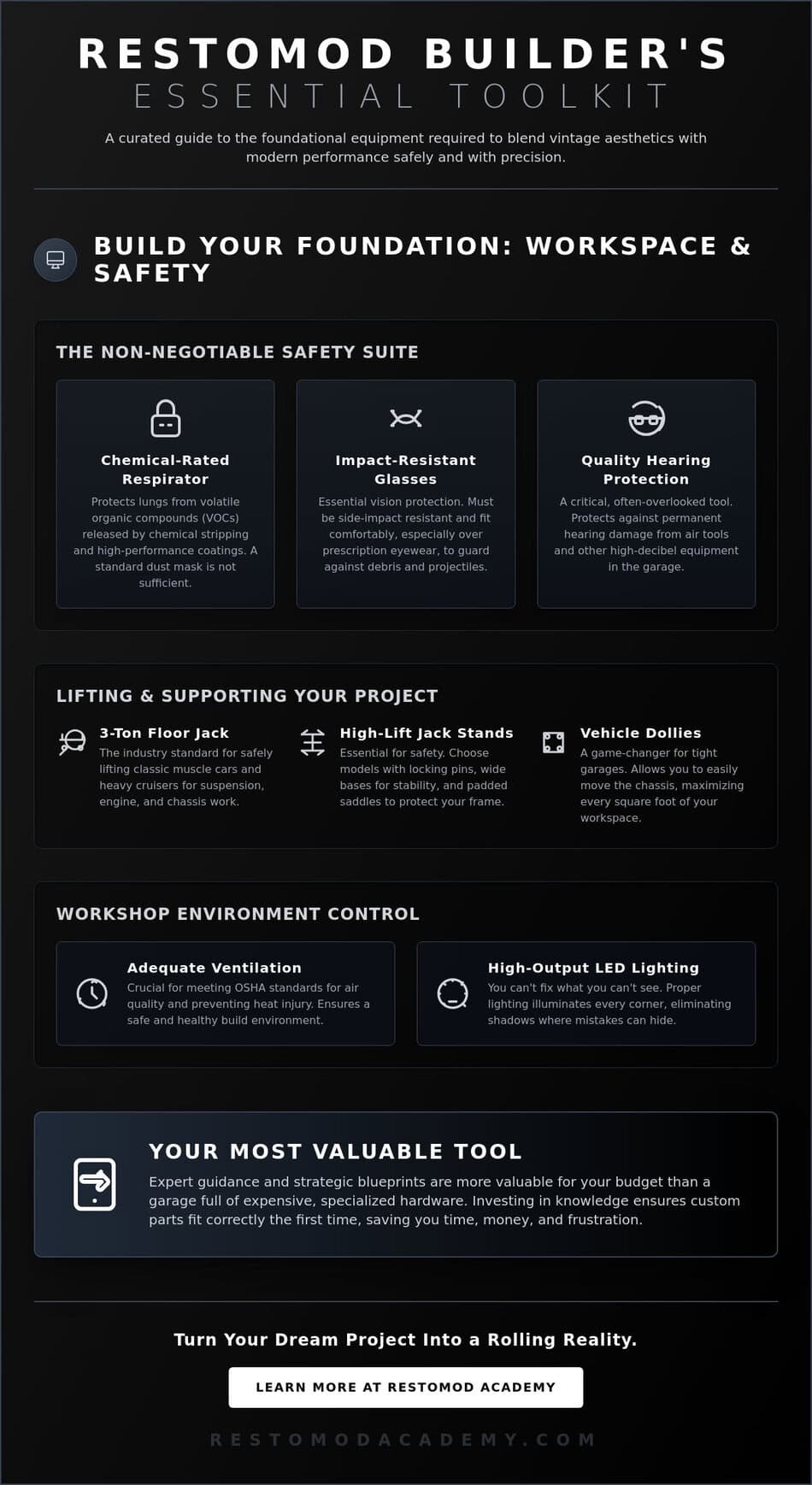
The Non-Negotiable Safety Suite
Your health is your most valuable asset in the garage. As we move through 2026, compliance with updated EPA standards like the 6H rule is more than a legal hurdle; it’s a guide for your personal safety. Modern restomods often involve chemical stripping and high-performance coatings that release volatile organic compounds. You need a respirator rated for these specific chemicals, as a standard dust mask won’t protect your lungs. Protect your vision with side-impact resistant glasses that fit comfortably over prescriptions. In a high-decibel environment filled with air tools, quality hearing protection is part of the essential tools for classic car restoration that many builders overlook. You can find more details on our recommended gear page to ensure you are fully protected.
Lifting and Supporting Your Project Safely
Accessibility is the key to precision. When you’re performing a suspension swap or an engine marriage, you need absolute trust in your lifting equipment. Compare floor jack capacities carefully. A 3-ton jack is the standard for most classic muscle or heavy cruisers. Don’t settle for budget jack stands. High-lift stands with locking pins offer a safety margin that saves lives. For those working in tight urban garages, vehicle dollies are a revelation. They allow you to slide a chassis into a corner, maximizing every square foot of your floor plan. This mobility is vital when you’re managing a complex project alongside daily life. Consider these features when selecting your supports:
- Ratchet-style locking mechanisms for quick adjustments.
- Wide tripod or four-point bases for stability on uneven concrete.
- Padded saddles to protect freshly painted frames.
Environmental control matters just as much as hardware. Ensure your shop has adequate ventilation to meet the updated 2026 OSHA standards for indoor air quality and heat injury prevention. Proper lighting is equally critical. You can’t fix what you can’t see, and shadows are where mistakes hide. Invest in high-output LED shop lights to illuminate every corner of the engine bay. These initial steps might feel slow, but they create the steady confidence required for the heavy mechanical work ahead.
The Mechanical Core: Precision Hand Tools and Power Equipment
Once your workspace is secure and you’ve donned your essential workshop safety gear, you face the mechanical heart of the machine. This stage is where many novice builders falter by using inferior tools that damage irreplaceable vintage hardware. Your goal is to dismantle decades of history without erasing it. High-quality hand tools are the true essential tools for classic car restoration because they offer the tactile feedback required to sense a bolt’s breaking point before it snaps. Listen to the resistance of the metal; it tells a story of where the car has been and how it wants to be rebuilt.
High-Quality Hand Tools for Vintage Hardware
Restomods are inherently hybrid creatures. You’ll often find yourself switching between SAE sockets for the original 1960s chassis and metric sets for a modern powertrain. Don’t cut corners with budget sets that round off corners. Invest in flank-drive wrenches that grip the flats of a fastener rather than the points. This design is critical for stubborn, rusted bolts that have survived fifty years of road grime. As you move toward the assembly phase, digital torque wrenches become vital. Modern aluminum blocks and performance heads require a level of precision that old beam-style wrenches simply cannot provide. If you’re just starting, understanding what is a restomod will help you anticipate this unique mix of hardware.
Power Tools That Save Hours of Labor
Speed matters, but only when it doesn’t compromise quality. Cordless impact wrenches have evolved significantly by 2026, offering massive torque without the clumsy tether of an air hose. They’re perfect for quick teardowns. However, traditional air-powered tools still hold their ground for consistent, high-intensity tasks like removing frozen leaf spring bolts. Beyond the drivetrain, the angle grinder serves as your primary weapon against oxidation. It’s the sculptor’s tool of the workshop, essential for metal preparation and cleaning up welds. When your project requires custom fabrication, a floor-mounted drill press ensures that every bracket and mount is perfectly square. These are the essential tools for classic car restoration that transform a pile of parts into a performance machine. For a complete list of the brands I trust in my own shop, check out our recommended gear for curated tool sets.
Building a car is as much about the process as the result. Taking the time to use the right tool for the specific task at hand prevents the frustration of broken parts and wasted weekends. If you want to move beyond the basics and start engineering your own performance upgrades, our Premium Project Blueprints provide the technical clarity needed to execute a professional-grade build right in your home garage.
Specialized Tools for Modern Performance and Restomodding
Transitioning from a standard rebuild to a high-performance restomod project shifts your focus from preservation to transformation. While your basic wrenches handle the disassembly, the integration of modern hardware requires a more surgical approach. You’re no longer just following a factory service manual; you’re engineering solutions that the original designers never imagined. This phase demands a specific tier of specialty restoration tools that bridge the gap between mid-century iron and 21st-century technology. These are the essential tools for classic car restoration that allow you to cut, join, and tune with professional-grade precision.
Metal Fabrication and Welding for Custom Fitment
Chassis stiffening and custom engine mounts are the hallmarks of a serious restomod. To execute these, you need a reliable welder. For most DIY builders, a MIG welder in the $600 to $1,500 range offers the best balance of ease and penetration for frame work. If you’re chasing the aesthetic perfection of exposed stainless steel plumbing, TIG welding provides the control you need, though it carries a steeper learning curve. Don’t overlook the utility of a plasma cutter. When you’re removing outdated suspension mounts to make room for a modern independent front suspension, a plasma cutter provides a clean, heat-controlled cut that an angle grinder simply cannot match. For the interior, metal shears and a bench-top brake allow you to craft custom floor pans or transmission tunnels to accommodate modern, larger gearboxes.
Electrical and Diagnostic Tools for Modern Engine Swaps
Modern performance relies on data as much as it does on fuel. Integrating a modern ECU into a classic harness is often the most intimidating part of a build. You must move past test lights and embrace the digital multimeter as your primary diagnostic partner. It’s the only way to accurately verify sensor voltages and circuit continuity without risking damage to sensitive electronics. If you are performing a LS engine swap or dropping in a Coyote crate motor, an OBD-II scanner is non-negotiable. It allows you to communicate with the engine’s brain, clearing codes and monitoring real-time data to ensure your modern powertrain is happy in its vintage home. These digital instruments are now essential tools for classic car restoration, ensuring your project starts the first time the key turns. For a deeper dive into the specific electronics required for these projects, our Premium Project Blueprints provide the wiring schematics and tool lists needed to conquer the electrical maze.
Managing the Chaos: Organization and Measurement Tools
A professional-grade restomod can easily consume 4,000 to 5,000 hours of labor. Over that span of time, even the most disciplined mind will lose track of where a specific shim belongs or which grade of bolt was intended for the rear suspension. The difference between a masterpiece and a stalled project often comes down to how you manage the chaos of thousands of individual components. Organization and measurement are the essential tools for classic car restoration that sustain your momentum when the initial excitement of the teardown fades. You must treat your garage like an engineering firm where every part has a digital and physical footprint.
Precision Measurement for Custom Engineering
When you transition from simple part replacement to custom engineering, your margin for error shrinks to thousandths of an inch. Digital calipers are mandatory for verifying the tolerances of custom suspension bushings or ensuring that a modern steering rack is perfectly centered. If you’re building a high-performance engine, a dial indicator is required to check crankshaft runout and ensure your build meets the precision standards of 2026 performance. Chassis alignment is another area where traditional methods fall short. Laser levels allow you to establish a perfectly square baseline for your frame, ensuring that your car tracks straight and handles predictably at high speeds. These instruments transform your work from guesswork into documented science.
Documentation and Parts Management Systems
Adopt a professional parts management system before the first fender comes off. Use a labeled bin system categorized by vehicle system, such as braking, cooling, or electrical. Photographic documentation is your most powerful ally; take ten photos for every one part you remove. Capture the routing of wiring looms, the orientation of brackets, and the specific sequence of fasteners. By the time you reach the reassembly phase months or years later, these images will be your primary guide. To keep your project on track, use digital templates to monitor your budget and timeline. This prevents the “scope creep” that often leads to unfinished builds and drained bank accounts.
Precision isn’t just about the hardware in your hand; it’s about the strategy behind your labor. If you want to ensure your custom-engineered parts fit correctly the first time, our The Ultimate Restomod Guide offers the technical frameworks you need to manage a complex build with the confidence of a seasoned pro. By integrating professional project planning with high-quality physical organization, you’ll avoid the trial-and-error trap that stops so many enthusiasts in their tracks. Start your journey with a clear roadmap and the right measurement gear to turn your vision into a high-performance reality.
Investing in Knowledge: Why Your Most Important Tool Isn’t in a Box
You’ve cleared the garage floor, secured your safety gear, and stocked your chests with precision instruments. Yet, even the most sophisticated hardware remains dormant without a mental framework to guide its application. In the world of custom building, your intellect and your access to proven information are the true essential tools for classic car restoration. A garage full of expensive equipment can actually become a burden if you lack a clear strategy, leading to a collection phase that never transitions into a creation phase. You must master the theory before you attempt the practice.
Beyond the Wrench: The Power of a Proven Roadmap
Structured guides do more than just list parts; they provide a sequence of operations that respects the delicate balance between vintage aesthetics and modern physics. When you utilize our Premium Project Blueprints, you aren’t just following instructions. You are adopting a professional workflow refined through years of trial and error. This roadmap prevents the heartbreak of wasted materials and the frustration of re-doing a task three times because the order of operations was flawed. Transitioning from a collector of tools to a master of the craft requires you to value the blueprint as much as the welder. It’s about knowing not just how to turn the bolt, but why that bolt belongs there in the first place.
Joining the Restomod Academy Community
Building a restomod is a solitary labor of love, but solving its most complex mechanical hurdles shouldn’t be. By joining our community, you gain access to more than just tutorials; you find a brotherhood of builders who have faced the same stubborn bolts and wiring nightmares you’re encountering now. Whether you need Restomod Consulting Services to troubleshoot a specific suspension geometry or you’re diving into the comprehensive curriculum of The Ultimate Restomod Guide, the goal remains project completion. Our resources focus on that elusive intersection of classic style and modern reliability, ensuring your machine is as dependable as it is beautiful. These educational frameworks are the essential tools for classic car restoration that ensure your project actually reaches the road.
Don’t let your project stall in the parts collection phase. Every hour spent studying a proven process saves ten hours of frustration in the shop. Take the final step in your toolkit preparation by securing the knowledge required to cross the finish line with confidence. Join Restomod Academy and access The Ultimate Restomod Guide today and transform your garage into a sanctuary of precision and progress. Your vision deserves a roadmap that matches your ambition.
Transform Your Vision Into a High-Performance Reality
You’ve explored the landscape of modern restomodding, from the foundational safety gear that preserves your health to the precision instruments that bridge decades of engineering. True mastery in the garage isn’t just about owning the right hardware; it’s about the disciplined application of that gear to achieve a flawless finish. By prioritizing organization and precise measurement, you ensure that every modern upgrade fits the vintage soul of your machine without compromise.
Selecting the essential tools for classic car restoration is a significant milestone, but your most powerful asset remains a proven strategy. Founded by enthusiast Brook Walsh, Restomod Academy provides the comprehensive project blueprints and mentor-led community focus you need to navigate every technical hurdle. Don’t let your project sit under a tarp for another season. Take command of your build by leveraging the expertise of those who have paved the way before you. The path from a bare frame to a roaring engine requires patience, but with the right guidance, it’s a journey you’ll navigate with confidence.
Start your build with The Ultimate Restomod Guide
The satisfaction of that first engine fire is within your reach. Trust your tools, follow your blueprint, and enjoy the slow, rewarding journey of bringing a legend back to life. Your workshop is ready, and the road is waiting.
Frequently Asked Questions
What are the most basic tools needed to start a restomod project?
Start with a comprehensive socket set in both SAE and metric, a heavy-duty floor jack, and professional-grade jack stands. These are the essential tools for classic car restoration that form your initial foundation for any teardown. You’ll also need a versatile set of screwdrivers, pliers, and a dead-blow hammer to handle the removal of stubborn interior trim and exterior brightwork without causing damage to the vintage materials.
Is it better to buy a complete tool set or individual tools as needed?
Invest in a high-quality base set of hand tools and then acquire specialized equipment individually as your project reaches specific milestones. Buying a massive master set often leaves you with filler tools you’ll never use. By purchasing individual high-torque or precision instruments as needed, you can afford professional-grade quality for the tasks that truly matter, such as engine assembly or custom suspension tuning.
What specialized tools are required for an LS engine swap?
You must have an engine hoist, a digital multimeter, and an OBD-II scanner to successfully marry a modern powertrain to a classic chassis. Integrating electronic fuel injection and modern engine management requires you to verify sensor voltages and circuit continuity with absolute precision. You will also need a high-pressure fuel gauge to ensure your new delivery system meets the requirements of a modern fuel rail.
Can I use standard car restoration tools for a restomod build?
You can use traditional tools for the bodywork and disassembly, but you must supplement them with modern diagnostic and fabrication gear. While a standard restoration focuses on original specifications, a restomod requires digital torque wrenches and multi-process welders to safely integrate high-performance components. The hybrid nature of these projects demands a more versatile toolkit that bridges the gap between old-school mechanicals and modern electronics.
How much should I budget for tools when starting my first restomod?
Budget between $2,000 and $5,000 for your initial tool investment to ensure you have reliable, safe equipment. This range covers a professional-grade MIG welder, a high-capacity floor jack, and a complete set of precision hand tools. While it’s tempting to cut costs, investing in quality gear from the start prevents the expensive frustration of broken fasteners and tool failures that can stall a build for weeks.
What safety tools are often overlooked by beginner builders?
Beginners frequently overlook the necessity of a high-quality respirator and a dedicated shop fire extinguisher. Modern chemical strippers and high-performance coatings release harmful vapors that a standard dust mask cannot filter. Always keep a Class B fire extinguisher within arm’s reach, especially when you’re working on fuel systems or performing any grinding and welding. Your long-term health and shop safety are as important as the car itself.
Do I need a welder for a restomod project?
A welder is a mandatory addition to your shop if your build involves chassis stiffening, custom engine mounts, or significant rust repair. Owning a MIG welder gives you the freedom to perform iterative fabrication and immediate repairs without the delay of outsourcing. It is one of the most empowering essential tools for classic car restoration, allowing you to transform a factory frame into a high-performance foundation.
How do I organize tools and parts for a project that takes years?
Implement a system of clear, labeled bins categorized by vehicle system and document the teardown with hundreds of photos. Group fasteners with their respective brackets in sealed bags and use a digital log to track your progress and inventory. This methodical approach ensures that even if your project spans several years, you’ll have the technical clarity needed to begin the reassembly phase with total confidence.
What if the most dangerous tool in your garage isn’t the one you’re using, but the one you’re missing? Building a restomod in 2026 requires more than just a set of inherited sockets; it demands a bridge between mid-century mechanical soul and modern engineering precision. You likely feel the weight of nostalgia for your project car, yet you’re haunted by the fear of a costly mistake during a complex engine swap or suspension upgrade. It is common to feel overwhelmed by the sheer volume of equipment available, especially when you are working with limited garage space and a strict budget.
I understand that tension because I’ve lived it. You want the reliability of a contemporary daily driver without losing the character of a vintage machine. This guide will empower you to master the hybrid toolkit required to blend vintage aesthetics with modern performance. We’ll identify the essential tools for classic car restoration that actually matter for a restomod build, distinguishing between basic upkeep and the precision instruments needed for high-stakes fabrication. You’ll gain a curated list of equipment, from MIG welders to HVLP spray guns, giving you the steady confidence to finally turn that dream project into a rolling reality.
Key Takeaways
- Prioritize your safety by establishing a secure workspace and investing in high-quality protective gear before turning a single bolt.
- Learn to select the essential tools for classic car restoration that protect vintage fasteners while providing the modern power needed for complex engine swaps.
- Master the specialized equipment required to integrate modern electronics and custom metalwork into your heritage chassis.
- Maintain project momentum by using professional organization and measurement techniques that ensure custom-engineered parts fit correctly the first time.
- Understand why expert guidance and strategic blueprints are more valuable for your budget than a garage full of expensive, specialized hardware.
Building Your Restomod Foundation: Safety Gear and Essential Workshop Equipment
Before you pick up a wrench, you must build a sanctuary for your vision. The automotive restoration process is a marathon, not a sprint; your workshop environment dictates your pace. Establishing a safe workspace ensures that your focus remains on the precision of the build rather than the risk of injury. These foundational pieces are the essential tools for classic car restoration that prevent a project from becoming a tragedy. You are not just preserving metal; you are protecting the person who will bring it back to life.
To better visualize the layout of a functional and safe workspace, watch this helpful video:
The Non-Negotiable Safety Suite
Your health is your most valuable asset in the garage. As we move through 2026, compliance with updated EPA standards like the 6H rule is more than a legal hurdle; it’s a guide for your personal safety. Modern restomods often involve chemical stripping and high-performance coatings that release volatile organic compounds. You need a respirator rated for these specific chemicals, as a standard dust mask won’t protect your lungs. Protect your vision with side-impact resistant glasses that fit comfortably over prescriptions. In a high-decibel environment filled with air tools, quality hearing protection is part of the essential tools for classic car restoration that many builders overlook. You can find more details on our recommended gear page to ensure you are fully protected.
Lifting and Supporting Your Project Safely
Accessibility is the key to precision. When you’re performing a suspension swap or an engine marriage, you need absolute trust in your lifting equipment. Compare floor jack capacities carefully. A 3-ton jack is the standard for most classic muscle or heavy cruisers. Don’t settle for budget jack stands. High-lift stands with locking pins offer a safety margin that saves lives. For those working in tight urban garages, vehicle dollies are a revelation. They allow you to slide a chassis into a corner, maximizing every square foot of your floor plan. This mobility is vital when you’re managing a complex project alongside daily life. Consider these features when selecting your supports:
- Ratchet-style locking mechanisms for quick adjustments.
- Wide tripod or four-point bases for stability on uneven concrete.
- Padded saddles to protect freshly painted frames.
Environmental control matters just as much as hardware. Ensure your shop has adequate ventilation to meet the updated 2026 OSHA standards for indoor air quality and heat injury prevention. Proper lighting is equally critical. You can’t fix what you can’t see, and shadows are where mistakes hide. Invest in high-output LED shop lights to illuminate every corner of the engine bay. These initial steps might feel slow, but they create the steady confidence required for the heavy mechanical work ahead.
The Mechanical Core: Precision Hand Tools and Power Equipment
Once your workspace is secure and you’ve donned your essential workshop safety gear, you face the mechanical heart of the machine. This stage is where many novice builders falter by using inferior tools that damage irreplaceable vintage hardware. Your goal is to dismantle decades of history without erasing it. High-quality hand tools are the true essential tools for classic car restoration because they offer the tactile feedback required to sense a bolt’s breaking point before it snaps. Listen to the resistance of the metal; it tells a story of where the car has been and how it wants to be rebuilt.
High-Quality Hand Tools for Vintage Hardware
Restomods are inherently hybrid creatures. You’ll often find yourself switching between SAE sockets for the original 1960s chassis and metric sets for a modern powertrain. Don’t cut corners with budget sets that round off corners. Invest in flank-drive wrenches that grip the flats of a fastener rather than the points. This design is critical for stubborn, rusted bolts that have survived fifty years of road grime. As you move toward the assembly phase, digital torque wrenches become vital. Modern aluminum blocks and performance heads require a level of precision that old beam-style wrenches simply cannot provide. If you’re just starting, understanding what is a restomod will help you anticipate this unique mix of hardware.
Power Tools That Save Hours of Labor
Speed matters, but only when it doesn’t compromise quality. Cordless impact wrenches have evolved significantly by 2026, offering massive torque without the clumsy tether of an air hose. They’re perfect for quick teardowns. However, traditional air-powered tools still hold their ground for consistent, high-intensity tasks like removing frozen leaf spring bolts. Beyond the drivetrain, the angle grinder serves as your primary weapon against oxidation. It’s the sculptor’s tool of the workshop, essential for metal preparation and cleaning up welds. When your project requires custom fabrication, a floor-mounted drill press ensures that every bracket and mount is perfectly square. These are the essential tools for classic car restoration that transform a pile of parts into a performance machine. For a complete list of the brands I trust in my own shop, check out our recommended gear for curated tool sets.
Building a car is as much about the process as the result. Taking the time to use the right tool for the specific task at hand prevents the frustration of broken parts and wasted weekends. If you want to move beyond the basics and start engineering your own performance upgrades, our Premium Project Blueprints provide the technical clarity needed to execute a professional-grade build right in your home garage.
Specialized Tools for Modern Performance and Restomodding
Transitioning from a standard rebuild to a high-performance restomod project shifts your focus from preservation to transformation. While your basic wrenches handle the disassembly, the integration of modern hardware requires a more surgical approach. You’re no longer just following a factory service manual; you’re engineering solutions that the original designers never imagined. This phase demands a specific tier of specialty restoration tools that bridge the gap between mid-century iron and 21st-century technology. These are the essential tools for classic car restoration that allow you to cut, join, and tune with professional-grade precision.
Metal Fabrication and Welding for Custom Fitment
Chassis stiffening and custom engine mounts are the hallmarks of a serious restomod. To execute these, you need a reliable welder. For most DIY builders, a MIG welder in the $600 to $1,500 range offers the best balance of ease and penetration for frame work. If you’re chasing the aesthetic perfection of exposed stainless steel plumbing, TIG welding provides the control you need, though it carries a steeper learning curve. Don’t overlook the utility of a plasma cutter. When you’re removing outdated suspension mounts to make room for a modern independent front suspension, a plasma cutter provides a clean, heat-controlled cut that an angle grinder simply cannot match. For the interior, metal shears and a bench-top brake allow you to craft custom floor pans or transmission tunnels to accommodate modern, larger gearboxes.
Electrical and Diagnostic Tools for Modern Engine Swaps
Modern performance relies on data as much as it does on fuel. Integrating a modern ECU into a classic harness is often the most intimidating part of a build. You must move past test lights and embrace the digital multimeter as your primary diagnostic partner. It’s the only way to accurately verify sensor voltages and circuit continuity without risking damage to sensitive electronics. If you are performing a LS engine swap or dropping in a Coyote crate motor, an OBD-II scanner is non-negotiable. It allows you to communicate with the engine’s brain, clearing codes and monitoring real-time data to ensure your modern powertrain is happy in its vintage home. These digital instruments are now essential tools for classic car restoration, ensuring your project starts the first time the key turns. For a deeper dive into the specific electronics required for these projects, our Premium Project Blueprints provide the wiring schematics and tool lists needed to conquer the electrical maze.
Managing the Chaos: Organization and Measurement Tools
A professional-grade restomod can easily consume 4,000 to 5,000 hours of labor. Over that span of time, even the most disciplined mind will lose track of where a specific shim belongs or which grade of bolt was intended for the rear suspension. The difference between a masterpiece and a stalled project often comes down to how you manage the chaos of thousands of individual components. Organization and measurement are the essential tools for classic car restoration that sustain your momentum when the initial excitement of the teardown fades. You must treat your garage like an engineering firm where every part has a digital and physical footprint.
Precision Measurement for Custom Engineering
When you transition from simple part replacement to custom engineering, your margin for error shrinks to thousandths of an inch. Digital calipers are mandatory for verifying the tolerances of custom suspension bushings or ensuring that a modern steering rack is perfectly centered. If you’re building a high-performance engine, a dial indicator is required to check crankshaft runout and ensure your build meets the precision standards of 2026 performance. Chassis alignment is another area where traditional methods fall short. Laser levels allow you to establish a perfectly square baseline for your frame, ensuring that your car tracks straight and handles predictably at high speeds. These instruments transform your work from guesswork into documented science.
Documentation and Parts Management Systems
Adopt a professional parts management system before the first fender comes off. Use a labeled bin system categorized by vehicle system, such as braking, cooling, or electrical. Photographic documentation is your most powerful ally; take ten photos for every one part you remove. Capture the routing of wiring looms, the orientation of brackets, and the specific sequence of fasteners. By the time you reach the reassembly phase months or years later, these images will be your primary guide. To keep your project on track, use digital templates to monitor your budget and timeline. This prevents the “scope creep” that often leads to unfinished builds and drained bank accounts.
Precision isn’t just about the hardware in your hand; it’s about the strategy behind your labor. If you want to ensure your custom-engineered parts fit correctly the first time, our The Ultimate Restomod Guide offers the technical frameworks you need to manage a complex build with the confidence of a seasoned pro. By integrating professional project planning with high-quality physical organization, you’ll avoid the trial-and-error trap that stops so many enthusiasts in their tracks. Start your journey with a clear roadmap and the right measurement gear to turn your vision into a high-performance reality.
Investing in Knowledge: Why Your Most Important Tool Isn’t in a Box
You’ve cleared the garage floor, secured your safety gear, and stocked your chests with precision instruments. Yet, even the most sophisticated hardware remains dormant without a mental framework to guide its application. In the world of custom building, your intellect and your access to proven information are the true essential tools for classic car restoration. A garage full of expensive equipment can actually become a burden if you lack a clear strategy, leading to a collection phase that never transitions into a creation phase. You must master the theory before you attempt the practice.
Beyond the Wrench: The Power of a Proven Roadmap
Structured guides do more than just list parts; they provide a sequence of operations that respects the delicate balance between vintage aesthetics and modern physics. When you utilize our Premium Project Blueprints, you aren’t just following instructions. You are adopting a professional workflow refined through years of trial and error. This roadmap prevents the heartbreak of wasted materials and the frustration of re-doing a task three times because the order of operations was flawed. Transitioning from a collector of tools to a master of the craft requires you to value the blueprint as much as the welder. It’s about knowing not just how to turn the bolt, but why that bolt belongs there in the first place.
Joining the Restomod Academy Community
Building a restomod is a solitary labor of love, but solving its most complex mechanical hurdles shouldn’t be. By joining our community, you gain access to more than just tutorials; you find a brotherhood of builders who have faced the same stubborn bolts and wiring nightmares you’re encountering now. Whether you need Restomod Consulting Services to troubleshoot a specific suspension geometry or you’re diving into the comprehensive curriculum of The Ultimate Restomod Guide, the goal remains project completion. Our resources focus on that elusive intersection of classic style and modern reliability, ensuring your machine is as dependable as it is beautiful. These educational frameworks are the essential tools for classic car restoration that ensure your project actually reaches the road.
Don’t let your project stall in the parts collection phase. Every hour spent studying a proven process saves ten hours of frustration in the shop. Take the final step in your toolkit preparation by securing the knowledge required to cross the finish line with confidence. Join Restomod Academy and access The Ultimate Restomod Guide today and transform your garage into a sanctuary of precision and progress. Your vision deserves a roadmap that matches your ambition.
Transform Your Vision Into a High-Performance Reality
You’ve explored the landscape of modern restomodding, from the foundational safety gear that preserves your health to the precision instruments that bridge decades of engineering. True mastery in the garage isn’t just about owning the right hardware; it’s about the disciplined application of that gear to achieve a flawless finish. By prioritizing organization and precise measurement, you ensure that every modern upgrade fits the vintage soul of your machine without compromise.
Selecting the essential tools for classic car restoration is a significant milestone, but your most powerful asset remains a proven strategy. Founded by enthusiast Brook Walsh, Restomod Academy provides the comprehensive project blueprints and mentor-led community focus you need to navigate every technical hurdle. Don’t let your project sit under a tarp for another season. Take command of your build by leveraging the expertise of those who have paved the way before you. The path from a bare frame to a roaring engine requires patience, but with the right guidance, it’s a journey you’ll navigate with confidence.
Start your build with The Ultimate Restomod Guide
The satisfaction of that first engine fire is within your reach. Trust your tools, follow your blueprint, and enjoy the slow, rewarding journey of bringing a legend back to life. Your workshop is ready, and the road is waiting.
Frequently Asked Questions
What are the most basic tools needed to start a restomod project?
Start with a comprehensive socket set in both SAE and metric, a heavy-duty floor jack, and professional-grade jack stands. These are the essential tools for classic car restoration that form your initial foundation for any teardown. You’ll also need a versatile set of screwdrivers, pliers, and a dead-blow hammer to handle the removal of stubborn interior trim and exterior brightwork without causing damage to the vintage materials.
Is it better to buy a complete tool set or individual tools as needed?
Invest in a high-quality base set of hand tools and then acquire specialized equipment individually as your project reaches specific milestones. Buying a massive master set often leaves you with filler tools you’ll never use. By purchasing individual high-torque or precision instruments as needed, you can afford professional-grade quality for the tasks that truly matter, such as engine assembly or custom suspension tuning.
What specialized tools are required for an LS engine swap?
You must have an engine hoist, a digital multimeter, and an OBD-II scanner to successfully marry a modern powertrain to a classic chassis. Integrating electronic fuel injection and modern engine management requires you to verify sensor voltages and circuit continuity with absolute precision. You will also need a high-pressure fuel gauge to ensure your new delivery system meets the requirements of a modern fuel rail.
Can I use standard car restoration tools for a restomod build?
You can use traditional tools for the bodywork and disassembly, but you must supplement them with modern diagnostic and fabrication gear. While a standard restoration focuses on original specifications, a restomod requires digital torque wrenches and multi-process welders to safely integrate high-performance components. The hybrid nature of these projects demands a more versatile toolkit that bridges the gap between old-school mechanicals and modern electronics.
How much should I budget for tools when starting my first restomod?
Budget between $2,000 and $5,000 for your initial tool investment to ensure you have reliable, safe equipment. This range covers a professional-grade MIG welder, a high-capacity floor jack, and a complete set of precision hand tools. While it’s tempting to cut costs, investing in quality gear from the start prevents the expensive frustration of broken fasteners and tool failures that can stall a build for weeks.
What safety tools are often overlooked by beginner builders?
Beginners frequently overlook the necessity of a high-quality respirator and a dedicated shop fire extinguisher. Modern chemical strippers and high-performance coatings release harmful vapors that a standard dust mask cannot filter. Always keep a Class B fire extinguisher within arm’s reach, especially when you’re working on fuel systems or performing any grinding and welding. Your long-term health and shop safety are as important as the car itself.
Do I need a welder for a restomod project?
A welder is a mandatory addition to your shop if your build involves chassis stiffening, custom engine mounts, or significant rust repair. Owning a MIG welder gives you the freedom to perform iterative fabrication and immediate repairs without the delay of outsourcing. It is one of the most empowering essential tools for classic car restoration, allowing you to transform a factory frame into a high-performance foundation.
How do I organize tools and parts for a project that takes years?
Implement a system of clear, labeled bins categorized by vehicle system and document the teardown with hundreds of photos. Group fasteners with their respective brackets in sealed bags and use a digital log to track your progress and inventory. This methodical approach ensures that even if your project spans several years, you’ll have the technical clarity needed to begin the reassembly phase with total confidence.