
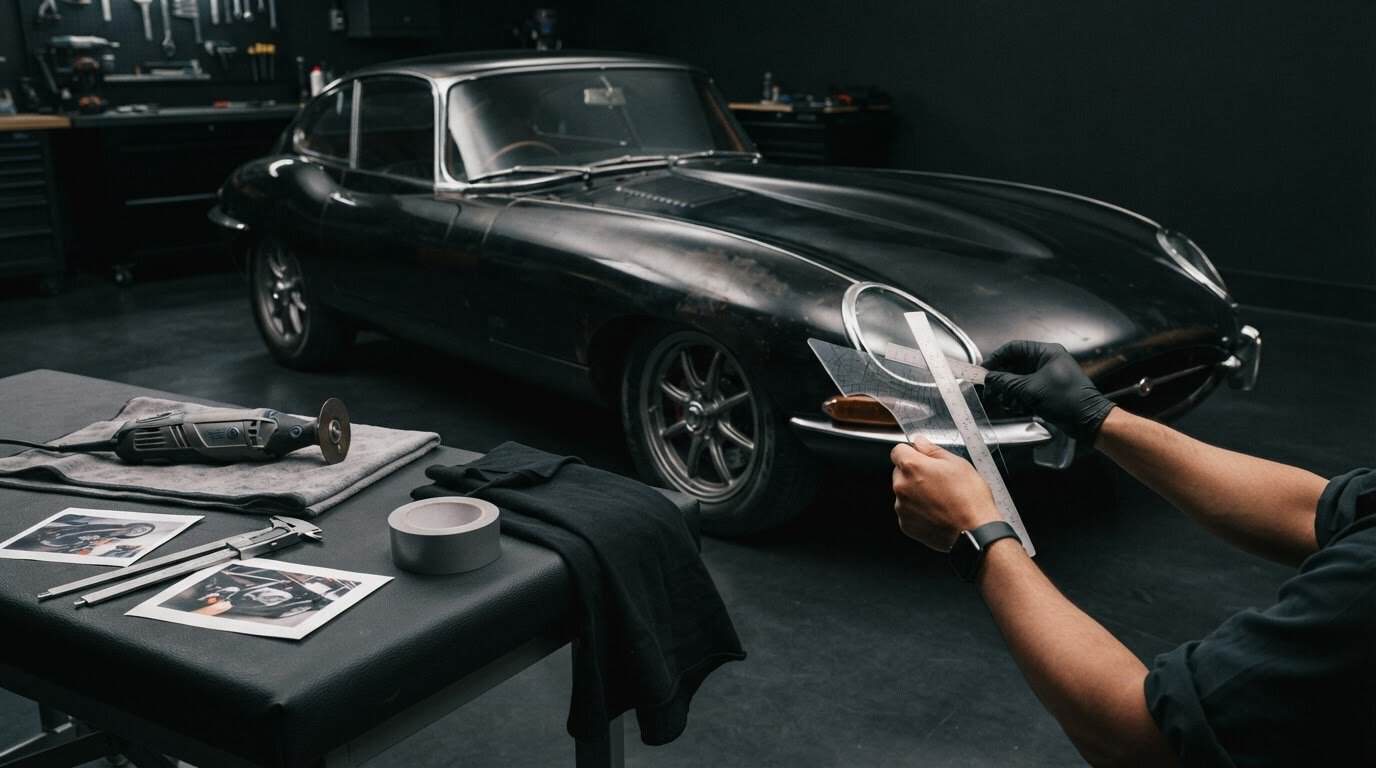
What if the first cut isn’t the real decision? The real decision is whether the change serves a clear purpose. The fear of the first cut on an original classic car is understandable: one rushed move can alter the character you’ve worked hard to preserve. If you’re unsure whether a modification is necessary, pause before reaching for the tools. That hesitation can help you protect the car’s history and make a more deliberate choice.
This guide will help you weigh the purpose of a change against originality, compare less permanent alternatives, and document your decision before work begins. Start by separating a genuine need from pressure to keep the project moving. Then turn your choice into a manageable plan: define the goal, identify what on the car is stopping you, and record the alternatives and trade-offs. A considered first cut doesn’t have to mean abandoning the car’s heritage. It can be a purposeful step toward the classic you want to drive.
Key Takeaways
- Treat the first cut as a decision point, not an automatic commitment to a full restomod.
- State what the modification needs to achieve, identify the obstacle on your car, and compare alternatives.
- Weigh preservation, modification, and replacement against your priorities and the change’s potential reversibility.
- Ease the fear of the first cut on an original classic car by documenting the area, scope, alternatives, and stopping point before work begins.
- Choose a deliberate next step, even if that means preserving the car as it is for now.
Why the First Cut on an Original Classic Car Feels So Final
An original classic carries more than sheet metal, paint, and mechanical parts. It reflects the choices of the people who designed, built, and cared for it, as well as the memories you’ve attached to it. That can create a real tension: you may want to shape the car for your own use, yet worry that changing one part will erase something you value. The fear of the first cut on an original classic car often comes from treating the moment as a point of no return.
Reframe it as a decision point. One modification doesn’t automatically commit you to a complete restomod, and pausing doesn’t mean you lack conviction. It gives you room to separate what the car means to you from the practical purpose a proposed change needs to serve. A cut should follow a clear reason, not become the reason you keep modifying.
For another perspective on restoration and restomods, watch this video:
What does “original” mean for your project?
Define what you want to preserve before deciding what can change. Is it the car’s visible character, such as its exterior lines or cabin layout? Is it the structure, or the feel of its original mechanical systems? Write down the qualities that matter most to you. “Keep it original” can mean different things to different owners, so make the phrase specific enough to guide a real decision.
Preserving a car’s character doesn’t necessarily mean leaving every component untouched. You might value its recognizable appearance while considering a change to address a practical need. The distinction between restoration and restomod can help frame that choice. Understanding what a restomod is gives you useful context for defining your direction. For a broader overview, Automotive restoration discusses restoration approaches and the importance of originality.
Why hesitation can be useful
Hesitation is information, not a reason for shame. It may signal that the modification’s purpose isn’t clear yet, or that you haven’t considered what you’d give up by making it. Notice what’s driving the urgency: momentum from work already underway, comparison with another builder’s finished car, or worry that stopping will undo your progress. None of those pressures, on its own, proves that a cut is right for your build.
Before making a physical change, record the concern in plain language. For example: “I’m unsure whether this alteration solves a real problem, or whether I’m following the direction of another build.” Then note what information or decision would help resolve that doubt. A written concern is easier to revisit calmly than a vague feeling in the workshop.
Pausing before irreversible work gives your intention time to catch up with your tools. Once you can explain what matters about the car and why a change may serve it, the next decision becomes clearer: define exactly what the cut must achieve.
Decide What the Cut Must Achieve Before You Touch the Car
Before choosing a tool or marking a panel, name the outcome you want. “I want the car to feel more usable” is a starting point, not yet a reason to cut. Make the goal testable by identifying what should change and what part of the current setup prevents it. This keeps the decision tied to the car in front of you, rather than an idea borrowed from someone else’s build.
Use this sequence to test the decision:
- State the goal. Describe the result in plain language, such as achieving a particular fit or design direction.
- Identify the obstacle. Record what you can observe on your actual vehicle that stands between it and the goal.
- Compare alternatives. Consider whether another approach could meet the same requirement while changing less original material.
- Decide deliberately. Proceed only when the proposed cut has a defined purpose and you understand the trade-offs you’re accepting.
Ask whether the change solves a real packaging, fitment, or design problem. If the answer is unclear, keep investigating. A modification may be needed to meet a specific project requirement, or it may be an optional aesthetic choice inspired by another car. Either can be valid, but each deserves careful thought. Be honest about which one you’re considering.
Turn a vague idea into a clear build requirement
Write down the desired outcome before naming a modification. Then describe the obstacle using observations from the vehicle, not assumptions about what “usually” needs to be done. Note what doesn’t fit, what conflicts with the intended design, or what remains unresolved. A project roadmap can help organize scope and sequence. The difference between a restoration and a restomod can also help clarify the direction you’re building toward.
Keep the requirement specific enough to evaluate. “Make it better” can’t tell you whether a cut is justified. “Create clearance for the planned fitment” gives you a question to investigate against the actual car. If the concern is still based on guesswork, record it as an open question rather than treating it as a confirmed obstacle.
Check for less-invasive alternatives
Before committing, compare options that may preserve more of the original material. Depending on the vehicle and goal, you might adjust the design, change the planned component or its position, or postpone the modification until you have better information. None is automatically suitable. Assess each against the same fitment needs, intended result, and preservation priorities.
- Does this option meet the stated goal?
- Does it resolve the observed obstacle on this car?
- How much original material or character would it affect?
- What technical questions still need answers?
Mark unanswered questions clearly. Don’t let an assumption become the justification for permanent work.
Decision rule: every planned cut must serve a specific, stated project goal. If you can’t explain that connection in one plain sentence, refine the plan before moving forward.
Originality, Reversibility, and the Real Trade-Off of Cutting
Once you’ve defined what a modification should achieve, weigh that goal against what you want to retain. There’s no single rule that says every original component must stay, or that modernization should take priority. The right choice depends on your project. Preserving a feature may matter more than a particular upgrade, while a modern outcome may be central to how you want to use the car.
Think of preserving, modifying, and replacing as decision approaches, not prescriptions. Preserving keeps the existing material in place. Modifying changes it to meet a goal. Replacing exchanges a component or material for another approach. Each can have different consequences for the car’s character and the rest of the build. The fear of the first cut on an original classic car can become easier to assess when you compare those consequences instead of treating “original” and “modified” as all-or-nothing choices.
Which parts of the car do you most want to preserve?
List the features that matter to you before the project scope expands. You might care most about visible body lines, a particular cabin detail, or the feel of a mechanical system. Those priorities are personal. Don’t assume every classic-car owner should preserve the same components, and don’t mistake another builder’s priorities for your own.
Bodywork deserves careful thought because metal fabrication can affect more than appearance. Consider how a proposed change relates to the surrounding material and the character you want to retain. Your priorities can help you assess the trade-offs involved in choosing a restomod approach, but the decision should remain specific to your car and goals.
How to think about reversible and permanent choices
Before work begins, ask what the decision changes: original material, mounting points, or nearby components? Consider whether the planned design could be revised later and what that might involve. Reversibility depends on the specific design and execution, so don’t treat it as a promise that the car can be returned to its previous condition.
Use this comparison to organize the trade-off. The questions in the final column are prompts to resolve before settling on an approach.
| Approach | Goal | Impact on original material | Questions still to resolve |
|---|---|---|---|
| Preserve | Keep a valued feature as it is | Leaves it unchanged | Can the build goal be met without altering it? |
| Modify | Adapt an existing feature | Changes original material or its configuration | What changes, and how does that affect surrounding parts? |
| Replace | Use a different component or design | Removes or displaces what was there | What happens to the removed material, and what does the new design require? |
Record the approach you choose and the reason behind it. Note which priorities guided the decision, what you expect the change to accomplish, and what remains uncertain. That record gives you a steady reference if the scope shifts later. It also makes the choice a considered part of the build, rather than a decision made on impulse.

Prepare the Car, the Plan, and Yourself Before Making a Cut
A clear decision on paper is easier to carry into the workshop than a half-formed idea. Separate planning from hands-on work: first confirm what you intend to change and why, then check that the car in front of you matches the assumptions behind the plan. If it doesn’t, pause and reassess. The fear of the first cut on an original classic car can grow when the work feels like one dramatic leap. Break it into smaller decisions instead.
A defined scope and a clear record turn a difficult cut into a more deliberate project decision. Keep a simple pre-cut record with the goal, intended change, alternatives considered, and reason your chosen approach fits your priorities. Add a photograph or notes that identify the relevant area before work begins. This record isn’t a substitute for sound technical judgment. It helps you remember what you decided and what still needs attention.
Make a simple pre-cut decision record
Keep the record short enough to use. State the outcome you want, describe the planned change in plain language, and note the specific reason it’s needed. Include the alternatives you considered and why they didn’t fit as well. If a question about the car or the plan remains unanswered, write it down rather than filling the gap with an assumption.
Set a stopping point before starting. For example, decide to stop and reassess if the area differs from your notes, the intended scope begins to expand, or new information changes the original reason for the work. A stopping point gives you permission to pause without treating that pause as failure. It also separates the agreed plan from a new decision that deserves its own review.
Reduce the pressure to rush
Ask one question at a time: What outcome am I aiming for? What have I observed on this car? What remains uncertain? Does the planned work stay within the scope I recorded? Answering these separately makes the decision easier to manage and shows where confidence ends and further investigation needs to begin.
Stress, fatigue, and frustration can make immediate action feel like progress. But a cut made to escape the discomfort of a stalled project may create a different problem to solve. Step away when you’re tired or pushing forward mainly because you’ve already invested time. Return to the record with fresh attention, or talk the decision through with fellow builders who understand the patience a classic-car project demands.
Before proceeding, use this quick check:
- The goal and reason for the change are written down.
- The planned scope is clear, and alternatives have been considered.
- The relevant area and current condition are documented.
- Unresolved questions are visible, not disguised as facts.
- A clear stopping point is set for reassessment.
Use Restomod Academy’s practical project guidance to keep planning manageable as your build moves forward. A measured pace is still progress.
Make the First Cut a Deliberate Step in Your Classic-Car Build
A confident project decision doesn’t require certainty about every part of the build. It requires a clear reason for the change, an honest view of what it may affect, and a plan that reflects your priorities. Define the goal, assess the trade-off, document the approach, then decide whether to proceed. That sequence turns the fear of the first cut on an original classic car into a practical question you can answer one step at a time.
Choosing to preserve the car is a valid outcome. A project isn’t a failure because you decide a proposed modification doesn’t serve it. The point is to build with intention, whether that means keeping a feature as it is, revising the plan, or moving forward with a change you’ve considered carefully.
Know when you are ready to proceed
Before committing, check that you can explain both the intended result and why the change is needed. Make sure you’ve considered alternatives and thought through the effect on the original features you value. Then ask whether the plan still fits the way you want to use and experience the car.
If your answers are clear, and the choice matches your priorities and understanding, you have a sound basis for the next step. If an important question remains open, make resolving it the next project task. You don’t need to force a decision just to keep the build moving.
Keep the build moving without losing its purpose
Give the decision a defined place in your project plan. Instead of letting it remain a recurring worry, write down the next action: review the scope, resolve an open question, discuss the trade-off, or proceed as planned. A small, specific task makes progress visible without letting momentum dictate the outcome.
Discussing the plan with fellow builders can also reveal assumptions you hadn’t noticed. Use those conversations to test your reasoning, not to copy someone else’s choices. If you’re weighing how a modification fits a broader build direction, understanding what a restomod is can help put the options in context. The car and your priorities still make the final call.
Build steadily. Keep a record of what you decide and why, and revisit it if the project or your goals change. Each decision is a chance to learn more about the car and become a more thoughtful builder. Whether you preserve the original character or shape it through considered updates, the result should feel like your choice.
Explore practical restomod guides for step-by-step ideas to support your build.
Let Your Build Earn Its Next Step
A classic-car project is a relationship with a machine that has its own history, alongside the one you’re creating. Give that relationship room to develop. You don’t have to settle every future modification today, and one decision doesn’t have to define the entire build. Let each step reflect how you want to experience the car, not just how it looks on a screen or in someone else’s garage.
If the fear of the first cut on an original classic car is still there, treat it as a signal to stay thoughtful, not a command to stop forever. You can return to a decision as your knowledge of the car and your vision for it grow. That’s part of becoming a builder: learning to make choices with care, then taking ownership of the direction you choose.
Keep exploring, keep learning, and let your next move be one you can stand behind. Explore practical guides for your restomod build and choose your next step with confidence.
Frequently Asked Questions
Is the first cut on an original classic car always irreversible?
No, but don’t assume a cut can be reversed simply because a later repair is possible. Repairing altered material may not restore its original condition, and the result depends on the location, design, and work involved. Before proceeding, consider what “reversible” means for your specific project: returning to the same appearance, restoring the original configuration, or simply making another change possible. Those aren’t always the same outcome.
Can I restomod a classic car without cutting its original body?
Yes, a restomod doesn’t automatically require cutting the body. You can define a build around the updates and changes that suit your goals while retaining the existing bodywork. The trade-off is that some desired outcomes may depend on a specific fit or design that the untouched body can’t accommodate. Decide which results matter most, then shape the project scope around those priorities instead of assuming body cuts are a standard part of restomodding.
What should I document before modifying an original classic car?
Record the car’s condition around the area you’re considering changing, along with the intended result and reason for the work. Take clear photographs from more than one angle, and note visible details that could be obscured or affected. Keep a record of the chosen approach, alternatives you considered, and questions that remain unresolved. If you revisit the project later, these notes can help distinguish what you observed from what you assumed.
How do I know whether a cut is necessary for my build?
A cut is worth considering when it addresses a specific obstacle to a clearly defined build goal, rather than simply matching another car’s appearance. Describe the outcome you want, identify what on your vehicle prevents it, and consider whether another approach could meet the same need. If the obstacle is based on an assumption, resolve that uncertainty before acting. The decision should make sense for your car and intended use, not just in theory.
Should I modify an original classic car if I am unsure?
If you’re unsure, pause before making a change that could be difficult to undo. The fear of the first cut on an original classic car can point to an unanswered question, such as whether the modification is needed or what original detail it may affect. Write down the concern, then identify what information would help you decide. You can keep planning the build without committing to the physical change yet.
Does making a modification mean the car is no longer a restoration?
Not necessarily. A project can involve restoring some parts of a car while modifying others, so the label alone may not describe the full scope. Think about the work itself: are you bringing a component back to its previous condition, changing it to meet a new goal, or doing both in different areas? Describing the project clearly helps set expectations for yourself and anyone following its progress, without forcing it into a single category.
What if the first cut isn’t the real decision? The real decision is whether the change serves a clear purpose. The fear of the first cut on an original classic car is understandable: one rushed move can alter the character you’ve worked hard to preserve. If you’re unsure whether a modification is necessary, pause before reaching for the tools. That hesitation can help you protect the car’s history and make a more deliberate choice.
This guide will help you weigh the purpose of a change against originality, compare less permanent alternatives, and document your decision before work begins. Start by separating a genuine need from pressure to keep the project moving. Then turn your choice into a manageable plan: define the goal, identify what on the car is stopping you, and record the alternatives and trade-offs. A considered first cut doesn’t have to mean abandoning the car’s heritage. It can be a purposeful step toward the classic you want to drive.
Key Takeaways
- Treat the first cut as a decision point, not an automatic commitment to a full restomod.
- State what the modification needs to achieve, identify the obstacle on your car, and compare alternatives.
- Weigh preservation, modification, and replacement against your priorities and the change’s potential reversibility.
- Ease the fear of the first cut on an original classic car by documenting the area, scope, alternatives, and stopping point before work begins.
- Choose a deliberate next step, even if that means preserving the car as it is for now.
Why the First Cut on an Original Classic Car Feels So Final
An original classic carries more than sheet metal, paint, and mechanical parts. It reflects the choices of the people who designed, built, and cared for it, as well as the memories you’ve attached to it. That can create a real tension: you may want to shape the car for your own use, yet worry that changing one part will erase something you value. The fear of the first cut on an original classic car often comes from treating the moment as a point of no return.
Reframe it as a decision point. One modification doesn’t automatically commit you to a complete restomod, and pausing doesn’t mean you lack conviction. It gives you room to separate what the car means to you from the practical purpose a proposed change needs to serve. A cut should follow a clear reason, not become the reason you keep modifying.
For another perspective on restoration and restomods, watch this video:
What does “original” mean for your project?
Define what you want to preserve before deciding what can change. Is it the car’s visible character, such as its exterior lines or cabin layout? Is it the structure, or the feel of its original mechanical systems? Write down the qualities that matter most to you. “Keep it original” can mean different things to different owners, so make the phrase specific enough to guide a real decision.
Preserving a car’s character doesn’t necessarily mean leaving every component untouched. You might value its recognizable appearance while considering a change to address a practical need. The distinction between restoration and restomod can help frame that choice. Understanding what a restomod is gives you useful context for defining your direction. For a broader overview, Automotive restoration discusses restoration approaches and the importance of originality.
Why hesitation can be useful
Hesitation is information, not a reason for shame. It may signal that the modification’s purpose isn’t clear yet, or that you haven’t considered what you’d give up by making it. Notice what’s driving the urgency: momentum from work already underway, comparison with another builder’s finished car, or worry that stopping will undo your progress. None of those pressures, on its own, proves that a cut is right for your build.
Before making a physical change, record the concern in plain language. For example: “I’m unsure whether this alteration solves a real problem, or whether I’m following the direction of another build.” Then note what information or decision would help resolve that doubt. A written concern is easier to revisit calmly than a vague feeling in the workshop.
Pausing before irreversible work gives your intention time to catch up with your tools. Once you can explain what matters about the car and why a change may serve it, the next decision becomes clearer: define exactly what the cut must achieve.
Decide What the Cut Must Achieve Before You Touch the Car
Before choosing a tool or marking a panel, name the outcome you want. “I want the car to feel more usable” is a starting point, not yet a reason to cut. Make the goal testable by identifying what should change and what part of the current setup prevents it. This keeps the decision tied to the car in front of you, rather than an idea borrowed from someone else’s build.
Use this sequence to test the decision:
- State the goal. Describe the result in plain language, such as achieving a particular fit or design direction.
- Identify the obstacle. Record what you can observe on your actual vehicle that stands between it and the goal.
- Compare alternatives. Consider whether another approach could meet the same requirement while changing less original material.
- Decide deliberately. Proceed only when the proposed cut has a defined purpose and you understand the trade-offs you’re accepting.
Ask whether the change solves a real packaging, fitment, or design problem. If the answer is unclear, keep investigating. A modification may be needed to meet a specific project requirement, or it may be an optional aesthetic choice inspired by another car. Either can be valid, but each deserves careful thought. Be honest about which one you’re considering.
Turn a vague idea into a clear build requirement
Write down the desired outcome before naming a modification. Then describe the obstacle using observations from the vehicle, not assumptions about what “usually” needs to be done. Note what doesn’t fit, what conflicts with the intended design, or what remains unresolved. A project roadmap can help organize scope and sequence. The difference between a restoration and a restomod can also help clarify the direction you’re building toward.
Keep the requirement specific enough to evaluate. “Make it better” can’t tell you whether a cut is justified. “Create clearance for the planned fitment” gives you a question to investigate against the actual car. If the concern is still based on guesswork, record it as an open question rather than treating it as a confirmed obstacle.
Check for less-invasive alternatives
Before committing, compare options that may preserve more of the original material. Depending on the vehicle and goal, you might adjust the design, change the planned component or its position, or postpone the modification until you have better information. None is automatically suitable. Assess each against the same fitment needs, intended result, and preservation priorities.
- Does this option meet the stated goal?
- Does it resolve the observed obstacle on this car?
- How much original material or character would it affect?
- What technical questions still need answers?
Mark unanswered questions clearly. Don’t let an assumption become the justification for permanent work.
Decision rule: every planned cut must serve a specific, stated project goal. If you can’t explain that connection in one plain sentence, refine the plan before moving forward.
Originality, Reversibility, and the Real Trade-Off of Cutting
Once you’ve defined what a modification should achieve, weigh that goal against what you want to retain. There’s no single rule that says every original component must stay, or that modernization should take priority. The right choice depends on your project. Preserving a feature may matter more than a particular upgrade, while a modern outcome may be central to how you want to use the car.
Think of preserving, modifying, and replacing as decision approaches, not prescriptions. Preserving keeps the existing material in place. Modifying changes it to meet a goal. Replacing exchanges a component or material for another approach. Each can have different consequences for the car’s character and the rest of the build. The fear of the first cut on an original classic car can become easier to assess when you compare those consequences instead of treating “original” and “modified” as all-or-nothing choices.
Which parts of the car do you most want to preserve?
List the features that matter to you before the project scope expands. You might care most about visible body lines, a particular cabin detail, or the feel of a mechanical system. Those priorities are personal. Don’t assume every classic-car owner should preserve the same components, and don’t mistake another builder’s priorities for your own.
Bodywork deserves careful thought because metal fabrication can affect more than appearance. Consider how a proposed change relates to the surrounding material and the character you want to retain. Your priorities can help you assess the trade-offs involved in choosing a restomod approach, but the decision should remain specific to your car and goals.
How to think about reversible and permanent choices
Before work begins, ask what the decision changes: original material, mounting points, or nearby components? Consider whether the planned design could be revised later and what that might involve. Reversibility depends on the specific design and execution, so don’t treat it as a promise that the car can be returned to its previous condition.
Use this comparison to organize the trade-off. The questions in the final column are prompts to resolve before settling on an approach.
| Approach | Goal | Impact on original material | Questions still to resolve |
|---|---|---|---|
| Preserve | Keep a valued feature as it is | Leaves it unchanged | Can the build goal be met without altering it? |
| Modify | Adapt an existing feature | Changes original material or its configuration | What changes, and how does that affect surrounding parts? |
| Replace | Use a different component or design | Removes or displaces what was there | What happens to the removed material, and what does the new design require? |
Record the approach you choose and the reason behind it. Note which priorities guided the decision, what you expect the change to accomplish, and what remains uncertain. That record gives you a steady reference if the scope shifts later. It also makes the choice a considered part of the build, rather than a decision made on impulse.
Prepare the Car, the Plan, and Yourself Before Making a Cut
A clear decision on paper is easier to carry into the workshop than a half-formed idea. Separate planning from hands-on work: first confirm what you intend to change and why, then check that the car in front of you matches the assumptions behind the plan. If it doesn’t, pause and reassess. The fear of the first cut on an original classic car can grow when the work feels like one dramatic leap. Break it into smaller decisions instead.
A defined scope and a clear record turn a difficult cut into a more deliberate project decision. Keep a simple pre-cut record with the goal, intended change, alternatives considered, and reason your chosen approach fits your priorities. Add a photograph or notes that identify the relevant area before work begins. This record isn’t a substitute for sound technical judgment. It helps you remember what you decided and what still needs attention.
Make a simple pre-cut decision record
Keep the record short enough to use. State the outcome you want, describe the planned change in plain language, and note the specific reason it’s needed. Include the alternatives you considered and why they didn’t fit as well. If a question about the car or the plan remains unanswered, write it down rather than filling the gap with an assumption.
Set a stopping point before starting. For example, decide to stop and reassess if the area differs from your notes, the intended scope begins to expand, or new information changes the original reason for the work. A stopping point gives you permission to pause without treating that pause as failure. It also separates the agreed plan from a new decision that deserves its own review.
Reduce the pressure to rush
Ask one question at a time: What outcome am I aiming for? What have I observed on this car? What remains uncertain? Does the planned work stay within the scope I recorded? Answering these separately makes the decision easier to manage and shows where confidence ends and further investigation needs to begin.
Stress, fatigue, and frustration can make immediate action feel like progress. But a cut made to escape the discomfort of a stalled project may create a different problem to solve. Step away when you’re tired or pushing forward mainly because you’ve already invested time. Return to the record with fresh attention, or talk the decision through with fellow builders who understand the patience a classic-car project demands.
Before proceeding, use this quick check:
- The goal and reason for the change are written down.
- The planned scope is clear, and alternatives have been considered.
- The relevant area and current condition are documented.
- Unresolved questions are visible, not disguised as facts.
- A clear stopping point is set for reassessment.
Use Restomod Academy’s practical project guidance to keep planning manageable as your build moves forward. A measured pace is still progress.
Make the First Cut a Deliberate Step in Your Classic-Car Build
A confident project decision doesn’t require certainty about every part of the build. It requires a clear reason for the change, an honest view of what it may affect, and a plan that reflects your priorities. Define the goal, assess the trade-off, document the approach, then decide whether to proceed. That sequence turns the fear of the first cut on an original classic car into a practical question you can answer one step at a time.
Choosing to preserve the car is a valid outcome. A project isn’t a failure because you decide a proposed modification doesn’t serve it. The point is to build with intention, whether that means keeping a feature as it is, revising the plan, or moving forward with a change you’ve considered carefully.
Know when you are ready to proceed
Before committing, check that you can explain both the intended result and why the change is needed. Make sure you’ve considered alternatives and thought through the effect on the original features you value. Then ask whether the plan still fits the way you want to use and experience the car.
If your answers are clear, and the choice matches your priorities and understanding, you have a sound basis for the next step. If an important question remains open, make resolving it the next project task. You don’t need to force a decision just to keep the build moving.
Keep the build moving without losing its purpose
Give the decision a defined place in your project plan. Instead of letting it remain a recurring worry, write down the next action: review the scope, resolve an open question, discuss the trade-off, or proceed as planned. A small, specific task makes progress visible without letting momentum dictate the outcome.
Discussing the plan with fellow builders can also reveal assumptions you hadn’t noticed. Use those conversations to test your reasoning, not to copy someone else’s choices. If you’re weighing how a modification fits a broader build direction, understanding what a restomod is can help put the options in context. The car and your priorities still make the final call.
Build steadily. Keep a record of what you decide and why, and revisit it if the project or your goals change. Each decision is a chance to learn more about the car and become a more thoughtful builder. Whether you preserve the original character or shape it through considered updates, the result should feel like your choice.
Explore practical restomod guides for step-by-step ideas to support your build.
Let Your Build Earn Its Next Step
A classic-car project is a relationship with a machine that has its own history, alongside the one you’re creating. Give that relationship room to develop. You don’t have to settle every future modification today, and one decision doesn’t have to define the entire build. Let each step reflect how you want to experience the car, not just how it looks on a screen or in someone else’s garage.
If the fear of the first cut on an original classic car is still there, treat it as a signal to stay thoughtful, not a command to stop forever. You can return to a decision as your knowledge of the car and your vision for it grow. That’s part of becoming a builder: learning to make choices with care, then taking ownership of the direction you choose.
Keep exploring, keep learning, and let your next move be one you can stand behind. Explore practical guides for your restomod build and choose your next step with confidence.
Frequently Asked Questions
Is the first cut on an original classic car always irreversible?
No, but don’t assume a cut can be reversed simply because a later repair is possible. Repairing altered material may not restore its original condition, and the result depends on the location, design, and work involved. Before proceeding, consider what “reversible” means for your specific project: returning to the same appearance, restoring the original configuration, or simply making another change possible. Those aren’t always the same outcome.
Can I restomod a classic car without cutting its original body?
Yes, a restomod doesn’t automatically require cutting the body. You can define a build around the updates and changes that suit your goals while retaining the existing bodywork. The trade-off is that some desired outcomes may depend on a specific fit or design that the untouched body can’t accommodate. Decide which results matter most, then shape the project scope around those priorities instead of assuming body cuts are a standard part of restomodding.
What should I document before modifying an original classic car?
Record the car’s condition around the area you’re considering changing, along with the intended result and reason for the work. Take clear photographs from more than one angle, and note visible details that could be obscured or affected. Keep a record of the chosen approach, alternatives you considered, and questions that remain unresolved. If you revisit the project later, these notes can help distinguish what you observed from what you assumed.
How do I know whether a cut is necessary for my build?
A cut is worth considering when it addresses a specific obstacle to a clearly defined build goal, rather than simply matching another car’s appearance. Describe the outcome you want, identify what on your vehicle prevents it, and consider whether another approach could meet the same need. If the obstacle is based on an assumption, resolve that uncertainty before acting. The decision should make sense for your car and intended use, not just in theory.
Should I modify an original classic car if I am unsure?
If you’re unsure, pause before making a change that could be difficult to undo. The fear of the first cut on an original classic car can point to an unanswered question, such as whether the modification is needed or what original detail it may affect. Write down the concern, then identify what information would help you decide. You can keep planning the build without committing to the physical change yet.
Does making a modification mean the car is no longer a restoration?
Not necessarily. A project can involve restoring some parts of a car while modifying others, so the label alone may not describe the full scope. Think about the work itself: are you bringing a component back to its previous condition, changing it to meet a new goal, or doing both in different areas? Describing the project clearly helps set expectations for yourself and anyone following its progress, without forcing it into a single category.