
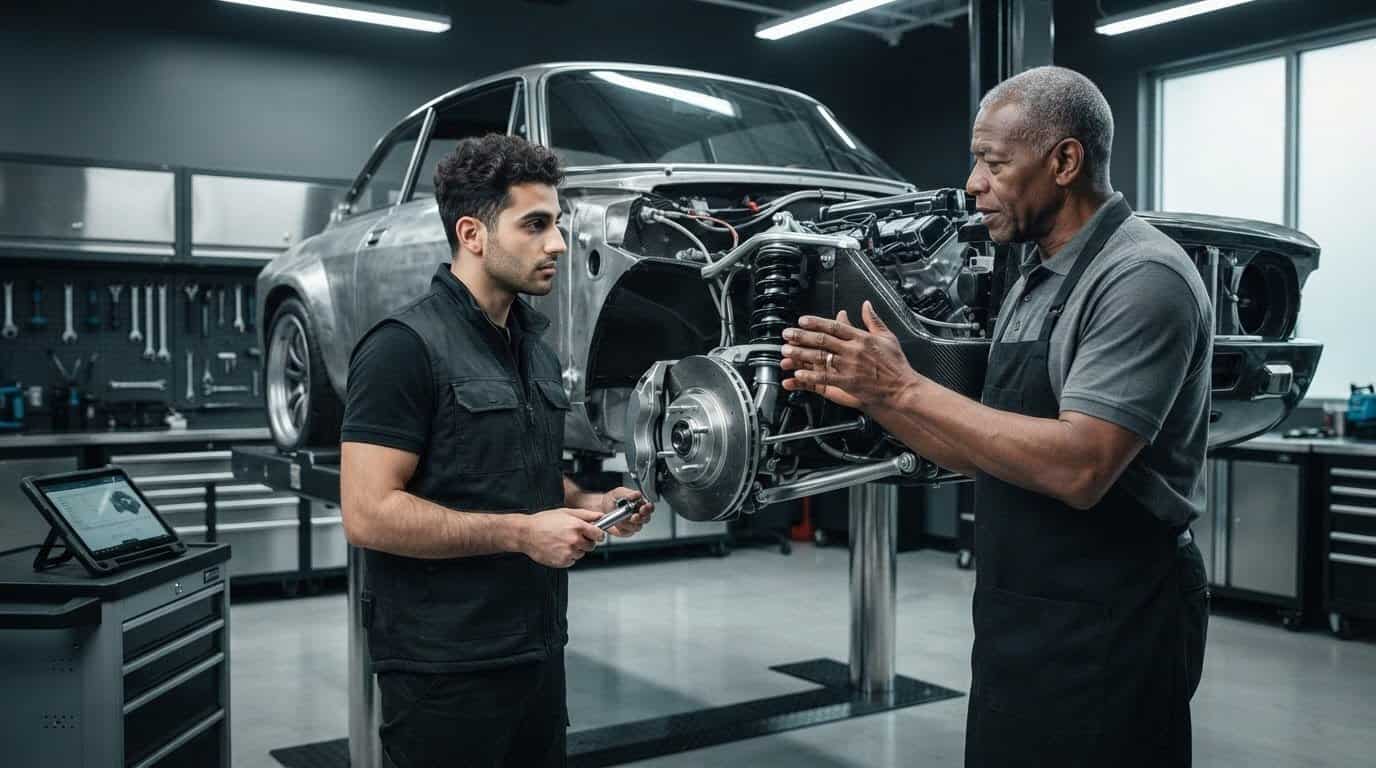
The greatest asset in a restoration shop isn’t a pristine toolkit; it’s the hard-earned wisdom of someone who has already made every mistake possible on a vintage chassis. Securing an automotive expert requires offering tangible value before asking for mechanical secrets. If you’re struggling with finding a mentor for your first car restoration, you’re likely realizing that true garage craftsmanship cannot be learned solely from online videos.
Staring at a stripped-down classic frame can feel incredibly isolating, especially when you fear making an expensive error on heritage metal or misusing specialized tools. You want to execute a safe, reliable build while learning the unspoken etiquette of traditional garage networks. This article shows you how to locate, approach, and build a relationship with an experienced automotive mentor to guide your first build. We will map out a clear path to transform you from a passive admirer into a confident creator who respects the artistry of the workshop.
Key Takeaways
- Identify the critical failure points in classic vehicle disassembly and learn how an experienced guide keeps your project from becoming another abandoned chassis.
- Redefine the mentor relationship as a partnership of mutual utility where you provide the labor and respect while they provide the technical oversight.
- Master the strategy for finding a mentor for your first car restoration by targeting specific local garage networks and high-value digital communities.
- Create a professional project pitch that demonstrates your preparation and commitment to ensure a master fabricator takes your request seriously.
- Integrate structured digital blueprints into your workflow to handle foundational questions independently, allowing your mentor to focus on complex troubleshooting.
The Reality of Your First Classic Car Project and Why Guidance Matters
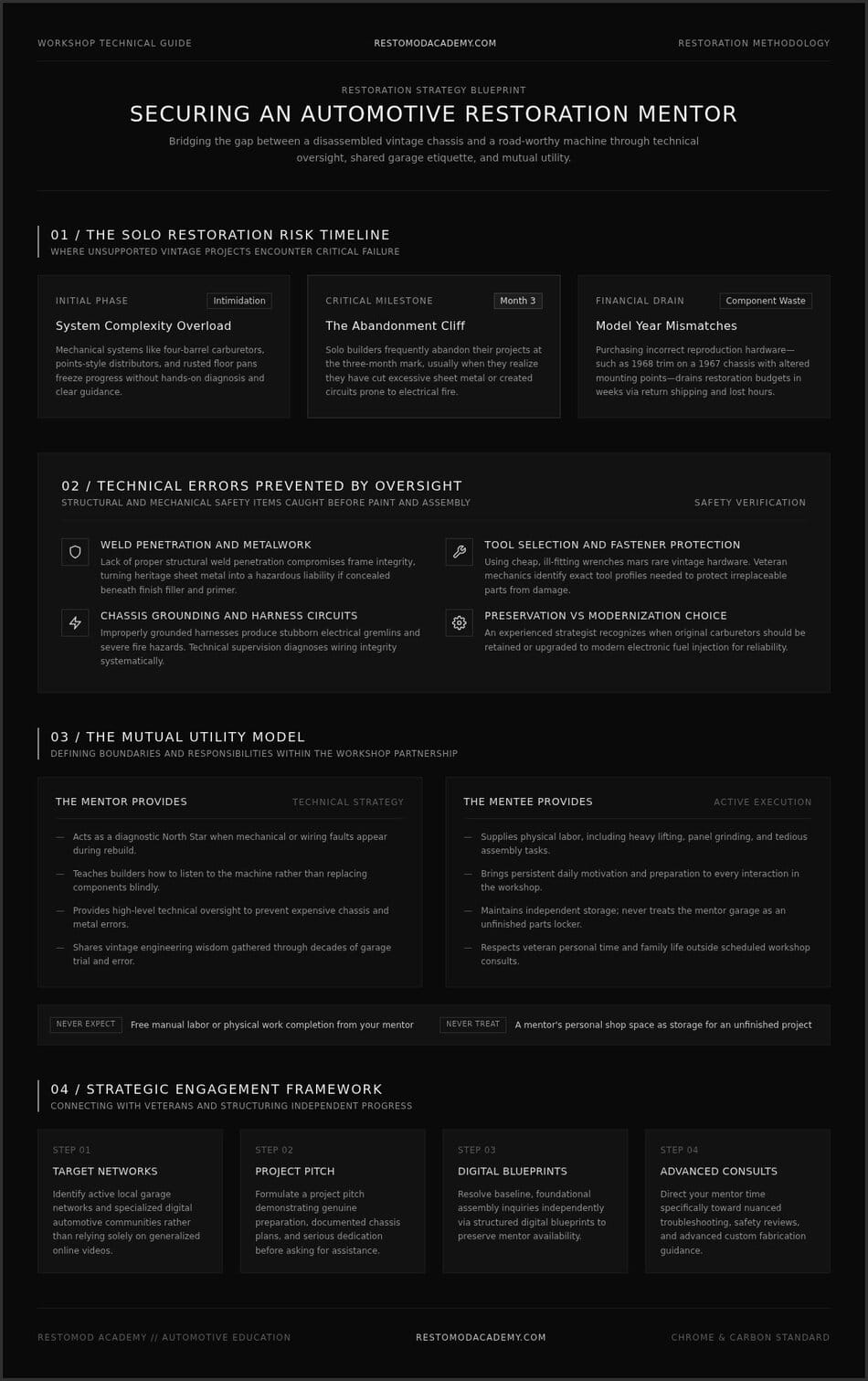
Tearing down a vintage machine feels like a rite of passage, but the distance between a pile of parts and a functional vehicle is often measured in years of frustration. You’ll quickly discover that the learning curve for metal fabrication and complex electrical systems is vertical. Solo builders frequently abandon their projects at the three-month mark, usually when they realize they’ve cut too much metal or wired a circuit that risks a fire. Because of these risks, finding a mentor for your first car restoration is a fundamental safety necessity rather than a luxury. It bridges the gap between a garage full of scrap and a road-worthy machine.
The Hidden Costs of Solo Restoration Mistakes
Structural integrity is non-negotiable. If your welds lack penetration or your wiring harness isn’t properly grounded, you aren’t just building a car; you’re building a liability. An experienced guide understands the role of a mentor is to spot these critical errors before they’re buried under paint and upholstery. Beyond safety, the financial drain of buying the wrong reproduction parts for a specific model year can derail a budget in weeks. You might spend hundreds on a trim piece that belongs on a 1968 model when your 1967 chassis requires a different mounting point. An expert eye ensures you purchase the correct components the first time, preventing costly shipping returns and wasted hours on parts that simply won’t fit.
Overcoming the Intimidation Factor of Vintage Metal
Don’t let the complexity of a four-barrel carburetor or a points-style distributor freeze your progress. These systems are logical, tactile, and masterable with the right guidance. Every master fabricator in the community once stood exactly where you are, holding a wrench with zero workshop knowledge and a healthy fear of the unknown. By integrating your hands-on learning with a clear sense of what is a restomod, you can blend vintage character with modern reliability. Finding a mentor for your first car restoration provides the steady hand needed to turn that intimidation into the quiet confidence of a creator. You’ll learn to see a rusted floor pan not as a disaster, but as a blank canvas for your new skills.
Defining the Role of an Automotive Mentor in the Modern Era
The process of finding a mentor for your first car restoration is ultimately about building a bridge between generations of enthusiasts. You aren’t just looking for a mechanic; you’re looking for a strategist who understands the delicate balance between heritage aesthetics and modern performance. In this era, a mentor serves as a guide who helps you navigate the intersection of vintage engineering and contemporary reliability. It’s about precision. You don’t just want someone who can tune a carburetor; you want an expert who knows when that system should be preserved or replaced with modern fuel injection for better drivability.
What a Restoration Mentor Does for You
A mentor acts as your diagnostic North Star. When you’re facing stubborn electrical gremlins or an engine that refuses to turn over, they provide the clarity that only decades of trial and error can produce. They teach you to listen to the machine rather than just replacing parts blindly. Beyond troubleshooting, they offer advice on proper tool selection to prevent you from marring rare vintage components with cheap, ill-fitting wrenches. Using the right recommended gear is the first step in respecting the craft. This level of guidance matters because it builds your self-esteem as a creator and refines your problem-solving skills in the workshop.
What a Mentor Is Not: Setting Healthy Boundaries
Don’t confuse a mentor with free project labor. Their role is to teach you how to fish, not to pull the net for you. You must be the one doing the heavy lifting, the grinding, and the tedious assembly. Expecting an expert to complete the difficult physical tasks for you is the fastest way to lose their respect. Likewise, your project vehicle should never permanently occupy their personal shop space. A mentor’s garage is their sanctuary, not a storage unit for your unfinished dreams. Finding a mentor for your first car restoration requires you to bring your own motivation to the table every single day.
Respecting a veteran builder’s personal time and family life is paramount. Most experts have their own long-term builds and personal obligations. Keep your questions focused and your visits scheduled. If you show up prepared with specific questions and a clean workspace, you demonstrate that you value their expertise. For those who want to ensure they are fully prepared before even approaching an expert, reviewing restomod consulting services can help you refine your project goals and show you’re serious about the work.
Where to Look: Digital Communities versus Local Garage Networks
Finding a mentor for your first car restoration requires you to look beyond your own driveway. You must decide how to balance the immediate, global reach of the internet with the tactile, high-stakes environment of a local garage. While a forum post might answer a bolt-torque question in minutes, it cannot help you steady a heavy transmission jack or hear the subtle knock of a misaligned valvetrain. You need a strategy that leverages both worlds to build your technical foundation.
Navigating Local Car Clubs and Traditional Workshops
Attend local cars and coffee events with an inquisitive mindset. Don’t just photograph the finished builds; look for the owners who have grease under their fingernails and ask them about their mechanical hurdles. Visit independent restoration shops during slow hours, typically mid-afternoon on a Tuesday, to introduce yourself to the owners. Many veteran mechanics appreciate a newcomer who respects heritage and wants to learn the right way to swing a hammer. Look for localized vintage vehicle organizations that prioritize beginner outreach, as these groups often have members eager to preserve the craft by teaching others. Physical environments like these allow you to witness proper workshop safety protocols firsthand, which is something a screen simply cannot provide.
Utilizing Specialized Online Forums and Digital Networks
Search dedicated build threads on platform forums specific to your vehicle make. These digital archives are goldmines for technical expertise, offering step-by-step documentation of complex assemblies. Use social media groups to locate regional builders who are working on similar chassis, as they might be looking for a second set of hands in exchange for knowledge. Marque-specific registries are particularly valuable for finding targeted technical data that isn’t available in generic repair manuals. For example, if you are planning a high-performance upgrade, studying the definitive guide to an ls engine swap can help you understand the modern components involved before you ask an expert for help. Digital networks complement local face-to-face mentorship by providing a broad library of reference material to support the practical lessons learned in the garage.
Finding a mentor for your first car restoration is easier when you show up prepared. Use digital spaces to handle your initial research and tool identification. This ensures that when you finally step into a master fabricator’s shop, you aren’t asking basic questions that a quick search could have answered. By doing your homework, you demonstrate a level of commitment that makes a veteran builder much more likely to invest their time in your education.
Step-by-Step Strategy for Approaching and Securing a Restoration Mentor
Success in finding a mentor for your first car restoration requires a fundamental shift in perspective. You must stop viewing the relationship as a favor you are asking for and start seeing it as a partnership of mutual utility. Most veteran builders are protective of their time and their shop space; they have seen dozens of beginners start projects only to abandon them when the work gets difficult. You must prove through your actions that you are the exception to that rule. Showing up with a plan and a willingness to work is the only way to earn a seat at the master’s table.
Leading with Value and Sweat Equity
Never walk into a professional or private shop with your hand out. Instead, walk in with a broom. Offer to sweep the floors, organize parts bins, or assist with heavy lifting during a complex engine pull. If you possess modern skills like digital marketing or social media management, offer to help an older builder document their own projects online. This sweat equity demonstrates that you respect the craft and are willing to do the dirty work. It builds immediate garage trust because it shows you aren’t just looking for a free ride, but are willing to contribute to the shop’s ecosystem.
The Perfect Initial Pitch: What to Say
Keep your initial introduction brief and focused on a surgical mechanical problem. Avoid asking someone to commit to a multi-year build mentorship during your first conversation. That is a massive request that will likely lead to a polite refusal. Instead, ask for a single shop visit or a brief look at a specific project they are currently finishing. Say, “I’m tackling the suspension on a 1967 chassis and I’ve hit a wall with the geometry. Could I buy you a coffee and look at how you solved that on your last build?” This low-pressure approach allows a relationship to form naturally without the weight of a long-term obligation.
Demonstrating Readiness and Teachability
When you approach finding a mentor for your first car restoration, remember that your preparation is your best currency. Show the expert that you have already purchased and studied the technical manuals for your specific vehicle. If you are planning advanced upgrades, such as those found in a classic car modern engine swap guide, bring your notes to show you understand the complexity involved. Accept constructive criticism regarding your technique without becoming defensive. A mentor wants to see that you can follow instructions and maintain high safety standards. To prove you are serious about your project and ready for professional guidance, secure the Ultimate Restomod Guide and arrive with a structured plan in hand.
Leveraging Structured Learning Tools alongside Your Personal Mentorship
Finding a mentor for your first car restoration is a significant milestone, but your success depends on how you utilize their time. A veteran builder’s expertise is best spent on complex troubleshooting and nuanced fabrication, not on explaining basic terminology or bolt patterns. Digital tools act as a force multiplier in this relationship. By using structured resources to handle the foundational knowledge, you ensure that every minute in the garage is focused on high-level skill transfer and precision engineering.
Digital guides provide the steady, repeatable instruction you need between hands-on sessions. When you walk into a workshop with a set of Premium Project Blueprints, you signal to your mentor that you respect their time enough to have done your homework. This level of preparation transforms the dynamic from a teacher-student relationship into a collaborative build environment where you are an active, informed creator.
Combining Hands-On Advice with Structured Digital Material
Use online tutorials to master basic skills like wire stripping or simple bolt-on assembly before you attempt advanced fabrication tasks. When you encounter a specific mechanical hurdle, bring technical diagrams to your mentor sessions to facilitate clearer discussions. Pointing to a specific component on a blueprint is far more effective than trying to describe a part you don’t yet have a name for. Integrating these visual aids allows you to discuss the nuances of what is a restomod and how to implement modern safety upgrade paths without compromising the vehicle’s heritage. This combination of digital precision and physical wisdom creates a build that is both authentic and reliable.
Taking Ownership of Your Restomod Journey
Document your progress meticulously to show your mentor that their advice is being put into practice. Take photos of your welds, your wiring looms, and your assembly sequences. This documentation serves as a record of your growth and allows your mentor to provide feedback even when they aren’t physically present. As the project advances, you should transition gradually from relying on constant guidance to making confident engineering decisions on your own. You’re the lead builder; the mentor is your consultant.
Brook Walsh founded this academy to provide the exact educational framework needed to bridge the gap between garage sessions. By exploring the educational ecosystem we’ve created, you gain access to the same professional-grade logic used by master fabricators. Take full ownership of your project’s trajectory. Use The Ultimate Restomod Guide to stay organized, keep your shop clean, and ensure that your first restoration results in a machine you are proud to drive.
Master the Craft and Claim Your Place in the Garage
Transitioning from a passive admirer to an active creator requires more than just a set of wrenches; it demands a strategic connection to the community. Finding a mentor for your first car restoration bridges the gap between mechanical frustration and the pride of a finished project. You now understand that a mentor is a diagnostic partner who values your sweat equity and preparation. By targeting local networks and specialized digital spaces, you can secure the guidance needed to navigate complex vintage systems with modern precision.
Don’t let your project stall due to a lack of clarity. Curated by automotive enthusiast Brook Walsh, our resources are built specifically for the DIY garage community to ensure you never work in isolation. You can accelerate your build preparation with The Ultimate Restomod Guide, which provides comprehensive digital blueprints for modern safety and performance. These tools serve as your digital companion, allowing you to approach any expert with the confidence of a serious builder. Pick up your tools, trust the process, and start turning that vintage chassis into a reliable masterpiece.
Frequently Asked Questions
Why is finding a mentor for your first car restoration so critical for beginners?
Mentorship is essential because it provides a safety net against irreversible mistakes on a vintage chassis. Beginners often struggle with specialized tool knowledge and proper workshop safety protocols, which can lead to structural failures if ignored. By finding a mentor for your first car restoration, you gain a trusted advisor who helps troubleshoot complex mechanical issues. This guidance transforms a daunting project into a logical sequence of steps while ensuring the final machine is safe.
How do I approach an experienced builder without sounding like I want free labor?
Shift your mindset from asking for a favor to offering mutual utility. Approach an expert by offering to perform the dirty work in their shop, such as sweeping floors, organizing parts bins, or assisting with heavy lifting. This demonstrates a willingness to contribute rather than just consume their time. Be specific about your project but keep the initial request small, such as asking for a brief shop visit rather than a long term commitment.
What should I do if there are no classic car clubs or restoration shops in my local area?
Leverage digital communities and marque specific registries to bridge the geographic gap. While physical proximity is ideal, global online platforms offer immediate answers and dedicated build threads for almost every vintage chassis. You can also utilize Restomod Academy consulting services to receive expert guidance remotely. Meticulously document your progress with photos and video to allow a digital mentor to provide accurate feedback. This structured approach ensures you stay on track anywhere.
Can an online forum or digital community replace a physical in-person garage mentor?
Digital communities serve as an excellent archive of technical data, but they cannot fully replace the hands on safety supervision of a physical mentor. A screen cannot help you feel the tension of a torque wrench or hear the subtle knock of a misaligned valvetrain. Instead, use digital spaces to handle initial research and tool identification. This preparation makes your limited in person sessions more efficient, allowing your physical mentor to focus on complex troubleshooting.
What kind of value can a complete novice offer to a veteran automotive master?
Novices can offer significant value through sweat equity and modern technical skills. Veteran builders often have backlogs of tedious tasks like cleaning shop equipment or organizing decades of accumulated parts. Additionally, many older experts appreciate help with digital marketing or social media documentation for their own long term builds. By providing these services, you build garage trust and prove you are serious. Your labor becomes a fair trade for their hard earned mechanical wisdom.
How do I handle disagreements with my mentor regarding vehicle modifications or restomod updates?
Handle disagreements by maintaining a teachable attitude while taking full ownership of your project trajectory. If your mentor prefers factory correct restoration but you want modern performance upgrades, explain your goals clearly using logic and safety data. Referencing a structured plan like The Ultimate Restomod Guide can help frame your choices as informed engineering decisions. Listen to their concerns regarding structural integrity, but remember that the final build must reflect your vision for reliability and style.
Is it appropriate to pay an automotive mentor for their time and guidance?
Offering compensation is often a sign of respect for an expert’s professional time. While many garage relationships are based on camaraderie, formal Restomod Consulting Services provide a structured way to access high level expertise without the ambiguity of a casual favor. If your mentor is a professional shop owner, respect their business by paying for diagnostic time or specialized fabrication work. Finding a mentor for your first car restoration involves recognizing that their mechanical wisdom is a valuable professional asset.
The greatest asset in a restoration shop isn’t a pristine toolkit; it’s the hard-earned wisdom of someone who has already made every mistake possible on a vintage chassis. Securing an automotive expert requires offering tangible value before asking for mechanical secrets. If you’re struggling with finding a mentor for your first car restoration, you’re likely realizing that true garage craftsmanship cannot be learned solely from online videos.
Staring at a stripped-down classic frame can feel incredibly isolating, especially when you fear making an expensive error on heritage metal or misusing specialized tools. You want to execute a safe, reliable build while learning the unspoken etiquette of traditional garage networks. This article shows you how to locate, approach, and build a relationship with an experienced automotive mentor to guide your first build. We will map out a clear path to transform you from a passive admirer into a confident creator who respects the artistry of the workshop.
Key Takeaways
- Identify the critical failure points in classic vehicle disassembly and learn how an experienced guide keeps your project from becoming another abandoned chassis.
- Redefine the mentor relationship as a partnership of mutual utility where you provide the labor and respect while they provide the technical oversight.
- Master the strategy for finding a mentor for your first car restoration by targeting specific local garage networks and high-value digital communities.
- Create a professional project pitch that demonstrates your preparation and commitment to ensure a master fabricator takes your request seriously.
- Integrate structured digital blueprints into your workflow to handle foundational questions independently, allowing your mentor to focus on complex troubleshooting.
The Reality of Your First Classic Car Project and Why Guidance Matters
Tearing down a vintage machine feels like a rite of passage, but the distance between a pile of parts and a functional vehicle is often measured in years of frustration. You’ll quickly discover that the learning curve for metal fabrication and complex electrical systems is vertical. Solo builders frequently abandon their projects at the three-month mark, usually when they realize they’ve cut too much metal or wired a circuit that risks a fire. Because of these risks, finding a mentor for your first car restoration is a fundamental safety necessity rather than a luxury. It bridges the gap between a garage full of scrap and a road-worthy machine.
The Hidden Costs of Solo Restoration Mistakes
Structural integrity is non-negotiable. If your welds lack penetration or your wiring harness isn’t properly grounded, you aren’t just building a car; you’re building a liability. An experienced guide understands the role of a mentor is to spot these critical errors before they’re buried under paint and upholstery. Beyond safety, the financial drain of buying the wrong reproduction parts for a specific model year can derail a budget in weeks. You might spend hundreds on a trim piece that belongs on a 1968 model when your 1967 chassis requires a different mounting point. An expert eye ensures you purchase the correct components the first time, preventing costly shipping returns and wasted hours on parts that simply won’t fit.
Overcoming the Intimidation Factor of Vintage Metal
Don’t let the complexity of a four-barrel carburetor or a points-style distributor freeze your progress. These systems are logical, tactile, and masterable with the right guidance. Every master fabricator in the community once stood exactly where you are, holding a wrench with zero workshop knowledge and a healthy fear of the unknown. By integrating your hands-on learning with a clear sense of what is a restomod, you can blend vintage character with modern reliability. Finding a mentor for your first car restoration provides the steady hand needed to turn that intimidation into the quiet confidence of a creator. You’ll learn to see a rusted floor pan not as a disaster, but as a blank canvas for your new skills.
Defining the Role of an Automotive Mentor in the Modern Era
The process of finding a mentor for your first car restoration is ultimately about building a bridge between generations of enthusiasts. You aren’t just looking for a mechanic; you’re looking for a strategist who understands the delicate balance between heritage aesthetics and modern performance. In this era, a mentor serves as a guide who helps you navigate the intersection of vintage engineering and contemporary reliability. It’s about precision. You don’t just want someone who can tune a carburetor; you want an expert who knows when that system should be preserved or replaced with modern fuel injection for better drivability.
What a Restoration Mentor Does for You
A mentor acts as your diagnostic North Star. When you’re facing stubborn electrical gremlins or an engine that refuses to turn over, they provide the clarity that only decades of trial and error can produce. They teach you to listen to the machine rather than just replacing parts blindly. Beyond troubleshooting, they offer advice on proper tool selection to prevent you from marring rare vintage components with cheap, ill-fitting wrenches. Using the right recommended gear is the first step in respecting the craft. This level of guidance matters because it builds your self-esteem as a creator and refines your problem-solving skills in the workshop.
What a Mentor Is Not: Setting Healthy Boundaries
Don’t confuse a mentor with free project labor. Their role is to teach you how to fish, not to pull the net for you. You must be the one doing the heavy lifting, the grinding, and the tedious assembly. Expecting an expert to complete the difficult physical tasks for you is the fastest way to lose their respect. Likewise, your project vehicle should never permanently occupy their personal shop space. A mentor’s garage is their sanctuary, not a storage unit for your unfinished dreams. Finding a mentor for your first car restoration requires you to bring your own motivation to the table every single day.
Respecting a veteran builder’s personal time and family life is paramount. Most experts have their own long-term builds and personal obligations. Keep your questions focused and your visits scheduled. If you show up prepared with specific questions and a clean workspace, you demonstrate that you value their expertise. For those who want to ensure they are fully prepared before even approaching an expert, reviewing restomod consulting services can help you refine your project goals and show you’re serious about the work.
Where to Look: Digital Communities versus Local Garage Networks
Finding a mentor for your first car restoration requires you to look beyond your own driveway. You must decide how to balance the immediate, global reach of the internet with the tactile, high-stakes environment of a local garage. While a forum post might answer a bolt-torque question in minutes, it cannot help you steady a heavy transmission jack or hear the subtle knock of a misaligned valvetrain. You need a strategy that leverages both worlds to build your technical foundation.
Navigating Local Car Clubs and Traditional Workshops
Attend local cars and coffee events with an inquisitive mindset. Don’t just photograph the finished builds; look for the owners who have grease under their fingernails and ask them about their mechanical hurdles. Visit independent restoration shops during slow hours, typically mid-afternoon on a Tuesday, to introduce yourself to the owners. Many veteran mechanics appreciate a newcomer who respects heritage and wants to learn the right way to swing a hammer. Look for localized vintage vehicle organizations that prioritize beginner outreach, as these groups often have members eager to preserve the craft by teaching others. Physical environments like these allow you to witness proper workshop safety protocols firsthand, which is something a screen simply cannot provide.
Utilizing Specialized Online Forums and Digital Networks
Search dedicated build threads on platform forums specific to your vehicle make. These digital archives are goldmines for technical expertise, offering step-by-step documentation of complex assemblies. Use social media groups to locate regional builders who are working on similar chassis, as they might be looking for a second set of hands in exchange for knowledge. Marque-specific registries are particularly valuable for finding targeted technical data that isn’t available in generic repair manuals. For example, if you are planning a high-performance upgrade, studying the definitive guide to an ls engine swap can help you understand the modern components involved before you ask an expert for help. Digital networks complement local face-to-face mentorship by providing a broad library of reference material to support the practical lessons learned in the garage.
Finding a mentor for your first car restoration is easier when you show up prepared. Use digital spaces to handle your initial research and tool identification. This ensures that when you finally step into a master fabricator’s shop, you aren’t asking basic questions that a quick search could have answered. By doing your homework, you demonstrate a level of commitment that makes a veteran builder much more likely to invest their time in your education.
Step-by-Step Strategy for Approaching and Securing a Restoration Mentor
Success in finding a mentor for your first car restoration requires a fundamental shift in perspective. You must stop viewing the relationship as a favor you are asking for and start seeing it as a partnership of mutual utility. Most veteran builders are protective of their time and their shop space; they have seen dozens of beginners start projects only to abandon them when the work gets difficult. You must prove through your actions that you are the exception to that rule. Showing up with a plan and a willingness to work is the only way to earn a seat at the master’s table.
Leading with Value and Sweat Equity
Never walk into a professional or private shop with your hand out. Instead, walk in with a broom. Offer to sweep the floors, organize parts bins, or assist with heavy lifting during a complex engine pull. If you possess modern skills like digital marketing or social media management, offer to help an older builder document their own projects online. This sweat equity demonstrates that you respect the craft and are willing to do the dirty work. It builds immediate garage trust because it shows you aren’t just looking for a free ride, but are willing to contribute to the shop’s ecosystem.
The Perfect Initial Pitch: What to Say
Keep your initial introduction brief and focused on a surgical mechanical problem. Avoid asking someone to commit to a multi-year build mentorship during your first conversation. That is a massive request that will likely lead to a polite refusal. Instead, ask for a single shop visit or a brief look at a specific project they are currently finishing. Say, “I’m tackling the suspension on a 1967 chassis and I’ve hit a wall with the geometry. Could I buy you a coffee and look at how you solved that on your last build?” This low-pressure approach allows a relationship to form naturally without the weight of a long-term obligation.
Demonstrating Readiness and Teachability
When you approach finding a mentor for your first car restoration, remember that your preparation is your best currency. Show the expert that you have already purchased and studied the technical manuals for your specific vehicle. If you are planning advanced upgrades, such as those found in a classic car modern engine swap guide, bring your notes to show you understand the complexity involved. Accept constructive criticism regarding your technique without becoming defensive. A mentor wants to see that you can follow instructions and maintain high safety standards. To prove you are serious about your project and ready for professional guidance, secure the Ultimate Restomod Guide and arrive with a structured plan in hand.
Leveraging Structured Learning Tools alongside Your Personal Mentorship
Finding a mentor for your first car restoration is a significant milestone, but your success depends on how you utilize their time. A veteran builder’s expertise is best spent on complex troubleshooting and nuanced fabrication, not on explaining basic terminology or bolt patterns. Digital tools act as a force multiplier in this relationship. By using structured resources to handle the foundational knowledge, you ensure that every minute in the garage is focused on high-level skill transfer and precision engineering.
Digital guides provide the steady, repeatable instruction you need between hands-on sessions. When you walk into a workshop with a set of Premium Project Blueprints, you signal to your mentor that you respect their time enough to have done your homework. This level of preparation transforms the dynamic from a teacher-student relationship into a collaborative build environment where you are an active, informed creator.
Combining Hands-On Advice with Structured Digital Material
Use online tutorials to master basic skills like wire stripping or simple bolt-on assembly before you attempt advanced fabrication tasks. When you encounter a specific mechanical hurdle, bring technical diagrams to your mentor sessions to facilitate clearer discussions. Pointing to a specific component on a blueprint is far more effective than trying to describe a part you don’t yet have a name for. Integrating these visual aids allows you to discuss the nuances of what is a restomod and how to implement modern safety upgrade paths without compromising the vehicle’s heritage. This combination of digital precision and physical wisdom creates a build that is both authentic and reliable.
Taking Ownership of Your Restomod Journey
Document your progress meticulously to show your mentor that their advice is being put into practice. Take photos of your welds, your wiring looms, and your assembly sequences. This documentation serves as a record of your growth and allows your mentor to provide feedback even when they aren’t physically present. As the project advances, you should transition gradually from relying on constant guidance to making confident engineering decisions on your own. You’re the lead builder; the mentor is your consultant.
Brook Walsh founded this academy to provide the exact educational framework needed to bridge the gap between garage sessions. By exploring the educational ecosystem we’ve created, you gain access to the same professional-grade logic used by master fabricators. Take full ownership of your project’s trajectory. Use The Ultimate Restomod Guide to stay organized, keep your shop clean, and ensure that your first restoration results in a machine you are proud to drive.
Master the Craft and Claim Your Place in the Garage
Transitioning from a passive admirer to an active creator requires more than just a set of wrenches; it demands a strategic connection to the community. Finding a mentor for your first car restoration bridges the gap between mechanical frustration and the pride of a finished project. You now understand that a mentor is a diagnostic partner who values your sweat equity and preparation. By targeting local networks and specialized digital spaces, you can secure the guidance needed to navigate complex vintage systems with modern precision.
Don’t let your project stall due to a lack of clarity. Curated by automotive enthusiast Brook Walsh, our resources are built specifically for the DIY garage community to ensure you never work in isolation. You can accelerate your build preparation with The Ultimate Restomod Guide, which provides comprehensive digital blueprints for modern safety and performance. These tools serve as your digital companion, allowing you to approach any expert with the confidence of a serious builder. Pick up your tools, trust the process, and start turning that vintage chassis into a reliable masterpiece.
Frequently Asked Questions
Why is finding a mentor for your first car restoration so critical for beginners?
Mentorship is essential because it provides a safety net against irreversible mistakes on a vintage chassis. Beginners often struggle with specialized tool knowledge and proper workshop safety protocols, which can lead to structural failures if ignored. By finding a mentor for your first car restoration, you gain a trusted advisor who helps troubleshoot complex mechanical issues. This guidance transforms a daunting project into a logical sequence of steps while ensuring the final machine is safe.
How do I approach an experienced builder without sounding like I want free labor?
Shift your mindset from asking for a favor to offering mutual utility. Approach an expert by offering to perform the dirty work in their shop, such as sweeping floors, organizing parts bins, or assisting with heavy lifting. This demonstrates a willingness to contribute rather than just consume their time. Be specific about your project but keep the initial request small, such as asking for a brief shop visit rather than a long term commitment.
What should I do if there are no classic car clubs or restoration shops in my local area?
Leverage digital communities and marque specific registries to bridge the geographic gap. While physical proximity is ideal, global online platforms offer immediate answers and dedicated build threads for almost every vintage chassis. You can also utilize Restomod Academy consulting services to receive expert guidance remotely. Meticulously document your progress with photos and video to allow a digital mentor to provide accurate feedback. This structured approach ensures you stay on track anywhere.
Can an online forum or digital community replace a physical in-person garage mentor?
Digital communities serve as an excellent archive of technical data, but they cannot fully replace the hands on safety supervision of a physical mentor. A screen cannot help you feel the tension of a torque wrench or hear the subtle knock of a misaligned valvetrain. Instead, use digital spaces to handle initial research and tool identification. This preparation makes your limited in person sessions more efficient, allowing your physical mentor to focus on complex troubleshooting.
What kind of value can a complete novice offer to a veteran automotive master?
Novices can offer significant value through sweat equity and modern technical skills. Veteran builders often have backlogs of tedious tasks like cleaning shop equipment or organizing decades of accumulated parts. Additionally, many older experts appreciate help with digital marketing or social media documentation for their own long term builds. By providing these services, you build garage trust and prove you are serious. Your labor becomes a fair trade for their hard earned mechanical wisdom.
How do I handle disagreements with my mentor regarding vehicle modifications or restomod updates?
Handle disagreements by maintaining a teachable attitude while taking full ownership of your project trajectory. If your mentor prefers factory correct restoration but you want modern performance upgrades, explain your goals clearly using logic and safety data. Referencing a structured plan like The Ultimate Restomod Guide can help frame your choices as informed engineering decisions. Listen to their concerns regarding structural integrity, but remember that the final build must reflect your vision for reliability and style.
Is it appropriate to pay an automotive mentor for their time and guidance?
Offering compensation is often a sign of respect for an expert’s professional time. While many garage relationships are based on camaraderie, formal Restomod Consulting Services provide a structured way to access high level expertise without the ambiguity of a casual favor. If your mentor is a professional shop owner, respect their business by paying for diagnostic time or specialized fabrication work. Finding a mentor for your first car restoration involves recognizing that their mechanical wisdom is a valuable professional asset.