

A Ford GT40 restomod isn’t a simple weekend hobby; it’s a precision engineering investment where your choice of transaxle alone can cost more than a brand-new sedan. Look past the glossy exterior and focus on the mechanical reality of your ambition. You likely already feel the weight of this project, knowing that capturing the spirit of Le Mans requires more than just a fiberglass shell. It’s easy to feel sticker shock when calculating the total ford gt40 restomod cost, especially when a new ZF transaxle carries a thirty-five thousand dollar price tag or when you’re deciding between a thirty thousand dollar AUD chassis and a high-end continuation.
I understand the fear of starting a project that slowly transforms into a bottomless money pit. This guide provides a clear roadmap for your build, stripping away the mystery behind component pricing and manufacturer value. You’ll discover the real-world expenses of modernizing this legend, from the eleven thousand dollar Coyote crate engines to the specific performance upgrades that define a world-class build. We will compare the major players in the market and help you choose the right path for your workshop, giving you the confidence to transition from an admirer to a creator.
Key Takeaways
- Master the distinction between multi-million dollar originals and high-performance replicas to set a realistic baseline for your project.
- Evaluate how the choice of a transaxle can dictate your entire ford gt40 restomod cost and why modern alternatives offer superior reliability over aging units.
- Compare the performance merits and integration challenges of the Ford Coyote V8 against the classic heritage of the 427 FE power plant.
- Weigh the sensory rewards of a 2,500-hour DIY journey against the precision and speed of a turnkey professional build.
- Identify the essential modern upgrades, such as air conditioning and digital integration, that transform a vintage cockpit into a functional road machine.
The GT40 Restomod Landscape: Defining Your Entry Point
Before you pick up a wrench, you must understand the foundation of this project. The ford gt40 restomod cost varies wildly because you aren’t just buying a car; you’re choosing a lineage. Realize that modifying an original chassis is virtually unheard of today. Those machines are historical artifacts, and looking into the Ford GT40 history reveals why they command seven-figure prices at auction. Instead, your journey begins with a high-quality replica or continuation chassis designed to handle modern torque and cooling requirements. If you’re new to this philosophy, it helps to understand exactly what is a restomod before committing to a specific build path.
Think of the chassis as the skeleton of your dream. Leading manufacturers like Superformance, Race Car Replicas (RCR), and Factory Five offer different entry points based on your mechanical skill and budget. A rolling chassis from a top-tier builder often serves as the baseline, requiring you to source the big three components: the engine, the transaxle, and the wiring harness. Expect the initial investment for a quality roller to start significantly higher than a standard kit, reflecting the precision engineering required for a mid-engine layout.
To better understand this concept, watch this helpful video:
Continuation vs. Replica: Impact on Long-term Value
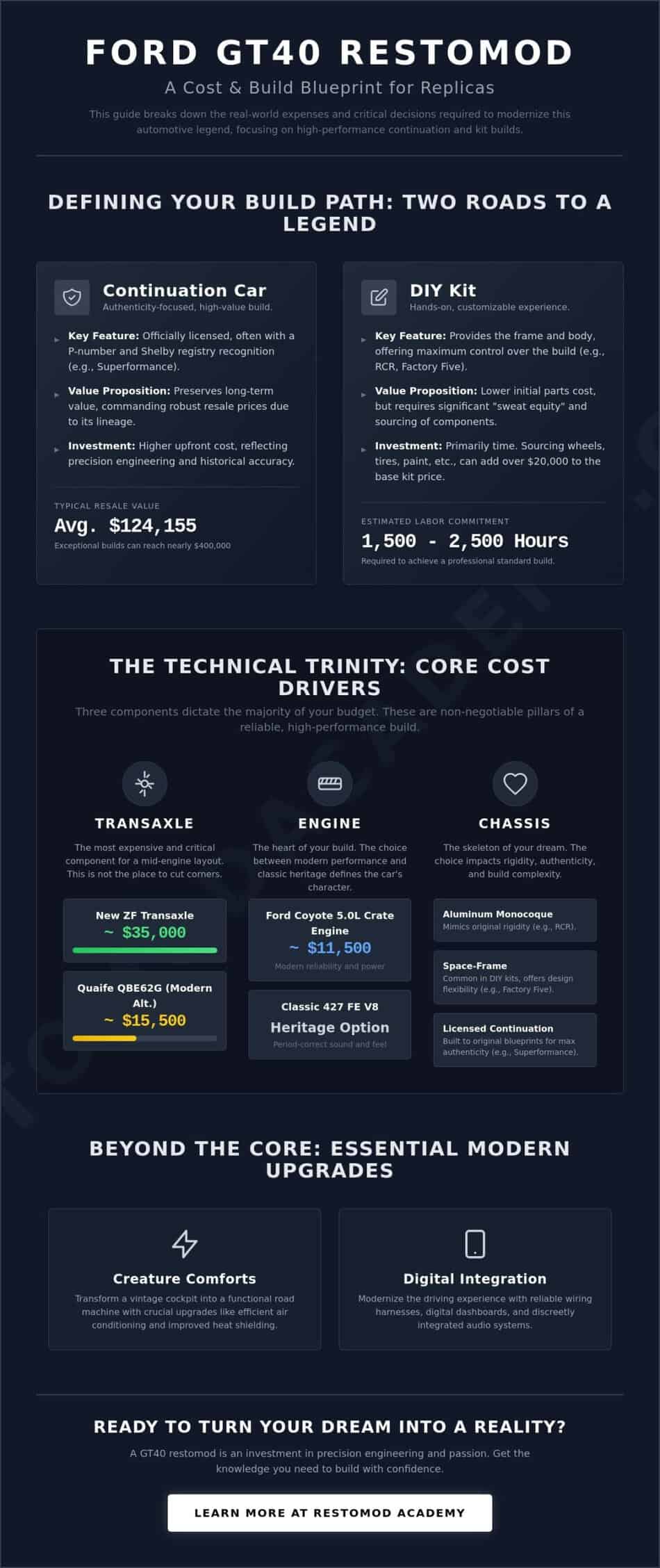
A continuation car, like those from Superformance, carries a P-number and is recognized by the Shelby registry. This isn’t just a vanity plate; it’s a mark of authenticity that preserves long-term value. While the upfront ford gt40 restomod cost for a licensed continuation is higher, the resale value remains robust. These cars are built to the original blueprints, allowing you to blend 1960s aesthetics with the reliability of a modern fuel-injected V8. Top-tier brands often see average sale prices around $124,155, though exceptional examples have reached nearly $400,000.
The DIY Kit Path: Factory Five and RCR
If you prefer the grit of the workshop, the DIY path through companies like RCR or Factory Five offers a different reward. A basic component kit might seem affordable at first glance, but you must account for the hundreds of hours of labor. These boxes typically include the frame and body panels, leaving you to hunt for suspension uprights, brakes, and cooling systems. For instance, an RCR kit often features an aluminum monocoque chassis that mimics the original’s rigidity, while a Factory Five version utilizes a space-frame design. Estimating your sweat equity is vital; a home-built project can take 1,500 to 2,500 hours to complete to a professional standard. You’ll need to source your own wheels, tires, and paint, which can easily add twenty thousand dollars to your running tally before the engine even arrives.
Ford GT40 Restomod Cost Breakdown: The Big Three Expenses
Respect the machine. When you calculate your ford gt40 restomod cost, you’ll quickly realize that three primary components dictate the majority of your budget. These aren’t areas where you can afford to cut corners. The transaxle, the engine, and the chassis itself form a technical trinity that determines whether your car is a reliable performer or a permanent resident of your garage. While many beginners focus on the engine, the transaxle is often the most expensive and misunderstood piece of the puzzle. A new ZF transaxle can cost approximately $35,000, and you might face a significant waitlist. If that exceeds your budget, modern alternatives like the Quaife QBE62G start at roughly £12,415.00, providing modern engineering for a mid-engine layout.
Your choice of powertrain adds another layer to the financial roadmap. A Ford Performance Gen 4 5.0L Coyote Crate Engine currently sits at $11,468.50, but remember that the engine is only half the battle. In a mid-engine car, the packaging of the cooling, exhaust, and fuel systems requires surgical precision. If you aren’t providing the labor yourself, professional assembly rates average between $20.63 and $35 per hour. However, high-end shops specializing in GT40 builds often command a premium for their expertise in managing the complex geometry of these cars. To find the right components for your build, check out our product reviews for tested hardware.
Budgeting for the Rolling Chassis
The foundation of your build starts with the chassis. A Kopelke Kitcars body and chassis unit can be sourced for around $30,000 AUD, but your choice between a steel space-frame and an aluminum monocoque will change your final tally. Beyond the frame, you must account for the rolling gear. High-performance braking systems and period-correct wheels are essential for the right aesthetic. A set of Avon CR6ZZ tires, which provide that authentic 1960s look with modern grip, will add several thousand dollars to your initial rolling chassis budget.
Hidden Assembly Costs: The Small Parts That Add Up
It’s the details that often lead to budget creep. The iconic “Bundle of Snakes” exhaust system is a work of art, but custom headers for a mid-engine V8 are labor-intensive and expensive to fabricate. You also need to prioritize a robust cooling system. Radiators, high-flow fans, and complex plumbing are mandatory to keep a high-horsepower engine cool in a glass-heavy cabin. Finally, don’t overlook the electronics. Integrating a modern ECU with a custom wiring harness ensures your fuel-injected build starts every time, but these systems require a dedicated portion of your financial roadmap.
Modern Power: Engine and Transaxle Selection
Choose your heart wisely. When you evaluate your ford gt40 restomod cost, the engine and transaxle selection will define the character of your machine. You’re balancing two distinct philosophies: the visceral, high-maintenance roar of heritage iron and the turn-key precision of modern engineering. While a period-correct 427 FE big block offers undeniable nostalgia, it often requires a specialized touch and frequent tuning. In contrast, modern crate engines provide a plug-and-play experience that lets you spend more time on the road and less time under the rear clamshell. Some builders even look toward the GM ecosystem for its compact packaging and vast aftermarket. If you’re weighing the pros and cons of cross-brand power, read the definitive guide to an LS engine swap to understand the structural implications for a mid-engine chassis.
Integrating these powerplants requires more than just a set of motor mounts. You must account for the bridge between the crank and the wheels. Installation kits and adapter plates are the unsung heroes of a successful build, ensuring that your Ford or GM engine mates perfectly with a high-performance transaxle. These components must be machined to exacting tolerances to prevent premature wear on the input shaft or clutch assembly. Don’t overlook the importance of selecting gear ratios that match your intended use; a car geared for the Mulsanne Straight will feel sluggish and unrefined in stop-and-go traffic.
The Coyote Crate Engine Advantage
The Ford Performance Gen 4 5.0L Coyote Crate Engine is the primary choice for the modern enthusiast, priced at $11,468.50 for the manual flywheel version. If you desire even more resilience for track days, the Gen 4 Coyote Aluminator is available for $14,499.99. Beyond the long block, you must budget for a Power Pack ECU and a high-pressure fuel system capable of supporting modern direct injection. The Coyote swap serves as the gold standard for 2026 reliability. This setup offers 480 horsepower with the peace of mind that comes from a factory-engineered solution.
Navigating the Transaxle Market
The transaxle remains the most critical variable in your ford gt40 restomod cost and driving experience. While a rebuilt ZF unit carries the torch of heritage, its thirty-five thousand dollar price tag and limited availability make it a difficult choice for many. Many modern builders now turn to the Graziano transaxle, sourced from the Audi R8 or Lamborghini Gallardo, because it offers robust synchros and a more forgiving shift feel. Alternatively, the Quaife QBE62G provides a 5-speed H-pattern layout designed as a direct modern replacement for the ZF. It starts at approximately £12,415.00, offering a balance of historical feel and contemporary durability.
Interior Comfort and Modern Technology Upgrades
While the world admires your GT40 from the sidewalk, you experience the machine from the cockpit. The interior of a mid-engine legend is notoriously tight and prone to extreme heat soak, making comfort upgrades a necessity rather than a luxury. When calculating your ford gt40 restomod cost, you must allocate a specific portion of the budget to managing the environment inside the cabin. A raw racing interior might look authentic, but it will limit your driving time to cool mornings and short bursts. To bridge the gap between a 1960s race car and a usable road machine, you need to master the art of blending heritage aesthetics with modern thermal and acoustic management.
Modern HVAC Systems for Mid-Engine Classics
Air conditioning isn’t optional when you have a massive windshield and a high-performance V8 sitting inches behind your shoulders. Most builders opt for a Vintage Air kit, but the challenge lies in the execution. Sourcing the kit is only the start; you must account for the labor required to route custom ducting through the narrow GT40 dashboard and plumb lines through the chassis. This process requires a meticulous hand to ensure the system doesn’t compromise the car’s cooling priority for the engine. For more inspiration on how to execute these upgrades without ruining the vintage vibe, explore these Restomod Interior Ideas.
Beyond cooling, focus on the sensory details of the seats and upholstery. If you’re over six feet tall, a Gurney bubble in the door is a mandatory structural modification that adds to your fabrication tally. Authenticity often comes at a price; period-correct ventilated seats with brass rivets provide the iconic look but require high-quality leather or Alcantara to withstand the heat. Pair these with modern sound-deadening mats. These layers are essential for making long-distance tours bearable, as they significantly reduce the mechanical drone and road noise that otherwise dominate the experience.
Audio and Electronics
Modern electronics should be felt, not necessarily seen. Preserving the vintage dashboard aesthetic often means choosing traditional Smiths gauges over digital displays, though some builders now hide digital screens behind period-correct housings. Safety is another critical area where technology justifies its cost. Because rear visibility is nearly non-existent in a GT40, integrating a hidden backup camera and parking sensors is a wise investment. You can also save weight and improve starting reliability by converting to a lithium-ion battery, which offers a higher power-to-weight ratio than traditional lead-acid units. If you find yourself overwhelmed by the technical choices, our Restomod Consulting Services can help you prioritize the upgrades that matter most for your specific build goals.
Final Budgeting: Professional Build vs. The DIY Journey
Decide which resource you have more of: time or capital. This is the final fork in the road for your project. A professional build offers the security of a seasoned hand and a guaranteed finish line, while the DIY path provides an intimate understanding of every nut and bolt. Your total ford gt40 restomod cost will reflect this choice. While a turnkey car from a high-end shop can reach into the mid-six figures, a self-built project allows you to distribute expenses over several years. However, don’t underestimate the sheer volume of labor required to reach a professional standard of fit and finish.
Beyond the initial assembly, you must account for the ongoing realities of ownership. Maintenance on a mid-engine machine is more intensive than your daily driver. Accessing the engine bay often requires removing large body sections, and specialized components like the transaxle need regular inspection. Insurance is another factor; you’ll need a specialty agreed-value policy that recognizes the unique market value of a high-end restomod. These recurring costs ensure your investment remains roadworthy and retains its value for decades to come.
The Professional Shop Route
Choosing a professional builder means paying for project management and specialized fabrication skills. In 2026, the average hourly rate for a custom car builder in the United States ranges from $20.63 to $35, though premier shops specializing in GT40 continuations often command higher premiums. A professional shop serves as a one-stop solution, handling the complex geometry of the suspension and the intricate plumbing of the cooling system. This route eliminates the trial-and-error phase that often plagues first-time builders, ensuring that the car is balanced and safe from the first mile.
Mastering the Build with Restomod Academy
If you choose to pick up the tools yourself, our resources are designed to prevent the expensive mistakes that turn projects into abandoned shells. We provide the technical framework you need to navigate the assembly phase with precision. Our Premium Project Blueprints offer the specific data required for engine placement and suspension tuning, saving you hundreds of hours of research and fabrication rework. Every successful build starts with a solid educational foundation. Before you buy your first component, consult The Ultimate Restomod Guide to establish your roadmap. By leveraging our collective expertise, you can manage your ford gt40 restomod cost effectively while achieving a level of craftsmanship that rivals the world’s best professional shops.
Take Command of Your GT40 Build
Building a legend requires more than just passion; it demands a meticulous budget and a clear engineering roadmap. You’ve seen how the choice of a modern transaxle or a Coyote crate engine dictates your final ford gt40 restomod cost, and why thermal management in the cockpit is just as vital as raw horsepower. Whether you choose the path of a professional shop or the rewarding labor of a DIY project, your success hinges on the precision of your planning and the quality of your components. Every decision you make now determines the character and reliability of your machine once it hits the pavement.
You don’t have to navigate this complex assembly alone. With expert mentorship from Brook Walsh, comprehensive component reviews, and a global community of professional and DIY builders at your side, you have the support needed to achieve a world-class finish. Download The Ultimate Restomod Guide to start your GT40 project today and transform your vision into a mechanical reality. The road to Le Mans style performance is long, but with the right guidance, every technical hurdle becomes a valuable step in your journey. Pick up your tools with confidence; the finish line is closer than you think.
Frequently Asked Questions
How much does a Superformance GT40 cost in 2026?
A turnkey Superformance GT40 typically ranges from $150,000 to over $300,000 depending on your engine and transaxle choices. While the rolling chassis has a set base price, the final ford gt40 restomod cost reflects the premium you pay for a licensed continuation with a Shelby P-number. These cars represent the high end of the market, offering a level of authenticity and resale value that justifies the initial six-figure investment.
Can I put a modern Ford Coyote engine in a GT40 replica?
You can absolutely install a modern Ford Coyote engine, and it’s currently considered the gold standard for reliability. A Gen 4 5.0L Coyote crate engine costs $11,468.50 and provides 480 horsepower with the convenience of modern fuel injection. This swap requires a specific installation kit and ECU, but the result is a machine that starts every time and survives the heat of a mid-engine engine bay.
What is the cheapest way to build a Ford GT40?
The most affordable path is a DIY kit build starting with a basic chassis unit, such as those from Kopelke Kitcars at $30,000 AUD. You can save significantly by sourcing a used transaxle and engine, though the lowest recorded sale for a completed replica was $18,000 in late 2023. Realize that cheap is relative in this world; you’ll still need to invest thousands of hours in sweat equity to finish the project.
Why are GT40 transaxles so expensive?
Transaxles are expensive because they must manage massive V8 torque while fitting into a compact mid-engine footprint. A new ZF unit costs approximately $35,000 because it’s a low-volume, precision-engineered component with a significant waitlist. Modern alternatives like the Quaife QBE62G start at £12,415.00, but the complex internal geometry required for high-performance shifting in a mid-engine layout keeps prices high across the board.
How long does it take to build a Factory Five GT40 kit?
Expect to invest between 1,500 and 2,500 hours to complete a Factory Five GT40 kit to a professional standard. This timeline assumes you’re handling the assembly, wiring, and interior work yourself in a well-equipped workshop. If you’re a first-time builder, the learning curve for mid-engine plumbing and alignment will likely push you toward the higher end of that hour estimate.
Is a Ford GT40 restomod a good investment?
High-quality GT40 continuations are generally considered stable investments with an average sale price of $124,155. Top-tier builds have reached record sales of $396,000, especially when they carry recognized registry numbers. While the initial ford gt40 restomod cost is high, the market for these cars remains strong because they offer the aesthetic of a multi-million dollar original at a fraction of the price.
What is the difference between a MkI and MkII GT40 restomod cost?
The cost difference usually stems from the powertrain choice rather than the bodywork itself. A MkII restomod often utilizes a 427 FE big block, which carries a higher heritage cost for parts and specialized tuning compared to the small-block Ford or Coyote engines typically found in MkI builds. You should also account for the larger cooling requirements and heavier-duty transaxles required to handle the increased torque of the MkII’s larger displacement.
Do I need a Gurney Bubble for my GT40 build?
You only need a Gurney Bubble if you or your frequent passengers are over six feet tall. This structural modification provides necessary helmet clearance in the notoriously low GT40 cabin. While it adds a small amount to your bodywork and paint budget, it’s a period-correct feature that significantly improves the ergonomics and usability of the car for taller drivers.
A Ford GT40 restomod isn’t a simple weekend hobby; it’s a precision engineering investment where your choice of transaxle alone can cost more than a brand-new sedan. Look past the glossy exterior and focus on the mechanical reality of your ambition. You likely already feel the weight of this project, knowing that capturing the spirit of Le Mans requires more than just a fiberglass shell. It’s easy to feel sticker shock when calculating the total ford gt40 restomod cost, especially when a new ZF transaxle carries a thirty-five thousand dollar price tag or when you’re deciding between a thirty thousand dollar AUD chassis and a high-end continuation.
I understand the fear of starting a project that slowly transforms into a bottomless money pit. This guide provides a clear roadmap for your build, stripping away the mystery behind component pricing and manufacturer value. You’ll discover the real-world expenses of modernizing this legend, from the eleven thousand dollar Coyote crate engines to the specific performance upgrades that define a world-class build. We will compare the major players in the market and help you choose the right path for your workshop, giving you the confidence to transition from an admirer to a creator.
Key Takeaways
- Master the distinction between multi-million dollar originals and high-performance replicas to set a realistic baseline for your project.
- Evaluate how the choice of a transaxle can dictate your entire ford gt40 restomod cost and why modern alternatives offer superior reliability over aging units.
- Compare the performance merits and integration challenges of the Ford Coyote V8 against the classic heritage of the 427 FE power plant.
- Weigh the sensory rewards of a 2,500-hour DIY journey against the precision and speed of a turnkey professional build.
- Identify the essential modern upgrades, such as air conditioning and digital integration, that transform a vintage cockpit into a functional road machine.
The GT40 Restomod Landscape: Defining Your Entry Point
Before you pick up a wrench, you must understand the foundation of this project. The ford gt40 restomod cost varies wildly because you aren’t just buying a car; you’re choosing a lineage. Realize that modifying an original chassis is virtually unheard of today. Those machines are historical artifacts, and looking into the Ford GT40 history reveals why they command seven-figure prices at auction. Instead, your journey begins with a high-quality replica or continuation chassis designed to handle modern torque and cooling requirements. If you’re new to this philosophy, it helps to understand exactly what is a restomod before committing to a specific build path.
Think of the chassis as the skeleton of your dream. Leading manufacturers like Superformance, Race Car Replicas (RCR), and Factory Five offer different entry points based on your mechanical skill and budget. A rolling chassis from a top-tier builder often serves as the baseline, requiring you to source the big three components: the engine, the transaxle, and the wiring harness. Expect the initial investment for a quality roller to start significantly higher than a standard kit, reflecting the precision engineering required for a mid-engine layout.
To better understand this concept, watch this helpful video:
Continuation vs. Replica: Impact on Long-term Value
A continuation car, like those from Superformance, carries a P-number and is recognized by the Shelby registry. This isn’t just a vanity plate; it’s a mark of authenticity that preserves long-term value. While the upfront ford gt40 restomod cost for a licensed continuation is higher, the resale value remains robust. These cars are built to the original blueprints, allowing you to blend 1960s aesthetics with the reliability of a modern fuel-injected V8. Top-tier brands often see average sale prices around $124,155, though exceptional examples have reached nearly $400,000.
The DIY Kit Path: Factory Five and RCR
If you prefer the grit of the workshop, the DIY path through companies like RCR or Factory Five offers a different reward. A basic component kit might seem affordable at first glance, but you must account for the hundreds of hours of labor. These boxes typically include the frame and body panels, leaving you to hunt for suspension uprights, brakes, and cooling systems. For instance, an RCR kit often features an aluminum monocoque chassis that mimics the original’s rigidity, while a Factory Five version utilizes a space-frame design. Estimating your sweat equity is vital; a home-built project can take 1,500 to 2,500 hours to complete to a professional standard. You’ll need to source your own wheels, tires, and paint, which can easily add twenty thousand dollars to your running tally before the engine even arrives.
Ford GT40 Restomod Cost Breakdown: The Big Three Expenses
Respect the machine. When you calculate your ford gt40 restomod cost, you’ll quickly realize that three primary components dictate the majority of your budget. These aren’t areas where you can afford to cut corners. The transaxle, the engine, and the chassis itself form a technical trinity that determines whether your car is a reliable performer or a permanent resident of your garage. While many beginners focus on the engine, the transaxle is often the most expensive and misunderstood piece of the puzzle. A new ZF transaxle can cost approximately $35,000, and you might face a significant waitlist. If that exceeds your budget, modern alternatives like the Quaife QBE62G start at roughly £12,415.00, providing modern engineering for a mid-engine layout.
Your choice of powertrain adds another layer to the financial roadmap. A Ford Performance Gen 4 5.0L Coyote Crate Engine currently sits at $11,468.50, but remember that the engine is only half the battle. In a mid-engine car, the packaging of the cooling, exhaust, and fuel systems requires surgical precision. If you aren’t providing the labor yourself, professional assembly rates average between $20.63 and $35 per hour. However, high-end shops specializing in GT40 builds often command a premium for their expertise in managing the complex geometry of these cars. To find the right components for your build, check out our product reviews for tested hardware.
Budgeting for the Rolling Chassis
The foundation of your build starts with the chassis. A Kopelke Kitcars body and chassis unit can be sourced for around $30,000 AUD, but your choice between a steel space-frame and an aluminum monocoque will change your final tally. Beyond the frame, you must account for the rolling gear. High-performance braking systems and period-correct wheels are essential for the right aesthetic. A set of Avon CR6ZZ tires, which provide that authentic 1960s look with modern grip, will add several thousand dollars to your initial rolling chassis budget.
Hidden Assembly Costs: The Small Parts That Add Up
It’s the details that often lead to budget creep. The iconic “Bundle of Snakes” exhaust system is a work of art, but custom headers for a mid-engine V8 are labor-intensive and expensive to fabricate. You also need to prioritize a robust cooling system. Radiators, high-flow fans, and complex plumbing are mandatory to keep a high-horsepower engine cool in a glass-heavy cabin. Finally, don’t overlook the electronics. Integrating a modern ECU with a custom wiring harness ensures your fuel-injected build starts every time, but these systems require a dedicated portion of your financial roadmap.
Modern Power: Engine and Transaxle Selection
Choose your heart wisely. When you evaluate your ford gt40 restomod cost, the engine and transaxle selection will define the character of your machine. You’re balancing two distinct philosophies: the visceral, high-maintenance roar of heritage iron and the turn-key precision of modern engineering. While a period-correct 427 FE big block offers undeniable nostalgia, it often requires a specialized touch and frequent tuning. In contrast, modern crate engines provide a plug-and-play experience that lets you spend more time on the road and less time under the rear clamshell. Some builders even look toward the GM ecosystem for its compact packaging and vast aftermarket. If you’re weighing the pros and cons of cross-brand power, read the definitive guide to an LS engine swap to understand the structural implications for a mid-engine chassis.
Integrating these powerplants requires more than just a set of motor mounts. You must account for the bridge between the crank and the wheels. Installation kits and adapter plates are the unsung heroes of a successful build, ensuring that your Ford or GM engine mates perfectly with a high-performance transaxle. These components must be machined to exacting tolerances to prevent premature wear on the input shaft or clutch assembly. Don’t overlook the importance of selecting gear ratios that match your intended use; a car geared for the Mulsanne Straight will feel sluggish and unrefined in stop-and-go traffic.
The Coyote Crate Engine Advantage
The Ford Performance Gen 4 5.0L Coyote Crate Engine is the primary choice for the modern enthusiast, priced at $11,468.50 for the manual flywheel version. If you desire even more resilience for track days, the Gen 4 Coyote Aluminator is available for $14,499.99. Beyond the long block, you must budget for a Power Pack ECU and a high-pressure fuel system capable of supporting modern direct injection. The Coyote swap serves as the gold standard for 2026 reliability. This setup offers 480 horsepower with the peace of mind that comes from a factory-engineered solution.
Navigating the Transaxle Market
The transaxle remains the most critical variable in your ford gt40 restomod cost and driving experience. While a rebuilt ZF unit carries the torch of heritage, its thirty-five thousand dollar price tag and limited availability make it a difficult choice for many. Many modern builders now turn to the Graziano transaxle, sourced from the Audi R8 or Lamborghini Gallardo, because it offers robust synchros and a more forgiving shift feel. Alternatively, the Quaife QBE62G provides a 5-speed H-pattern layout designed as a direct modern replacement for the ZF. It starts at approximately £12,415.00, offering a balance of historical feel and contemporary durability.
Interior Comfort and Modern Technology Upgrades
While the world admires your GT40 from the sidewalk, you experience the machine from the cockpit. The interior of a mid-engine legend is notoriously tight and prone to extreme heat soak, making comfort upgrades a necessity rather than a luxury. When calculating your ford gt40 restomod cost, you must allocate a specific portion of the budget to managing the environment inside the cabin. A raw racing interior might look authentic, but it will limit your driving time to cool mornings and short bursts. To bridge the gap between a 1960s race car and a usable road machine, you need to master the art of blending heritage aesthetics with modern thermal and acoustic management.
Modern HVAC Systems for Mid-Engine Classics
Air conditioning isn’t optional when you have a massive windshield and a high-performance V8 sitting inches behind your shoulders. Most builders opt for a Vintage Air kit, but the challenge lies in the execution. Sourcing the kit is only the start; you must account for the labor required to route custom ducting through the narrow GT40 dashboard and plumb lines through the chassis. This process requires a meticulous hand to ensure the system doesn’t compromise the car’s cooling priority for the engine. For more inspiration on how to execute these upgrades without ruining the vintage vibe, explore these Restomod Interior Ideas.
Beyond cooling, focus on the sensory details of the seats and upholstery. If you’re over six feet tall, a Gurney bubble in the door is a mandatory structural modification that adds to your fabrication tally. Authenticity often comes at a price; period-correct ventilated seats with brass rivets provide the iconic look but require high-quality leather or Alcantara to withstand the heat. Pair these with modern sound-deadening mats. These layers are essential for making long-distance tours bearable, as they significantly reduce the mechanical drone and road noise that otherwise dominate the experience.
Audio and Electronics
Modern electronics should be felt, not necessarily seen. Preserving the vintage dashboard aesthetic often means choosing traditional Smiths gauges over digital displays, though some builders now hide digital screens behind period-correct housings. Safety is another critical area where technology justifies its cost. Because rear visibility is nearly non-existent in a GT40, integrating a hidden backup camera and parking sensors is a wise investment. You can also save weight and improve starting reliability by converting to a lithium-ion battery, which offers a higher power-to-weight ratio than traditional lead-acid units. If you find yourself overwhelmed by the technical choices, our Restomod Consulting Services can help you prioritize the upgrades that matter most for your specific build goals.
Final Budgeting: Professional Build vs. The DIY Journey
Decide which resource you have more of: time or capital. This is the final fork in the road for your project. A professional build offers the security of a seasoned hand and a guaranteed finish line, while the DIY path provides an intimate understanding of every nut and bolt. Your total ford gt40 restomod cost will reflect this choice. While a turnkey car from a high-end shop can reach into the mid-six figures, a self-built project allows you to distribute expenses over several years. However, don’t underestimate the sheer volume of labor required to reach a professional standard of fit and finish.
Beyond the initial assembly, you must account for the ongoing realities of ownership. Maintenance on a mid-engine machine is more intensive than your daily driver. Accessing the engine bay often requires removing large body sections, and specialized components like the transaxle need regular inspection. Insurance is another factor; you’ll need a specialty agreed-value policy that recognizes the unique market value of a high-end restomod. These recurring costs ensure your investment remains roadworthy and retains its value for decades to come.
The Professional Shop Route
Choosing a professional builder means paying for project management and specialized fabrication skills. In 2026, the average hourly rate for a custom car builder in the United States ranges from $20.63 to $35, though premier shops specializing in GT40 continuations often command higher premiums. A professional shop serves as a one-stop solution, handling the complex geometry of the suspension and the intricate plumbing of the cooling system. This route eliminates the trial-and-error phase that often plagues first-time builders, ensuring that the car is balanced and safe from the first mile.
Mastering the Build with Restomod Academy
If you choose to pick up the tools yourself, our resources are designed to prevent the expensive mistakes that turn projects into abandoned shells. We provide the technical framework you need to navigate the assembly phase with precision. Our Premium Project Blueprints offer the specific data required for engine placement and suspension tuning, saving you hundreds of hours of research and fabrication rework. Every successful build starts with a solid educational foundation. Before you buy your first component, consult The Ultimate Restomod Guide to establish your roadmap. By leveraging our collective expertise, you can manage your ford gt40 restomod cost effectively while achieving a level of craftsmanship that rivals the world’s best professional shops.
Take Command of Your GT40 Build
Building a legend requires more than just passion; it demands a meticulous budget and a clear engineering roadmap. You’ve seen how the choice of a modern transaxle or a Coyote crate engine dictates your final ford gt40 restomod cost, and why thermal management in the cockpit is just as vital as raw horsepower. Whether you choose the path of a professional shop or the rewarding labor of a DIY project, your success hinges on the precision of your planning and the quality of your components. Every decision you make now determines the character and reliability of your machine once it hits the pavement.
You don’t have to navigate this complex assembly alone. With expert mentorship from Brook Walsh, comprehensive component reviews, and a global community of professional and DIY builders at your side, you have the support needed to achieve a world-class finish. Download The Ultimate Restomod Guide to start your GT40 project today and transform your vision into a mechanical reality. The road to Le Mans style performance is long, but with the right guidance, every technical hurdle becomes a valuable step in your journey. Pick up your tools with confidence; the finish line is closer than you think.
Frequently Asked Questions
How much does a Superformance GT40 cost in 2026?
A turnkey Superformance GT40 typically ranges from $150,000 to over $300,000 depending on your engine and transaxle choices. While the rolling chassis has a set base price, the final ford gt40 restomod cost reflects the premium you pay for a licensed continuation with a Shelby P-number. These cars represent the high end of the market, offering a level of authenticity and resale value that justifies the initial six-figure investment.
Can I put a modern Ford Coyote engine in a GT40 replica?
You can absolutely install a modern Ford Coyote engine, and it’s currently considered the gold standard for reliability. A Gen 4 5.0L Coyote crate engine costs $11,468.50 and provides 480 horsepower with the convenience of modern fuel injection. This swap requires a specific installation kit and ECU, but the result is a machine that starts every time and survives the heat of a mid-engine engine bay.
What is the cheapest way to build a Ford GT40?
The most affordable path is a DIY kit build starting with a basic chassis unit, such as those from Kopelke Kitcars at $30,000 AUD. You can save significantly by sourcing a used transaxle and engine, though the lowest recorded sale for a completed replica was $18,000 in late 2023. Realize that cheap is relative in this world; you’ll still need to invest thousands of hours in sweat equity to finish the project.
Why are GT40 transaxles so expensive?
Transaxles are expensive because they must manage massive V8 torque while fitting into a compact mid-engine footprint. A new ZF unit costs approximately $35,000 because it’s a low-volume, precision-engineered component with a significant waitlist. Modern alternatives like the Quaife QBE62G start at £12,415.00, but the complex internal geometry required for high-performance shifting in a mid-engine layout keeps prices high across the board.
How long does it take to build a Factory Five GT40 kit?
Expect to invest between 1,500 and 2,500 hours to complete a Factory Five GT40 kit to a professional standard. This timeline assumes you’re handling the assembly, wiring, and interior work yourself in a well-equipped workshop. If you’re a first-time builder, the learning curve for mid-engine plumbing and alignment will likely push you toward the higher end of that hour estimate.
Is a Ford GT40 restomod a good investment?
High-quality GT40 continuations are generally considered stable investments with an average sale price of $124,155. Top-tier builds have reached record sales of $396,000, especially when they carry recognized registry numbers. While the initial ford gt40 restomod cost is high, the market for these cars remains strong because they offer the aesthetic of a multi-million dollar original at a fraction of the price.
What is the difference between a MkI and MkII GT40 restomod cost?
The cost difference usually stems from the powertrain choice rather than the bodywork itself. A MkII restomod often utilizes a 427 FE big block, which carries a higher heritage cost for parts and specialized tuning compared to the small-block Ford or Coyote engines typically found in MkI builds. You should also account for the larger cooling requirements and heavier-duty transaxles required to handle the increased torque of the MkII’s larger displacement.
Do I need a Gurney Bubble for my GT40 build?
You only need a Gurney Bubble if you or your frequent passengers are over six feet tall. This structural modification provides necessary helmet clearance in the notoriously low GT40 cabin. While it adds a small amount to your bodywork and paint budget, it’s a period-correct feature that significantly improves the ergonomics and usability of the car for taller drivers.