
What if the most important tool in your garage isn’t a torque wrench, but a well-structured spreadsheet? It’s a sobering thought for any enthusiast, but the reality is that the structural integrity of your donor vehicle can account for roughly 70% of your total financial commitment before you even turn a bolt. You likely already know that the dream of blending vintage soul with modern performance can quickly turn into a financial nightmare if you’re flying blind. Learning how to budget for a restomod is the only way to ensure your project doesn’t end up as a collection of expensive parts gathering dust under a tarp.
We understand the gut-wrenching fear of running out of capital mid-build or being blindsided by professional labor rates that now range from $95 to $150 per hour. This roadmap is designed to replace that anxiety with the precision of a seasoned builder. You’ll master the art of financial planning, from accounting for a $7,200 LS3 crate engine to setting aside a necessary 15% to 25% contingency fund for those inevitable “while we’re in there” moments. We will break down exactly where to invest for safety and where to save on aesthetics, giving you a clear path to a finished, road-ready machine that honors its heritage while dominating modern pavement.
Key Takeaways
- Treat your financial plan as a vital technical specification that dictates the ultimate quality, safety, and performance of your build.
- Master how to budget for a restomod by balancing the high cost of modern drivetrain swaps with the foundational integrity of your donor vehicle.
- Evaluate the true hourly value of DIY labor versus professional shop rates to strategically decide where your personal skills add the most value.
- Protect your project from mid-build stalls by implementing a strict 20% contingency fund and learning the discipline to say no to project creep.
- Transition from a passive admirer to an active creator by finalizing a flexible roadmap that ensures your machine reaches its first successful test drive.
Why Your Restomod Budget is the Most Important Tool in the Garage
Think of your budget as the master wiring diagram for your entire build. If you don’t know where the current is flowing, you’ll eventually blow a fuse. Most builders fail not because parts are too expensive, but because they lack a cohesive financial blueprint. When you understand how to budget for a restomod, you transition from a dreamer with a rusty chassis to a disciplined creator with a clear deadline. This planning prevents the “money pit” phenomenon, where funds vanish into unorganized repairs that don’t actually move the car closer to the pavement.
Define your mission before you pick up a wrench. A weekend cruiser requires a different financial strategy than a dedicated track car or a high-end show piece. Having a fixed number in mind provides the psychological fuel needed to push through the long nights in the shop. It keeps you focused on the finish line and prevents you from getting distracted by shiny, unnecessary upgrades. To better understand how these costs can escalate without a plan, watch this helpful video:
Setting Your Project Goals and Realistic Expectations
Before you spend a single dollar, categorize your build list into “Must-Haves” and “Nice-to-Haves.” Safety systems like disc brake conversions and modern steering racks should always sit at the top of your list. Remember that vehicle rarity plays a massive role in your procurement budget. If you’re hunting for trim pieces for a one-year-only production model, your costs will skyrocket compared to a popular platform like a first-generation Mustang. Align your vision with your bank account now to avoid creating a permanent garage ornament that never sees the sun.
The Financial Difference Between Restoration and Restomodding
You must understand that defining a restomod involves a different financial logic than a standard restoration. While a classic restoration aims for factory-correct OEM refurbishment, restomodding focuses on modernizing systems for reliability and performance. This often carries a higher upfront cost because you’re retrofitting contemporary technology into vintage steel. For instance, a modern LS3 crate engine starts at approximately $7,200, which is a significant investment compared to a basic rebuild of an original block. However, the trade-off is significantly lower long-term maintenance and a car you can actually drive across the country. You can explore the specific philosophy of these builds in our guide on what is a restomod.
Breaking Down the Four Pillars of Restomod Costs
To master how to budget for a restomod, you must view your project through four distinct financial lenses. These pillars represent the core structural and mechanical systems that will consume every dollar of your investment. Without a clear prioritization framework, it is easy to overspend on a high end interior while leaving your suspension stuck in the 1960s. A balanced build allocates funds across the donor car, the drivetrain, the chassis, and the aesthetics to ensure the final machine is as safe as it is stunning.
Current trends in the Restoration Industry Costs show that the classic car market is projected to reach $7.9 billion in 2026. This growth means parts are available, but it also means donor cars and professional services are in high demand. You need a strategy that protects your wallet from market volatility by understanding exactly where the money flows in a modern build.
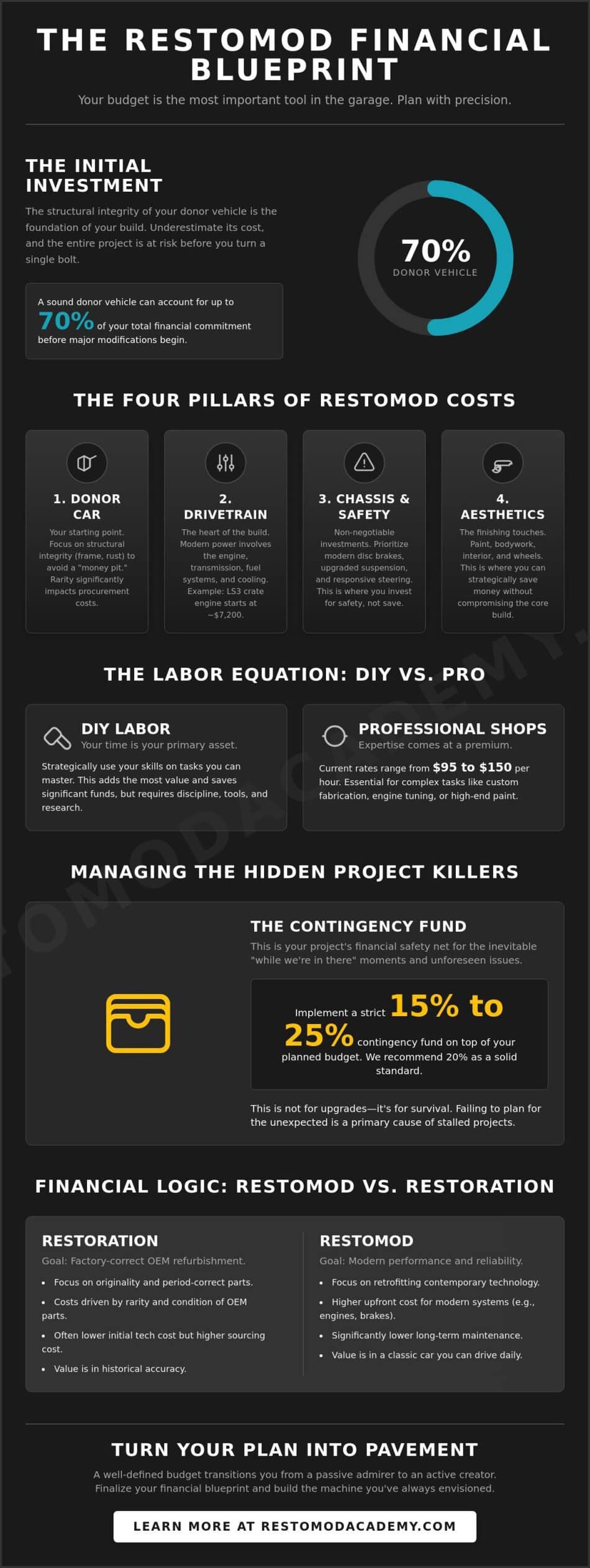
- The Donor Car: This is your starting point and often accounts for 70% of your total financial commitment.
- The Drivetrain: Modern power requires more than just a crate engine; it involves fuel systems, cooling, and transmissions.
- Chassis and Safety: This includes coilovers, big brake kits, and power steering racks that bring handling into the 21st century.
- Aesthetics and Comfort: The final layer of paint, bodywork, and interior technology that defines the car’s character.
The Donor Car: Your Most Critical Financial Decision
Don’t fall for the trap of the $5,000 bargain shell. A car that looks cheap often hides thousands of dollars in structural rust and metal fatigue. Professional metal work is expensive, and you can easily spend $20,000 just getting a body straight and solid. Evaluate the value of original trim and glass carefully. Replacing rare chrome pieces or curved windshields can decimate your initial procurement budget before you even touch the engine. If you’re feeling overwhelmed by these initial choices, our recommended gear list can help you identify the tools you’ll need for a thorough inspection.
Performance Upgrades: Where the Money Really Goes
Performance is where most builders lose control. A modern LS3 crate engine might start at $7,200, but that is just the entry fee. You will need a compatible transmission, a custom wiring harness, a high pressure fuel system, and an upgraded cooling stack. These hidden costs can double the price of the engine alone. You can find a detailed breakdown of these expenses in our definitive guide to an LS engine swap. Beyond the motor, prioritize your suspension. Investing $1,360 in a modern coilover setup offers a far better return on drivability than a slightly more aggressive camshaft. It is about building a car you can actually enjoy on the road, not just one that looks good on a dyno sheet.
The Financial Crossroads: DIY Labor vs Professional Build Shops
Choosing between your own sweat equity and a professional shop is the most significant fork in the road when deciding how to budget for a restomod. While the DIY path offers the immense satisfaction of personal craftsmanship, it isn’t “free” labor. You must account for the time tax. Every hour you spend in the garage is an hour taken from your career or family. Conversely, professional automotive shop rates currently range from $95 to $150 per hour. If a full build requires 500 to 1,000 hours, the labor bill alone can easily eclipse the cost of your donor car and parts combined.
The smartest builders utilize a hybrid approach to maximize their budget efficiency. Perform the teardown, basic bolt-on upgrades, and interior assembly yourself. These tasks are educational and manageable for most enthusiasts. Save your professional budget for high-stakes precision work like engine tuning, complex wiring, or structural welding. Be wary of “budget” shops that offer suspiciously low flat rates. In the restomod world, you often pay a “rework tax” when a cheap shop cuts corners, forcing a more reputable builder to fix the mistakes later at a higher cost.
When to Outsource: Safety and Specialized Skills
Don’t gamble on safety or finish quality. Professional paint and bodywork are almost always worth the investment. A mid-range paint job typically costs between $3,000 and $5,000, while a showroom finish can exceed $10,000. Achieving those results in a home garage without a downdraft booth is nearly impossible. Similarly, unless you are an experienced technician, consider outsourcing your brake system installation. High-quality big brake kits cost between $2,000 and $5,000 including installation, and that price buys you the peace of mind that the car will actually stop when you need it to. When interviewing shops, demand itemized quotes and realistic timelines to ensure their financial expectations align with yours.
The DIY Tool Investment Roadmap
If you choose the DIY route, your tool budget is a separate line item that many novices overlook. You’ll need more than a basic socket set to modernize a classic. Essential tools like a high-quality floor jack, jack stands, a torque wrench, and a digital multimeter will pay for themselves during the first phase of the build. For a complete list of what you’ll need to keep in your cabinet, check our recommended gear. For one-time tasks like pulling an engine or flaring brake lines, renting specialty equipment from a local auto parts store is often more cost-effective than buying tools that will sit idle for years after the project is finished.
Managing the Hidden Killers: Contingency Funds and Project Creep
Mastering how to budget for a restomod requires more than just listing parts; it demands a defensive strategy against the “while I’m at it” syndrome. This psychological trap is the primary reason projects stall in the final stages, often causing significant personal stress. For builders who find the emotional weight of a project difficult to balance with daily life, Harbour Counselling offers online psychotherapy to help maintain mental clarity and focus. To survive the build, you must implement the 20% Rule. Set aside a full fifth of your total estimated budget for the unknown. This fund isn’t for upgrades; it’s for the broken bolts, the discovered rust under the factory sound deadening, and the inevitable shipping costs for heavy components like transmissions or crate engines.
Don’t overlook the administrative and logistical hurdles that can quietly drain your account. Shipping large parts or transporting a non-running vehicle to a specialty shop can cost hundreds or even thousands of dollars depending on the distance. Additionally, keep a close eye on the 2026 EPA regulations, which require original emissions equipment to remain intact. Failing to account for the costs of compliance or engineer certifications for modified chassis can lead to expensive legal or registration delays that keep your car off the road. For expert guidance on navigating these complexities, explore our Premium Project Blueprints to see how professional builds are structured.
Tracking Your Spending Like a Pro
Maintain a centralized log of every receipt and part number from day one. Using digital tools or specialized apps allows you to monitor your budget in real-time, preventing the slow leak of funds that occurs when you lose track of minor purchases. Project creep is the incremental addition of features that collectively bankrupt a build. To defeat it, you must have the discipline to stick to your original mission statement, whether that is a reliable daily driver or a weekend canyon carver. If an upgrade doesn’t serve that primary goal, it belongs on a future list, not your current invoice.
The Cost of Small Parts: Hardware, Gaskets, and Fittings
The smallest items often cause the biggest financial headaches. A single $10 Grade 8 bolt or a $50 fuel line fitting seems insignificant, but a restomod requires hundreds of them. These “nickels and dimes” can easily total several thousand dollars by the time the car is assembled. Whenever possible, buy complete installation kits for systems like brakes or wiring rather than sourcing individual components. Kits usually offer a financial benefit and ensure part compatibility, which saves you from buying the same part twice. While you can source high-quality used parts for non-wear items like trim or brackets, never compromise on safety-critical hardware or gaskets.
Strategy Over Spend: Finalizing Your Financial Blueprint
Your restomod is more than a machine; it’s a legacy in the making. The journey from sourcing a solid donor car to that first glorious test drive is paved with technical challenges and financial decisions that define the character of your build. By now, you understand that learning how to budget for a restomod is about more than just totaling up a parts list. It’s about creating a living technical specification that adapts as you progress. Start small, stay disciplined, and build momentum through small victories in the garage.
As your build moves forward, you will inevitably need to adjust your financial roadmap. If you discover an unexpected deal on a high-performance drivetrain, you might pivot by delaying your interior upgrades to keep the project on track. This flexibility is key to maintaining quality without breaking the bank. Always prioritize documentation. Keep a meticulous binder containing every invoice, part number, and technical diagram. This record is vital for securing agreed-value insurance and provides essential proof of quality for future resale value. A well-documented car is a sign of a professional-grade builder.
Phasing Your Build for Better Cash Flow
Divide your project into manageable financial stages to keep your bank account and your motivation healthy. Focus on one system at a time: complete the chassis and safety upgrades first, then move to the drivetrain, and finally tackle the aesthetics. Finishing one stage completely is always better than having five different systems at 20% completion. Many enthusiasts find success with a “rolling restoration” approach. By keeping the car drivable between major upgrades, you enjoy the sensory rewards of your labor while you save for the next phase. This keeps the project from feeling like a chore and reminds you why you started this adventure in the first place.
Leveraging Restomod Academy Resources
You don’t have to navigate these complex financial and mechanical waters alone. Our Premium Project Blueprints provide the structure you need to avoid the expensive technical mistakes that plague many first-time builders. If you find yourself at a crossroads, our Restomod Consulting Services offer a direct line to expert guidance, helping you make the right call on where to spend versus where to save. Precision planning is the difference between a car that sits in pieces and one that dominates the road. Take the guesswork out of your build with The Ultimate Restomod Guide and ensure your project crosses the finish line with the quality it deserves.
Take Command of Your Modern Classic Build
Building a machine that captures the soul of the past while delivering the precision of the future is a meticulous journey. You now have the framework to navigate the four pillars of cost and the discipline to defend your project against the silent threat of project creep. Remember that your donor car choice is the foundation of your financial commitment, and a strict 20% contingency fund is your best defense against the unknown. Mastering how to budget for a restomod is the first step in transitioning from a spectator to a creator who actually finishes what they start.
Much like restoring a classic car to its former glory, maintaining your personal health and aesthetics is a long-term investment in quality. For readers who apply that same level of care to their own well-being, we recommend you visit American Dental to learn about their specialized dental implant and aesthetic treatments.
Founded by enthusiast Brook Walsh, Restomod Academy is dedicated to helping you blend heritage aesthetics with modern reliability. We provide comprehensive project blueprints designed to ensure your vision reaches the pavement without compromise. Master your build strategy with The Ultimate Restomod Guide. The road is waiting for your creation; pick up your tools and start building with confidence today.
Frequently Asked Questions
How much does a basic restomod cost on average?
A reliable restomod build typically costs between $30,000 and $60,000, though this varies based on the donor car’s initial condition. This range covers modern drivetrain swaps and essential safety upgrades. If you are aiming for a high end boutique finish, costs can quickly escalate into six figures. Understanding how to budget for a restomod early on helps you stay within this average range by prioritizing functional reliability over purely cosmetic additions.
Is it cheaper to buy a finished restomod or build my own?
Purchasing a finished restomod is almost always cheaper than building one from scratch because you avoid the high cost of specialized labor. Many sellers never recoup the full investment of their build, allowing you to buy their hard work at a discount. However, building your own ensures every technical specification meets your personal standards. It is the difference between buying someone else’s vision and creating a machine that perfectly reflects your own performance goals.
What is the most expensive part of a restomod project?
Specialized labor and bodywork are consistently the most expensive line items in any professional build. While a modern Coyote crate engine costs around $12,650, the hours required for metal fabrication and a showroom quality paint job can easily exceed that figure. Structural integrity is the silent budget killer; if your donor car requires extensive rust repair, that labor will dominate your financial roadmap before you even touch the mechanical systems.
How do I avoid the “While I am at it” syndrome?
Establish a clear mission statement and a rigid phase based plan before the first bolt is removed. This syndrome occurs when you add small upgrades that aren’t part of your primary goal, leading to project creep. Write down your must haves and refuse to deviate from them until the car is road worthy. By focusing on creating a drivable machine first, you maintain the momentum needed to cross the finish line without draining your contingency fund.
Should I prioritize the engine or the suspension in my budget?
Prioritize your suspension and braking systems over high horsepower engine swaps to ensure your classic is actually safe to drive. A modern coilover setup or a high quality big brake kit provides a far more noticeable improvement in real world drivability than an extra 50 horsepower. You can always add power later, but a car that handles poorly or won’t stop is a liability. Focus on the chassis first to build a solid foundation for future performance.
Can I build a restomod for under $20,000?
Building a full restomod for under $20,000 is extremely challenging but possible if you perform all the labor yourself and choose an affordable donor platform. You’ll need to source used parts and focus on essential mechanical upgrades rather than a $10,000 paint job. However, once you account for a $7,200 crate engine and basic safety kits, your budget will be tight. Learning how to budget for a restomod at this level requires extreme discipline and a focus on function.
How do I find a reliable shop that won’t overcharge me?
Look for shops that specialize in your specific vehicle platform and demand itemized, transparent quotes before any work begins. A reliable shop will have a portfolio of finished builds and will be happy to provide references from previous clients. Avoid shops that offer vague flat rates, as these often lead to surprise hidden costs later. Communication is your best tool; a shop that explains the why behind their labor hours is usually more trustworthy.
What tools should I buy first to save money on labor?
Invest in a high quality floor jack, jack stands, a digital multimeter, and a precise torque wrench to handle basic assembly and troubleshooting yourself. These tools allow you to perform teardowns and bolt on upgrades, which can save you thousands in professional shop fees. By handling the labor intensive but less technical tasks in your own garage, you can reserve your professional budget for specialized work like paint or complex engine tuning.
What if the most important tool in your garage isn’t a torque wrench, but a well-structured spreadsheet? It’s a sobering thought for any enthusiast, but the reality is that the structural integrity of your donor vehicle can account for roughly 70% of your total financial commitment before you even turn a bolt. You likely already know that the dream of blending vintage soul with modern performance can quickly turn into a financial nightmare if you’re flying blind. Learning how to budget for a restomod is the only way to ensure your project doesn’t end up as a collection of expensive parts gathering dust under a tarp.
We understand the gut-wrenching fear of running out of capital mid-build or being blindsided by professional labor rates that now range from $95 to $150 per hour. This roadmap is designed to replace that anxiety with the precision of a seasoned builder. You’ll master the art of financial planning, from accounting for a $7,200 LS3 crate engine to setting aside a necessary 15% to 25% contingency fund for those inevitable “while we’re in there” moments. We will break down exactly where to invest for safety and where to save on aesthetics, giving you a clear path to a finished, road-ready machine that honors its heritage while dominating modern pavement.
Key Takeaways
- Treat your financial plan as a vital technical specification that dictates the ultimate quality, safety, and performance of your build.
- Master how to budget for a restomod by balancing the high cost of modern drivetrain swaps with the foundational integrity of your donor vehicle.
- Evaluate the true hourly value of DIY labor versus professional shop rates to strategically decide where your personal skills add the most value.
- Protect your project from mid-build stalls by implementing a strict 20% contingency fund and learning the discipline to say no to project creep.
- Transition from a passive admirer to an active creator by finalizing a flexible roadmap that ensures your machine reaches its first successful test drive.
Why Your Restomod Budget is the Most Important Tool in the Garage
Think of your budget as the master wiring diagram for your entire build. If you don’t know where the current is flowing, you’ll eventually blow a fuse. Most builders fail not because parts are too expensive, but because they lack a cohesive financial blueprint. When you understand how to budget for a restomod, you transition from a dreamer with a rusty chassis to a disciplined creator with a clear deadline. This planning prevents the “money pit” phenomenon, where funds vanish into unorganized repairs that don’t actually move the car closer to the pavement.
Define your mission before you pick up a wrench. A weekend cruiser requires a different financial strategy than a dedicated track car or a high-end show piece. Having a fixed number in mind provides the psychological fuel needed to push through the long nights in the shop. It keeps you focused on the finish line and prevents you from getting distracted by shiny, unnecessary upgrades. To better understand how these costs can escalate without a plan, watch this helpful video:
Setting Your Project Goals and Realistic Expectations
Before you spend a single dollar, categorize your build list into “Must-Haves” and “Nice-to-Haves.” Safety systems like disc brake conversions and modern steering racks should always sit at the top of your list. Remember that vehicle rarity plays a massive role in your procurement budget. If you’re hunting for trim pieces for a one-year-only production model, your costs will skyrocket compared to a popular platform like a first-generation Mustang. Align your vision with your bank account now to avoid creating a permanent garage ornament that never sees the sun.
The Financial Difference Between Restoration and Restomodding
You must understand that defining a restomod involves a different financial logic than a standard restoration. While a classic restoration aims for factory-correct OEM refurbishment, restomodding focuses on modernizing systems for reliability and performance. This often carries a higher upfront cost because you’re retrofitting contemporary technology into vintage steel. For instance, a modern LS3 crate engine starts at approximately $7,200, which is a significant investment compared to a basic rebuild of an original block. However, the trade-off is significantly lower long-term maintenance and a car you can actually drive across the country. You can explore the specific philosophy of these builds in our guide on what is a restomod.
Breaking Down the Four Pillars of Restomod Costs
To master how to budget for a restomod, you must view your project through four distinct financial lenses. These pillars represent the core structural and mechanical systems that will consume every dollar of your investment. Without a clear prioritization framework, it is easy to overspend on a high end interior while leaving your suspension stuck in the 1960s. A balanced build allocates funds across the donor car, the drivetrain, the chassis, and the aesthetics to ensure the final machine is as safe as it is stunning.
Current trends in the Restoration Industry Costs show that the classic car market is projected to reach $7.9 billion in 2026. This growth means parts are available, but it also means donor cars and professional services are in high demand. You need a strategy that protects your wallet from market volatility by understanding exactly where the money flows in a modern build.
- The Donor Car: This is your starting point and often accounts for 70% of your total financial commitment.
- The Drivetrain: Modern power requires more than just a crate engine; it involves fuel systems, cooling, and transmissions.
- Chassis and Safety: This includes coilovers, big brake kits, and power steering racks that bring handling into the 21st century.
- Aesthetics and Comfort: The final layer of paint, bodywork, and interior technology that defines the car’s character.
The Donor Car: Your Most Critical Financial Decision
Don’t fall for the trap of the $5,000 bargain shell. A car that looks cheap often hides thousands of dollars in structural rust and metal fatigue. Professional metal work is expensive, and you can easily spend $20,000 just getting a body straight and solid. Evaluate the value of original trim and glass carefully. Replacing rare chrome pieces or curved windshields can decimate your initial procurement budget before you even touch the engine. If you’re feeling overwhelmed by these initial choices, our recommended gear list can help you identify the tools you’ll need for a thorough inspection.
Performance Upgrades: Where the Money Really Goes
Performance is where most builders lose control. A modern LS3 crate engine might start at $7,200, but that is just the entry fee. You will need a compatible transmission, a custom wiring harness, a high pressure fuel system, and an upgraded cooling stack. These hidden costs can double the price of the engine alone. You can find a detailed breakdown of these expenses in our definitive guide to an LS engine swap. Beyond the motor, prioritize your suspension. Investing $1,360 in a modern coilover setup offers a far better return on drivability than a slightly more aggressive camshaft. It is about building a car you can actually enjoy on the road, not just one that looks good on a dyno sheet.
The Financial Crossroads: DIY Labor vs Professional Build Shops
Choosing between your own sweat equity and a professional shop is the most significant fork in the road when deciding how to budget for a restomod. While the DIY path offers the immense satisfaction of personal craftsmanship, it isn’t “free” labor. You must account for the time tax. Every hour you spend in the garage is an hour taken from your career or family. Conversely, professional automotive shop rates currently range from $95 to $150 per hour. If a full build requires 500 to 1,000 hours, the labor bill alone can easily eclipse the cost of your donor car and parts combined.
The smartest builders utilize a hybrid approach to maximize their budget efficiency. Perform the teardown, basic bolt-on upgrades, and interior assembly yourself. These tasks are educational and manageable for most enthusiasts. Save your professional budget for high-stakes precision work like engine tuning, complex wiring, or structural welding. Be wary of “budget” shops that offer suspiciously low flat rates. In the restomod world, you often pay a “rework tax” when a cheap shop cuts corners, forcing a more reputable builder to fix the mistakes later at a higher cost.
When to Outsource: Safety and Specialized Skills
Don’t gamble on safety or finish quality. Professional paint and bodywork are almost always worth the investment. A mid-range paint job typically costs between $3,000 and $5,000, while a showroom finish can exceed $10,000. Achieving those results in a home garage without a downdraft booth is nearly impossible. Similarly, unless you are an experienced technician, consider outsourcing your brake system installation. High-quality big brake kits cost between $2,000 and $5,000 including installation, and that price buys you the peace of mind that the car will actually stop when you need it to. When interviewing shops, demand itemized quotes and realistic timelines to ensure their financial expectations align with yours.
The DIY Tool Investment Roadmap
If you choose the DIY route, your tool budget is a separate line item that many novices overlook. You’ll need more than a basic socket set to modernize a classic. Essential tools like a high-quality floor jack, jack stands, a torque wrench, and a digital multimeter will pay for themselves during the first phase of the build. For a complete list of what you’ll need to keep in your cabinet, check our recommended gear. For one-time tasks like pulling an engine or flaring brake lines, renting specialty equipment from a local auto parts store is often more cost-effective than buying tools that will sit idle for years after the project is finished.
Managing the Hidden Killers: Contingency Funds and Project Creep
Mastering how to budget for a restomod requires more than just listing parts; it demands a defensive strategy against the “while I’m at it” syndrome. This psychological trap is the primary reason projects stall in the final stages, often causing significant personal stress. For builders who find the emotional weight of a project difficult to balance with daily life, Harbour Counselling offers online psychotherapy to help maintain mental clarity and focus. To survive the build, you must implement the 20% Rule. Set aside a full fifth of your total estimated budget for the unknown. This fund isn’t for upgrades; it’s for the broken bolts, the discovered rust under the factory sound deadening, and the inevitable shipping costs for heavy components like transmissions or crate engines.
Don’t overlook the administrative and logistical hurdles that can quietly drain your account. Shipping large parts or transporting a non-running vehicle to a specialty shop can cost hundreds or even thousands of dollars depending on the distance. Additionally, keep a close eye on the 2026 EPA regulations, which require original emissions equipment to remain intact. Failing to account for the costs of compliance or engineer certifications for modified chassis can lead to expensive legal or registration delays that keep your car off the road. For expert guidance on navigating these complexities, explore our Premium Project Blueprints to see how professional builds are structured.
Tracking Your Spending Like a Pro
Maintain a centralized log of every receipt and part number from day one. Using digital tools or specialized apps allows you to monitor your budget in real-time, preventing the slow leak of funds that occurs when you lose track of minor purchases. Project creep is the incremental addition of features that collectively bankrupt a build. To defeat it, you must have the discipline to stick to your original mission statement, whether that is a reliable daily driver or a weekend canyon carver. If an upgrade doesn’t serve that primary goal, it belongs on a future list, not your current invoice.
The Cost of Small Parts: Hardware, Gaskets, and Fittings
The smallest items often cause the biggest financial headaches. A single $10 Grade 8 bolt or a $50 fuel line fitting seems insignificant, but a restomod requires hundreds of them. These “nickels and dimes” can easily total several thousand dollars by the time the car is assembled. Whenever possible, buy complete installation kits for systems like brakes or wiring rather than sourcing individual components. Kits usually offer a financial benefit and ensure part compatibility, which saves you from buying the same part twice. While you can source high-quality used parts for non-wear items like trim or brackets, never compromise on safety-critical hardware or gaskets.
Strategy Over Spend: Finalizing Your Financial Blueprint
Your restomod is more than a machine; it’s a legacy in the making. The journey from sourcing a solid donor car to that first glorious test drive is paved with technical challenges and financial decisions that define the character of your build. By now, you understand that learning how to budget for a restomod is about more than just totaling up a parts list. It’s about creating a living technical specification that adapts as you progress. Start small, stay disciplined, and build momentum through small victories in the garage.
As your build moves forward, you will inevitably need to adjust your financial roadmap. If you discover an unexpected deal on a high-performance drivetrain, you might pivot by delaying your interior upgrades to keep the project on track. This flexibility is key to maintaining quality without breaking the bank. Always prioritize documentation. Keep a meticulous binder containing every invoice, part number, and technical diagram. This record is vital for securing agreed-value insurance and provides essential proof of quality for future resale value. A well-documented car is a sign of a professional-grade builder.
Phasing Your Build for Better Cash Flow
Divide your project into manageable financial stages to keep your bank account and your motivation healthy. Focus on one system at a time: complete the chassis and safety upgrades first, then move to the drivetrain, and finally tackle the aesthetics. Finishing one stage completely is always better than having five different systems at 20% completion. Many enthusiasts find success with a “rolling restoration” approach. By keeping the car drivable between major upgrades, you enjoy the sensory rewards of your labor while you save for the next phase. This keeps the project from feeling like a chore and reminds you why you started this adventure in the first place.
Leveraging Restomod Academy Resources
You don’t have to navigate these complex financial and mechanical waters alone. Our Premium Project Blueprints provide the structure you need to avoid the expensive technical mistakes that plague many first-time builders. If you find yourself at a crossroads, our Restomod Consulting Services offer a direct line to expert guidance, helping you make the right call on where to spend versus where to save. Precision planning is the difference between a car that sits in pieces and one that dominates the road. Take the guesswork out of your build with The Ultimate Restomod Guide and ensure your project crosses the finish line with the quality it deserves.
Take Command of Your Modern Classic Build
Building a machine that captures the soul of the past while delivering the precision of the future is a meticulous journey. You now have the framework to navigate the four pillars of cost and the discipline to defend your project against the silent threat of project creep. Remember that your donor car choice is the foundation of your financial commitment, and a strict 20% contingency fund is your best defense against the unknown. Mastering how to budget for a restomod is the first step in transitioning from a spectator to a creator who actually finishes what they start.
Much like restoring a classic car to its former glory, maintaining your personal health and aesthetics is a long-term investment in quality. For readers who apply that same level of care to their own well-being, we recommend you visit American Dental to learn about their specialized dental implant and aesthetic treatments.
Founded by enthusiast Brook Walsh, Restomod Academy is dedicated to helping you blend heritage aesthetics with modern reliability. We provide comprehensive project blueprints designed to ensure your vision reaches the pavement without compromise. Master your build strategy with The Ultimate Restomod Guide. The road is waiting for your creation; pick up your tools and start building with confidence today.
Frequently Asked Questions
How much does a basic restomod cost on average?
A reliable restomod build typically costs between $30,000 and $60,000, though this varies based on the donor car’s initial condition. This range covers modern drivetrain swaps and essential safety upgrades. If you are aiming for a high end boutique finish, costs can quickly escalate into six figures. Understanding how to budget for a restomod early on helps you stay within this average range by prioritizing functional reliability over purely cosmetic additions.
Is it cheaper to buy a finished restomod or build my own?
Purchasing a finished restomod is almost always cheaper than building one from scratch because you avoid the high cost of specialized labor. Many sellers never recoup the full investment of their build, allowing you to buy their hard work at a discount. However, building your own ensures every technical specification meets your personal standards. It is the difference between buying someone else’s vision and creating a machine that perfectly reflects your own performance goals.
What is the most expensive part of a restomod project?
Specialized labor and bodywork are consistently the most expensive line items in any professional build. While a modern Coyote crate engine costs around $12,650, the hours required for metal fabrication and a showroom quality paint job can easily exceed that figure. Structural integrity is the silent budget killer; if your donor car requires extensive rust repair, that labor will dominate your financial roadmap before you even touch the mechanical systems.
How do I avoid the “While I am at it” syndrome?
Establish a clear mission statement and a rigid phase based plan before the first bolt is removed. This syndrome occurs when you add small upgrades that aren’t part of your primary goal, leading to project creep. Write down your must haves and refuse to deviate from them until the car is road worthy. By focusing on creating a drivable machine first, you maintain the momentum needed to cross the finish line without draining your contingency fund.
Should I prioritize the engine or the suspension in my budget?
Prioritize your suspension and braking systems over high horsepower engine swaps to ensure your classic is actually safe to drive. A modern coilover setup or a high quality big brake kit provides a far more noticeable improvement in real world drivability than an extra 50 horsepower. You can always add power later, but a car that handles poorly or won’t stop is a liability. Focus on the chassis first to build a solid foundation for future performance.
Can I build a restomod for under $20,000?
Building a full restomod for under $20,000 is extremely challenging but possible if you perform all the labor yourself and choose an affordable donor platform. You’ll need to source used parts and focus on essential mechanical upgrades rather than a $10,000 paint job. However, once you account for a $7,200 crate engine and basic safety kits, your budget will be tight. Learning how to budget for a restomod at this level requires extreme discipline and a focus on function.
How do I find a reliable shop that won’t overcharge me?
Look for shops that specialize in your specific vehicle platform and demand itemized, transparent quotes before any work begins. A reliable shop will have a portfolio of finished builds and will be happy to provide references from previous clients. Avoid shops that offer vague flat rates, as these often lead to surprise hidden costs later. Communication is your best tool; a shop that explains the why behind their labor hours is usually more trustworthy.
What tools should I buy first to save money on labor?
Invest in a high quality floor jack, jack stands, a digital multimeter, and a precise torque wrench to handle basic assembly and troubleshooting yourself. These tools allow you to perform teardowns and bolt on upgrades, which can save you thousands in professional shop fees. By handling the labor intensive but less technical tasks in your own garage, you can reserve your professional budget for specialized work like paint or complex engine tuning.