
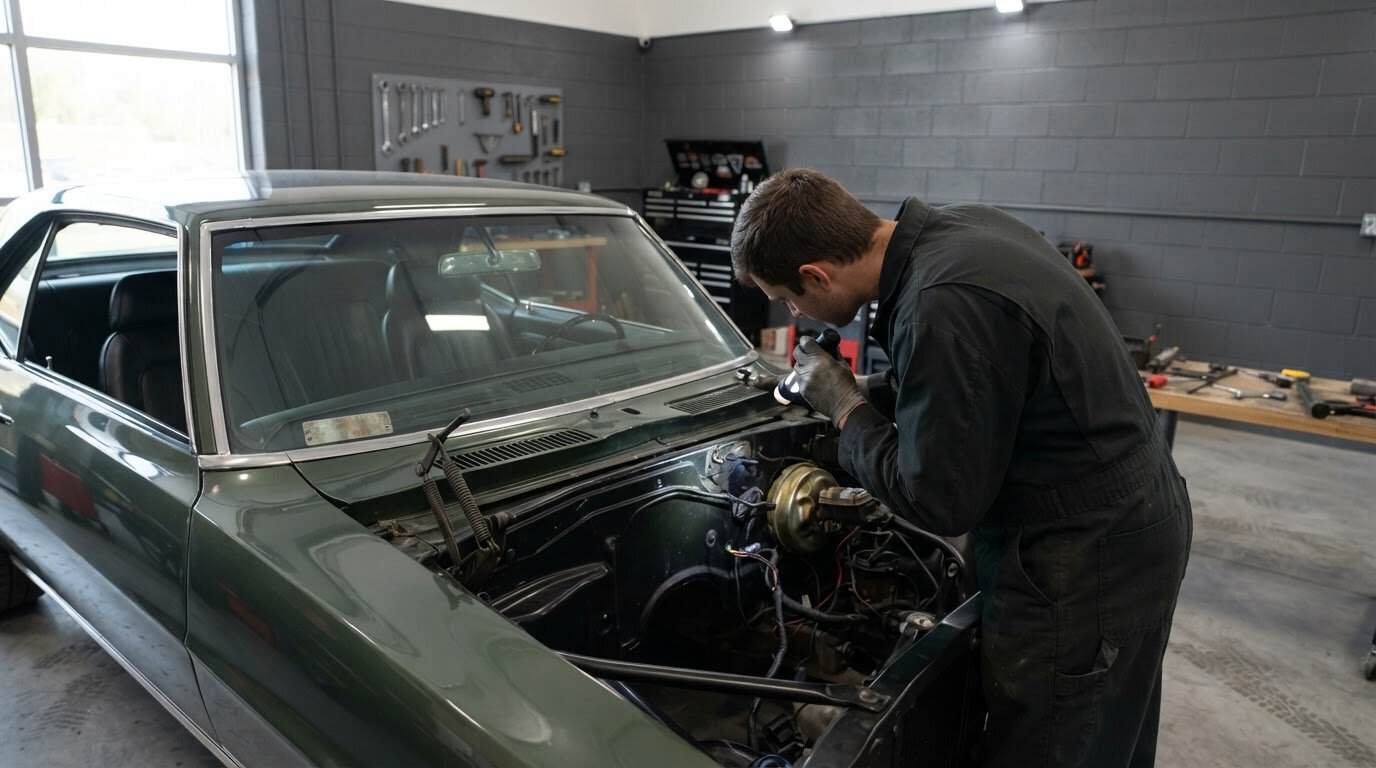
A VIN alone can’t tell the whole authenticity story. To learn how to decode a VIN and trim tag for authenticity, read the VIN for model-year and assembly clues, then compare it with the cowl tag. In the United States, each motor vehicle must contain a 17-character VIN, according to the National Highway Traffic Safety Administration.
That first read is a useful start, but classic VIN formats and tag layouts vary by make and year. The cowl tag may provide another clue: the month and week the body was built. Comparing the VIN and tag can help clarify what the vehicle’s identifiers reveal.
Follow a practical sequence to interpret the VIN, locate the relevant tag, and connect the codes to the vehicle’s specs, model year, manufacturing plant, country, and body build date. You’ll also see why plant information deserves a close look when tracing a car’s history. Take it one code at a time, and the stamped details become a useful guide to the machine’s heritage.
Key Takeaways
- Use the VIN as a starting point for identifying a vehicle’s specifications, then interpret its characters in the context of its make and year.
- Locate the cowl tag and use its date code to add a clue about when the body was built.
- Read the VIN’s model-year position with care, especially when decoding a classic vehicle with an older format.
- Trace plant and country clues through the VIN, and consider them alongside the vehicle’s other identification details.
Can I look up my vehicle specs by VIN number?
Yes. In the United States, each motor vehicle must contain a 17-character vehicle identification number (VIN) that encodes specific information about the vehicle, according to the National Highway Traffic Safety Administration. A VIN decoder can help interpret those details, but classic formats vary by make and year.
Neither a decoder nor a trim tag alone confirms authenticity. The U.S. requirement stated here is that vehicles contain a 17-character VIN; this doesn’t establish other rules for tags or plates.
-
Read Body-Style and Cylinder Indicators
First identify the make and VIN format, then interpret the body-style characters using the matching pattern. For full-size Chevrolet body-style numbers, the first digit designates Chevrolet, the second identifies the series, and the third identifies body style. An odd third digit indicates a six-cylinder engine; an even third digit indicates an eight-cylinder engine.
Don’t apply Chevrolet’s pattern to another make. Some full-size Chevrolet plants displayed a V8 body-style code on the cowl tag regardless of engine size, so use the VIN to distinguish six-cylinder and V8 builds.
-
Identify Engine Details in the VIN
Next, read characters four through eight for information such as manufacturer, engine size, and vehicle type. In Toyota VINs, positions five through eight indicate trim or series, engine type, and often transmission information. These positions differ across manufacturers, so use a guide for the vehicle’s specific format.
To develop a method for how to decode a VIN and trim tag for authenticity, compare the VIN’s engine details with physical identifiers. On Chevrolet V8s, the assembly-stamping pad sits forward of the passenger-side cylinder head, often beneath the alternator. The casting number is near the driver-side bellhousing.
-
Read Trim and Transmission Codes
Read the trim or fender tag with a reference for its make and year. A Mopar example uses E55 for a 340 CID four-barrel V8 engine. Code D21 identifies an A833 four-speed manual transmission.
Keep trim, engine, and transmission codes separate. Their meanings depend on the manufacturer’s format, so compare each decoded detail with the vehicle. One matching code does not verify the vehicle’s complete specification.
-
Compare VIN and Tag Details
To learn how to decode a VIN and trim tag for authenticity, compare both with manufacturer records or a build sheet, checking whether the listed specifications match. A decoder can organize the clues, while a physical inspection can assess the identifiers alongside other evidence.
Disturbed fasteners, uneven spacing, mismatched fonts, fresh paint, or inconsistent stamping depth can warrant closer scrutiny for alteration or replacement. None is conclusive on its own. The cost of reports and inspections depends on their scope, so there is no single cost that applies to every vehicle.
Cowl-tag location and body build date
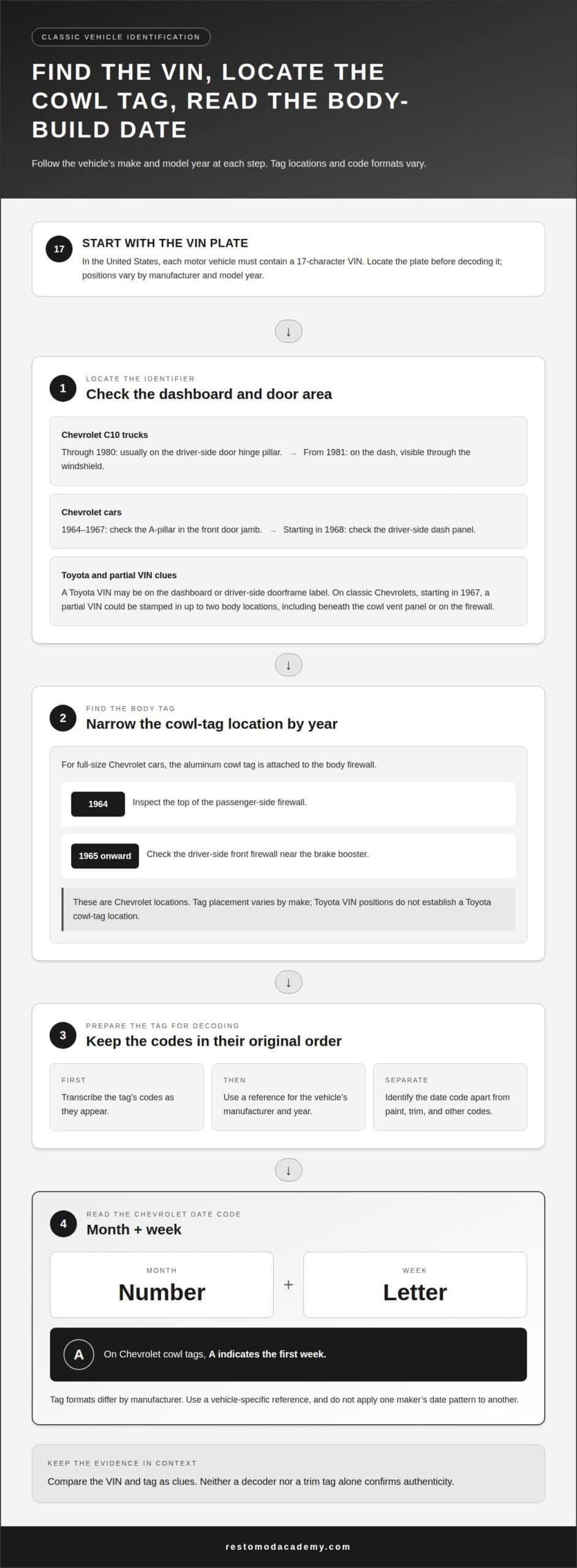
Locate the VIN plate and cowl tag before decoding either. Their positions and formats vary by manufacturer and model year.
-
Locate the VIN Plate and Partial VINs
Inspect the driver-side dashboard through the windshield, then check the driver-side doorframe. Chevrolet C10 trucks through 1980 usually carry the VIN plate on the driver-side door hinge pillar; from 1981, it’s on the dash, visible through the windshield. On Chevrolet cars from 1964-1967, look at the A-pillar in the front door jamb; starting in 1968, check the driver-side dash panel.
For a classic Chevrolet, also look for a partial VIN. Starting in 1967, it could be stamped in up to two body locations, including beneath the cowl vent panel or on the firewall. A Toyota VIN may also be found on the dashboard or driver-side doorframe label.
-
Find the Trim or Cowl Tag
Search the firewall for a Chevrolet cowl tag, then use the model year to narrow the location. On full-size Chevrolet cars, the aluminum tag is attached to the body firewall. For 1964 models, inspect the passenger-side firewall’s top; starting in 1965, check the driver-side front firewall near the brake booster.
That year-specific approach matters because tag placement varies by make. Toyota VIN positions identify information within the VIN, not a Toyota-specific cowl-tag location. Don’t assume a Chevrolet firewall location applies to another manufacturer.
-
Read the Tag Format and Build Date
Transcribe the tag’s codes in their original order, then interpret them using a reference for that manufacturer and year. When decoding a classic cowl tag, separate the date code from paint, trim, and other codes instead of treating the string as one continuous identifier.
On Chevrolet cowl tags, the body build date gives the month and week: the month is a number, and the week is a letter, with A indicating the first week. Tag codes can use different formats, so check a reference specific to the vehicle’s manufacturer. These formats differ, so don’t apply one maker’s date pattern to another.

Finding a vehicle’s model year from its VIN
Start with the VIN format for the vehicle’s make and year. The model-year position depends on that format, particularly for classic trucks.
-
Identify the Model-Year Code
Locate the model-year position for the vehicle’s specific VIN format. The 10th character of a vehicle’s VIN can help identify its model year, according to the National Highway Traffic Safety Administration. On Toyota VINs, the 10th position indicates the model year; the letter A can represent 1980 or 2010, so interpret it with the vehicle’s broader context.
For a 1966-1970 Mopar VIN, don’t use the modern 10th-character method. Older Mopar VIN formats may use different positions to indicate the model year, so match the code to the vehicle’s specific format. Match the code to the correct make-specific format before assigning a year.
-
Confirm the Year and Truck Series
Check the VIN’s length and sequence against the Chevrolet C10 year range before reading its model-year code. A 1967-1971 C10 VIN has 12 characters; the 1972 format has 13. Square-body C10 trucks use 13 characters through 1980, then 17 characters from 1981. These changes matter because the same position may not carry the same meaning across formats.
Use the VIN’s series and year clues together, then compare them with the vehicle’s identification details. For a C10, distinguish the half-ton, two-wheel-drive model from a K10 four-wheel-drive truck; C20 and C30 models are heavier-duty. Owners can use these identifiers to assess whether the truck series aligns with the stated model year. Treat a mismatch as a reason to review the format and sequence again, not to force one character into a modern decoding chart.
Finding a vehicle’s plant and country of manufacture
Interpret plant clues using the VIN format for the vehicle’s make and year. A plant code identifies an assembly location, but may not establish the country on its own.
-
Identify the Manufacturing Plant
Find the plant-code position in a make-specific VIN guide, then match its character to the listed factory. In the Mopar example, the third character shows where the vehicle was built, and the letter R indicates the assembly plant. Toyota uses a different position: its 11th VIN position identifies the assembly plant.
Keep the manufacturer and model year beside the code as you decode it. A letter can mean different things across formats, so don’t transfer Mopar’s R to a Toyota VIN. For a 1970 Mopar example, fender-tag code N0B identifies a vehicle built at Hamtramck. Use that tag clue as a cross-check, not as a universal code.
-
Identify the Country of Manufacture
After identifying the factory, use manufacturer records for that make and year to establish which country the plant belongs to. The plant name links a VIN character to a country; don’t assume a single letter has the same meaning across manufacturers.
Account for older formats before drawing a conclusion. Canadian Chevrolet VINs made before 1967 did not include an assembly-plant code, so that VIN cannot supply a plant identifier in the same way. For these vehicles, separate what the VIN tells you from what requires a plant or production record. Record the decoded plant and country together, then compare them with the vehicle’s other identification details. This approach keeps a country-of-manufacture conclusion tied to the specific factory, rather than a guess based on the badge or model name.
Restomod Academy
Restomod Academy helps classic-car enthusiasts turn vehicle research into informed restoration and modification decisions. Once VIN and tag clues clarify a car’s starting point, its educational resources can help you consider the wider project, from preserving the car’s character to planning modern upgrades.
Use The Ultimate Restomod Guide to learn about the restomod process, or consider Restomod Consulting Services for guidance on shaping a project around your vehicle and goals. Premium Project Blueprints can support planning as you move from research toward hands-on work. These resources complement identification research; they don’t replace records or a physical inspection when authenticity is in question.
Keep decoded details and project questions together as you plan your next step. Contact Restomod Academy to discuss your restoration goals.
Build Your Next Step on a Clear Foundation
Knowing how to decode a VIN and trim tag for authenticity gives your restoration plan a stronger starting point. Use the research to guide decisions, from preserving the car’s original character to choosing thoughtful modernization. The aim isn’t simply to collect codes, but to understand the story they support and make deliberate choices about the vehicle you want to build.
Keep your notes, photographs, and questions together as the project takes shape. This record can help you explain your priorities, revisit decisions, and keep the work aligned with your vision. Leave room to learn as you go. Each considered decision brings the finished car closer to the balance of heritage and modern performance you want.
Start a conversation with Restomod Academy about the direction you want to take. Your next step can begin with a clear question and a willingness to build with purpose.
Frequently Asked Questions
How do you decode a VIN?
Decode a VIN by identifying its manufacturer and model-year format, then interpreting its character groups with a matching guide. Copy the identifier carefully, preserving every letter and digit, and compare the decoded details with the vehicle and its paperwork. For a Toyota, the ninth character is a check digit calculated from the other VIN characters, providing a way to check the identifier’s validity.
Can my VIN number tell me what engine I have?
A VIN can indicate the engine installed when the vehicle was built, depending on its make-specific format. It cannot confirm that the same engine remains in the car today. If a previous owner replaced the engine, compare the VIN’s engine information with the engine’s stamped identifiers and casting number. These physical markings can help distinguish the original specification from a later drivetrain change.
How do I find out what options my car was ordered with?
Look for a factory build sheet or decode the vehicle’s accessory codes using records for its make and model year. For 1964-1967 full-size Chevrolets, Fisher Body accessory-code references can help interpret tag entries, but no known factory documentation lists every code. Treat an unfamiliar entry carefully, and distinguish factory-order information from equipment added by a later owner.
How do you find out what features a car has?
Start with the vehicle label and identification tags, then compare their details with the equipment currently installed. A Toyota VIN, for example, can provide information about series, engine type, and often transmission, while a vehicle label may add other details. For a classic car, distinguish original specifications from later upgrades, since installed features may differ from the factory configuration.
How do you tell what year your car is?
Use the model-year character only after identifying the VIN format for your vehicle’s manufacturer. A Toyota VIN’s tenth character indicates model year, but a letter can recur across different year cycles. For instance, A can represent 1980 or 2010. Use the vehicle’s overall context and applicable records to distinguish between those possibilities rather than relying on the letter alone.
What does each character mean?
Each VIN character has a position-specific meaning, interpreted according to the manufacturer and format. In a Toyota VIN, the first three positions identify make, model, and manufacturer; the fourth indicates safety features; the ninth is a check digit; the tenth indicates model year; and the eleventh identifies the assembly plant. Positions twelve through seventeen are serial or production numbers for that vehicle.
A VIN alone can’t tell the whole authenticity story. To learn how to decode a VIN and trim tag for authenticity, read the VIN for model-year and assembly clues, then compare it with the cowl tag. In the United States, each motor vehicle must contain a 17-character VIN, according to the National Highway Traffic Safety Administration.
That first read is a useful start, but classic VIN formats and tag layouts vary by make and year. The cowl tag may provide another clue: the month and week the body was built. Comparing the VIN and tag can help clarify what the vehicle’s identifiers reveal.
Follow a practical sequence to interpret the VIN, locate the relevant tag, and connect the codes to the vehicle’s specs, model year, manufacturing plant, country, and body build date. You’ll also see why plant information deserves a close look when tracing a car’s history. Take it one code at a time, and the stamped details become a useful guide to the machine’s heritage.
Key Takeaways
- Use the VIN as a starting point for identifying a vehicle’s specifications, then interpret its characters in the context of its make and year.
- Locate the cowl tag and use its date code to add a clue about when the body was built.
- Read the VIN’s model-year position with care, especially when decoding a classic vehicle with an older format.
- Trace plant and country clues through the VIN, and consider them alongside the vehicle’s other identification details.
Can I look up my vehicle specs by VIN number?
Yes. In the United States, each motor vehicle must contain a 17-character vehicle identification number (VIN) that encodes specific information about the vehicle, according to the National Highway Traffic Safety Administration. A VIN decoder can help interpret those details, but classic formats vary by make and year.
Neither a decoder nor a trim tag alone confirms authenticity. The U.S. requirement stated here is that vehicles contain a 17-character VIN; this doesn’t establish other rules for tags or plates.
-
Read Body-Style and Cylinder Indicators
First identify the make and VIN format, then interpret the body-style characters using the matching pattern. For full-size Chevrolet body-style numbers, the first digit designates Chevrolet, the second identifies the series, and the third identifies body style. An odd third digit indicates a six-cylinder engine; an even third digit indicates an eight-cylinder engine.
Don’t apply Chevrolet’s pattern to another make. Some full-size Chevrolet plants displayed a V8 body-style code on the cowl tag regardless of engine size, so use the VIN to distinguish six-cylinder and V8 builds.
-
Identify Engine Details in the VIN
Next, read characters four through eight for information such as manufacturer, engine size, and vehicle type. In Toyota VINs, positions five through eight indicate trim or series, engine type, and often transmission information. These positions differ across manufacturers, so use a guide for the vehicle’s specific format.
To develop a method for how to decode a VIN and trim tag for authenticity, compare the VIN’s engine details with physical identifiers. On Chevrolet V8s, the assembly-stamping pad sits forward of the passenger-side cylinder head, often beneath the alternator. The casting number is near the driver-side bellhousing.
-
Read Trim and Transmission Codes
Read the trim or fender tag with a reference for its make and year. A Mopar example uses E55 for a 340 CID four-barrel V8 engine. Code D21 identifies an A833 four-speed manual transmission.
Keep trim, engine, and transmission codes separate. Their meanings depend on the manufacturer’s format, so compare each decoded detail with the vehicle. One matching code does not verify the vehicle’s complete specification.
-
Compare VIN and Tag Details
To learn how to decode a VIN and trim tag for authenticity, compare both with manufacturer records or a build sheet, checking whether the listed specifications match. A decoder can organize the clues, while a physical inspection can assess the identifiers alongside other evidence.
Disturbed fasteners, uneven spacing, mismatched fonts, fresh paint, or inconsistent stamping depth can warrant closer scrutiny for alteration or replacement. None is conclusive on its own. The cost of reports and inspections depends on their scope, so there is no single cost that applies to every vehicle.
Cowl-tag location and body build date
Locate the VIN plate and cowl tag before decoding either. Their positions and formats vary by manufacturer and model year.
-
Locate the VIN Plate and Partial VINs
Inspect the driver-side dashboard through the windshield, then check the driver-side doorframe. Chevrolet C10 trucks through 1980 usually carry the VIN plate on the driver-side door hinge pillar; from 1981, it’s on the dash, visible through the windshield. On Chevrolet cars from 1964-1967, look at the A-pillar in the front door jamb; starting in 1968, check the driver-side dash panel.
For a classic Chevrolet, also look for a partial VIN. Starting in 1967, it could be stamped in up to two body locations, including beneath the cowl vent panel or on the firewall. A Toyota VIN may also be found on the dashboard or driver-side doorframe label.
-
Find the Trim or Cowl Tag
Search the firewall for a Chevrolet cowl tag, then use the model year to narrow the location. On full-size Chevrolet cars, the aluminum tag is attached to the body firewall. For 1964 models, inspect the passenger-side firewall’s top; starting in 1965, check the driver-side front firewall near the brake booster.
That year-specific approach matters because tag placement varies by make. Toyota VIN positions identify information within the VIN, not a Toyota-specific cowl-tag location. Don’t assume a Chevrolet firewall location applies to another manufacturer.
-
Read the Tag Format and Build Date
Transcribe the tag’s codes in their original order, then interpret them using a reference for that manufacturer and year. When decoding a classic cowl tag, separate the date code from paint, trim, and other codes instead of treating the string as one continuous identifier.
On Chevrolet cowl tags, the body build date gives the month and week: the month is a number, and the week is a letter, with A indicating the first week. Tag codes can use different formats, so check a reference specific to the vehicle’s manufacturer. These formats differ, so don’t apply one maker’s date pattern to another.
Finding a vehicle’s model year from its VIN
Start with the VIN format for the vehicle’s make and year. The model-year position depends on that format, particularly for classic trucks.
-
Identify the Model-Year Code
Locate the model-year position for the vehicle’s specific VIN format. The 10th character of a vehicle’s VIN can help identify its model year, according to the National Highway Traffic Safety Administration. On Toyota VINs, the 10th position indicates the model year; the letter A can represent 1980 or 2010, so interpret it with the vehicle’s broader context.
For a 1966-1970 Mopar VIN, don’t use the modern 10th-character method. Older Mopar VIN formats may use different positions to indicate the model year, so match the code to the vehicle’s specific format. Match the code to the correct make-specific format before assigning a year.
-
Confirm the Year and Truck Series
Check the VIN’s length and sequence against the Chevrolet C10 year range before reading its model-year code. A 1967-1971 C10 VIN has 12 characters; the 1972 format has 13. Square-body C10 trucks use 13 characters through 1980, then 17 characters from 1981. These changes matter because the same position may not carry the same meaning across formats.
Use the VIN’s series and year clues together, then compare them with the vehicle’s identification details. For a C10, distinguish the half-ton, two-wheel-drive model from a K10 four-wheel-drive truck; C20 and C30 models are heavier-duty. Owners can use these identifiers to assess whether the truck series aligns with the stated model year. Treat a mismatch as a reason to review the format and sequence again, not to force one character into a modern decoding chart.
Finding a vehicle’s plant and country of manufacture
Interpret plant clues using the VIN format for the vehicle’s make and year. A plant code identifies an assembly location, but may not establish the country on its own.
-
Identify the Manufacturing Plant
Find the plant-code position in a make-specific VIN guide, then match its character to the listed factory. In the Mopar example, the third character shows where the vehicle was built, and the letter R indicates the assembly plant. Toyota uses a different position: its 11th VIN position identifies the assembly plant.
Keep the manufacturer and model year beside the code as you decode it. A letter can mean different things across formats, so don’t transfer Mopar’s R to a Toyota VIN. For a 1970 Mopar example, fender-tag code N0B identifies a vehicle built at Hamtramck. Use that tag clue as a cross-check, not as a universal code.
-
Identify the Country of Manufacture
After identifying the factory, use manufacturer records for that make and year to establish which country the plant belongs to. The plant name links a VIN character to a country; don’t assume a single letter has the same meaning across manufacturers.
Account for older formats before drawing a conclusion. Canadian Chevrolet VINs made before 1967 did not include an assembly-plant code, so that VIN cannot supply a plant identifier in the same way. For these vehicles, separate what the VIN tells you from what requires a plant or production record. Record the decoded plant and country together, then compare them with the vehicle’s other identification details. This approach keeps a country-of-manufacture conclusion tied to the specific factory, rather than a guess based on the badge or model name.
Restomod Academy
Restomod Academy helps classic-car enthusiasts turn vehicle research into informed restoration and modification decisions. Once VIN and tag clues clarify a car’s starting point, its educational resources can help you consider the wider project, from preserving the car’s character to planning modern upgrades.
Use The Ultimate Restomod Guide to learn about the restomod process, or consider Restomod Consulting Services for guidance on shaping a project around your vehicle and goals. Premium Project Blueprints can support planning as you move from research toward hands-on work. These resources complement identification research; they don’t replace records or a physical inspection when authenticity is in question.
Keep decoded details and project questions together as you plan your next step. Contact Restomod Academy to discuss your restoration goals.
Build Your Next Step on a Clear Foundation
Knowing how to decode a VIN and trim tag for authenticity gives your restoration plan a stronger starting point. Use the research to guide decisions, from preserving the car’s original character to choosing thoughtful modernization. The aim isn’t simply to collect codes, but to understand the story they support and make deliberate choices about the vehicle you want to build.
Keep your notes, photographs, and questions together as the project takes shape. This record can help you explain your priorities, revisit decisions, and keep the work aligned with your vision. Leave room to learn as you go. Each considered decision brings the finished car closer to the balance of heritage and modern performance you want.
Start a conversation with Restomod Academy about the direction you want to take. Your next step can begin with a clear question and a willingness to build with purpose.
Frequently Asked Questions
How do you decode a VIN?
Decode a VIN by identifying its manufacturer and model-year format, then interpreting its character groups with a matching guide. Copy the identifier carefully, preserving every letter and digit, and compare the decoded details with the vehicle and its paperwork. For a Toyota, the ninth character is a check digit calculated from the other VIN characters, providing a way to check the identifier’s validity.
Can my VIN number tell me what engine I have?
A VIN can indicate the engine installed when the vehicle was built, depending on its make-specific format. It cannot confirm that the same engine remains in the car today. If a previous owner replaced the engine, compare the VIN’s engine information with the engine’s stamped identifiers and casting number. These physical markings can help distinguish the original specification from a later drivetrain change.
How do I find out what options my car was ordered with?
Look for a factory build sheet or decode the vehicle’s accessory codes using records for its make and model year. For 1964-1967 full-size Chevrolets, Fisher Body accessory-code references can help interpret tag entries, but no known factory documentation lists every code. Treat an unfamiliar entry carefully, and distinguish factory-order information from equipment added by a later owner.
How do you find out what features a car has?
Start with the vehicle label and identification tags, then compare their details with the equipment currently installed. A Toyota VIN, for example, can provide information about series, engine type, and often transmission, while a vehicle label may add other details. For a classic car, distinguish original specifications from later upgrades, since installed features may differ from the factory configuration.
How do you tell what year your car is?
Use the model-year character only after identifying the VIN format for your vehicle’s manufacturer. A Toyota VIN’s tenth character indicates model year, but a letter can recur across different year cycles. For instance, A can represent 1980 or 2010. Use the vehicle’s overall context and applicable records to distinguish between those possibilities rather than relying on the letter alone.
What does each character mean?
Each VIN character has a position-specific meaning, interpreted according to the manufacturer and format. In a Toyota VIN, the first three positions identify make, model, and manufacturer; the fourth indicates safety features; the ninth is a check digit; the tenth indicates model year; and the eleventh identifies the assembly plant. Positions twelve through seventeen are serial or production numbers for that vehicle.