
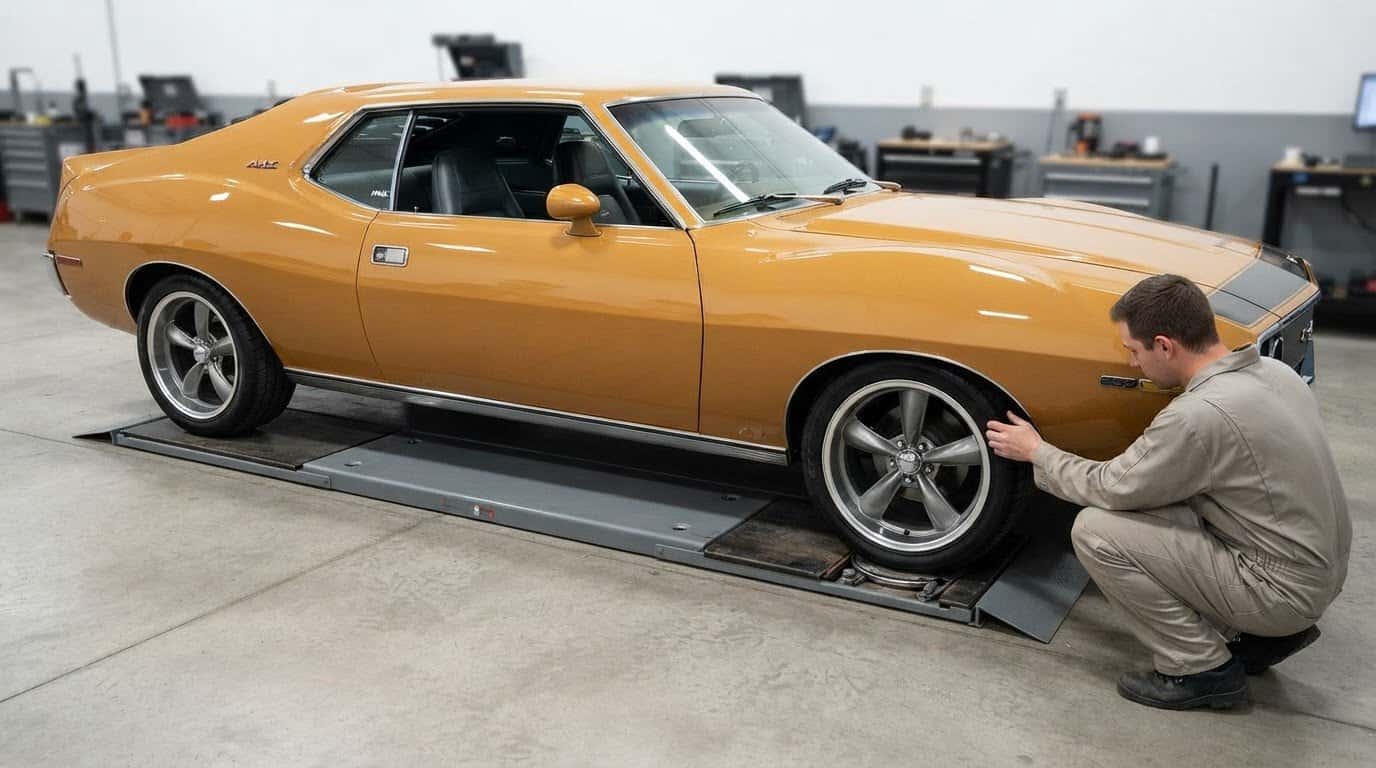
The right stance can make a Javelin restomod feel purposeful without losing its original character. An AMC Javelin restomod project guide starts with the body’s proportions: the 1968 model has a 109-inch wheelbase, while 1971-1974 models measure 110 inches.
That extra inch is only one part of the build. The 1971 AMX’s bold styling gives you a clear design reference, but wheel placement, body fit and drivetrain choices all shape how the finished car looks and drives.
See how to plan around Javelin dimensions, translate 1971 AMX-inspired cues into a cohesive design, and weigh transmission options, including the TorqueFlite 727 offered in AMC passenger cars and fullsize Jeeps after 1972. The examples ahead connect those decisions, so you can preserve the car’s heritage while making deliberate choices for modern performance.
Key Takeaways
- Plan body and chassis changes around the specific Javelin generation, so the finished stance works with the car’s proportions.
- Use 1971 AMX cues as a design reference, then make wheel placement and body fit serve one coherent look.
- Choose a transmission by considering the engine, intended driving character, and how the full drivetrain will work together.
- Match the project year and trim to your build priorities, weighing original configuration against the changes you want to make.
Wheelbase and vehicle dimensions
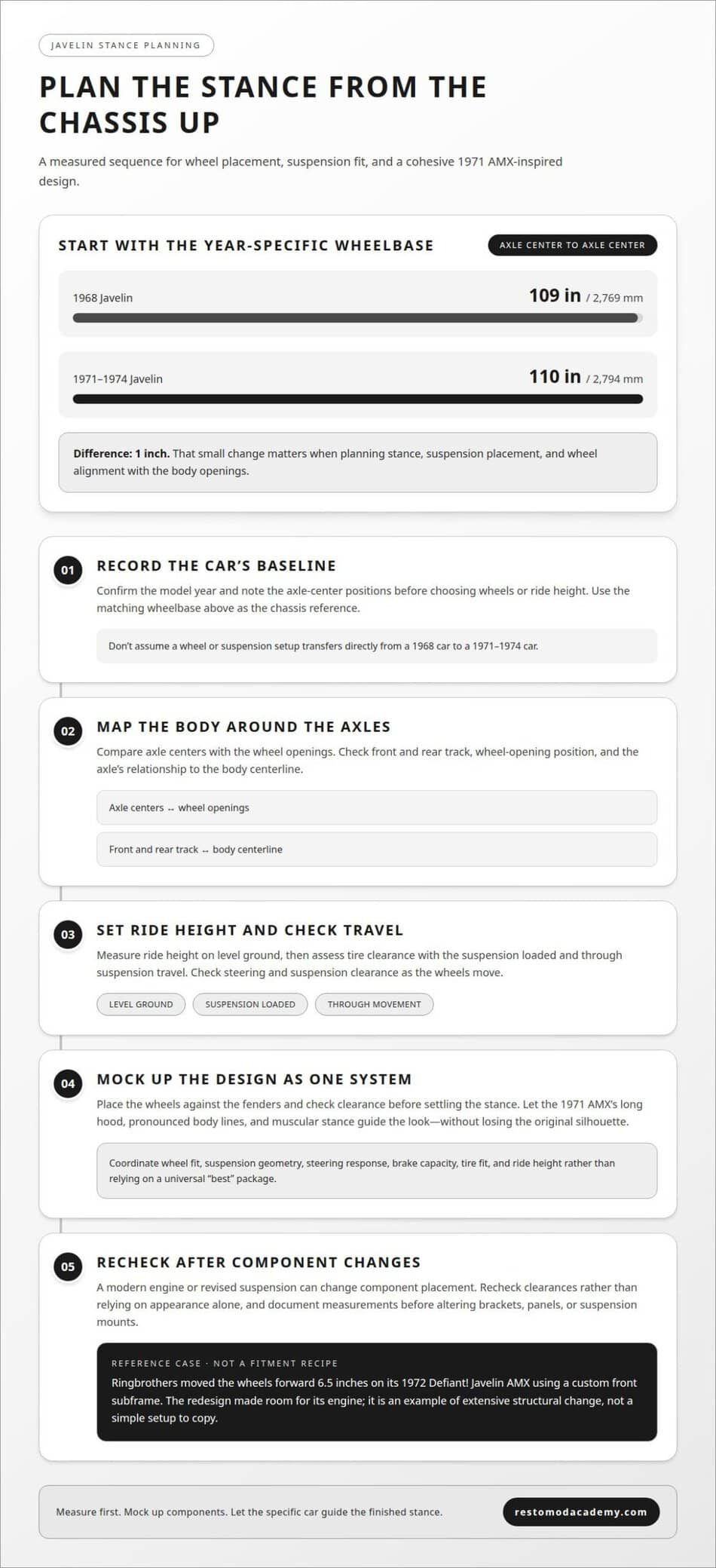
A useful AMC Javelin restomod project guide starts with the chassis, not the wheel choice. The 1968 AMC Javelin has a 109-inch (2,769 mm) wheelbase; 1971-1974 models measure 110 inches (2,794 mm). Wheelbase is the distance between the front and rear axle centers. That one-inch difference matters when planning stance, suspension placement, and wheel alignment with the body openings.
Situation: A 1968 Javelin is being prepared for a restomod, and its proportions must remain recognizable. Action: Record the axle-center positions and compare them with the body’s wheel openings before choosing wheels or ride height. Result: Those measurements give the build a reliable reference, helping avoid a stance that looks misplaced against the original body.
Situation: A 1971-1974 Javelin is the starting point, with different bodywork and a slightly longer wheelbase. Action: Treat its 110-inch measurement as the chassis baseline, then plan suspension and tire clearance around the actual car. Don’t assume a wheel or suspension setup transfers directly from a 1968 model. Result: The design can follow the later car’s proportions instead of forcing an earlier-year fit.
Body dimensions involve more than wheelbase. Check front and rear track, wheel-opening position, tire clearance through suspension travel, and the axle’s relationship to the body centerline. Measure ride height on level ground, then assess clearance with the suspension loaded. These checks can reveal fit issues before final assembly. If a modern engine or revised suspension changes component placement, recheck clearances rather than relying on appearance alone.
Finally, document the measurements before altering brackets, panels, or suspension mounts. A consistent baseline helps distinguish a body-fit problem from a ride-height choice. Keep this AMC Javelin restomod project guide grounded in measured dimensions as you refine the build. Understanding what a restomod involves can clarify how preservation and modification work together. Measure first, mock up components, and let the Javelin’s year-specific dimensions guide the finished stance.
1971 AMC Javelin AMX restomod design
Build around the 1971 AMX’s own character, not a Mustang template. Its long hood, pronounced body lines, and muscular stance create a strong foundation for modern performance. Situation: You want contemporary wheel fitment without losing the original silhouette. Action: Mock up the wheels against the fenders and check steering and suspension clearance through movement. Result: The stance looks intentional, and the body remains the visual anchor.
For suspension, brakes, steering, and wheels, prioritize compatible geometry and clearance rather than a universal “best” package. A project used front disc assemblies from a 1973 Javelin AMX; Kelsey-Hayes brakes use single-piston sliding calipers and vented rotors. Keep steering response, brake capacity, tire fit, and ride height working as one system.
Situation: A builder wants a more dramatic wheel position. Action: Ringbrothers moved the wheels forward 6.5 inches on its 1972 Defiant! Javelin AMX, using a custom front subframe. Result: The car gained room for its engine, but this extensive redesign is an example, not a simple fitment recipe. A 1971 AMX-inspired build can borrow its visual confidence without copying its structural changes.
For a U.S. Javelin, emissions, safety inspection, title, and registration requirements depend on state rules, the model year, powertrain, and modifications. Plan around those requirements from the start. Insurance and resale can also be affected by documented modifications, parts choices, and how clearly the finished build is represented.
Javelin AMX average values sit in the mid-20k range. Parts and complete project-car prices vary with condition, completeness, and rarity. Inspect lower body panels, floor areas, and repaired sections for rust or collision evidence; inventory trim and model-specific pieces before disassembly. Find parts by identifying the exact year, component, and interchange needs, then organize sourcing around reproduction, used, or donor components.
Plan the build in stages: assess the body, set the design, then coordinate chassis, engine, wiring, fuel, cooling, and driveline work. Those systems must suit the chosen engine and transmission; build costs follow the car’s condition, parts scope, and fabrication required. For swap planning, use this LS engine swap guide as a reference for coordinating major systems.
AMC transmission options
Choose the gearbox as part of the complete powertrain, not as an isolated upgrade. AMC passenger cars and fullsize Jeeps could be equipped with a Chrysler TorqueFlite 727 after 1972. That gives a Javelin builder a documented automatic option to consider, while the engine, intended driving character, and supporting components shape the final choice.
Situation: A street-focused Javelin needs an automatic transmission. Action: Match the engine’s bellhousing pattern and output arrangement to the transmission, then plan the mount, crossmember, shifter, and driveshaft. Result: The gearbox becomes part of a coordinated layout, not a late-stage fitment problem. Chrome shifter trim can preserve a period-inspired cabin appearance, but it does not determine mechanical compatibility.
Modern engines and transmissions can be paired with a Javelin, but no universal combination fits every build without changes. Plan for engine and transmission mounts, tunnel clearance, driveshaft length, shifter controls, cooling, wiring, and the rear axle. Each choice affects the next, so settle the powertrain layout before fabricating mounts or finishing the interior.
Situation: A builder wants a manual gearbox and modern engine response. Action: Select the engine and transmission together, then mock up both in the chassis before finalizing the crossmember and driveshaft. Result: The team can resolve clearance and control placement while components are accessible. For an automatic, make the same checks and include cooler routing and shifter operation in the plan.
Compare the transmission’s operating character with the car’s purpose. A relaxed street build may prioritize smooth shifts and usable gearing, while a performance-focused Javelin may need different ratios and stronger supporting components. The engine’s torque, tire choice, axle gearing, and intended use all influence the decision. Before paint, upholstery, or final chrome details, confirm the complete assembly clears the chassis and works with the car’s controls. A deliberate mock-up preserves service access and helps keep the finished cabin clean.
The section identifies the Chrysler TorqueFlite 727 as a documented automatic option, but gives no specific modern engine models. Pair the engine and transmission by bellhousing pattern and output arrangement, and plan for any needed changes to the mounts, crossmember, tunnel clearance, driveshaft, shifter controls, cooling, wiring, and rear axle.
Which AMC Javelin model years and trims are best for a restomod project?
The right starting point depends on your priorities: original character, available performance, or a particular body style. AMC produced Javelins from 1967 through 1974. The second generation began in August 1970 and continued through 1974, giving builders two distinct design eras to consider.
Situation: You want a period-focused early build with a performance drivetrain. Action: Consider a 1968-1969 Javelin SST or AMX with a four-speed and a 343- or 390-cubic-inch engine. The 390 was rated at 315 hp in those model years. Result: This combination offers a strong foundation for a restomod that keeps its early muscle-car identity.
Situation: Your design direction favors the second-generation body. Action: Compare 1970-1974 cars by condition, trim, and the engine already in place. Engine availability and rated output can vary by model year and configuration. For 1971, the 304 V8 was rated at 210 hp, while the 401 V8 was rated at 330 hp. Result: Engine choice can shape how much of the original powertrain your project retains or replaces.
AMX trim can suit a performance-led build, but it isn’t the only workable starting point. AMC produced almost 16,000 Javelin AMX-edition cars between 1971 and 1974. That gives buyers a meaningful range of AMX examples to assess, while a non-AMX Javelin can support a distinct custom direction.
Make the decision methodically. First choose the generation and body style you want; then assess rust, completeness, and drivetrain condition. Next, match the trim and existing engine to your planned changes. A sound, complete car may simplify the build, while a rare configuration may make preservation a higher priority. Use a structured Javelin project plan to weigh those trade-offs before choosing your starting car.
Restomod Academy: The Ultimate Restomod Guide
Restomod Academy’s The Ultimate Restomod Guide helps organize the decisions behind a classic-car build, from choosing a starting vehicle to planning restoration and reassembly. Use it when your Javelin’s body, styling, and drivetrain choices need to come together in a clear project plan.
For a build that needs a more specific roadmap, Premium Project Blueprints can help shape the project around its intended direction. Restomod Consulting Services can help you work through decisions when fitment, scope, or sequencing feels difficult to resolve. These resources help connect the Javelin’s original character with the modern systems you want, while keeping each stage purposeful.
Have a Javelin project in mind or a decision you’re ready to work through? Contact Restomod Academy to discuss your next step.
Set Your Javelin’s Direction
The strongest builds begin with a clear idea of how the finished car should feel, not a pile of parts. Decide what you want to preserve, where modern performance matters most, and which compromises you can accept. Then turn that direction into a sequence of choices, so each change supports the next instead of pulling the project off course.
Use this AMC Javelin restomod project guide to set your priorities. A defined plan makes it easier to preserve the car’s character while giving your craftsmanship room to show. You don’t need to solve every detail at once. Choose the next decision, document it, and build carefully from there.
If you’re ready to work through your project’s direction, contact Restomod Academy about your project. Take the first deliberate step, and let the finished Javelin reflect the thought you put into every choice.
Frequently Asked Questions
What is the current price range for AMC Javelin project cars and parts?
Project-car and parts prices vary with condition, completeness, and rarity.
Which modern engines and transmissions fit an AMC Javelin, and what modifications are needed?
The guide names no specific modern engine combinations. AMC passenger cars and fullsize Jeeps could use a Chrysler TorqueFlite 727 after 1972; match the engine and transmission by bellhousing pattern and output arrangement, and plan for mounts, crossmember, tunnel clearance, driveshaft, shifter controls, cooling, wiring, and rear axle changes.
Where can I find AMC Javelin restoration parts, reproduction body panels, and specialist shops?
Identify the exact year, component, and interchange needs, then look to reproduction, used, or donor components. The material gives no specific parts suppliers or specialist shops.
What are the main steps and typical costs for an AMC Javelin restomod build?
Assess the body, set the design, then coordinate chassis, engine, wiring, fuel, cooling, and driveline work. Costs depend on the car’s condition, parts scope, and fabrication required.
What wiring, fuel-system, cooling, and driveline issues commonly arise during an AMC Javelin swap?
Coordinate wiring, fuel, cooling, and driveline work with the chosen engine and transmission. Mock up the powertrain and check mounts, tunnel clearance, driveshaft length, shifter controls, cooling, wiring, and rear-axle compatibility before fabrication and final assembly.
What insurance, safety, and resale risks should I consider before starting an AMC Javelin restomod?
State safety-inspection requirements depend on the model year, powertrain, and modifications. Insurance and resale can be affected by documented modifications, parts choices, and how clearly the finished build is represented. During planning, check fit and clearance throughout suspension travel.
The right stance can make a Javelin restomod feel purposeful without losing its original character. An AMC Javelin restomod project guide starts with the body’s proportions: the 1968 model has a 109-inch wheelbase, while 1971-1974 models measure 110 inches.
That extra inch is only one part of the build. The 1971 AMX’s bold styling gives you a clear design reference, but wheel placement, body fit and drivetrain choices all shape how the finished car looks and drives.
See how to plan around Javelin dimensions, translate 1971 AMX-inspired cues into a cohesive design, and weigh transmission options, including the TorqueFlite 727 offered in AMC passenger cars and fullsize Jeeps after 1972. The examples ahead connect those decisions, so you can preserve the car’s heritage while making deliberate choices for modern performance.
Key Takeaways
- Plan body and chassis changes around the specific Javelin generation, so the finished stance works with the car’s proportions.
- Use 1971 AMX cues as a design reference, then make wheel placement and body fit serve one coherent look.
- Choose a transmission by considering the engine, intended driving character, and how the full drivetrain will work together.
- Match the project year and trim to your build priorities, weighing original configuration against the changes you want to make.
Wheelbase and vehicle dimensions
A useful AMC Javelin restomod project guide starts with the chassis, not the wheel choice. The 1968 AMC Javelin has a 109-inch (2,769 mm) wheelbase; 1971-1974 models measure 110 inches (2,794 mm). Wheelbase is the distance between the front and rear axle centers. That one-inch difference matters when planning stance, suspension placement, and wheel alignment with the body openings.
Situation: A 1968 Javelin is being prepared for a restomod, and its proportions must remain recognizable. Action: Record the axle-center positions and compare them with the body’s wheel openings before choosing wheels or ride height. Result: Those measurements give the build a reliable reference, helping avoid a stance that looks misplaced against the original body.
Situation: A 1971-1974 Javelin is the starting point, with different bodywork and a slightly longer wheelbase. Action: Treat its 110-inch measurement as the chassis baseline, then plan suspension and tire clearance around the actual car. Don’t assume a wheel or suspension setup transfers directly from a 1968 model. Result: The design can follow the later car’s proportions instead of forcing an earlier-year fit.
Body dimensions involve more than wheelbase. Check front and rear track, wheel-opening position, tire clearance through suspension travel, and the axle’s relationship to the body centerline. Measure ride height on level ground, then assess clearance with the suspension loaded. These checks can reveal fit issues before final assembly. If a modern engine or revised suspension changes component placement, recheck clearances rather than relying on appearance alone.
Finally, document the measurements before altering brackets, panels, or suspension mounts. A consistent baseline helps distinguish a body-fit problem from a ride-height choice. Keep this AMC Javelin restomod project guide grounded in measured dimensions as you refine the build. Understanding what a restomod involves can clarify how preservation and modification work together. Measure first, mock up components, and let the Javelin’s year-specific dimensions guide the finished stance.
1971 AMC Javelin AMX restomod design
Build around the 1971 AMX’s own character, not a Mustang template. Its long hood, pronounced body lines, and muscular stance create a strong foundation for modern performance. Situation: You want contemporary wheel fitment without losing the original silhouette. Action: Mock up the wheels against the fenders and check steering and suspension clearance through movement. Result: The stance looks intentional, and the body remains the visual anchor.
For suspension, brakes, steering, and wheels, prioritize compatible geometry and clearance rather than a universal “best” package. A project used front disc assemblies from a 1973 Javelin AMX; Kelsey-Hayes brakes use single-piston sliding calipers and vented rotors. Keep steering response, brake capacity, tire fit, and ride height working as one system.
Situation: A builder wants a more dramatic wheel position. Action: Ringbrothers moved the wheels forward 6.5 inches on its 1972 Defiant! Javelin AMX, using a custom front subframe. Result: The car gained room for its engine, but this extensive redesign is an example, not a simple fitment recipe. A 1971 AMX-inspired build can borrow its visual confidence without copying its structural changes.
For a U.S. Javelin, emissions, safety inspection, title, and registration requirements depend on state rules, the model year, powertrain, and modifications. Plan around those requirements from the start. Insurance and resale can also be affected by documented modifications, parts choices, and how clearly the finished build is represented.
Javelin AMX average values sit in the mid-20k range. Parts and complete project-car prices vary with condition, completeness, and rarity. Inspect lower body panels, floor areas, and repaired sections for rust or collision evidence; inventory trim and model-specific pieces before disassembly. Find parts by identifying the exact year, component, and interchange needs, then organize sourcing around reproduction, used, or donor components.
Plan the build in stages: assess the body, set the design, then coordinate chassis, engine, wiring, fuel, cooling, and driveline work. Those systems must suit the chosen engine and transmission; build costs follow the car’s condition, parts scope, and fabrication required. For swap planning, use this LS engine swap guide as a reference for coordinating major systems.
AMC transmission options
Choose the gearbox as part of the complete powertrain, not as an isolated upgrade. AMC passenger cars and fullsize Jeeps could be equipped with a Chrysler TorqueFlite 727 after 1972. That gives a Javelin builder a documented automatic option to consider, while the engine, intended driving character, and supporting components shape the final choice.
Situation: A street-focused Javelin needs an automatic transmission. Action: Match the engine’s bellhousing pattern and output arrangement to the transmission, then plan the mount, crossmember, shifter, and driveshaft. Result: The gearbox becomes part of a coordinated layout, not a late-stage fitment problem. Chrome shifter trim can preserve a period-inspired cabin appearance, but it does not determine mechanical compatibility.
Modern engines and transmissions can be paired with a Javelin, but no universal combination fits every build without changes. Plan for engine and transmission mounts, tunnel clearance, driveshaft length, shifter controls, cooling, wiring, and the rear axle. Each choice affects the next, so settle the powertrain layout before fabricating mounts or finishing the interior.
Situation: A builder wants a manual gearbox and modern engine response. Action: Select the engine and transmission together, then mock up both in the chassis before finalizing the crossmember and driveshaft. Result: The team can resolve clearance and control placement while components are accessible. For an automatic, make the same checks and include cooler routing and shifter operation in the plan.
Compare the transmission’s operating character with the car’s purpose. A relaxed street build may prioritize smooth shifts and usable gearing, while a performance-focused Javelin may need different ratios and stronger supporting components. The engine’s torque, tire choice, axle gearing, and intended use all influence the decision. Before paint, upholstery, or final chrome details, confirm the complete assembly clears the chassis and works with the car’s controls. A deliberate mock-up preserves service access and helps keep the finished cabin clean.
The section identifies the Chrysler TorqueFlite 727 as a documented automatic option, but gives no specific modern engine models. Pair the engine and transmission by bellhousing pattern and output arrangement, and plan for any needed changes to the mounts, crossmember, tunnel clearance, driveshaft, shifter controls, cooling, wiring, and rear axle.
Which AMC Javelin model years and trims are best for a restomod project?
The right starting point depends on your priorities: original character, available performance, or a particular body style. AMC produced Javelins from 1967 through 1974. The second generation began in August 1970 and continued through 1974, giving builders two distinct design eras to consider.
Situation: You want a period-focused early build with a performance drivetrain. Action: Consider a 1968-1969 Javelin SST or AMX with a four-speed and a 343- or 390-cubic-inch engine. The 390 was rated at 315 hp in those model years. Result: This combination offers a strong foundation for a restomod that keeps its early muscle-car identity.
Situation: Your design direction favors the second-generation body. Action: Compare 1970-1974 cars by condition, trim, and the engine already in place. Engine availability and rated output can vary by model year and configuration. For 1971, the 304 V8 was rated at 210 hp, while the 401 V8 was rated at 330 hp. Result: Engine choice can shape how much of the original powertrain your project retains or replaces.
AMX trim can suit a performance-led build, but it isn’t the only workable starting point. AMC produced almost 16,000 Javelin AMX-edition cars between 1971 and 1974. That gives buyers a meaningful range of AMX examples to assess, while a non-AMX Javelin can support a distinct custom direction.
Make the decision methodically. First choose the generation and body style you want; then assess rust, completeness, and drivetrain condition. Next, match the trim and existing engine to your planned changes. A sound, complete car may simplify the build, while a rare configuration may make preservation a higher priority. Use a structured Javelin project plan to weigh those trade-offs before choosing your starting car.
Restomod Academy: The Ultimate Restomod Guide
Restomod Academy’s The Ultimate Restomod Guide helps organize the decisions behind a classic-car build, from choosing a starting vehicle to planning restoration and reassembly. Use it when your Javelin’s body, styling, and drivetrain choices need to come together in a clear project plan.
For a build that needs a more specific roadmap, Premium Project Blueprints can help shape the project around its intended direction. Restomod Consulting Services can help you work through decisions when fitment, scope, or sequencing feels difficult to resolve. These resources help connect the Javelin’s original character with the modern systems you want, while keeping each stage purposeful.
Have a Javelin project in mind or a decision you’re ready to work through? Contact Restomod Academy to discuss your next step.
Set Your Javelin’s Direction
The strongest builds begin with a clear idea of how the finished car should feel, not a pile of parts. Decide what you want to preserve, where modern performance matters most, and which compromises you can accept. Then turn that direction into a sequence of choices, so each change supports the next instead of pulling the project off course.
Use this AMC Javelin restomod project guide to set your priorities. A defined plan makes it easier to preserve the car’s character while giving your craftsmanship room to show. You don’t need to solve every detail at once. Choose the next decision, document it, and build carefully from there.
If you’re ready to work through your project’s direction, contact Restomod Academy about your project. Take the first deliberate step, and let the finished Javelin reflect the thought you put into every choice.
Frequently Asked Questions
What is the current price range for AMC Javelin project cars and parts?
Project-car and parts prices vary with condition, completeness, and rarity.
Which modern engines and transmissions fit an AMC Javelin, and what modifications are needed?
The guide names no specific modern engine combinations. AMC passenger cars and fullsize Jeeps could use a Chrysler TorqueFlite 727 after 1972; match the engine and transmission by bellhousing pattern and output arrangement, and plan for mounts, crossmember, tunnel clearance, driveshaft, shifter controls, cooling, wiring, and rear axle changes.
Where can I find AMC Javelin restoration parts, reproduction body panels, and specialist shops?
Identify the exact year, component, and interchange needs, then look to reproduction, used, or donor components. The material gives no specific parts suppliers or specialist shops.
What are the main steps and typical costs for an AMC Javelin restomod build?
Assess the body, set the design, then coordinate chassis, engine, wiring, fuel, cooling, and driveline work. Costs depend on the car’s condition, parts scope, and fabrication required.
What wiring, fuel-system, cooling, and driveline issues commonly arise during an AMC Javelin swap?
Coordinate wiring, fuel, cooling, and driveline work with the chosen engine and transmission. Mock up the powertrain and check mounts, tunnel clearance, driveshaft length, shifter controls, cooling, wiring, and rear-axle compatibility before fabrication and final assembly.
What insurance, safety, and resale risks should I consider before starting an AMC Javelin restomod?
State safety-inspection requirements depend on the model year, powertrain, and modifications. Insurance and resale can be affected by documented modifications, parts choices, and how clearly the finished build is represented. During planning, check fit and clearance throughout suspension travel.