
Why does your prized vintage restoration sound like a tin can full of marbles the moment you hit sixty miles per hour? You’ve spent countless hours perfecting the engine and the paint, yet the experience behind the wheel is often marred by a relentless exhaust drone and heat radiating through the floorpan. It’s a common frustration for enthusiasts who want to maintain heritage aesthetics without sacrificing modern comfort. You shouldn’t have to choose between a classic look and a cabin where you can actually hold a conversation.
I’m here to guide you through the precision process of how to soundproof a classic car interior using a professional three-layer acoustic system. By strategically applying modern materials to dampen vibrations and block airborne noise, you can achieve a documented reduction in cabin noise of 5 to 15 dB. This guide will show you how to master the intersection of damping, decoupling, and blocking to transform your noisy cabin into a quiet sanctuary. We’ll explore the specific steps to eliminate panel resonance and heat transfer, ensuring your finished project reflects the high standard of quality and craftsmanship it deserves.
Key Takeaways
- Identify the primary mechanical and environmental noise contributors to engineer a system that stops vibrations before they reach your ears.
- Discover the professional three-layer method that utilizes damping, decoupling, and blocking to achieve modern cabin silence.
- Follow our methodical guide on how to soundproof a classic car interior to ensure every panel is treated for maximum acoustic efficiency.
- Plan your layout with a zone-based strategy that balances significant cabin noise reduction with the weight-conscious needs of a restomod build.
- Prepare your vehicle using professional-grade cleaning and stripping techniques to guarantee your acoustic materials bond permanently for the life of the car.
Understanding the Acoustic Challenges of Vintage Steel
Vintage steel has a distinct personality, but it also has a specific resonant frequency. When you’re learning how to soundproof a classic car interior, you must first recognize that your cabin is essentially a large, metallic echo chamber. Unlike modern vehicles that use sophisticated unibody dampening, classic cars were built with thin-gauge panels and minimal factory insulation. This creates a high noise floor where mechanical drone from the exhaust, wind turbulence around upright A-pillars, and road impact from the suspension all compete for your attention. The goal of a professional restomod isn’t just to add weight; it’s to lower this noise floor to improve passenger comfort and allow your high-end audio system to shine.
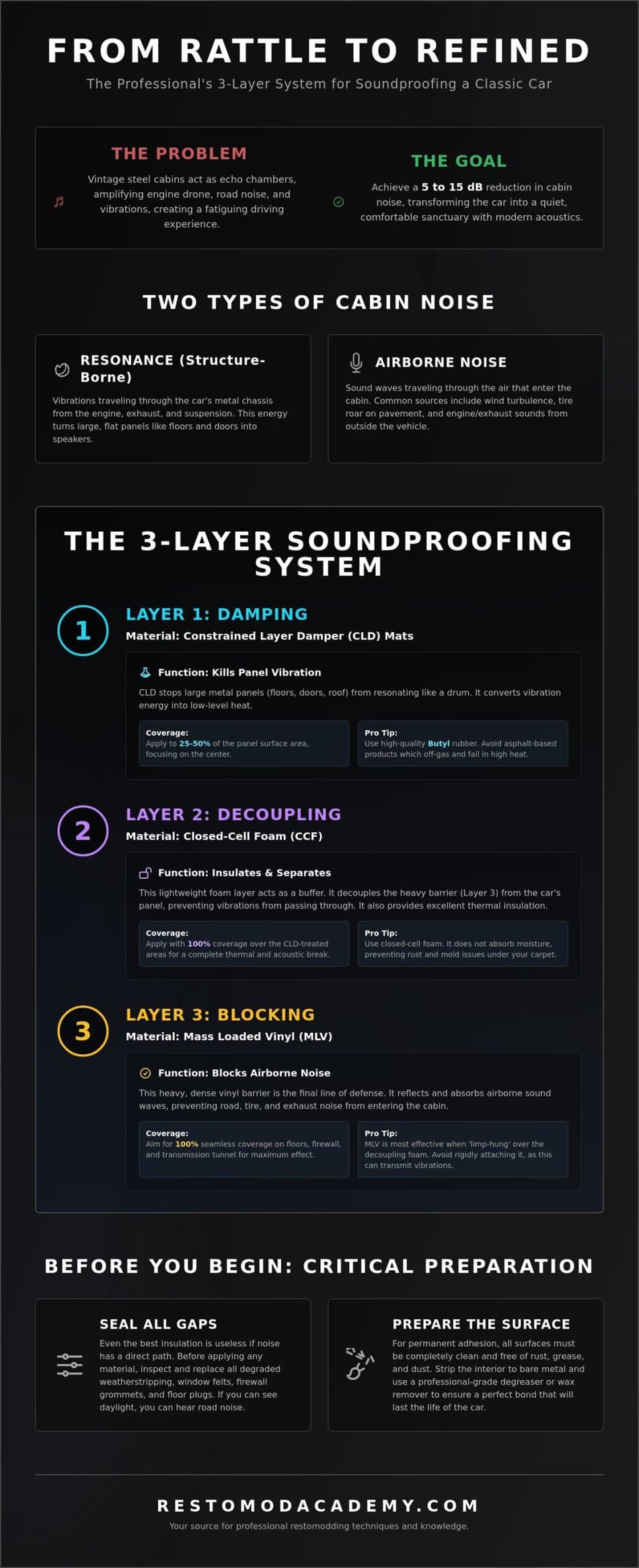
To master this process, you need to understand the fundamental automotive soundproofing principles that govern how energy moves through your vehicle. Soundproofing is a two-part strategy involving vibration control to stop the metal from ringing and sound wave blocking to keep external noise out. By addressing both, you can achieve a documented reduction in cabin noise of 5 to 15 dB, turning a fatiguing highway drive into a refined experience.
To better understand these concepts in a workshop setting, watch this helpful video:
Resonance vs Airborne Noise
Every time your tires hit a seam in the pavement, energy travels through the chassis and turns your flat floorpans into speakers. This is structure-borne resonance. It’s different from airborne noise, such as the whistle of wind through a window gap or the high-pitched whine of a gearbox. A successful project addresses both. You’ll use dense materials to change the resonant frequency of the metal while employing barriers to catch the sounds traveling through the air. Strategic placement is more effective than blind coverage; focusing on the center of large panels often yields the best results without adding unnecessary bulk.
The Role of Interior Seals and Gaps
Even the most expensive acoustic mats will fail if your secondary defenses are down. Before you commit to how to soundproof a classic car interior with heavy layers, inspect your weatherstripping and window felts. Degraded rubber allows wind and road spray to bypass your insulation entirely. Check your firewall for missing grommets and ensure the floor pan plugs are seated tightly. Sealing these small apertures is just as critical as the insulation itself. If you can see daylight through a gap in the door seal, that’s a direct path for noise to enter your sanctuary.
The Three Layer System for Professional Sound Deadening
Many builders start their journey by buying the thickest mat they can find. While enthusiasm is great, understanding the physics behind how to soundproof a classic car interior will save you both time and weight. Professional soundproofing isn’t about bulk; it’s about an engineered system of layers working in harmony. If you simply stick mats everywhere, you’re adding a massive weight penalty without addressing the actual noise paths. Instead, we use a strategic three-layer approach that focuses on damping, decoupling, and blocking to achieve a modern luxury feel in a vintage machine.
Constrained Layer Dampers: Killing the Ring
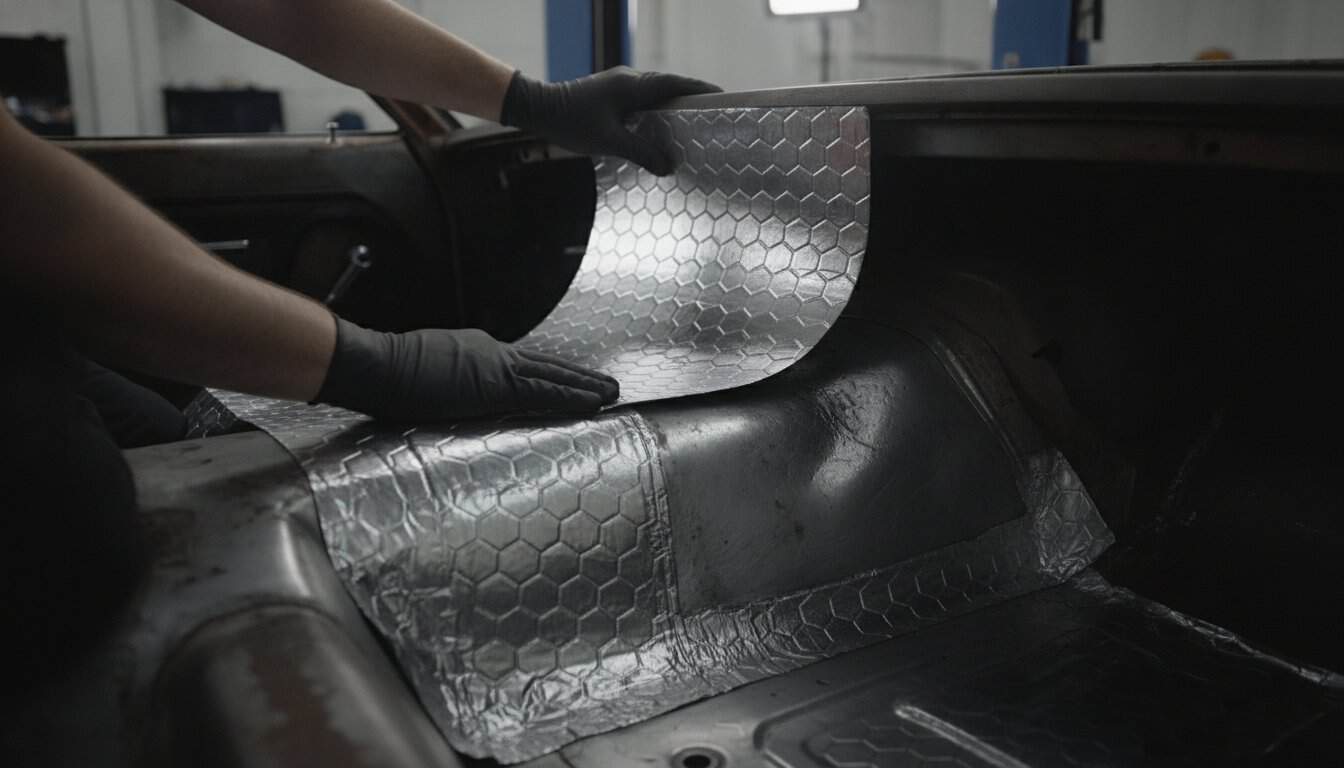
The first layer is the Constrained Layer Damper, or CLD. These mats stop the large, flat metal panels of your car from acting like a drum. When the chassis vibrates, the butyl rubber in the CLD stretches and shears, converting that mechanical motion into low-grade heat. You should avoid asphalt-based products entirely. They’re prone to off-gassing, they smell terrible in the sun, and they can’t handle the high temperatures of a floorpan near a performance exhaust. High-quality butyl is the professional standard for a reason. A scientific analysis of soundproofing materials confirms that the density and elasticity of your chosen material dictate how well it absorbs energy. Remember the rule of thumb: you don’t need 100 percent coverage. Covering 25 to 50 percent of the panel’s surface area is sufficient. Target the center of doors, roof skins, and floor sections to kill the resonance effectively.
Mass Loaded Vinyl and Closed Cell Foam
After you’ve silenced the metal, you need to block the noise that travels through the air. This requires a two-part combination of Closed Cell Foam (CCF) and Mass Loaded Vinyl (MLV). The CCF acts as a decoupler. It’s a thin, flexible layer that prevents the heavy MLV from making direct contact with the car’s vibrating floor. This creates a mechanical break in the sound’s path. The MLV is the heavy hitter. It’s a dense, flexible sheet that reflects sound waves back toward their source rather than letting them pass through.
Achieving a quiet cabin is a hallmark of a high-quality build, and knowing how to soundproof a classic car interior properly means respecting the role of every layer. For a truly professional result, think of these final layers as a floating blanket. Don’t glue the MLV down to every single contour. Instead, drape it over the interior with as few seams as possible. If you’re looking for more ways to refine your build, take a look at our product reviews for tested solutions. This system ensures that road noise stays outside where it belongs, leaving your cabin quiet enough for a modern audio experience and comfortable long-distance cruising.
Evaluating Materials and Planning Your Layout
Planning your layout is the stage where you transition from a general enthusiast to a technical builder. When you map out how to soundproof a classic car interior, you must look at the vehicle as a series of specific acoustic zones. Each area requires a different material density and application technique. A floorpan needs heavy blocking to combat road impact, while a roof skin requires lightweight damping to prevent wind noise without negatively affecting your center of gravity. A methodical approach here prevents the common mistake of adding weight where it isn’t needed.
Before you peel back the first adhesive liner, gather the essential tools required for a professional finish. You’ll need a heavy-duty steel roller to ensure a permanent, air-free bond between the butyl and the metal. High-quality shears or a sharp utility knife are necessary to handle thick mass-loaded vinyl. Finally, never skip the decontamination step. Use a professional-grade wax and grease remover to clean every square inch of the interior sheet metal to ensure your materials don’t peel away over time.
Thermal Insulation Benefits for Restomods
High-performance V8 engines and long-tube headers generate incredible heat that often radiates directly through the firewall and floor. This thermal transfer is a major pain point for vintage owners, especially during long summer cruises. Modern sound deadening materials frequently incorporate foil-backed layers that act as high-performance thermal barriers. By managing this heat transfer, you significantly reduce the load on your vintage air conditioning kit. This creates a cabin that stays cool and comfortable, allowing the mechanical systems to work more efficiently while you enjoy the drive.
Weight Management Strategies
A performance-oriented restomod build requires a careful balance between luxury and agility. You don’t want to turn your car into a lead sled by over-applying heavy materials in every corner. Focus your heaviest layers, like mass-loaded vinyl, on the floorpan and wheel wells where road noise is most aggressive. For the roof and upper door panels, lean toward lighter closed-cell foams and thin damping sheets. This approach honors the patented multi-layer soundproofing system design while protecting your power-to-weight ratio. For a full list of the specific products and rollers I use in the shop, check out our Recommended Gear page. This methodical planning ensures your car remains fast, quiet, and cool without sacrificing the raw performance of your build.
Step by Step Installation for a Quiet Cabin
Executing the physical installation of how to soundproof a classic car interior is where your meticulous planning meets the reality of the workshop. This stage requires a methodical pace. Don’t rush the process. You’re building a foundation that will last for decades, and the quality of your labor here dictates the final acoustic result. Follow this logical progression to ensure every layer performs its intended function.
- Step 1: Strip the cabin entirely. Remove seats, center consoles, and every scrap of old factory jute or carpet.
- Step 2: Apply your damping mats. Focus on the center of large metal panels. Use your roller to press the material into every contour until the foil backing shows the texture of the steel beneath.
- Step 3: Install the closed cell foam layer. This serves as your decoupler. It prevents the heavy top layer from vibrating against the chassis.
- Step 4: Lay the mass loaded vinyl. Unlike the damping mats, this layer requires 100 percent coverage. Think of it as a heavy waterproof suit for your floorpan. Seal every seam with high-quality industrial tape.
- Step 5: Reinstall your trim and carpet. Be prepared for a tight fit. The added thickness of a professional three-layer system can make seat bolts and kick panels a challenge.
Preparing the Surface for Permanent Adhesion
Adhesion is everything. If your materials peel away in six months, you’ve wasted your investment. Start by scraping away old adhesive residue and brittle factory sound deadener. If you discover surface rust, stop. Treat it now with a high-quality converter or a wire wheel. Covering rust with butyl is a recipe for structural failure. Once the metal is clean and dry, perform a final wipe-down with 90 percent isopropyl alcohol. This removes any lingering oils and ensures the adhesive bonds at a molecular level.
Treating Doors and the Firewall
Doors are notorious for sounding like empty tin cans. Reach through the access holes to apply damping material directly to the inside of the outer door skin. Use the thud test. Tap the outside of the door with your knuckle; you want a dull, heavy sound rather than a high-pitched ring. The firewall is your primary defense against engine heat and mechanical clatter. It’s a complex area with cable harnesses and steering columns, so take your time trimming around these obstructions. If you need help selecting the right tools for these tight spaces, our Recommended Gear list provides the specific rollers and shears we use in our own builds. Mastering how to soundproof a classic car interior is a rewarding journey that elevates your vehicle from a simple machine to a refined masterpiece.
Finishing Your Interior for Modern Comfort
Once the technical layers of butyl and vinyl are securely in place, you’ve reached the most rewarding phase of the build. Completing the journey of how to soundproof a classic car interior isn’t just about the hidden materials; it’s about how those materials interact with your final upholstery and electronics. A quiet cabin is the foundation for a high-fidelity environment that rivals modern luxury vehicles. Now is the time to ensure your carpet kits and underlayment fit perfectly over the new acoustic stack, providing that plush, factory-plus feel underfoot.
You must pay close attention to the final fitment of your trim pieces. The added thickness from your professional three-layer system can sometimes interfere with seat tracks or center consoles. Take the time to trim back any excess material around bolt holes and mounting points. This precision ensures that your interior looks as good as it sounds, with no unsightly bulges or misaligned panels. It’s the difference between a project that feels “modified” and one that feels “engineered.”
Integrating Audio and Upholstery
A lower noise floor changes your entire approach to audio. When you aren’t fighting 80 decibels of road noise, you don’t need massive, power-hungry amplifiers just to hear your favorite tracks. You can focus on high-fidelity speakers and a balanced sound stage. I always recommend applying extra damping inside kick panels and across rear package trays to prevent speaker back-waves from vibrating the trim. This meticulous attention to detail is what separates a standard restoration from a professional-grade restomod. For more inspiration on merging classic aesthetics with these modern upgrades, explore our restomod interior ideas.
Final Testing and Cabin Sealing
Before you bolt the seats down for the last time, perform a final sweep for acoustic leaks. Check the steering column seal and the shifter boot. These are often overlooked portals that allow engine heat and gear whine to bypass your hard work. Use small scraps of acoustic foam or specialized gaskets to plug these tiny gaps. Once the interior is reassembled, take the car for a road test. This is your victory lap. Listen for any remaining rattles or resonant frequencies that might have been masked by the general din before. Use the knock test on your panels one last time; they should sound as solid as a bank vault.
Mastering how to soundproof a classic car interior is a transformative experience for any builder. It shifts the character of the machine from a noisy vintage relic to a refined, daily-capable sanctuary. You’ve transitioned from a passive admirer of classic style to a creator of modern performance. Enjoy the silence, and more importantly, enjoy the drive.
Take the Wheel of a Refined Classic
You’ve now mastered the engineering behind a truly quiet cabin. By applying the professional three-layer system of damping, decoupling, and blocking, you’ve moved beyond simple restoration into the precision world of restomodding. You understand that success depends on meticulous surface preparation and the strategic placement of materials to kill resonance without adding unnecessary bulk. Mastering how to soundproof a classic car interior is the final step in bridging the gap between vintage heritage and modern performance, ensuring every mile is as comfortable as it is stylish.
This project is just the beginning of your build. For those ready to plan a complete transformation, I’ve compiled my years of experience into a single resource. You can Download The Ultimate Restomod Guide to access the same step-by-step project blueprints I use in the shop. Join a community of thousands of DIY restomodders and benefit from the expert guidance of builder Brook Walsh. It’s time to stop being a passive admirer and start creating the machine you’ve always envisioned. Your next great adventure is waiting just beyond the garage door.
Frequently Asked Questions
Will soundproofing my classic car make it significantly heavier?
No, a strategic installation shouldn’t compromise your performance. While a full three-layer system can add between 40 and 100 pounds depending on the vehicle size, you can minimize this by following the 25 to 60 percent coverage rule for damping mats. Focus the heaviest materials on the floorpan and wheel wells while using lighter foams for the roof to maintain a favorable center of gravity.
Can I use hardware store insulation instead of automotive-grade materials?
Avoid using residential products like roofing tape or fiberglass batts in your vehicle. These materials aren’t engineered for the high-vibration and extreme-heat cycles of a car. Roofing tape often contains asphalt that off-gasses unpleasant fumes and can melt into a mess. Stick to high-quality butyl rubber and closed-cell foams that are specifically designed to handle the rigors of the road without degrading.
Is it necessary to cover 100 percent of the metal with damping mats?
No, covering every square inch with vibration damping mats is an unnecessary weight penalty. You only need to treat enough of the panel to stop it from ringing like a bell, which usually requires 25 to 60 percent coverage in the center of flat sections. However, you must aim for 100 percent coverage when laying your mass-loaded vinyl barrier to prevent airborne noise from finding a path into the cabin.
How do I prevent rust from forming under the sound deadening mats?
Ensure the metal surface is surgically clean and free of existing oxidation before you begin. If you find rust, treat it with a converter or wire wheel and prime the area first. Use a heavy-duty steel roller during installation to eliminate air pockets. A permanent, air-tight bond prevents moisture from being trapped between the material and the steel, protecting your chassis for the long term.
Will soundproofing also help keep my classic car cooler in the summer?
Yes, modern acoustic materials are excellent thermal insulators. Foil-backed butyl mats are designed to reflect radiant heat from high-performance engines and exhaust systems. By reducing the heat transfer through the firewall and floor, you’ll stay more comfortable and reduce the load on your air conditioning. Mastering how to soundproof a classic car interior effectively solves both noise and temperature issues in one project.
What is the best material to stop exhaust drone in a restomod?
A combination of mass-loaded vinyl and closed-cell foam is the most effective solution for blocking low-frequency exhaust drone. While damping mats stop the floor panels from vibrating, the heavy vinyl layer acts as a true sound barrier that reflects the drone back toward the pavement. This system is essential for any build featuring a high-flow performance exhaust and long-tube headers.
Can I install sound deadening over existing factory insulation?
No, you should always strip the interior down to the bare metal for the best results. New materials require a clean, solid surface to achieve a permanent bond. Leaving old, brittle factory insulation or damp jute underneath your new mats will compromise adhesion and can trap moisture against the floorpan. Start with a clean slate to ensure your acoustic system performs as intended.
How long does it typically take to soundproof a full classic car interior?
Plan to spend approximately 15 to 20 hours of labor for a comprehensive, three-layer installation. This timeline includes the time required to remove the interior, decontaminate the sheet metal, and carefully trim and roll every layer. Taking a methodical approach to how to soundproof a classic car interior ensures that you won’t have to pull the carpet back up to fix mistakes later.
Why does your prized vintage restoration sound like a tin can full of marbles the moment you hit sixty miles per hour? You’ve spent countless hours perfecting the engine and the paint, yet the experience behind the wheel is often marred by a relentless exhaust drone and heat radiating through the floorpan. It’s a common frustration for enthusiasts who want to maintain heritage aesthetics without sacrificing modern comfort. You shouldn’t have to choose between a classic look and a cabin where you can actually hold a conversation.
I’m here to guide you through the precision process of how to soundproof a classic car interior using a professional three-layer acoustic system. By strategically applying modern materials to dampen vibrations and block airborne noise, you can achieve a documented reduction in cabin noise of 5 to 15 dB. This guide will show you how to master the intersection of damping, decoupling, and blocking to transform your noisy cabin into a quiet sanctuary. We’ll explore the specific steps to eliminate panel resonance and heat transfer, ensuring your finished project reflects the high standard of quality and craftsmanship it deserves.
Key Takeaways
- Identify the primary mechanical and environmental noise contributors to engineer a system that stops vibrations before they reach your ears.
- Discover the professional three-layer method that utilizes damping, decoupling, and blocking to achieve modern cabin silence.
- Follow our methodical guide on how to soundproof a classic car interior to ensure every panel is treated for maximum acoustic efficiency.
- Plan your layout with a zone-based strategy that balances significant cabin noise reduction with the weight-conscious needs of a restomod build.
- Prepare your vehicle using professional-grade cleaning and stripping techniques to guarantee your acoustic materials bond permanently for the life of the car.
Understanding the Acoustic Challenges of Vintage Steel
Vintage steel has a distinct personality, but it also has a specific resonant frequency. When you’re learning how to soundproof a classic car interior, you must first recognize that your cabin is essentially a large, metallic echo chamber. Unlike modern vehicles that use sophisticated unibody dampening, classic cars were built with thin-gauge panels and minimal factory insulation. This creates a high noise floor where mechanical drone from the exhaust, wind turbulence around upright A-pillars, and road impact from the suspension all compete for your attention. The goal of a professional restomod isn’t just to add weight; it’s to lower this noise floor to improve passenger comfort and allow your high-end audio system to shine.
To master this process, you need to understand the fundamental automotive soundproofing principles that govern how energy moves through your vehicle. Soundproofing is a two-part strategy involving vibration control to stop the metal from ringing and sound wave blocking to keep external noise out. By addressing both, you can achieve a documented reduction in cabin noise of 5 to 15 dB, turning a fatiguing highway drive into a refined experience.
To better understand these concepts in a workshop setting, watch this helpful video:
Resonance vs Airborne Noise
Every time your tires hit a seam in the pavement, energy travels through the chassis and turns your flat floorpans into speakers. This is structure-borne resonance. It’s different from airborne noise, such as the whistle of wind through a window gap or the high-pitched whine of a gearbox. A successful project addresses both. You’ll use dense materials to change the resonant frequency of the metal while employing barriers to catch the sounds traveling through the air. Strategic placement is more effective than blind coverage; focusing on the center of large panels often yields the best results without adding unnecessary bulk.
The Role of Interior Seals and Gaps
Even the most expensive acoustic mats will fail if your secondary defenses are down. Before you commit to how to soundproof a classic car interior with heavy layers, inspect your weatherstripping and window felts. Degraded rubber allows wind and road spray to bypass your insulation entirely. Check your firewall for missing grommets and ensure the floor pan plugs are seated tightly. Sealing these small apertures is just as critical as the insulation itself. If you can see daylight through a gap in the door seal, that’s a direct path for noise to enter your sanctuary.
The Three Layer System for Professional Sound Deadening
Many builders start their journey by buying the thickest mat they can find. While enthusiasm is great, understanding the physics behind how to soundproof a classic car interior will save you both time and weight. Professional soundproofing isn’t about bulk; it’s about an engineered system of layers working in harmony. If you simply stick mats everywhere, you’re adding a massive weight penalty without addressing the actual noise paths. Instead, we use a strategic three-layer approach that focuses on damping, decoupling, and blocking to achieve a modern luxury feel in a vintage machine.
Constrained Layer Dampers: Killing the Ring
The first layer is the Constrained Layer Damper, or CLD. These mats stop the large, flat metal panels of your car from acting like a drum. When the chassis vibrates, the butyl rubber in the CLD stretches and shears, converting that mechanical motion into low-grade heat. You should avoid asphalt-based products entirely. They’re prone to off-gassing, they smell terrible in the sun, and they can’t handle the high temperatures of a floorpan near a performance exhaust. High-quality butyl is the professional standard for a reason. A scientific analysis of soundproofing materials confirms that the density and elasticity of your chosen material dictate how well it absorbs energy. Remember the rule of thumb: you don’t need 100 percent coverage. Covering 25 to 50 percent of the panel’s surface area is sufficient. Target the center of doors, roof skins, and floor sections to kill the resonance effectively.
Mass Loaded Vinyl and Closed Cell Foam
After you’ve silenced the metal, you need to block the noise that travels through the air. This requires a two-part combination of Closed Cell Foam (CCF) and Mass Loaded Vinyl (MLV). The CCF acts as a decoupler. It’s a thin, flexible layer that prevents the heavy MLV from making direct contact with the car’s vibrating floor. This creates a mechanical break in the sound’s path. The MLV is the heavy hitter. It’s a dense, flexible sheet that reflects sound waves back toward their source rather than letting them pass through.
Achieving a quiet cabin is a hallmark of a high-quality build, and knowing how to soundproof a classic car interior properly means respecting the role of every layer. For a truly professional result, think of these final layers as a floating blanket. Don’t glue the MLV down to every single contour. Instead, drape it over the interior with as few seams as possible. If you’re looking for more ways to refine your build, take a look at our product reviews for tested solutions. This system ensures that road noise stays outside where it belongs, leaving your cabin quiet enough for a modern audio experience and comfortable long-distance cruising.
Evaluating Materials and Planning Your Layout
Planning your layout is the stage where you transition from a general enthusiast to a technical builder. When you map out how to soundproof a classic car interior, you must look at the vehicle as a series of specific acoustic zones. Each area requires a different material density and application technique. A floorpan needs heavy blocking to combat road impact, while a roof skin requires lightweight damping to prevent wind noise without negatively affecting your center of gravity. A methodical approach here prevents the common mistake of adding weight where it isn’t needed.
Before you peel back the first adhesive liner, gather the essential tools required for a professional finish. You’ll need a heavy-duty steel roller to ensure a permanent, air-free bond between the butyl and the metal. High-quality shears or a sharp utility knife are necessary to handle thick mass-loaded vinyl. Finally, never skip the decontamination step. Use a professional-grade wax and grease remover to clean every square inch of the interior sheet metal to ensure your materials don’t peel away over time.
Thermal Insulation Benefits for Restomods
High-performance V8 engines and long-tube headers generate incredible heat that often radiates directly through the firewall and floor. This thermal transfer is a major pain point for vintage owners, especially during long summer cruises. Modern sound deadening materials frequently incorporate foil-backed layers that act as high-performance thermal barriers. By managing this heat transfer, you significantly reduce the load on your vintage air conditioning kit. This creates a cabin that stays cool and comfortable, allowing the mechanical systems to work more efficiently while you enjoy the drive.
Weight Management Strategies
A performance-oriented restomod build requires a careful balance between luxury and agility. You don’t want to turn your car into a lead sled by over-applying heavy materials in every corner. Focus your heaviest layers, like mass-loaded vinyl, on the floorpan and wheel wells where road noise is most aggressive. For the roof and upper door panels, lean toward lighter closed-cell foams and thin damping sheets. This approach honors the patented multi-layer soundproofing system design while protecting your power-to-weight ratio. For a full list of the specific products and rollers I use in the shop, check out our Recommended Gear page. This methodical planning ensures your car remains fast, quiet, and cool without sacrificing the raw performance of your build.
Step by Step Installation for a Quiet Cabin
Executing the physical installation of how to soundproof a classic car interior is where your meticulous planning meets the reality of the workshop. This stage requires a methodical pace. Don’t rush the process. You’re building a foundation that will last for decades, and the quality of your labor here dictates the final acoustic result. Follow this logical progression to ensure every layer performs its intended function.
- Step 1: Strip the cabin entirely. Remove seats, center consoles, and every scrap of old factory jute or carpet.
- Step 2: Apply your damping mats. Focus on the center of large metal panels. Use your roller to press the material into every contour until the foil backing shows the texture of the steel beneath.
- Step 3: Install the closed cell foam layer. This serves as your decoupler. It prevents the heavy top layer from vibrating against the chassis.
- Step 4: Lay the mass loaded vinyl. Unlike the damping mats, this layer requires 100 percent coverage. Think of it as a heavy waterproof suit for your floorpan. Seal every seam with high-quality industrial tape.
- Step 5: Reinstall your trim and carpet. Be prepared for a tight fit. The added thickness of a professional three-layer system can make seat bolts and kick panels a challenge.
Preparing the Surface for Permanent Adhesion
Adhesion is everything. If your materials peel away in six months, you’ve wasted your investment. Start by scraping away old adhesive residue and brittle factory sound deadener. If you discover surface rust, stop. Treat it now with a high-quality converter or a wire wheel. Covering rust with butyl is a recipe for structural failure. Once the metal is clean and dry, perform a final wipe-down with 90 percent isopropyl alcohol. This removes any lingering oils and ensures the adhesive bonds at a molecular level.
Treating Doors and the Firewall
Doors are notorious for sounding like empty tin cans. Reach through the access holes to apply damping material directly to the inside of the outer door skin. Use the thud test. Tap the outside of the door with your knuckle; you want a dull, heavy sound rather than a high-pitched ring. The firewall is your primary defense against engine heat and mechanical clatter. It’s a complex area with cable harnesses and steering columns, so take your time trimming around these obstructions. If you need help selecting the right tools for these tight spaces, our Recommended Gear list provides the specific rollers and shears we use in our own builds. Mastering how to soundproof a classic car interior is a rewarding journey that elevates your vehicle from a simple machine to a refined masterpiece.
Finishing Your Interior for Modern Comfort
Once the technical layers of butyl and vinyl are securely in place, you’ve reached the most rewarding phase of the build. Completing the journey of how to soundproof a classic car interior isn’t just about the hidden materials; it’s about how those materials interact with your final upholstery and electronics. A quiet cabin is the foundation for a high-fidelity environment that rivals modern luxury vehicles. Now is the time to ensure your carpet kits and underlayment fit perfectly over the new acoustic stack, providing that plush, factory-plus feel underfoot.
You must pay close attention to the final fitment of your trim pieces. The added thickness from your professional three-layer system can sometimes interfere with seat tracks or center consoles. Take the time to trim back any excess material around bolt holes and mounting points. This precision ensures that your interior looks as good as it sounds, with no unsightly bulges or misaligned panels. It’s the difference between a project that feels “modified” and one that feels “engineered.”
Integrating Audio and Upholstery
A lower noise floor changes your entire approach to audio. When you aren’t fighting 80 decibels of road noise, you don’t need massive, power-hungry amplifiers just to hear your favorite tracks. You can focus on high-fidelity speakers and a balanced sound stage. I always recommend applying extra damping inside kick panels and across rear package trays to prevent speaker back-waves from vibrating the trim. This meticulous attention to detail is what separates a standard restoration from a professional-grade restomod. For more inspiration on merging classic aesthetics with these modern upgrades, explore our restomod interior ideas.
Final Testing and Cabin Sealing
Before you bolt the seats down for the last time, perform a final sweep for acoustic leaks. Check the steering column seal and the shifter boot. These are often overlooked portals that allow engine heat and gear whine to bypass your hard work. Use small scraps of acoustic foam or specialized gaskets to plug these tiny gaps. Once the interior is reassembled, take the car for a road test. This is your victory lap. Listen for any remaining rattles or resonant frequencies that might have been masked by the general din before. Use the knock test on your panels one last time; they should sound as solid as a bank vault.
Mastering how to soundproof a classic car interior is a transformative experience for any builder. It shifts the character of the machine from a noisy vintage relic to a refined, daily-capable sanctuary. You’ve transitioned from a passive admirer of classic style to a creator of modern performance. Enjoy the silence, and more importantly, enjoy the drive.
Take the Wheel of a Refined Classic
You’ve now mastered the engineering behind a truly quiet cabin. By applying the professional three-layer system of damping, decoupling, and blocking, you’ve moved beyond simple restoration into the precision world of restomodding. You understand that success depends on meticulous surface preparation and the strategic placement of materials to kill resonance without adding unnecessary bulk. Mastering how to soundproof a classic car interior is the final step in bridging the gap between vintage heritage and modern performance, ensuring every mile is as comfortable as it is stylish.
This project is just the beginning of your build. For those ready to plan a complete transformation, I’ve compiled my years of experience into a single resource. You can Download The Ultimate Restomod Guide to access the same step-by-step project blueprints I use in the shop. Join a community of thousands of DIY restomodders and benefit from the expert guidance of builder Brook Walsh. It’s time to stop being a passive admirer and start creating the machine you’ve always envisioned. Your next great adventure is waiting just beyond the garage door.
Frequently Asked Questions
Will soundproofing my classic car make it significantly heavier?
No, a strategic installation shouldn’t compromise your performance. While a full three-layer system can add between 40 and 100 pounds depending on the vehicle size, you can minimize this by following the 25 to 60 percent coverage rule for damping mats. Focus the heaviest materials on the floorpan and wheel wells while using lighter foams for the roof to maintain a favorable center of gravity.
Can I use hardware store insulation instead of automotive-grade materials?
Avoid using residential products like roofing tape or fiberglass batts in your vehicle. These materials aren’t engineered for the high-vibration and extreme-heat cycles of a car. Roofing tape often contains asphalt that off-gasses unpleasant fumes and can melt into a mess. Stick to high-quality butyl rubber and closed-cell foams that are specifically designed to handle the rigors of the road without degrading.
Is it necessary to cover 100 percent of the metal with damping mats?
No, covering every square inch with vibration damping mats is an unnecessary weight penalty. You only need to treat enough of the panel to stop it from ringing like a bell, which usually requires 25 to 60 percent coverage in the center of flat sections. However, you must aim for 100 percent coverage when laying your mass-loaded vinyl barrier to prevent airborne noise from finding a path into the cabin.
How do I prevent rust from forming under the sound deadening mats?
Ensure the metal surface is surgically clean and free of existing oxidation before you begin. If you find rust, treat it with a converter or wire wheel and prime the area first. Use a heavy-duty steel roller during installation to eliminate air pockets. A permanent, air-tight bond prevents moisture from being trapped between the material and the steel, protecting your chassis for the long term.
Will soundproofing also help keep my classic car cooler in the summer?
Yes, modern acoustic materials are excellent thermal insulators. Foil-backed butyl mats are designed to reflect radiant heat from high-performance engines and exhaust systems. By reducing the heat transfer through the firewall and floor, you’ll stay more comfortable and reduce the load on your air conditioning. Mastering how to soundproof a classic car interior effectively solves both noise and temperature issues in one project.
What is the best material to stop exhaust drone in a restomod?
A combination of mass-loaded vinyl and closed-cell foam is the most effective solution for blocking low-frequency exhaust drone. While damping mats stop the floor panels from vibrating, the heavy vinyl layer acts as a true sound barrier that reflects the drone back toward the pavement. This system is essential for any build featuring a high-flow performance exhaust and long-tube headers.
Can I install sound deadening over existing factory insulation?
No, you should always strip the interior down to the bare metal for the best results. New materials require a clean, solid surface to achieve a permanent bond. Leaving old, brittle factory insulation or damp jute underneath your new mats will compromise adhesion and can trap moisture against the floorpan. Start with a clean slate to ensure your acoustic system performs as intended.
How long does it typically take to soundproof a full classic car interior?
Plan to spend approximately 15 to 20 hours of labor for a comprehensive, three-layer installation. This timeline includes the time required to remove the interior, decontaminate the sheet metal, and carefully trim and roll every layer. Taking a methodical approach to how to soundproof a classic car interior ensures that you won’t have to pull the carpet back up to fix mistakes later.