
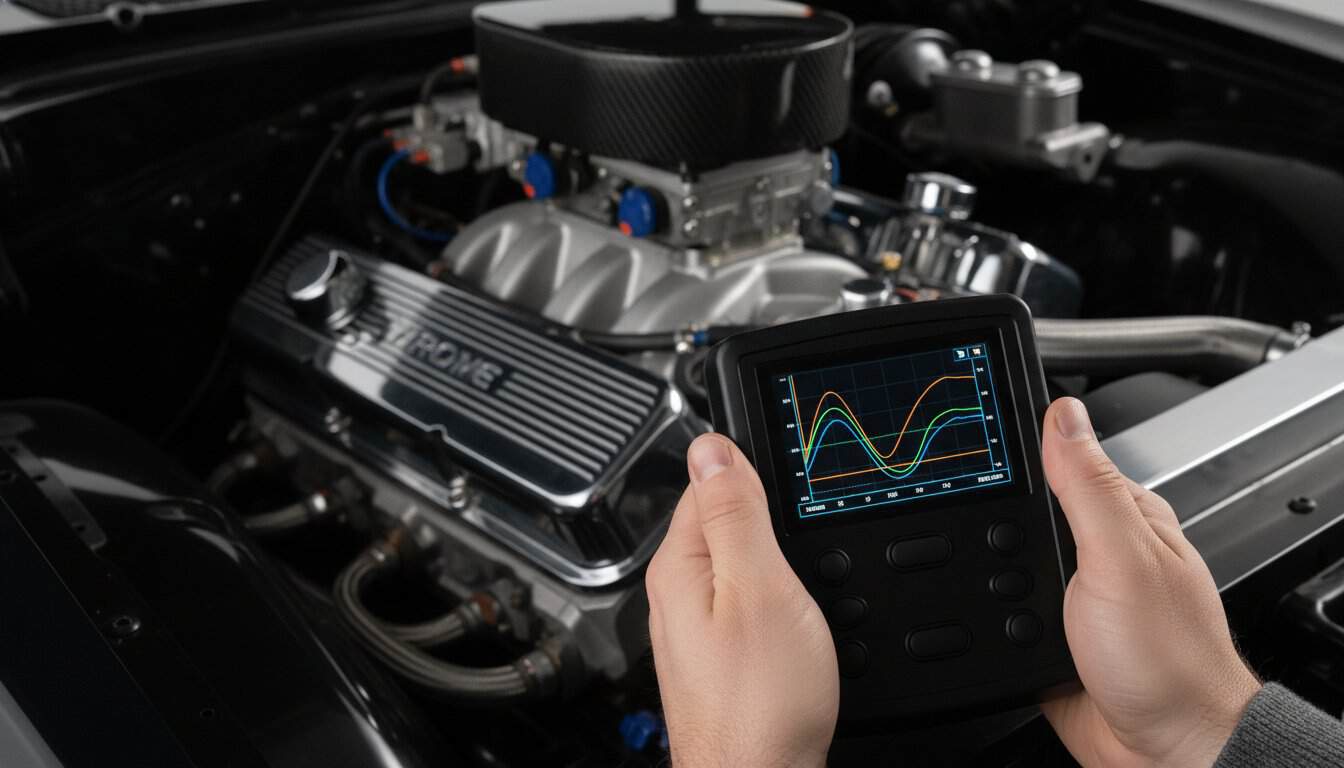
The promise of a “set it and forget it” fuel system is one of the greatest myths in the modern restomod world. While these units are incredibly smart, simply plugging in a handheld won’t solve a flooding idle or a lean spike under load without your guidance. Understanding how to tune a self-learning efi system is less about mastering code and more about learning to communicate with your machine. You aren’t just a passenger in this process; you’re the lead engineer. It takes more than a basic wiring harness to achieve that perfect balance of vintage character and modern performance.
It’s frustrating when your beautiful project feels held back by a digital brain that doesn’t seem to listen. You want that crisp throttle response and a reliable cold start every time you turn the key, not a screen full of confusing settings. This guide will show you how to master the handheld controller and bridge the gap between mechanical soul and electronic precision. We’ll walk through the essential setup steps, sensor calibration, and the specific adjustments needed to turn a generic base map into a custom masterpiece. Let’s get to work on making your build as reliable as it is powerful.
Key Takeaways
- Verify your mechanical foundation by eliminating exhaust leaks and stabilizing fuel pressure to prevent false sensor readings during the learning phase.
- Discover how to tune a self-learning efi system through methodical driving techniques that teach the ECU to handle a wide range of real-world load conditions.
- Input accurate engine profile data into the setup wizard to ensure your system calculates the most effective initial volumetric efficiency table for your specific displacement.
- Take command of advanced settings like idle air control counts and digital acceleration enrichment to refine the subtle performance details that automation might overlook.
- Transition from a passive user to a confident tuner by understanding the critical balance between automated data collection and your own manual input.
Understanding Self-Learning EFI: Automation vs. Human Input
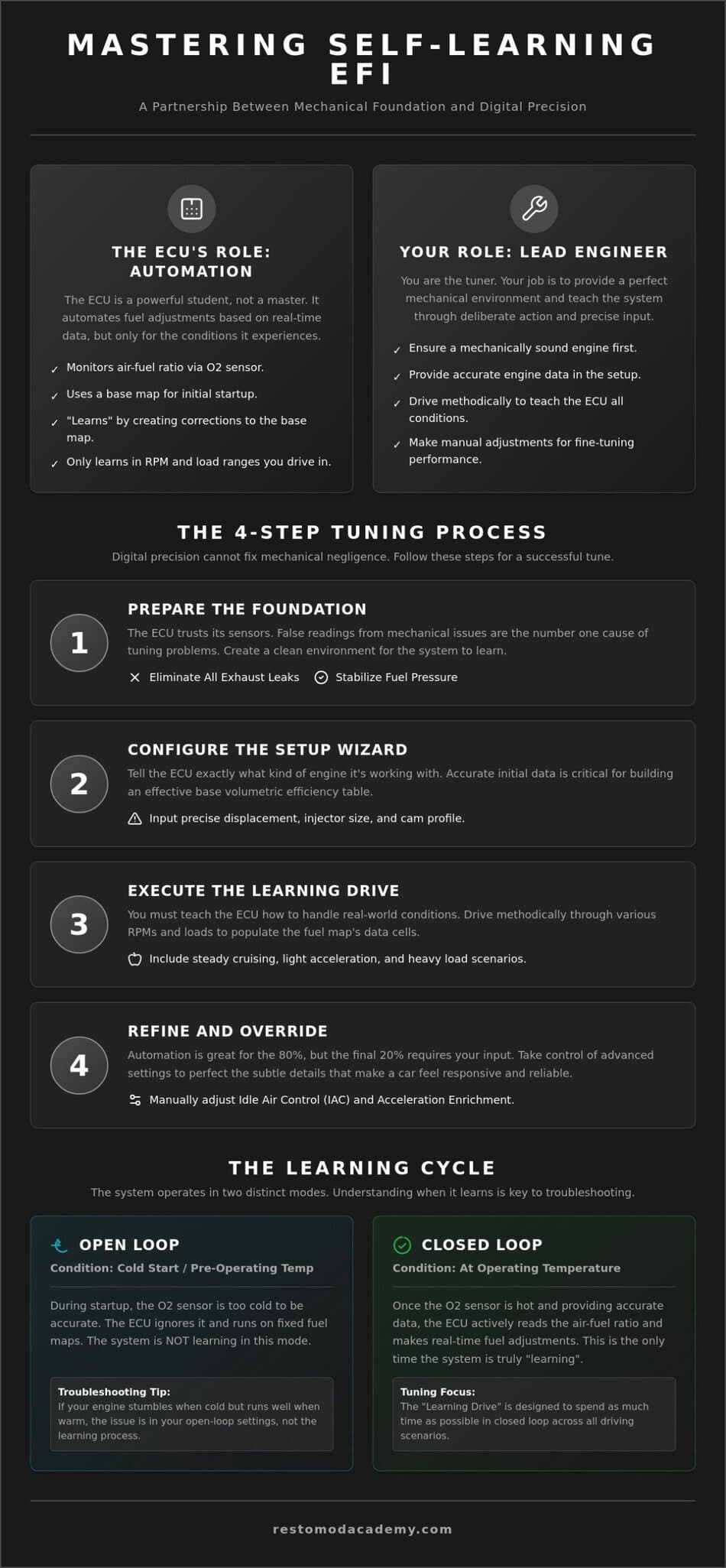
Self-learning EFI isn’t a hands-off miracle; it’s a sophisticated partnership between your mechanical intuition and digital precision. At its core, this is a closed-loop system that utilizes a wideband oxygen sensor to monitor exhaust gases and reach specific target air-fuel ratios. When you first fire up the engine, the ECU relies on a base map, which is a generic set of instructions for fuel delivery. The “learning” part is actually an overlay. This overlay records deviations from the base map and applies corrections in real-time. However, you must realize that the ECU only learns in the specific cells, or combinations of RPM and engine load, where the engine actually spends time. If you never drive at 3,500 RPM under heavy load, the computer remains blind to those requirements.
Many enthusiasts fall into the trap of thinking the system is on autopilot. It’s not. You are the lead engineer, and the system is your student. Mastering how to tune a self-learning efi system starts with your initial configuration. You have to tell the computer exactly what kind of engine it’s feeding before it can begin to optimize. While the automation handles the steady-state cruising, your human input is still required for edge-case tuning and refining the transitions that make a car feel truly responsive. Don’t expect the software to fix mechanical flaws; instead, use it to highlight the potential of a well-built machine.
To better understand this concept, watch this helpful video:
The Role of the Wideband O2 Sensor
Think of the wideband O2 sensor as the ECU’s eyes in the exhaust stream. It detects the amount of unburned oxygen in the spent gases, allowing the computer to determine if the mixture is rich or lean. Because of this, sensor placement is the most critical factor for successful learning. If you place the sensor too close to the exhaust tip, outside air can swirl back and cause false lean readings. Conversely, putting it too close to the cylinder head can lead to sensor overheating and premature failure. The sensor creates a continuous feedback loop where it reports exhaust chemistry and the ECU adjusts the fuel injector pulse width to maintain your desired performance. Modern Fuel injection systems depend entirely on this data to make accurate adjustments.
Closed-Loop vs. Open-Loop Operation
Your system cycles through two distinct states of operation. During a cold start, the ECU runs in open-loop mode. Because the oxygen sensor requires significant heat to provide an accurate signal, the computer ignores it and relies on fixed data tables to keep the engine running. Once the engine reaches a pre-set operating temperature, it transitions into closed-loop operation. This is the only time the system is actually learning and adjusting. Understanding this transition is vital when you’re figuring out how to tune a self-learning efi system for smooth morning warm-ups. If your car runs great when hot but stumbles when cold, the problem lies in your open-loop settings, where the “self-learning” hasn’t yet taken the wheel.
Pre-Flight Checklist: Ensuring Your Hardware is Ready for EFI
Before you even power up your handheld controller, you must accept a fundamental truth: digital precision cannot fix mechanical negligence. A self-learning system is only as smart as the data it receives from its sensors. If your foundation is shaky, the ECU will spend its time chasing its own tail rather than optimizing your performance. Most enthusiasts who struggle with how to tune a self-learning efi system are actually fighting hardware ghosts. You need to verify every physical component before you ask the computer to take the wheel. It’s about creating a clean environment where the technology can actually do its job.
Sealing the Exhaust System
An exhaust leak is the absolute number one killer of a self-learning tune. If you have a pinhole leak near a header gasket or a loose collector flange, outside air will get sucked into the exhaust stream during the engine’s natural pulses. The wideband O2 sensor detects this extra oxygen and reports a false lean condition to the ECU. In response, the computer dumps massive amounts of fuel into the engine, leading to fouled plugs and a sluggish idle. To understand the logic behind these adjustments, you can review Holley’s guide to self-learning technology, which explains how the feedback loop reacts to sensor data. Use high-quality gaskets and high-temp RTV to ensure your exhaust is air-tight from the cylinder head to at least 18 inches past the O2 sensor.
Fuel System Requirements
Modern EFI systems demand consistent, high-pressure fuel delivery to function correctly. Most throttle body units require a stable 43 PSI or 58 PSI, depending on the specific kit requirements. If your pressure drops under load, you’ll experience lean spikes that the self-learning overlay can’t compensate for fast enough. A high-quality fuel pressure regulator is your best friend here; it ensures the injectors see the exact same pressure regardless of engine demand. For detailed plumbing tips that apply to any modern conversion, check out the definitive guide to an LS engine swap. Getting the fuel delivery right is half the battle when learning how to tune a self-learning efi system.
Don’t overlook your ignition and vacuum systems. A noisy tachometer signal from a failing ignition coil or old plug wires can cause the ECU to see “phantom” RPM spikes, which ruins the fuel map. Similarly, a vacuum leak confuses the MAP sensor, making the computer think the engine is under load when it’s actually just idling. If you want a tune that stays sharp, your mechanical systems must be beyond reproach. If you need a second pair of eyes on your project’s architecture, my Restomod Consulting Services can provide the technical clarity you need to move forward with confidence.
Configuring the Setup Wizard for Your Engine Profile
The setup wizard is your engine’s first introduction to its new digital brain. Whether you are using a system from Holley, FAST, or FiTech, this initial handshake determines the accuracy of your base map. Mastering how to tune a self-learning efi system begins with total honesty during this phase. The computer uses your engine’s displacement to calculate the initial Volumetric Efficiency (VE) table. If you input 350 cubic inches for a 454, the injectors will never supply enough fuel. The learning overlay would have to work twice as hard to correct that mistake, often resulting in a car that feels sluggish or “hunts” for the right mixture. Take your time with these questions; they are the foundation of your entire tune.
Think of the wizard as a technical interview for your powerplant. It will ask for your ignition type, fuel pump style, and cooling fan triggers. Each answer helps the ECU build a mathematical model of your car’s physical needs. If you provide accurate data here, the system can start the engine on the very first try. If you find yourself stuck on a specific parameter, remember that these systems are designed to be logical. Most errors at this stage come from over-complicating the answers rather than a lack of technical skill. Keep it simple and follow the prompts exactly as they appear on your handheld controller.
Selecting the Right Camshaft Profile
The camshaft selection is about more than just horsepower; it is about vacuum. A Street cam typically produces high, steady vacuum at idle, while a Race cam with high duration creates a choppy, low-vacuum signal. If you choose a profile that is too aggressive for your actual hardware, the ECU will struggle to stabilize the idle. The MAP sensor needs to know what kind of “noise” to expect from the intake manifold. Be realistic about your duration. Over-estimating your cam specs often leads to an erratic idle that no amount of self-learning can smooth out. If you are unsure, always lean toward the milder setting to give the ECU a more stable starting point.
Setting Target AFR for Performance and Longevity
Your Target Air-Fuel Ratio (AFR) table is the roadmap the ECU follows. While 14.7:1 is the stoichiometric ideal for emissions, classic iron often prefers a slightly richer mixture to stay cool and responsive. For a reliable cruise, aim for 14.0 to 14.5 to balance fuel economy with drivability. When you step on the throttle, you need to protect your investment. Set your wide-open throttle targets between 12.5 and 12.8 to ensure the engine stays safe under heavy load. If you run into trouble during this phase, consulting EFI troubleshooting and tuning tips can help you identify if your targets are realistic for your specific build. A well-defined AFR table ensures the learning process is both fast and effective.
Executing the Learning Drive: How to Teach Your EFI System
The most common mistake builders make is thinking a twenty minute cruise down the interstate constitutes a complete tune. In reality, your ECU is a student that requires a diverse curriculum. Every combination of RPM and engine load represents a cell on a digital grid. To understand how to tune a self-learning efi system effectively, you must provide enough hits in each of these cells for the computer to gather a statistically significant sample. If you only drive at 2,000 RPM in fourth gear, the computer will never learn how to handle a steep hill or a sudden downshift. You have to be intentional about where you take the car during these first few hours.
Steady throttle is your best tool during the first 50 miles. Avoid erratic footwork and rapid pumping of the gas pedal. Instead, practice soaking the cells. This involves holding the engine at a specific RPM and load for several seconds at a time. If you are on a quiet road, try holding 2,500 RPM in second gear, then third, then fourth. This methodical approach gives the wideband sensor enough time to report back and the ECU enough time to apply a permanent correction to the base map. Hold off on aggressive wide open throttle runs until your cruise and part throttle maps have stabilized. You want the foundation to be rock solid before you ask for maximum power.
The Three Phases of a Successful Learning Drive
- Phase 1: Stationary Warm-up. Start the engine and let it reach full operating temperature without touching the throttle. This allows the ECU to stabilize the idle and learn the initial air requirements for a hot start.
- Phase 2: Neighborhood Transitions. Drive through residential areas with frequent stop and go cycles. Focus on light acceleration and smooth deceleration. This teaches the system how to handle the transition from idle to cruise.
- Phase 3: Load Variation. Head to a highway with varying elevations. Use different gears to maintain the same speed at different RPM levels. This forces the ECU to see high load at low RPM and low load at high RPM.
Monitoring the Learning Percentage
Keep your handheld controller within sight so you can monitor the Learn Table or Compensation values. These numbers tell you how much the ECU is deviating from the base map to hit your targets. If you see corrections of 20 percent or more, the system is still doing heavy lifting. As you continue to drive, these numbers should settle into the single digits. When the values stop changing significantly, your tune has plateaued. This is the goal. It means the software has successfully adapted to your engine’s unique mechanical personality. For those who want to dive deeper into the data, you can find professional diagnostic tools in my list of recommended gear to help visualize these trends.
Mastering the learning drive is the difference between a car that runs and a car that performs. If you want to skip the trial and error and get straight to the results, my The Ultimate Restomod Guide provides the step by step framework you need for a professional grade finish. Take the time to teach your system correctly, and it will reward you with years of reliable service.
Beyond the Basics: Troubleshooting and Manual Overrides
You’ve logged the miles and watched the compensation values settle into their groove. However, even the most advanced software can’t account for every mechanical nuance of a custom build. True expertise in how to tune a self-learning efi system means recognizing when the automation has reached its limit and stepping in to provide a manual override. Your handheld controller is more than just a digital gauge; it is your direct line of communication to the engine’s fuel map. Don’t be afraid to dive into the advanced menus to polish those final details that make a car truly drivable. Refinement is what separates a finished project from a professional masterpiece.
One area that often requires a human touch is Acceleration Enrichment. Think of this as the digital version of a carburetor’s accelerator pump. If you notice a momentary stumble or “pop” when you quickly snap the throttle open, the system isn’t delivering fuel fast enough to match the sudden rush of air. You can manually increase the enrichment values to provide that extra squirt of fuel. Conversely, if the car feels heavy or sluggish when you accelerate, you may need to trim those values back. Always make small, incremental changes. Test the results after each adjustment to ensure you’re moving in the right direction.
Solving the Dreaded Idle Stumble
The Idle Air Control (IAC) motor is often the most misunderstood component in a throttle body system. It works in tandem with the physical throttle blade adjustment screw on the side of the unit. If your IAC counts are too high at a hot idle, usually above 20 to 30 steps, your engine is struggling for air. You need to crack the throttle blade open slightly with the screw until the IAC counts settle into a comfortable range, typically between 5 and 15 steps. This gives the motor enough room to react when you turn on the air conditioning or shift into gear. You can also navigate to the startup menus and increase the Crank Fuel percentage to provide the extra prime needed for crisp cold starts.
When to Seek Professional Dyno Tuning
While self-learning is revolutionary, it is not a replacement for a professional with a chassis dyno when dealing with extreme builds. Systems that learn fuel delivery rarely learn ignition timing on their own. If you are running forced induction or a radical race profile with very low vacuum, a professional tuner can optimize your spark curves to prevent detonation and maximize torque. This is especially true for complex integrations found in the definitive guide to an LS engine swap, where modern electronics meet vintage iron. Remember that if you ever make a significant hardware change, such as swapping a camshaft or changing your exhaust headers, you must use the Clear Learn function to wipe the old data and let the system start fresh. This ensures your technology is always working with the most accurate information possible.
Take the Wheel of Your Digital Performance
You’ve moved beyond the myth of “set it and forget it” and embraced the role of the lead engineer. By ensuring your hardware is air-tight and teaching the ECU through methodical cell soaking, you’ve bridged the gap between vintage soul and modern reliability. Learning how to tune a self-learning efi system is a rewarding journey that turns an intimidating handheld controller into your most powerful workshop tool. It’s about the satisfaction of hearing that engine settle into a perfect idle and feeling the immediate response when you hit the throttle.
I’ve spent years refining these processes so you don’t have to learn through expensive mistakes. To master every phase of your build with community-tested technical advice, Download The Ultimate Restomod Guide to master every phase of your build. This resource, authored by restomod mentor Brook Walsh, provides the step-by-step blueprints you need for modernizing classics with professional precision. Your project is a testament to your labor and vision. Keep pushing for that perfect tune, and enjoy every mile of the drive ahead.
Frequently Asked Questions
How long does it take for a self-learning EFI system to finish tuning?
It typically takes about 50 to 100 miles of diverse driving conditions for the system to populate the majority of its learning table. This process depends entirely on your ability to hit different RPM and load combinations. If you only cruise at a steady speed, the learning will stall. You must be active in exploring the engine’s full operating range to provide the ECU with the data it needs to stabilize. This ensures every cell in the map is accurately addressed.
Can I use a self-learning EFI system with a very large camshaft?
You can certainly use a self-learning EFI system with a large camshaft, provided you select the appropriate “Race” or “Low Vacuum” setting during the initial setup. Large cams produce erratic vacuum signals that can confuse a standard base map. By choosing the correct engine profile, the ECU adjusts its expectations for manifold pressure. This allows it to maintain a steady idle despite the aggressive duration of a performance cam.
Why is my EFI system running rich even though it is supposedly self-tuning?
Your EFI system is likely running rich because of a mechanical issue like an exhaust leak or a poorly placed oxygen sensor. If outside air enters the exhaust stream, the sensor reports a false lean condition, causing the ECU to dump excess fuel. This highlights why understanding how to tune a self-learning efi system requires a solid mechanical foundation. Check your header gaskets and collector flanges for any signs of soot or leaks that might be fooling the computer.
Do I need a laptop to tune my self-learning EFI kit?
Most modern self-tuning kits include a full-color touchscreen handheld controller that eliminates the need for a laptop in standard applications. You can perform the initial setup, monitor live data, and make manual adjustments directly through this interface. While a laptop offers deeper data logging for professional-level refinement, the handheld is your primary tool for a successful street tune. It provides all the necessary parameters to get your project running reliably.
What happens if I disconnect the battery? Will the EFI lose its memory?
Disconnecting the battery will not cause your EFI system to lose its learned memory. These units use non-volatile storage to keep your base map and learning overlay safe even during long periods of storage. You can pull the battery for winter maintenance or electrical repairs without worrying about starting from scratch. Only a manual “Clear Learn” command from the handheld will reset the data and force the system to start its education over.
Can a self-learning EFI system tune my ignition timing automatically?
Most self-learning EFI systems do not tune ignition timing automatically. While they can control timing if you have the compatible distributor or crank trigger hardware, you must still input the desired spark curve manually. The “learning” function is almost exclusively focused on fuel delivery to reach your target air-fuel ratios. Don’t expect the computer to find the optimal spark advance without your direct guidance and input.
Is a wideband O2 sensor necessary for self-learning to work?
A wideband O2 sensor is absolutely necessary because it provides the high-resolution data required for the closed-loop feedback loop. Unlike a narrow-band sensor that only tells the ECU if the mixture is rich or lean, a wideband sensor reports the exact air-fuel ratio. This precision is what allows the system to make the granular adjustments that define how to tune a self-learning efi system for peak street performance and reliability.
How do I know if my EFI system has finished the learning process?
You will know the learning process has reached a plateau when the compensation or learn values on your handheld stay in the low single digits. If the ECU is only making 1 or 2 percent adjustments during normal driving, it has successfully adapted to your engine’s needs. At this point, the tune is stable, and you can focus on enjoying the drive rather than constantly monitoring the handheld screen for changes.
The promise of a “set it and forget it” fuel system is one of the greatest myths in the modern restomod world. While these units are incredibly smart, simply plugging in a handheld won’t solve a flooding idle or a lean spike under load without your guidance. Understanding how to tune a self-learning efi system is less about mastering code and more about learning to communicate with your machine. You aren’t just a passenger in this process; you’re the lead engineer. It takes more than a basic wiring harness to achieve that perfect balance of vintage character and modern performance.
It’s frustrating when your beautiful project feels held back by a digital brain that doesn’t seem to listen. You want that crisp throttle response and a reliable cold start every time you turn the key, not a screen full of confusing settings. This guide will show you how to master the handheld controller and bridge the gap between mechanical soul and electronic precision. We’ll walk through the essential setup steps, sensor calibration, and the specific adjustments needed to turn a generic base map into a custom masterpiece. Let’s get to work on making your build as reliable as it is powerful.
Key Takeaways
- Verify your mechanical foundation by eliminating exhaust leaks and stabilizing fuel pressure to prevent false sensor readings during the learning phase.
- Discover how to tune a self-learning efi system through methodical driving techniques that teach the ECU to handle a wide range of real-world load conditions.
- Input accurate engine profile data into the setup wizard to ensure your system calculates the most effective initial volumetric efficiency table for your specific displacement.
- Take command of advanced settings like idle air control counts and digital acceleration enrichment to refine the subtle performance details that automation might overlook.
- Transition from a passive user to a confident tuner by understanding the critical balance between automated data collection and your own manual input.
Understanding Self-Learning EFI: Automation vs. Human Input
Self-learning EFI isn’t a hands-off miracle; it’s a sophisticated partnership between your mechanical intuition and digital precision. At its core, this is a closed-loop system that utilizes a wideband oxygen sensor to monitor exhaust gases and reach specific target air-fuel ratios. When you first fire up the engine, the ECU relies on a base map, which is a generic set of instructions for fuel delivery. The “learning” part is actually an overlay. This overlay records deviations from the base map and applies corrections in real-time. However, you must realize that the ECU only learns in the specific cells, or combinations of RPM and engine load, where the engine actually spends time. If you never drive at 3,500 RPM under heavy load, the computer remains blind to those requirements.
Many enthusiasts fall into the trap of thinking the system is on autopilot. It’s not. You are the lead engineer, and the system is your student. Mastering how to tune a self-learning efi system starts with your initial configuration. You have to tell the computer exactly what kind of engine it’s feeding before it can begin to optimize. While the automation handles the steady-state cruising, your human input is still required for edge-case tuning and refining the transitions that make a car feel truly responsive. Don’t expect the software to fix mechanical flaws; instead, use it to highlight the potential of a well-built machine.
To better understand this concept, watch this helpful video:
The Role of the Wideband O2 Sensor
Think of the wideband O2 sensor as the ECU’s eyes in the exhaust stream. It detects the amount of unburned oxygen in the spent gases, allowing the computer to determine if the mixture is rich or lean. Because of this, sensor placement is the most critical factor for successful learning. If you place the sensor too close to the exhaust tip, outside air can swirl back and cause false lean readings. Conversely, putting it too close to the cylinder head can lead to sensor overheating and premature failure. The sensor creates a continuous feedback loop where it reports exhaust chemistry and the ECU adjusts the fuel injector pulse width to maintain your desired performance. Modern Fuel injection systems depend entirely on this data to make accurate adjustments.
Closed-Loop vs. Open-Loop Operation
Your system cycles through two distinct states of operation. During a cold start, the ECU runs in open-loop mode. Because the oxygen sensor requires significant heat to provide an accurate signal, the computer ignores it and relies on fixed data tables to keep the engine running. Once the engine reaches a pre-set operating temperature, it transitions into closed-loop operation. This is the only time the system is actually learning and adjusting. Understanding this transition is vital when you’re figuring out how to tune a self-learning efi system for smooth morning warm-ups. If your car runs great when hot but stumbles when cold, the problem lies in your open-loop settings, where the “self-learning” hasn’t yet taken the wheel.
Pre-Flight Checklist: Ensuring Your Hardware is Ready for EFI
Before you even power up your handheld controller, you must accept a fundamental truth: digital precision cannot fix mechanical negligence. A self-learning system is only as smart as the data it receives from its sensors. If your foundation is shaky, the ECU will spend its time chasing its own tail rather than optimizing your performance. Most enthusiasts who struggle with how to tune a self-learning efi system are actually fighting hardware ghosts. You need to verify every physical component before you ask the computer to take the wheel. It’s about creating a clean environment where the technology can actually do its job.
Sealing the Exhaust System
An exhaust leak is the absolute number one killer of a self-learning tune. If you have a pinhole leak near a header gasket or a loose collector flange, outside air will get sucked into the exhaust stream during the engine’s natural pulses. The wideband O2 sensor detects this extra oxygen and reports a false lean condition to the ECU. In response, the computer dumps massive amounts of fuel into the engine, leading to fouled plugs and a sluggish idle. To understand the logic behind these adjustments, you can review Holley’s guide to self-learning technology, which explains how the feedback loop reacts to sensor data. Use high-quality gaskets and high-temp RTV to ensure your exhaust is air-tight from the cylinder head to at least 18 inches past the O2 sensor.
Fuel System Requirements
Modern EFI systems demand consistent, high-pressure fuel delivery to function correctly. Most throttle body units require a stable 43 PSI or 58 PSI, depending on the specific kit requirements. If your pressure drops under load, you’ll experience lean spikes that the self-learning overlay can’t compensate for fast enough. A high-quality fuel pressure regulator is your best friend here; it ensures the injectors see the exact same pressure regardless of engine demand. For detailed plumbing tips that apply to any modern conversion, check out the definitive guide to an LS engine swap. Getting the fuel delivery right is half the battle when learning how to tune a self-learning efi system.
Don’t overlook your ignition and vacuum systems. A noisy tachometer signal from a failing ignition coil or old plug wires can cause the ECU to see “phantom” RPM spikes, which ruins the fuel map. Similarly, a vacuum leak confuses the MAP sensor, making the computer think the engine is under load when it’s actually just idling. If you want a tune that stays sharp, your mechanical systems must be beyond reproach. If you need a second pair of eyes on your project’s architecture, my Restomod Consulting Services can provide the technical clarity you need to move forward with confidence.
Configuring the Setup Wizard for Your Engine Profile
The setup wizard is your engine’s first introduction to its new digital brain. Whether you are using a system from Holley, FAST, or FiTech, this initial handshake determines the accuracy of your base map. Mastering how to tune a self-learning efi system begins with total honesty during this phase. The computer uses your engine’s displacement to calculate the initial Volumetric Efficiency (VE) table. If you input 350 cubic inches for a 454, the injectors will never supply enough fuel. The learning overlay would have to work twice as hard to correct that mistake, often resulting in a car that feels sluggish or “hunts” for the right mixture. Take your time with these questions; they are the foundation of your entire tune.
Think of the wizard as a technical interview for your powerplant. It will ask for your ignition type, fuel pump style, and cooling fan triggers. Each answer helps the ECU build a mathematical model of your car’s physical needs. If you provide accurate data here, the system can start the engine on the very first try. If you find yourself stuck on a specific parameter, remember that these systems are designed to be logical. Most errors at this stage come from over-complicating the answers rather than a lack of technical skill. Keep it simple and follow the prompts exactly as they appear on your handheld controller.
Selecting the Right Camshaft Profile
The camshaft selection is about more than just horsepower; it is about vacuum. A Street cam typically produces high, steady vacuum at idle, while a Race cam with high duration creates a choppy, low-vacuum signal. If you choose a profile that is too aggressive for your actual hardware, the ECU will struggle to stabilize the idle. The MAP sensor needs to know what kind of “noise” to expect from the intake manifold. Be realistic about your duration. Over-estimating your cam specs often leads to an erratic idle that no amount of self-learning can smooth out. If you are unsure, always lean toward the milder setting to give the ECU a more stable starting point.
Setting Target AFR for Performance and Longevity
Your Target Air-Fuel Ratio (AFR) table is the roadmap the ECU follows. While 14.7:1 is the stoichiometric ideal for emissions, classic iron often prefers a slightly richer mixture to stay cool and responsive. For a reliable cruise, aim for 14.0 to 14.5 to balance fuel economy with drivability. When you step on the throttle, you need to protect your investment. Set your wide-open throttle targets between 12.5 and 12.8 to ensure the engine stays safe under heavy load. If you run into trouble during this phase, consulting EFI troubleshooting and tuning tips can help you identify if your targets are realistic for your specific build. A well-defined AFR table ensures the learning process is both fast and effective.
Executing the Learning Drive: How to Teach Your EFI System
The most common mistake builders make is thinking a twenty minute cruise down the interstate constitutes a complete tune. In reality, your ECU is a student that requires a diverse curriculum. Every combination of RPM and engine load represents a cell on a digital grid. To understand how to tune a self-learning efi system effectively, you must provide enough hits in each of these cells for the computer to gather a statistically significant sample. If you only drive at 2,000 RPM in fourth gear, the computer will never learn how to handle a steep hill or a sudden downshift. You have to be intentional about where you take the car during these first few hours.
Steady throttle is your best tool during the first 50 miles. Avoid erratic footwork and rapid pumping of the gas pedal. Instead, practice soaking the cells. This involves holding the engine at a specific RPM and load for several seconds at a time. If you are on a quiet road, try holding 2,500 RPM in second gear, then third, then fourth. This methodical approach gives the wideband sensor enough time to report back and the ECU enough time to apply a permanent correction to the base map. Hold off on aggressive wide open throttle runs until your cruise and part throttle maps have stabilized. You want the foundation to be rock solid before you ask for maximum power.
The Three Phases of a Successful Learning Drive
- Phase 1: Stationary Warm-up. Start the engine and let it reach full operating temperature without touching the throttle. This allows the ECU to stabilize the idle and learn the initial air requirements for a hot start.
- Phase 2: Neighborhood Transitions. Drive through residential areas with frequent stop and go cycles. Focus on light acceleration and smooth deceleration. This teaches the system how to handle the transition from idle to cruise.
- Phase 3: Load Variation. Head to a highway with varying elevations. Use different gears to maintain the same speed at different RPM levels. This forces the ECU to see high load at low RPM and low load at high RPM.
Monitoring the Learning Percentage
Keep your handheld controller within sight so you can monitor the Learn Table or Compensation values. These numbers tell you how much the ECU is deviating from the base map to hit your targets. If you see corrections of 20 percent or more, the system is still doing heavy lifting. As you continue to drive, these numbers should settle into the single digits. When the values stop changing significantly, your tune has plateaued. This is the goal. It means the software has successfully adapted to your engine’s unique mechanical personality. For those who want to dive deeper into the data, you can find professional diagnostic tools in my list of recommended gear to help visualize these trends.
Mastering the learning drive is the difference between a car that runs and a car that performs. If you want to skip the trial and error and get straight to the results, my The Ultimate Restomod Guide provides the step by step framework you need for a professional grade finish. Take the time to teach your system correctly, and it will reward you with years of reliable service.
Beyond the Basics: Troubleshooting and Manual Overrides
You’ve logged the miles and watched the compensation values settle into their groove. However, even the most advanced software can’t account for every mechanical nuance of a custom build. True expertise in how to tune a self-learning efi system means recognizing when the automation has reached its limit and stepping in to provide a manual override. Your handheld controller is more than just a digital gauge; it is your direct line of communication to the engine’s fuel map. Don’t be afraid to dive into the advanced menus to polish those final details that make a car truly drivable. Refinement is what separates a finished project from a professional masterpiece.
One area that often requires a human touch is Acceleration Enrichment. Think of this as the digital version of a carburetor’s accelerator pump. If you notice a momentary stumble or “pop” when you quickly snap the throttle open, the system isn’t delivering fuel fast enough to match the sudden rush of air. You can manually increase the enrichment values to provide that extra squirt of fuel. Conversely, if the car feels heavy or sluggish when you accelerate, you may need to trim those values back. Always make small, incremental changes. Test the results after each adjustment to ensure you’re moving in the right direction.
Solving the Dreaded Idle Stumble
The Idle Air Control (IAC) motor is often the most misunderstood component in a throttle body system. It works in tandem with the physical throttle blade adjustment screw on the side of the unit. If your IAC counts are too high at a hot idle, usually above 20 to 30 steps, your engine is struggling for air. You need to crack the throttle blade open slightly with the screw until the IAC counts settle into a comfortable range, typically between 5 and 15 steps. This gives the motor enough room to react when you turn on the air conditioning or shift into gear. You can also navigate to the startup menus and increase the Crank Fuel percentage to provide the extra prime needed for crisp cold starts.
When to Seek Professional Dyno Tuning
While self-learning is revolutionary, it is not a replacement for a professional with a chassis dyno when dealing with extreme builds. Systems that learn fuel delivery rarely learn ignition timing on their own. If you are running forced induction or a radical race profile with very low vacuum, a professional tuner can optimize your spark curves to prevent detonation and maximize torque. This is especially true for complex integrations found in the definitive guide to an LS engine swap, where modern electronics meet vintage iron. Remember that if you ever make a significant hardware change, such as swapping a camshaft or changing your exhaust headers, you must use the Clear Learn function to wipe the old data and let the system start fresh. This ensures your technology is always working with the most accurate information possible.
Take the Wheel of Your Digital Performance
You’ve moved beyond the myth of “set it and forget it” and embraced the role of the lead engineer. By ensuring your hardware is air-tight and teaching the ECU through methodical cell soaking, you’ve bridged the gap between vintage soul and modern reliability. Learning how to tune a self-learning efi system is a rewarding journey that turns an intimidating handheld controller into your most powerful workshop tool. It’s about the satisfaction of hearing that engine settle into a perfect idle and feeling the immediate response when you hit the throttle.
I’ve spent years refining these processes so you don’t have to learn through expensive mistakes. To master every phase of your build with community-tested technical advice, Download The Ultimate Restomod Guide to master every phase of your build. This resource, authored by restomod mentor Brook Walsh, provides the step-by-step blueprints you need for modernizing classics with professional precision. Your project is a testament to your labor and vision. Keep pushing for that perfect tune, and enjoy every mile of the drive ahead.
Frequently Asked Questions
How long does it take for a self-learning EFI system to finish tuning?
It typically takes about 50 to 100 miles of diverse driving conditions for the system to populate the majority of its learning table. This process depends entirely on your ability to hit different RPM and load combinations. If you only cruise at a steady speed, the learning will stall. You must be active in exploring the engine’s full operating range to provide the ECU with the data it needs to stabilize. This ensures every cell in the map is accurately addressed.
Can I use a self-learning EFI system with a very large camshaft?
You can certainly use a self-learning EFI system with a large camshaft, provided you select the appropriate “Race” or “Low Vacuum” setting during the initial setup. Large cams produce erratic vacuum signals that can confuse a standard base map. By choosing the correct engine profile, the ECU adjusts its expectations for manifold pressure. This allows it to maintain a steady idle despite the aggressive duration of a performance cam.
Why is my EFI system running rich even though it is supposedly self-tuning?
Your EFI system is likely running rich because of a mechanical issue like an exhaust leak or a poorly placed oxygen sensor. If outside air enters the exhaust stream, the sensor reports a false lean condition, causing the ECU to dump excess fuel. This highlights why understanding how to tune a self-learning efi system requires a solid mechanical foundation. Check your header gaskets and collector flanges for any signs of soot or leaks that might be fooling the computer.
Do I need a laptop to tune my self-learning EFI kit?
Most modern self-tuning kits include a full-color touchscreen handheld controller that eliminates the need for a laptop in standard applications. You can perform the initial setup, monitor live data, and make manual adjustments directly through this interface. While a laptop offers deeper data logging for professional-level refinement, the handheld is your primary tool for a successful street tune. It provides all the necessary parameters to get your project running reliably.
What happens if I disconnect the battery? Will the EFI lose its memory?
Disconnecting the battery will not cause your EFI system to lose its learned memory. These units use non-volatile storage to keep your base map and learning overlay safe even during long periods of storage. You can pull the battery for winter maintenance or electrical repairs without worrying about starting from scratch. Only a manual “Clear Learn” command from the handheld will reset the data and force the system to start its education over.
Can a self-learning EFI system tune my ignition timing automatically?
Most self-learning EFI systems do not tune ignition timing automatically. While they can control timing if you have the compatible distributor or crank trigger hardware, you must still input the desired spark curve manually. The “learning” function is almost exclusively focused on fuel delivery to reach your target air-fuel ratios. Don’t expect the computer to find the optimal spark advance without your direct guidance and input.
Is a wideband O2 sensor necessary for self-learning to work?
A wideband O2 sensor is absolutely necessary because it provides the high-resolution data required for the closed-loop feedback loop. Unlike a narrow-band sensor that only tells the ECU if the mixture is rich or lean, a wideband sensor reports the exact air-fuel ratio. This precision is what allows the system to make the granular adjustments that define how to tune a self-learning efi system for peak street performance and reliability.
How do I know if my EFI system has finished the learning process?
You will know the learning process has reached a plateau when the compensation or learn values on your handheld stay in the low single digits. If the ECU is only making 1 or 2 percent adjustments during normal driving, it has successfully adapted to your engine’s needs. At this point, the tune is stable, and you can focus on enjoying the drive rather than constantly monitoring the handheld screen for changes.