
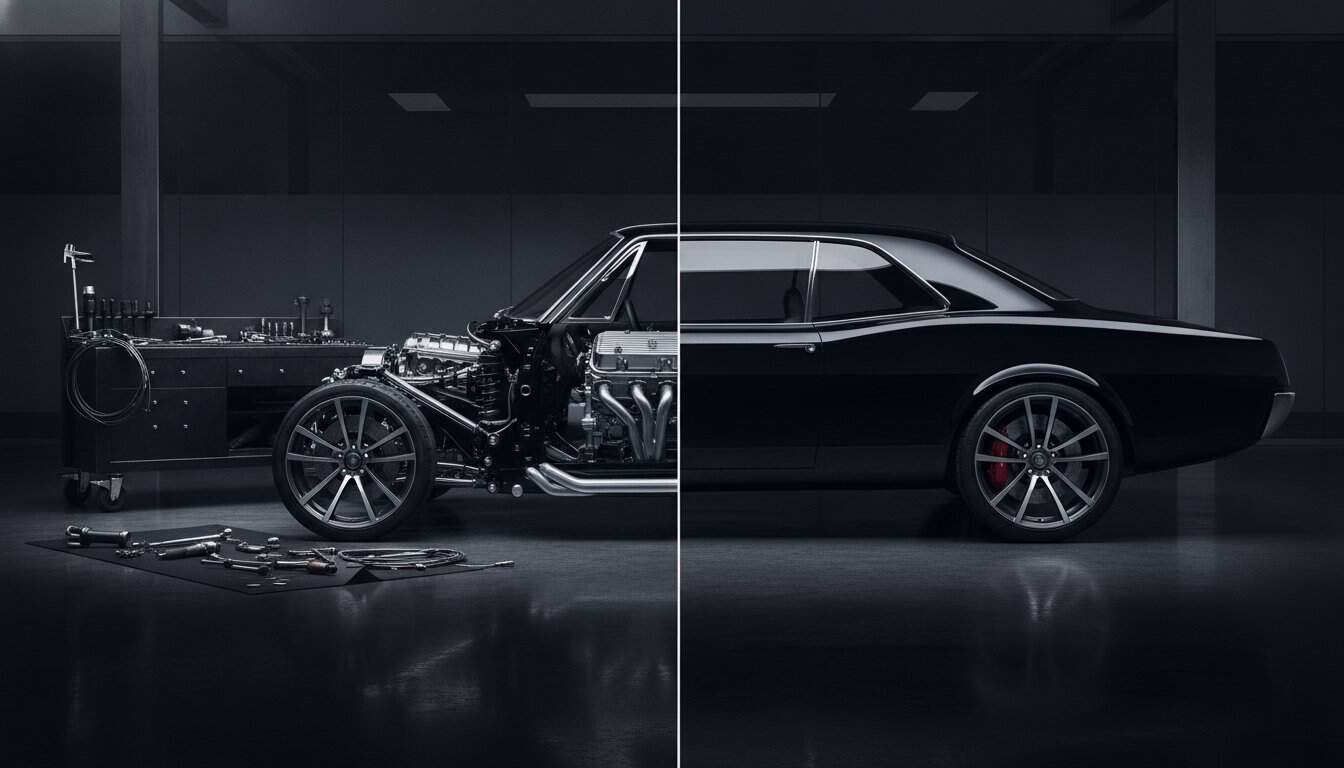
Would you rather write one big check today or a thousand small ones that add up to double the price of a finished car? It’s a question that haunts every enthusiast standing in a garage staring at a rusted frame. You are likely asking yourself: is it cheaper to buy or build a restomod? The lure of the DIY journey is powerful. You imagine the pride of the first start and the precision of modern suspension meeting vintage steel. However, the financial reality of 2026 can turn a passion project into a bottomless pit if you aren’t careful.
I understand the desire to get your hands dirty and save money through sweat equity. It feels like the most authentic way to own a classic. In this guide, I will show you the hidden costs of the workshop versus the upfront premium of a turn-key machine. Protect your wallet by understanding the stakes. We’ll explore the true price gap between buying and building and provide a realistic budget framework. Whether you use The Ultimate Restomod Guide to streamline your assembly or lean on Restomod Consulting Services to vet a purchase, you’ll finish this article with total financial confidence.
Key Takeaways
- Analyze the total financial landscape of 2026 to settle the debate on whether is it cheaper to buy or build a restomod based on your available time and mechanical experience.
- Account for the Tool Tax and the cumulative cost of specialized diagnostic gear that often pushes a DIY budget far beyond the initial estimates for parts.
- Leverage the depreciation advantage by identifying finished builds where the sale price is significantly lower than the total cost of high-end components and professional labor.
- Perform an honest audit of your fabrication skills and lifestyle commitments to ensure your project results in a road-worthy machine rather than a permanent garage fixture.
- Apply the instructional frameworks found in The Ultimate Restomod Guide to streamline your assembly and prevent thousands in wasted labor and incorrect parts orders.
The Restomod Dilemma: Defining the Financial Landscape in 2026
Restomodding represents the perfect marriage between the soul of a classic machine and the precision of modern performance. It’s the thrill of a 1960s silhouette powered by the heartbeat of a 2026 crate engine. This intersection of heritage aesthetics and contemporary technology is seductive, but it brings a difficult financial question to the surface. Many enthusiasts spend months wondering: is it cheaper to buy or build a restomod? There’s no universal price tag that applies to every garage. Instead, the answer lives within a variable equation that balances your technical aptitude, your patience for long-term projects, and the specific performance goals you’ve set for your machine.
To better understand this concept, watch this helpful video:
Restomod vs. Restoration: Why the Costs Diverge
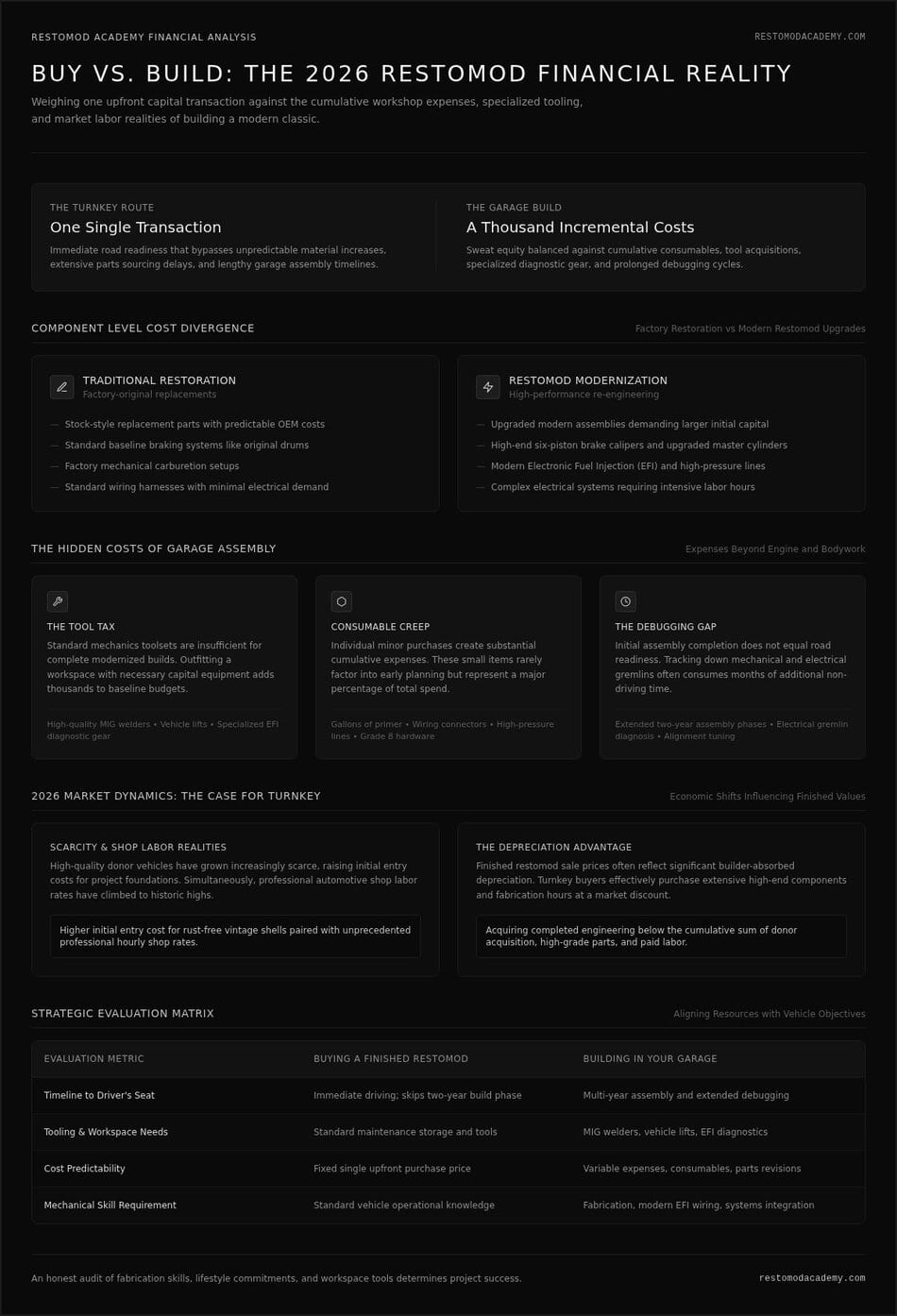
A traditional restoration focuses on returning a vehicle to its factory-original state, often using stock-style replacement parts that are relatively affordable. Restomodding takes a different path. You aren’t just replacing old parts; you’re upgrading them. Swapping basic drum brakes for high-end six-piston calipers or replacing a temperamental carburetor with a modern electronic fuel injection system adds significant cost. These high-performance components demand a larger initial investment than standard OEM gear. Beyond the parts cost, modernization introduces complex electrical and mechanical challenges that require more labor hours to resolve. If you’re still refining your understanding of these project types, our restomod meaning guide offers a deep dive into the specific characteristics that define this category.
The 2026 Market Pulse: Why Finished Cars Command a Premium
In 2026, the market for turnkey modern classics has shifted. High-quality donor vehicles are becoming increasingly scarce, driving up the entry price for any DIY project. Simultaneously, professional shop labor rates have climbed to historic highs. When you look at a finished car for sale, the price might seem steep, but it often reflects a depreciation advantage for the buyer. You are essentially buying someone else’s labor at a discount. Deciding if is it cheaper to buy or build a restomod in the current market requires you to account for the value of immediate reliability. A finished build allows you to skip the two-year assembly phase and the frustrating debugging period where small gremlins are hunted down. By examining vehicle restoration and restomod economics, it becomes clear that buying a completed car is often the fastest way to protect your capital while enjoying the drive from day one.
The Hidden Costs of Building: Why DIY Isn’t Always Free
Building a car in your own garage feels like the ultimate path to savings. You assume that by providing the labor, you’ll slash the total cost in half. But the brutal reality often sets in when you realize that your existing socket set isn’t enough for a full-scale modernization. The Tool Tax is the first major hidden expense. If you’re starting from scratch, you’ll need a high-quality MIG welder, a reliable vehicle lift, and specialized diagnostic gear for modern EFI systems. When people ask is it cheaper to buy or build a restomod, they often forget that these tools can easily add thousands to the initial budget.
Then comes the death by a thousand $50 cuts. It’s rarely the big-ticket items like the engine or the paint job that sink a budget. It’s the consumables. Think about the gallons of primer, boxes of wiring connectors, high-pressure fuel lines, and the endless supply of grade 8 hardware. Individually, these items seem insignificant. Collectively, they can represent a massive percentage of your total build cost. To get a head start on the right inventory, check our recommended gear page for high-value tool investments that won’t break the bank.
Specialized Equipment Requirements
Modern engine swaps and suspension upgrades require more than just basic hand tools. You will likely need a plasma cutter for frame modifications or a hydraulic press for new bushings. Beyond the tools, you must budget for the Mistake Factor. This involves the cost of parts you break, wiring you fry, or components you install incorrectly the first time. Every builder, no matter how experienced, pays this education tax. While you can recoup some tool costs through resale, the cost of ruined parts is gone forever. If you’re feeling overwhelmed by these requirements, Restomod Academy provides the framework to prioritize your purchases.
The Logistics of a Long-Term Project
Don’t overlook the logistics of keeping a project alive for three to five years. You must pay for shop space, climate control to prevent rust on bare metal, and increased utility bills for lighting and power tools. There’s also the cost of transporting the vehicle to specialized sub-contractors for things like professional upholstery or final paint. According to a Hemmings restomod valuation analysis, these administrative and logistical costs often go unrecorded by DIY builders, leading to a skewed perception of the final bill. Finally, consider the opportunity cost. A typical high-level build requires roughly 1,500 hours of labor. If you value your time at even a modest rate, the question of whether is it cheaper to buy or build a restomod takes on a completely different meaning.
Buying a Finished Restomod: Upfront Premiums vs. Market Realities
While building offers personal satisfaction, buying a finished car introduces the Depreciation Advantage. In many cases, you can acquire a vehicle for significantly less than the sum of its parts and labor. A builder might spend $120,000 on a pro-touring 1969 Camaro, but the market might only support a $90,000 sale price. This gap exists because the market rarely pays dollar-for-dollar for specialized labor. When you ask is it cheaper to buy or build a restomod, the answer often leans toward buying if you want a high-spec machine without the educational tax of a multi-year project.
Turnkey reliability is the second major financial driver. A finished car is ready for the road on day one. You skip the three-year wait and the endless debugging phase where small issues like cooling leaks or electrical gremlins steal your weekends. This immediate utility has a clear dollar value. According to Hagerty’s breakdown of restoration economics, the escalating cost of shop labor and parts makes the buy option increasingly attractive for those who value their time in 2026.
Valuing the Components in a Finished Build
To determine if an asking price is fair, you must audit the spec sheet with a critical eye. Look for name-brand components like Wilwood brakes, Holley EFI, or Tremec transmissions. These parts hold their value and offer better long-term support. Before committing, spend time reading our product reviews to verify if the components used in the build actually live up to their marketing claims. A car built with no-name parts might look good on the surface, but it will likely cost you more in future repairs. High-end builds should come with a binder of receipts and documentation for every major system.
The Inspection Protocol: Avoiding Costly Surprises
Buying someone else’s project carries the risk of inheriting their shortcuts. Poor wiring or hidden rust under fresh paint can turn a deal into a disaster. This is where professional Restomod Consulting Services become a cheap insurance policy. An expert eye can spot common red flags in metal fabrication or poor engineering that a novice might miss. Look closely at the gaps between body panels and the quality of the welds in the engine bay. Financing and insurance are also much simpler for a finished vehicle. Most lenders and insurers are far more comfortable with a running, titled car than a pile of high-performance parts sitting in a driveway.
The Decision Matrix: Assessing Skills, Tools, and Timeline
Before you commit to a donor car or start browsing auction sites, you must look in the mirror with total honesty. Deciding if is it cheaper to buy or build a restomod depends heavily on your existing technical foundation. If you can already TIG weld, plumb a fuel system, and navigate a wiring harness, your sweat equity has high value. However, if you have to learn these precision crafts as you go, your project will inevitably face delays and expensive re-dos. Every hour you spend watching tutorials is an hour the car sits idle; every mistake is a withdrawal from your savings. Be realistic about your current capabilities versus the high standards required for a safe, modern machine.
Time is the most overlooked currency in the workshop. A high-level restomod typically demands 1,500 to 2,500 hours of focused labor. Can your current lifestyle, family commitments, and career accommodate a project that might span three to five years? Many enthusiasts start with fire in their belly only to see that passion fade when the car is still on jack stands after twenty four months. If your primary goal is the sensory reward of the open road, buying a finished car is the superior financial move. If you find deep satisfaction in the meticulous process of assembly, then the act of building becomes its own reward, regardless of the final bill.
The Hybrid Approach: Building in Stages
You don’t have to choose between a bare frame and a completed masterpiece. A rolling restoration allows you to buy a running, driving classic and upgrade individual systems over time. This approach spreads the financial hit and lets you enjoy the car while you work. You might start by focusing on restomod interior ideas to improve the daily driving experience, then move to suspension and braking. By balancing DIY labor with professional help for critical tasks like final paint or complex engine tuning, you keep the project moving without becoming overwhelmed by the technical debt of a full teardown.
Using Blueprints to Narrow the Gap
Structured project planning is the only way to prevent a build from spiraling out of control. When you follow a proven roadmap, such as the definitive guide to an LS engine swap, you eliminate the guesswork that leads to wasted parts. These frameworks provide the exact specifications needed for compatibility between vintage steel and modern alloy. Using our Premium Project Blueprints ensures you select the right components the first time, effectively killing the “buy-twice” syndrome that plagues disorganized builds. To ensure your project stays on track and under budget, start your journey with Restomod Academy today.
Maximising Your Investment with Restomod Academy
Precision is the only thing that stands between a successful project and a financial disaster. When you analyze whether is it cheaper to buy or build a restomod, the variable that matters most is your access to proven information. The Ultimate Restomod Guide functions as a mechanical insurance policy for your bank account. It identifies the common engine swap mistakes that typically bleed builders dry, such as mismatched accessory drives or improper fuel system plumbing. By leveraging community knowledge and shared blueprints, you can find the best deals on performance parts without sacrificing quality or safety.
The final verdict is simple. Education is the only way to ensure your restomod is truly cheap in the long run. Without a structured framework, you are just guessing with your life savings. Every incorrect part ordered and every hour of wasted labor adds to the total cost, eventually erasing the sweat equity advantage of a DIY build. Choosing to build is a commitment to a journey, but that journey requires a map to reach the finish line without going bankrupt. Use the resources available to you to turn your garage from a place of frustration into a center of engineering excellence.
The Definitive Guide to Saving Money on Your Build
Brook Walsh founded this academy to bridge the gap between amateur enthusiasm and professional execution. Our curriculum includes specific cost-saving modules that teach you how to prioritize high-impact upgrades over aesthetic fluff. You’ll learn which components require a premium investment and where you can save money by using smart alternatives. For instance, the definitive guide to an LS engine swap provides a granular look at the exact mounting hardware and wiring solutions required to avoid expensive trial and error. Having a seasoned mentor in your corner prevents the small mistakes that lead to massive setbacks.
Next Steps for the Aspiring Owner
Take control of your finances today by setting up a rigorous project budget that accounts for every nut and bolt. If you are leaning toward the purchase of a finished car, use our Restomod Consulting Services to ensure you aren’t paying a premium for hidden structural flaws or poor engineering. Education is the ultimate tool in your workshop. It ensures that when you ask is it cheaper to buy or build a restomod, your specific answer results in a high-performance machine that holds its value in 2026 and beyond. Join the academy now and start your journey with the precision and focus of a seasoned builder.
Take Command of Your Restomod Financial Future
You now understand the brutal financial reality of the workshop. Buying a finished car often secures a depreciation advantage, while building demands a heavy investment in tools and the inevitable education tax of trial and error. The answer to whether is it cheaper to buy or build a restomod depends on how you value your labor and your desire for immediate reliability versus personal creation. Every dollar spent on specialized diagnostic gear or wasted on incorrect part orders can be avoided with the right roadmap.
Don’t let your dream machine become a permanent fixture on jack stands. You have the power to transition from a passive admirer to an active creator with precision and confidence. Secure your financial future and master the build with The Ultimate Restomod Guide. By accessing pro-level project blueprints and joining a community of like-minded builders, you can avoid the $10,000 mistakes that most beginners make. Pick up your tools, trust the process, and get ready to experience the incomparable thrill of that first turn of the key.
Frequently Asked Questions
Is it really cheaper to build a restomod if I do all the work myself?
It can be, but only if you value your labor at zero and already own the necessary specialized tools. Sweat equity significantly reduces the cash outlay for shop labor, which is a major expense in 2026. However, once you factor in the cost of consumables, mistakes, and the specialized equipment mentioned earlier, the price gap shrinks. For many, is it cheaper to buy or build a restomod depends on whether they view their time as a cost or a hobby.
How much should I budget for a mid-level restomod build in 2026?
A mid-level build in the 2026 market typically requires a budget between $50,000 and $100,000, excluding the donor vehicle. This range covers a modern crate engine swap, updated suspension, disc brake conversions, and a high-quality interior. Professional paint and bodywork alone can consume thirty percent of this budget. High-end components from major retailers ensure reliability but demand a significant upfront investment compared to scrounging for used parts from a donor yard.
What are the best cars to restomod if I’m on a tight budget?
Focus on vehicles with massive aftermarket support to keep costs manageable. The 1967 to 1972 Chevrolet C10 pickups and late 1960s Ford Mustangs remain the gold standard for budget-conscious builders. Because parts are produced in high volumes, they are more affordable and easier to source than components for rare or obscure models. These platforms also have extensive community documentation, which helps you avoid the expensive trial and error phase of assembly.
Can I finance the parts for a restomod build?
Most traditional auto lenders do not offer financing for individual performance parts or project builds. You would typically rely on personal loans, credit lines, or specialized high-interest enthusiast financing programs. However, it is often more financially sound to save cash for each phase of the build. Financing a project that doesn’t run yet can lead to debt fatigue, where the monthly payments drain the motivation needed to finish the car.
Does a restomod hold its value better than a stock classic car?
Generally, yes, because modern buyers prioritize drivability and safety over total factory originality. A well-executed restomod with air conditioning, reliable fuel injection, and modern brakes often commands a higher price than a standard driver-quality stock car. While a 100-point numbers-matching restoration still sits at the top of the market, the average enthusiast in 2026 is looking for a machine they can actually use for cross-country trips and daily commutes.
What is the most expensive part of a restomod project?
Professional paint and bodywork usually represent the single largest expense, often exceeding the cost of a modern engine and transmission. Achieving a laser-straight finish on vintage steel requires hundreds of hours of meticulous labor. If the donor car has hidden rust or previous poor repairs, these costs can double quickly. Mechanical systems like an LS or Coyote swap are expensive, but the labor-intensive nature of metal fabrication is what truly drains a budget.
How long does the average DIY restomod take to complete?
Expect a comprehensive DIY project to take between 1,500 and 2,500 hours of labor over three to five years. This timeline assumes you are working on the car during weekends and evenings. The complexity of modern wiring harnesses and custom plumbing for EFI systems adds significant time compared to a simple stock restoration. Using structured project blueprints can help you stay organized and potentially shave months off the total duration of the build.
Would you rather write one big check today or a thousand small ones that add up to double the price of a finished car? It’s a question that haunts every enthusiast standing in a garage staring at a rusted frame. You are likely asking yourself: is it cheaper to buy or build a restomod? The lure of the DIY journey is powerful. You imagine the pride of the first start and the precision of modern suspension meeting vintage steel. However, the financial reality of 2026 can turn a passion project into a bottomless pit if you aren’t careful.
I understand the desire to get your hands dirty and save money through sweat equity. It feels like the most authentic way to own a classic. In this guide, I will show you the hidden costs of the workshop versus the upfront premium of a turn-key machine. Protect your wallet by understanding the stakes. We’ll explore the true price gap between buying and building and provide a realistic budget framework. Whether you use The Ultimate Restomod Guide to streamline your assembly or lean on Restomod Consulting Services to vet a purchase, you’ll finish this article with total financial confidence.
Key Takeaways
- Analyze the total financial landscape of 2026 to settle the debate on whether is it cheaper to buy or build a restomod based on your available time and mechanical experience.
- Account for the Tool Tax and the cumulative cost of specialized diagnostic gear that often pushes a DIY budget far beyond the initial estimates for parts.
- Leverage the depreciation advantage by identifying finished builds where the sale price is significantly lower than the total cost of high-end components and professional labor.
- Perform an honest audit of your fabrication skills and lifestyle commitments to ensure your project results in a road-worthy machine rather than a permanent garage fixture.
- Apply the instructional frameworks found in The Ultimate Restomod Guide to streamline your assembly and prevent thousands in wasted labor and incorrect parts orders.
The Restomod Dilemma: Defining the Financial Landscape in 2026
Restomodding represents the perfect marriage between the soul of a classic machine and the precision of modern performance. It’s the thrill of a 1960s silhouette powered by the heartbeat of a 2026 crate engine. This intersection of heritage aesthetics and contemporary technology is seductive, but it brings a difficult financial question to the surface. Many enthusiasts spend months wondering: is it cheaper to buy or build a restomod? There’s no universal price tag that applies to every garage. Instead, the answer lives within a variable equation that balances your technical aptitude, your patience for long-term projects, and the specific performance goals you’ve set for your machine.
To better understand this concept, watch this helpful video:
Restomod vs. Restoration: Why the Costs Diverge
A traditional restoration focuses on returning a vehicle to its factory-original state, often using stock-style replacement parts that are relatively affordable. Restomodding takes a different path. You aren’t just replacing old parts; you’re upgrading them. Swapping basic drum brakes for high-end six-piston calipers or replacing a temperamental carburetor with a modern electronic fuel injection system adds significant cost. These high-performance components demand a larger initial investment than standard OEM gear. Beyond the parts cost, modernization introduces complex electrical and mechanical challenges that require more labor hours to resolve. If you’re still refining your understanding of these project types, our restomod meaning guide offers a deep dive into the specific characteristics that define this category.
The 2026 Market Pulse: Why Finished Cars Command a Premium
In 2026, the market for turnkey modern classics has shifted. High-quality donor vehicles are becoming increasingly scarce, driving up the entry price for any DIY project. Simultaneously, professional shop labor rates have climbed to historic highs. When you look at a finished car for sale, the price might seem steep, but it often reflects a depreciation advantage for the buyer. You are essentially buying someone else’s labor at a discount. Deciding if is it cheaper to buy or build a restomod in the current market requires you to account for the value of immediate reliability. A finished build allows you to skip the two-year assembly phase and the frustrating debugging period where small gremlins are hunted down. By examining vehicle restoration and restomod economics, it becomes clear that buying a completed car is often the fastest way to protect your capital while enjoying the drive from day one.
The Hidden Costs of Building: Why DIY Isn’t Always Free
Building a car in your own garage feels like the ultimate path to savings. You assume that by providing the labor, you’ll slash the total cost in half. But the brutal reality often sets in when you realize that your existing socket set isn’t enough for a full-scale modernization. The Tool Tax is the first major hidden expense. If you’re starting from scratch, you’ll need a high-quality MIG welder, a reliable vehicle lift, and specialized diagnostic gear for modern EFI systems. When people ask is it cheaper to buy or build a restomod, they often forget that these tools can easily add thousands to the initial budget.
Then comes the death by a thousand $50 cuts. It’s rarely the big-ticket items like the engine or the paint job that sink a budget. It’s the consumables. Think about the gallons of primer, boxes of wiring connectors, high-pressure fuel lines, and the endless supply of grade 8 hardware. Individually, these items seem insignificant. Collectively, they can represent a massive percentage of your total build cost. To get a head start on the right inventory, check our recommended gear page for high-value tool investments that won’t break the bank.
Specialized Equipment Requirements
Modern engine swaps and suspension upgrades require more than just basic hand tools. You will likely need a plasma cutter for frame modifications or a hydraulic press for new bushings. Beyond the tools, you must budget for the Mistake Factor. This involves the cost of parts you break, wiring you fry, or components you install incorrectly the first time. Every builder, no matter how experienced, pays this education tax. While you can recoup some tool costs through resale, the cost of ruined parts is gone forever. If you’re feeling overwhelmed by these requirements, Restomod Academy provides the framework to prioritize your purchases.
The Logistics of a Long-Term Project
Don’t overlook the logistics of keeping a project alive for three to five years. You must pay for shop space, climate control to prevent rust on bare metal, and increased utility bills for lighting and power tools. There’s also the cost of transporting the vehicle to specialized sub-contractors for things like professional upholstery or final paint. According to a Hemmings restomod valuation analysis, these administrative and logistical costs often go unrecorded by DIY builders, leading to a skewed perception of the final bill. Finally, consider the opportunity cost. A typical high-level build requires roughly 1,500 hours of labor. If you value your time at even a modest rate, the question of whether is it cheaper to buy or build a restomod takes on a completely different meaning.
Buying a Finished Restomod: Upfront Premiums vs. Market Realities
While building offers personal satisfaction, buying a finished car introduces the Depreciation Advantage. In many cases, you can acquire a vehicle for significantly less than the sum of its parts and labor. A builder might spend $120,000 on a pro-touring 1969 Camaro, but the market might only support a $90,000 sale price. This gap exists because the market rarely pays dollar-for-dollar for specialized labor. When you ask is it cheaper to buy or build a restomod, the answer often leans toward buying if you want a high-spec machine without the educational tax of a multi-year project.
Turnkey reliability is the second major financial driver. A finished car is ready for the road on day one. You skip the three-year wait and the endless debugging phase where small issues like cooling leaks or electrical gremlins steal your weekends. This immediate utility has a clear dollar value. According to Hagerty’s breakdown of restoration economics, the escalating cost of shop labor and parts makes the buy option increasingly attractive for those who value their time in 2026.
Valuing the Components in a Finished Build
To determine if an asking price is fair, you must audit the spec sheet with a critical eye. Look for name-brand components like Wilwood brakes, Holley EFI, or Tremec transmissions. These parts hold their value and offer better long-term support. Before committing, spend time reading our product reviews to verify if the components used in the build actually live up to their marketing claims. A car built with no-name parts might look good on the surface, but it will likely cost you more in future repairs. High-end builds should come with a binder of receipts and documentation for every major system.
The Inspection Protocol: Avoiding Costly Surprises
Buying someone else’s project carries the risk of inheriting their shortcuts. Poor wiring or hidden rust under fresh paint can turn a deal into a disaster. This is where professional Restomod Consulting Services become a cheap insurance policy. An expert eye can spot common red flags in metal fabrication or poor engineering that a novice might miss. Look closely at the gaps between body panels and the quality of the welds in the engine bay. Financing and insurance are also much simpler for a finished vehicle. Most lenders and insurers are far more comfortable with a running, titled car than a pile of high-performance parts sitting in a driveway.
The Decision Matrix: Assessing Skills, Tools, and Timeline
Before you commit to a donor car or start browsing auction sites, you must look in the mirror with total honesty. Deciding if is it cheaper to buy or build a restomod depends heavily on your existing technical foundation. If you can already TIG weld, plumb a fuel system, and navigate a wiring harness, your sweat equity has high value. However, if you have to learn these precision crafts as you go, your project will inevitably face delays and expensive re-dos. Every hour you spend watching tutorials is an hour the car sits idle; every mistake is a withdrawal from your savings. Be realistic about your current capabilities versus the high standards required for a safe, modern machine.
Time is the most overlooked currency in the workshop. A high-level restomod typically demands 1,500 to 2,500 hours of focused labor. Can your current lifestyle, family commitments, and career accommodate a project that might span three to five years? Many enthusiasts start with fire in their belly only to see that passion fade when the car is still on jack stands after twenty four months. If your primary goal is the sensory reward of the open road, buying a finished car is the superior financial move. If you find deep satisfaction in the meticulous process of assembly, then the act of building becomes its own reward, regardless of the final bill.
The Hybrid Approach: Building in Stages
You don’t have to choose between a bare frame and a completed masterpiece. A rolling restoration allows you to buy a running, driving classic and upgrade individual systems over time. This approach spreads the financial hit and lets you enjoy the car while you work. You might start by focusing on restomod interior ideas to improve the daily driving experience, then move to suspension and braking. By balancing DIY labor with professional help for critical tasks like final paint or complex engine tuning, you keep the project moving without becoming overwhelmed by the technical debt of a full teardown.
Using Blueprints to Narrow the Gap
Structured project planning is the only way to prevent a build from spiraling out of control. When you follow a proven roadmap, such as the definitive guide to an LS engine swap, you eliminate the guesswork that leads to wasted parts. These frameworks provide the exact specifications needed for compatibility between vintage steel and modern alloy. Using our Premium Project Blueprints ensures you select the right components the first time, effectively killing the “buy-twice” syndrome that plagues disorganized builds. To ensure your project stays on track and under budget, start your journey with Restomod Academy today.
Maximising Your Investment with Restomod Academy
Precision is the only thing that stands between a successful project and a financial disaster. When you analyze whether is it cheaper to buy or build a restomod, the variable that matters most is your access to proven information. The Ultimate Restomod Guide functions as a mechanical insurance policy for your bank account. It identifies the common engine swap mistakes that typically bleed builders dry, such as mismatched accessory drives or improper fuel system plumbing. By leveraging community knowledge and shared blueprints, you can find the best deals on performance parts without sacrificing quality or safety.
The final verdict is simple. Education is the only way to ensure your restomod is truly cheap in the long run. Without a structured framework, you are just guessing with your life savings. Every incorrect part ordered and every hour of wasted labor adds to the total cost, eventually erasing the sweat equity advantage of a DIY build. Choosing to build is a commitment to a journey, but that journey requires a map to reach the finish line without going bankrupt. Use the resources available to you to turn your garage from a place of frustration into a center of engineering excellence.
The Definitive Guide to Saving Money on Your Build
Brook Walsh founded this academy to bridge the gap between amateur enthusiasm and professional execution. Our curriculum includes specific cost-saving modules that teach you how to prioritize high-impact upgrades over aesthetic fluff. You’ll learn which components require a premium investment and where you can save money by using smart alternatives. For instance, the definitive guide to an LS engine swap provides a granular look at the exact mounting hardware and wiring solutions required to avoid expensive trial and error. Having a seasoned mentor in your corner prevents the small mistakes that lead to massive setbacks.
Next Steps for the Aspiring Owner
Take control of your finances today by setting up a rigorous project budget that accounts for every nut and bolt. If you are leaning toward the purchase of a finished car, use our Restomod Consulting Services to ensure you aren’t paying a premium for hidden structural flaws or poor engineering. Education is the ultimate tool in your workshop. It ensures that when you ask is it cheaper to buy or build a restomod, your specific answer results in a high-performance machine that holds its value in 2026 and beyond. Join the academy now and start your journey with the precision and focus of a seasoned builder.
Take Command of Your Restomod Financial Future
You now understand the brutal financial reality of the workshop. Buying a finished car often secures a depreciation advantage, while building demands a heavy investment in tools and the inevitable education tax of trial and error. The answer to whether is it cheaper to buy or build a restomod depends on how you value your labor and your desire for immediate reliability versus personal creation. Every dollar spent on specialized diagnostic gear or wasted on incorrect part orders can be avoided with the right roadmap.
Don’t let your dream machine become a permanent fixture on jack stands. You have the power to transition from a passive admirer to an active creator with precision and confidence. Secure your financial future and master the build with The Ultimate Restomod Guide. By accessing pro-level project blueprints and joining a community of like-minded builders, you can avoid the $10,000 mistakes that most beginners make. Pick up your tools, trust the process, and get ready to experience the incomparable thrill of that first turn of the key.
Frequently Asked Questions
Is it really cheaper to build a restomod if I do all the work myself?
It can be, but only if you value your labor at zero and already own the necessary specialized tools. Sweat equity significantly reduces the cash outlay for shop labor, which is a major expense in 2026. However, once you factor in the cost of consumables, mistakes, and the specialized equipment mentioned earlier, the price gap shrinks. For many, is it cheaper to buy or build a restomod depends on whether they view their time as a cost or a hobby.
How much should I budget for a mid-level restomod build in 2026?
A mid-level build in the 2026 market typically requires a budget between $50,000 and $100,000, excluding the donor vehicle. This range covers a modern crate engine swap, updated suspension, disc brake conversions, and a high-quality interior. Professional paint and bodywork alone can consume thirty percent of this budget. High-end components from major retailers ensure reliability but demand a significant upfront investment compared to scrounging for used parts from a donor yard.
What are the best cars to restomod if I’m on a tight budget?
Focus on vehicles with massive aftermarket support to keep costs manageable. The 1967 to 1972 Chevrolet C10 pickups and late 1960s Ford Mustangs remain the gold standard for budget-conscious builders. Because parts are produced in high volumes, they are more affordable and easier to source than components for rare or obscure models. These platforms also have extensive community documentation, which helps you avoid the expensive trial and error phase of assembly.
Can I finance the parts for a restomod build?
Most traditional auto lenders do not offer financing for individual performance parts or project builds. You would typically rely on personal loans, credit lines, or specialized high-interest enthusiast financing programs. However, it is often more financially sound to save cash for each phase of the build. Financing a project that doesn’t run yet can lead to debt fatigue, where the monthly payments drain the motivation needed to finish the car.
Does a restomod hold its value better than a stock classic car?
Generally, yes, because modern buyers prioritize drivability and safety over total factory originality. A well-executed restomod with air conditioning, reliable fuel injection, and modern brakes often commands a higher price than a standard driver-quality stock car. While a 100-point numbers-matching restoration still sits at the top of the market, the average enthusiast in 2026 is looking for a machine they can actually use for cross-country trips and daily commutes.
What is the most expensive part of a restomod project?
Professional paint and bodywork usually represent the single largest expense, often exceeding the cost of a modern engine and transmission. Achieving a laser-straight finish on vintage steel requires hundreds of hours of meticulous labor. If the donor car has hidden rust or previous poor repairs, these costs can double quickly. Mechanical systems like an LS or Coyote swap are expensive, but the labor-intensive nature of metal fabrication is what truly drains a budget.
How long does the average DIY restomod take to complete?
Expect a comprehensive DIY project to take between 1,500 and 2,500 hours of labor over three to five years. This timeline assumes you are working on the car during weekends and evenings. The complexity of modern wiring harnesses and custom plumbing for EFI systems adds significant time compared to a simple stock restoration. Using structured project blueprints can help you stay organized and potentially shave months off the total duration of the build.