
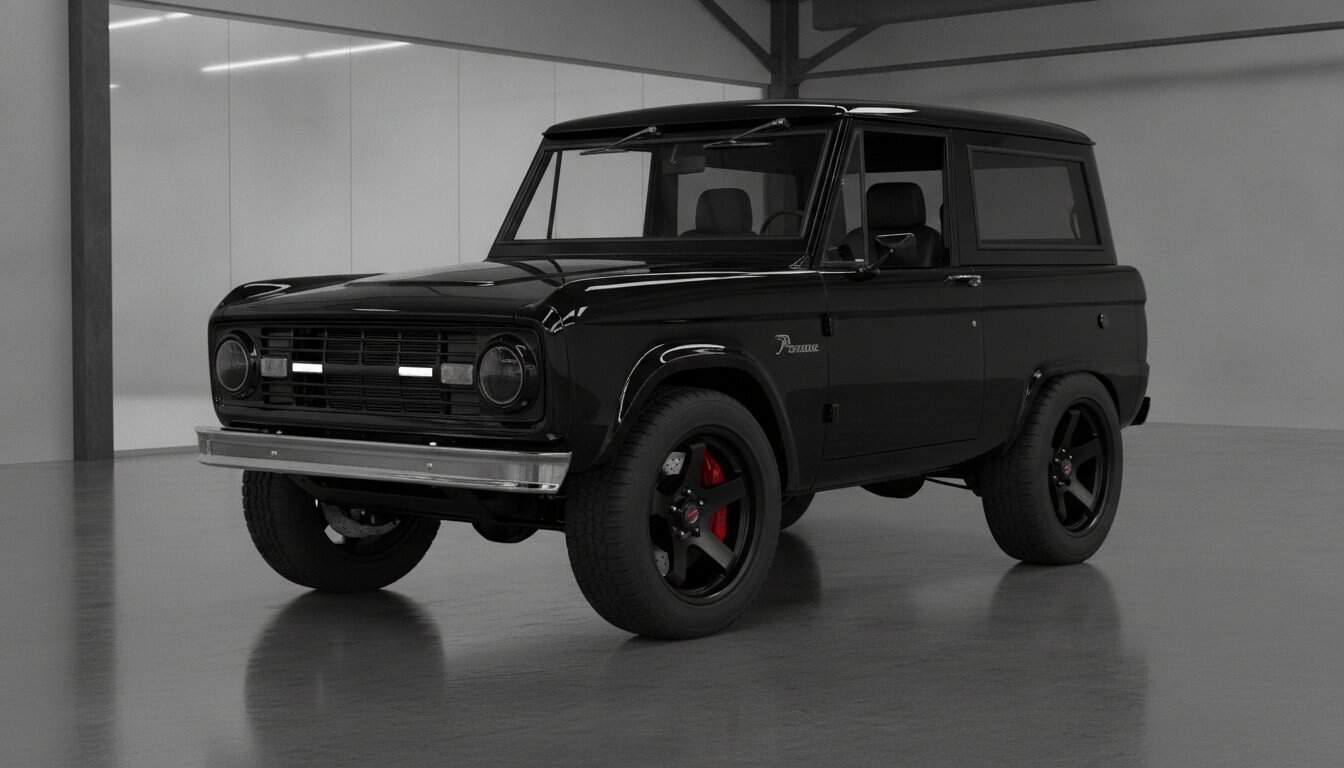
What if that $250,000 invoice for a vintage Bronco isn’t an exercise in excess, but a calculated investment in superior engineering? It’s a question that stops many enthusiasts in their tracks, especially when the fear of overpaying for a mechanical nightmare feels all too real. You’ve likely felt the weight of uncertainty when looking at build quotes, wondering if the invisible labor costs truly translate to long-term value. I understand that hesitation; it’s the mark of a builder who respects both the craft and the capital required to see it through to the finish line.
This article provides the clarity you need for justifying a six-figure restomod build by stripping away the mystery of high-end fabrication. We’ll explore why the global restomod market has surged to a $7.9 billion industry and how specialized labor rates averaging $132 per hour drive the pursuit of precision. You’ll learn to distinguish between a simple engine swap and a ground-up engineering project that integrates modern safety with heritage aesthetics. We will break down the structural requirements of high-performance builds and examine the rising demand for investment-grade assets. By the end, you’ll have a clear path to managing your budget and the confidence to ensure your finished machine delivers maximum value.
Key Takeaways
- Distinguish between a standard aesthetic restoration and the deep engineering required to create a high-performance machine.
- Account for the 2,000 to 4,000 man-hours necessary to achieve world-class metal fabrication and precise body alignment.
- Identify the safety and performance upgrades that transform a vintage chassis into a vehicle capable of handling modern road speeds.
- Evaluate auction trends and documentation strategies for justifying a six-figure restomod build as a legitimate, appreciating financial asset.
- Establish a rigorous vetting process for professional shops and utilize a project roadmap to prevent unforeseen budget creep.
Decoding the Six-Figure Sticker Price: What You Are Actually Buying
When you see a price tag exceeding $150,000, it’s easy to assume you’re paying for a brand name or a shiny paint job. In reality, you’re financing a total mechanical transformation. Traditional Conservation and restoration of road vehicles focuses on returning a car to its factory-original state, often preserving its original flaws. A restomod, however, is a ground-up engineering project that replaces 1960s technology with 2026 performance standards. You aren’t just buying a car; you’re buying a bespoke driving experience that bridges the gap between classic soul and modern supercar capability. Understanding this distinction is the first step in justifying a six-figure restomod build.
The Donor Car Myth: Why the Starting Point is Only 10 Percent
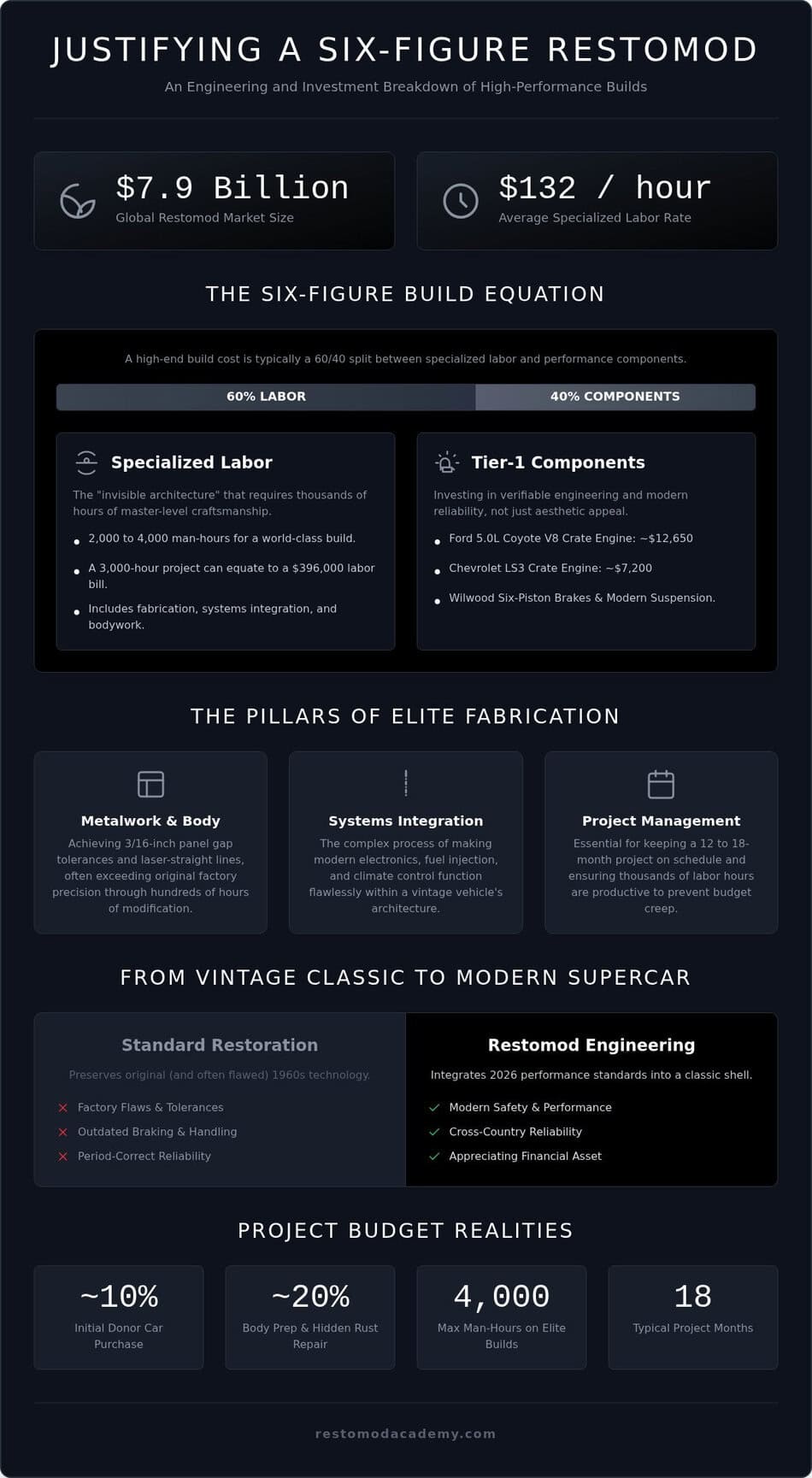
Many enthusiasts believe that finding a rust-free donor car will save them a fortune. While a solid foundation helps, the initial purchase price is often the smallest line item on the ledger. To understand the baseline, you should first explore what is a restomod to grasp how deep these projects go. Even a clean 1969 Camaro requires hundreds of hours of fabrication to accommodate a modern Roadster Shop chassis or wider tires. Hidden rust, metal fatigue, and the need for laser-straight body lines can consume 20 percent of your budget before the first coat of primer is applied. Justifying a six-figure restomod build starts with accepting that the vintage shell is merely a template for the new machine.
Component Quality: Investing in Tier 1 Performance Parts
Every bolt on a high-end build represents a choice between good enough and excellence. Choosing a Ford 5.0-Liter Coyote V8 crate engine at $12,650 or a Chevrolet LS3 at $7,200 provides immediate reliability that a rebuilt vintage block simply cannot match. You aren’t just paying for the engine; you’re paying for the fuel injection, modern cooling, and the ability to drive across the country without a toolkit. When you add Wilwood six-piston brakes and independent rear suspension, you’re investing in safety that matches modern traffic speeds. In a professional six-figure build, the average cost ratio typically settles at approximately 40 percent for high-performance components and 60 percent for specialized labor. This balance ensures that the premium hardware is installed with the precision required to perform at its peak. By prioritizing these tier 1 components, you ensure the vehicle’s value is backed by verifiable engineering rather than just aesthetic appeal.
The Invisible Architecture: Why Labor and Engineering Drive Build Costs
The most significant portion of your budget isn’t found in the crate engine or the leather interior; it’s hidden in the thousands of hours of expert labor required to assemble them. The math is simple. When you consider that the national average labor rate for independent shops is approximately $132 per hour, a 3,000-hour build carries a $396,000 labor bill before a single part is ordered. World-class projects typically demand between 2,000 and 4,000 man-hours to reach completion. This staggering commitment of time is the primary factor in justifying a six-figure restomod build. Professional project management is the only way to keep these hours productive and prevent the timeline from stretching beyond the typical 12 to 18-month window.
Metal Fabrication and Bodywork: The Foundation of Value
Mastering the metal is where the soul of the machine is refined. While a driver-quality finish might look good from ten feet away, a concours restomod requires thousands of hours in panel alignment and gap setting. Technicians work to achieve 3/16-inch tolerances across every door, hood, and trunk line. This often involves cutting and welding factory panels to make them straighter than they ever were when they left the assembly line. You’ll also face structural modifications, like custom floor pans and firewall recesses, just to fit a modern six-speed transmission or a high-displacement V8. This level of fabrication ensures the car doesn’t just look classic; it feels like a precision-engineered modern vehicle from the frame up.
Systems Integration: Making Modern Tech Work in a Vintage Shell
Modern systems integration is the final hurdle that separates a hobbyist project from a professional build. You’re trying to pack a modern climate control system, a high-end audio setup, and a complex EFI computer into an interior that was never designed for them. This requires modern safety and performance upgrades that work in harmony, rather than fighting for space. Custom wiring harnesses are non-negotiable for long-term reliability. Without them, you’re looking at a future of electrical gremlins and roadside breakdowns. If you’re struggling with how to fit these components, check out these restomod interior ideas for inspiration on blending styles. Successful integration is about making the technology invisible until it’s needed. To keep these complex tasks organized, I recommend using Premium Project Blueprints to map out every connection before you strike the first arc.
Safety and Modern Capability: The Core Justification for High-End Builds
Stop assuming original equipment is sufficient for today’s driving environment. A stock 1960s muscle car might look aggressive, but its manual drum brakes and flexible frame are genuine liabilities on a 2026 highway. Modern traffic moves faster and stops harder than anything engineers imagined sixty years ago. Justifying a six-figure restomod build becomes a logical decision when you prioritize safety and modern responsiveness. You aren’t just paying for a higher top speed; you’re investing in the ability to navigate a world where a standard family SUV can out-brake and out-corner a vintage icon. High-end builds bridge this performance gap, ensuring your classic can handle the demands of distracted drivers and high-speed interchanges with confidence.
Reliability serves as the second pillar of this investment. The classic car headache often stems from vapor lock, overheating in traffic, or points-style ignitions that fail at the worst moment. A six-figure project eliminates these frustrations by integrating modern cooling systems and high-pressure fuel delivery. This creates a turn-key experience where the car starts every time, regardless of the weather or how long it has been sitting. By justifying a six-figure restomod build through the lens of usability, you transform a garage queen into a vehicle you can actually drive to work or take on a cross-country tour without a chase truck.
Modern Drivetrains: Reliability Meets Performance
Installing a modern crate engine is the most effective way to gain contemporary performance without sacrificing the vintage aesthetic. Powerplants like the Coyote or LS series provide a foundation of high horsepower with factory-level reliability. These engines offer 100,000 miles of worry-free operation and integrate seamlessly with modern electronics. For those considering the Chevrolet route, I recommend checking out the definitive guide to an LS engine swap to understand the technical requirements of this transition. Pairing these powerplants with a modern five or six-speed transmission transforms the highway cruising experience, dropping engine RPMs and making long-distance travel significantly more comfortable.
Chassis and Braking: The Structural Necessity of Upgrades
A high-horsepower engine is useless if the chassis cannot handle the torque. Six-figure builds require a rigid foundation to manage modern grip levels and acceleration. Original unibodies often flex under pressure, leading to cracked paint and poor handling. Upgrading to a full perimeter frame or integrated subframe connectors is a structural necessity. This rigidity allows the suspension to do its job properly. You can find more detail in this ultimate restomod handling guide. Big brake kits with six-piston calipers and modern ABS integration provide the stopping power required to match the car’s newfound speed. This safety ROI is impossible to ignore when building a machine designed for the real world.
Market Realities and ROI: Evaluating the Financial Logic of Restomodding
Don’t let the fear of depreciation stall your project. While the old adage says you never get your money back on a custom car, the 2026 market tells a different story. High-end restomods are increasingly viewed as blue-chip assets that can outperform traditional restorations at major auctions. In 2026, the global classic car restoration and restomod market reached a valuation of $7.9 billion, with muscle cars accounting for 31.4 percent of that demand. Results from platforms like Bring a Trailer and Barrett-Jackson show that buyers now prioritize drivability and modern performance over 100 percent factory originality. This shift is a fundamental component in justifying a six-figure restomod build. Unlike a new exotic supercar that loses 20 percent of its value the moment you drive it off the lot, a premier restomod is a one-of-one creation that often retains its investment because it cannot be easily replicated.
The Valuation Gap: Restomod vs. Original Restoration
The market has reached a tipping point where a well-executed restomod often commands a higher price than a numbers-matching original. Collectors are moving away from trailer queens that can only be looked at and toward machines they can actually enjoy on the road. To capture this premium, you must use name-brand components and recognized professional standards. Buyers look for the security of knowing the engineering was handled by experts rather than amateurs. Comprehensive documentation serves as a non-negotiable insurance policy that validates every dollar of your project’s market value to future buyers. It proves that the six-figure investment went into structural integrity and Tier 1 components rather than just surface-level aesthetics.
Investment vs. Enjoyment: Calculating the True ROI
Calculate your return on investment by looking at the utility of the vehicle. A finicky, original classic might only see the sun four times a year because of reliability concerns. A restomod with a modern drivetrain and cooling system can be driven weekly, providing a psychological ROI that a museum piece cannot match. However, you must avoid the over-built trap by matching your build level to the known market ceiling for your specific model. Building a $400,000 car in a $200,000 market is a passion project, not a financial one. Focus on creating a balanced machine that emphasizes the intersection of classic style and modern reliability to ensure the broadest appeal. To make sure your budget aligns with market realities before you start, I highly recommend downloading The Ultimate Restomod Guide as your first strategic step.
Executing Your Vision: How to Manage a High-Stakes Restomod Project
Planning for Success: The Ultimate Restomod Roadmap
Define the car’s end use before the first bolt is turned. Are you building a cross-country tourer or a weekend track weapon? This decision dictates every component choice and prevents expensive mid-project pivots, which is essential when justifying a six-figure restomod build to your family or your financial planner. Using professional consulting can save you tens of thousands of dollars by vetting builder quotes and ensuring the technical specifications align with your goals. Our Restomod Consulting Services provide an objective third-party audit of your project, ensuring that the engineering justifies the investment. To get started, revisit our guide on what is a restomod to ensure your goals align with the true definition of a high-performance build.
The Restomod Academy Approach: Education as Protection
Education is your best defense against budget creep. The Ultimate Restomod Guide empowers you to speak the builder’s language, allowing you to ask the right questions about suspension geometry or electrical integration. When you understand the technical reason behind a specific fabrication task, you can better manage the builder-client relationship. Our Premium Project Blueprints provide the technical framework necessary to ensure engineering consistency from front to back. These tools transform you from a passive customer into an informed creator. Take command of your investment today. Book a session with our Restomod Consulting Services to ensure your six-figure build is built on a solid foundation of excellence.
Master the Art of the High-End Build
You now have the framework for justifying a six-figure restomod build by looking past the paint to the engineering beneath. You’ve seen how the global market rewards those who prioritize modern safety and reliable performance over factory-original flaws. It’s clear that your investment thrives on thousands of hours of specialized labor and the integration of Tier 1 components. To ensure your vision translates to a blue-chip asset, you must remain an active, educated participant in the process. This approach ensures that every dollar spent contributes to a machine that is as safe as it is stunning.
With expert guidance from Brook Walsh and our authoritative product reviews, you can navigate the complexities of fabrication and assembly with ease. Our Premium Project Blueprints offer the technical precision needed to keep your budget on track. The road to a world-class machine is long, but with the right mentorship, the journey is as rewarding as the first turn of the key. Similarly, for those who want to apply this level of systemic excellence to their career, you can find out more about professional mastery training. Don’t let the technical hurdles of a high-stakes project slow you down. Let’s get to work.
Start your build with the confidence of an expert; get The Ultimate Restomod Guide today.
Frequently Asked Questions
Is a six-figure restomod build a good investment?
Yes, provided the build emphasizes modern reliability and classic aesthetics. High-end restomods are increasingly viewed as blue-chip assets. The global market valuation of $7.9 billion in 2026 shows strong demand. Unlike mass-produced exotics, these one-of-one machines often retain value because they can’t be easily replicated. Success in justifying a six-figure restomod build depends on using recognized professional standards and Tier 1 components that collectors value at auction.
Why do restomods cost more than simple restorations?
Restomods involve extensive engineering and modernization rather than just refurbishing old parts. While a restoration returns a car to factory specs, a restomod integrates modern drivetrains, complex wiring, and advanced suspension systems. This requires thousands of specialized man-hours. You aren’t just fixing what’s broken; you’re re-engineering the entire vehicle to meet 2026 performance and safety standards. The labor costs for this level of bespoke fabrication drive the price significantly higher.
How do I choose the right builder for a high-end project?
Choose a builder based on their technical workflow and transparency rather than just their portfolio. Audit their shop rates against the national average of $132 per hour and ask for a detailed project roadmap. A reputable builder should provide a clear timeline and be willing to discuss the engineering challenges of your specific vision. Ensure they have experience with modern systems integration, as this is where most high-stakes projects succeed or fail.
Can I get my money back if I sell my restomod?
You can maximize your return by focusing on high-demand models like muscle cars, which hold a 31.4 percent market share. Professional documentation is the most critical factor in justifying a six-figure restomod build during a sale. It acts as an insurance policy for your investment. While you might not recoup every dollar of a passion project, well-documented builds using name-brand chassis and engines frequently outperform original restorations at major auctions.
What are the most expensive parts of a restomod build?
Specialized labor is the single largest expense, often accounting for 60 percent of the total budget. Regarding hardware, the drivetrain and chassis command the highest premiums. A Ford Coyote V8 crate engine costs approximately $12,650, while a custom chassis can reach high five figures. Other significant costs include bespoke interiors, high-end paint finishes, and modern climate control systems. Every premium part requires additional labor for precise fitment and integration.
How long does a six-figure restomod project typically take?
A professional ground-up build typically requires 12 to 18 months of dedicated shop time. This timeline accounts for the 2,000 to 4,000 man-hours needed for meticulous metal fabrication, wiring, and final assembly. If you’re undertaking parts of the project yourself, expect the schedule to stretch to two or three years. Proper project management and a comprehensive blueprint are essential to prevent the timeline from drifting and the budget from creeping.
Do I need a modern chassis for a high-end restomod?
A modern chassis is highly recommended for any build exceeding 450 horsepower. Original vintage frames often lack the rigidity to handle the torque of a modern LS or Coyote engine. A specialized chassis provides superior suspension geometry, better handling, and a safer foundation for high-speed driving. While it adds significant cost, it’s often the difference between a car that feels like an old machine and one that rivals modern sports cars.
What is the difference between a restomod and a pro-touring build?
A restomod focuses on blending classic style with modern comfort and reliability for street use. A pro-touring build is a specific subset of restomodding designed primarily for track performance and autocross. Pro-touring cars emphasize extreme handling, aggressive suspension tuning, and weight reduction. While all pro-touring cars are restomods, not every restomod is built for the track. Most six-figure builds focus on the restomod balance of luxury and drivability.
What if that $250,000 invoice for a vintage Bronco isn’t an exercise in excess, but a calculated investment in superior engineering? It’s a question that stops many enthusiasts in their tracks, especially when the fear of overpaying for a mechanical nightmare feels all too real. You’ve likely felt the weight of uncertainty when looking at build quotes, wondering if the invisible labor costs truly translate to long-term value. I understand that hesitation; it’s the mark of a builder who respects both the craft and the capital required to see it through to the finish line.
This article provides the clarity you need for justifying a six-figure restomod build by stripping away the mystery of high-end fabrication. We’ll explore why the global restomod market has surged to a $7.9 billion industry and how specialized labor rates averaging $132 per hour drive the pursuit of precision. You’ll learn to distinguish between a simple engine swap and a ground-up engineering project that integrates modern safety with heritage aesthetics. We will break down the structural requirements of high-performance builds and examine the rising demand for investment-grade assets. By the end, you’ll have a clear path to managing your budget and the confidence to ensure your finished machine delivers maximum value.
Key Takeaways
- Distinguish between a standard aesthetic restoration and the deep engineering required to create a high-performance machine.
- Account for the 2,000 to 4,000 man-hours necessary to achieve world-class metal fabrication and precise body alignment.
- Identify the safety and performance upgrades that transform a vintage chassis into a vehicle capable of handling modern road speeds.
- Evaluate auction trends and documentation strategies for justifying a six-figure restomod build as a legitimate, appreciating financial asset.
- Establish a rigorous vetting process for professional shops and utilize a project roadmap to prevent unforeseen budget creep.
Decoding the Six-Figure Sticker Price: What You Are Actually Buying
When you see a price tag exceeding $150,000, it’s easy to assume you’re paying for a brand name or a shiny paint job. In reality, you’re financing a total mechanical transformation. Traditional Conservation and restoration of road vehicles focuses on returning a car to its factory-original state, often preserving its original flaws. A restomod, however, is a ground-up engineering project that replaces 1960s technology with 2026 performance standards. You aren’t just buying a car; you’re buying a bespoke driving experience that bridges the gap between classic soul and modern supercar capability. Understanding this distinction is the first step in justifying a six-figure restomod build.
The Donor Car Myth: Why the Starting Point is Only 10 Percent
Many enthusiasts believe that finding a rust-free donor car will save them a fortune. While a solid foundation helps, the initial purchase price is often the smallest line item on the ledger. To understand the baseline, you should first explore what is a restomod to grasp how deep these projects go. Even a clean 1969 Camaro requires hundreds of hours of fabrication to accommodate a modern Roadster Shop chassis or wider tires. Hidden rust, metal fatigue, and the need for laser-straight body lines can consume 20 percent of your budget before the first coat of primer is applied. Justifying a six-figure restomod build starts with accepting that the vintage shell is merely a template for the new machine.
Component Quality: Investing in Tier 1 Performance Parts
Every bolt on a high-end build represents a choice between good enough and excellence. Choosing a Ford 5.0-Liter Coyote V8 crate engine at $12,650 or a Chevrolet LS3 at $7,200 provides immediate reliability that a rebuilt vintage block simply cannot match. You aren’t just paying for the engine; you’re paying for the fuel injection, modern cooling, and the ability to drive across the country without a toolkit. When you add Wilwood six-piston brakes and independent rear suspension, you’re investing in safety that matches modern traffic speeds. In a professional six-figure build, the average cost ratio typically settles at approximately 40 percent for high-performance components and 60 percent for specialized labor. This balance ensures that the premium hardware is installed with the precision required to perform at its peak. By prioritizing these tier 1 components, you ensure the vehicle’s value is backed by verifiable engineering rather than just aesthetic appeal.
The Invisible Architecture: Why Labor and Engineering Drive Build Costs
The most significant portion of your budget isn’t found in the crate engine or the leather interior; it’s hidden in the thousands of hours of expert labor required to assemble them. The math is simple. When you consider that the national average labor rate for independent shops is approximately $132 per hour, a 3,000-hour build carries a $396,000 labor bill before a single part is ordered. World-class projects typically demand between 2,000 and 4,000 man-hours to reach completion. This staggering commitment of time is the primary factor in justifying a six-figure restomod build. Professional project management is the only way to keep these hours productive and prevent the timeline from stretching beyond the typical 12 to 18-month window.
Metal Fabrication and Bodywork: The Foundation of Value
Mastering the metal is where the soul of the machine is refined. While a driver-quality finish might look good from ten feet away, a concours restomod requires thousands of hours in panel alignment and gap setting. Technicians work to achieve 3/16-inch tolerances across every door, hood, and trunk line. This often involves cutting and welding factory panels to make them straighter than they ever were when they left the assembly line. You’ll also face structural modifications, like custom floor pans and firewall recesses, just to fit a modern six-speed transmission or a high-displacement V8. This level of fabrication ensures the car doesn’t just look classic; it feels like a precision-engineered modern vehicle from the frame up.
Systems Integration: Making Modern Tech Work in a Vintage Shell
Modern systems integration is the final hurdle that separates a hobbyist project from a professional build. You’re trying to pack a modern climate control system, a high-end audio setup, and a complex EFI computer into an interior that was never designed for them. This requires modern safety and performance upgrades that work in harmony, rather than fighting for space. Custom wiring harnesses are non-negotiable for long-term reliability. Without them, you’re looking at a future of electrical gremlins and roadside breakdowns. If you’re struggling with how to fit these components, check out these restomod interior ideas for inspiration on blending styles. Successful integration is about making the technology invisible until it’s needed. To keep these complex tasks organized, I recommend using Premium Project Blueprints to map out every connection before you strike the first arc.
Safety and Modern Capability: The Core Justification for High-End Builds
Stop assuming original equipment is sufficient for today’s driving environment. A stock 1960s muscle car might look aggressive, but its manual drum brakes and flexible frame are genuine liabilities on a 2026 highway. Modern traffic moves faster and stops harder than anything engineers imagined sixty years ago. Justifying a six-figure restomod build becomes a logical decision when you prioritize safety and modern responsiveness. You aren’t just paying for a higher top speed; you’re investing in the ability to navigate a world where a standard family SUV can out-brake and out-corner a vintage icon. High-end builds bridge this performance gap, ensuring your classic can handle the demands of distracted drivers and high-speed interchanges with confidence.
Reliability serves as the second pillar of this investment. The classic car headache often stems from vapor lock, overheating in traffic, or points-style ignitions that fail at the worst moment. A six-figure project eliminates these frustrations by integrating modern cooling systems and high-pressure fuel delivery. This creates a turn-key experience where the car starts every time, regardless of the weather or how long it has been sitting. By justifying a six-figure restomod build through the lens of usability, you transform a garage queen into a vehicle you can actually drive to work or take on a cross-country tour without a chase truck.
Modern Drivetrains: Reliability Meets Performance
Installing a modern crate engine is the most effective way to gain contemporary performance without sacrificing the vintage aesthetic. Powerplants like the Coyote or LS series provide a foundation of high horsepower with factory-level reliability. These engines offer 100,000 miles of worry-free operation and integrate seamlessly with modern electronics. For those considering the Chevrolet route, I recommend checking out the definitive guide to an LS engine swap to understand the technical requirements of this transition. Pairing these powerplants with a modern five or six-speed transmission transforms the highway cruising experience, dropping engine RPMs and making long-distance travel significantly more comfortable.
Chassis and Braking: The Structural Necessity of Upgrades
A high-horsepower engine is useless if the chassis cannot handle the torque. Six-figure builds require a rigid foundation to manage modern grip levels and acceleration. Original unibodies often flex under pressure, leading to cracked paint and poor handling. Upgrading to a full perimeter frame or integrated subframe connectors is a structural necessity. This rigidity allows the suspension to do its job properly. You can find more detail in this ultimate restomod handling guide. Big brake kits with six-piston calipers and modern ABS integration provide the stopping power required to match the car’s newfound speed. This safety ROI is impossible to ignore when building a machine designed for the real world.
Market Realities and ROI: Evaluating the Financial Logic of Restomodding
Don’t let the fear of depreciation stall your project. While the old adage says you never get your money back on a custom car, the 2026 market tells a different story. High-end restomods are increasingly viewed as blue-chip assets that can outperform traditional restorations at major auctions. In 2026, the global classic car restoration and restomod market reached a valuation of $7.9 billion, with muscle cars accounting for 31.4 percent of that demand. Results from platforms like Bring a Trailer and Barrett-Jackson show that buyers now prioritize drivability and modern performance over 100 percent factory originality. This shift is a fundamental component in justifying a six-figure restomod build. Unlike a new exotic supercar that loses 20 percent of its value the moment you drive it off the lot, a premier restomod is a one-of-one creation that often retains its investment because it cannot be easily replicated.
The Valuation Gap: Restomod vs. Original Restoration
The market has reached a tipping point where a well-executed restomod often commands a higher price than a numbers-matching original. Collectors are moving away from trailer queens that can only be looked at and toward machines they can actually enjoy on the road. To capture this premium, you must use name-brand components and recognized professional standards. Buyers look for the security of knowing the engineering was handled by experts rather than amateurs. Comprehensive documentation serves as a non-negotiable insurance policy that validates every dollar of your project’s market value to future buyers. It proves that the six-figure investment went into structural integrity and Tier 1 components rather than just surface-level aesthetics.
Investment vs. Enjoyment: Calculating the True ROI
Calculate your return on investment by looking at the utility of the vehicle. A finicky, original classic might only see the sun four times a year because of reliability concerns. A restomod with a modern drivetrain and cooling system can be driven weekly, providing a psychological ROI that a museum piece cannot match. However, you must avoid the over-built trap by matching your build level to the known market ceiling for your specific model. Building a $400,000 car in a $200,000 market is a passion project, not a financial one. Focus on creating a balanced machine that emphasizes the intersection of classic style and modern reliability to ensure the broadest appeal. To make sure your budget aligns with market realities before you start, I highly recommend downloading The Ultimate Restomod Guide as your first strategic step.
Executing Your Vision: How to Manage a High-Stakes Restomod Project
Don’t hand over a six-figure check and hope for the best. Managing a build of this magnitude requires the same level of precision as the metalwork itself. You’ve already done the hard work of justifying a six-figure restomod build by understanding the engineering and market value. Now, you must act as the project manager or hire an expert to bridge the gap between your vision and the shop’s execution. A full professional build typically takes 12 to 18 months. Without a clear plan, that timeline can easily double, leading to the nightmare build scenarios that haunt automotive forums. Vetting a shop isn’t just about looking at finished cars; it’s about auditing their workflow, their communication style, and their transparency regarding those $132 per hour labor blocks.
Planning for Success: The Ultimate Restomod Roadmap
Define the car’s end use before the first bolt is turned. Are you building a cross-country tourer or a weekend track weapon? This decision dictates every component choice and prevents expensive mid-project pivots, which is essential when justifying a six-figure restomod build to your family or your financial planner. Using professional consulting can save you tens of thousands of dollars by vetting builder quotes and ensuring the technical specifications align with your goals. Our Restomod Consulting Services provide an objective third-party audit of your project, ensuring that the engineering justifies the investment. To get started, revisit our guide on what is a restomod to ensure your goals align with the true definition of a high-performance build.
The Restomod Academy Approach: Education as Protection
Education is your best defense against budget creep. The Ultimate Restomod Guide empowers you to speak the builder’s language, allowing you to ask the right questions about suspension geometry or electrical integration. When you understand the technical reason behind a specific fabrication task, you can better manage the builder-client relationship. Our Premium Project Blueprints provide the technical framework necessary to ensure engineering consistency from front to back. These tools transform you from a passive customer into an informed creator. Take command of your investment today. Book a session with our Restomod Consulting Services to ensure your six-figure build is built on a solid foundation of excellence.
Master the Art of the High-End Build
You now have the framework for justifying a six-figure restomod build by looking past the paint to the engineering beneath. You’ve seen how the global market rewards those who prioritize modern safety and reliable performance over factory-original flaws. It’s clear that your investment thrives on thousands of hours of specialized labor and the integration of Tier 1 components. To ensure your vision translates to a blue-chip asset, you must remain an active, educated participant in the process. This approach ensures that every dollar spent contributes to a machine that is as safe as it is stunning.
With expert guidance from Brook Walsh and our authoritative product reviews, you can navigate the complexities of fabrication and assembly with ease. Our Premium Project Blueprints offer the technical precision needed to keep your budget on track. The road to a world-class machine is long, but with the right mentorship, the journey is as rewarding as the first turn of the key. Don’t let the technical hurdles of a high-stakes project slow you down. Let’s get to work.
Start your build with the confidence of an expert; get The Ultimate Restomod Guide today.
Frequently Asked Questions
Is a six-figure restomod build a good investment?
Yes, provided the build emphasizes modern reliability and classic aesthetics. High-end restomods are increasingly viewed as blue-chip assets. The global market valuation of $7.9 billion in 2026 shows strong demand. Unlike mass-produced exotics, these one-of-one machines often retain value because they can’t be easily replicated. Success in justifying a six-figure restomod build depends on using recognized professional standards and Tier 1 components that collectors value at auction.
Why do restomods cost more than simple restorations?
Restomods involve extensive engineering and modernization rather than just refurbishing old parts. While a restoration returns a car to factory specs, a restomod integrates modern drivetrains, complex wiring, and advanced suspension systems. This requires thousands of specialized man-hours. You aren’t just fixing what’s broken; you’re re-engineering the entire vehicle to meet 2026 performance and safety standards. The labor costs for this level of bespoke fabrication drive the price significantly higher.
How do I choose the right builder for a high-end project?
Choose a builder based on their technical workflow and transparency rather than just their portfolio. Audit their shop rates against the national average of $132 per hour and ask for a detailed project roadmap. A reputable builder should provide a clear timeline and be willing to discuss the engineering challenges of your specific vision. Ensure they have experience with modern systems integration, as this is where most high-stakes projects succeed or fail.
Can I get my money back if I sell my restomod?
You can maximize your return by focusing on high-demand models like muscle cars, which hold a 31.4 percent market share. Professional documentation is the most critical factor in justifying a six-figure restomod build during a sale. It acts as an insurance policy for your investment. While you might not recoup every dollar of a passion project, well-documented builds using name-brand chassis and engines frequently outperform original restorations at major auctions.
What are the most expensive parts of a restomod build?
Specialized labor is the single largest expense, often accounting for 60 percent of the total budget. Regarding hardware, the drivetrain and chassis command the highest premiums. A Ford Coyote V8 crate engine costs approximately $12,650, while a custom chassis can reach high five figures. Other significant costs include bespoke interiors, high-end paint finishes, and modern climate control systems. Every premium part requires additional labor for precise fitment and integration.
How long does a six-figure restomod project typically take?
A professional ground-up build typically requires 12 to 18 months of dedicated shop time. This timeline accounts for the 2,000 to 4,000 man-hours needed for meticulous metal fabrication, wiring, and final assembly. If you’re undertaking parts of the project yourself, expect the schedule to stretch to two or three years. Proper project management and a comprehensive blueprint are essential to prevent the timeline from drifting and the budget from creeping.
Do I need a modern chassis for a high-end restomod?
A modern chassis is highly recommended for any build exceeding 450 horsepower. Original vintage frames often lack the rigidity to handle the torque of a modern LS or Coyote engine. A specialized chassis provides superior suspension geometry, better handling, and a safer foundation for high-speed driving. While it adds significant cost, it’s often the difference between a car that feels like an old machine and one that rivals modern sports cars.
What is the difference between a restomod and a pro-touring build?
A restomod focuses on blending classic style with modern comfort and reliability for street use. A pro-touring build is a specific subset of restomodding designed primarily for track performance and autocross. Pro-touring cars emphasize extreme handling, aggressive suspension tuning, and weight reduction. While all pro-touring cars are restomods, not every restomod is built for the track. Most six-figure builds focus on the restomod balance of luxury and drivability.