

What if the best way to get your project car moving again is to stop pushing for a moment? A growing list of unfinished jobs, surprise setbacks, and decisions that won’t settle can turn garage time into another source of pressure. Managing project car burnout and frustration starts with identifying what’s draining your energy, not blaming yourself for losing momentum. A build can matter deeply to you and still feel like too much right now.
You don’t have to rush the car or abandon the vision. This guide will help you work out what’s behind the frustration, then decide whether your project needs a pause, a narrower scope, or a clearer plan. Turn the long list into manageable next steps so your next workshop session has a purpose you can reach. Progress isn’t measured only by a finished engine or a first drive. A sound decision, a documented inspection, or one completed task can bring back some of the satisfaction of building.
Key Takeaways
- Spot signs like avoiding the garage, getting stuck on decisions, or dreading workshop time before frustration stalls the build.
- Identify whether unclear priorities, dependencies, or an ambitious scope are making progress hard to see.
- Compare a short pause, a smaller scope, and steady continuation to choose the response that fits your current energy.
- Use a simple reset to name the blocker, choose one achievable task, and record the next action for your workshop session.
- Managing project car burnout and frustration starts with a clear roadmap that protects your energy and makes the next step visible.
Project Car Burnout: Recognize the Frustration Before It Stops Your Build
A long-term build can be meaningful and still become frustrating. You may care about preserving the car’s character, getting the mechanical details right, and seeing your vision take shape, yet find yourself reluctant to step into the garage. That tension doesn’t mean you’ve stopped caring. It may mean the way you’re approaching the project is taking more energy than it gives back.
Look for a pattern rather than judging yourself by one difficult evening. Maybe you keep putting off the same unfinished job, such as tracing a wiring fault or measuring a bracket. Perhaps every option seems to require more research, or you feel dread before workshop time even begins. One delay may simply reflect a busy week. Repeated avoidance, indecision, or frustration that follows you into the garage is a reason to pause and take stock.
A stalled pattern is useful information. Notice it early, and you can choose a next step that addresses the actual source of friction.
What project-car frustration can look like
Progress is hard to see when your attention stays fixed on everything that remains. A cleaned-up engine bay or a sorted suspension component may represent solid work, but a long task list can make those gains feel insignificant. Setbacks add to the strain, especially when one unresolved issue blocks several jobs behind it.
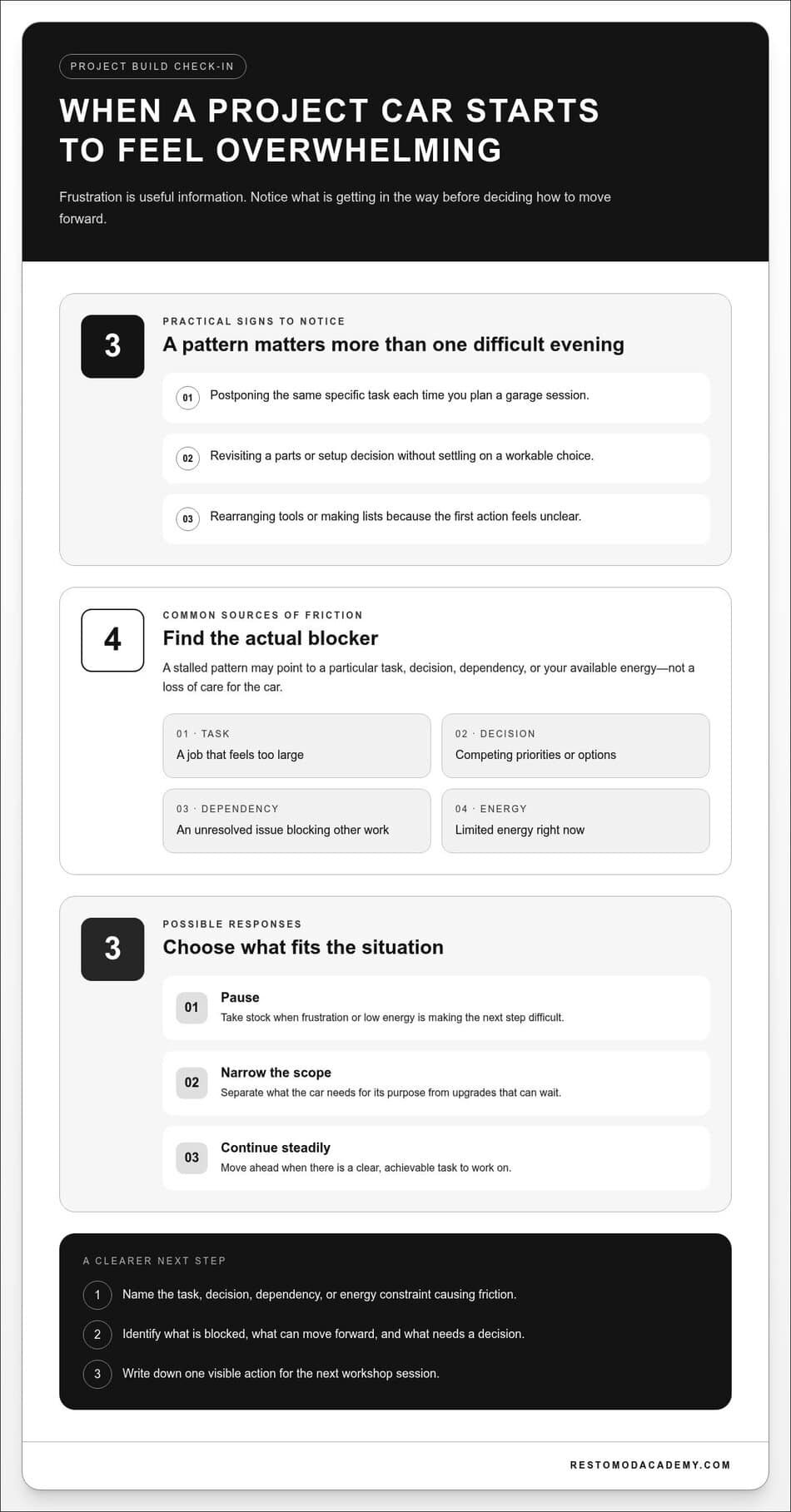
Watch for practical signs such as:
- Postponing one specific task every time you plan a garage session.
- Revisiting the same parts or setup decision without settling on a workable choice.
- Spending workshop time rearranging tools or making lists because the first action feels unclear.
These signals don’t diagnose anything, and they don’t prove the project is wrong for you. They show where your attention may be getting stuck. Naming the exact task or decision is more useful than concluding that you’ve lost enthusiasm for the whole car.
Why “just push through” may not solve the problem
Pressure can turn a hands-on hobby into another obligation. If every garage visit becomes a test of discipline, you may start associating the car with guilt rather than the satisfaction of careful work. Forcing a session without understanding the obstacle can deepen that association, especially if the job depends on a part, measurement, or decision you can’t resolve that day.
The word burnout is also used broadly. The overview of Burnout (psychology) describes a wider concept; everyday frustration with a project isn’t, by itself, a medical diagnosis. Use the term as a prompt to examine your experience, not as a label you have to accept.
Taking stock is not giving up. Separate the sources of frustration: a task that feels too large, a decision with competing priorities, a dependency that has stalled progress, or simply limited energy right now. Managing project car burnout and frustration starts with identifying that friction before choosing to pause, adjust the scope, or carry on. The car doesn’t need a permanent verdict today. It needs an honest assessment of what’s making the next step difficult.
Why a Restomod Build Starts to Feel Overwhelming
A restomod asks you to balance two compelling aims: keeping the character of a classic car while shaping it around how you want to drive and use it. That creative freedom can also make a project feel as if it has no natural stopping point. A new idea appears, one decision affects another, and the original plan starts to blur beneath a growing list of possibilities.
Build pressure often comes from the way tasks connect. A choice about the car’s intended use can influence the mechanical work, while the condition of one system may affect when you can move on to another. If the sequence isn’t clear, even a task you could tackle today may feel blocked by a decision you haven’t made yet.
A visible next action is more useful than an undefined goal like “finish the car.” It gives your attention somewhere practical to land.
When the project scope keeps expanding
New ideas are part of the fun, but each one can move the finish line. You might begin with a plan to preserve a period-correct appearance, then consider modernizing the driving experience, then add more refinements as the vision develops. Before adding a goal, separate what the car needs to meet its original purpose from upgrades that would be appealing later. Keep both on the list, but don’t make every good idea a requirement for the current phase.
This distinction protects the build’s identity. A classic exterior paired with a more contemporary feel can be a coherent direction, but you still need to decide which elements define the project and which are optional enhancements. Write down the must-haves first. Revisit the “later” list when it fits the scope, time, and energy you can realistically dedicate.
When uncertainty creates workshop friction
An unclear repair sequence can turn a simple garage session into a string of decisions. You arrive ready to make progress, then wonder whether a component needs inspection before another job can begin, or whether you need more information to proceed confidently. Rather than trying to solve every open question on the spot, record each one alongside the task it affects. This separates research from hands-on work and keeps unresolved decisions from crowding your attention.
Also distinguish a true dependency from an assumption. A delayed part may prevent one operation without stopping every task. A skill gap may call for learning before you proceed, while an unanswered design choice may affect only a later phase. Mark what is blocked, what can move forward, and what needs a decision. For a broader look at how classic styling and modern upgrades fit together, explore what defines a restomod build as you clarify the direction of your own project.
Use a roadmap to connect the vision to the workbench: define the project’s purpose, group related jobs, note dependencies, and choose one action you can take next. Managing project car burnout and frustration becomes more practical when the plan shows not only what remains, but also what can move forward now. You don’t have to settle every future detail before making useful progress.
Pause, Simplify, or Continue? Choose the Right Response to Build Frustration
There isn’t one correct response to a difficult stretch. The useful choice depends on what’s causing the friction, what you want the finished car to be, and what your time and energy can support. Changing direction doesn’t mean the build has failed. A thoughtful adjustment can protect the purpose of the project better than pushing ahead with a plan that no longer fits.
Use this comparison to consider your options. Treat it as a decision aid, not a deadline. You can reassess as the project changes.
| Response | When it may fit | Trade-off to consider |
|---|---|---|
| Pause | You’re circling the same task or decision without gaining clarity. | The unresolved work remains, so note the question and a possible return point. |
| Simplify | The scope has grown beyond the car’s essential purpose or your current capacity. | Some desired changes will move to a later phase or leave the plan. |
| Continue steadily | You know the next safe, useful task and have the capacity to do it. | Progress may be gradual, and continuing without reviewing priorities can preserve unnecessary work. |
When a pause can create room to think
Step back from a specific task if repeated attempts leave you no closer to a decision. Before leaving the workshop, write down what you were trying to resolve, what you already know, and the question that remains. That note gives you a clear point of return instead of making you reconstruct the problem from memory. A pause creates room to think, but it doesn’t guarantee that motivation will return on a schedule.
When reducing scope protects the build’s purpose
Revisit the essentials: what should the car look and feel like, and what do you need it to do? A builder focused on preserving classic character may defer modern refinements; another may prioritize a contemporary driving experience. Neither direction is automatically better. Keep changes that serve your core vision in the active plan and move appealing extras to a “later” list. Deferring an upgrade can preserve the build’s purpose without erasing the idea.
Before choosing, consider your priorities, available capacity, and intended finished car together. If you can name a next task that fits all three, steady continuation may make sense. If you can’t, that’s a cue to adjust, not a verdict on the project. Managing project car burnout and frustration means choosing deliberately, then giving that choice enough room to work before judging it.
A Practical Reset: Turn Project-Car Frustration Into One Clear Next Step
Once you’ve identified what’s slowing the build, resist the urge to overhaul the entire plan in one sitting. Reset around the next useful action. A short pause, a clear note, and one manageable task can make a complicated restoration feel workable again without pretending every challenge is solved.
Use this sequence to restart with intention:
- Pause. Step back long enough to look at the project without immediately adding tasks or making a rushed decision.
- Name the blocker. Write down what’s stopping progress. Is the job unclear, waiting on information, dependent on another task, or simply too broad?
- Choose one task. Pick an action that can be completed or clearly advanced in a single workshop session.
- Record what comes next. Note the result, any decision you made, and the first action for your next visit.
Keep a simple project log in a notebook or digital document. It doesn’t need a complex template. A date, task, decision, open question, and next action are enough to preserve context between sessions. Record decisions as progress, too. Settling on an approach or ruling out an option can move a build forward even when no parts have been fitted.
Break a stalled job into manageable actions
Replace a broad goal like “sort the bodywork” with a visible action, such as inspecting one area, photographing its condition, and noting what needs further assessment. Then separate work you can do now from tasks waiting on information or another job. This makes dependencies easier to see and helps you avoid treating one blocked item as a reason the entire project must stop.
For example, if a section of a classic car needs restoration, document what you can observe first, list the questions you still need to answer, and choose a separate task that can proceed in the meantime. The next action doesn’t have to finish the repair. A clear step that narrows the problem is progress.
Make the next workshop session easier to start
Before wrapping up, leave yourself a useful handoff: write the first action for next time and gather the relevant notes or references. Set up the work area so you can begin without spending the first part of the session remembering where you left off. Keep decisions and completed tasks in the log alongside physical work, so your record reflects the thinking as well as the wrenching.
If a task is blocked, record exactly what information would unblock it rather than carrying a vague reminder in your head. That keeps the next session focused and makes it easier to choose another useful job if the answer isn’t ready. Managing project car burnout and frustration becomes more manageable when each visit has a defined purpose, even if that purpose is simply to inspect, document, or resolve one question.
Build a clearer path from idea to workshop action with Restomod Academy’s classic-car project resources.
Build Sustainable Momentum With a Clear Restomod Roadmap
A sustainable build doesn’t depend on constant enthusiasm or long days in the workshop. It depends on a plan that fits the car’s purpose and your available energy: define the scope, keep decisions organized, and know what task comes next. A roadmap isn’t a demand to solve every mechanical or design question today. It gives each decision a place and helps you work through the project in a considered order.
Start with a simple project brief. Describe the finished car in practical and personal terms: what should it feel like to drive, what character do you want to preserve, and what matters most in its use? Keep those answers visible. They can help you assess new ideas without treating every possibility as a must-have. If a proposed change supports the intended car, decide where it belongs in the plan. If it doesn’t, defer it or let it go.
Reconnect the build to the reason you started
Write a short description of the car you’re building, not just a list of modifications. Maybe the goal is to retain a familiar classic feel while making the car suit your driving priorities. That purpose gives you a consistent way to weigh competing choices, from preserving original character to adding modern touches. For a clearer sense of the broader approach, explore what a restomod is and consider which parts of that idea fit your vision.
Keep moving with a project roadmap
Turn the brief into stages that make sense for your car. Your roadmap might group inspection, planning, restoration, modification, and final checks, with tasks and open decisions recorded under the stage where they belong. The exact sequence depends on the build, but organizing the work helps reveal which choices need attention now and which can wait. It also lets you recognize progress in planning and learning, not only in completed physical work.
Managing project car burnout and frustration is easier to approach when the whole build no longer has to live in your head. A structured learning resource can help you understand unfamiliar choices and organize the broader project, while your own notes keep the plan specific to your car. The Ultimate Restomod Guide is an educational resource for planning a classic-car project. Use it to develop your understanding alongside the roadmap you’re creating.
Keep the next move modest. Revisit the project brief when priorities shift, update the plan when you learn something new, and choose a task that fits your current capacity. The aim isn’t to hurry a car you care about. It’s to keep the build connected to your original vision while making steady, thoughtful progress.
Explore The Ultimate Restomod Guide as you shape a clearer roadmap for your build.
Give Your Build a Clearer Path Forward
Your next step doesn’t need to solve the whole project. Let it reconnect the work in front of you with the car you want to create. A considered plan leaves room to learn, revise, and take pride in decisions along the way, whether you’re preserving a classic’s character or blending it with modern touches. That’s a steadier foundation for managing project car burnout and frustration than demanding constant progress from yourself.
For guidance as you shape the bigger picture, explore The Ultimate Restomod Guide, Restomod Academy’s primary educational resource. Founded by automotive enthusiast Brook Walsh, Restomod Academy offers learning resources for both beginner and experienced builders, covering the choices involved in classic-car restoration and modification.
Explore The Ultimate Restomod Guide and choose one idea that can help clarify your build’s direction. Then take that understanding back to the garage, one deliberate step at a time. Your project still has room to become something unmistakably yours.
Frequently Asked Questions
Is it normal to lose motivation during a project car build?
Yes, motivation can rise and fall during a long build, especially when the work shifts from exciting visible changes to repetitive preparation or troubleshooting. A quiet stretch doesn’t automatically mean you’ve lost interest in the car. Notice whether a particular kind of work is draining you, or whether the project no longer matches what you want from it. That distinction can help you decide what needs attention.
How do I get motivated to work on my project car again?
Start with a task that gives you a clear sense of progress, rather than waiting to feel fully motivated before you begin. You might clean and label removed hardware, document a section you’ve inspected, or finish a small piece of preparation. For managing project car burnout and frustration, make the session about that one action, not the entire build. Completing a task can make it easier to decide what to tackle next.
What should I do if my project car is taking longer than expected?
Review what changed and adjust your expectations to reflect the build as it exists now. A repair may uncover additional work, or a decision may take more thought than you allowed for. Compare the original plan with completed work and unresolved dependencies, then revise the order of tasks. Treat dates as planning aids, not proof of failure. A more realistic sequence can help you keep the project moving without rushing important work.
Should I sell my project car if I am frustrated with it?
Don’t make the decision solely in the middle of a frustrating workshop session. Give yourself room to consider whether the car still fits your goals and whether continuing is practical for your current circumstances. You could first pause work or set aside optional changes, then reconsider with a clearer head. If selling still feels right after that, organize your project notes and document the car’s condition so your decision is informed.
How can I stop spending time on upgrades that are not essential?
Before adding an upgrade, ask what purpose it serves and what current priority it might displace. Keep a separate list of ideas you like but don’t need for the build’s core goal. For example, if a change improves appearance but delays work needed to make the car usable as intended, defer it and review it later. This preserves good ideas without letting every new possibility expand the active project.
What if I do not know what to do next on my restoration?
Choose a small fact-finding action before committing to a repair. Inspect the relevant area, take clear notes or photographs, and identify the specific question preventing progress. Then consult reliable information that matches the vehicle and task, rather than guessing at a procedure. If the next step involves work beyond your knowledge or ability, pause and build that understanding before proceeding. Knowing what you need to learn is useful progress, too.
What if the best way to get your project car moving again is to stop pushing for a moment? A growing list of unfinished jobs, surprise setbacks, and decisions that won’t settle can turn garage time into another source of pressure. Managing project car burnout and frustration starts with identifying what’s draining your energy, not blaming yourself for losing momentum. A build can matter deeply to you and still feel like too much right now.
You don’t have to rush the car or abandon the vision. This guide will help you work out what’s behind the frustration, then decide whether your project needs a pause, a narrower scope, or a clearer plan. Turn the long list into manageable next steps so your next workshop session has a purpose you can reach. Progress isn’t measured only by a finished engine or a first drive. A sound decision, a documented inspection, or one completed task can bring back some of the satisfaction of building.
Key Takeaways
- Spot signs like avoiding the garage, getting stuck on decisions, or dreading workshop time before frustration stalls the build.
- Identify whether unclear priorities, dependencies, or an ambitious scope are making progress hard to see.
- Compare a short pause, a smaller scope, and steady continuation to choose the response that fits your current energy.
- Use a simple reset to name the blocker, choose one achievable task, and record the next action for your workshop session.
- Managing project car burnout and frustration starts with a clear roadmap that protects your energy and makes the next step visible.
Project Car Burnout: Recognize the Frustration Before It Stops Your Build
A long-term build can be meaningful and still become frustrating. You may care about preserving the car’s character, getting the mechanical details right, and seeing your vision take shape, yet find yourself reluctant to step into the garage. That tension doesn’t mean you’ve stopped caring. It may mean the way you’re approaching the project is taking more energy than it gives back.
Look for a pattern rather than judging yourself by one difficult evening. Maybe you keep putting off the same unfinished job, such as tracing a wiring fault or measuring a bracket. Perhaps every option seems to require more research, or you feel dread before workshop time even begins. One delay may simply reflect a busy week. Repeated avoidance, indecision, or frustration that follows you into the garage is a reason to pause and take stock.
A stalled pattern is useful information. Notice it early, and you can choose a next step that addresses the actual source of friction.
What project-car frustration can look like
Progress is hard to see when your attention stays fixed on everything that remains. A cleaned-up engine bay or a sorted suspension component may represent solid work, but a long task list can make those gains feel insignificant. Setbacks add to the strain, especially when one unresolved issue blocks several jobs behind it.
Watch for practical signs such as:
- Postponing one specific task every time you plan a garage session.
- Revisiting the same parts or setup decision without settling on a workable choice.
- Spending workshop time rearranging tools or making lists because the first action feels unclear.
These signals don’t diagnose anything, and they don’t prove the project is wrong for you. They show where your attention may be getting stuck. Naming the exact task or decision is more useful than concluding that you’ve lost enthusiasm for the whole car.
Why “just push through” may not solve the problem
Pressure can turn a hands-on hobby into another obligation. If every garage visit becomes a test of discipline, you may start associating the car with guilt rather than the satisfaction of careful work. Forcing a session without understanding the obstacle can deepen that association, especially if the job depends on a part, measurement, or decision you can’t resolve that day.
The word burnout is also used broadly. The overview of Burnout (psychology) describes a wider concept; everyday frustration with a project isn’t, by itself, a medical diagnosis. Use the term as a prompt to examine your experience, not as a label you have to accept.
Taking stock is not giving up. Separate the sources of frustration: a task that feels too large, a decision with competing priorities, a dependency that has stalled progress, or simply limited energy right now. Managing project car burnout and frustration starts with identifying that friction before choosing to pause, adjust the scope, or carry on. The car doesn’t need a permanent verdict today. It needs an honest assessment of what’s making the next step difficult.
Why a Restomod Build Starts to Feel Overwhelming
A restomod asks you to balance two compelling aims: keeping the character of a classic car while shaping it around how you want to drive and use it. That creative freedom can also make a project feel as if it has no natural stopping point. A new idea appears, one decision affects another, and the original plan starts to blur beneath a growing list of possibilities.
Build pressure often comes from the way tasks connect. A choice about the car’s intended use can influence the mechanical work, while the condition of one system may affect when you can move on to another. If the sequence isn’t clear, even a task you could tackle today may feel blocked by a decision you haven’t made yet.
A visible next action is more useful than an undefined goal like “finish the car.” It gives your attention somewhere practical to land.
When the project scope keeps expanding
New ideas are part of the fun, but each one can move the finish line. You might begin with a plan to preserve a period-correct appearance, then consider modernizing the driving experience, then add more refinements as the vision develops. Before adding a goal, separate what the car needs to meet its original purpose from upgrades that would be appealing later. Keep both on the list, but don’t make every good idea a requirement for the current phase.
This distinction protects the build’s identity. A classic exterior paired with a more contemporary feel can be a coherent direction, but you still need to decide which elements define the project and which are optional enhancements. Write down the must-haves first. Revisit the “later” list when it fits the scope, time, and energy you can realistically dedicate.
When uncertainty creates workshop friction
An unclear repair sequence can turn a simple garage session into a string of decisions. You arrive ready to make progress, then wonder whether a component needs inspection before another job can begin, or whether you need more information to proceed confidently. Rather than trying to solve every open question on the spot, record each one alongside the task it affects. This separates research from hands-on work and keeps unresolved decisions from crowding your attention.
Also distinguish a true dependency from an assumption. A delayed part may prevent one operation without stopping every task. A skill gap may call for learning before you proceed, while an unanswered design choice may affect only a later phase. Mark what is blocked, what can move forward, and what needs a decision. For a broader look at how classic styling and modern upgrades fit together, explore what defines a restomod build as you clarify the direction of your own project.
Use a roadmap to connect the vision to the workbench: define the project’s purpose, group related jobs, note dependencies, and choose one action you can take next. Managing project car burnout and frustration becomes more practical when the plan shows not only what remains, but also what can move forward now. You don’t have to settle every future detail before making useful progress.
Pause, Simplify, or Continue? Choose the Right Response to Build Frustration
There isn’t one correct response to a difficult stretch. The useful choice depends on what’s causing the friction, what you want the finished car to be, and what your time and energy can support. Changing direction doesn’t mean the build has failed. A thoughtful adjustment can protect the purpose of the project better than pushing ahead with a plan that no longer fits.
Use this comparison to consider your options. Treat it as a decision aid, not a deadline. You can reassess as the project changes.
| Response | When it may fit | Trade-off to consider |
|---|---|---|
| Pause | You’re circling the same task or decision without gaining clarity. | The unresolved work remains, so note the question and a possible return point. |
| Simplify | The scope has grown beyond the car’s essential purpose or your current capacity. | Some desired changes will move to a later phase or leave the plan. |
| Continue steadily | You know the next safe, useful task and have the capacity to do it. | Progress may be gradual, and continuing without reviewing priorities can preserve unnecessary work. |
When a pause can create room to think
Step back from a specific task if repeated attempts leave you no closer to a decision. Before leaving the workshop, write down what you were trying to resolve, what you already know, and the question that remains. That note gives you a clear point of return instead of making you reconstruct the problem from memory. A pause creates room to think, but it doesn’t guarantee that motivation will return on a schedule.
When reducing scope protects the build’s purpose
Revisit the essentials: what should the car look and feel like, and what do you need it to do? A builder focused on preserving classic character may defer modern refinements; another may prioritize a contemporary driving experience. Neither direction is automatically better. Keep changes that serve your core vision in the active plan and move appealing extras to a “later” list. Deferring an upgrade can preserve the build’s purpose without erasing the idea.
Before choosing, consider your priorities, available capacity, and intended finished car together. If you can name a next task that fits all three, steady continuation may make sense. If you can’t, that’s a cue to adjust, not a verdict on the project. Managing project car burnout and frustration means choosing deliberately, then giving that choice enough room to work before judging it.
A Practical Reset: Turn Project-Car Frustration Into One Clear Next Step
Once you’ve identified what’s slowing the build, resist the urge to overhaul the entire plan in one sitting. Reset around the next useful action. A short pause, a clear note, and one manageable task can make a complicated restoration feel workable again without pretending every challenge is solved.
Use this sequence to restart with intention:
- Pause. Step back long enough to look at the project without immediately adding tasks or making a rushed decision.
- Name the blocker. Write down what’s stopping progress. Is the job unclear, waiting on information, dependent on another task, or simply too broad?
- Choose one task. Pick an action that can be completed or clearly advanced in a single workshop session.
- Record what comes next. Note the result, any decision you made, and the first action for your next visit.
Keep a simple project log in a notebook or digital document. It doesn’t need a complex template. A date, task, decision, open question, and next action are enough to preserve context between sessions. Record decisions as progress, too. Settling on an approach or ruling out an option can move a build forward even when no parts have been fitted.
Break a stalled job into manageable actions
Replace a broad goal like “sort the bodywork” with a visible action, such as inspecting one area, photographing its condition, and noting what needs further assessment. Then separate work you can do now from tasks waiting on information or another job. This makes dependencies easier to see and helps you avoid treating one blocked item as a reason the entire project must stop.
For example, if a section of a classic car needs restoration, document what you can observe first, list the questions you still need to answer, and choose a separate task that can proceed in the meantime. The next action doesn’t have to finish the repair. A clear step that narrows the problem is progress.
Make the next workshop session easier to start
Before wrapping up, leave yourself a useful handoff: write the first action for next time and gather the relevant notes or references. Set up the work area so you can begin without spending the first part of the session remembering where you left off. Keep decisions and completed tasks in the log alongside physical work, so your record reflects the thinking as well as the wrenching.
If a task is blocked, record exactly what information would unblock it rather than carrying a vague reminder in your head. That keeps the next session focused and makes it easier to choose another useful job if the answer isn’t ready. Managing project car burnout and frustration becomes more manageable when each visit has a defined purpose, even if that purpose is simply to inspect, document, or resolve one question.
Build a clearer path from idea to workshop action with Restomod Academy’s classic-car project resources.
Build Sustainable Momentum With a Clear Restomod Roadmap
A sustainable build doesn’t depend on constant enthusiasm or long days in the workshop. It depends on a plan that fits the car’s purpose and your available energy: define the scope, keep decisions organized, and know what task comes next. A roadmap isn’t a demand to solve every mechanical or design question today. It gives each decision a place and helps you work through the project in a considered order.
Start with a simple project brief. Describe the finished car in practical and personal terms: what should it feel like to drive, what character do you want to preserve, and what matters most in its use? Keep those answers visible. They can help you assess new ideas without treating every possibility as a must-have. If a proposed change supports the intended car, decide where it belongs in the plan. If it doesn’t, defer it or let it go.
Reconnect the build to the reason you started
Write a short description of the car you’re building, not just a list of modifications. Maybe the goal is to retain a familiar classic feel while making the car suit your driving priorities. That purpose gives you a consistent way to weigh competing choices, from preserving original character to adding modern touches. For a clearer sense of the broader approach, explore what a restomod is and consider which parts of that idea fit your vision.
Keep moving with a project roadmap
Turn the brief into stages that make sense for your car. Your roadmap might group inspection, planning, restoration, modification, and final checks, with tasks and open decisions recorded under the stage where they belong. The exact sequence depends on the build, but organizing the work helps reveal which choices need attention now and which can wait. It also lets you recognize progress in planning and learning, not only in completed physical work.
Managing project car burnout and frustration is easier to approach when the whole build no longer has to live in your head. A structured learning resource can help you understand unfamiliar choices and organize the broader project, while your own notes keep the plan specific to your car. The Ultimate Restomod Guide is an educational resource for planning a classic-car project. Use it to develop your understanding alongside the roadmap you’re creating.
Keep the next move modest. Revisit the project brief when priorities shift, update the plan when you learn something new, and choose a task that fits your current capacity. The aim isn’t to hurry a car you care about. It’s to keep the build connected to your original vision while making steady, thoughtful progress.
Explore The Ultimate Restomod Guide as you shape a clearer roadmap for your build.
Give Your Build a Clearer Path Forward
Your next step doesn’t need to solve the whole project. Let it reconnect the work in front of you with the car you want to create. A considered plan leaves room to learn, revise, and take pride in decisions along the way, whether you’re preserving a classic’s character or blending it with modern touches. That’s a steadier foundation for managing project car burnout and frustration than demanding constant progress from yourself.
For guidance as you shape the bigger picture, explore The Ultimate Restomod Guide, Restomod Academy’s primary educational resource. Founded by automotive enthusiast Brook Walsh, Restomod Academy offers learning resources for both beginner and experienced builders, covering the choices involved in classic-car restoration and modification.
Explore The Ultimate Restomod Guide and choose one idea that can help clarify your build’s direction. Then take that understanding back to the garage, one deliberate step at a time. Your project still has room to become something unmistakably yours.
Frequently Asked Questions
Is it normal to lose motivation during a project car build?
Yes, motivation can rise and fall during a long build, especially when the work shifts from exciting visible changes to repetitive preparation or troubleshooting. A quiet stretch doesn’t automatically mean you’ve lost interest in the car. Notice whether a particular kind of work is draining you, or whether the project no longer matches what you want from it. That distinction can help you decide what needs attention.
How do I get motivated to work on my project car again?
Start with a task that gives you a clear sense of progress, rather than waiting to feel fully motivated before you begin. You might clean and label removed hardware, document a section you’ve inspected, or finish a small piece of preparation. For managing project car burnout and frustration, make the session about that one action, not the entire build. Completing a task can make it easier to decide what to tackle next.
What should I do if my project car is taking longer than expected?
Review what changed and adjust your expectations to reflect the build as it exists now. A repair may uncover additional work, or a decision may take more thought than you allowed for. Compare the original plan with completed work and unresolved dependencies, then revise the order of tasks. Treat dates as planning aids, not proof of failure. A more realistic sequence can help you keep the project moving without rushing important work.
Should I sell my project car if I am frustrated with it?
Don’t make the decision solely in the middle of a frustrating workshop session. Give yourself room to consider whether the car still fits your goals and whether continuing is practical for your current circumstances. You could first pause work or set aside optional changes, then reconsider with a clearer head. If selling still feels right after that, organize your project notes and document the car’s condition so your decision is informed.
How can I stop spending time on upgrades that are not essential?
Before adding an upgrade, ask what purpose it serves and what current priority it might displace. Keep a separate list of ideas you like but don’t need for the build’s core goal. For example, if a change improves appearance but delays work needed to make the car usable as intended, defer it and review it later. This preserves good ideas without letting every new possibility expand the active project.
What if I do not know what to do next on my restoration?
Choose a small fact-finding action before committing to a repair. Inspect the relevant area, take clear notes or photographs, and identify the specific question preventing progress. Then consult reliable information that matches the vehicle and task, rather than guessing at a procedure. If the next step involves work beyond your knowledge or ability, pause and build that understanding before proceeding. Knowing what you need to learn is useful progress, too.