
Imagine you’re cruising down the interstate in your 1967 Mustang, the engine is humming perfectly, but the traffic ahead suddenly grinds to a halt. In that split second, you realize your vintage drum brakes and manual steering aren’t just charming quirks; they’re liabilities in a world of 2026 distracted drivers. You love the raw, mechanical soul of your machine, but you shouldn’t have to choose between heritage and survival every time you pull out of the garage. It’s a common anxiety for builders who want to actually drive their creations rather than just polish them. Finding the right balance of modern safety upgrades for classic cars allows you to keep that iconic silhouette while gaining the stopping power and structural integrity of a contemporary vehicle.
I’ve spent decades in the shop refining the art of the restomod, and I can tell you that safety is the ultimate performance metric. Precision matters. This guide will show you how to integrate high-performance disc brakes, modern LED lighting, and reinforced steering systems into your vintage build without stripping away its character. We’ll break down the essential components that make your car handle modern traffic with confidence, from three-point seatbelts that have saved over a million lives to the latest 2026 LED conversion kits like the Hikari 2026. You’re going to learn how to transition from a cautious Sunday driver to a confident pilot of a machine that’s as secure as it is beautiful.
Key Takeaways
- Master the stop by converting your single-circuit master cylinder to a dual-reservoir system, ensuring your vintage machine has a failsafe against hydraulic failure.
- Shift from vague, wandering steering to surgical precision by integrating modern rack and pinion systems that respond instantly to your inputs.
- Secure the passenger cell by identifying structural vulnerabilities like rigid steering columns and upgrading to retractable three-point harnesses.
- Develop a phased implementation plan for modern safety upgrades for classic cars that prioritizes mechanical reliability without sacrificing heritage aesthetics.
- Increase your project’s long-term worth by learning how to document technical enhancements for specialized classic car insurance and future collectors.
Why Original Classic Car Safety Is No Longer Sufficient
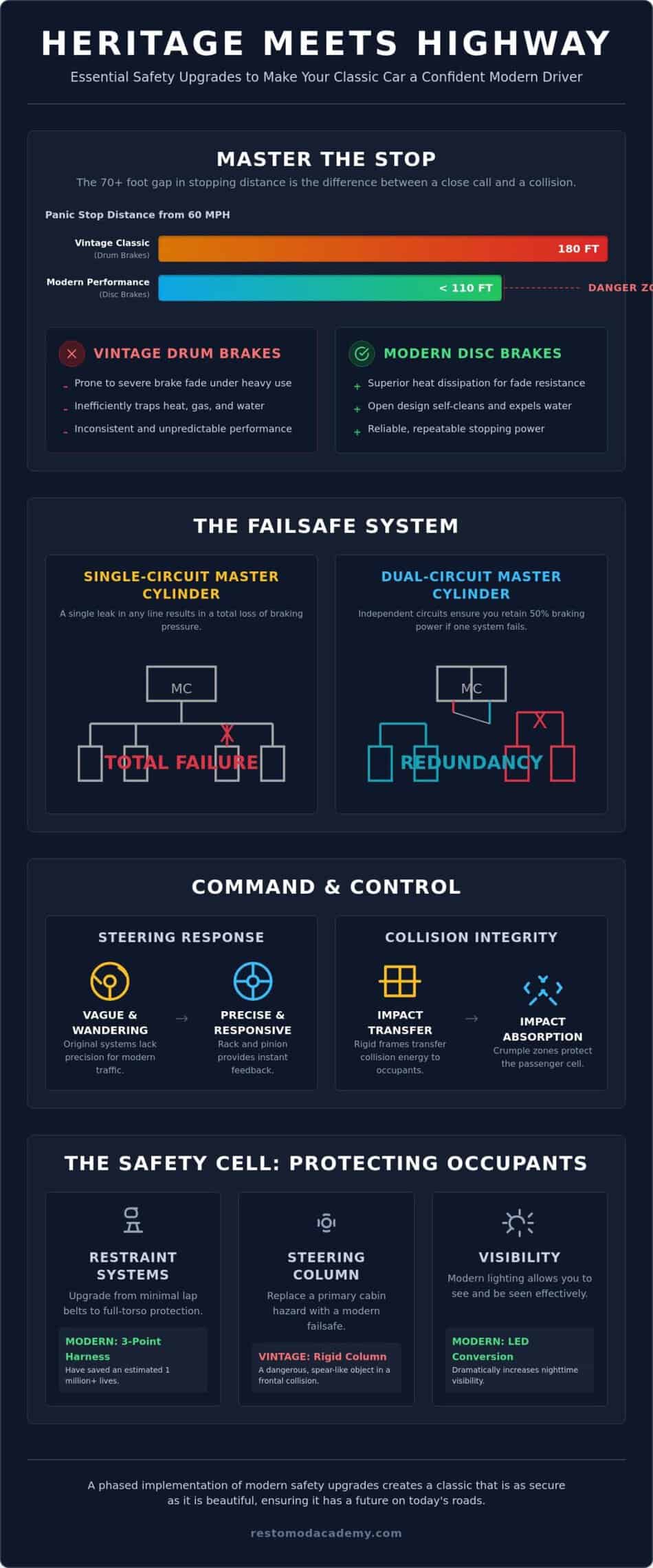
Building a classic car is about preserving history, but driving one in 2026 requires a serious reality check. When your car rolled off the assembly line in the mid-sixties, highway speeds were lower and traffic density was a fraction of what we face today. Modern drivers expect instant deceleration and surgical lane changes from every vehicle on the road. Your vintage machine, if equipped with a factory single-circuit master cylinder, is literally one pinhole leak away from total brake failure. This design provides no redundancy; if one line fails, you lose pressure at all four corners. Transitioning your build through Resto-modification isn’t about erasing the past, it’s about giving your car a future on modern roads.
Integrating modern safety upgrades for classic cars is the only way to bridge this sixty-year gap in engineering. We aren’t just talking about comfort or aesthetics. We’re talking about active safety. Old-school bias-ply tires and drum brakes were designed for a different era of physics. They lack the heat dissipation and grip required for emergency maneuvers at 75 mph. To see how these vintage machines are being adapted for the modern era, watch this helpful video:
The Evolution of Stopping Distances
Consider the math of a panic stop. A well-maintained 1965 Mustang might take 180 feet to stop from 60 mph, while a modern performance car achieves the same feat in under 110 feet. That 70-foot gap is the difference between a close call and a total loss. Drum brakes are particularly prone to brake fade, where repeated use generates heat that causes the shoes to lose their friction coefficient. In modern stop-and-go traffic, this isn’t just an inconvenience; it’s a hazard that demands attention.
Structural Limitations of Vintage Steel
Beyond the mechanical systems, the very bones of your car behave differently in a collision. Most classics utilize a rigid body-on-frame or early unibody design that lacks modern crumple zones. While the heavy steel feels indestructible, it doesn’t absorb energy; it transfers it directly to the passengers. Excessive chassis flex also makes handling unpredictable during high-speed swerves. Understanding what is a restomod helps you see how reinforcing these structures and adding modern safety upgrades for classic cars creates a predictable, protective environment for you and your family.
Master the Stop: Modern Disc Brake Conversions
If there is one modification that stands above the rest in your build, it is the braking system. You can’t enjoy the power of a modern engine if you can’t stop it with absolute certainty. Disc brake conversions are the top priority for modern safety upgrades for classic cars because they transform the driving experience from a game of chance into a controlled operation. While original drums were adequate for the sparse traffic of 1960, they simply aren’t engineered for the rapid deceleration required on today’s congested highways.
Drum brakes work by pushing shoes outward against a rotating drum, a design that inherently traps heat and gases. This leads to brake fade, where the system loses its effectiveness just when you need it most. Calipers, however, squeeze pads against a rotor exposed to the air. This mechanical advantage allows for consistent, repeatable stopping power. Basic front conversion kits typically range from $300 to $800, while rear kits sit between $250 and $700. Investing in this hardware ensures your car responds to your foot as quickly as a modern sedan.
Don’t stop at the wheels; you must upgrade to a dual-circuit master cylinder to ensure true redundancy. This setup creates two independent hydraulic circuits, meaning if a line fails on the rear axle, you still have pressure to the front. To keep the system balanced, install an adjustable proportioning valve. This allows you to fine-tune the pressure bias between the front and rear, preventing the rear wheels from locking up prematurely during a hard stop. For those seeking subtle upgrades to modernize your classic, these internal changes offer massive safety gains without altering the car’s vintage silhouette.
Power Boosters and Master Cylinders
Moving from manual to power-assisted brakes is a revelation for any builder. Vacuum boosters use engine vacuum to multiply your leg’s force, but if you’re running a high-performance cam with low vacuum, a hydroboost system is the superior path. Precision is key here; you must match your master cylinder bore size to your caliper piston area. A bore that is too large creates a rock-hard pedal with minimal stopping force, while one that is too small leads to excessive pedal travel.
Choosing the Right Big Brake Kit
When you’re ready to step up, multi-piston calipers offer even pressure distribution and better heat management. Keep in mind that larger rotors require larger wheels for clearance; an 11-inch rotor might fit a 15-inch vintage wheel, but a 13-inch performance rotor often demands a 17-inch rim. If you’re feeling overwhelmed by the technical specs, our product reviews break down which kits provide the best value for specific makes and models.
If you’re planning your first conversion, checking out our Premium Project Blueprints can save you from costly compatibility mistakes.
Steering and Suspension: Control Beyond the Straight Line
Safety is more than just surviving a collision; it is the ability to avoid one entirely. We call this active safety. If your steering feels like you are making suggestions rather than giving commands, you are at the mercy of the road’s crown and every passing gust of wind. Integrating modern safety upgrades for classic cars must prioritize predictable handling to ensure you can navigate 2026 traffic with the same agility as the vehicles surrounding you.
Vintage steering boxes, while durable, rely on a series of complex linkages, idler arms, and pitman arms that naturally develop play over time. This creates a “dead zone” at the center of your wheel where no actual steering occurs. Replacing this archaic setup with a modern rack and pinion system provides a direct mechanical link between your hands and the pavement. When you combine this with modern radial tires, the car stops wandering and starts tracking with surgical precision. It is the difference between fighting your machine and wearing it.
Don’t overlook the smaller components that hold your geometry together. Original rubber bushings deflect under load, causing your alignment to shift exactly when you need stability during a hard corner or panic swerve. Upgrading to polyurethane or Delrin bushings ensures your suspension remains fixed. Couple this with larger diameter sway bars to flatten out body roll. This ensures that when you perform an evasive maneuver, the chassis settles quickly instead of oscillating dangerously, keeping your tires planted firmly on the asphalt.
Rack and Pinion Steering Upgrades
Transitioning to a rack and pinion removes the complexity of multiple pivot points, significantly reducing the weight and clutter in your engine bay. This precision is vital at highway speeds where a few degrees of movement matter. If you are adding power assistance, consider an electric power steering (EPS) conversion. These kits generally cost under $1,500 for parts and provide modern feel without the need for hydraulic pumps or hoses. Always verify your steering geometry after installation to prevent bump steer, a condition where the car steers itself as the suspension travels over dips.
Modern Suspension Geometry
Factory stamped-steel control arms were never designed for the high-grip levels of 2026 performance tires. Tubular control arms are a superior alternative because they are engineered with improved camber gain, keeping more tire tread on the road during hard cornering. For the ultimate in adjustability, coilovers allow you to corner-weight the vehicle, ensuring perfectly balanced handling. To dive deeper into the technical assembly of these components, check out our guide on suspension upgrades for cars.
Interior and Visibility: Protecting the Passenger Cell
While we often obsess over the engine bay, the cockpit is where you actually experience the drive. It is also where the engineering of the past is most unforgiving. Early steering systems featured solid, non-collapsible shafts that earned the grim nickname of spearing columns because of their tendency to move toward the driver in a crash. When you combine this with a rigid metal dashboard, the interior of a vintage machine becomes a significant hazard. Implementing modern safety upgrades for classic cars inside the cabin is about creating a survival space that respects the original design while utilizing modern materials to absorb energy.
Visibility is your first line of defense. Standard 6V or 12V incandescent bulbs are dim and slow to reach full brightness. Upgrading to LED brake lights provides an instant-on signal to the driver behind you, which can save several feet of reaction distance at highway speeds. You can also integrate a high-mount third brake light subtly into the rear package tray or the top of the rear window. This simple addition ensures your intentions are clear even to drivers in tall modern SUVs who might not see your low-mounted factory tail lamps. It’s a small change that makes a massive difference in how you’re perceived by modern traffic.
Three-Point Seatbelts and Roll Cages
Factory lap belts only secure your waist, leaving your torso to pivot forward in an impact. You must locate or fabricate reinforced mounting points on the B-pillar or floor pan to install retractable three-point harnesses properly. If your build is intended for high-performance track days or features a weakened pillar design, a four-point roll bar adds essential structural integrity without the clutter of a full cage. This reinforcement keeps the roof from collapsing and provides a rigid mounting point for your safety gear. Modern high-density seat foam reduces occupant fatigue and improves control by keeping you firmly planted during lateral maneuvers.
LED Lighting and Modern Mirrors
Ditch the yellowed, weak glow of sealed-beam headlights for modern H4 conversions or LED projectors like the Hikari 2026. These units offer a sharp cutoff and a wider beam pattern, allowing you to see hazards long before they become emergencies. Don’t forget your mirrors; smaller vintage glass often has blind spots that modern traffic won’t forgive. Replacing them with larger, convex glass options housed in period-correct casings provides the visibility you need without ruining the car’s lines. Using these modern safety upgrades for classic cars ensures you aren’t just driving a relic, but a machine that can hold its own in the dark.
If you want to ensure your interior modifications are up to professional standards, our Recommended Gear list features the specific harness kits and lighting components I trust in my own builds.
Implementing Your Safety Roadmap with Restomod Academy
Building a car is a long-term technical project that rewards patience and precision. It is easy to get distracted by the allure of a high-horsepower engine or a flawless paint job, but those mean nothing if the vehicle is too dangerous to handle modern traffic speeds. Adopting a safety-first philosophy ensures your project remains a source of pride rather than a source of anxiety. When you integrate modern safety upgrades for classic cars, you aren’t just following a checklist; you’re engineering a machine that respects its heritage while embracing the demands of the future.
Documentation is your best friend during this journey. Keep a detailed log of every component installed, from the specific caliper piston area to the wiring diagrams for your LED conversions. This meticulous record-keeping does more than just help with maintenance; it significantly boosts your car’s resale value and simplifies the process of securing specialized classic car insurance. When an appraiser sees that you’ve addressed the single-circuit master cylinder and added structural reinforcements, they see a professional-grade build that deserves a premium valuation. Treat every mechanical challenge as an educational milestone that brings you closer to mastering your machine.
Budgeting for Safety First
Your budget should reflect your priorities. Buy your disc brake conversion kits and rack and pinion systems before you spend a dime on aesthetics. A car that stops and steers with 2026 precision is a car you will actually use. To help you navigate the sea of available parts, I’ve curated a recommended gear list that features the exact hardware I trust for reliability and fitment. Investing in quality components early prevents the double-cost of replacing cheap, failing parts later. The return on investment for a safe, drivable restomod is found in every mile of confidence you gain on the open road. It is the difference between a trailer queen and a cross-country cruiser.
Join the Restomod Community
You don’t have to tackle these mechanical hurdles alone. The DIY community is a powerful resource for peer-reviewing your modifications and troubleshooting complex assembly tasks. Sharing your progress and asking technical questions turns the intimidating world of custom building into a shared adventure. Viewing every challenge as a learning opportunity is the hallmark of a true active creator. Whether you need a guiding hand in the shop or want to explore Great Dad Coaching (1-on-1) to navigate the complexities of fatherhood, having expert support ensures you succeed in every area of life.
The transformation from a vintage relic to a reliable modern-day classic is a rewarding process that begins with the right knowledge. If you are ready to move from planning to action, start with The Ultimate Restomod Guide or dive into our Premium Project Blueprints for step-by-step technical instructions. Just as mastering car safety requires the right guidance, those looking to master the waves can learn more about Vaarschool.be to explore their Belgian boating license resources. You can also reach out for Restomod Consulting Services if you need a more personalized roadmap for your build. Take the first step today; your machine is waiting for its second life.
Secure Your Legacy on Modern Roads
You’ve seen how a vintage machine can be transformed from a fragile relic into a confident, high-performance machine. By prioritizing disc brake conversions and precision steering, you eliminate the dead zones and fade that make old steel dangerous in modern traffic. Protecting the passenger cell with retractable harnesses and piercing LED lighting doesn’t hide your car’s character; it ensures you’re around to enjoy it for decades to come. Integrating modern safety upgrades for classic cars is the most vital investment you’ll make in your garage.
I’ve spent years refining these mechanical systems to help you achieve professional-grade results in your own shop. Through the expert guidance of seasoned builder Brook Walsh, you gain access to comprehensive blueprints for modernizing classic systems with a focus on DIY empowerment and precision engineering. It’s time to transition from a passive admirer to an active creator. Start your safety-first build with The Ultimate Restomod Guide and take command of your restoration journey. Your project deserves the best of both worlds: timeless style and modern reliability. Let’s get to work.
Frequently Asked Questions
What are the most essential safety upgrades for a classic car?
The most essential safety upgrades include a disc brake conversion, a dual-circuit master cylinder, and modern radial tires. These components form the foundation of active safety by ensuring your car can stop and steer predictably in modern traffic. Prioritize these mechanical systems over cosmetic changes because they directly impact your ability to avoid a collision. Once the car is mechanically sound, you can focus on passive protection like three-point seatbelts and improved lighting.
Can I install modern three-point seatbelts in a car that only had lap belts?
You can install modern three-point seatbelts in older vehicles, but the project requires finding or creating reinforced structural mounting points. Most vintage pillars weren’t engineered to handle the concentrated load of a shoulder harness during an impact. Use specialized steel backing plates or grade-8 hardware to ensure the anchors don’t pull through the thin factory sheet metal. This modification is one of the most effective modern safety upgrades for classic cars for protecting occupants in a crash.
Are disc brake conversions difficult for a beginner to install?
Disc brake conversions are a manageable project for beginners if you choose a comprehensive bolt-on kit designed for your specific spindle. These kits eliminate the need for custom fabrication or machining, allowing you to complete the swap with basic hand tools. You’ll need to be meticulous when bleeding the hydraulic lines and setting the proportioning valve. Take your time to ensure the calipers are centered and the pedal feel is firm before you head out for a test drive.
How do LED headlights improve safety without looking too modern?
LED headlights improve safety by providing a much sharper beam cutoff and brighter illumination than original sealed-beam units. To maintain a vintage aesthetic, select LED kits with a 4,000K warm color temperature that mimics the look of classic halogen bulbs. Many manufacturers now offer high-performance LEDs housed in traditional fluted glass lenses. This allows you to enjoy 2026 lighting performance and instant-on response times without sacrificing the period-correct face of your machine.
Do safety upgrades like roll cages decrease the value of a classic car?
Safety upgrades like roll bars or cages typically maintain or increase the value of a restomod, though they might affect the price of a 100-point original survivor. In the performance community, a well-installed roll bar signals that the builder prioritized structural integrity and occupant protection. If you want to keep the car’s interior looking clean, a four-point street bar provides excellent protection and a secure mounting point for harnesses without requiring you to climb over intrusive door bars.
What is a dual-circuit master cylinder and why is it safer?
A dual-circuit master cylinder uses two separate hydraulic reservoirs to operate the front and rear brakes independently. If a leak occurs in one part of the system, the other circuit remains pressurized so you can still bring the vehicle to a stop. Original single-circuit systems are a single point of failure; one ruptured hose results in a total loss of braking power. Replacing an old single-pot unit is a non-negotiable step for any car meant to handle highway speeds.
Will modern suspension upgrades make my classic car ride too harshly?
Modern suspension upgrades often improve ride quality by replacing high-friction rubber bushings and tired shocks with precision-engineered components. While a full track setup is stiff, a street-focused refresh using adjustable coilovers allows you to tune the damping for a smooth, composed feel. These modern safety upgrades for classic cars ensure your tires maintain a consistent contact patch with the road. This results in a car that feels more stable and comfortable than it did with the floaty factory suspension.
How much should I budget for a full safety modernization of a 60s muscle car?
Budgeting for a full safety modernization generally requires between $5,000 and $12,000 depending on the complexity of your chosen components. A front disc conversion and basic suspension refresh might cost around $3,000 in parts, while adding power steering and high-end LED lighting will increase that total. Spread these costs out by tackling the braking system first. This approach ensures your investment is protected and the car is drivable while you save for the next phase of the project.
Imagine you’re cruising down the interstate in your 1967 Mustang, the engine is humming perfectly, but the traffic ahead suddenly grinds to a halt. In that split second, you realize your vintage drum brakes and manual steering aren’t just charming quirks; they’re liabilities in a world of 2026 distracted drivers. You love the raw, mechanical soul of your machine, but you shouldn’t have to choose between heritage and survival every time you pull out of the garage. It’s a common anxiety for builders who want to actually drive their creations rather than just polish them. Finding the right balance of modern safety upgrades for classic cars allows you to keep that iconic silhouette while gaining the stopping power and structural integrity of a contemporary vehicle.
I’ve spent decades in the shop refining the art of the restomod, and I can tell you that safety is the ultimate performance metric. Precision matters. This guide will show you how to integrate high-performance disc brakes, modern LED lighting, and reinforced steering systems into your vintage build without stripping away its character. We’ll break down the essential components that make your car handle modern traffic with confidence, from three-point seatbelts that have saved over a million lives to the latest 2026 LED conversion kits like the Hikari 2026. You’re going to learn how to transition from a cautious Sunday driver to a confident pilot of a machine that’s as secure as it is beautiful.
Key Takeaways
- Master the stop by converting your single-circuit master cylinder to a dual-reservoir system, ensuring your vintage machine has a failsafe against hydraulic failure.
- Shift from vague, wandering steering to surgical precision by integrating modern rack and pinion systems that respond instantly to your inputs.
- Secure the passenger cell by identifying structural vulnerabilities like rigid steering columns and upgrading to retractable three-point harnesses.
- Develop a phased implementation plan for modern safety upgrades for classic cars that prioritizes mechanical reliability without sacrificing heritage aesthetics.
- Increase your project’s long-term worth by learning how to document technical enhancements for specialized classic car insurance and future collectors.
Why Original Classic Car Safety Is No Longer Sufficient
Building a classic car is about preserving history, but driving one in 2026 requires a serious reality check. When your car rolled off the assembly line in the mid-sixties, highway speeds were lower and traffic density was a fraction of what we face today. Modern drivers expect instant deceleration and surgical lane changes from every vehicle on the road. Your vintage machine, if equipped with a factory single-circuit master cylinder, is literally one pinhole leak away from total brake failure. This design provides no redundancy; if one line fails, you lose pressure at all four corners. Transitioning your build through Resto-modification isn’t about erasing the past, it’s about giving your car a future on modern roads.
Integrating modern safety upgrades for classic cars is the only way to bridge this sixty-year gap in engineering. We aren’t just talking about comfort or aesthetics. We’re talking about active safety. Old-school bias-ply tires and drum brakes were designed for a different era of physics. They lack the heat dissipation and grip required for emergency maneuvers at 75 mph. To see how these vintage machines are being adapted for the modern era, watch this helpful video:
The Evolution of Stopping Distances
Consider the math of a panic stop. A well-maintained 1965 Mustang might take 180 feet to stop from 60 mph, while a modern performance car achieves the same feat in under 110 feet. That 70-foot gap is the difference between a close call and a total loss. Drum brakes are particularly prone to brake fade, where repeated use generates heat that causes the shoes to lose their friction coefficient. In modern stop-and-go traffic, this isn’t just an inconvenience; it’s a hazard that demands attention.
Structural Limitations of Vintage Steel
Beyond the mechanical systems, the very bones of your car behave differently in a collision. Most classics utilize a rigid body-on-frame or early unibody design that lacks modern crumple zones. While the heavy steel feels indestructible, it doesn’t absorb energy; it transfers it directly to the passengers. Excessive chassis flex also makes handling unpredictable during high-speed swerves. Understanding what is a restomod helps you see how reinforcing these structures and adding modern safety upgrades for classic cars creates a predictable, protective environment for you and your family.
Master the Stop: Modern Disc Brake Conversions
If there is one modification that stands above the rest in your build, it is the braking system. You can’t enjoy the power of a modern engine if you can’t stop it with absolute certainty. Disc brake conversions are the top priority for modern safety upgrades for classic cars because they transform the driving experience from a game of chance into a controlled operation. While original drums were adequate for the sparse traffic of 1960, they simply aren’t engineered for the rapid deceleration required on today’s congested highways.
Drum brakes work by pushing shoes outward against a rotating drum, a design that inherently traps heat and gases. This leads to brake fade, where the system loses its effectiveness just when you need it most. Calipers, however, squeeze pads against a rotor exposed to the air. This mechanical advantage allows for consistent, repeatable stopping power. Basic front conversion kits typically range from $300 to $800, while rear kits sit between $250 and $700. Investing in this hardware ensures your car responds to your foot as quickly as a modern sedan.
Don’t stop at the wheels; you must upgrade to a dual-circuit master cylinder to ensure true redundancy. This setup creates two independent hydraulic circuits, meaning if a line fails on the rear axle, you still have pressure to the front. To keep the system balanced, install an adjustable proportioning valve. This allows you to fine-tune the pressure bias between the front and rear, preventing the rear wheels from locking up prematurely during a hard stop. For those seeking subtle upgrades to modernize your classic, these internal changes offer massive safety gains without altering the car’s vintage silhouette.
Power Boosters and Master Cylinders
Moving from manual to power-assisted brakes is a revelation for any builder. Vacuum boosters use engine vacuum to multiply your leg’s force, but if you’re running a high-performance cam with low vacuum, a hydroboost system is the superior path. Precision is key here; you must match your master cylinder bore size to your caliper piston area. A bore that is too large creates a rock-hard pedal with minimal stopping force, while one that is too small leads to excessive pedal travel.
Choosing the Right Big Brake Kit
When you’re ready to step up, multi-piston calipers offer even pressure distribution and better heat management. Keep in mind that larger rotors require larger wheels for clearance; an 11-inch rotor might fit a 15-inch vintage wheel, but a 13-inch performance rotor often demands a 17-inch rim. If you’re feeling overwhelmed by the technical specs, our product reviews break down which kits provide the best value for specific makes and models.
If you’re planning your first conversion, checking out our Premium Project Blueprints can save you from costly compatibility mistakes.
Steering and Suspension: Control Beyond the Straight Line
Safety is more than just surviving a collision; it is the ability to avoid one entirely. We call this active safety. If your steering feels like you are making suggestions rather than giving commands, you are at the mercy of the road’s crown and every passing gust of wind. Integrating modern safety upgrades for classic cars must prioritize predictable handling to ensure you can navigate 2026 traffic with the same agility as the vehicles surrounding you.
Vintage steering boxes, while durable, rely on a series of complex linkages, idler arms, and pitman arms that naturally develop play over time. This creates a “dead zone” at the center of your wheel where no actual steering occurs. Replacing this archaic setup with a modern rack and pinion system provides a direct mechanical link between your hands and the pavement. When you combine this with modern radial tires, the car stops wandering and starts tracking with surgical precision. It is the difference between fighting your machine and wearing it.
Don’t overlook the smaller components that hold your geometry together. Original rubber bushings deflect under load, causing your alignment to shift exactly when you need stability during a hard corner or panic swerve. Upgrading to polyurethane or Delrin bushings ensures your suspension remains fixed. Couple this with larger diameter sway bars to flatten out body roll. This ensures that when you perform an evasive maneuver, the chassis settles quickly instead of oscillating dangerously, keeping your tires planted firmly on the asphalt.
Rack and Pinion Steering Upgrades
Transitioning to a rack and pinion removes the complexity of multiple pivot points, significantly reducing the weight and clutter in your engine bay. This precision is vital at highway speeds where a few degrees of movement matter. If you are adding power assistance, consider an electric power steering (EPS) conversion. These kits generally cost under $1,500 for parts and provide modern feel without the need for hydraulic pumps or hoses. Always verify your steering geometry after installation to prevent bump steer, a condition where the car steers itself as the suspension travels over dips.
Modern Suspension Geometry
Factory stamped-steel control arms were never designed for the high-grip levels of 2026 performance tires. Tubular control arms are a superior alternative because they are engineered with improved camber gain, keeping more tire tread on the road during hard cornering. For the ultimate in adjustability, coilovers allow you to corner-weight the vehicle, ensuring perfectly balanced handling. To dive deeper into the technical assembly of these components, check out our guide on suspension upgrades for cars.
Interior and Visibility: Protecting the Passenger Cell
While we often obsess over the engine bay, the cockpit is where you actually experience the drive. It is also where the engineering of the past is most unforgiving. Early steering systems featured solid, non-collapsible shafts that earned the grim nickname of spearing columns because of their tendency to move toward the driver in a crash. When you combine this with a rigid metal dashboard, the interior of a vintage machine becomes a significant hazard. Implementing modern safety upgrades for classic cars inside the cabin is about creating a survival space that respects the original design while utilizing modern materials to absorb energy.
Visibility is your first line of defense. Standard 6V or 12V incandescent bulbs are dim and slow to reach full brightness. Upgrading to LED brake lights provides an instant-on signal to the driver behind you, which can save several feet of reaction distance at highway speeds. You can also integrate a high-mount third brake light subtly into the rear package tray or the top of the rear window. This simple addition ensures your intentions are clear even to drivers in tall modern SUVs who might not see your low-mounted factory tail lamps. It’s a small change that makes a massive difference in how you’re perceived by modern traffic.
Three-Point Seatbelts and Roll Cages
Factory lap belts only secure your waist, leaving your torso to pivot forward in an impact. You must locate or fabricate reinforced mounting points on the B-pillar or floor pan to install retractable three-point harnesses properly. If your build is intended for high-performance track days or features a weakened pillar design, a four-point roll bar adds essential structural integrity without the clutter of a full cage. This reinforcement keeps the roof from collapsing and provides a rigid mounting point for your safety gear. Modern high-density seat foam reduces occupant fatigue and improves control by keeping you firmly planted during lateral maneuvers.
LED Lighting and Modern Mirrors
Ditch the yellowed, weak glow of sealed-beam headlights for modern H4 conversions or LED projectors like the Hikari 2026. These units offer a sharp cutoff and a wider beam pattern, allowing you to see hazards long before they become emergencies. Don’t forget your mirrors; smaller vintage glass often has blind spots that modern traffic won’t forgive. Replacing them with larger, convex glass options housed in period-correct casings provides the visibility you need without ruining the car’s lines. Using these modern safety upgrades for classic cars ensures you aren’t just driving a relic, but a machine that can hold its own in the dark.
If you want to ensure your interior modifications are up to professional standards, our Recommended Gear list features the specific harness kits and lighting components I trust in my own builds.
Implementing Your Safety Roadmap with Restomod Academy
Building a car is a long-term technical project that rewards patience and precision. It is easy to get distracted by the allure of a high-horsepower engine or a flawless paint job, but those mean nothing if the vehicle is too dangerous to handle modern traffic speeds. Adopting a safety-first philosophy ensures your project remains a source of pride rather than a source of anxiety. When you integrate modern safety upgrades for classic cars, you aren’t just following a checklist; you’re engineering a machine that respects its heritage while embracing the demands of the future.
Documentation is your best friend during this journey. Keep a detailed log of every component installed, from the specific caliper piston area to the wiring diagrams for your LED conversions. This meticulous record-keeping does more than just help with maintenance; it significantly boosts your car’s resale value and simplifies the process of securing specialized classic car insurance. When an appraiser sees that you’ve addressed the single-circuit master cylinder and added structural reinforcements, they see a professional-grade build that deserves a premium valuation. Treat every mechanical challenge as an educational milestone that brings you closer to mastering your machine.
Budgeting for Safety First
Your budget should reflect your priorities. Buy your disc brake conversion kits and rack and pinion systems before you spend a dime on aesthetics. A car that stops and steers with 2026 precision is a car you will actually use. To help you navigate the sea of available parts, I’ve curated a recommended gear list that features the exact hardware I trust for reliability and fitment. Investing in quality components early prevents the double-cost of replacing cheap, failing parts later. The return on investment for a safe, drivable restomod is found in every mile of confidence you gain on the open road. It is the difference between a trailer queen and a cross-country cruiser.
Join the Restomod Community
You don’t have to tackle these mechanical hurdles alone. The DIY community is a powerful resource for peer-reviewing your modifications and troubleshooting complex assembly tasks. Sharing your progress and asking technical questions turns the intimidating world of custom building into a shared adventure. Viewing every challenge as a learning opportunity is the hallmark of a true active creator. Whether you need a guiding hand in the shop or want to explore Great Dad Coaching (1-on-1) to navigate the complexities of fatherhood, having expert support ensures you succeed in every area of life.
The transformation from a vintage relic to a reliable modern-day classic is a rewarding process that begins with the right knowledge. If you are ready to move from planning to action, start with The Ultimate Restomod Guide or dive into our Premium Project Blueprints for step-by-step technical instructions. Just as mastering car safety requires the right guidance, those looking to master the waves can learn more about Vaarschool.be to explore their Belgian boating license resources. You can also reach out for Restomod Consulting Services if you need a more personalized roadmap for your build. Take the first step today; your machine is waiting for its second life.
Secure Your Legacy on Modern Roads
You’ve seen how a vintage machine can be transformed from a fragile relic into a confident, high-performance machine. By prioritizing disc brake conversions and precision steering, you eliminate the dead zones and fade that make old steel dangerous in modern traffic. Protecting the passenger cell with retractable harnesses and piercing LED lighting doesn’t hide your car’s character; it ensures you’re around to enjoy it for decades to come. Integrating modern safety upgrades for classic cars is the most vital investment you’ll make in your garage.
I’ve spent years refining these mechanical systems to help you achieve professional-grade results in your own shop. Through the expert guidance of seasoned builder Brook Walsh, you gain access to comprehensive blueprints for modernizing classic systems with a focus on DIY empowerment and precision engineering. It’s time to transition from a passive admirer to an active creator. Start your safety-first build with The Ultimate Restomod Guide and take command of your restoration journey. Your project deserves the best of both worlds: timeless style and modern reliability. Let’s get to work.
Frequently Asked Questions
What are the most essential safety upgrades for a classic car?
The most essential safety upgrades include a disc brake conversion, a dual-circuit master cylinder, and modern radial tires. These components form the foundation of active safety by ensuring your car can stop and steer predictably in modern traffic. Prioritize these mechanical systems over cosmetic changes because they directly impact your ability to avoid a collision. Once the car is mechanically sound, you can focus on passive protection like three-point seatbelts and improved lighting.
Can I install modern three-point seatbelts in a car that only had lap belts?
You can install modern three-point seatbelts in older vehicles, but the project requires finding or creating reinforced structural mounting points. Most vintage pillars weren’t engineered to handle the concentrated load of a shoulder harness during an impact. Use specialized steel backing plates or grade-8 hardware to ensure the anchors don’t pull through the thin factory sheet metal. This modification is one of the most effective modern safety upgrades for classic cars for protecting occupants in a crash.
Are disc brake conversions difficult for a beginner to install?
Disc brake conversions are a manageable project for beginners if you choose a comprehensive bolt-on kit designed for your specific spindle. These kits eliminate the need for custom fabrication or machining, allowing you to complete the swap with basic hand tools. You’ll need to be meticulous when bleeding the hydraulic lines and setting the proportioning valve. Take your time to ensure the calipers are centered and the pedal feel is firm before you head out for a test drive.
How do LED headlights improve safety without looking too modern?
LED headlights improve safety by providing a much sharper beam cutoff and brighter illumination than original sealed-beam units. To maintain a vintage aesthetic, select LED kits with a 4,000K warm color temperature that mimics the look of classic halogen bulbs. Many manufacturers now offer high-performance LEDs housed in traditional fluted glass lenses. This allows you to enjoy 2026 lighting performance and instant-on response times without sacrificing the period-correct face of your machine.
Do safety upgrades like roll cages decrease the value of a classic car?
Safety upgrades like roll bars or cages typically maintain or increase the value of a restomod, though they might affect the price of a 100-point original survivor. In the performance community, a well-installed roll bar signals that the builder prioritized structural integrity and occupant protection. If you want to keep the car’s interior looking clean, a four-point street bar provides excellent protection and a secure mounting point for harnesses without requiring you to climb over intrusive door bars.
What is a dual-circuit master cylinder and why is it safer?
A dual-circuit master cylinder uses two separate hydraulic reservoirs to operate the front and rear brakes independently. If a leak occurs in one part of the system, the other circuit remains pressurized so you can still bring the vehicle to a stop. Original single-circuit systems are a single point of failure; one ruptured hose results in a total loss of braking power. Replacing an old single-pot unit is a non-negotiable step for any car meant to handle highway speeds.
Will modern suspension upgrades make my classic car ride too harshly?
Modern suspension upgrades often improve ride quality by replacing high-friction rubber bushings and tired shocks with precision-engineered components. While a full track setup is stiff, a street-focused refresh using adjustable coilovers allows you to tune the damping for a smooth, composed feel. These modern safety upgrades for classic cars ensure your tires maintain a consistent contact patch with the road. This results in a car that feels more stable and comfortable than it did with the floaty factory suspension.
How much should I budget for a full safety modernization of a 60s muscle car?
Budgeting for a full safety modernization generally requires between $5,000 and $12,000 depending on the complexity of your chosen components. A front disc conversion and basic suspension refresh might cost around $3,000 in parts, while adding power steering and high-end LED lighting will increase that total. Spread these costs out by tackling the braking system first. This approach ensures your investment is protected and the car is drivable while you save for the next phase of the project.