
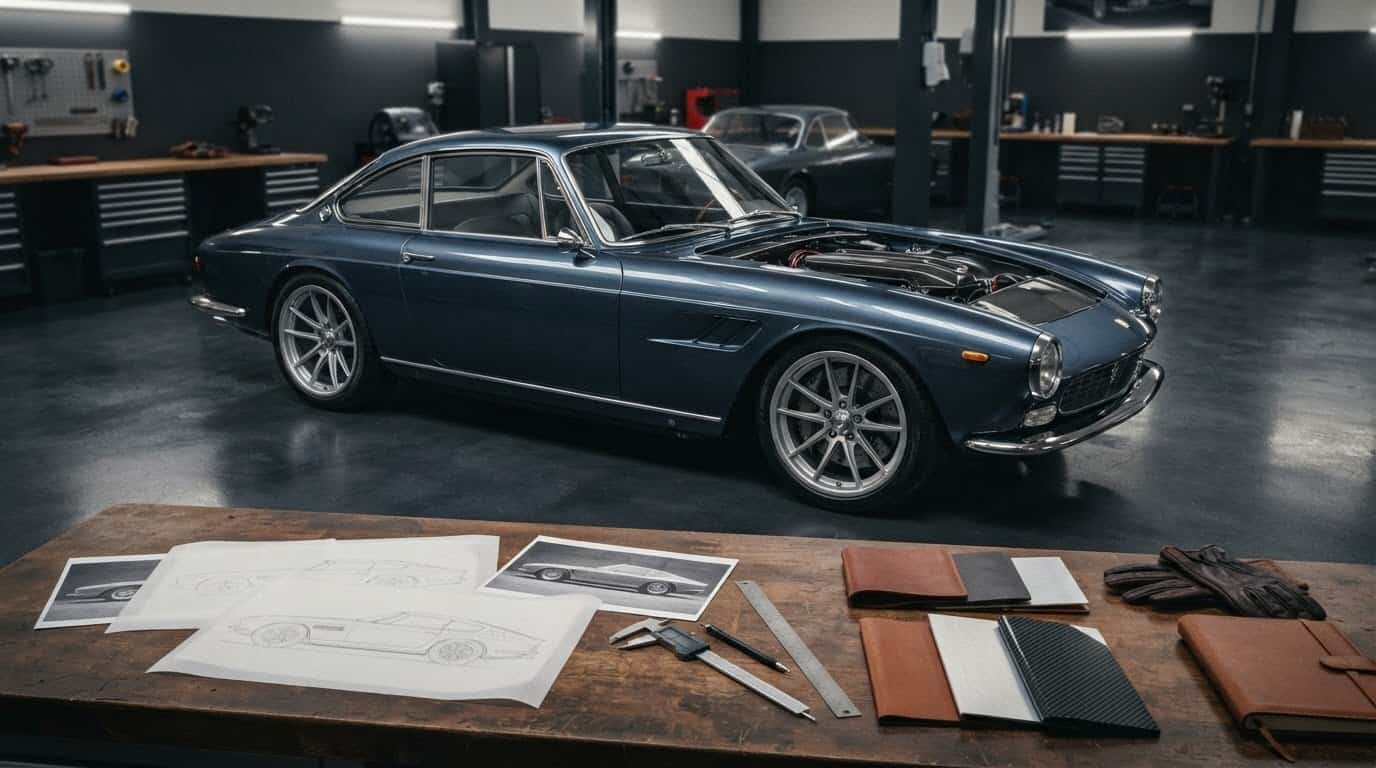
A commissioned restomod can drift from your vision before the first wrench turns. Creating a project brief for a commissioned restomod isn’t about choosing every part in advance. It’s about making the car’s purpose, character, and priorities clear enough to guide the decisions ahead. You may know how you want it to feel on the road without knowing which engine, suspension, or braking setup will get you there. That’s a sound place to start. A useful brief leaves room for expert collaboration while keeping your non-negotiables in view.
Before work begins, define what matters most: weekend drives or long-distance touring, heritage styling or modern comfort, originality or sharper performance. Then note what’s flexible, what’s off-limits, and where you’re open to recommendations. This guide will help you describe the car’s intended use, set priorities without needing a complete parts list, and give the project a clear direction while leaving space for thoughtful solutions.
Key Takeaways
- Start creating a project brief for a commissioned restomod by recording the vehicle, intended use, goals, constraints, and questions that still need answers.
- Rank originality, performance, and comfort so it’s clear which outcomes matter most and where there’s room to adapt.
- Keep the main brief concise, then add supporting photos and vehicle records as appendices.
- Review and revise the brief before build discussions so it gives decisions and scope a practical foundation.
- Use structured learning or consulting to prepare for more focused conversations about your project.
Why a commissioned restomod needs a clear project brief
A commissioned restomod begins with an idea: perhaps a classic shape with modern reliability, or a familiar car that feels more composed on long drives. But an idea can mean different things to different people. Creating a project brief for a commissioned restomod gives the owner and builder a shared record of goals, constraints, priorities, and open decisions. It turns a broad vision into something they can discuss and refine.
Think of the brief as a compass, not a promise of an exact result. It keeps the car’s intended character visible as technical choices take shape and makes room to discuss feasibility, trade-offs, and alternatives. A clear starting point can also reveal differences in expectations before they become harder to resolve.
For a general project-brief framework, watch this short video:
What a commissioning brief is meant to do
Put the desired driving experience into words before focusing on components. “Comfortable on weekend touring roads, with responsive passing power” communicates a goal more clearly than simply asking for a more powerful engine. Record assumptions too: whether the car should retain a recognizable vintage appearance, who will usually drive it, and what kinds of journeys matter. For background on what defines a restomod, consider how it combines classic character with selected modern updates.
This written reference is useful when conversations move between styling, chassis, powertrain, and interior. It won’t settle every choice, but it gives each discussion a common point of reference. A proposed change can then be weighed against the car you set out to create.
What the brief does not need to decide upfront
Separate driving outcomes from engineering decisions. You can ask for predictable braking and confident handling without naming a specific caliper, spring rate, or part number. Mark unresolved items as questions, such as whether a particular transmission suits the intended use. That signals where you want guidance instead of turning an early thought into a fixed requirement.
A commissioning brief isn’t a contract, technical drawing, or completed specification. It also differs from a general overview of restomods, which explains the broader idea, and a project roadmap, which tracks work as a build progresses. The brief makes early conversations more useful; detailed decisions develop through discussion.
Use it to identify what must stay true, what can change, and what still needs an informed answer. For example, an owner might want to preserve the original silhouette and cabin feel while remaining open to modern brake or suspension solutions. Stating that distinction protects the vision without prescribing every method. The strongest brief is specific about the desired experience and honest about uncertainty, giving collaboration a firm foundation without taking the craft out of the builder’s hands. A broader definition of Restomod can also help establish shared terminology before those conversations begin.
What to include in a commissioned restomod project brief
Give the brief enough detail to make the car tangible, but don’t mistake technical vocabulary for clarity. A builder can respond more usefully to “a calm, dependable car for weekend touring” than to a list of parts chosen before the goals are understood. While creating a project brief for a commissioned restomod, separate the experience you want from the technical path that might deliver it.
Use this checklist to gather the essentials:
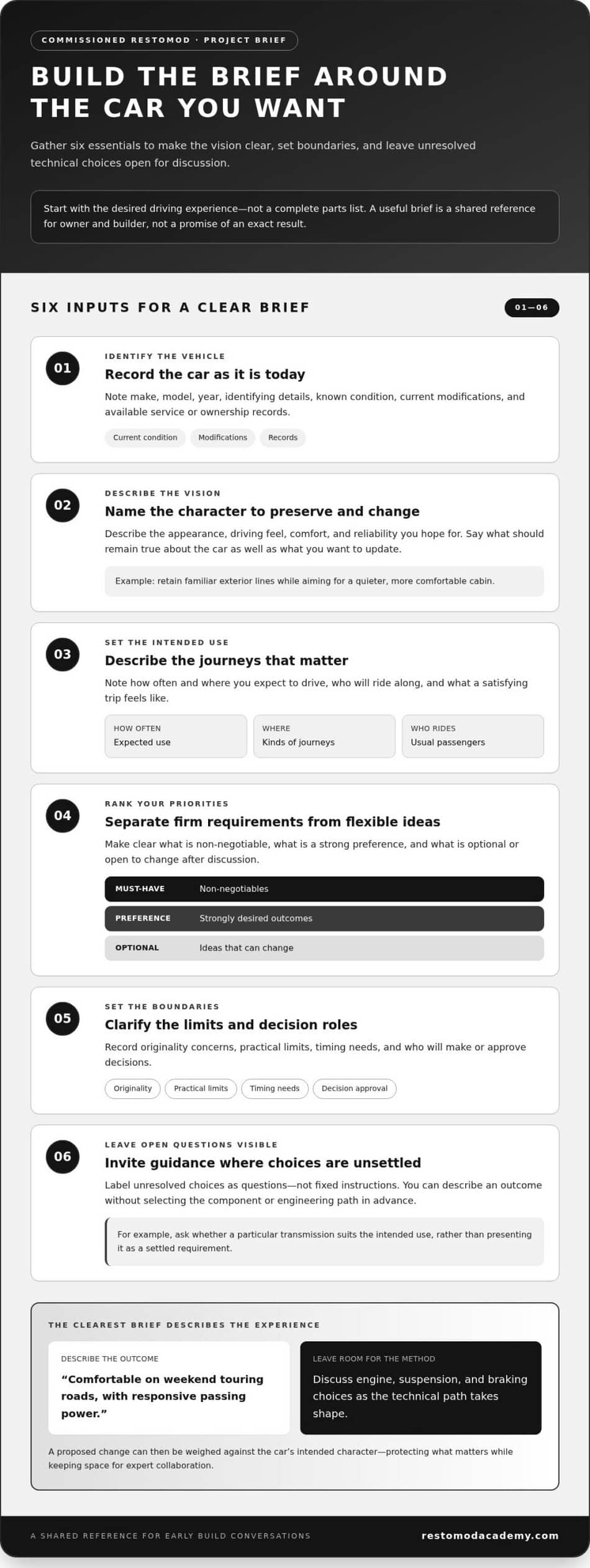
- Vehicle: Make, model, year, identifying details, known condition, current modifications, and available service or ownership records.
- Vision: The character you want to preserve and the changes you hope to make to appearance, driving feel, comfort, and reliability.
- Intended use: How often and where you expect to drive it, who will ride in it, and what a satisfying trip feels like.
- Priorities: Non-negotiables, strong preferences, and optional ideas that can change after discussion.
- Boundaries: Originality concerns, practical limits, timing needs, and who will make or approve decisions.
- Open questions: Choices you want to explore rather than present as settled requirements.
Describe the car, its intended use, and its character
Start with the car as it sits today. Note what works, what needs attention, what has been modified, and which records or photographs you can provide. Then describe the finished car in plain language: perhaps it should feel composed on longer drives, retain its familiar exterior lines, and offer a quieter, more comfortable cabin. The Automotive Restoration Market Organization (ARMO) provides broader industry context for restoration and vehicle customization, but your own use case should lead the brief.
Describe the experience, not just the category of upgrade. “I want modern performance” leaves a lot open; “I want confident passing power without losing the car’s relaxed touring character” gives clearer direction. Include an engine change as a goal only if it’s genuinely part of your vision.
Document priorities, constraints, and unresolved choices
Separate must-haves from preferences and optional ideas. Preserving a particular exterior appearance might be non-negotiable, while interior materials remain open to discussion. State usability or safety priorities as outcomes, not unsupported specifications. If a decision is unsettled, label it as a question so it invites collaboration instead of sounding like a fixed instruction.
Add reference images with short captions that explain what each one shows: “seat shape, not color” or “stance and ride height.” Captions prevent a single image from being mistaken for a complete design direction.
Be candid about timing needs and decision ownership. Note important target dates as planning context, identify who will approve changes, and explain how you’d like unresolved choices presented. If turning your priorities into a clear brief feels daunting, Restomod Academy’s restomod consulting services can help you develop your project direction.
How to balance originality, performance, comfort, and flexibility
A useful brief doesn’t need to name every component or dictate how the work must be done. It needs to make clear what the finished car should deliver and which compromises would change its character. Treat originality, performance, comfort, usability, and flexibility as related goals, not as five promises that must all be maximized. When creating a project brief for a commissioned restomod, rank what matters instead of filling the page with unresearched part numbers.
“A clear priority tells the build team what the car must feel like; a parts list only guesses at how to get there.”
Use a simple matrix to compare each goal. Give each one a rank, such as highest, important, or flexible, and add a note about what it means to you:
- Originality: Which visual details, materials, or period character should remain recognizable?
- Performance: What response or capability do you want from the car, without naming hardware prematurely?
- Comfort: Which aspects of the cabin or ride matter most during the drives you expect to take?
- Usability: How often will the car be driven, and what practical qualities will make it enjoyable to use?
- Flexibility: Which design or technical decisions can change if a better-fitting solution emerges?
Rank goals when they compete
Choose the two or three outcomes that most shape your experience behind the wheel. Then ask what you’d accept to protect them. Hypothetical example: an owner who ranks period appearance first might accept a less modern-looking cabin, while another might favor everyday comfort over strict interior originality. These are possibilities, not universal rules. Write down which compromises feel acceptable and which would take the car too far from your vision.
Keep collaboration open without losing direction
Label each decision as decided, preferred, or open for technical discussion. A chosen body color might be decided; a seat material could be preferred; the approach to improving ride quality might remain open. This gives collaborators room to discuss implementation while preserving your design intent. It also makes trade-offs visible: don’t present a priority as achievable without affecting other choices.
Review the rankings after describing how you’ll use the car. If everything is marked essential, the brief won’t help resolve competing ideas. Revisit each item and ask: would changing this undermine the experience I want, or could I live with another solution? That distinction gives technical discussions direction without pretending the engineering is already settled.
How to write, review, and use the brief before the build
Build the document in passes. Start with the intent, then add the facts and decisions that make it practical to discuss. Creating a project brief for a commissioned restomod works best as a repeatable process, not a one-sitting attempt to specify every detail.
- Gather facts. Collect vehicle records, notes on its present condition, and any known modifications. Keep supporting documents together so they’re easy to reference.
- Write the outcome. Begin with one paragraph describing the car you hope to drive and how you expect to use it.
- Rank priorities. Identify which qualities matter most and explain how each one shapes your experience of the finished car.
- Record constraints. Note practical boundaries, important timing needs, decision ownership, and any requirements that affect the project’s direction.
- Review the draft. Look for unclear terms, conflicting priorities, assumptions presented as facts, and questions that need discussion.
- Revise as decisions develop. Update the brief when new information changes the direction or scope, and preserve earlier versions for context.
Turn ideas and references into a readable first draft
Keep the main document concise enough to use in a conversation. An opening paragraph can describe the car’s intended character, the driving experience you want, and the elements you hope to preserve. Put supporting material in appendices: photographs, service records, modification notes, and longer reference collections. This keeps the central purpose easy to find without losing useful detail.
Give every reference image a short caption that identifies what it communicates, such as “dashboard layout,” “subtle exterior finish,” or “relaxed ride height.” A picture can suggest several things at once, so be precise about the feature or feeling you’re pointing to. Use restomod project planning as a broader frame for how the brief fits into the project journey.
Review the brief and keep decisions traceable
Read each priority and ask whether its reason is clear. “Keep the original character” may need a note explaining which details carry that character for you. Separate agreed decisions from assumptions and unanswered questions. A simple decision log can record the item, current status, date or version, and reason for a change. Keep it alongside the brief so later scope discussions have context.
A project brief is a living record of intent, updated as decisions turn an initial vision into a workable direction. Review it when a major choice or proposed scope change arises, and note what changed rather than silently replacing the earlier direction. For a wider view of the steps involved in planning a restomod, explore Restomod Academy’s project-planning resources.
Prepare for your commissioned restomod with Restomod Academy
A strong brief gives project conversations a starting point: clear outcomes show what you want the car to become, boundaries identify what needs protecting, and open questions make room for informed discussion. Creating a project brief for a commissioned restomod doesn’t require you to solve every technical detail alone. It helps you express the experience you’re aiming for and identify where more learning or advice could sharpen your direction.
Restomod Academy offers resources for enthusiasts preparing to commission a build. The Ultimate Restomod Guide is an educational resource for understanding the wider build journey, while Restomod Consulting Services can help you develop your project direction. Both can help you approach build conversations with greater clarity, while leaving the decisions and collaboration involved in your build in your hands.
Choose the next learning step that fits your project
If you’re still building your understanding of how restomods bring vintage character together with modern updates, start with this classic-car restomod overview. For a broader learning path, The Ultimate Restomod Guide offers structured restomod education. Premium project blueprints are another educational resource to explore as you develop your knowledge, alongside a brief tailored to your car.
Move from a rough vision to a focused brief
Take a first step today: write one paragraph describing how you want the finished car to look, feel, and be used. Then name the priorities that matter most and separate decisions you’re ready to make from questions you want to discuss. A rough draft is useful. It gives you something concrete to refine instead of waiting for perfect technical language.
If you want support shaping that direction, Restomod Consulting Services can help you work through the vision and clarify the questions your brief needs to raise. Keep the goal in view: your brief should communicate what matters to you while leaving space for thoughtful technical discussion. Build your understanding of the process and take the next step with Explore The Ultimate Restomod Guide.
Give Your Vision a Clear Starting Point
The first version of your brief doesn’t need to sound like an engineer wrote it. It needs to sound like you. Creating a project brief for a commissioned restomod starts with naming what would make the finished car feel unmistakably right to its owner, then bringing that intent into the decisions ahead.
Let the document evolve as you learn. New knowledge may change your view of a particular solution, but it can also help you explain more clearly what you want to preserve and what you’re ready to rethink. That balance is part of the craft: respecting a car’s heritage while shaping it for the roads and experiences you have in mind.
Restomod Academy, founded by enthusiast Brook Walsh, offers education for owners preparing to make those choices. Take the next step and explore The Ultimate Restomod Guide to build your understanding of the wider restomod journey. Your project can begin with one clear thought, then grow into a vision you’re ready to share with confidence.
Frequently Asked Questions
What should I include in a project brief for a commissioned restomod?
Include the car’s identifying details, what you know about its current condition, how you expect to use it, and the character you want the finished vehicle to have. When creating a project brief for a commissioned restomod, rank key priorities and note constraints, reference materials, and questions that need discussion. A sample prompt can help: “What should a typical drive feel like?” Answering in your own words gives the conversation a useful starting point.
How detailed should a restomod project brief be?
Make it detailed enough that someone unfamiliar with your vision can understand the intended experience and the boundaries that matter to you. A few clear sentences about how the car should drive can be more useful than pages of guessed specifications. Include relevant context, but leave choices you haven’t researched, such as a particular suspension setup, open for discussion. If readers interpret a phrase differently, clarify it with a concrete example.
Can I commission a restomod if I do not know which parts I want?
Yes. You can describe outcomes without selecting components. For example, say you want braking that feels predictable in regular driving rather than specifying a brake package. Mark equipment choices as questions for technical discussion and explain what you hope each choice will achieve. That gives the build conversation room to consider suitable approaches. You don’t need a complete parts list to communicate what you want the car to do.
Is a restomod project brief the same as a contract?
No. A project brief is a planning and communication document that explains your goals, preferences, boundaries, and unresolved questions. It helps organize early conversations, but it shouldn’t be treated as a substitute for formal project terms. Keep those documents distinct: use the brief to clarify intent, and address formal arrangements separately with the appropriate parties. This FAQ offers general project-planning guidance, not legal advice.
What information should I gather about my classic car before writing the brief?
Gather the vehicle’s make, model, year, identifying details, known condition, and a list of existing modifications. Pull together service records, ownership paperwork, and photographs you already have. Note what you know firsthand and what remains uncertain, such as when a modification was made or whether a system has been repaired. A short “known, unknown, needs inspection” note helps keep assumptions from being mistaken for confirmed facts.
What should I do if originality and modern performance are both priorities?
Decide which aspects of originality matter most, then rank performance goals against them. You might want the exterior appearance to remain close to stock while being open to changes beneath the body, or prefer to preserve a particular cabin detail even if other features are updated. Write down compromises you’d accept and those you wouldn’t. Treat the ranking as a guide for discussing trade-offs, not as a promise that every aim can be maximized.
How should I record changes after a commissioned build begins?
Log each change in one shared record, noting what decision changed, why it changed, which questions remain, and when the update was made. Identify the relevant brief version so the current direction is easy to distinguish from earlier notes. For example, record that a preferred finish changed after reviewing a sample rather than quietly replacing the original reference. This creates a traceable history for later conversations about scope and intent.
A commissioned restomod can drift from your vision before the first wrench turns. Creating a project brief for a commissioned restomod isn’t about choosing every part in advance. It’s about making the car’s purpose, character, and priorities clear enough to guide the decisions ahead. You may know how you want it to feel on the road without knowing which engine, suspension, or braking setup will get you there. That’s a sound place to start. A useful brief leaves room for expert collaboration while keeping your non-negotiables in view.
Before work begins, define what matters most: weekend drives or long-distance touring, heritage styling or modern comfort, originality or sharper performance. Then note what’s flexible, what’s off-limits, and where you’re open to recommendations. This guide will help you describe the car’s intended use, set priorities without needing a complete parts list, and give the project a clear direction while leaving space for thoughtful solutions.
Key Takeaways
- Start creating a project brief for a commissioned restomod by recording the vehicle, intended use, goals, constraints, and questions that still need answers.
- Rank originality, performance, and comfort so it’s clear which outcomes matter most and where there’s room to adapt.
- Keep the main brief concise, then add supporting photos and vehicle records as appendices.
- Review and revise the brief before build discussions so it gives decisions and scope a practical foundation.
- Use structured learning or consulting to prepare for more focused conversations about your project.
Why a commissioned restomod needs a clear project brief
A commissioned restomod begins with an idea: perhaps a classic shape with modern reliability, or a familiar car that feels more composed on long drives. But an idea can mean different things to different people. Creating a project brief for a commissioned restomod gives the owner and builder a shared record of goals, constraints, priorities, and open decisions. It turns a broad vision into something they can discuss and refine.
Think of the brief as a compass, not a promise of an exact result. It keeps the car’s intended character visible as technical choices take shape and makes room to discuss feasibility, trade-offs, and alternatives. A clear starting point can also reveal differences in expectations before they become harder to resolve.
For a general project-brief framework, watch this short video:
What a commissioning brief is meant to do
Put the desired driving experience into words before focusing on components. “Comfortable on weekend touring roads, with responsive passing power” communicates a goal more clearly than simply asking for a more powerful engine. Record assumptions too: whether the car should retain a recognizable vintage appearance, who will usually drive it, and what kinds of journeys matter. For background on what defines a restomod, consider how it combines classic character with selected modern updates.
This written reference is useful when conversations move between styling, chassis, powertrain, and interior. It won’t settle every choice, but it gives each discussion a common point of reference. A proposed change can then be weighed against the car you set out to create.
What the brief does not need to decide upfront
Separate driving outcomes from engineering decisions. You can ask for predictable braking and confident handling without naming a specific caliper, spring rate, or part number. Mark unresolved items as questions, such as whether a particular transmission suits the intended use. That signals where you want guidance instead of turning an early thought into a fixed requirement.
A commissioning brief isn’t a contract, technical drawing, or completed specification. It also differs from a general overview of restomods, which explains the broader idea, and a project roadmap, which tracks work as a build progresses. The brief makes early conversations more useful; detailed decisions develop through discussion.
Use it to identify what must stay true, what can change, and what still needs an informed answer. For example, an owner might want to preserve the original silhouette and cabin feel while remaining open to modern brake or suspension solutions. Stating that distinction protects the vision without prescribing every method. The strongest brief is specific about the desired experience and honest about uncertainty, giving collaboration a firm foundation without taking the craft out of the builder’s hands. A broader definition of Restomod can also help establish shared terminology before those conversations begin.
What to include in a commissioned restomod project brief
Give the brief enough detail to make the car tangible, but don’t mistake technical vocabulary for clarity. A builder can respond more usefully to “a calm, dependable car for weekend touring” than to a list of parts chosen before the goals are understood. While creating a project brief for a commissioned restomod, separate the experience you want from the technical path that might deliver it.
Use this checklist to gather the essentials:
- Vehicle: Make, model, year, identifying details, known condition, current modifications, and available service or ownership records.
- Vision: The character you want to preserve and the changes you hope to make to appearance, driving feel, comfort, and reliability.
- Intended use: How often and where you expect to drive it, who will ride in it, and what a satisfying trip feels like.
- Priorities: Non-negotiables, strong preferences, and optional ideas that can change after discussion.
- Boundaries: Originality concerns, practical limits, timing needs, and who will make or approve decisions.
- Open questions: Choices you want to explore rather than present as settled requirements.
Describe the car, its intended use, and its character
Start with the car as it sits today. Note what works, what needs attention, what has been modified, and which records or photographs you can provide. Then describe the finished car in plain language: perhaps it should feel composed on longer drives, retain its familiar exterior lines, and offer a quieter, more comfortable cabin. The Automotive Restoration Market Organization (ARMO) provides broader industry context for restoration and vehicle customization, but your own use case should lead the brief.
Describe the experience, not just the category of upgrade. “I want modern performance” leaves a lot open; “I want confident passing power without losing the car’s relaxed touring character” gives clearer direction. Include an engine change as a goal only if it’s genuinely part of your vision.
Document priorities, constraints, and unresolved choices
Separate must-haves from preferences and optional ideas. Preserving a particular exterior appearance might be non-negotiable, while interior materials remain open to discussion. State usability or safety priorities as outcomes, not unsupported specifications. If a decision is unsettled, label it as a question so it invites collaboration instead of sounding like a fixed instruction.
Add reference images with short captions that explain what each one shows: “seat shape, not color” or “stance and ride height.” Captions prevent a single image from being mistaken for a complete design direction.
Be candid about timing needs and decision ownership. Note important target dates as planning context, identify who will approve changes, and explain how you’d like unresolved choices presented. If turning your priorities into a clear brief feels daunting, Restomod Academy’s restomod consulting services can help you develop your project direction.
How to balance originality, performance, comfort, and flexibility
A useful brief doesn’t need to name every component or dictate how the work must be done. It needs to make clear what the finished car should deliver and which compromises would change its character. Treat originality, performance, comfort, usability, and flexibility as related goals, not as five promises that must all be maximized. When creating a project brief for a commissioned restomod, rank what matters instead of filling the page with unresearched part numbers.
“A clear priority tells the build team what the car must feel like; a parts list only guesses at how to get there.”
Use a simple matrix to compare each goal. Give each one a rank, such as highest, important, or flexible, and add a note about what it means to you:
- Originality: Which visual details, materials, or period character should remain recognizable?
- Performance: What response or capability do you want from the car, without naming hardware prematurely?
- Comfort: Which aspects of the cabin or ride matter most during the drives you expect to take?
- Usability: How often will the car be driven, and what practical qualities will make it enjoyable to use?
- Flexibility: Which design or technical decisions can change if a better-fitting solution emerges?
Rank goals when they compete
Choose the two or three outcomes that most shape your experience behind the wheel. Then ask what you’d accept to protect them. Hypothetical example: an owner who ranks period appearance first might accept a less modern-looking cabin, while another might favor everyday comfort over strict interior originality. These are possibilities, not universal rules. Write down which compromises feel acceptable and which would take the car too far from your vision.
Keep collaboration open without losing direction
Label each decision as decided, preferred, or open for technical discussion. A chosen body color might be decided; a seat material could be preferred; the approach to improving ride quality might remain open. This gives collaborators room to discuss implementation while preserving your design intent. It also makes trade-offs visible: don’t present a priority as achievable without affecting other choices.
Review the rankings after describing how you’ll use the car. If everything is marked essential, the brief won’t help resolve competing ideas. Revisit each item and ask: would changing this undermine the experience I want, or could I live with another solution? That distinction gives technical discussions direction without pretending the engineering is already settled.
How to write, review, and use the brief before the build
Build the document in passes. Start with the intent, then add the facts and decisions that make it practical to discuss. Creating a project brief for a commissioned restomod works best as a repeatable process, not a one-sitting attempt to specify every detail.
- Gather facts. Collect vehicle records, notes on its present condition, and any known modifications. Keep supporting documents together so they’re easy to reference.
- Write the outcome. Begin with one paragraph describing the car you hope to drive and how you expect to use it.
- Rank priorities. Identify which qualities matter most and explain how each one shapes your experience of the finished car.
- Record constraints. Note practical boundaries, important timing needs, decision ownership, and any requirements that affect the project’s direction.
- Review the draft. Look for unclear terms, conflicting priorities, assumptions presented as facts, and questions that need discussion.
- Revise as decisions develop. Update the brief when new information changes the direction or scope, and preserve earlier versions for context.
Turn ideas and references into a readable first draft
Keep the main document concise enough to use in a conversation. An opening paragraph can describe the car’s intended character, the driving experience you want, and the elements you hope to preserve. Put supporting material in appendices: photographs, service records, modification notes, and longer reference collections. This keeps the central purpose easy to find without losing useful detail.
Give every reference image a short caption that identifies what it communicates, such as “dashboard layout,” “subtle exterior finish,” or “relaxed ride height.” A picture can suggest several things at once, so be precise about the feature or feeling you’re pointing to. Use restomod project planning as a broader frame for how the brief fits into the project journey.
Review the brief and keep decisions traceable
Read each priority and ask whether its reason is clear. “Keep the original character” may need a note explaining which details carry that character for you. Separate agreed decisions from assumptions and unanswered questions. A simple decision log can record the item, current status, date or version, and reason for a change. Keep it alongside the brief so later scope discussions have context.
A project brief is a living record of intent, updated as decisions turn an initial vision into a workable direction. Review it when a major choice or proposed scope change arises, and note what changed rather than silently replacing the earlier direction. For a wider view of the steps involved in planning a restomod, explore Restomod Academy’s project-planning resources.
Prepare for your commissioned restomod with Restomod Academy
A strong brief gives project conversations a starting point: clear outcomes show what you want the car to become, boundaries identify what needs protecting, and open questions make room for informed discussion. Creating a project brief for a commissioned restomod doesn’t require you to solve every technical detail alone. It helps you express the experience you’re aiming for and identify where more learning or advice could sharpen your direction.
Restomod Academy offers resources for enthusiasts preparing to commission a build. The Ultimate Restomod Guide is an educational resource for understanding the wider build journey, while Restomod Consulting Services can help you develop your project direction. Both can help you approach build conversations with greater clarity, while leaving the decisions and collaboration involved in your build in your hands.
Choose the next learning step that fits your project
If you’re still building your understanding of how restomods bring vintage character together with modern updates, start with this classic-car restomod overview. For a broader learning path, The Ultimate Restomod Guide offers structured restomod education. Premium project blueprints are another educational resource to explore as you develop your knowledge, alongside a brief tailored to your car.
Move from a rough vision to a focused brief
Take a first step today: write one paragraph describing how you want the finished car to look, feel, and be used. Then name the priorities that matter most and separate decisions you’re ready to make from questions you want to discuss. A rough draft is useful. It gives you something concrete to refine instead of waiting for perfect technical language.
If you want support shaping that direction, Restomod Consulting Services can help you work through the vision and clarify the questions your brief needs to raise. Keep the goal in view: your brief should communicate what matters to you while leaving space for thoughtful technical discussion. Build your understanding of the process and take the next step with Explore The Ultimate Restomod Guide.
Give Your Vision a Clear Starting Point
The first version of your brief doesn’t need to sound like an engineer wrote it. It needs to sound like you. Creating a project brief for a commissioned restomod starts with naming what would make the finished car feel unmistakably right to its owner, then bringing that intent into the decisions ahead.
Let the document evolve as you learn. New knowledge may change your view of a particular solution, but it can also help you explain more clearly what you want to preserve and what you’re ready to rethink. That balance is part of the craft: respecting a car’s heritage while shaping it for the roads and experiences you have in mind.
Restomod Academy, founded by enthusiast Brook Walsh, offers education for owners preparing to make those choices. Take the next step and explore The Ultimate Restomod Guide to build your understanding of the wider restomod journey. Your project can begin with one clear thought, then grow into a vision you’re ready to share with confidence.
Frequently Asked Questions
What should I include in a project brief for a commissioned restomod?
Include the car’s identifying details, what you know about its current condition, how you expect to use it, and the character you want the finished vehicle to have. When creating a project brief for a commissioned restomod, rank key priorities and note constraints, reference materials, and questions that need discussion. A sample prompt can help: “What should a typical drive feel like?” Answering in your own words gives the conversation a useful starting point.
How detailed should a restomod project brief be?
Make it detailed enough that someone unfamiliar with your vision can understand the intended experience and the boundaries that matter to you. A few clear sentences about how the car should drive can be more useful than pages of guessed specifications. Include relevant context, but leave choices you haven’t researched, such as a particular suspension setup, open for discussion. If readers interpret a phrase differently, clarify it with a concrete example.
Can I commission a restomod if I do not know which parts I want?
Yes. You can describe outcomes without selecting components. For example, say you want braking that feels predictable in regular driving rather than specifying a brake package. Mark equipment choices as questions for technical discussion and explain what you hope each choice will achieve. That gives the build conversation room to consider suitable approaches. You don’t need a complete parts list to communicate what you want the car to do.
Is a restomod project brief the same as a contract?
No. A project brief is a planning and communication document that explains your goals, preferences, boundaries, and unresolved questions. It helps organize early conversations, but it shouldn’t be treated as a substitute for formal project terms. Keep those documents distinct: use the brief to clarify intent, and address formal arrangements separately with the appropriate parties. This FAQ offers general project-planning guidance, not legal advice.
What information should I gather about my classic car before writing the brief?
Gather the vehicle’s make, model, year, identifying details, known condition, and a list of existing modifications. Pull together service records, ownership paperwork, and photographs you already have. Note what you know firsthand and what remains uncertain, such as when a modification was made or whether a system has been repaired. A short “known, unknown, needs inspection” note helps keep assumptions from being mistaken for confirmed facts.
What should I do if originality and modern performance are both priorities?
Decide which aspects of originality matter most, then rank performance goals against them. You might want the exterior appearance to remain close to stock while being open to changes beneath the body, or prefer to preserve a particular cabin detail even if other features are updated. Write down compromises you’d accept and those you wouldn’t. Treat the ranking as a guide for discussing trade-offs, not as a promise that every aim can be maximized.
How should I record changes after a commissioned build begins?
Log each change in one shared record, noting what decision changed, why it changed, which questions remain, and when the update was made. Identify the relevant brief version so the current direction is easy to distinguish from earlier notes. For example, record that a preferred finish changed after reviewing a sample rather than quietly replacing the original reference. This creates a traceable history for later conversations about scope and intent.